
Software Product Line Testing Part II Variability Modeling
Software Product Line Testing Part II : Variability Modeling Myra Cohen Matthew Dwyer Laboratory for Empirically-based Software Quality Research Department of Computer Science University of Nebraska - Lincoln Work supported by NSF CCF through awards 0429149 and 0444167, by the U. S. Army Research Office through award DAAD 190110564 and by an NSF EPSCo. R FIRST award. e 2 ESQua. Re. D
Outline Software Product Lines : What and Why? Modeling Variability in Software Product Lines Validating Product Lines A Framework for Variability Coverage Toward Product Line Driven Test Processes 2
Outline Modeling Variability in Software Product Lines 1. 2. 3. 4. 5. What is variability? Variability and other attributes Feature models Rich variability modeling notations A formal variability modeling framework 3
What is Variability? Commonality The features shared by a set of systems Variability The features that differ between some pair of systems 4
Variability as an Abstraction Mechanisms for implementing variability – – – – Compile flags Properties files Command-line arguments Inheritance Interface definition (and information hiding) Design patterns (e. g. , strategy) Connectors (e. g. , in architecture) We are interested in the abstraction 5
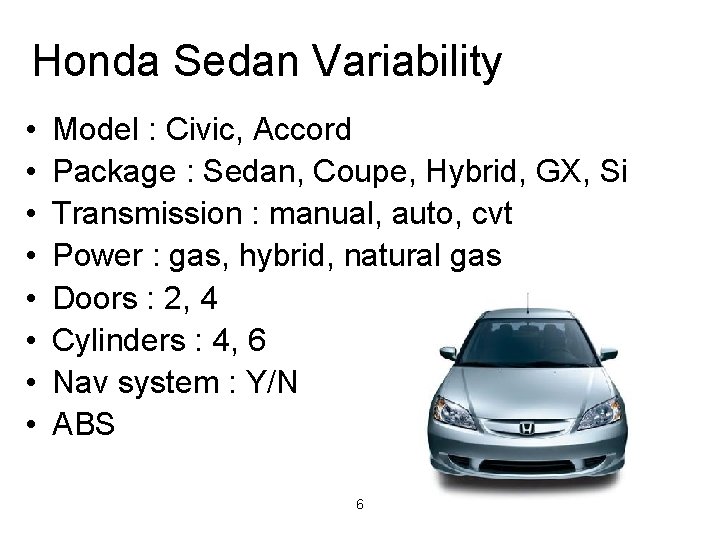
Honda Sedan Variability • • Model : Civic, Accord Package : Sedan, Coupe, Hybrid, GX, Si Transmission : manual, auto, cvt Power : gas, hybrid, natural gas Doors : 2, 4 Cylinders : 4, 6 Nav system : Y/N ABS 6
Types of Variability External Variability – Visible to the customer: • Example: manual vs automatic transmission • Example: your cell phone may or may not have a camera and you may have different resolution options Internal Variability – Hidden from customer: • Example: battery technology in hybrid electric car • Example: communication protocol 7
Product Line = Variability is the key concept in product lines A product line with no variability is a single system To define a product line we must define the ways that instances of the product line may vary 8
Defining Variability Lots of terminology in the literature feature, variation, variability, … We will use Pohl et al. ’s terminology variation point – A feature of PL instances that may variant – The realization of a feature dependence – Declares the potential binding of a realization to a feature 9
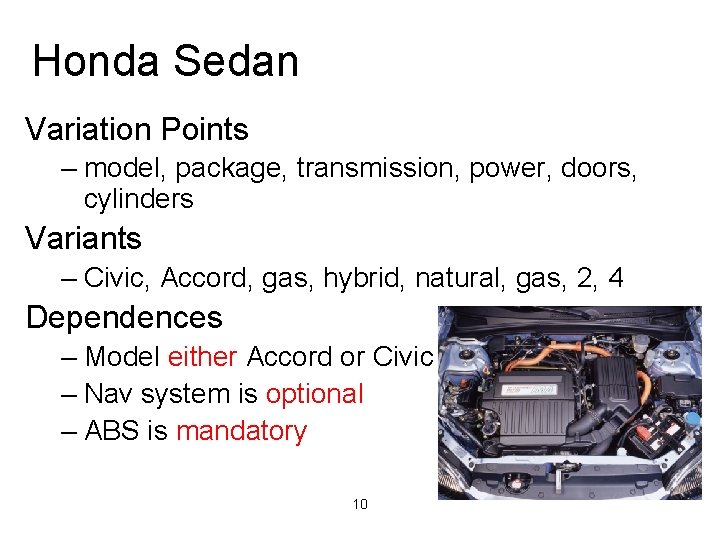
Honda Sedan Variation Points – model, package, transmission, power, doors, cylinders Variants – Civic, Accord, gas, hybrid, natural, gas, 2, 4 Dependences – Model either Accord or Civic – Nav system is optional – ABS is mandatory 10
Variability & Development Artifacts Variability must be expressed in … requirements architecture design implementation testing … in a coordinated manner. 11
Avionics Mission Computing Enormous range of aircraft and missions Enormous space of requirements and feature variability Consider autopilot navigation – Requirements : it is required or not – Architecture : include components and integrating connectors for auto-navigation facilities with rest of system 12
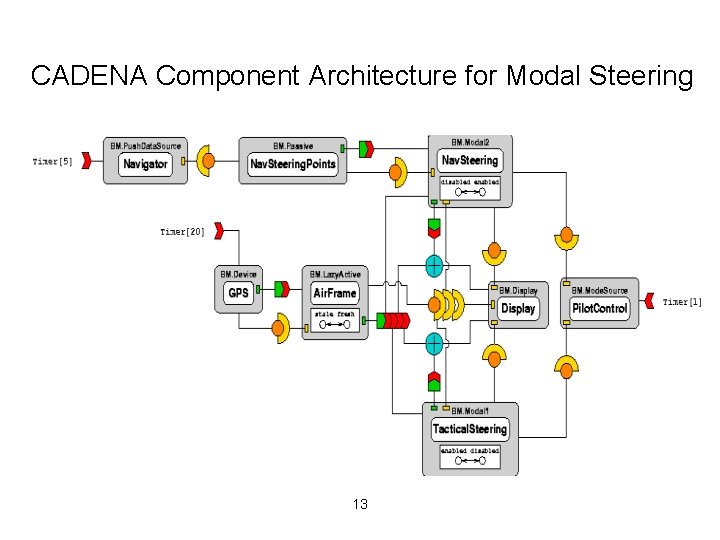
CADENA Component Architecture for Modal Steering 13
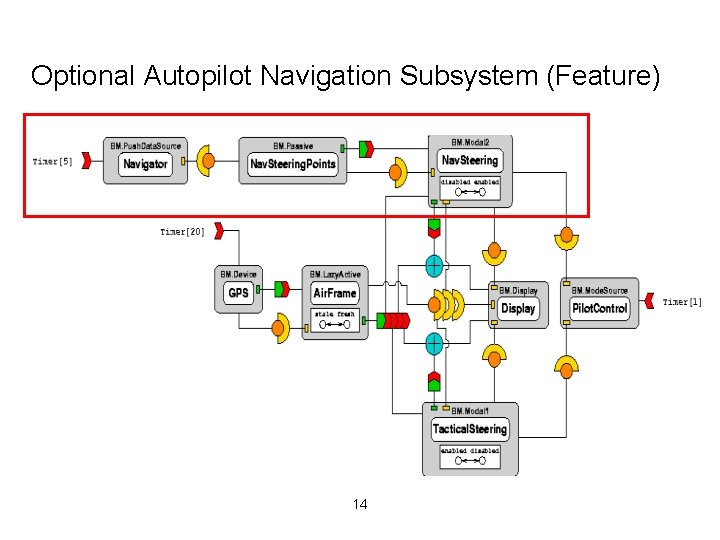
Optional Autopilot Navigation Subsystem (Feature) 14
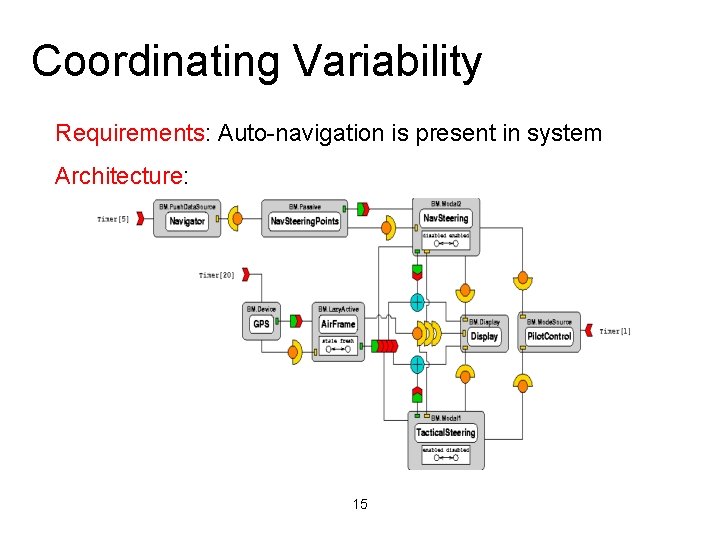
Coordinating Variability Requirements: Auto-navigation is present in system Architecture: 15
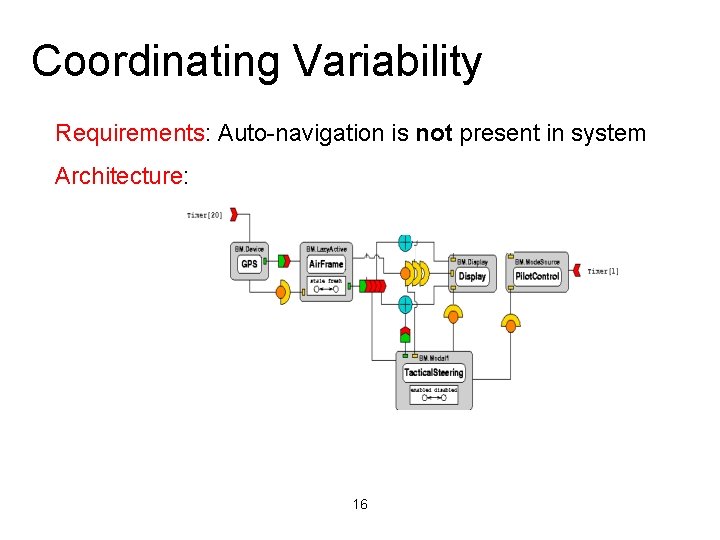
Coordinating Variability Requirements: Auto-navigation is not present in system Architecture: 16
Modeling Product Lines An important aspect of successful product line development is defining an architecture that enables systematic reuse We need a way to model the architectural details in order to represent the variability and commonality 17
Feature Oriented Domain Analysis SEI FODA Project in Late 1980 s Identified features (variability) as the key to software product lines Identified the need for artifact-independent modeling of the features in an SPL Introduced the feature diagram 18
Feature Diagrams Trees of features – Nodes represent variation points and variants Child relationship represents binding – Dependence and/or graphs provide flexibility in defining feature realizations/relationships 19
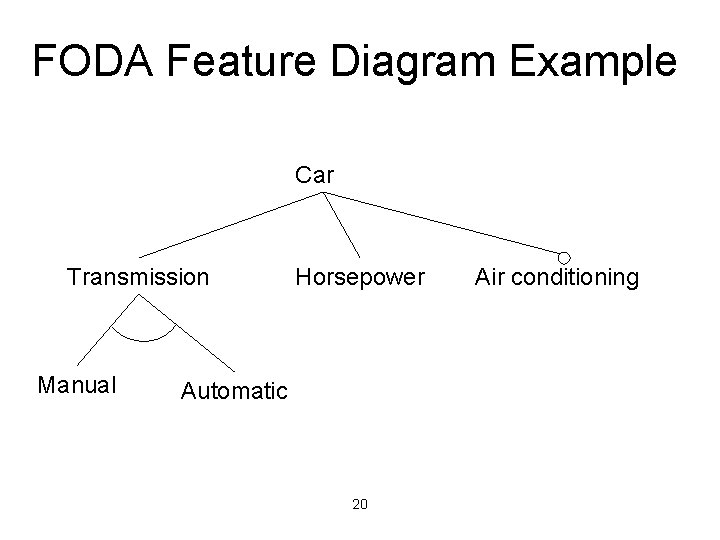
FODA Feature Diagram Example Car Transmission Manual Horsepower Automatic 20 Air conditioning
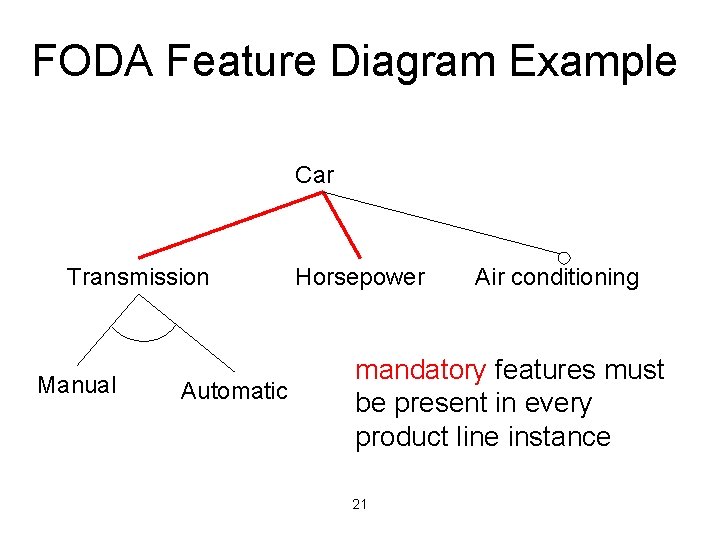
FODA Feature Diagram Example Car Transmission Manual Automatic Horsepower Air conditioning mandatory features must be present in every product line instance 21
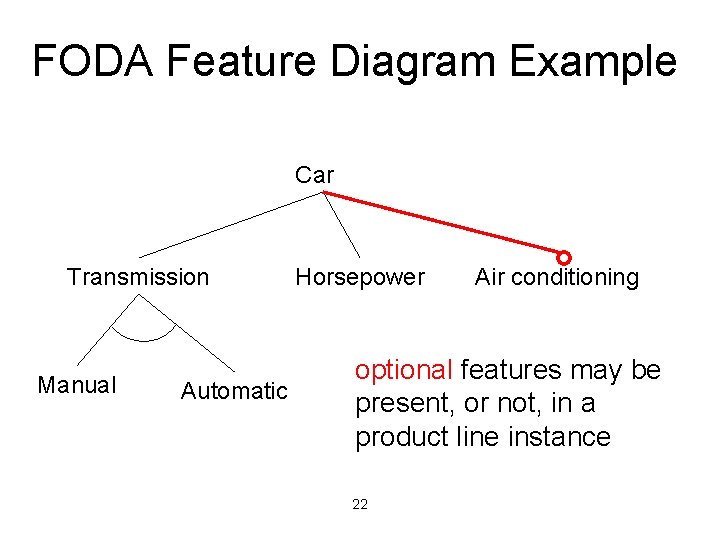
FODA Feature Diagram Example Car Transmission Manual Automatic Horsepower Air conditioning optional features may be present, or not, in a product line instance 22
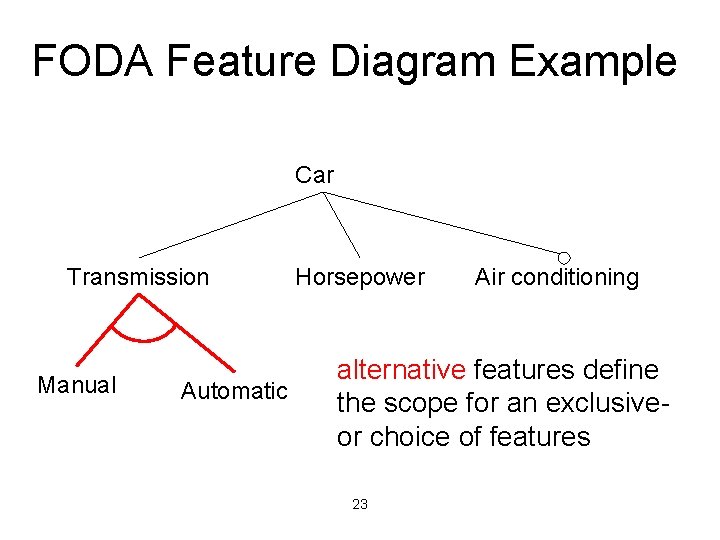
FODA Feature Diagram Example Car Transmission Manual Automatic Horsepower Air conditioning alternative features define the scope for an exclusiveor choice of features 23
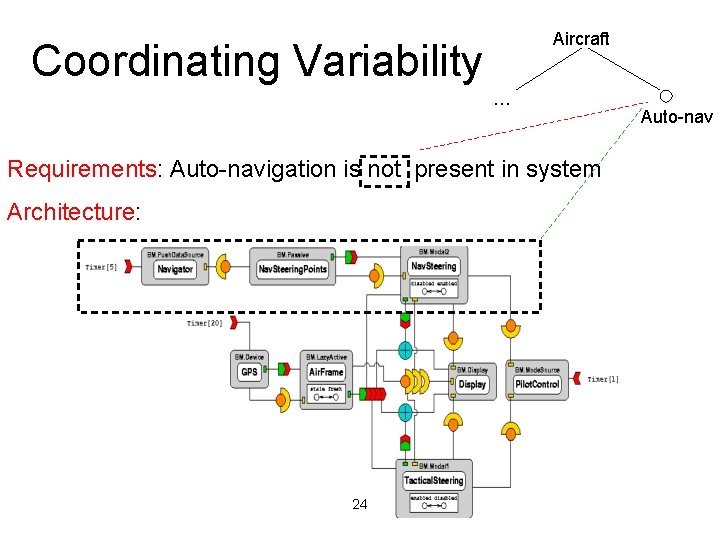
Aircraft Coordinating Variability … Requirements: Auto-navigation is not present in system Architecture: 24 Auto-nav
Constraints Not all possible combinations of features correspond to feasible SPL instances FODA introduced simple composition rules – feature 1 requires feature 2 – feature 3 excludes feature 4 Constraints are essential for defining complex SPLs feature diagram + constraints = feature model 25
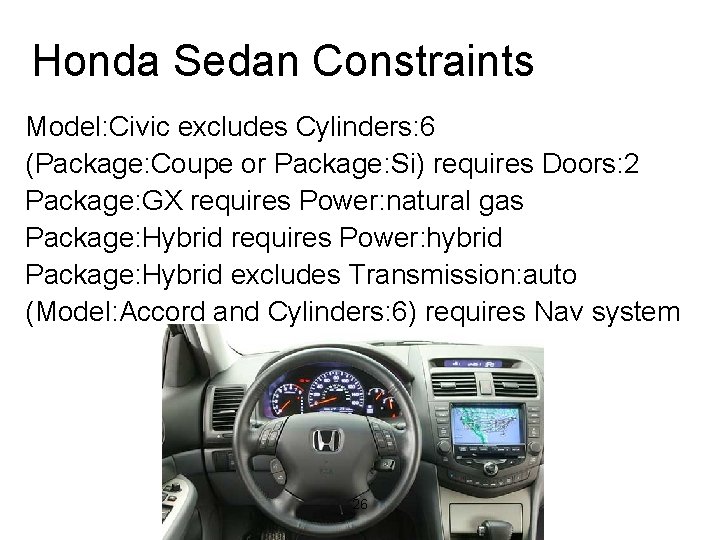
Honda Sedan Constraints Model: Civic excludes Cylinders: 6 (Package: Coupe or Package: Si) requires Doors: 2 Package: GX requires Power: natural gas Package: Hybrid requires Power: hybrid Package: Hybrid excludes Transmission: auto (Model: Accord and Cylinders: 6) requires Nav system 26
Building on FODA In recent years, several efforts have extended feature model constraint languages We focus on two such extensions – Czarnecki et al. ’s cardinality-based models – Pohl et al. ’s orthogonal variability model (OVM) 27
Cardinality-based Feature Models Feature models cannot express the multiplicity of features present in a PL instance For example – A car has between 3 and 12 cylinders – An airplane can have between 1 and 6 engines Multiplicity of features is an essential point of variation in product lines 28
Cardinality-based Feature Models Cardinality constraints can be associated with all of the attributes of a feature model Variation Points – e. g. , the number of seats in a car Variants – e. g. , multiple sensors to guard against hardware failure Dependences – e. g. , multiple music players radio, cd, mp 3 29
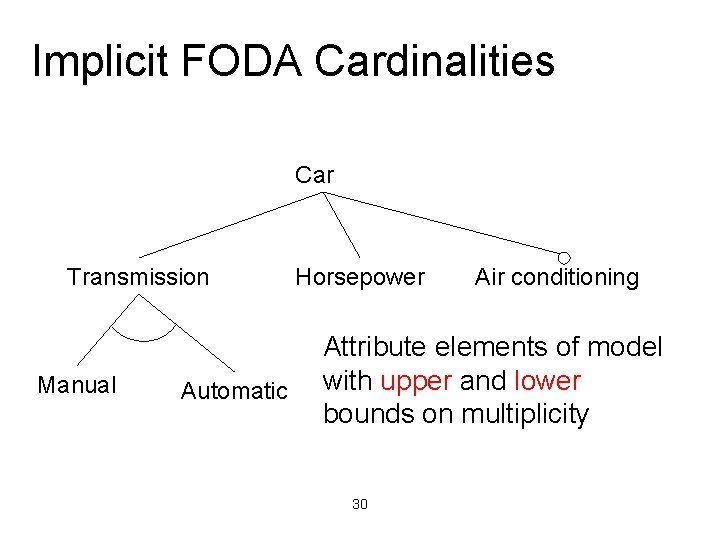
Implicit FODA Cardinalities Car Transmission Manual Automatic Horsepower Air conditioning Attribute elements of model with upper and lower bounds on multiplicity 30
![Implicit FODA Cardinalities Car [0, 1] Transmission Manual Automatic Horsepower Air conditioning Optional features](http://slidetodoc.com/presentation_image/95a2a7383fdacf9e4c2fd46892e8ad83/image-31.jpg "Implicit FODA Cardinalities Car [0, 1] Transmission Manual Automatic Horsepower Air conditioning Optional features")
Implicit FODA Cardinalities Car [0, 1] Transmission Manual Automatic Horsepower Air conditioning Optional features have bounds of [0, 1] on the dependence 31
![Implicit FODA Cardinalities Car [0, 1] [1, 1] Transmission Manual Horsepower Air conditioning Automatic](http://slidetodoc.com/presentation_image/95a2a7383fdacf9e4c2fd46892e8ad83/image-32.jpg "Implicit FODA Cardinalities Car [0, 1] [1, 1] Transmission Manual Horsepower Air conditioning Automatic")
Implicit FODA Cardinalities Car [0, 1] [1, 1] Transmission Manual Horsepower Air conditioning Automatic Mandatory features have bounds of [1, 1] on a dependence 32
![Implicit FODA Cardinalities Car [0, 1] [1, 1] Transmission Horsepower Air conditioning [1, 1]](http://slidetodoc.com/presentation_image/95a2a7383fdacf9e4c2fd46892e8ad83/image-33.jpg "Implicit FODA Cardinalities Car [0, 1] [1, 1] Transmission Horsepower Air conditioning [1, 1]")
Implicit FODA Cardinalities Car [0, 1] [1, 1] Transmission Horsepower Air conditioning [1, 1] Manual Automatic Alternative features have bounds of [1, 1] on a set of dependences 33
![Explicit Cardinalities Car [0, 2] [1, 2] Transmission Motor Air conditioner [1, 1] Manual](http://slidetodoc.com/presentation_image/95a2a7383fdacf9e4c2fd46892e8ad83/image-34.jpg "Explicit Cardinalities Car [0, 2] [1, 2] Transmission Motor Air conditioner [1, 1] Manual")
Explicit Cardinalities Car [0, 2] [1, 2] Transmission Motor Air conditioner [1, 1] Manual Automatic Provide significant expressive power over the base FODA feature models 34
Orthogonal Variability Model (OVM) • Bühen, Lauenroth, Pohl (2005) • A flat model of variability in a product line • Basic elements: – Variation points – Variability dependences (with cardinalities) – Constraints 35
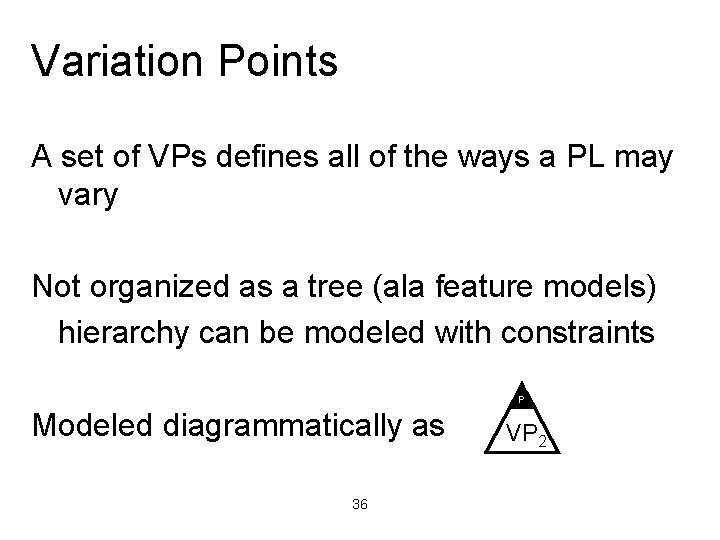
Variation Points A set of VPs defines all of the ways a PL may vary Not organized as a tree (ala feature models) hierarchy can be modeled with constraints V P Modeled diagrammatically as 36 VP 2
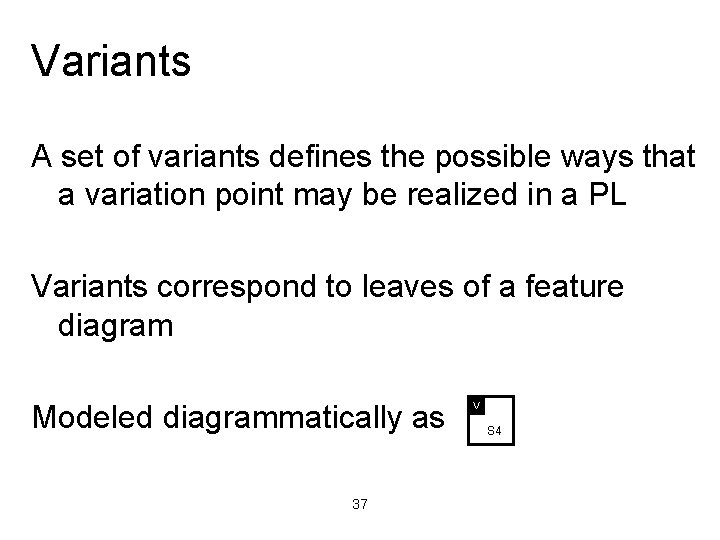
Variants A set of variants defines the possible ways that a variation point may be realized in a PL Variants correspond to leaves of a feature diagram Modeled diagrammatically as 37 V S 4
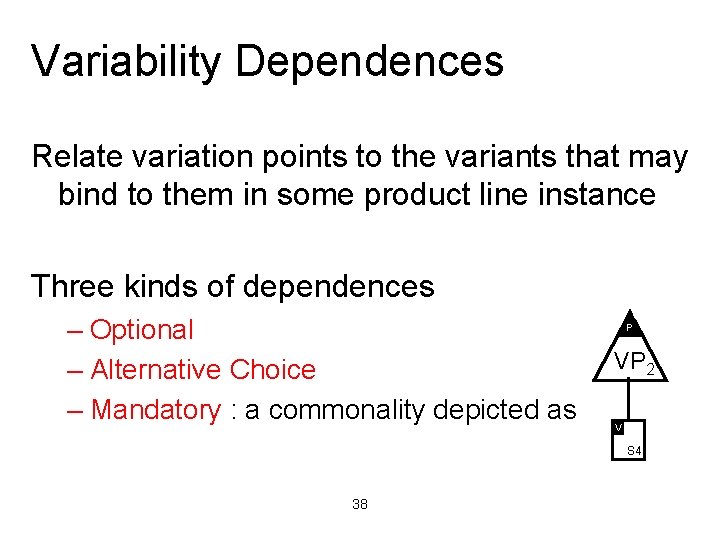
Variability Dependences Relate variation points to the variants that may bind to them in some product line instance Three kinds of dependences – Optional – Alternative Choice – Mandatory : a commonality depicted as V P VP 2 V S 4 38
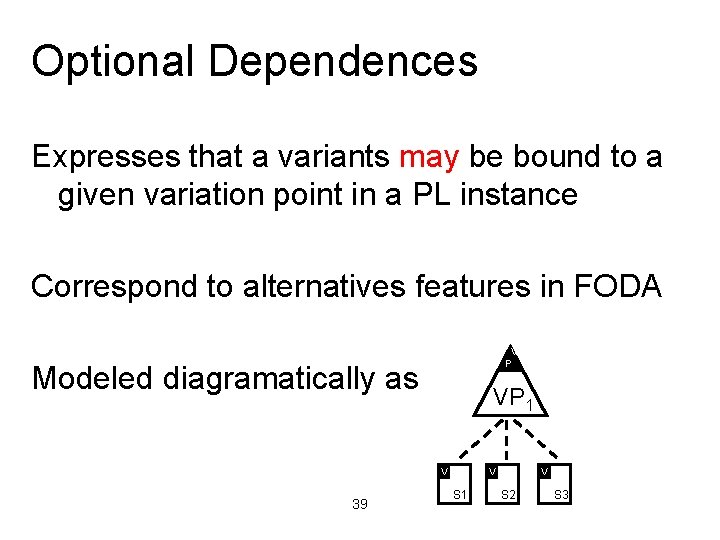
Optional Dependences Expresses that a variants may be bound to a given variation point in a PL instance Correspond to alternatives features in FODA V P Modeled diagramatically as VP 1 V 39 V S 1 V S 2 S 3
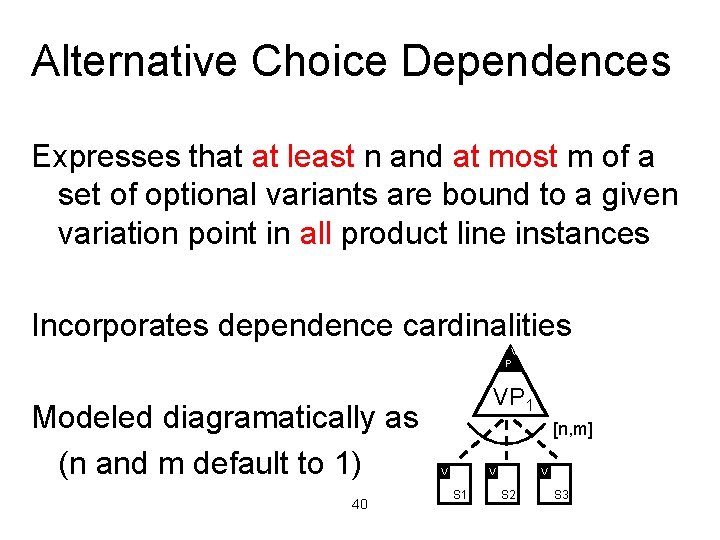
Alternative Choice Dependences Expresses that at least n and at most m of a set of optional variants are bound to a given variation point in all product line instances Incorporates dependence cardinalities V P Modeled diagramatically as (n and m default to 1) 40 VP 1 [n, m] V V S 1 V S 2 S 3
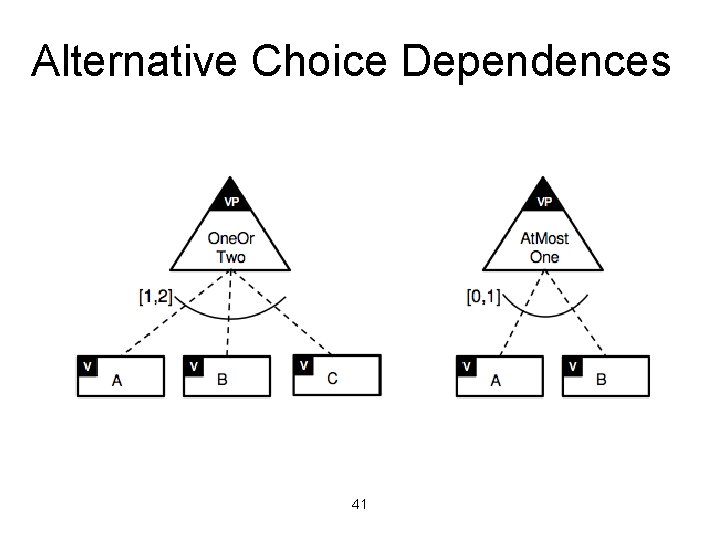
Alternative Choice Dependences 41
Constraints Restrict the binding of dependent variants to variation points in a product line instance There are three classes of constraints – Variant (v_v) – Variation Point (vp_vp) – Variant to Variation Point (v_vp) Within each class there can be – requires : make allowable bindings explicit – excludes : make unallowable bindings explicit 42
Variant to Variant Constraints Restrict the binding of specific variants in an instance NB: dependent VPs are implicit V 1 requires V 2 – If V 1 is in a PL instance, then V 2 must be in that instance V 1 excludes V 2 – If V 1 is in a PL instance, then V 2 cannot be in that instance Allows for specification of feature sets – Sets of variants that are active together 43
More Variant Constraints are directed e. g. , “V 1 requires V 2” demands nothing of V 1 Multiple constraints originating from a variant union the targets of the constraint e. g. , V 1 requires {V 2, V 3} Modeled diagramatically as dashed hyperedges 44
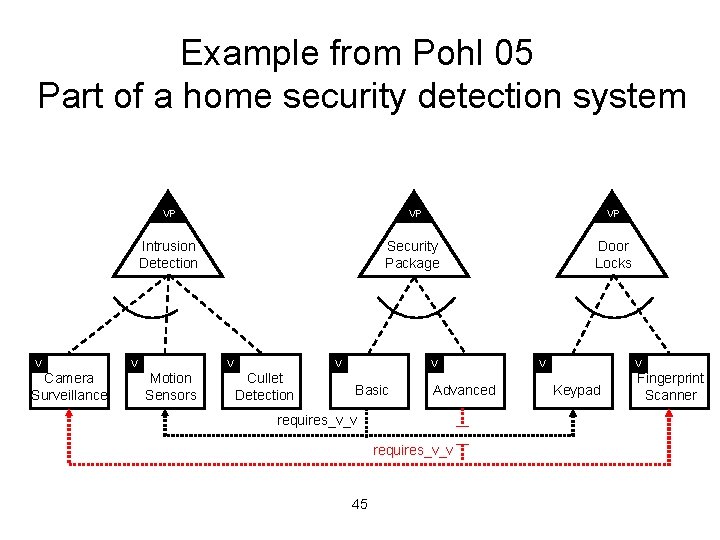
Example from Pohl 05 Part of a home security detection system V Camera Surveillance VP VP VP Intrusion Detection Security Package Door Locks V V Motion Sensors V Cullet Detection V Basic Advanced requires_v_v 45 V V Keypad Fingerprint Scanner
Variant to VP Constraints Controls the inclusion of a VP based on the inclusion of a variant in a PL instance By default, we consider all VPs in an OVM model to contribute to the description of the product line instance In certain product lines, we may have instances in which certain VPs play no role 46
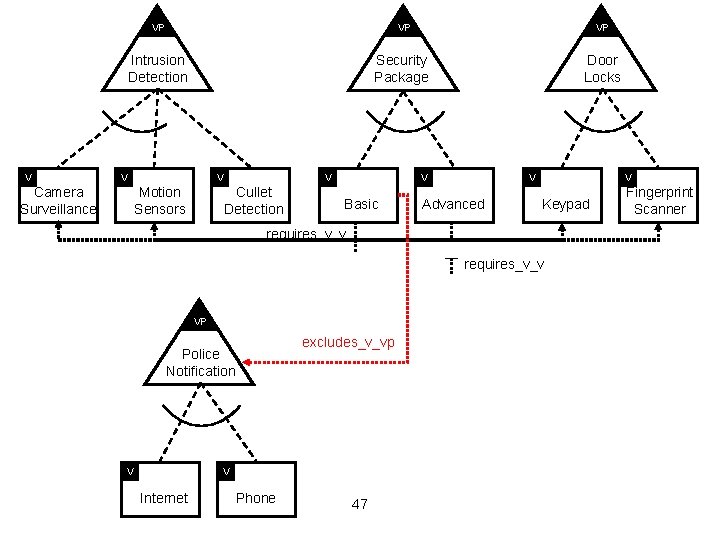
V VP VP VP Intrusion Detection Security Package Door Locks V Camera Surveillance V Motion Sensors V Cullet Detection V Basic V Advanced V Keypad requires_v_v VP excludes_v_vp Police Notification V V Internet Phone 47 Fingerprint Scanner
VP to VP Constraints Controls the inclusion of a VP based on the inclusion of another VP in a PL instance Another level of generality that is useful in describing complex product lines Can be used to hierarchies of VPs – e. g. , express hierarchical dependences between VP via requires_vp_vp 48
Formalizing Variability Models Subsequent to FODA there have been a number of misinterpretations of feature models Czarnecki observed the need for a formal definition of feature models to resolve such ambiguity Formalization also has value in enabling • • reasoning about properties of an SPL application of existing V&V techniques 49
Basic Approach Ignore mandatory dependences Define a relational model whose tuples encode combinations of variants Apply constraints to eliminate tuples that do not correspond to feasible instances of the PL Resulting relation defines the extent of the PL model 50
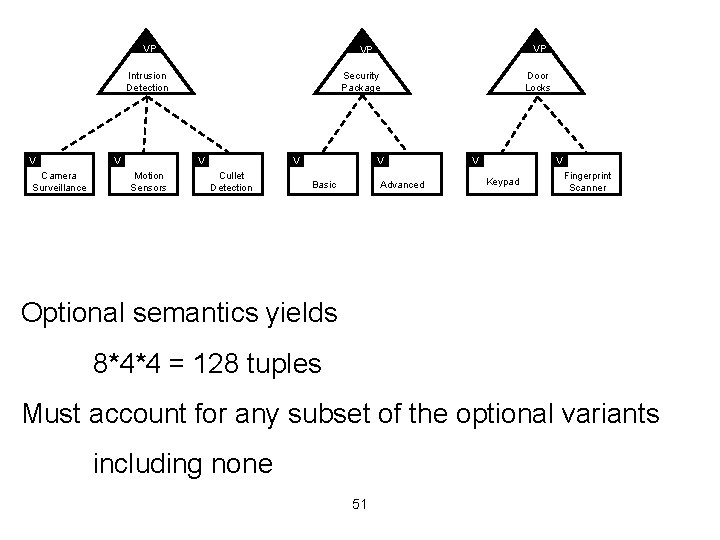
VP Intrusion Detection V Camera Surveillance V Security Package V Motion Sensors VP VP V Cullet Detection V Basic Advanced Door Locks V V Keypad Fingerprint Scanner Optional semantics yields 8*4*4 = 128 tuples Must account for any subset of the optional variants including none 51
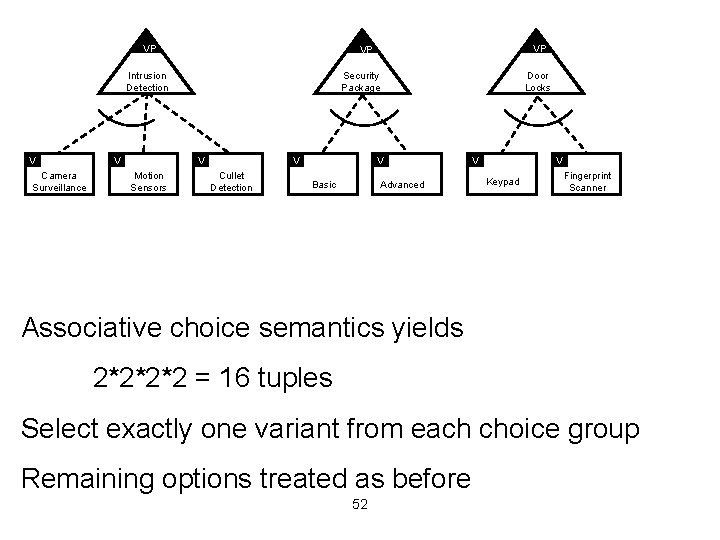
VP Intrusion Detection V Camera Surveillance V Security Package V Motion Sensors VP VP V Cullet Detection V Basic Advanced Door Locks V V Keypad Fingerprint Scanner Associative choice semantics yields 2*2*2*2 = 16 tuples Select exactly one variant from each choice group Remaining options treated as before 52
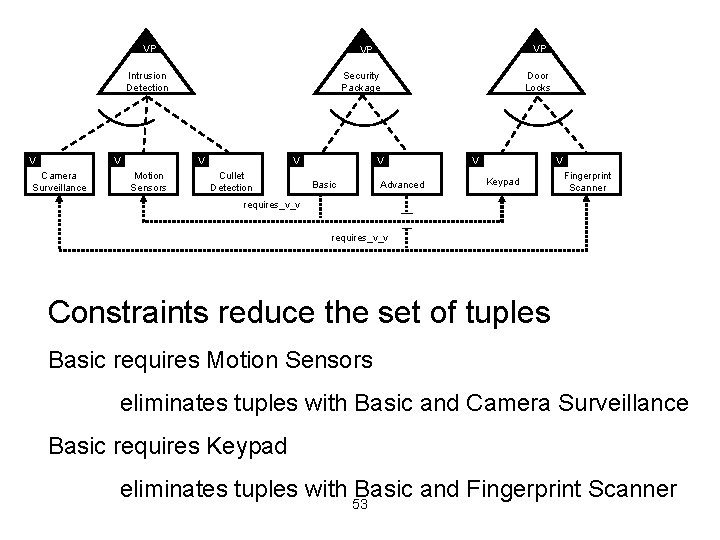
VP Intrusion Detection V V Camera Surveillance Security Package V Motion Sensors VP VP V Cullet Detection V Basic Advanced Door Locks V V Keypad Fingerprint Scanner requires_v_v Constraints reduce the set of tuples Basic requires Motion Sensors eliminates tuples with Basic and Camera Surveillance Basic requires Keypad eliminates tuples with 53 Basic and Fingerprint Scanner
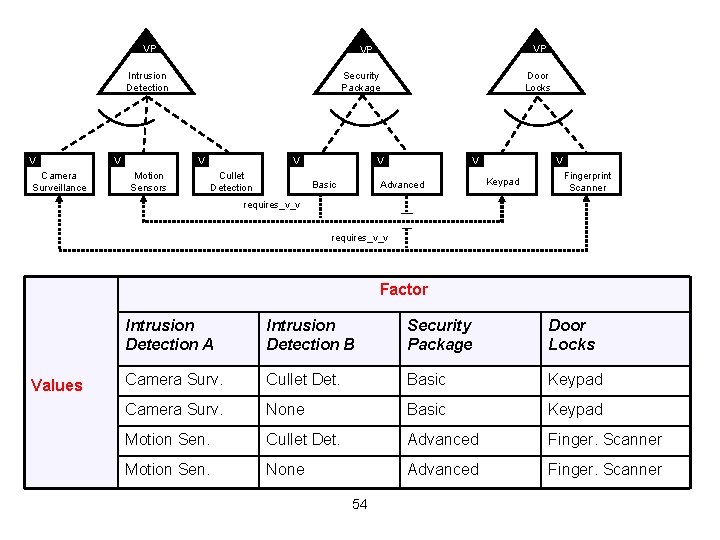
VP Intrusion Detection V Camera Surveillance V Security Package V Motion Sensors VP VP V Cullet Detection Door Locks V Basic V Advanced V Keypad Fingerprint Scanner requires_v_v Factor Values Intrusion Detection A Intrusion Detection B Security Package Door Locks Camera Surv. Cullet Det. Basic Keypad Camera Surv. None Basic Keypad Motion Sen. Cullet Det. Advanced Finger. Scanner Motion Sen. None Advanced Finger. Scanner 54
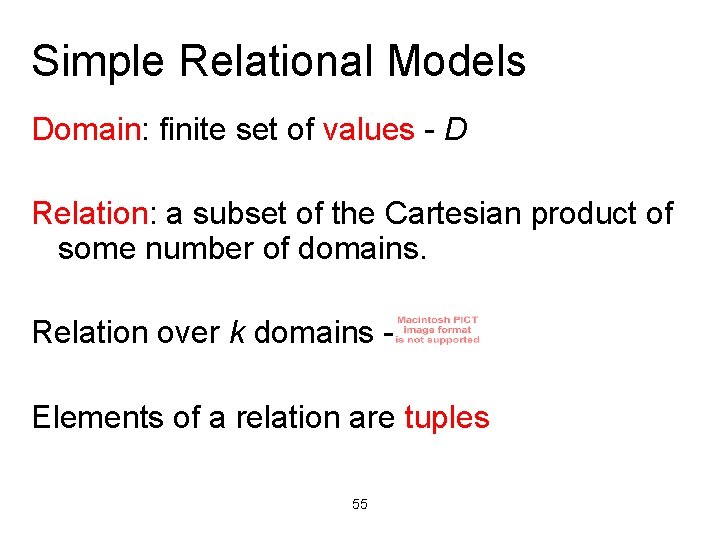
Simple Relational Models Domain: finite set of values - D Relation: a subset of the Cartesian product of some number of domains. Relation over k domains Elements of a relation are tuples 55
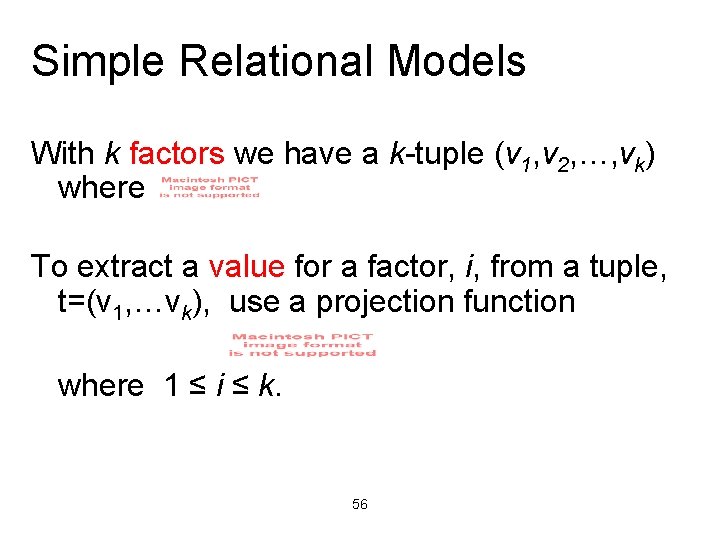
Simple Relational Models With k factors we have a k-tuple (v 1, v 2, …, vk) where To extract a value for a factor, i, from a tuple, t=(v 1, …vk), use a projection function where 1 ≤ i ≤ k. 56
Basic OVM Mapping Variation point: modeled by a set of factors denoted f(vp) for some variation point vp Variants: modeled as values Variability dependencies: relate a set of variants to a variation point (defines the domain) 57
Basic OVM Mapping Mandatory dependences ignore since these do not vary Optional dependences introduce multiple factors for a variation point to allow a variation point to be related to a set of variants Associative choice dependences more complex 58
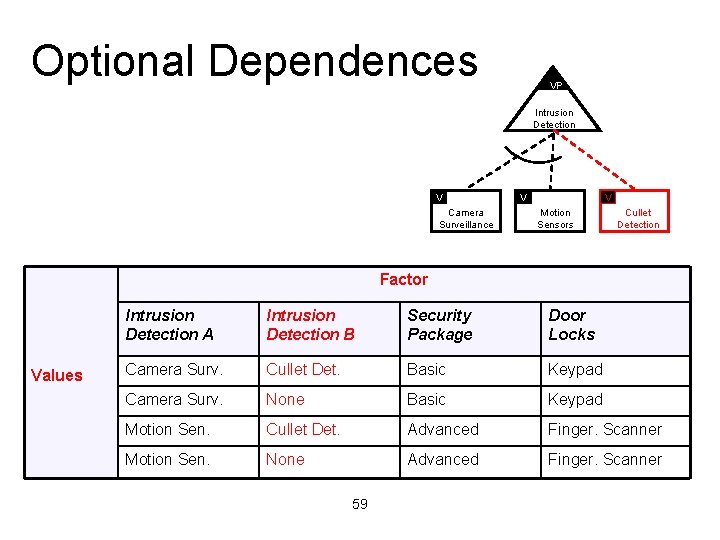
Optional Dependences VP Intrusion Detection V Camera Surveillance V V Motion Sensors Cullet Detection Factor Values Intrusion Detection A Intrusion Detection B Security Package Door Locks Camera Surv. Cullet Det. Basic Keypad Camera Surv. None Basic Keypad Motion Sen. Cullet Det. Advanced Finger. Scanner Motion Sen. None Advanced Finger. Scanner 59
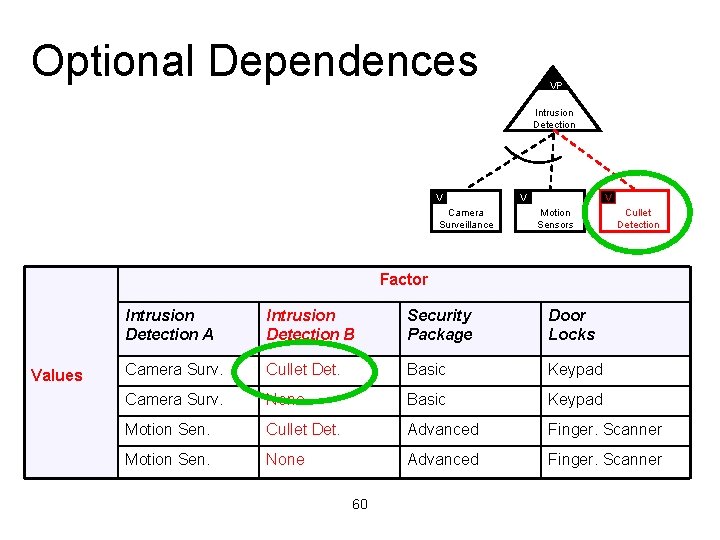
Optional Dependences VP Intrusion Detection V Camera Surveillance V V Motion Sensors Cullet Detection Factor Values Intrusion Detection A Intrusion Detection B Security Package Door Locks Camera Surv. Cullet Det. Basic Keypad Camera Surv. None Basic Keypad Motion Sen. Cullet Det. Advanced Finger. Scanner Motion Sen. None Advanced Finger. Scanner 60
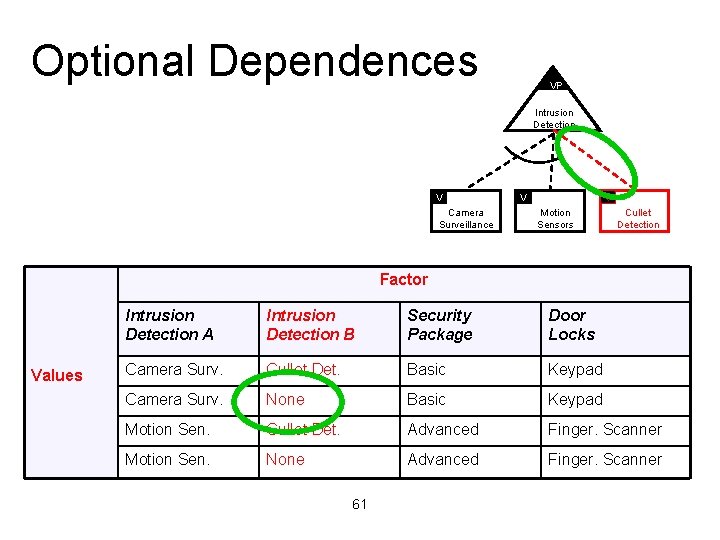
Optional Dependences VP Intrusion Detection V Camera Surveillance V V Motion Sensors Cullet Detection Factor Values Intrusion Detection A Intrusion Detection B Security Package Door Locks Camera Surv. Cullet Det. Basic Keypad Camera Surv. None Basic Keypad Motion Sen. Cullet Det. Advanced Finger. Scanner Motion Sen. None Advanced Finger. Scanner 61
![Alternative Choice Dependencies Given an alternative choice with bounds [i, j] Introduce i factors](http://slidetodoc.com/presentation_image/95a2a7383fdacf9e4c2fd46892e8ad83/image-62.jpg "Alternative Choice Dependencies Given an alternative choice with bounds [i, j] Introduce i factors")
Alternative Choice Dependencies Given an alternative choice with bounds [i, j] Introduce i factors for the variation point with domain defined by the exact set of dependent variant values Introduce j-i factors for the variation point with a domain defined by the set of variant values and Ø (the empty value) 62
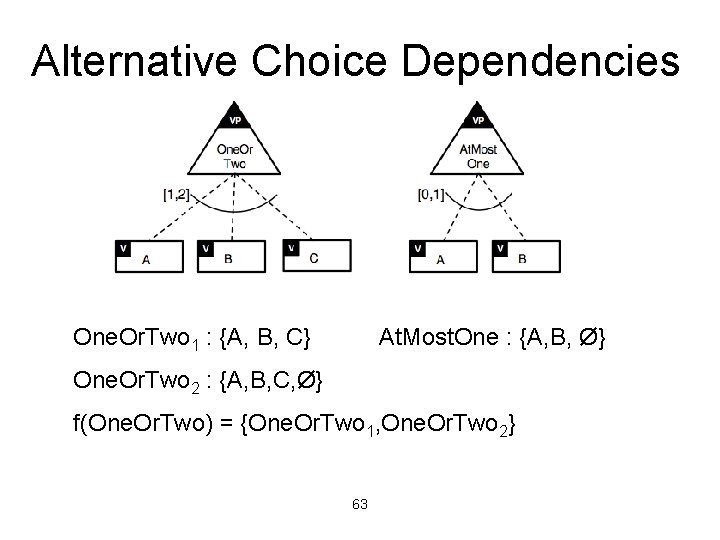
Alternative Choice Dependencies One. Or. Two 1 : {A, B, C} At. Most. One : {A, B, Ø} One. Or. Two 2 : {A, B, C, Ø} f(One. Or. Two) = {One. Or. Two 1, One. Or. Two 2} 63
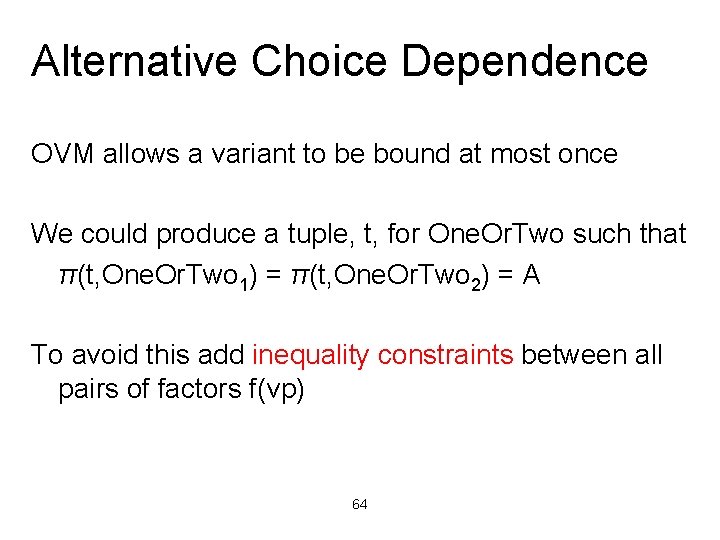
Alternative Choice Dependence OVM allows a variant to be bound at most once We could produce a tuple, t, for One. Or. Two such that π(t, One. Or. Two 1) = π(t, One. Or. Two 2) = A To avoid this add inequality constraints between all pairs of factors f(vp) 64
Basic OVM Mapping Size In the worst case where all dependences are optional an OVM model with k variants gives rise to a relational model with k factors However, alternative choices with default [1, 1] bounds seem very common so we expect the number to be closer to the number of variation points since a single factor is needed for a VP 65
Mapping OVM Constraints An unconstrained OVM model is: tuples of the unconstrained model over approximate the set of feasible product line instances 66
Constraints Strategy: – Define sub-relations of U that are consistent with each constraint – Intersect resulting constraints Example (non- Inequality Constraint): 67
Cumulative Inequality Constraints For a variation point, vp: For an OVM model: 68
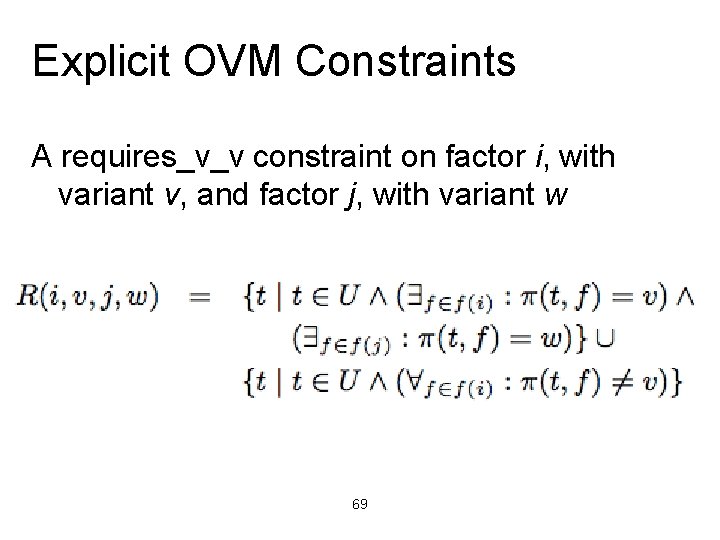
Explicit OVM Constraints A requires_v_v constraint on factor i, with variant v, and factor j, with variant w 69
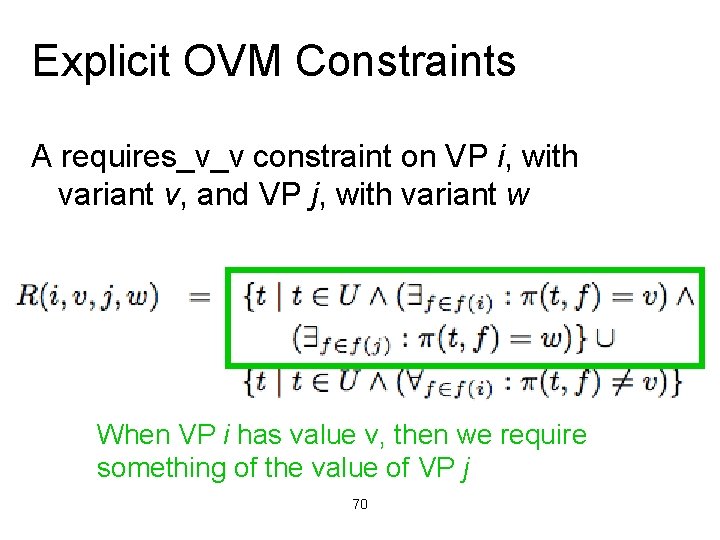
Explicit OVM Constraints A requires_v_v constraint on VP i, with variant v, and VP j, with variant w When VP i has value v, then we require something of the value of VP j 70
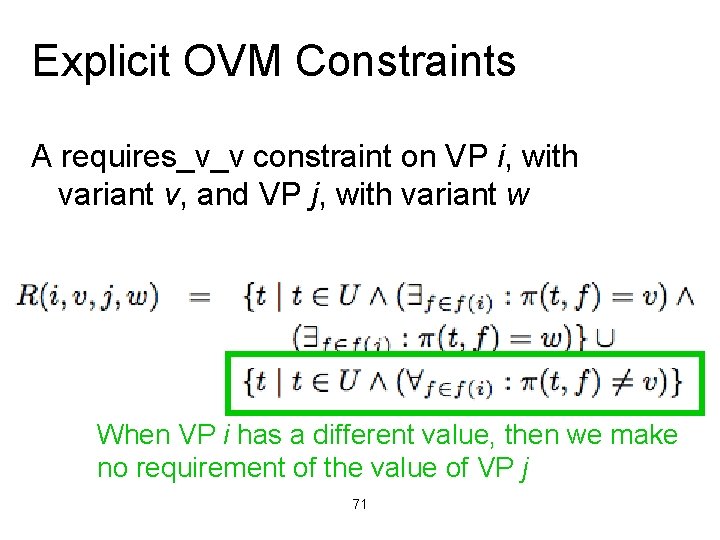
Explicit OVM Constraints A requires_v_v constraint on VP i, with variant v, and VP j, with variant w When VP i has a different value, then we make no requirement of the value of VP j 71
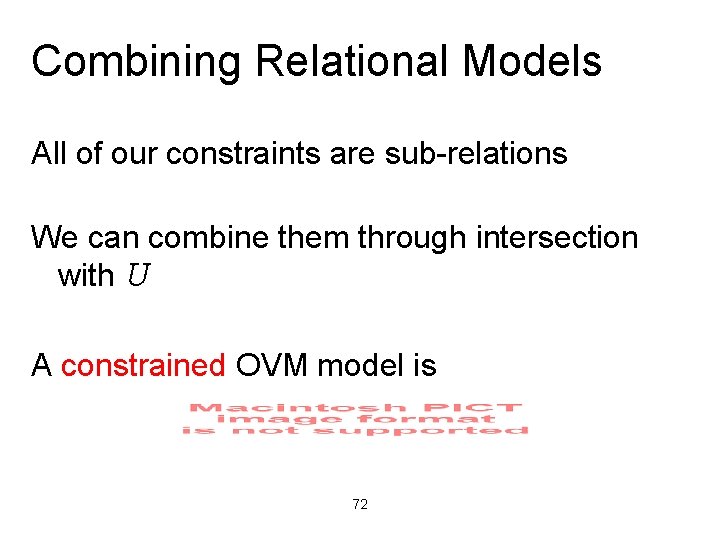
Combining Relational Models All of our constraints are sub-relations We can combine them through intersection with U A constrained OVM model is 72
Limitations Czarnecki’s approach allows for recursive feature diagrams multiple instances of a variant for a VP Batory has suggested propositional constraints 73
References Kang, K. , Cohen, S. , Hess, J. , Nowak, W. , and Peterson, S. , Feature-oriented Domain Analysis (FODA) Feasibility Study, Technical Report CMU/SEI-90 TR-21, Software Engineering Institute, Carnegie Mellon, Pittsburgh, PA (1990) Czarnecki, K. , Helsen, S. , and Eisenecker, U. , Staged Configuration Using Feature Models, Software Product Line Conference, LNCS 3154 (2004) Czarnecki, K. , Helsen, S. , and Eisenecker, U. , Formalizing Cardinality-based Feature Models and their Specialization, Software Process Improvement and Practice (2005) Czarnecki, K. , and Kim, C. H. P. , Cardinality-based Feature Modeling and Constraints : A Progress Report, OOPSLA’ 05 Workshop on Software Factories (2005) Buhne, S. , Lauenroth, K. , and Pohl, K. , Modelling Requirements Variability across Product Lines, IEEE Symposium on Requirements Engineering (2005) Pohl, K. , Bockle, G. , and van der Linden, F. , Software Product Line Engineering : Foundations, Principles, and Techniques, Springer (2005) Batory, D. , Feature Models, Grammars, and Propositional Formulas, Software Product Line Conference, LNCS 3714 (2005) 74
- Slides: 74