
Software Measurement Halsteads Software Science measure 18 1
- Slides: 12
Software Measurement Halstead’s Software Science measure 18 1
Maurice Halstead u Originally a meteorologist – Involved in first cloud seeding u In 1970’s he did empirical studies looking for relationships between code and the “ilities” – maintainability, readability, testability, etc u Wanted to find the intrinsic things to measure 18 2
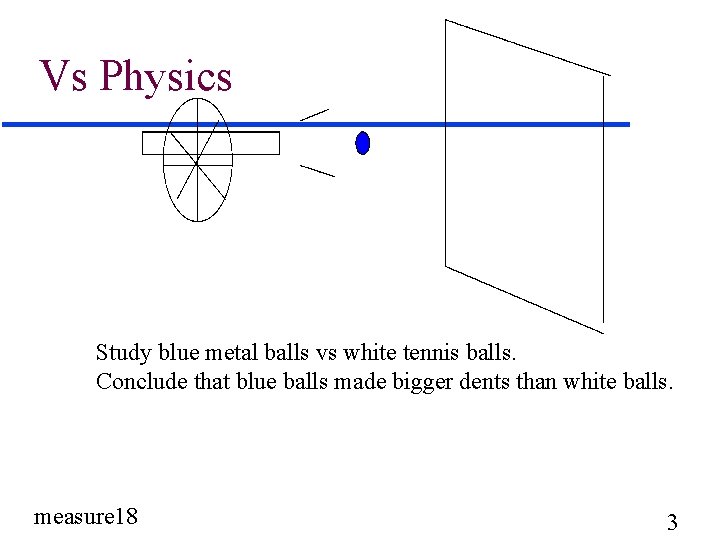
Vs Physics Study blue metal balls vs white tennis balls. Conclude that blue balls made bigger dents than white balls. measure 18 3
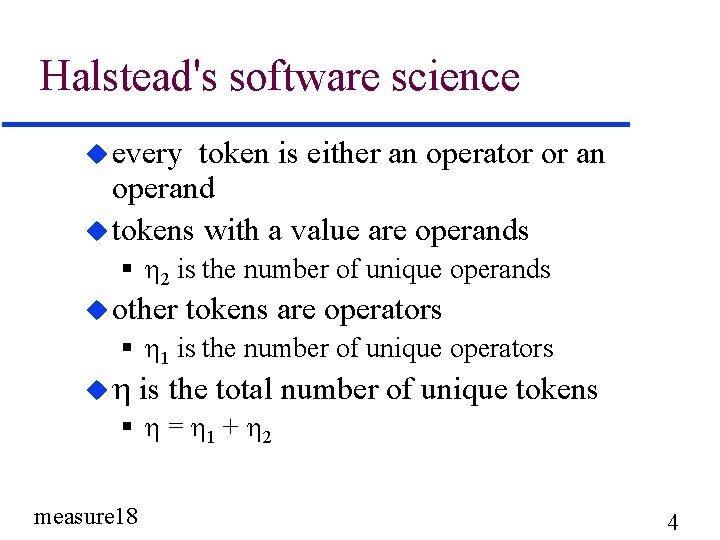
Halstead's software science u every token is either an operator or an operand u tokens with a value are operands § 2 is the number of unique operands u other tokens are operators § 1 is the number of unique operators u is the total number of unique tokens § = 1 + 2 measure 18 4
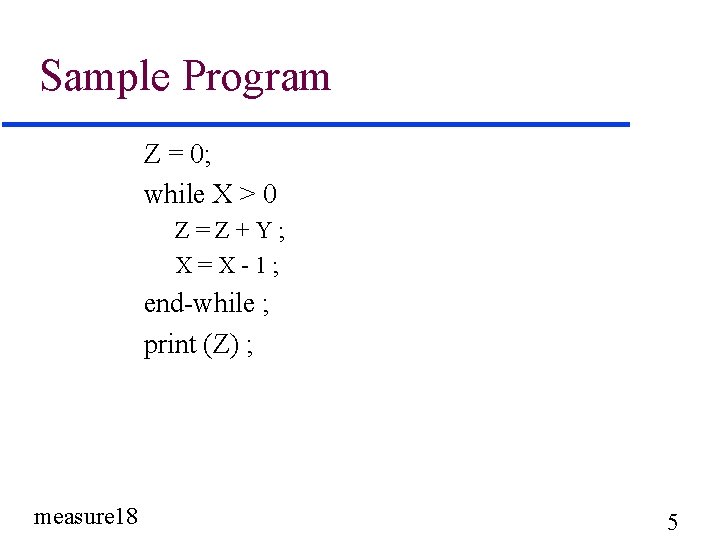
Sample Program Z = 0; while X > 0 Z=Z+Y; X=X-1; end-while ; print (Z) ; measure 18 5
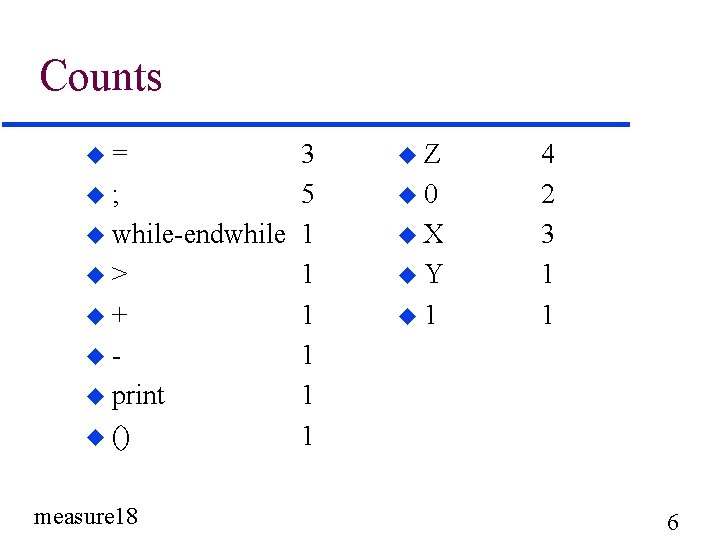
Counts u= 3 u; 5 u while-endwhile 1 u> 1 u+ 1 u print 1 u () 1 measure 18 u. Z u 0 u. X u. Y u 1 4 2 3 1 1 6
Counting Rules u Halstead also was concerned about algorithms and not about declarations, i/o statements, etc. u Thus, he did not count declarations, input or output statements, or comments. measure 18 7
Counting Rules u There is a lot of debate about counting rules. In fact there was a conference that dealt just with counting rules. One conclusion, the results are not very sensitive to the counting rules. Pick a set of rules and be consistent. u Suggest syntax-oriented counting rules measure 18 8
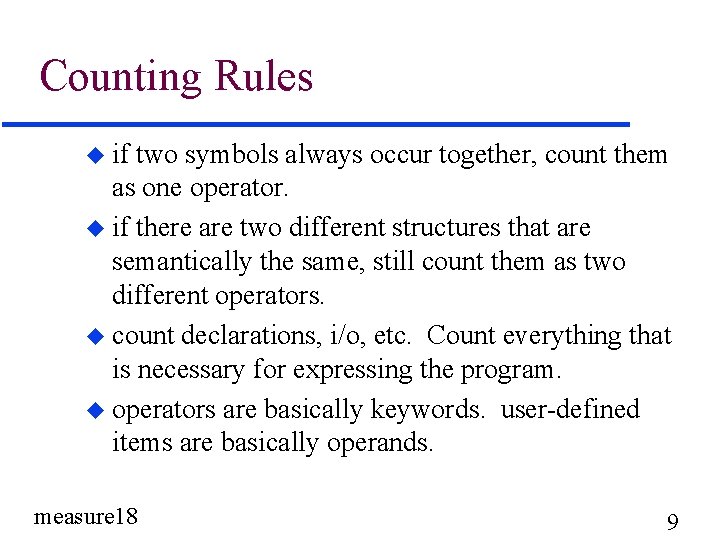
Counting Rules u if two symbols always occur together, count them as one operator. u if there are two different structures that are semantically the same, still count them as two different operators. u count declarations, i/o, etc. Count everything that is necessary for expressing the program. u operators are basically keywords. user-defined items are basically operands. measure 18 9
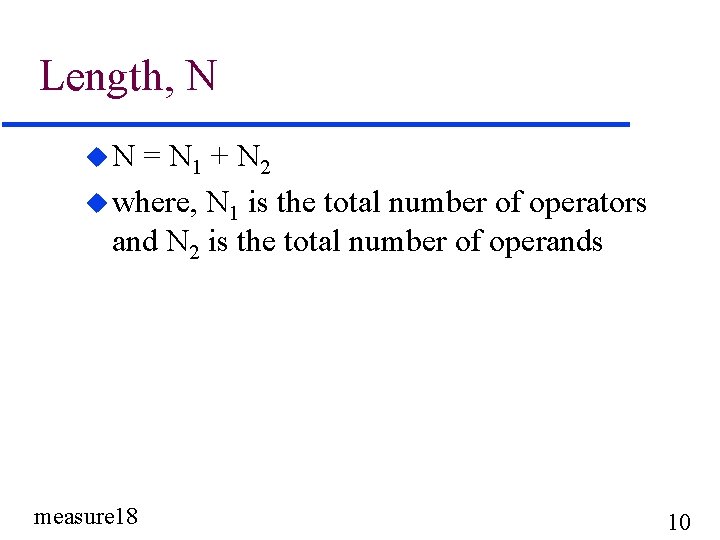
Length, N u. N = N 1 + N 2 u where, N 1 is the total number of operators and N 2 is the total number of operands measure 18 10
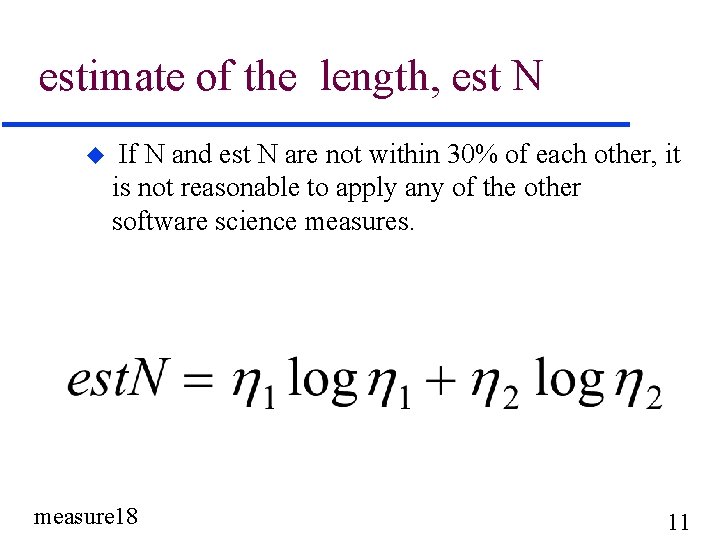
estimate of the length, est N u If N and est N are not within 30% of each other, it is not reasonable to apply any of the other software science measures. measure 18 11
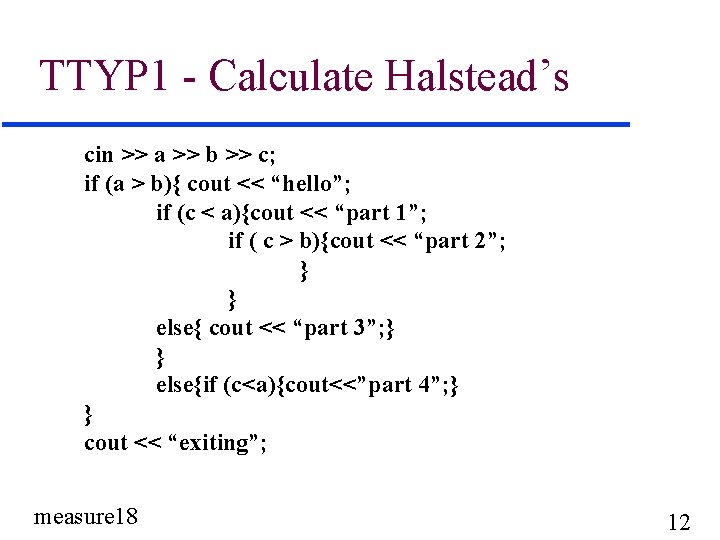
TTYP 1 - Calculate Halstead’s cin >> a >> b >> c; if (a > b){ cout << “hello”; if (c < a){cout << “part 1”; if ( c > b){cout << “part 2”; } } else{ cout << “part 3”; } } else{if (c<a){cout<<”part 4”; } } cout << “exiting”; measure 18 12