
Software Management Aaron G Sauers CLP Overview 2
- Slides: 20
Software Management Aaron G. Sauers, CLP
Overview • • • 2 Who am I? Software Intellectual Property Software Licensing Open Source Software (OSS) License Compatibility Current Events
3
GOGO vs. GOCO • GOGO = Government Owned, Government Operated • GOCO = Government Owned, Contractor Operated • US Government does not assert copyright in works created under official duties of employees • Contractors can assert copyright – particularly relevant to software • Contractors can assign copyright to another entity (i. e. a publisher, foundation, etc. ) or the government 4
Copyright Management As a Government-Owned Contractor-Operated (GOCO) Laboratory, Fermilab (and most DOE labs): • Can request permission to assert copyright in copyrighted materials from the cognizant government agency • Must commit to licensing copyrighted materials • Permission to assert copyright extends only 5 years • If licensing activities are ongoing, the contractor may request permission to assert copyright for an additional 5 years • Thereafter, the government will have the right to grant nonexclusive licenses • Owner/assignee of IP is contractor (government license still applies in all cases) 5
What is a Copyright? Copyright protection subsists…. in original works of authorship fixed in any tangible medium of expression …. . otherwise communicated, either directly or with the aid of a machine or device. (17 U. S. C. § 102) – Applicable for: • Software • Schematics/drawings • Firmware • Publications (technical/journal articles, etc. ) 6
What’s Not a Copyright? In no case does copyright protection …extend to any idea, procedure, process, system, method of operation, concept, principle, or discovery, regardless of the form in which it is described, explained, illustrated, or embodied in such work. 17 U. S. C. § 102(b) Unlike a patent, a copyright protects the form of expression rather than the subject matter of the work. Thus, for software, an author is s/he who actually keys the code. 7
What is the Duration of a Copyright? • On or after January 1, 1978 – subsists from its creation and endures for a term consisting of the life of the author and 70 years after the author’s death. • Works For Hire – endures for a term of 95 years from the year of its first publication, or a term of 120 years from the year of its creation, whichever expires first. 8
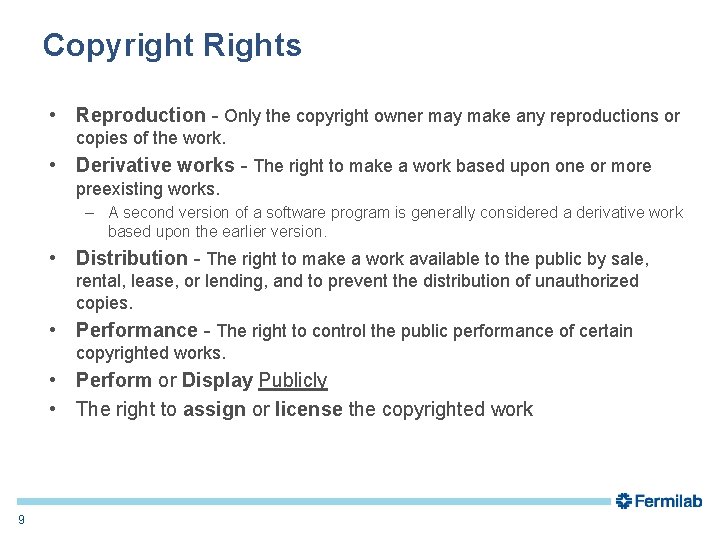
Copyright Rights • Reproduction - Only the copyright owner may make any reproductions or copies of the work. • Derivative works - The right to make a work based upon one or more preexisting works. – A second version of a software program is generally considered a derivative work based upon the earlier version. • Distribution - The right to make a work available to the public by sale, rental, lease, or lending, and to prevent the distribution of unauthorized copies. • Performance - The right to control the public performance of certain copyrighted works. • Perform or Display Publicly • The right to assign or license the copyrighted work 9
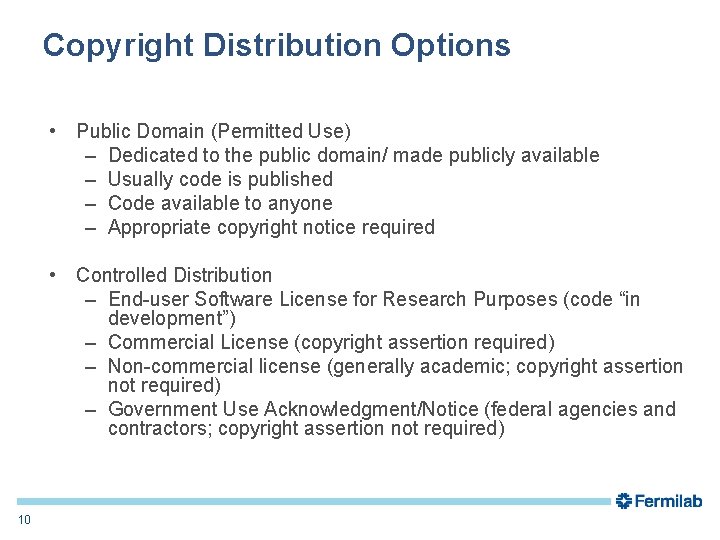
Copyright Distribution Options • Public Domain (Permitted Use) – Dedicated to the public domain/ made publicly available – Usually code is published – Code available to anyone – Appropriate copyright notice required • Controlled Distribution – End-user Software License for Research Purposes (code “in development”) – Commercial License (copyright assertion required) – Non-commercial license (generally academic; copyright assertion not required) – Government Use Acknowledgment/Notice (federal agencies and contractors; copyright assertion not required) 10
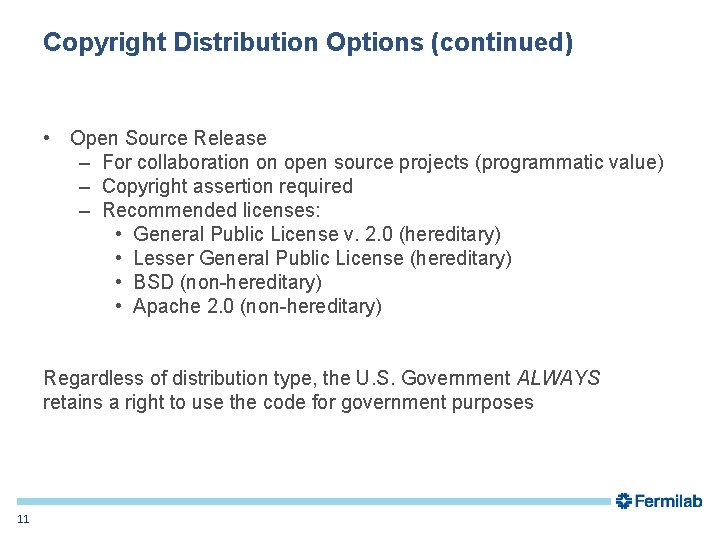
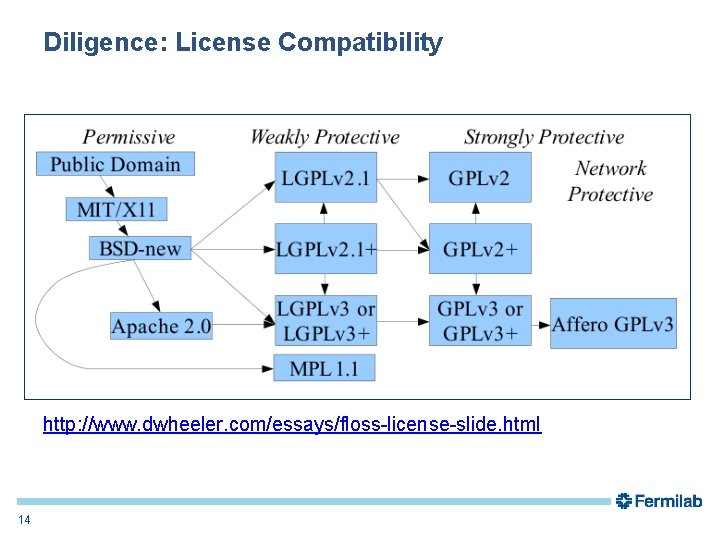
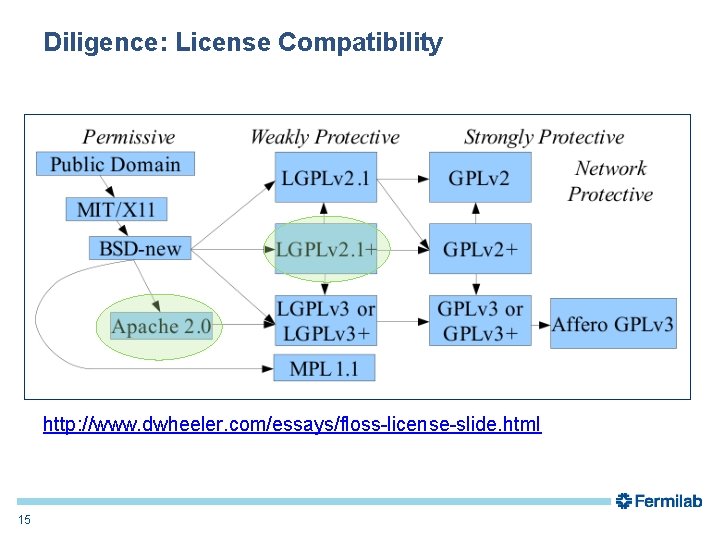
Copyright Distribution Options (continued) • Open Source Release – For collaboration on open source projects (programmatic value) – Copyright assertion required – Recommended licenses: • General Public License v. 2. 0 (hereditary) • Lesser General Public License (hereditary) • BSD (non-hereditary) • Apache 2. 0 (non-hereditary) Regardless of distribution type, the U. S. Government ALWAYS retains a right to use the code for government purposes 11
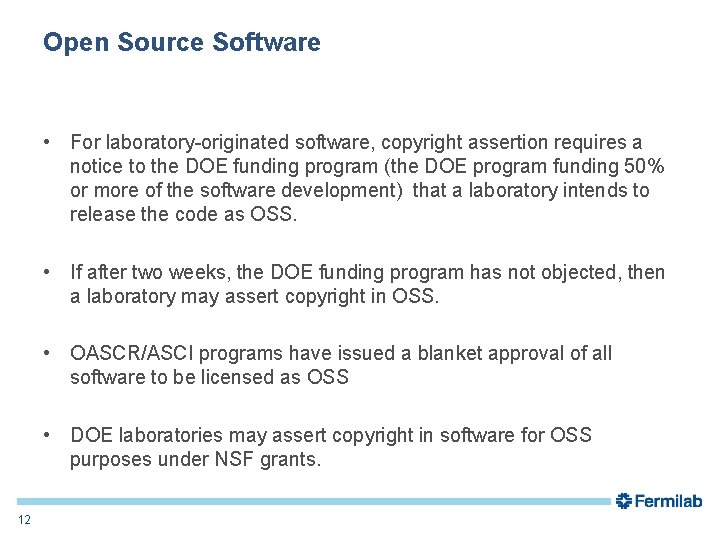
Open Source Software • For laboratory-originated software, copyright assertion requires a notice to the DOE funding program (the DOE program funding 50% or more of the software development) that a laboratory intends to release the code as OSS. • If after two weeks, the DOE funding program has not objected, then a laboratory may assert copyright in OSS. • OASCR/ASCI programs have issued a blanket approval of all software to be licensed as OSS • DOE laboratories may assert copyright in software for OSS purposes under NSF grants. 12
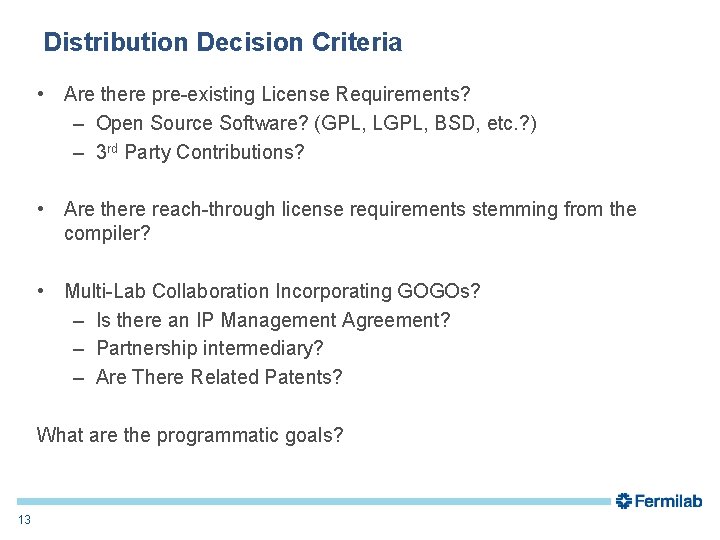
Distribution Decision Criteria • Are there pre-existing License Requirements? – Open Source Software? (GPL, LGPL, BSD, etc. ? ) – 3 rd Party Contributions? • Are there reach-through license requirements stemming from the compiler? • Multi-Lab Collaboration Incorporating GOGOs? – Is there an IP Management Agreement? – Partnership intermediary? – Are There Related Patents? What are the programmatic goals? 13
Diligence: License Compatibility http: //www. dwheeler. com/essays/floss-license-slide. html 14
Diligence: License Compatibility http: //www. dwheeler. com/essays/floss-license-slide. html 15
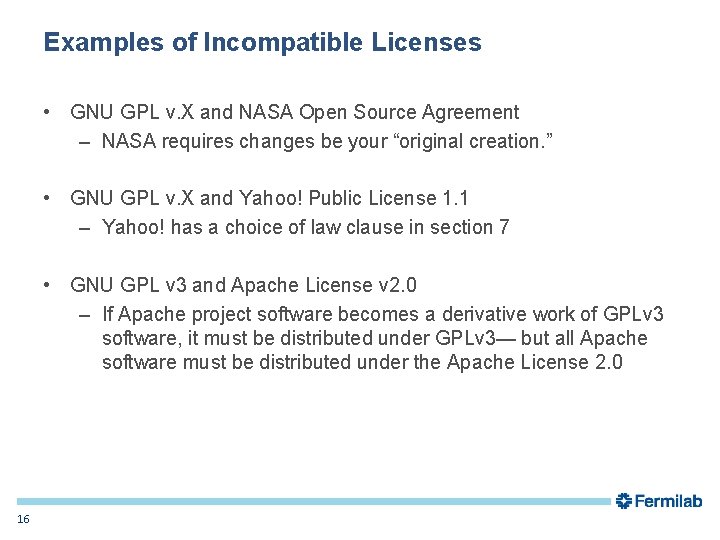
Examples of Incompatible Licenses • GNU GPL v. X and NASA Open Source Agreement – NASA requires changes be your “original creation. ” • GNU GPL v. X and Yahoo! Public License 1. 1 – Yahoo! has a choice of law clause in section 7 • GNU GPL v 3 and Apache License v 2. 0 – If Apache project software becomes a derivative work of GPLv 3 software, it must be distributed under GPLv 3— but all Apache software must be distributed under the Apache License 2. 0 16
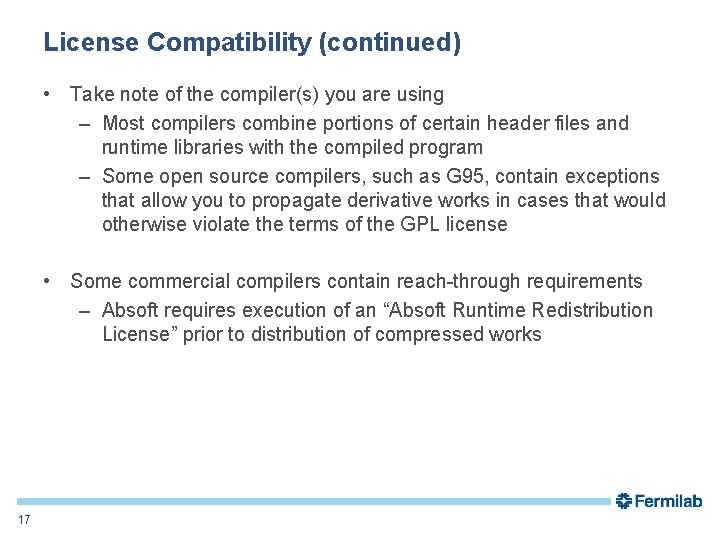
License Compatibility (continued) • Take note of the compiler(s) you are using – Most compilers combine portions of certain header files and runtime libraries with the compiled program – Some open source compilers, such as G 95, contain exceptions that allow you to propagate derivative works in cases that would otherwise violate the terms of the GPL license • Some commercial compilers contain reach-through requirements – Absoft requires execution of an “Absoft Runtime Redistribution License” prior to distribution of compressed works 17
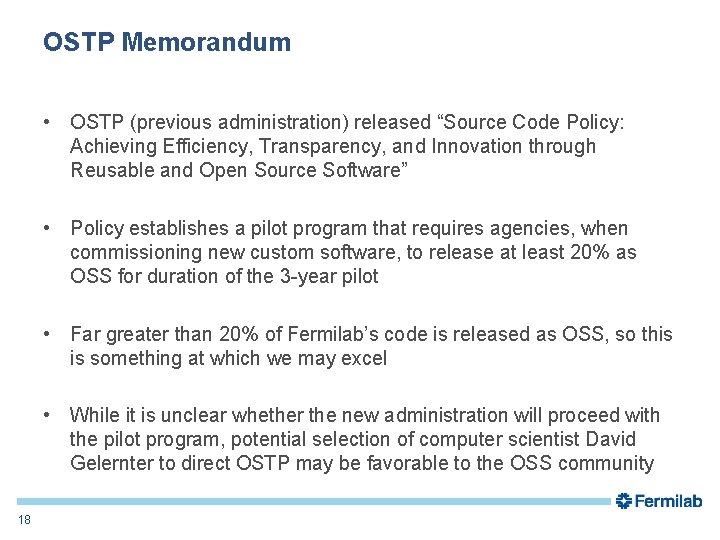
OSTP Memorandum • OSTP (previous administration) released “Source Code Policy: Achieving Efficiency, Transparency, and Innovation through Reusable and Open Source Software” • Policy establishes a pilot program that requires agencies, when commissioning new custom software, to release at least 20% as OSS for duration of the 3 -year pilot • Far greater than 20% of Fermilab’s code is released as OSS, so this is something at which we may excel • While it is unclear whether the new administration will proceed with the pilot program, potential selection of computer scientist David Gelernter to direct OSTP may be favorable to the OSS community 18
Thank you Aaron G. Sauers, CLP Phone: 630 -840 -4432 Email: asauers@fnal. gov 19
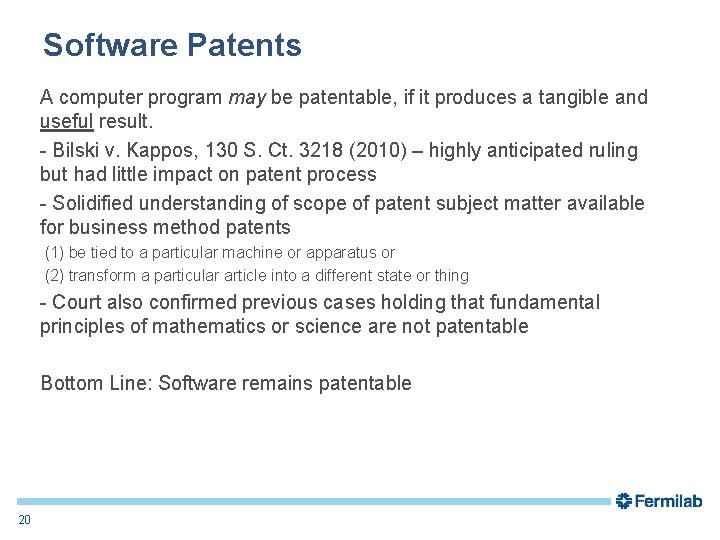
Software Patents A computer program may be patentable, if it produces a tangible and useful result. - Bilski v. Kappos, 130 S. Ct. 3218 (2010) – highly anticipated ruling but had little impact on patent process - Solidified understanding of scope of patent subject matter available for business method patents (1) be tied to a particular machine or apparatus or (2) transform a particular article into a different state or thing - Court also confirmed previous cases holding that fundamental principles of mathematics or science are not patentable Bottom Line: Software remains patentable 20