
Software Maintenance and Evolution Above Hill AFBs maintenance
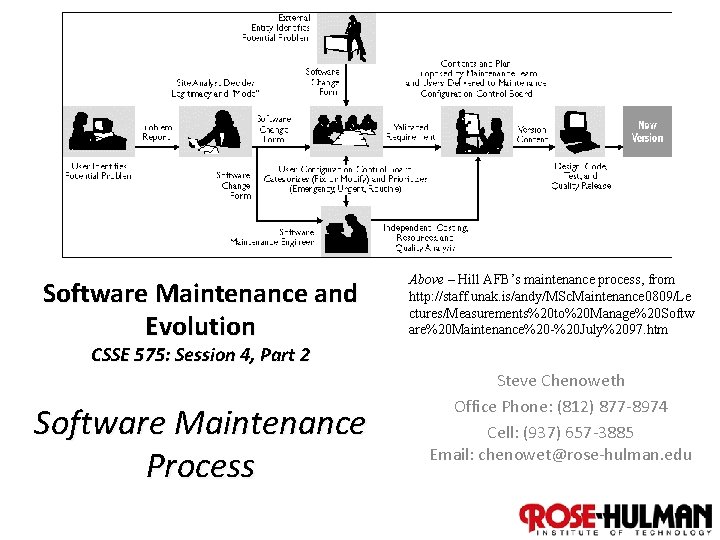
Software Maintenance and Evolution Above – Hill AFB’s maintenance process, from http: //staff. unak. is/andy/MSc. Maintenance 0809/Le ctures/Measurements%20 to%20 Manage%20 Softw are%20 Maintenance%20 -%20 July%2097. htm CSSE 575: Session 4, Part 2 Software Maintenance Process Steve Chenoweth Office Phone: (812) 877 -8974 Cell: (937) 657 -3885 Email: chenowet@rose-hulman. edu 1
Maintenance topics on these slides • The financials and planning of a maintenance activity • Ingredients of the maintenance process – E. g. , role of release management • Maintenance process standards • Maintainability 2
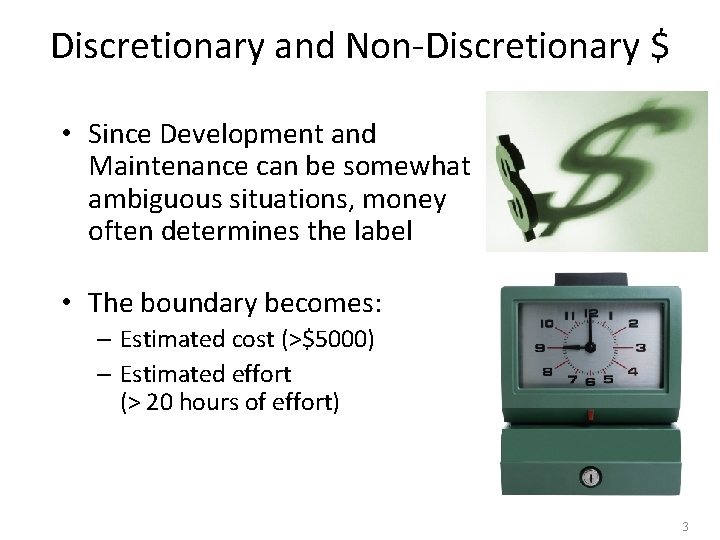
Discretionary and Non-Discretionary $ • Since Development and Maintenance can be somewhat ambiguous situations, money often determines the label • The boundary becomes: – Estimated cost (>$5000) – Estimated effort (> 20 hours of effort) 3

Development versus Maintenance Risk • Development Risks – Technology - sometimes bleeding edge – Personnel - sometimes high turnover – Budget - risk entrepreneurial investments – Business - business case based on future customers • Maintenance Risks – Technology - sometimes technology obsolete – Personnel - sometimes dated skills – Budget - risk averse cost containment – Business - business case based on existing customers 4
Key Software Maintenance Factors • Software Product • User Requirements (i. e. , Change Request and Specification) • Organizational Environment • Operational Environment • Maintenance Personnel • Maintenance Process 5
Software Product • Application domain • Documentation quality • Code flexibility • Code complexity/structure • Product quality 6
User Requirements • Requests for additional features • Correction of defects (bugs) • Other support (e. g. training, help desk) 7
Organizational Environment • Change in Policies – Medical – FDA 13485 Medical Device Regulation • Competition • Informal standards – like: – What your client is used to! – What the developers are used to! • Internal Management Changes – Mergers and Acquisitions 8
Operational Environment • Hardware • Communications • Operating Systems • Systems Software • Third Party Software 9
Maintenance Personnel • Staff Turnover • Application Domain Expertise • Working Practices 10
Ingredients of a Maintenance Process (1 of 2) Process requests before working on them: – Capture maintenance requests – Deal with Emergency Fixes/Priority CRs – Investigate change requests • Verify bugs from DRs/PRs • Understand the impacts (1 st Impact Analysis) – Estimate the Effort / Cost – Prioritize requests • Competing against other requests! – Assigning to maintenance release and team – Scheduling the maintenance release 11
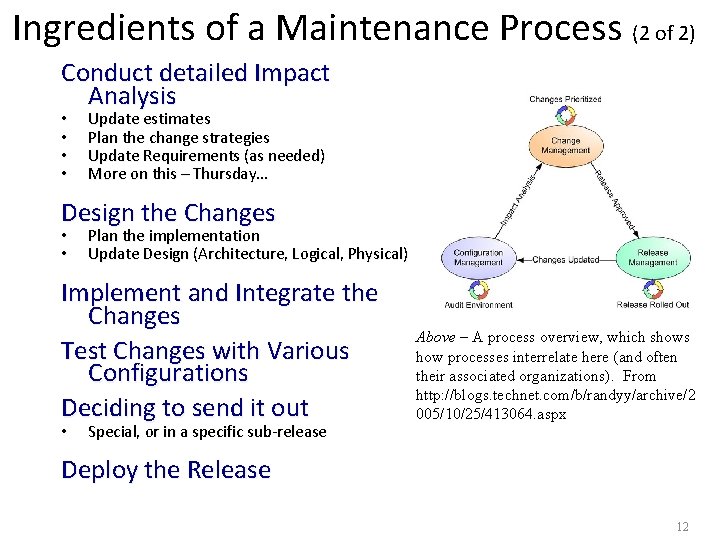
Ingredients of a Maintenance Process (2 of 2) Conduct detailed Impact Analysis • • Update estimates Plan the change strategies Update Requirements (as needed) More on this – Thursday… Design the Changes • • Plan the implementation Update Design (Architecture, Logical, Physical) Implement and Integrate the Changes Test Changes with Various Configurations Deciding to send it out • Special, or in a specific sub-release Above – A process overview, which shows how processes interrelate here (and often their associated organizations). From http: //blogs. technet. com/b/randyy/archive/2 005/10/25/413064. aspx Deploy the Release 12
What is Release Management? • The key role in managing what goes out next • A team or person who makes those decisions – Consider what customers want ASAP – Consider what’s tested & ready to include – Take out “extras” you don’t want • A cool software management job for technical people 13
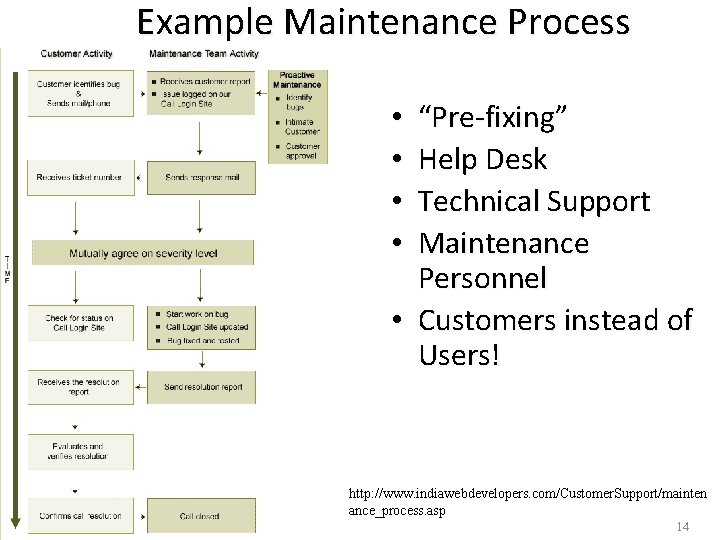
Example Maintenance Process “Pre-fixing” Help Desk Technical Support Maintenance Personnel • Customers instead of Users! • • http: //www. indiawebdevelopers. com/Customer. Support/mainten ance_process. asp 14
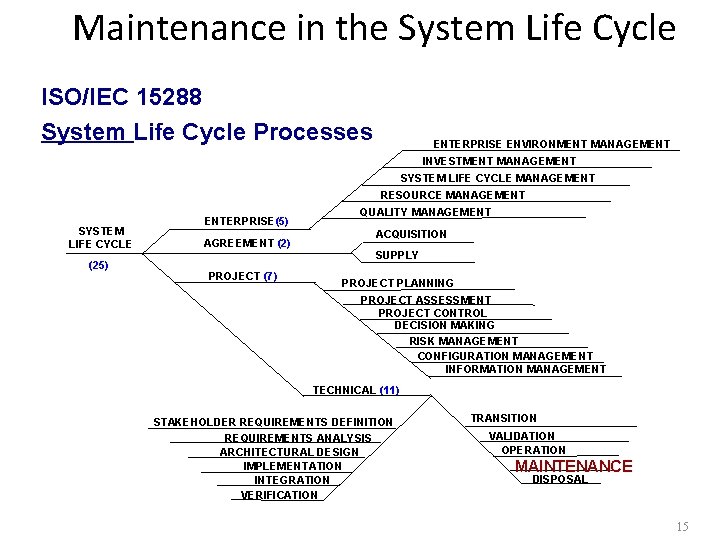
Maintenance in the System Life Cycle ISO/IEC 15288 System Life Cycle Processes ENTERPRISE ENVIRONMENT MANAGEMENT INVESTMENT MANAGEMENT SYSTEM LIFE CYCLE MANAGEMENT RESOURCE MANAGEMENT SYSTEM LIFE CYCLE (25) ENTERPRISE(5) AGREEMENT (2) PROJECT (7) QUALITY MANAGEMENT ACQUISITION SUPPLY PROJECT PLANNING PROJECT ASSESSMENT PROJECT CONTROL DECISION MAKING RISK MANAGEMENT CONFIGURATION MANAGEMENT INFORMATION MANAGEMENT TECHNICAL (11) STAKEHOLDER REQUIREMENTS DEFINITION REQUIREMENTS ANALYSIS ARCHITECTURAL DESIGN IMPLEMENTATION INTEGRATION VERIFICATION TRANSITION VALIDATION OPERATION MAINTENANCE DISPOSAL 15

Maintenance in the Software Life Cycle IEEE/EIA 12207 Software Life Cycle Processes SOFTWARE LIFE CYCLE (17+1) SUPPLY DEVELOPMENT OPERATION MAINTENANCE PRIMARY (5) SUPPORTING (8) ACQUISITION DOCUMENTATION CONFIGURATION MANAGEMENT QUALITY ASSURANCE VERIFICATION VALIDATION JOINT REVIEW AUDIT PROBLEM RESOLUTION ORGANIZATIONAL (4) MANAGEMENT INFRASTRUCTURE IMPROVEMENT TRAINING TAILORING 16
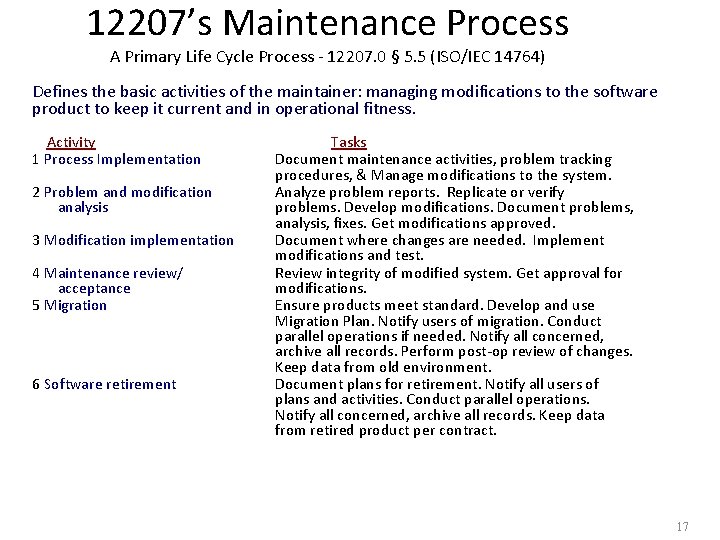
12207’s Maintenance Process A Primary Life Cycle Process - 12207. 0 § 5. 5 (ISO/IEC 14764) Defines the basic activities of the maintainer: managing modifications to the software product to keep it current and in operational fitness. Activity 1 Process Implementation 2 Problem and modification analysis 3 Modification implementation 4 Maintenance review/ acceptance 5 Migration 6 Software retirement Tasks Document maintenance activities, problem tracking procedures, & Manage modifications to the system. Analyze problem reports. Replicate or verify problems. Develop modifications. Document problems, analysis, fixes. Get modifications approved. Document where changes are needed. Implement modifications and test. Review integrity of modified system. Get approval for modifications. Ensure products meet standard. Develop and use Migration Plan. Notify users of migration. Conduct parallel operations if needed. Notify all concerned, archive all records. Perform post-op review of changes. Keep data from old environment. Document plans for retirement. Notify all users of plans and activities. Conduct parallel operations. Notify all concerned, archive all records. Keep data from retired product per contract. 17
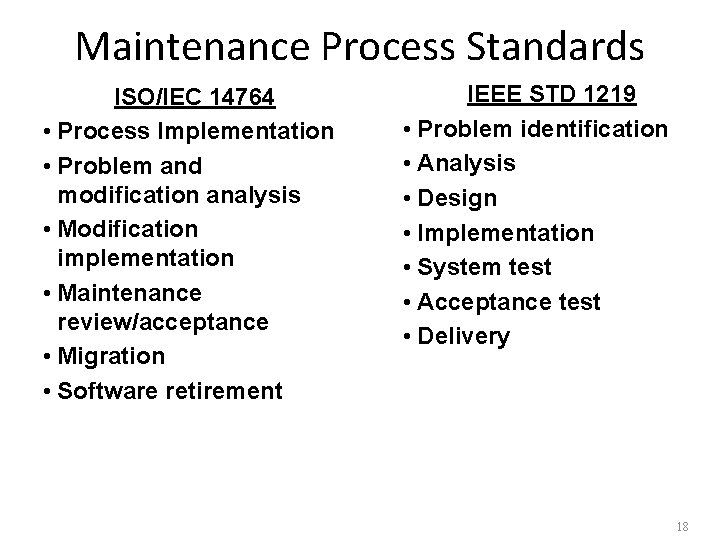
Maintenance Process Standards ISO/IEC 14764 • Process Implementation • Problem and modification analysis • Modification implementation • Maintenance review/acceptance • Migration • Software retirement IEEE STD 1219 • Problem identification • Analysis • Design • Implementation • System test • Acceptance test • Delivery 18
Maintainability • Means – Management – Operational environment of the target systems – Target system software, maturity, documentation • For the developer, especially means “modifiability of code”: – Localizing changes • All the refactoring ideas! – Preventing ripple effects • Ditto – Deferring binding time • Like runtime registration, configurations, parameterization, component replacement, scripting 19
“Demystifying Maintainability” Article by Manfred Broy, et al • Everyone thinks they know what “maintainability” is, – And something about how to achieve it – Like having a good design to begin with – And doing refactoring • But in contrast to attributes such as performance and correctness, there is no common understanding of: – What maintainability actually is, how it can be achieved, measured, or assessed. – In fact, every software organization has its own definition of maintainability. • The authors defined a quality model that – – Associates maintenance activities with system properties, including – The capabilities of the organization. • They found that keys to maintainability were – – Measurements as well as – Manual inspections. • • They applied this to large scale commercial software projects. Having a good definition of maintainability caused – – A slowdown of decay and – A significantly increased awareness for long-term quality aspects. 20
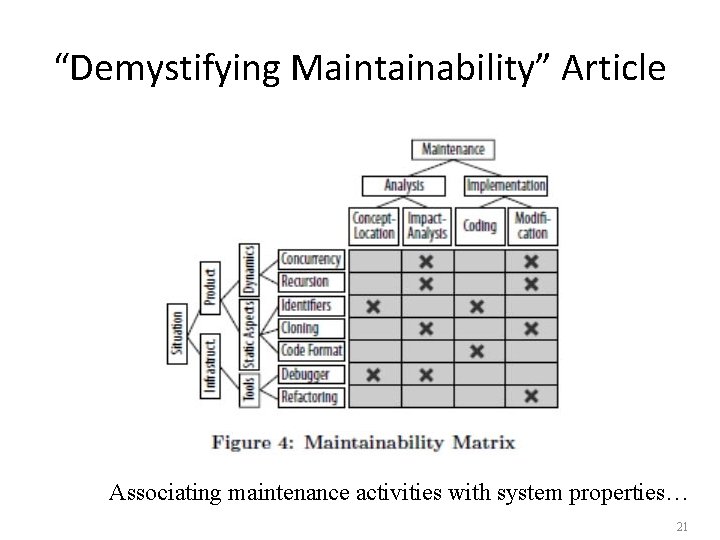
“Demystifying Maintainability” Article Associating maintenance activities with system properties… 21
- Slides: 21