
Software Life Cycle Main issues Discussion of different
- Slides: 47
Software Life Cycle Main issues: § Discussion of different life cycle models § Maintenance or evolution
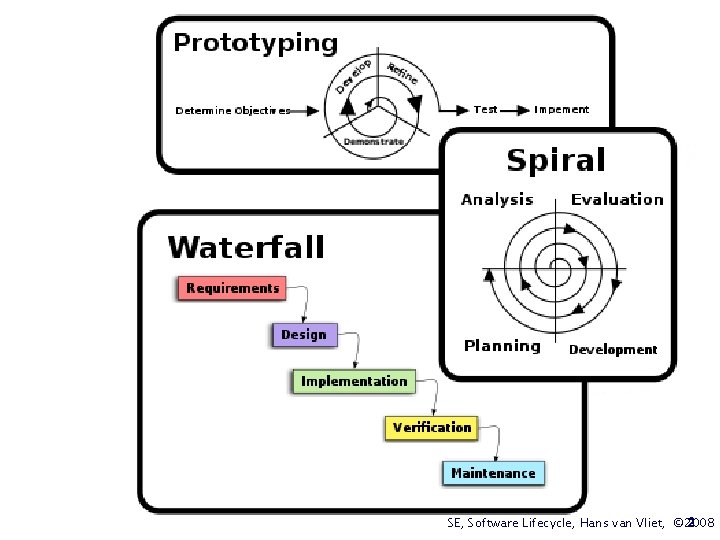
2 SE, Software Lifecycle, Hans van Vliet, © 2008
Introduction § software development projects are large and complex § a phased approach to control it is necessary § traditional models are document-driven: there is a new pile of paper after each phase is completed § evolutionary models recognize that much of what is called maintenance is inevitable § latest fashion: agile methods, e. Xtreme Programming § life cycle models can be explicitly modeled, in a process modeling language SE, Software Lifecycle, Hans van Vliet, © 2008 3
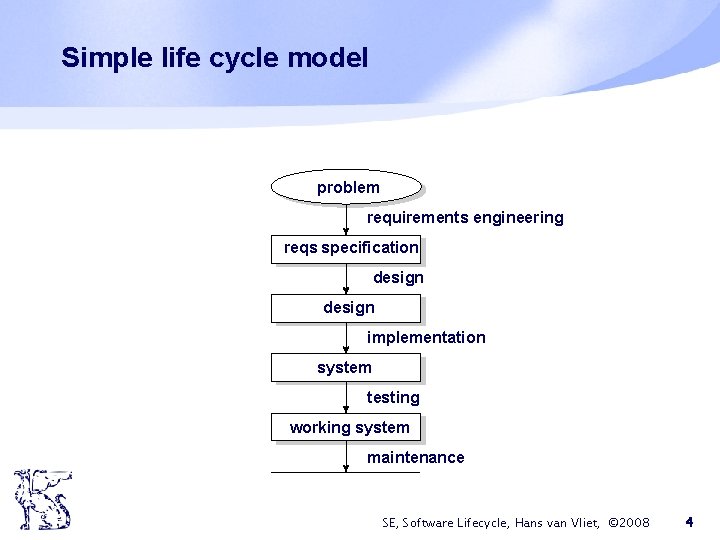
Simple life cycle model problem requirements engineering reqs specification design implementation system testing working system maintenance SE, Software Lifecycle, Hans van Vliet, © 2008 4
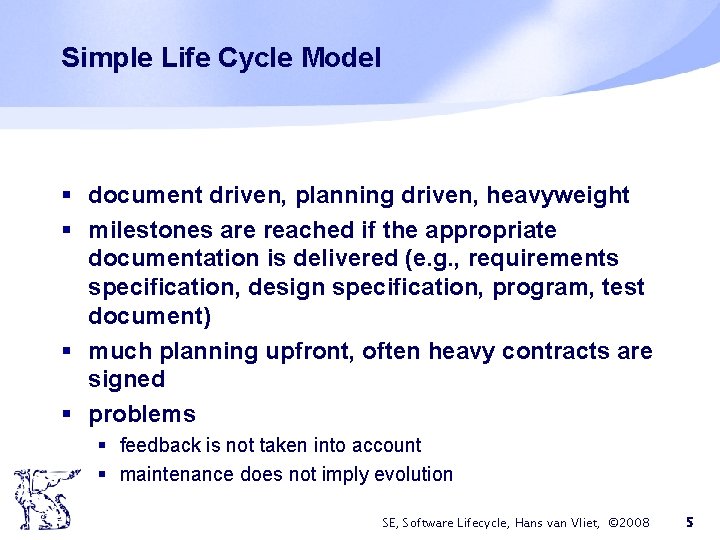
Simple Life Cycle Model § document driven, planning driven, heavyweight § milestones are reached if the appropriate documentation is delivered (e. g. , requirements specification, design specification, program, test document) § much planning upfront, often heavy contracts are signed § problems § feedback is not taken into account § maintenance does not imply evolution SE, Software Lifecycle, Hans van Vliet, © 2008 5
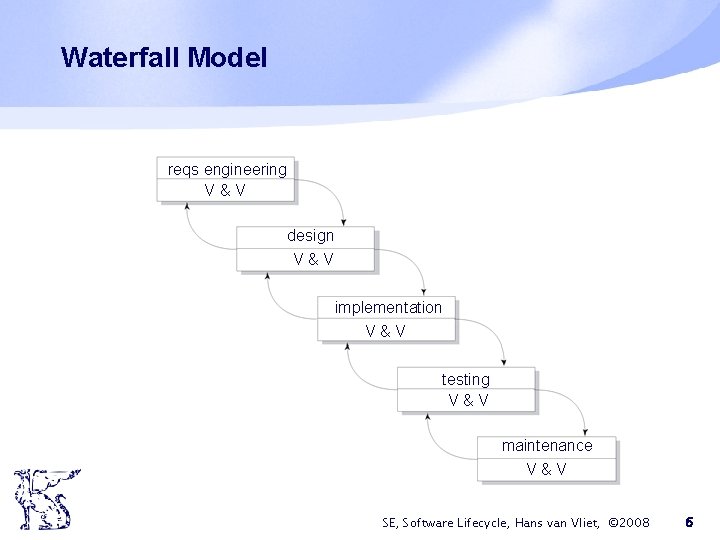
Waterfall Model reqs engineering V&V design V&V implementation V&V testing V&V maintenance V&V SE, Software Lifecycle, Hans van Vliet, © 2008 6
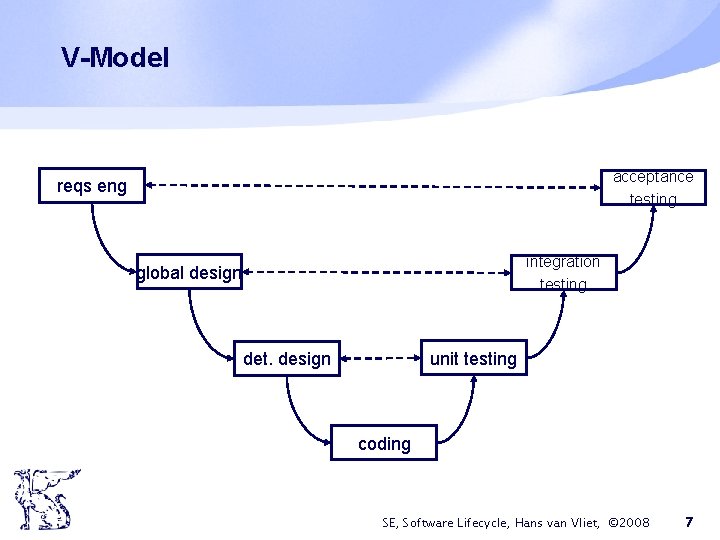
V-Model acceptance testing reqs eng integration testing global design unit testing det. design coding SE, Software Lifecycle, Hans van Vliet, © 2008 7
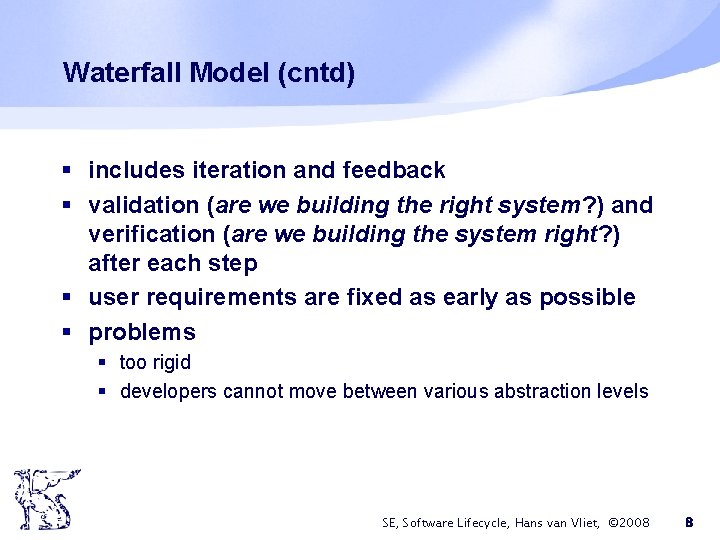
Waterfall Model (cntd) § includes iteration and feedback § validation (are we building the right system? ) and verification (are we building the system right? ) after each step § user requirements are fixed as early as possible § problems § too rigid § developers cannot move between various abstraction levels SE, Software Lifecycle, Hans van Vliet, © 2008 8
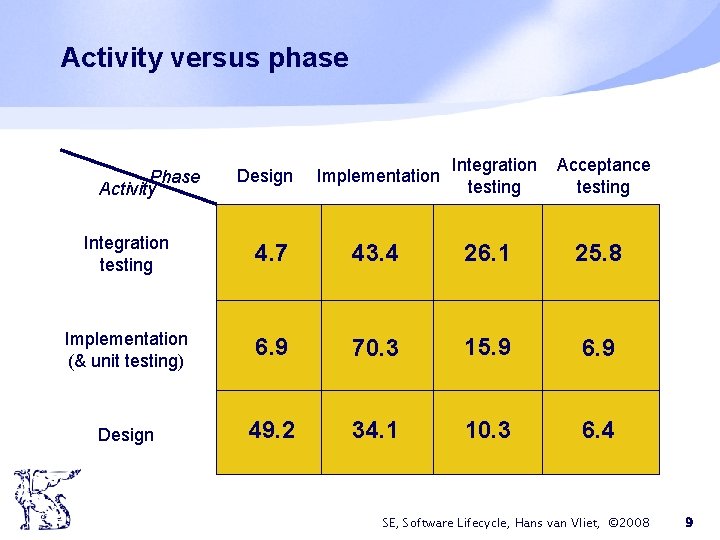
Activity versus phase Phase Activity Design Implementation Integration testing Acceptance testing Integration testing 4. 7 43. 4 26. 1 25. 8 Implementation (& unit testing) 6. 9 70. 3 15. 9 6. 9 Design 49. 2 34. 1 10. 3 6. 4 SE, Software Lifecycle, Hans van Vliet, © 2008 9
Lightweight (agile) approaches § prototyping § incremental development § RAD, DSDM § XP SE, Software Lifecycle, Hans van Vliet, © 2008 10
The Agile Manifesto § Individuals and interactions over processes and tools § Working software over comprehensive documentation § Customer collaboration over contract negotiation § Responding to change over following a plan SE, Software Lifecycle, Hans van Vliet, © 2008 11
Prototyping § requirements elicitation is difficult § software is developed because the present situation is unsatisfactory § however, the desirable new situation is as yet unknown § prototyping is used to obtain the requirements of some aspects of the system § prototyping should be a relatively cheap process § use rapid prototyping languages and tools § not all functionality needs to be implemented § production quality is not required SE, Software Lifecycle, Hans van Vliet, © 2008 12
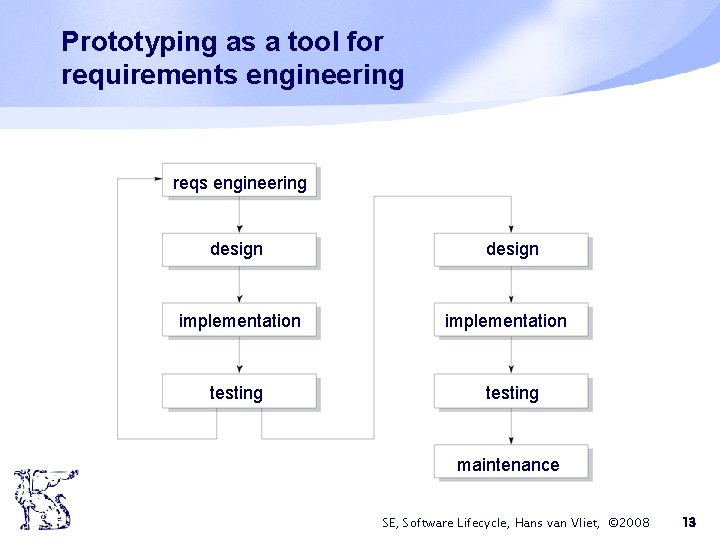
Prototyping as a tool for requirements engineering reqs engineering design implementation testing maintenance SE, Software Lifecycle, Hans van Vliet, © 2008 13
SE, Software Lifecycle, Hans van Vliet, © 2008 14
SE, Software Lifecycle, Hans van Vliet, © 2008 15
Prototyping (cntd) § throwaway prototyping: the n-th prototype is followed by a waterfall-like process (as depicted on previous slide) § evolutionary prototyping: the nth prototype is delivered SE, Software Lifecycle, Hans van Vliet, © 2008 16
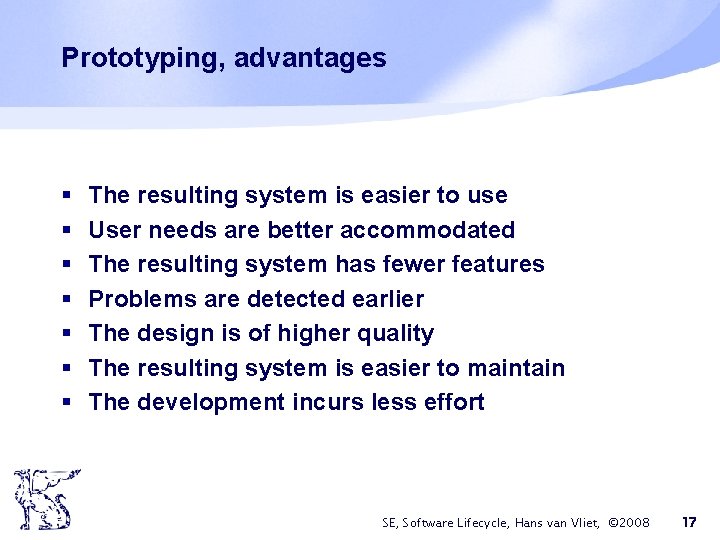
Prototyping, advantages § § § § The resulting system is easier to use User needs are better accommodated The resulting system has fewer features Problems are detected earlier The design is of higher quality The resulting system is easier to maintain The development incurs less effort SE, Software Lifecycle, Hans van Vliet, © 2008 17
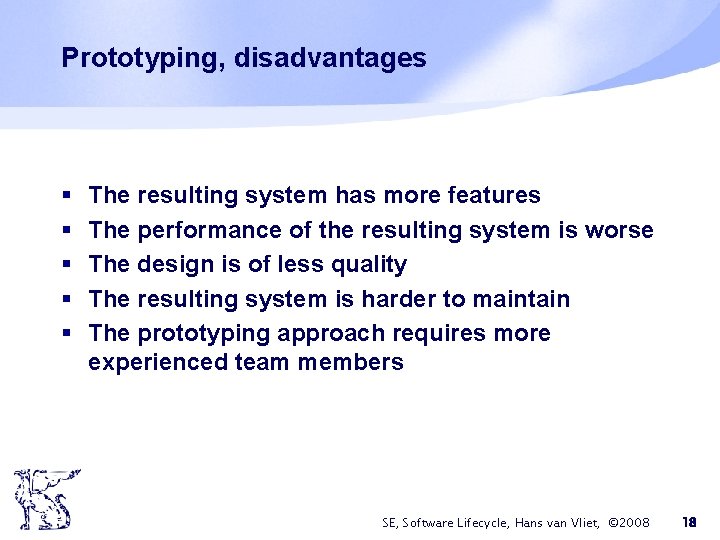
Prototyping, disadvantages § § § The resulting system has more features The performance of the resulting system is worse The design is of less quality The resulting system is harder to maintain The prototyping approach requires more experienced team members SE, Software Lifecycle, Hans van Vliet, © 2008 18
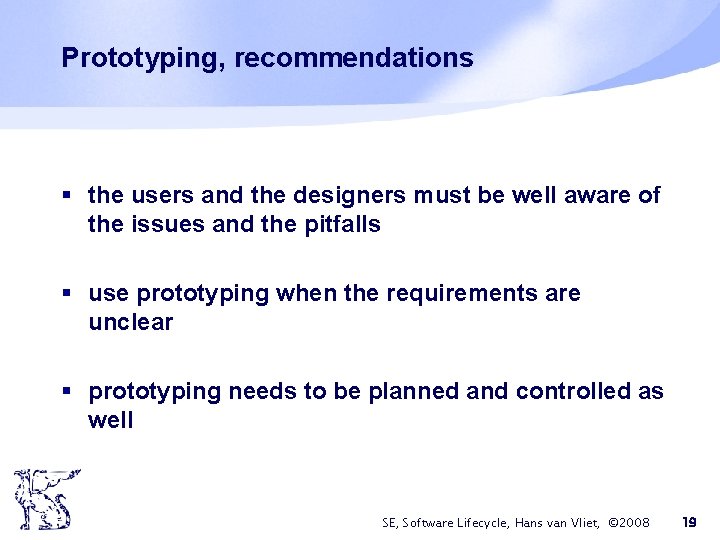
Prototyping, recommendations § the users and the designers must be well aware of the issues and the pitfalls § use prototyping when the requirements are unclear § prototyping needs to be planned and controlled as well SE, Software Lifecycle, Hans van Vliet, © 2008 19
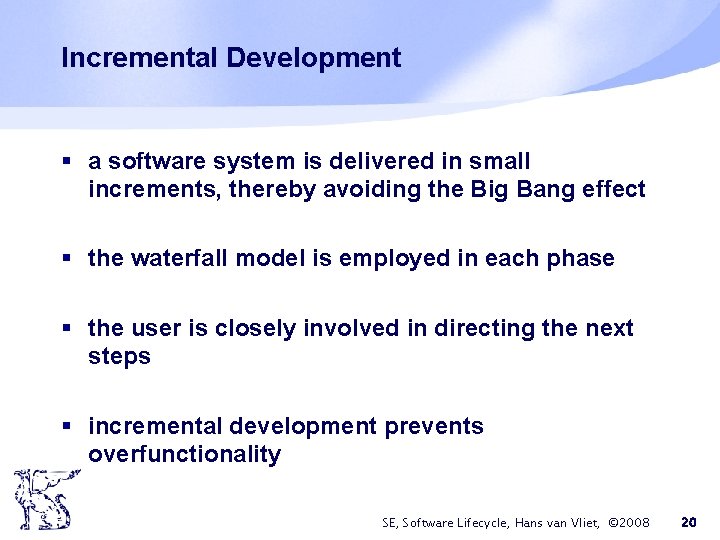
Incremental Development § a software system is delivered in small increments, thereby avoiding the Big Bang effect § the waterfall model is employed in each phase § the user is closely involved in directing the next steps § incremental development prevents overfunctionality SE, Software Lifecycle, Hans van Vliet, © 2008 20
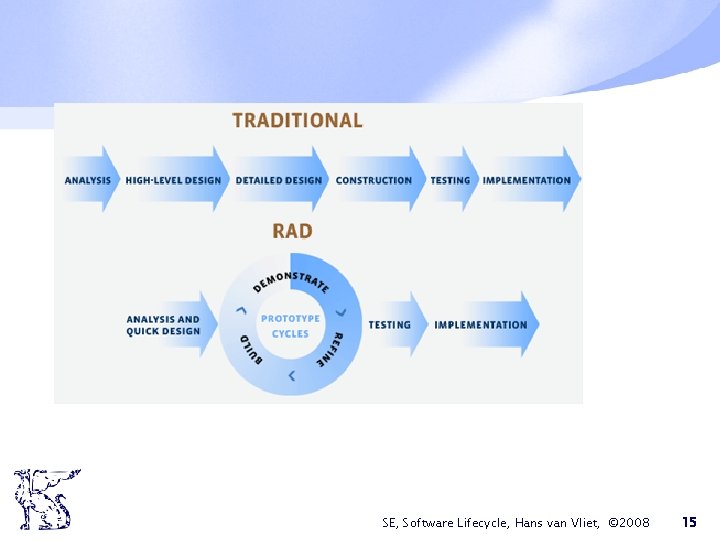
RAD: Rapid Application Development § evolutionary development, with time boxes: fixed time frames within which activities are done; § time frame is decided upon first, then one tries to realize as much as possible within that time frame; § other elements: Joint Requirements Planning (JRP) and Joint Application Design (JAD), workshops in which users participate; § requirements prioritization through a triage; § development in a SWAT team: Skilled Workers with Advanced Tools SE, Software Lifecycle, Hans van Vliet, © 2008 21
DSDM § Dynamic Systems Development Method, #1 RAD framework in UK § Fundamental idea: fix time and resources (timebox), adjust functionality accordingly § One needs to be a member of the DSDM consortium SE, Software Lifecycle, Hans van Vliet, © 2008 22
DSDM phases § Feasibility: delivers feasibility report and outline plan, optionally fast prototype (few weeks) § Business study: analyze characteristics of business and technology (in workshops), delivers a. o. System Architecture Definition § Functional model iteration: timeboxed iterative, incremental phase, yields requirements § Design and build iteration § Implementation: transfer to production environment SE, Software Lifecycle, Hans van Vliet, © 2008 23
DSDM practices § § § § § Active user involvement is imperative Empowered teams Frequent delivery of products Acceptance determined by fitness for business purpose Iterative, incremental development All changes are reversible Requirements baselined at high level Testing integrated in life cycle Collaborative, cooperative approach shared by all stakeholders is essential SE, Software Lifecycle, Hans van Vliet, © 2008 24
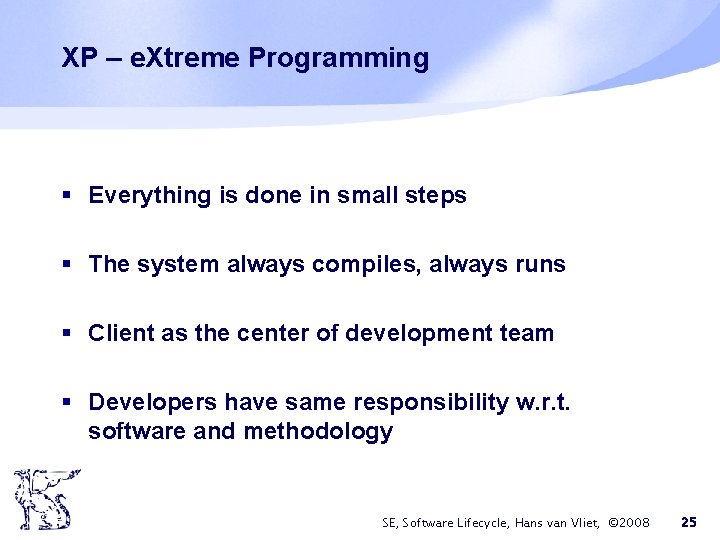
XP – e. Xtreme Programming § Everything is done in small steps § The system always compiles, always runs § Client as the center of development team § Developers have same responsibility w. r. t. software and methodology SE, Software Lifecycle, Hans van Vliet, © 2008 25
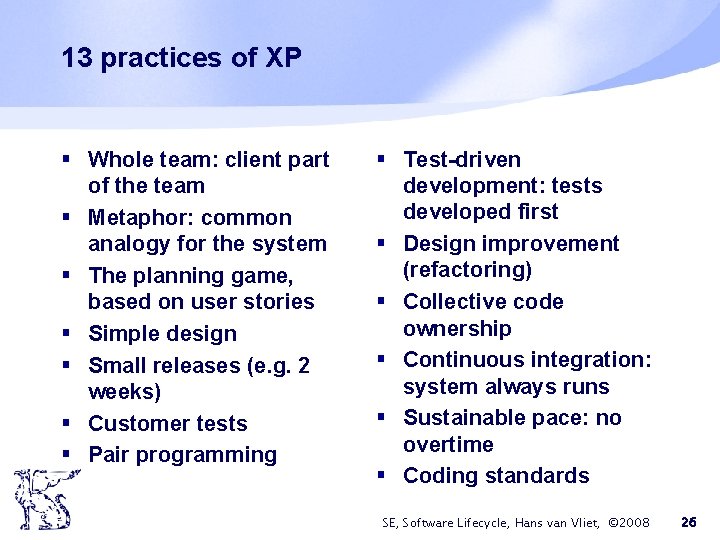
13 practices of XP § Whole team: client part of the team § Metaphor: common analogy for the system § The planning game, based on user stories § Simple design § Small releases (e. g. 2 weeks) § Customer tests § Pair programming § Test-driven development: tests developed first § Design improvement (refactoring) § Collective code ownership § Continuous integration: system always runs § Sustainable pace: no overtime § Coding standards SE, Software Lifecycle, Hans van Vliet, © 2008 26
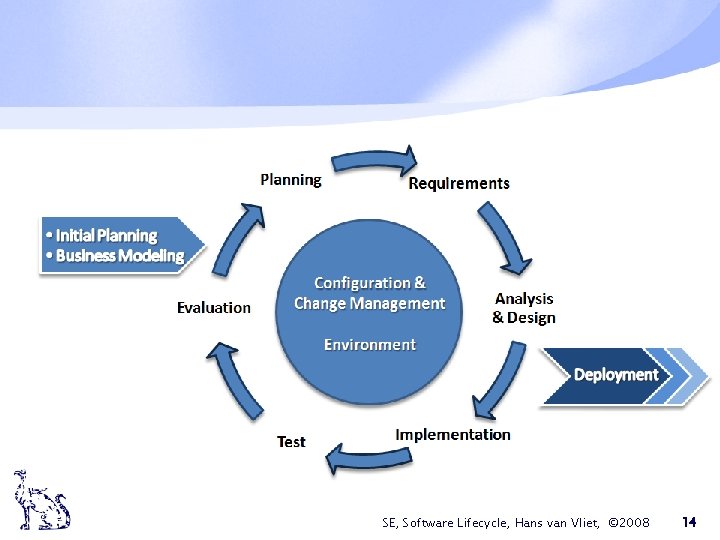
RUP § Rational Unified Process § Complement to UML (Unified Modeling Language) § Iterative approach for object-oriented systems, strongly embraces use cases for modeling requirements § Tool-supported (UML-tools, Clear. Case) SE, Software Lifecycle, Hans van Vliet, © 2008 27
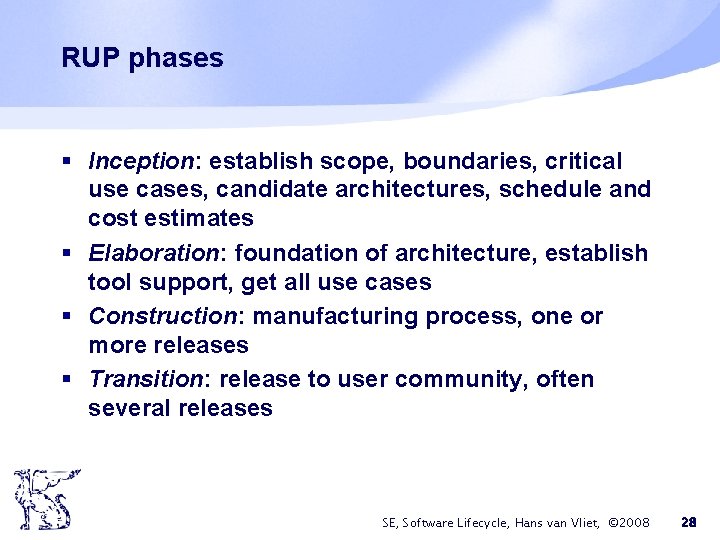
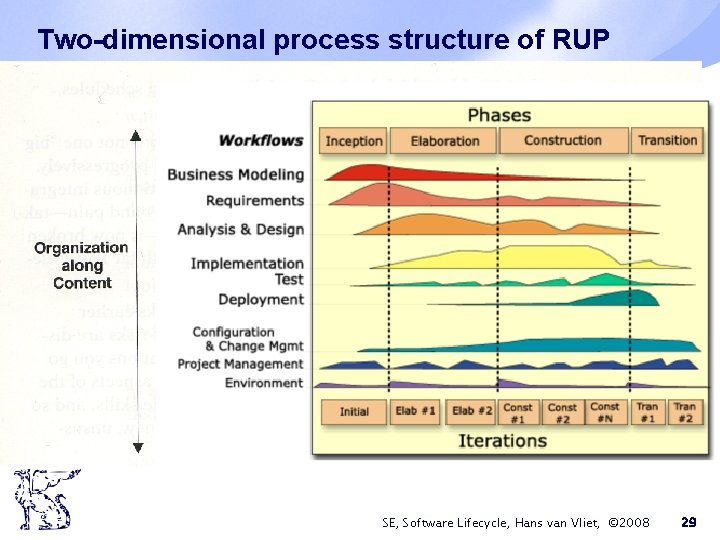
RUP phases § Inception: establish scope, boundaries, critical use cases, candidate architectures, schedule and cost estimates § Elaboration: foundation of architecture, establish tool support, get all use cases § Construction: manufacturing process, one or more releases § Transition: release to user community, often several releases SE, Software Lifecycle, Hans van Vliet, © 2008 28
Two-dimensional process structure of RUP SE, Software Lifecycle, Hans van Vliet, © 2008 29
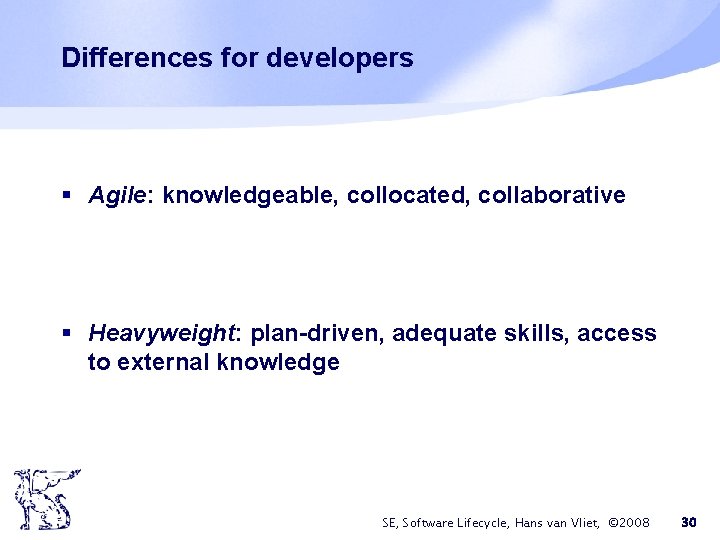
Differences for developers § Agile: knowledgeable, collocated, collaborative § Heavyweight: plan-driven, adequate skills, access to external knowledge SE, Software Lifecycle, Hans van Vliet, © 2008 30
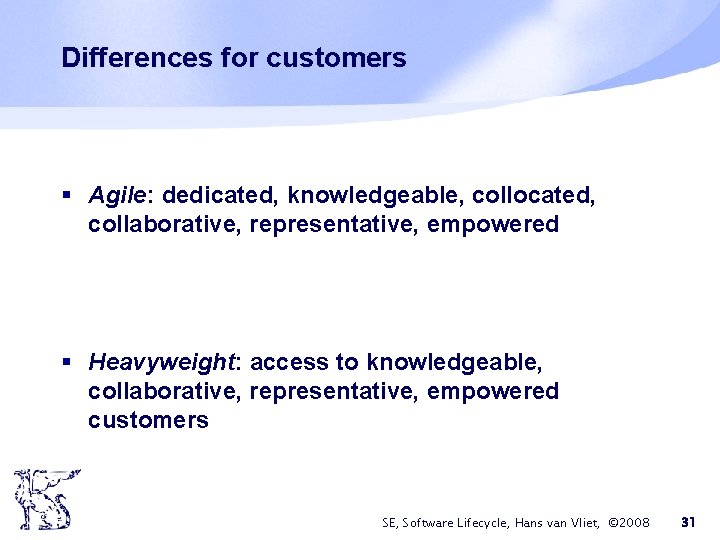
Differences for customers § Agile: dedicated, knowledgeable, collocated, collaborative, representative, empowered § Heavyweight: access to knowledgeable, collaborative, representative, empowered customers SE, Software Lifecycle, Hans van Vliet, © 2008 31
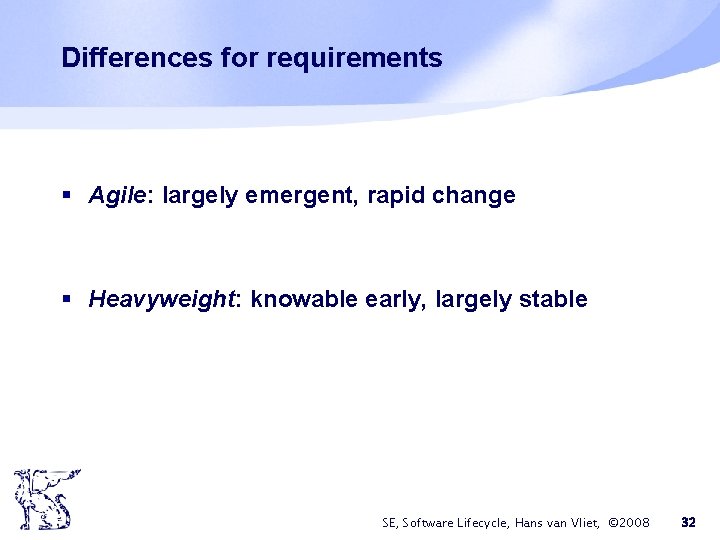
Differences for requirements § Agile: largely emergent, rapid change § Heavyweight: knowable early, largely stable SE, Software Lifecycle, Hans van Vliet, © 2008 32
Differences for architecture § Agile: designed for current requirements § Heavyweight: designed for current and foreseeable requirements SE, Software Lifecycle, Hans van Vliet, © 2008 33
Differences for size § Agile: smaller teams and products § Heavyweight: larger teams and products SE, Software Lifecycle, Hans van Vliet, © 2008 34
Differences for primary objective § Agile: rapid value § Heavyweight: high assurance SE, Software Lifecycle, Hans van Vliet, © 2008 35
The advantages of screen wipers SE, Software Lifecycle, Hans van Vliet, © 2008 36
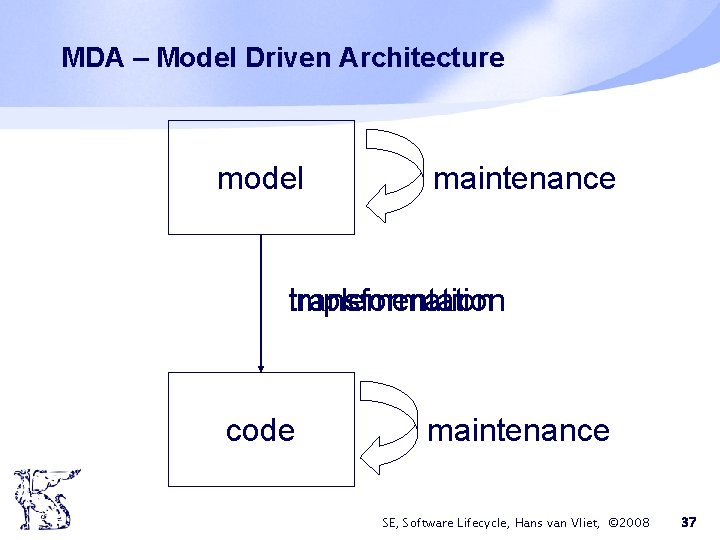
MDA – Model Driven Architecture model maintenance implementation transformation code maintenance SE, Software Lifecycle, Hans van Vliet, © 2008 37
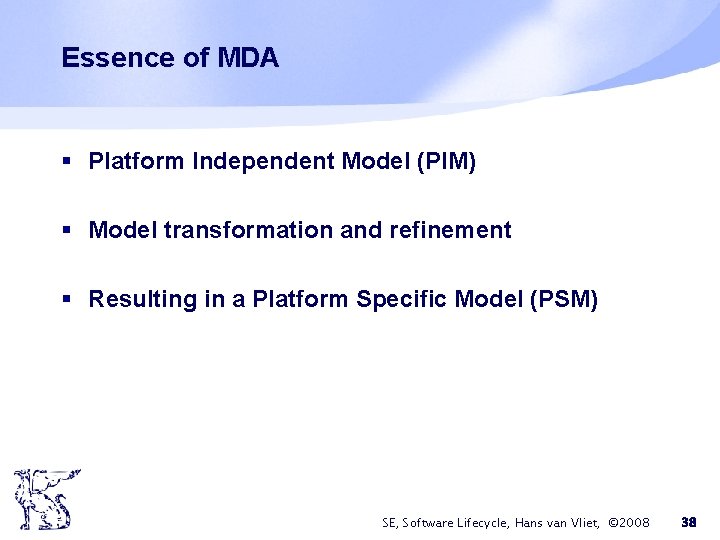
Essence of MDA § Platform Independent Model (PIM) § Model transformation and refinement § Resulting in a Platform Specific Model (PSM) SE, Software Lifecycle, Hans van Vliet, © 2008 38
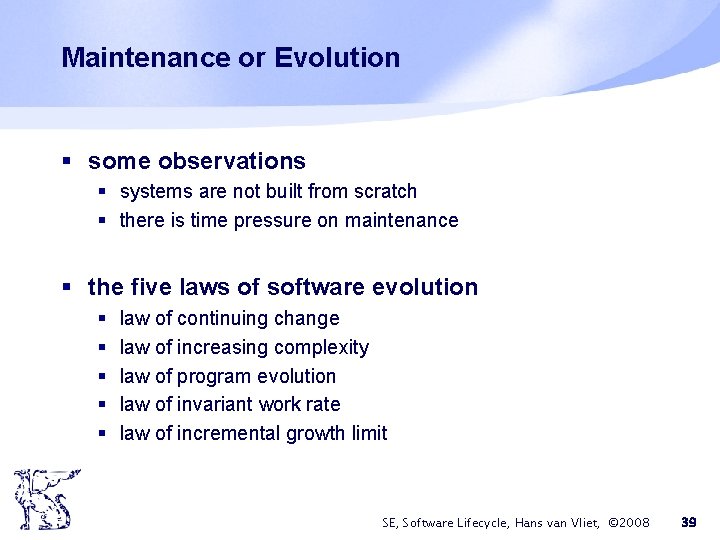
Maintenance or Evolution § some observations § systems are not built from scratch § there is time pressure on maintenance § the five laws of software evolution § § § law of continuing change law of increasing complexity law of program evolution law of invariant work rate law of incremental growth limit SE, Software Lifecycle, Hans van Vliet, © 2008 39
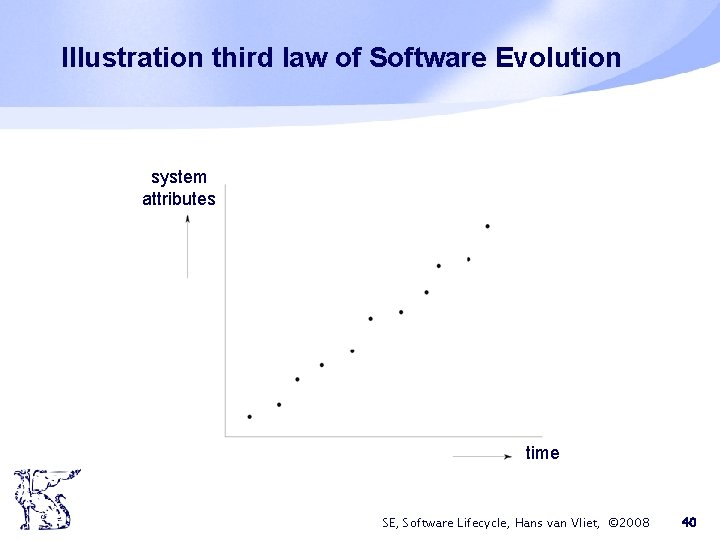
Illustration third law of Software Evolution system attributes time SE, Software Lifecycle, Hans van Vliet, © 2008 40
Software Product Lines § developers are not inclined to make a maintainable and reusable product, it has additional costs § this viewpoint is changed somewhat if the product family is the focus of attention rather than producing a single version of a product § two processes result: domain engineering, and application engineering SE, Software Lifecycle, Hans van Vliet, © 2008 41
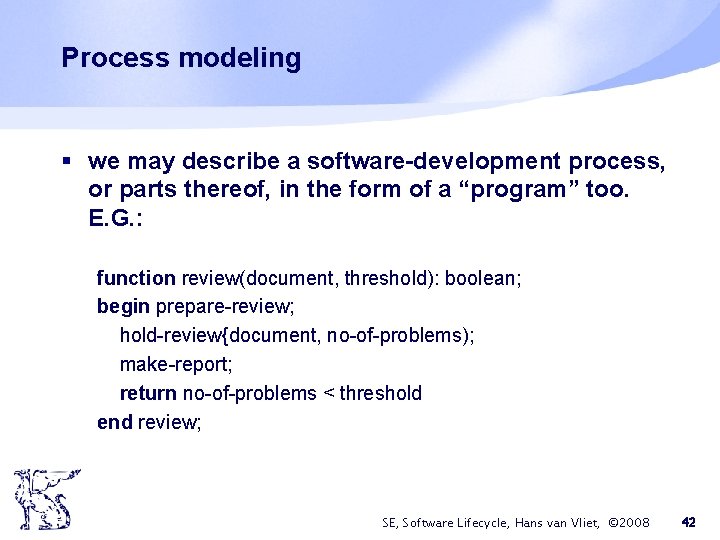
Process modeling § we may describe a software-development process, or parts thereof, in the form of a “program” too. E. G. : function review(document, threshold): boolean; begin prepare-review; hold-review{document, no-of-problems); make-report; return no-of-problems < threshold end review; SE, Software Lifecycle, Hans van Vliet, © 2008 42
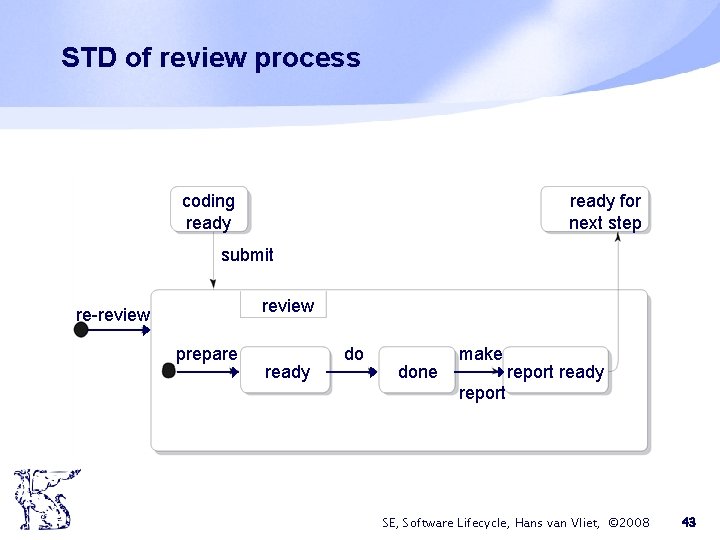
STD of review process coding ready for next step submit review re-review prepare ready do done make report ready report SE, Software Lifecycle, Hans van Vliet, © 2008 43
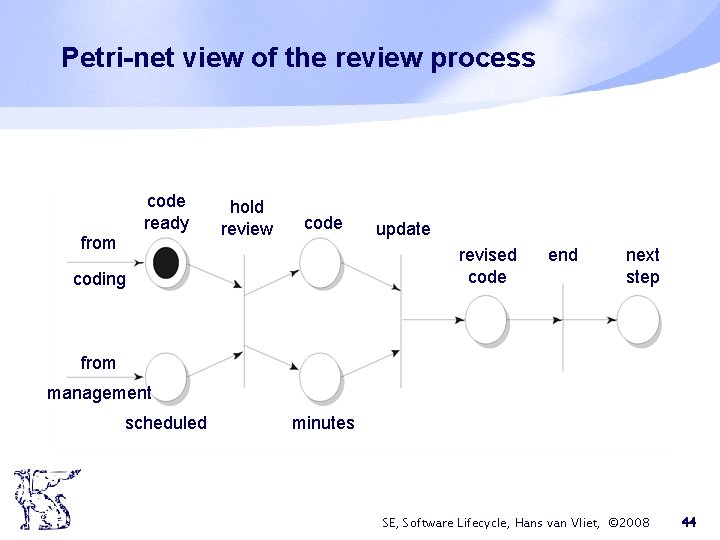
Petri-net view of the review process code ready from hold review code update revised code coding end next step from management scheduled minutes SE, Software Lifecycle, Hans van Vliet, © 2008 44
Purposes of process modeling § Faciliitates understanding and communication by providing a shared view of the process § Supports management and improvement; it can be used to assign tasks, track progress, and identify trouble spots § Serves as a basis for automated support (usually not fully automatic) SE, Software Lifecycle, Hans van Vliet, © 2008 45
Caveats of process modeling § not all aspects of software development can be caught in an algorithm § a model is a model, thus a simplification of reality § progression of stages differs from what is actually done § some processes (e. g. learning the domain) tend to be ignored § no support for transfer across projects SE, Software Lifecycle, Hans van Vliet, © 2008 46
Summary § Traditional models focus on control of the process § There is no one-size-fits-all model; each situation requires its own approach § A pure project approach inhibits reuse and maintenance § There has been quite some attention for process modeling, and tools based on such process models SE, Software Lifecycle, Hans van Vliet, © 2008 47