
Software Independent Verification and Validation IVV An Agency

- Slides: 59
Software Independent Verification and Validation (IV&V): An Agency Overview IV&V Program Kenneth A Costello IV&V Program Lead Engineer GSFC Systems Engineering Seminar Series 12 Sep 2006 1
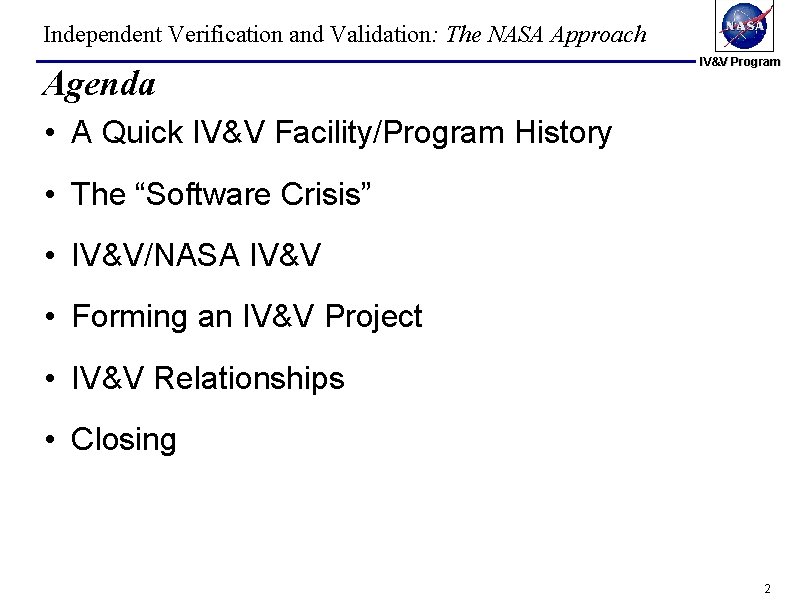
Independent Verification and Validation: The NASA Approach Agenda IV&V Program • A Quick IV&V Facility/Program History • The “Software Crisis” • IV&V/NASA IV&V • Forming an IV&V Project • IV&V Relationships • Closing 2
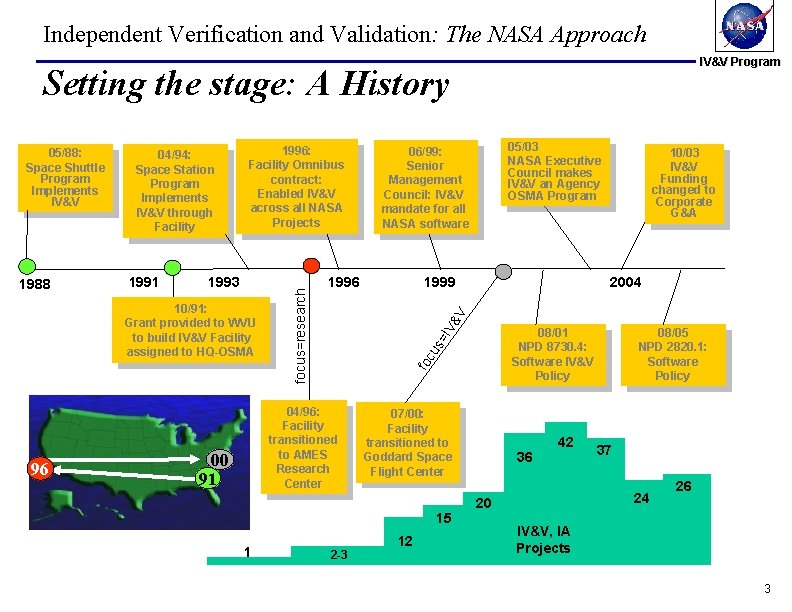
Independent Verification and Validation: The NASA Approach IV&V Program Setting the stage: A History 96 04/96: Facility transitioned to AMES Research Center 00 91 1999 1 08/01 NPD 8730. 4: Software IV&V Policy 07/00: Facility transitioned to Goddard Space Flight Center 15 2 -3 12 10/03 IV&V Funding changed to Corporate G&A 2004 &V 10/91: Grant provided to WVU to build IV&V Facility assigned to HQ-OSMA 1996 =IV 1993 05/03 NASA Executive Council makes IV&V an Agency OSMA Program 06/99: Senior Management Council: IV&V mandate for all NASA software us 1991 1996: Facility Omnibus contract: Enabled IV&V across all NASA Projects foc 1988 04/94: Space Station Program Implements IV&V through Facility focus=research 05/88: Space Shuttle Program Implements IV&V 36 42 08/05 NPD 2820. 1: Software Policy 37 24 20 26 IV&V, IA Projects 3
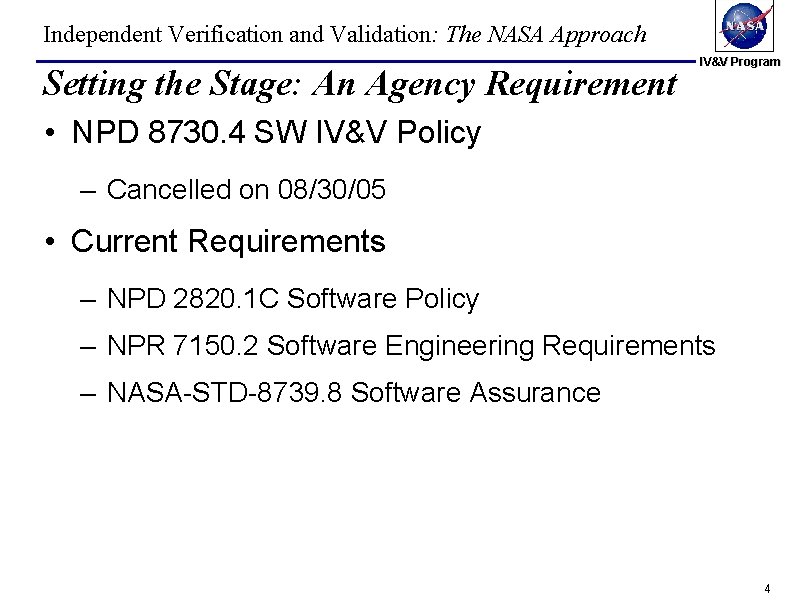
Independent Verification and Validation: The NASA Approach Setting the Stage: An Agency Requirement IV&V Program • NPD 8730. 4 SW IV&V Policy – Cancelled on 08/30/05 • Current Requirements – NPD 2820. 1 C Software Policy – NPR 7150. 2 Software Engineering Requirements – NASA-STD-8739. 8 Software Assurance 4
Independent Verification and Validation: The NASA Approach NPD 2820. 1 C Software Policy • IV&V Program NASA policy regarding software activities for each project is to accomplish the following: (5) Projects shall ensure software providers allow access to software and associated artifacts to enable insight/oversight by software engineering and software assurance which includes Independent Verification and Validation (IV&V) and NASA's Safety and Mission Assurance organizations. c. Use the NASA IV&V Facility as the sole provider of IV&V services when software created by or for NASA is selected for IV&V by the NASA Chief Safety and Mission Assurance Officer. • Responsibilities c. The NASA Chief Safety and Mission Assurance Officer shall: (1) … (6) Oversee the functional management of the NASA IV&V Program and assure the performance of all of IV&V processes, services, and activities. (7) Establish and manage processes for the selection of software to which to apply IV&V. (8) Charter the IV&V Board of Directors (IBD) which makes prioritized recommendations for allocating IV&V services to projects based on the annual Software Inventory (maintained by the Chief Engineer) and the Office of Safety and Mission Assurance(OSMA) defined process. (9) Select and maintain the list of software projects to which IV&V is to be applied. (10)… d. The IV&V Program Manager shall 1) establish and manage the Agency's software IV&V services and procedures; 2) establish, maintain, and report on the results of IV&V services and findings; and 3) support NASA's program for improving software assurance and other trusted verifications (e. g. , independent assessments, peer reviews, and research). The IV&V Facility shall determine and document the services provided by the Facility on projects selected for IV&V by the NASA Chief Safety and Mission Assurance Officer. 5
Independent Verification and Validation: The NASA Approach IV&V Program NPR 7150. 2 Software Engineering Requirements • Section 5. 1. 1. 1 states required content for SW Development Plans. – “The Software Development or Mgmt Plan shall contain: [SWE-102] • a. Project organizational structure showing authority and responsibility of each organizational unit, including external organizations (i. e. , Safety and Mission Assurance, Independent Verification and Validation (IV&V), Independent Technical Authority (ITA), NASA Engineering and Safety Center (NESC))". • Additionally, within section 5. 1. 5 which addresses SW Assurance, it states: "The SW Assurance Plan details the procedures, reviews, and audits required to accomplish software assurance. The project office should coordinate, document, and gain concurrence with the Office of Safety and Mission Assurance as to the extent and responsibilities of the assurance and safety of the project. This will be documented into the project plans and reflected in the assurance process. • Section 5. 1 states “The SW Assurance Plan(s) shall be written per NASA-STD-8739. 8, NASA SW Assurance Standard. [SWE-106]". 6
Independent Verification and Validation: The NASA Approach NASA-STD-8739. 8 Software Assurance IV&V Program • Std states the following: – Section 6. 1. 4 When IV&V has been selected for a project, the provider shall coordinate with IV&V personnel to share data and information. – Section 7. 5. 3 When the IV&V function is required, the provider shall provide all required information to NASA IV&V Facility personnel. (This requirement includes specifying on the contracts and subcontracts, IV&V’s access to system and software products and personnel. ) 7
Independent Verification and Validation: The NASA Approach IV&V Program A Software Crisis 8
Independent Verification and Validation: The NASA Approach Growing Software Importance IV&V Program • Fundamental Concern: – First NASA robotic mission with actual software launched in 1969 (Mariner 6) – Software size has grown over time • 128 words of assembly; equivalent 30 lines of C code • MER has about 600, 000 lines of equivalent C code – More functionality is being placed within software and software constructed devices (Programmable Logic Devices) – With increased processing power and memory, more tasks are running concurrently • Control software increasing in complexity and size • Software used to monitor and react to hardware faults 9
Independent Verification and Validation: The NASA Approach Software is still hard to get right • The Carnegie Mellon Software Engineering Institute reports(1) that at least 42 -50 percent of software defects originate in the requirements phase. IV&V Program • The Defense Acquisition University Program Manager Magazine(2) reports in a Department of Defense study that over 50 percent of all software errors originate in the requirements phase. 1 – Carnegie Mellon Software Engineering Institute, The Business Case for Requirements Engineering, RE’ 2003, 12 September 2003 2 - Defense Acquisition University Program Manager Magazine, Nov-Dec 1999, Curing the Software Requirements and Cost Estimating Blues 10
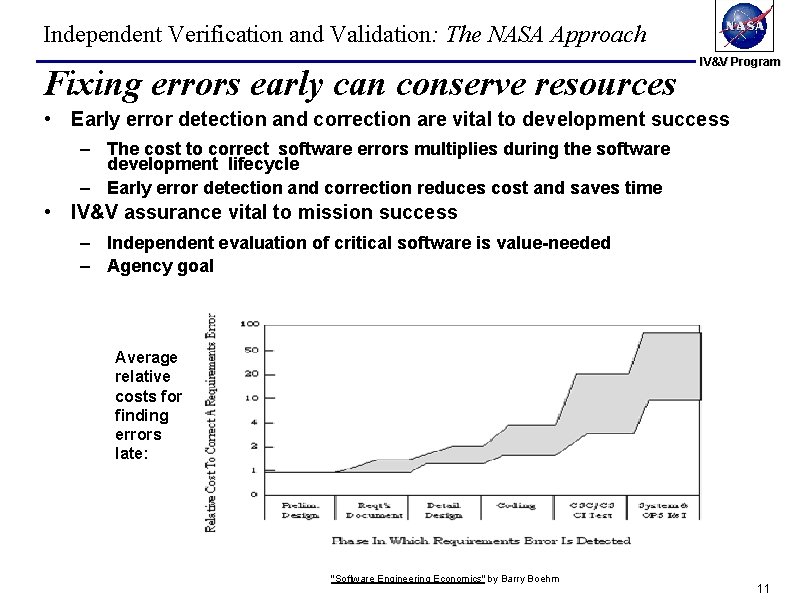
Independent Verification and Validation: The NASA Approach Fixing errors early can conserve resources IV&V Program • Early error detection and correction are vital to development success – The cost to correct software errors multiplies during the software development lifecycle – Early error detection and correction reduces cost and saves time • IV&V assurance vital to mission success – Independent evaluation of critical software is value-needed – Agency goal Average relative costs for finding errors late: "Software Engineering Economics" by Barry Boehm 11
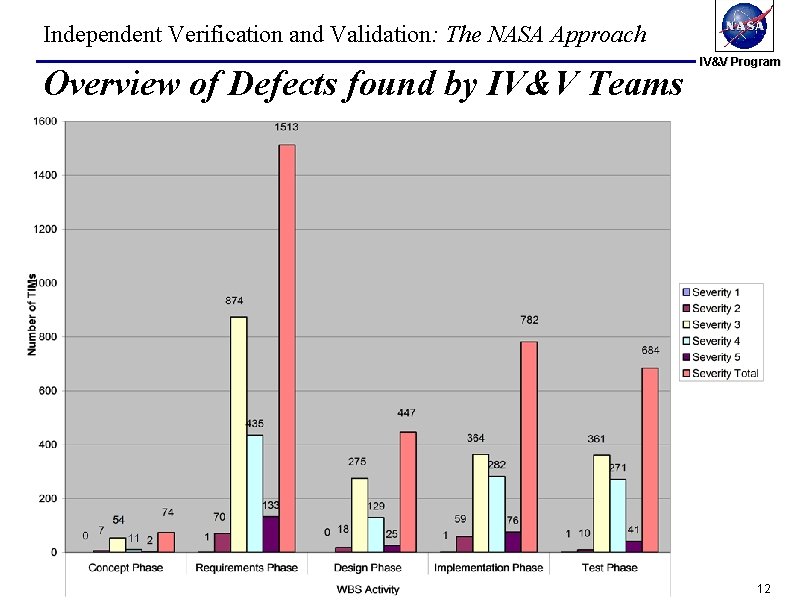
Independent Verification and Validation: The NASA Approach Overview of Defects found by IV&V Teams IV&V Program 12
Independent Verification and Validation: The NASA Approach IV&V Program Independent Verification and Validation 13
Independent Verification and Validation: The NASA Approach What is Verification and Validation? IV&V Program • Simply put, assuring that a software system meets the user’s needs • Verifying that the software is accurate and representative of its specification • Validating that the software will do what the user really wants it to do 14
Independent Verification and Validation: The NASA Approach What is up with that I? IV&V Program • I = Independent • Financially: Funded from Corporate G&A for Agency identified high priority Projects – Customer Project may also fund the effort • Technical: IV&V program defines scope and tasks, tailored by an IV&V criticality assessment – Uses a predefined work breakdown structure • Managerial: Functional management supplied by OSMA – Project management supplied from the IV&V program 15
Independent Verification and Validation: The NASA Approach So what is IV&V? IV&V Program • An engineering discipline employing rigorous methods for evaluating the correctness and quality of the software product throughout the software life cycle from a system level viewpoint. • The NASA Software IV&V approach covers not only expected operating conditions but the full spectrum of the system and its interfaces in the face of unexpected operating conditions or inputs. 16
Independent Verification and Validation: The NASA Approach So what else is IV&V? IV&V Program • Testing at the end of the life cycle? • No • IV&V is testing, but it is whole life cycle testing • The IV&V team “tests” artifacts ranging from system and software requirements to source code and test results • Each task in the IV&V WBS is designed to “test” a development artifact or process 17
Independent Verification and Validation: The NASA Approach What are the objectives of IV&V? IV&V Program • Find defects within the system with a focus on software and its interactions with the system • Make an assessment of whether or not the system is usable in an operational environment, again with a focus on the software within the system • Identify any latent risks associated with the software 18
Independent Verification and Validation: The NASA Approach What is the goal of IV&V? IV&V Program Establish confidence that the software is fit for its purpose within the context of the system • Note that the software may not be free from defects – Rarely the case and difficult to prove • The software must be good enough for its intended use – As described by the requirements – Correct requirements • The type of use will determine the level of confidence that is needed – Consequence of software defect/failure 19
Independent Verification and Validation: The NASA Approach Are there any other benefits to IV&V? IV&V Program • Primary purpose to provide confidence to OSMA, however. . . • Development projects receive all findings – The good, the bad, the ugly – Allows PM to have unbiased view of software development effort – Provides knowledge resource for software developers – In phase IV&V work provides early error detection and may save the project money in error correction 20
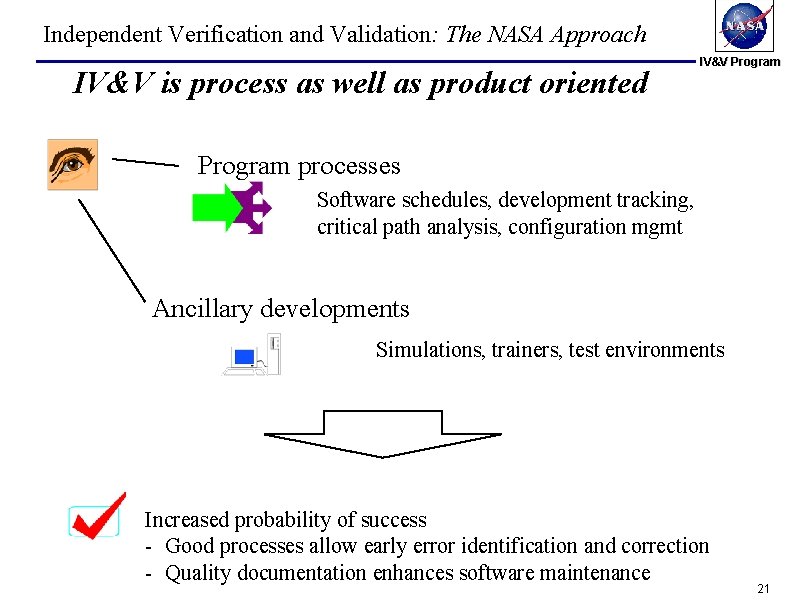
Independent Verification and Validation: The NASA Approach IV&V is process as well as product oriented IV&V Program processes Software schedules, development tracking, critical path analysis, configuration mgmt Ancillary developments Simulations, trainers, test environments Increased probability of success - Good processes allow early error identification and correction - Quality documentation enhances software maintenance 21
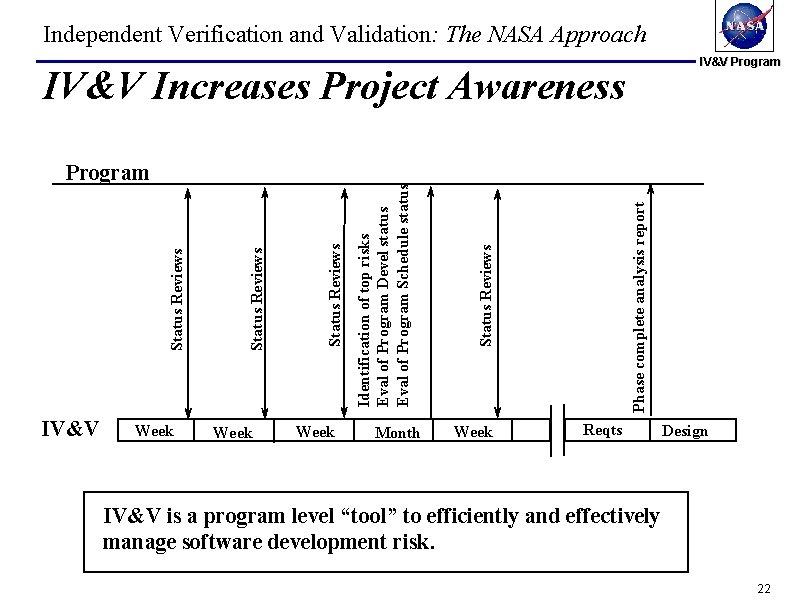
Independent Verification and Validation: The NASA Approach IV&V Program IV&V Week Month Phase complete analysis report Status Reviews Program Identification of top risks Eval of Program Devel status Eval of Program Schedule status IV&V Increases Project Awareness Week Reqts Design IV&V is a program level “tool” to efficiently and effectively manage software development risk. 22
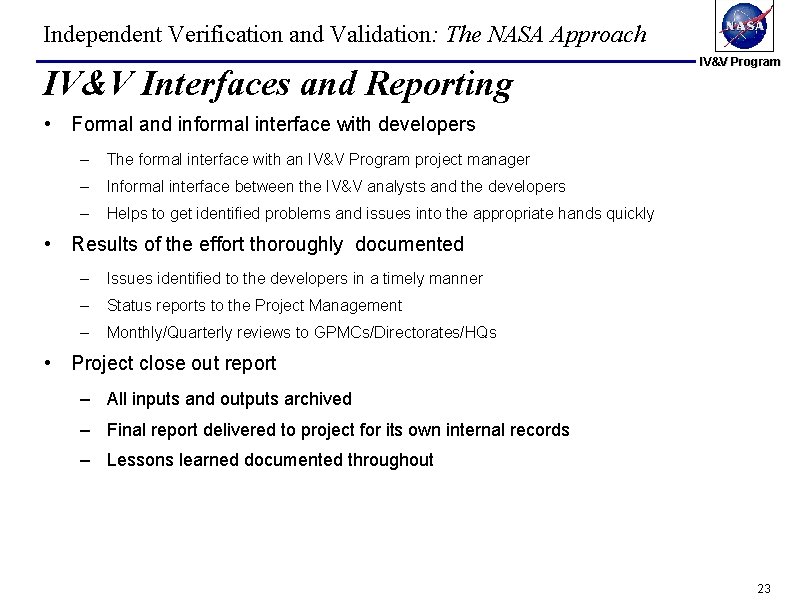
Independent Verification and Validation: The NASA Approach IV&V Interfaces and Reporting IV&V Program • Formal and informal interface with developers – The formal interface with an IV&V Program project manager – Informal interface between the IV&V analysts and the developers – Helps to get identified problems and issues into the appropriate hands quickly • Results of the effort thoroughly documented – Issues identified to the developers in a timely manner – Status reports to the Project Management – Monthly/Quarterly reviews to GPMCs/Directorates/HQs • Project close out report – All inputs and outputs archived – Final report delivered to project for its own internal records – Lessons learned documented throughout 23
Independent Verification and Validation: The NASA Approach IV&V Program NASA IV&V 24
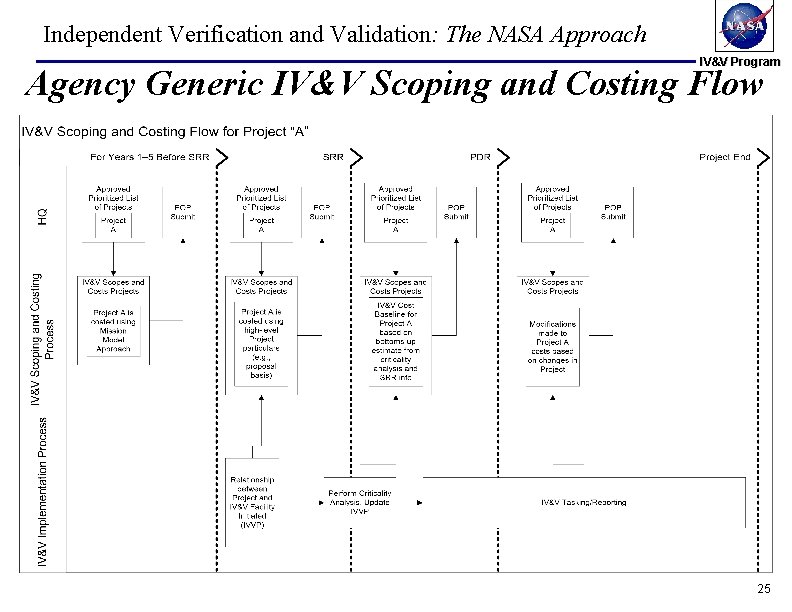
Independent Verification and Validation: The NASA Approach IV&V Program Agency Generic IV&V Scoping and Costing Flow 25
Independent Verification and Validation: The NASA Approach The IV&V Life Cycle IV&V Program • An IV&V Project follows a life cycle similar to most Projects – Formulation – Execution – Close-out 26
Independent Verification and Validation: The NASA Approach Formulation Phase IV&V Program • The Formulation phase is used to plan and scope the work to be performed • Starts usually prior to System Requirements Review (SRR) with initial planning and contact with the Project • Generally between SRR and Preliminary Design Review (PDR) planning and scoping process is executed – Criticality analysis developed as foundation for the IV&V effort on the project – The effort addresses all of the software on a Project – The process generates a tailored approach based on the results of the assessment 27
Independent Verification and Validation: The NASA Approach Execution Phase IV&V Program • Majority of the IV&V effort is performed • Documented in an IV&V Plan (IVVP) that is an output of the Formulation work – The IVVP is provided to the Project for review and applicable concurrence • Approach taken from the WBS and tailored based on the results of the Formulation work • The Execution phase generally ends somewhere around or shortly after launch – In some cases, work may extend beyond launch when software is still being developed (MER) 28
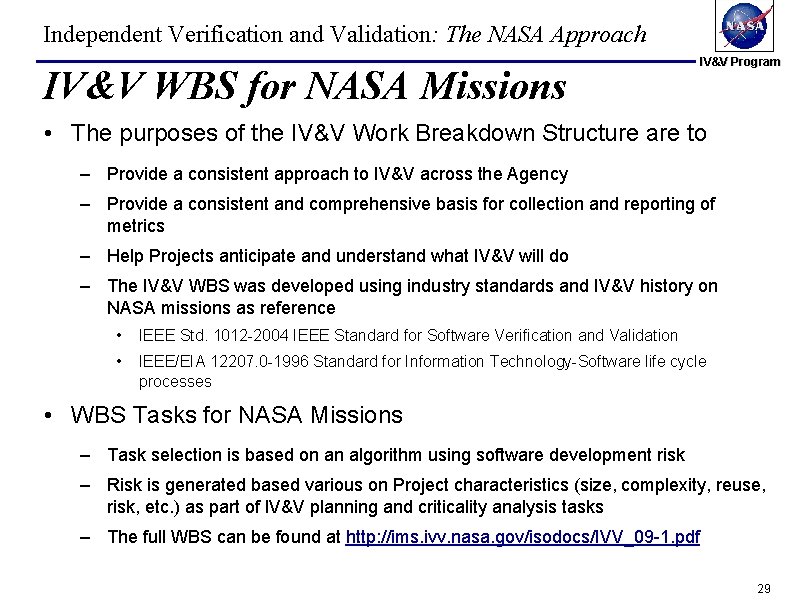
Independent Verification and Validation: The NASA Approach IV&V WBS for NASA Missions IV&V Program • The purposes of the IV&V Work Breakdown Structure are to – Provide a consistent approach to IV&V across the Agency – Provide a consistent and comprehensive basis for collection and reporting of metrics – Help Projects anticipate and understand what IV&V will do – The IV&V WBS was developed using industry standards and IV&V history on NASA missions as reference • IEEE Std. 1012 -2004 IEEE Standard for Software Verification and Validation • IEEE/EIA 12207. 0 -1996 Standard for Information Technology-Software life cycle processes • WBS Tasks for NASA Missions – Task selection is based on an algorithm using software development risk – Risk is generated based various on Project characteristics (size, complexity, reuse, risk, etc. ) as part of IV&V planning and criticality analysis tasks – The full WBS can be found at http: //ims. ivv. nasa. gov/isodocs/IVV_09 -1. pdf 29
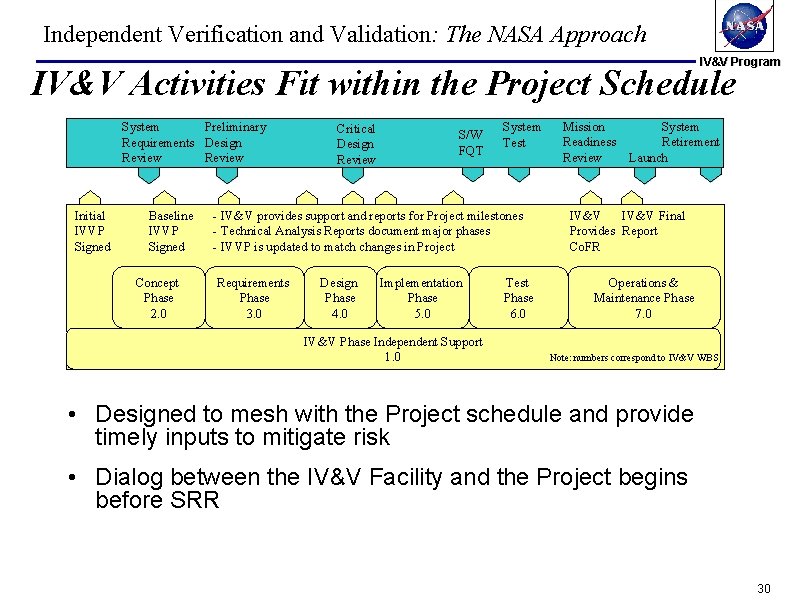
Independent Verification and Validation: The NASA Approach IV&V Program IV&V Activities Fit within the Project Schedule System Preliminary Requirements Design Review Initial IVVP Signed Baseline IVVP Signed Concept Phase 2. 0 Critical Design Review S/W FQT System Test - IV&V provides support and reports for Project milestones - Technical Analysis Reports document major phases - IVVP is updated to match changes in Project Requirements Phase 3. 0 Design Phase 4. 0 Implementation Phase 5. 0 IV&V Phase Independent Support 1. 0 Test Phase 6. 0 Mission Readiness Review System Retirement Launch IV&V Final Provides Report Co. FR Operations & Maintenance Phase 7. 0 Note: numbers correspond to IV&V WBS • Designed to mesh with the Project schedule and provide timely inputs to mitigate risk • Dialog between the IV&V Facility and the Project begins before SRR 30
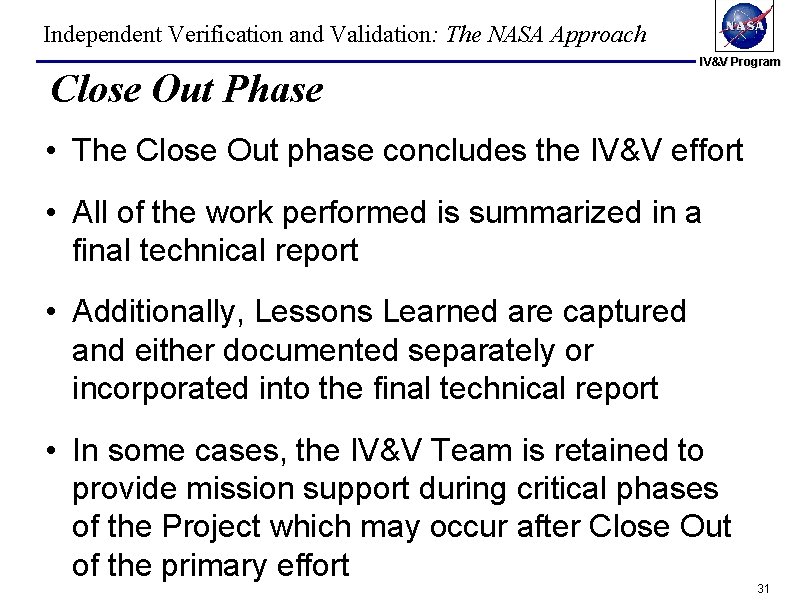
Independent Verification and Validation: The NASA Approach Close Out Phase IV&V Program • The Close Out phase concludes the IV&V effort • All of the work performed is summarized in a final technical report • Additionally, Lessons Learned are captured and either documented separately or incorporated into the final technical report • In some cases, the IV&V Team is retained to provide mission support during critical phases of the Project which may occur after Close Out of the primary effort 31
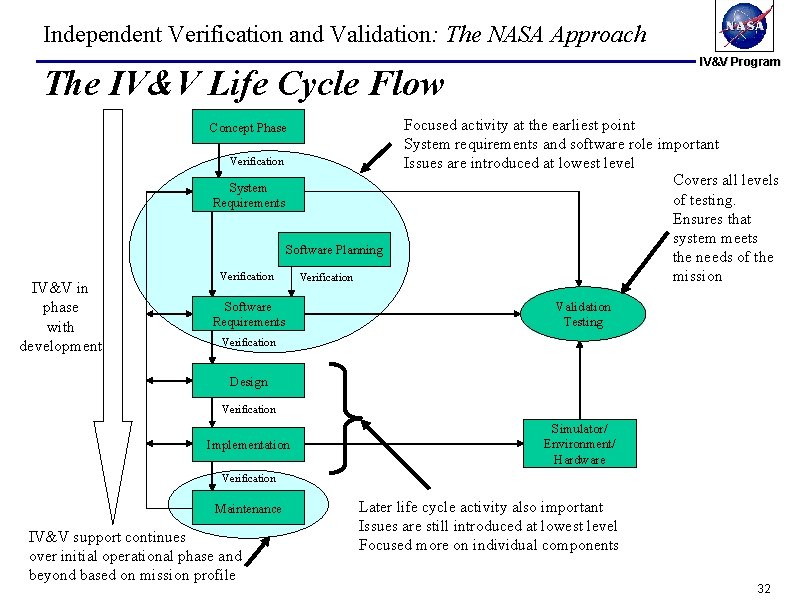
Independent Verification and Validation: The NASA Approach IV&V Program The IV&V Life Cycle Flow Concept Phase Verification System Requirements Software Planning IV&V in phase with development Verification Software Requirements Verification Focused activity at the earliest point System requirements and software role important Issues are introduced at lowest level Covers all levels of testing. Ensures that system meets the needs of the mission Validation Testing Verification Design Verification Implementation Simulator/ Environment/ Hardware Verification Maintenance IV&V support continues over initial operational phase and beyond based on mission profile Later life cycle activity also important Issues are still introduced at lowest level Focused more on individual components 32
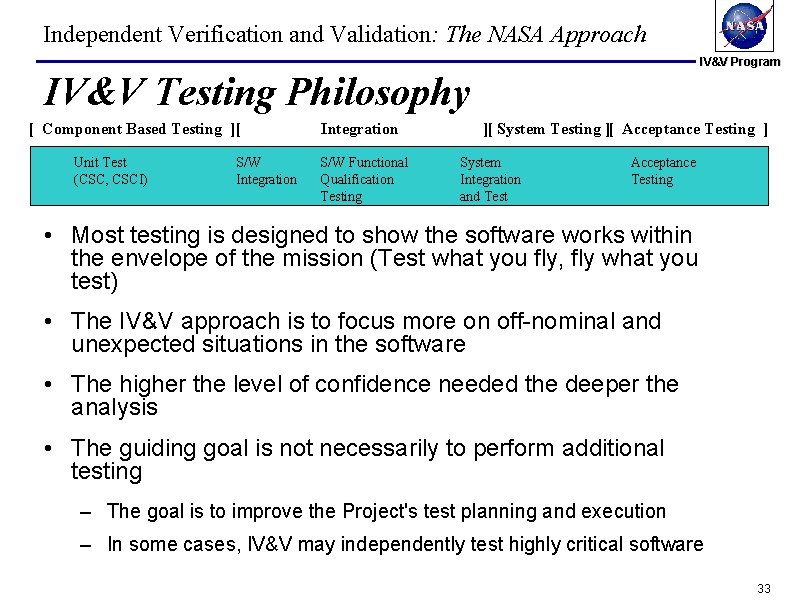
Independent Verification and Validation: The NASA Approach IV&V Program IV&V Testing Philosophy [ Component Based Testing ][ Unit Test (CSC, CSCI) S/W Integration S/W Functional Qualification Testing ][ System Testing ][ Acceptance Testing ] System Integration and Test Acceptance Testing • Most testing is designed to show the software works within the envelope of the mission (Test what you fly, fly what you test) • The IV&V approach is to focus more on off-nominal and unexpected situations in the software • The higher the level of confidence needed the deeper the analysis • The guiding goal is not necessarily to perform additional testing – The goal is to improve the Project's test planning and execution – In some cases, IV&V may independently test highly critical software 33
Independent Verification and Validation: The NASA Approach IV&V Program Forming an IV&V Project 34
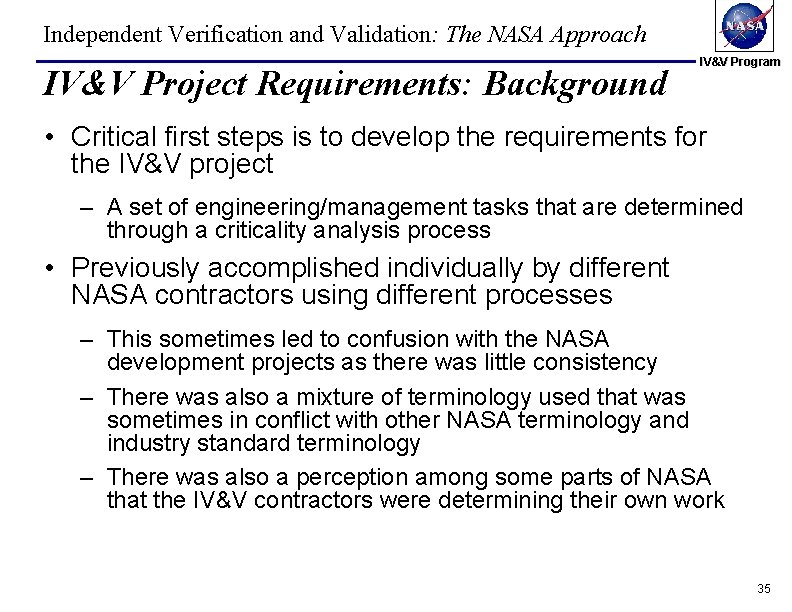
Independent Verification and Validation: The NASA Approach IV&V Project Requirements: Background IV&V Program • Critical first steps is to develop the requirements for the IV&V project – A set of engineering/management tasks that are determined through a criticality analysis process • Previously accomplished individually by different NASA contractors using different processes – This sometimes led to confusion with the NASA development projects as there was little consistency – There was also a mixture of terminology used that was sometimes in conflict with other NASA terminology and industry standard terminology – There was also a perception among some parts of NASA that the IV&V contractors were determining their own work 35
Independent Verification and Validation: The NASA Approach IV&V Program Software Integrity Level Assessment Process • To help mitigate or eliminate some of these issues the IV&V Program undertook an initiative to develop a new process • Examined the best of current criticality analysis processes from industry and academia • The primary objective of the process is to develop the requirements for an IV&V project 36
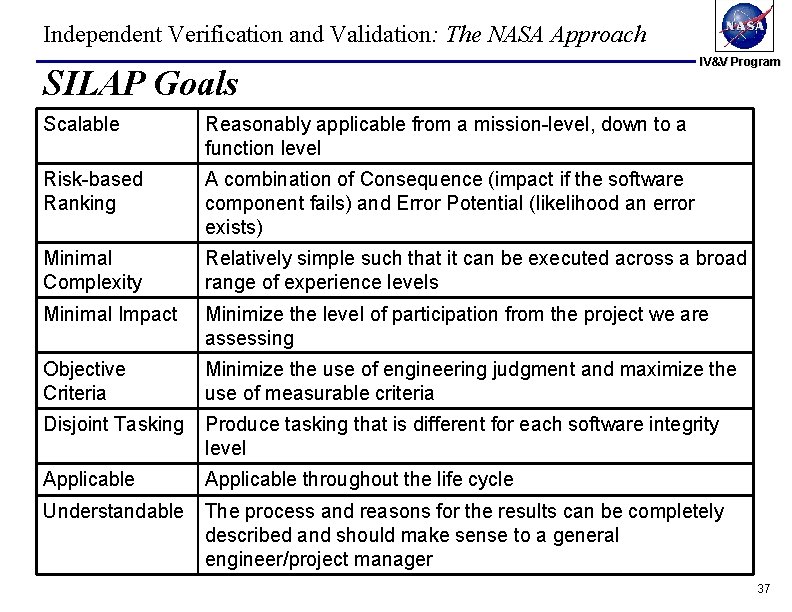
Independent Verification and Validation: The NASA Approach SILAP Goals IV&V Program Scalable Reasonably applicable from a mission-level, down to a function level Risk-based Ranking A combination of Consequence (impact if the software component fails) and Error Potential (likelihood an error exists) Minimal Complexity Relatively simple such that it can be executed across a broad range of experience levels Minimal Impact Minimize the level of participation from the project we are assessing Objective Criteria Minimize the use of engineering judgment and maximize the use of measurable criteria Disjoint Tasking Produce tasking that is different for each software integrity level Applicable throughout the life cycle Understandable The process and reasons for the results can be completely described and should make sense to a general engineer/project manager 37
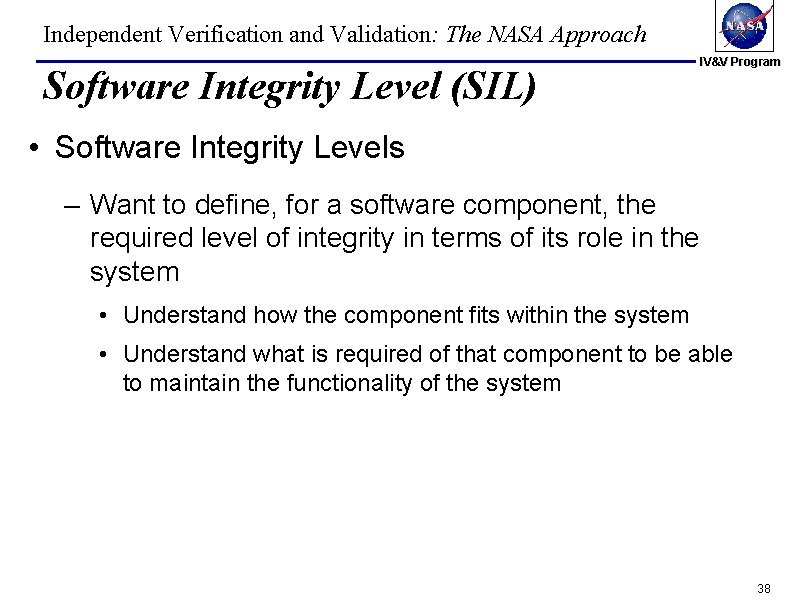
Independent Verification and Validation: The NASA Approach Software Integrity Level (SIL) IV&V Program • Software Integrity Levels – Want to define, for a software component, the required level of integrity in terms of its role in the system • Understand how the component fits within the system • Understand what is required of that component to be able to maintain the functionality of the system 38
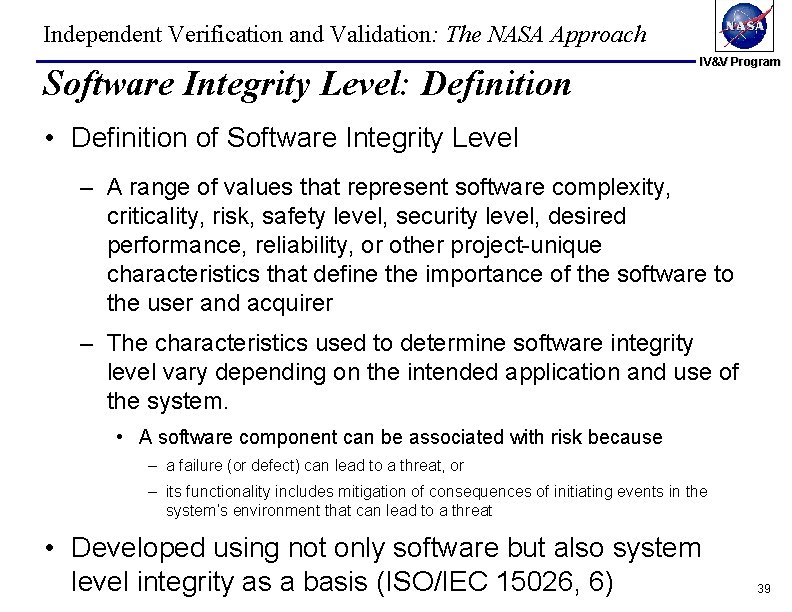
Independent Verification and Validation: The NASA Approach Software Integrity Level: Definition IV&V Program • Definition of Software Integrity Level – A range of values that represent software complexity, criticality, risk, safety level, security level, desired performance, reliability, or other project-unique characteristics that define the importance of the software to the user and acquirer – The characteristics used to determine software integrity level vary depending on the intended application and use of the system. • A software component can be associated with risk because – a failure (or defect) can lead to a threat, or – its functionality includes mitigation of consequences of initiating events in the system’s environment that can lead to a threat • Developed using not only software but also system level integrity as a basis (ISO/IEC 15026, 6) 39
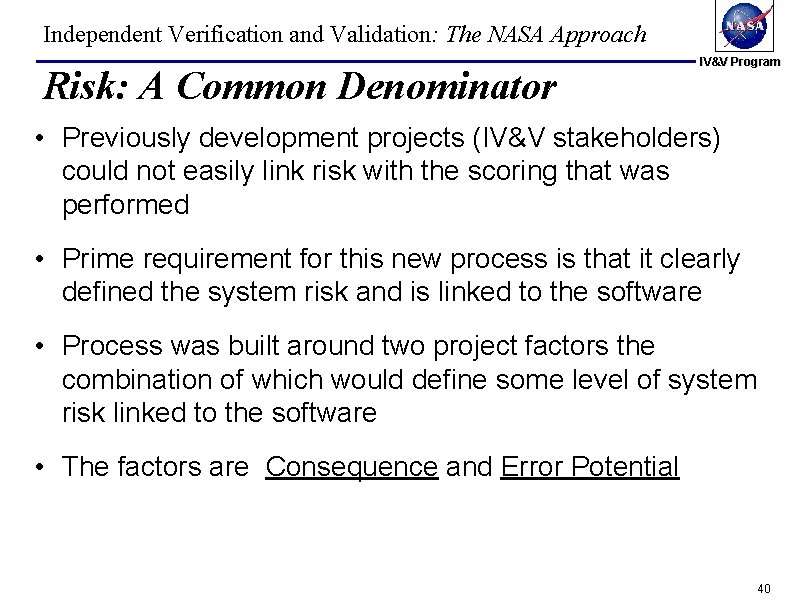
Independent Verification and Validation: The NASA Approach Risk: A Common Denominator IV&V Program • Previously development projects (IV&V stakeholders) could not easily link risk with the scoring that was performed • Prime requirement for this new process is that it clearly defined the system risk and is linked to the software • Process was built around two project factors the combination of which would define some level of system risk linked to the software • The factors are Consequence and Error Potential 40
Independent Verification and Validation: The NASA Approach Consequence vs. Error Potential IV&V Program • Consequence is a measure of the system level impact of an error in a software component – Generally, take the worse case error (at the software component level) that has a reasonable or credible fault/failure scenario – Then consider the system architecture and try to understand how that software fault/failure scenario may affect the system • Error Potential is a measure of the probability that the developer may insert an error into the software component – An error is a defect in the human thought process – A fault is a concrete manifestation of errors within the software – A failure is a departure of the system behavior from the requirements – With these definitions in mind, the approach is not to assess faults or failures, but to assess errors • Scoring 41
Independent Verification and Validation: The NASA Approach Consequence IV&V Program • Consequence consists of the following items – Human Safety – This is a measure of the impact that a failure of this component would have on human life – Asset Safety – This is a measure of the impact that a failure would have on hardware – Performance – This is a measure of the impact that a failure would have on a mission being able to meet its goals 42
Independent Verification and Validation: The NASA Approach Error Potential IV&V Program • Error Potential consists of the following items – Developer Characteristics • Experience – This is a measure of the system developer’s experience in developing similar systems • Organization – This is a measure of the complexity of the organization developing the system (distance and number of organizations involved tend to increase the probability of errors being introduced into the system) – Software/System Characteristics • Complexity – This is a measure of the complexity of the software being developed • Degree of Innovation – This is a measure of the level of innovation needed in order to develop this system/software • System Size – This is a measurement of the size of the system in terms of the software (i. e. , Source Lines of Code) 43
Independent Verification and Validation: The NASA Approach Error Potential (2) IV&V Program – Development Process Characteristics • Formality of the Process – This is a measure of how maturity of the developer’s processes • Re-use Approach – This is a measure of the level of reuse for the system/software • Artifact Maturity – This is a measure of the current state of the development documentation in relation to the state of the overall development project (i. e. , the is past critical design review but the requirements documents are still full of TBDs and incompletes) 44
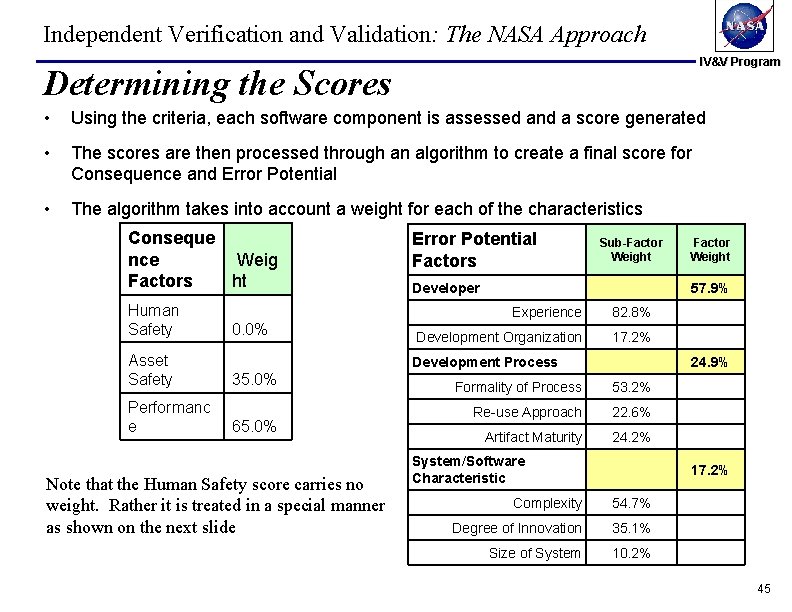
Independent Verification and Validation: The NASA Approach IV&V Program Determining the Scores • Using the criteria, each software component is assessed and a score generated • The scores are then processed through an algorithm to create a final score for Consequence and Error Potential • The algorithm takes into account a weight for each of the characteristics Conseque nce Weig Factors ht Human Safety Asset Safety Performanc e 0. 0% Error Potential Factors Sub-Factor Weight Developer 57. 9% Experience 82. 8% Development Organization 17. 2% Development Process 35. 0% 65. 0% Note that the Human Safety score carries no weight. Rather it is treated in a special manner as shown on the next slide Factor Weight 24. 9% Formality of Process 53. 2% Re-use Approach 22. 6% Artifact Maturity 24. 2% System/Software Characteristic 17. 2% Complexity 54. 7% Degree of Innovation 35. 1% Size of System 10. 2% 45
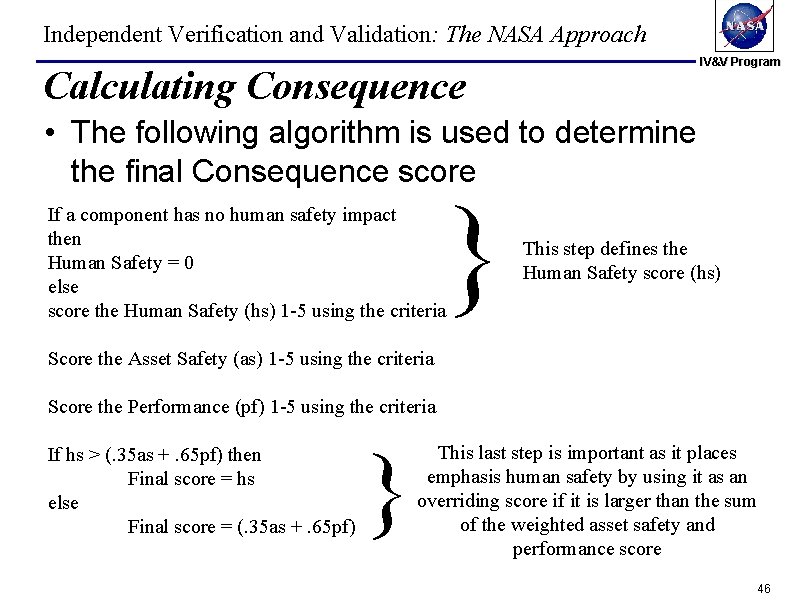
Independent Verification and Validation: The NASA Approach IV&V Program Calculating Consequence • The following algorithm is used to determine the final Consequence score } If a component has no human safety impact then Human Safety = 0 else score the Human Safety (hs) 1 -5 using the criteria This step defines the Human Safety score (hs) Score the Asset Safety (as) 1 -5 using the criteria Score the Performance (pf) 1 -5 using the criteria If hs > (. 35 as +. 65 pf) then Final score = hs else Final score = (. 35 as +. 65 pf) } This last step is important as it places emphasis human safety by using it as an overriding score if it is larger than the sum of the weighted asset safety and performance score 46
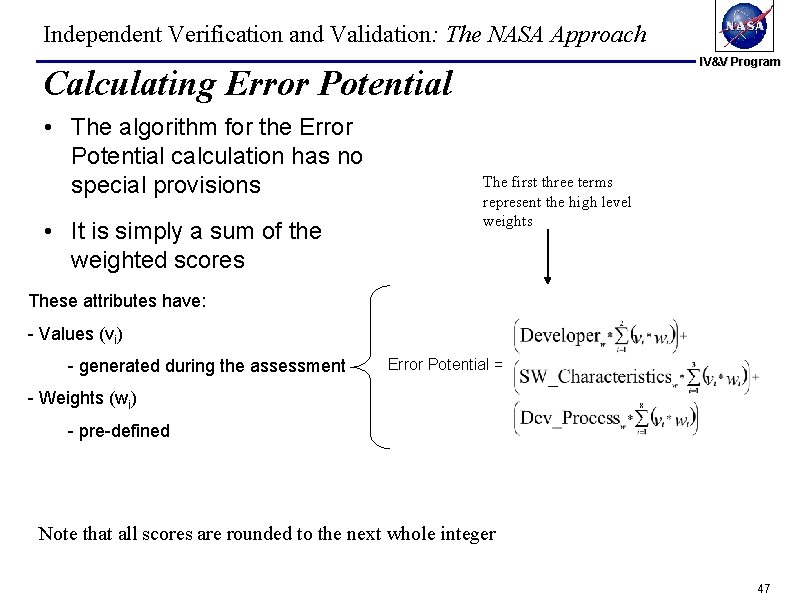
Independent Verification and Validation: The NASA Approach IV&V Program Calculating Error Potential • The algorithm for the Error Potential calculation has no special provisions • It is simply a sum of the weighted scores The first three terms represent the high level weights These attributes have: - Values (vi) - generated during the assessment Error Potential = - Weights (wi) - pre-defined Note that all scores are rounded to the next whole integer 47
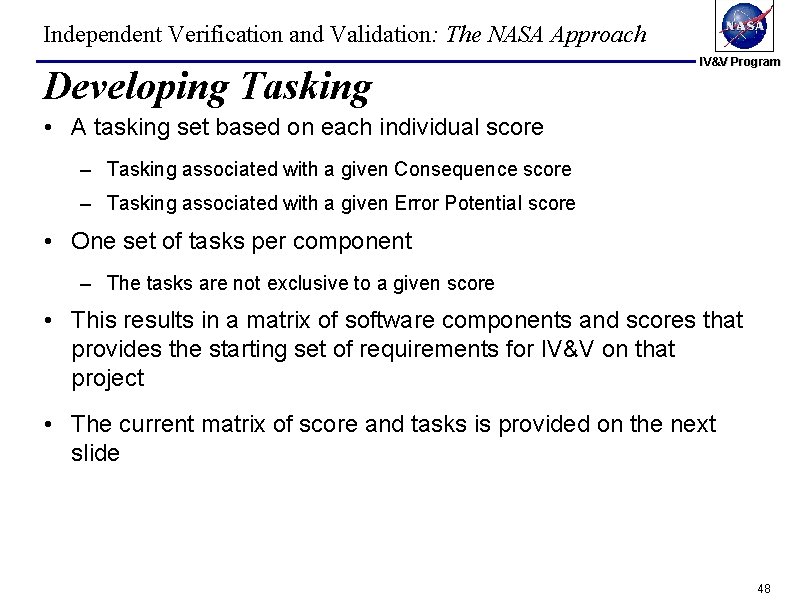
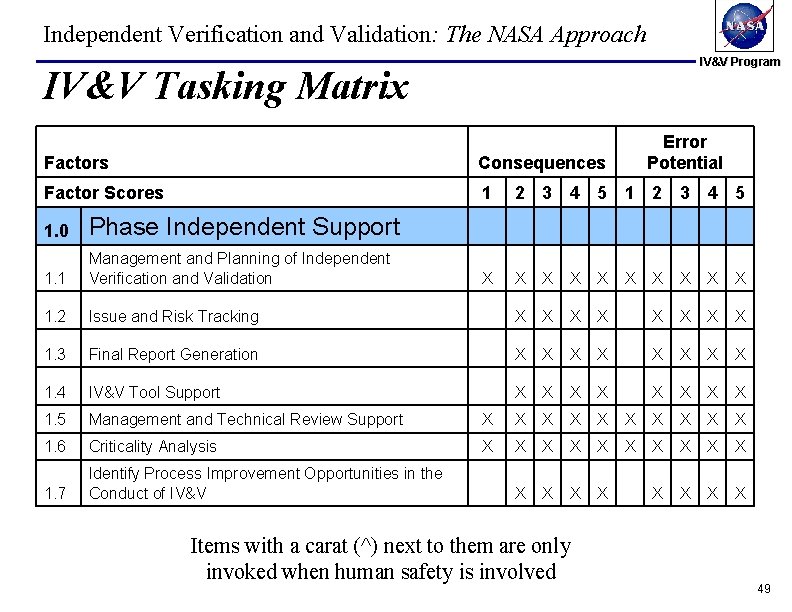
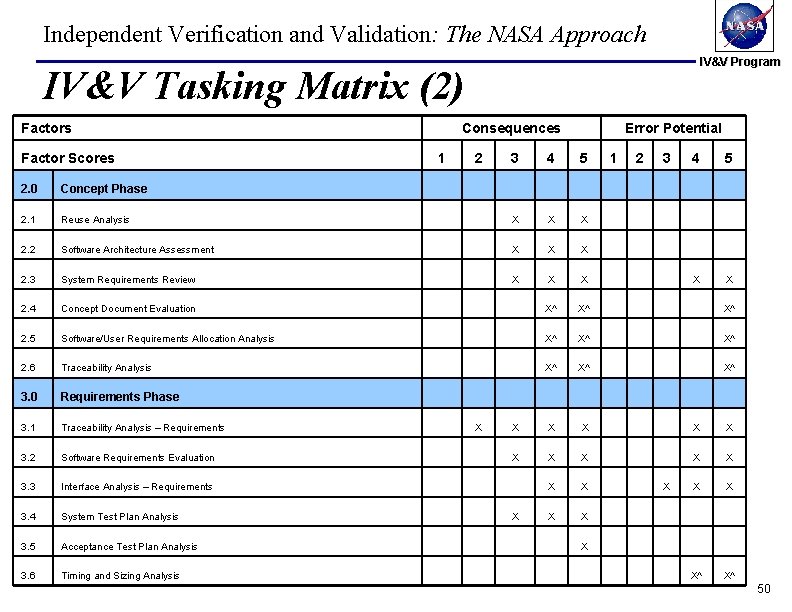
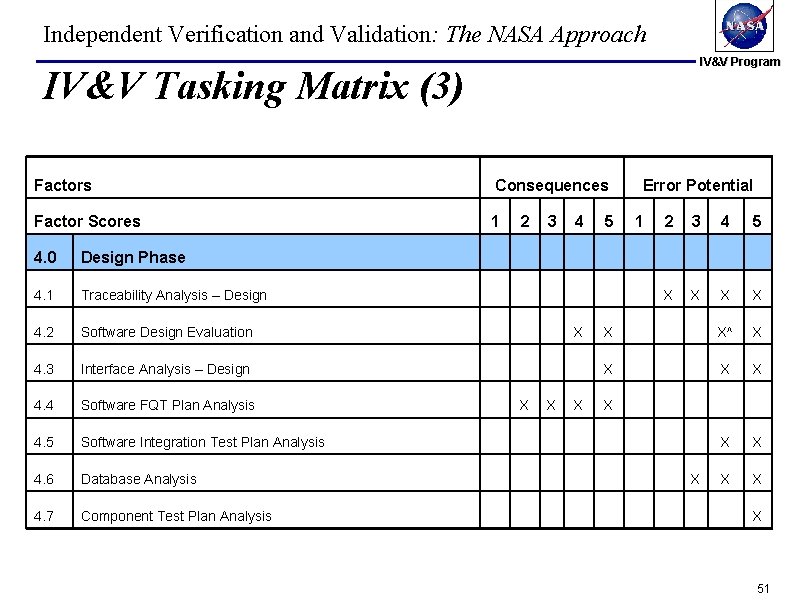
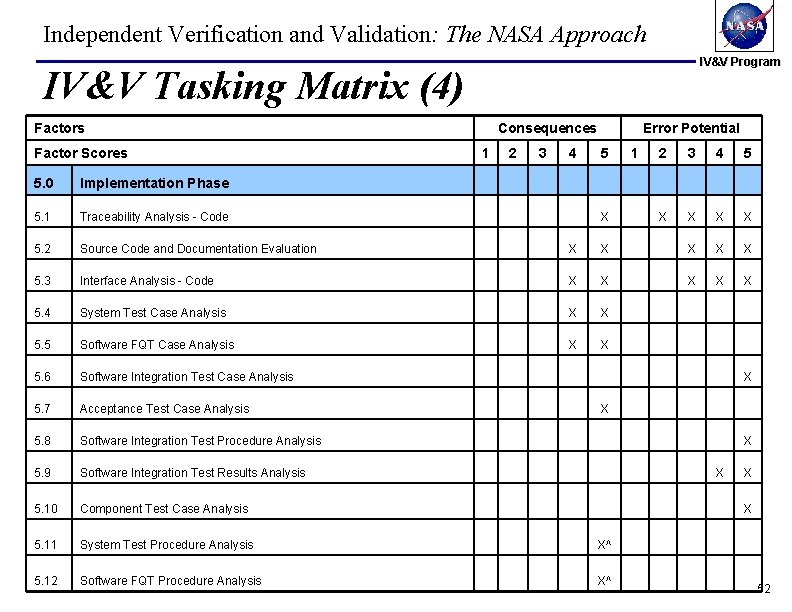
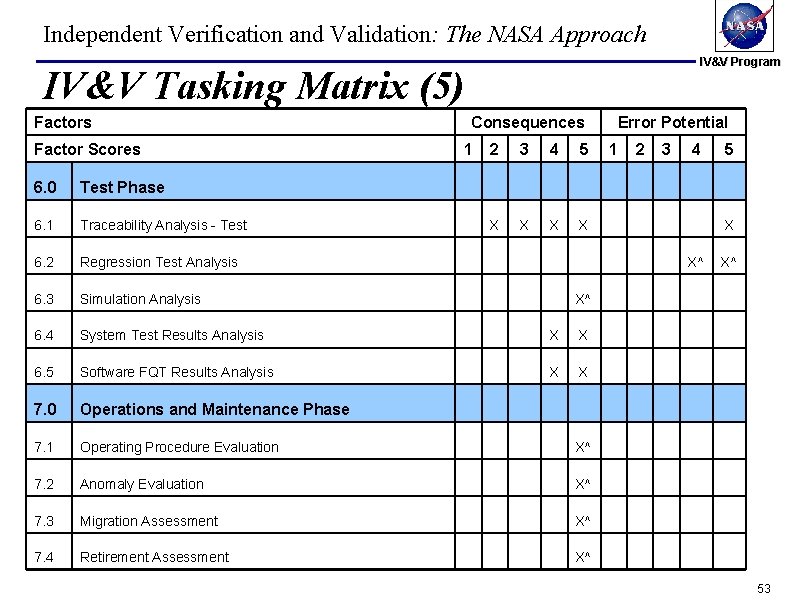
Independent Verification and Validation: The NASA Approach Developing Tasking IV&V Program • A tasking set based on each individual score – Tasking associated with a given Consequence score – Tasking associated with a given Error Potential score • One set of tasks per component – The tasks are not exclusive to a given score • This results in a matrix of software components and scores that provides the starting set of requirements for IV&V on that project • The current matrix of score and tasks is provided on the next slide 48
Independent Verification and Validation: The NASA Approach IV&V Program IV&V Tasking Matrix Error Potential Factors Consequences Factor Scores 1 2 3 4 5 X X X 1. 0 Phase Independent Support 1. 1 Management and Planning of Independent Verification and Validation 1. 2 Issue and Risk Tracking X X X 1. 3 Final Report Generation X X 1. 4 IV&V Tool Support X 1. 5 Management and Technical Review Support X 1. 6 Criticality Analysis X 1. 7 Identify Process Improvement Opportunities in the Conduct of IV&V X X X X X X X X X X X X Items with a carat (^) next to them are only invoked when human safety is involved X 49
Independent Verification and Validation: The NASA Approach IV&V Program IV&V Tasking Matrix (2) Factors Factor Scores Consequences 1 2 Error Potential 3 4 5 1 2 3 4 5 X X 2. 0 Concept Phase 2. 1 Reuse Analysis X X X 2. 2 Software Architecture Assessment X X X 2. 3 System Requirements Review X X X 2. 4 Concept Document Evaluation X^ X^ X^ 2. 5 Software/User Requirements Allocation Analysis X^ X^ X^ 2. 6 Traceability Analysis X^ X^ X^ 3. 0 Requirements Phase 3. 1 Traceability Analysis – Requirements X X X 3. 2 Software Requirements Evaluation X X X 3. 3 Interface Analysis – Requirements X X 3. 4 System Test Plan Analysis X X 3. 5 Acceptance Test Plan Analysis 3. 6 Timing and Sizing Analysis X^ X^ X X 50
Independent Verification and Validation: The NASA Approach IV&V Program IV&V Tasking Matrix (3) Factors Consequences Factor Scores 1 4. 0 Design Phase 4. 1 Traceability Analysis – Design 4. 2 Software Design Evaluation 4. 3 Interface Analysis – Design 4. 4 Software FQT Plan Analysis 4. 5 Software Integration Test Plan Analysis 4. 6 Database Analysis 4. 7 Component Test Plan Analysis 2 3 4 X X 5 Error Potential 1 2 3 4 5 X X X^ X X X 51
Independent Verification and Validation: The NASA Approach IV&V Program IV&V Tasking Matrix (4) Factors Factor Scores Consequences 1 2 3 4 Error Potential 5 1 2 3 4 5 X X 5. 0 Implementation Phase 5. 1 Traceability Analysis - Code 5. 2 Source Code and Documentation Evaluation X X X 5. 3 Interface Analysis - Code X X X 5. 4 System Test Case Analysis X X 5. 5 Software FQT Case Analysis X X 5. 6 Software Integration Test Case Analysis 5. 7 Acceptance Test Case Analysis 5. 8 Software Integration Test Procedure Analysis 5. 9 Software Integration Test Results Analysis 5. 10 Component Test Case Analysis 5. 11 System Test Procedure Analysis X^ 5. 12 Software FQT Procedure Analysis X^ X X X X 52
Independent Verification and Validation: The NASA Approach IV&V Program IV&V Tasking Matrix (5) Factors Factor Scores Consequences 1 2 3 4 5 X X 6. 0 Test Phase 6. 1 Traceability Analysis - Test 6. 2 Regression Test Analysis 6. 3 Simulation Analysis 6. 4 System Test Results Analysis X X 6. 5 Software FQT Results Analysis X X 7. 0 Operations and Maintenance Phase 7. 1 Operating Procedure Evaluation X^ 7. 2 Anomaly Evaluation X^ 7. 3 Migration Assessment X^ 7. 4 Retirement Assessment X^ Error Potential 1 2 3 4 5 X X^ X^ X^ 53
Independent Verification and Validation: The NASA Approach IV&V Program IV&V Relationships 54
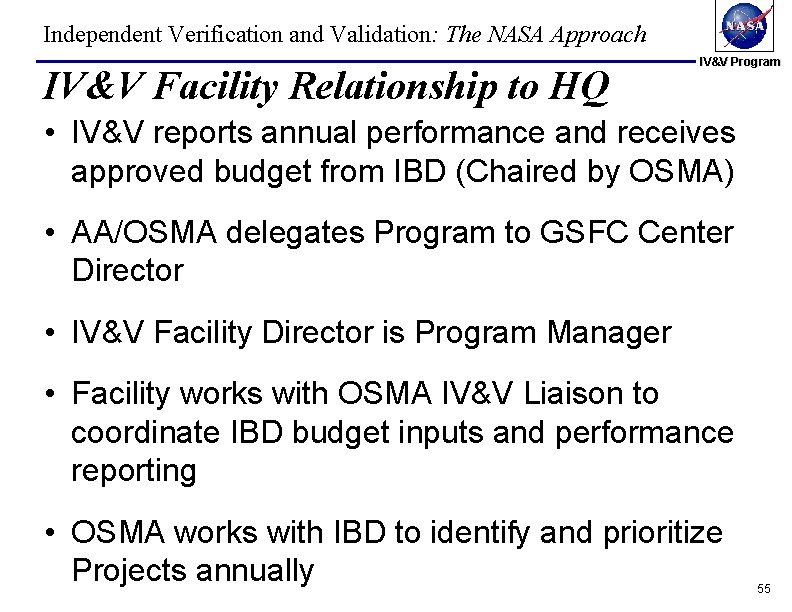
Independent Verification and Validation: The NASA Approach IV&V Facility Relationship to HQ IV&V Program • IV&V reports annual performance and receives approved budget from IBD (Chaired by OSMA) • AA/OSMA delegates Program to GSFC Center Director • IV&V Facility Director is Program Manager • Facility works with OSMA IV&V Liaison to coordinate IBD budget inputs and performance reporting • OSMA works with IBD to identify and prioritize Projects annually 55
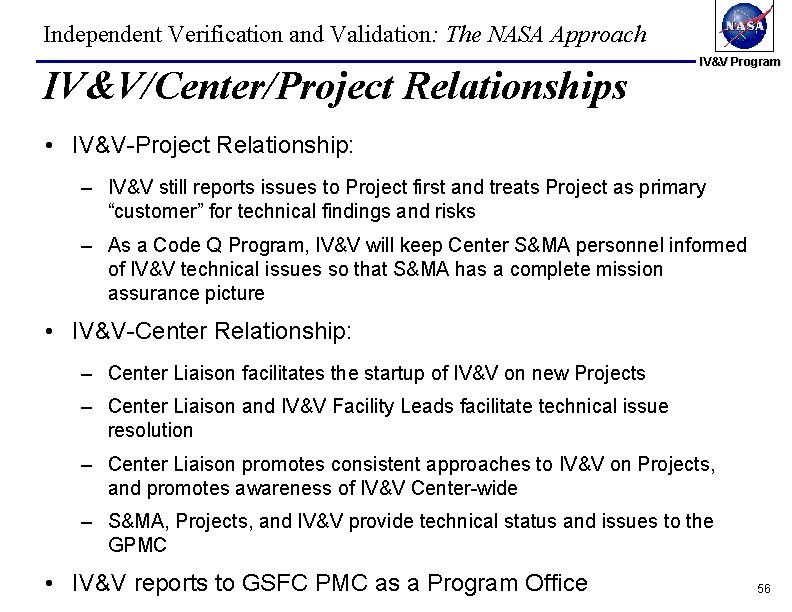
Independent Verification and Validation: The NASA Approach IV&V/Center/Project Relationships IV&V Program • IV&V-Project Relationship: – IV&V still reports issues to Project first and treats Project as primary “customer” for technical findings and risks – As a Code Q Program, IV&V will keep Center S&MA personnel informed of IV&V technical issues so that S&MA has a complete mission assurance picture • IV&V-Center Relationship: – Center Liaison facilitates the startup of IV&V on new Projects – Center Liaison and IV&V Facility Leads facilitate technical issue resolution – Center Liaison promotes consistent approaches to IV&V on Projects, and promotes awareness of IV&V Center-wide – S&MA, Projects, and IV&V provide technical status and issues to the GPMC • IV&V reports to GSFC PMC as a Program Office 56
Independent Verification and Validation: The NASA Approach Closing IV&V Program Software IV&V, as practiced by the NASA Software IV&V Facility, is a well-defined, proven, systems engineering discipline designed to reduce the risk in major software developments 57
Independent Verification and Validation: The NASA Approach Points of Contact IV&V Program • Bill Jackson Acting Director 304 -367 -8202 Bill. L. Jackson@nasa. gov • Ken Costello Lead Engineer 304 -367 -8343 Kenneth. A. Costello@nasa. gov 58