
Software Engineering models Predictive And Adaptive Models Ajith
- Slides: 50
Software Engineering models • Predictive And Adaptive Models Ajith G. S: poposir. orgfree. com
Software Engineering models • Predictive Models • Predictive development model Predict in advance what needs to be done and then do it. • It uses the requirements to design the system, and use the design as a blueprint to write the code and then test the code • Adaptive Model • An adaptive development model enables you to change the project’s goals if necessary during development. • An adaptive model lets you periodically reevaluate and decide whether you need to change direction. • The adaptive model just gives chances to fine‐tune the project if necessary. Ajith G. S: poposir. orgfree. com
Software Engineering models • Waterfall Model • Waterfall is the plain vanilla of the predictive model world. • It assumes that finish each step completely and thoroughly before you move on to the next step. • The waterfall model can work reasonably well if all the following assumptions are satisfied: • The requirements are precisely known in advance. • The requirements include no unresolved high‐risk items. • The requirements won’t change much during development. Ajith G. S: poposir. orgfree. com
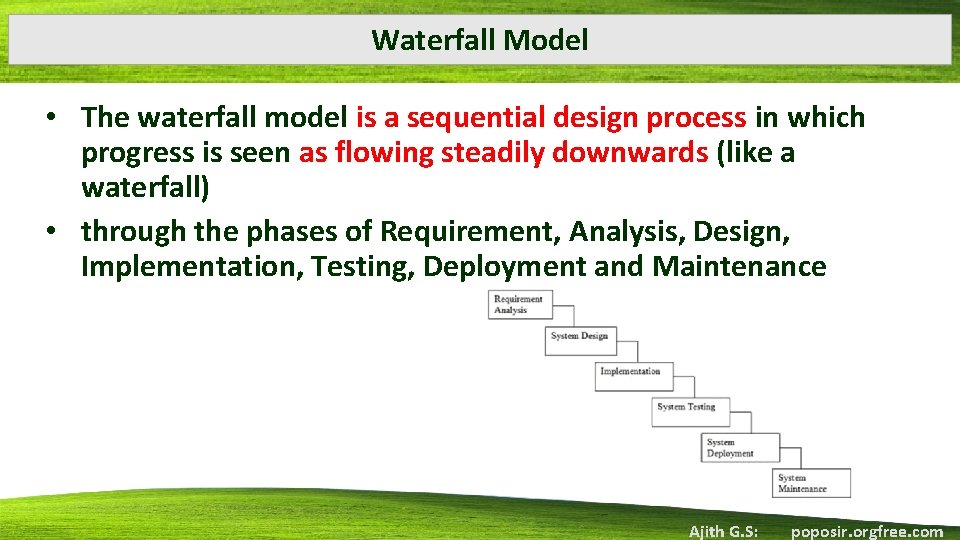
Waterfall Model • The waterfall model is a sequential design process in which progress is seen as flowing steadily downwards (like a waterfall) • through the phases of Requirement, Analysis, Design, Implementation, Testing, Deployment and Maintenance Ajith G. S: poposir. orgfree. com
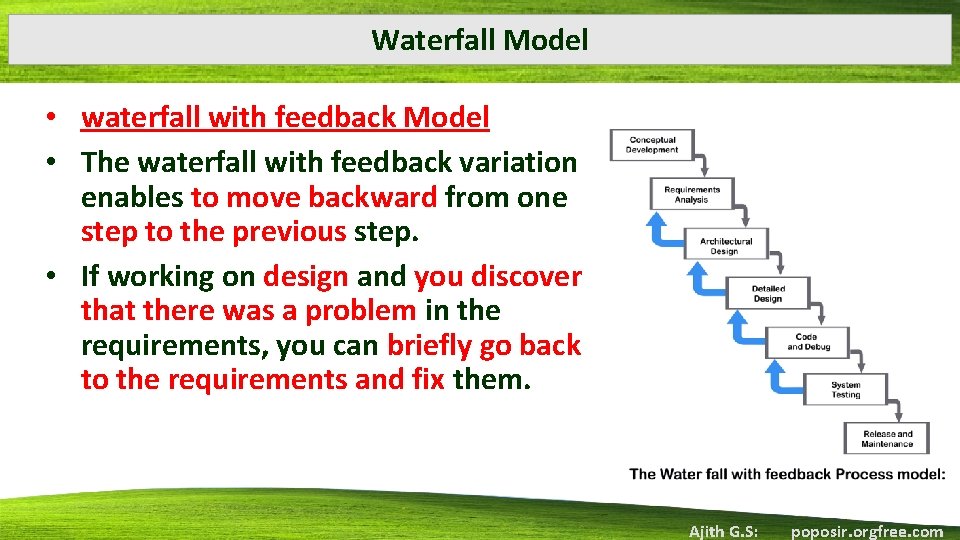
Waterfall Model • waterfall with feedback Model • The waterfall with feedback variation enables to move backward from one step to the previous step. • If working on design and you discover that there was a problem in the requirements, you can briefly go back to the requirements and fix them. Ajith G. S: poposir. orgfree. com
Waterfall Model • waterfall with feedback Model • The farther you have to go back up the cascade, the harder it is. • For example, if working on implementation and discover a problem in the requirements, it’s hard to skip back up two steps to fix the problem. Ajith G. S: poposir. orgfree. com
Waterfall Model • waterfall with feedback Model • It’s also less meaningful to move back up the cascade for the later steps. • For example, if you find a problem during maintenance, then you should probably treat it as a maintenance task instead of moving back into the deployment stage. Ajith G. S: poposir. orgfree. com
Waterfall Model Sashimi • Sashimi (also called sashimi waterfall and waterfall with overlapping phases) is similar to the waterfall model except the steps are allowed to overlap. • In a project’s first phase, some requirements will be defined while we are still working on others. • At that point, some of the team members can start designing the defined features while others continue working on the remaining requirements Ajith G. S: poposir. orgfree. com
Waterfall Model Sashimi • A bit later, the design for some parts of the application will be more or less finished but the design for other parts of the system won’t be. • At that point, some developers can start writing code for the designed parts of the system while others continue working on the rest of the design tasks and possibly even on remaining requirements. Ajith G. S: poposir. orgfree. com
Waterfall Model Sashimi • Advantage • People with different skills can focus on their specialties without waiting for others. • A second advantage is that it lets you perform a spike or deep dive into a particular topic to learn more about it. • A third advantage to overlapping phases is it lets later phases modify earlier phases. • If you discover during design that the requirements are impossible or need alterations, you can make the necessary changes. Ajith G. S: poposir. orgfree. com
Waterfall Model Incremental Waterfall • The incremental waterfall l model (also called the multi‐waterfall model) • uses a series of separate waterfall cascades. • Each cascade ends with the delivery of a usable application called an increment. • Each increment includes more features than the previous one, so you’re building the final application incrementally. • During each increment, you’ll get a better understanding of what the final application should look like. Ajith G. S: poposir. orgfree. com
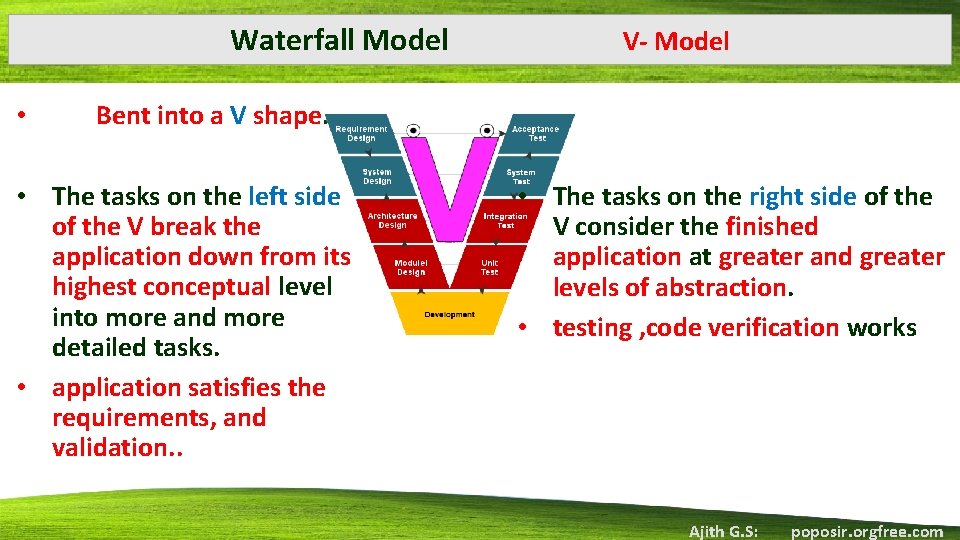
Waterfall Model • V‐ Model Bent into a V shape. • The tasks on the left side of the V break the application down from its highest conceptual level into more and more detailed tasks. • application satisfies the requirements, and validation. . • The tasks on the right side of the V consider the finished application at greater and greater levels of abstraction. • testing , code verification works Ajith G. S: poposir. orgfree. com
Waterfall Model V‐ Model • V‐model is basically a waterfall that’s been bent into a V shape. • The tasks on the left side of the V break the application down from its highest conceptual level into more and more detailed tasks. • This process of breaking the application down into pieces that you can implement is called decomposition • The tasks on the right side of the V consider the finished application at greater and greater levels of abstraction. • At the lowest level, testing verifies that the code works. • At the next level, verification confirms that the application satisfies the requirements, and validation confirms that the application meets the customers’ needs. Ajith G. S: poposir. orgfree. com
Waterfall Model V‐ Model • This process of working back up to the conceptual top of the application is called integration. • Each of the tasks on the left corresponds to a task on the right with a similar level of abstraction. • At the highest level, the initial concept corresponds to operation and maintenance. • At the next level, the requirements correspond quite directly to verification and validation. Testing confirms that the design worked. Ajith G. S: poposir. orgfree. com
Systems Development Life Cycle (SDLC) • The software development life cycle ( SDLC ), is also called the application development life cycle. • It covers all the tasks that in a software engineering project from start to finish: • requirements, design, implementation, verification, deployment, maintenance. Ajith G. S: poposir. orgfree. com
Systems Development Life Cycle (SDLC) • Waterfall model is one version of SDLC. • The incremental waterfall model is basically just a series of SDLCs flattened out and possibly with some overlap. • So one project starts before the previous one is completely finished. • The two main ideas of SDLC • The end of one project can feed directly into the next project in a never‐ending circle of life. • The second new idea is that you can break down the basic steps in a lot more detail if you like. Ajith G. S: poposir. orgfree. com
Systems Development Life Cycle (SDLC) Common Task • Tasks that are commonly represented as part of the SDLC as follows. • Initiation —An initiator (often a customer, executive champion, or software manager) comes up with the initial idea. • Concept development —The initiator, usually with help from others who might be interested in the project, explores the concept to see if it’s worthwhile and to evaluate possible alternatives. Ajith G. S: poposir. orgfree. com
Systems Development Life Cycle (SDLC) Common Task • Preliminary planning —A project manager (PM) and technical lead are assigned to the project, and they start planning. • If it’s a big project, the project might be broken into teams and team leads would be assigned. • All these leaders make preliminary plans to estimate necessary resources such as staffing, computers, network, development tools etc. Ajith G. S: poposir. orgfree. com
Systems Development Life Cycle (SDLC) Common Task • Requirements analysis —The team studies the user’s needs and creates requirement documents. • Those may include text, pictures, use cases, prototypes, and long‐winded descriptions of business rules. • It may also include UML diagrams showing application structure, user behavior, and anything else that helps the users understand what the team will be building. Ajith G. S: poposir. orgfree. com
Systems Development Life Cycle (SDLC) Common Task • High‐level design —The team creates high‐level designs that specify major subsystems, data flow, database needs, and the rest of the application’s high‐level structure. • Low‐level design —The team creates low‐level designs that explain how to build the application’s pieces. • Development —The team writes the program code and follow good programming practices. • They perform unit tests, regression tests, and system tests. • They fix the bugs that appear and handle any change requests that are approved by the change committee. • The team also prepares user documentation and training materials Ajith G. S: poposir. orgfree. com
Systems Development Life Cycle (SDLC) Common Task • Acceptance testing —The customers finally get a chance to take the application for a test drive in its (almost) final form. • After a few bug fixes and perhaps a small change or two, the customers agree that the application satisfies the requirements • Deployment —The team rolls out the application. Ajith G. S: poposir. orgfree. com
Systems Development Life Cycle (SDLC) Common Task • Maintenance —bug fixes and change requests. • The team continues to track the application’s usefulness throughout its lifetime to determine whether it needs repair, enhancement, or replacement with a new version or with something completely different • The maintenance team needs to figure out how to upgrade the application to the latest hardware and operating system, and how to dispose of the old hardware • Review —The team uses metrics to assess the project and decide whether the development process can be improved in the future. Ajith G. S: poposir. orgfree. com
Systems Development Life Cycle (SDLC) Common Task • Disposal —Eventually, the application’s usefulness comes to an end. • During this stage, cleanup crew plans the application’s removal and possibly its replacement by something else. • The crew needs to decide what data needs to be archived and how to protect it so that a hacker can’t break in and steal sensitive data. Ajith G. S: poposir. orgfree. com
Iterative Model • Iterative Versus Predictive • Predictive models are not suited to handle unexpected change. • Predictive projects spend a lot of effort at the beginning , figuring out exactly what they will do. • After gather requirements and commit to a schedule, it’s hard to change course. • Iterative models address build the application incrementally. • They start by building the smallest program that is reasonably useful. • Then they use a series of increments to add more features to the program until it’s finished. Ajith G. S: poposir. orgfree. com
Iterative Model • Iterative Versus Incremental • An iterative project might not be incremental. • According to Karl Scotland , the difference between iterative and incremental development is clear by considering the fidelity(completeness) of a project’s features. Ajith G. S: poposir. orgfree. com
Iterative Model • Consider working on a project that provides three features. Here’s how we might use fidelity to describe different development approaches: • Predictive ‐Provides all three features at the same time with full fidelity. • Iterative ‐Initially provides all three features at a low (but usable) fidelity. • Later iterations provide higher and higher fidelity until all the features are provided with full fidelity. Ajith G. S: poposir. orgfree. com
Iterative Model • Incremental ‐Initially provides the fewest possible features for a usable application, but all the features present are provided with full fidelity. • Later versions add more features, always at full fidelity. Ajith G. S: poposir. orgfree. com
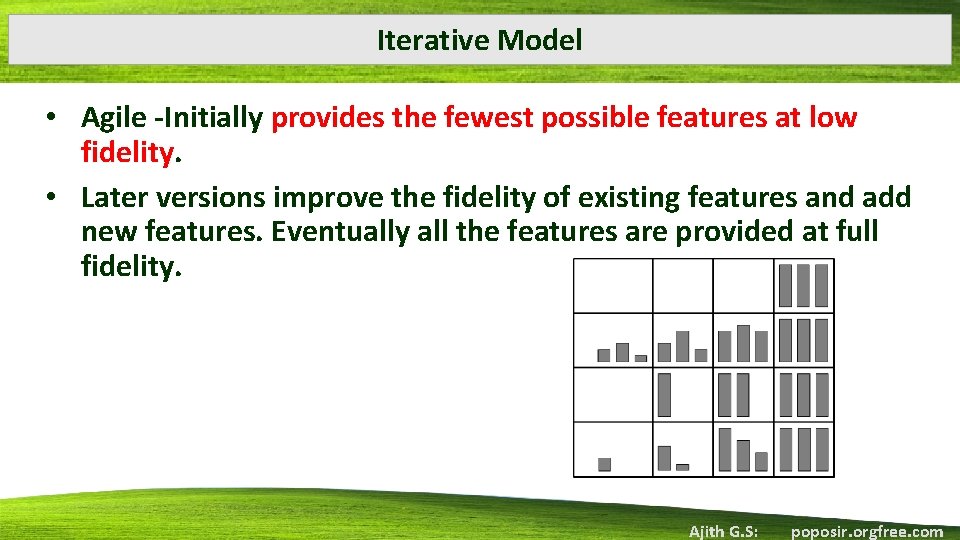
Iterative Model • Agile ‐Initially provides the fewest possible features at low fidelity. • Later versions improve the fidelity of existing features and add new features. Eventually all the features are provided at full fidelity. Ajith G. S: poposir. orgfree. com
Prototypes • Two important facts about prototypes are • They don’t need to work the same way the final application will. • They don’t need to implement all the features of the final application • After the customers experiment with the prototype, they can give the feedback to help refine the requirements. Ajith G. S: poposir. orgfree. com
Prototypes Types of Prototypes • Throwaway prototypes‐ We use the prototype to study some aspect of the system and then you throw it away and write code from scratch • Evolutionary prototypes‐The prototype demonstrates some of the application’s features. • As the project progresses, you refine those features and add new ones until the prototype morphs into the finished application. • Incremental Prototyping‐ In incremental prototyping , we build a collection of prototypes of that separately demonstrate the finished application’s features and then combine the prototypes (or at least their code) to build the finished application Ajith G. S: poposir. orgfree. com
Prototypes Advantages • Common vision —Prototypes let the customers and developers see the same preview of the finished application, so they are more likely to have a common vision of what the application should do and what it should look like. • Better design —Prototypes (particularly vertical prototypes) let the developers quickly explore specific pieces of the application to learn what they involve. • Prototypes also let developers test different approaches to see which one is best. Ajith G. S: poposir. orgfree. com
Prototypes Disadvantage • Narrowing vision —People tend to focus on a prototype’s specific approach rather than on the problem it addresses. • Customer impatience —A good prototype can make customers think that the finished application is just around the corner • Schedule pressure —If customers see a prototype that they think is mostly done, they may not understand that you need another year to finish and may pressure you to shorten the schedule • Raised expectations —Sometimes, a prototype may demonstrate features that won’t be included in the application. Ajith G. S: poposir. orgfree. com
Prototypes Disadvantage • Attachment to code —Sometimes, developers become attached to the prototype’s code. That can make them follow the methods used by that code (or even reuse the code wholesale) even if a better design exists. • Never‐ending prototypes —Throwaway prototypes are supposed to be built relatively quickly to provide fast feedback. • Sometimes, developers spend far too much time refining a prototype to make it look better and include more features that aren’t actually necessary. Ajith G. S: poposir. orgfree. com
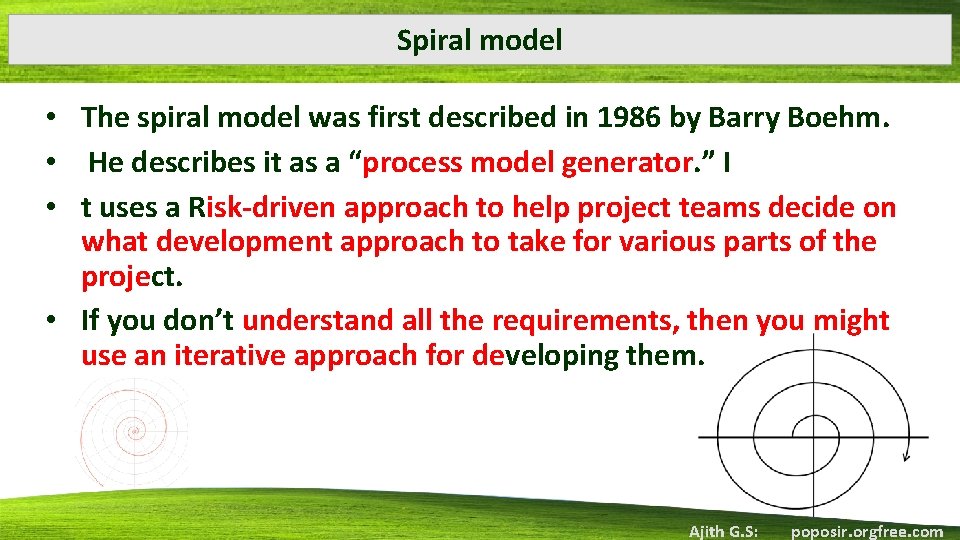
Spiral model • The spiral model was first described in 1986 by Barry Boehm. • He describes it as a “process model generator. ” I • t uses a Risk‐driven approach to help project teams decide on what development approach to take for various parts of the project. • If you don’t understand all the requirements, then you might use an iterative approach for developing them. Ajith G. S: poposir. orgfree. com
Spiral model • In the first phase, you determine the objectives of the current cycle. You define any alternatives and constraints on the objectives. • In the second phase ( risk analysis phase), risk analysis is performed to determine what the biggest risk factors are that could prevent you from achieving this cycle’s objectives. • Resolve the risks and build a prototype to achieve your objectives. • In the third phase ( engineering phase), use the prototype we just built to evaluate our solution. • Some simulations and model specific problems to see if we’re on the right track. Ajith G. S: poposir. orgfree. com
Spiral model • In the fourth phase ( evaluation phase), we evaluate the progress so far and make sure the project’s major stakeholders agree that the solution you came up with is correct and that the project should continue. • If they decide you’ve made a mistake, you run another lap around the spiral to fix whatever problems remain. (You identify the missed objectives, evaluate alternatives, identify and resolve risks, and produce another prototype. ) • After you’re sure you’re on the right track, you plan the next trip around the spiral. Ajith G. S: poposir. orgfree. com
Spiral model • The first trip around the spiral builds the project requirements. • The team examines alternatives, identifies the largest risks , resolves the risks, and builds a prototype set of requirements. • Team members then use the prototype to analyze the requirements and verify that they are correct. • At that point, the verified requirements become the actual requirements. Ajith G. S: poposir. orgfree. com
Spiral model • The next trip around the spiral builds the application design. • The team evaluates design alternatives, identifies and resolves the major risks, and builds a prototype design. • Team members analyze the design and verify that it makes sense. The prototype design then becomes the design. Ajith G. S: poposir. orgfree. com
Spiral model • The final trip around the spiral drives the application’s implementation. • The team evaluates implementation alternatives. • They identify risks and resolve them. • The team then builds an operational prototype that shows how the program will work. • They use the prototype to verify that everything is on track, and then they actually build the application Ajith G. S: poposir. orgfree. com
Spiral model • The implementation steps are broken down into detailed design, programming, unit testing, integration testing, and acceptance testing. Ajith G. S: poposir. orgfree. com
Spiral model : Clarifications • Boehm has made several clarifications mostly to correct mistakes people made interpreting the method. • This is not simply a series of waterfall models drawn in a spiral and executed one after another to form an incremental approach. In fact, you could use multiple spirals to build different versions of an application. Ajith G. S: poposir. orgfree. com
Spiral model : Clarifications • The activities need not follow a single spiral sequence. • For example, you could spin the user interface design and database design off into completely separate spirals that both feed into an overall project cycle. • You can add items, remove items, or perform items in different orders in a specific spiral model as needed. The activities you need to perform depend on the project. Ajith G. S: poposir. orgfree. com
Spiral model six characteristics • Boehm further defined six characteristics that spiral development cycles should follow: • 1. Define tasks concurrently. • There’s no need to perform everything sequentially. • 2. Perform the following four tasks in each cycle. (Basically they are goals of the four phases. ) • a. Consider the goals of all stakeholders. • b. Identify and evaluate alternative approaches for satisfying the stakeholders’ goals. • c. Identify and resolve risks in the selected approach. • d. Make sure the stakeholders agree that the results of the current cycle are correct. Get the stakeholders’ approval to continue the project into the next cycle. Ajith G. S: poposir. orgfree. com
Spiral model six characteristics • 3. Use risk to determine the level of effort. • For example, perform enough code reviews to minimize the risk of buggy code, but don’t perform so many reviews that you risk finishing late • 4. Use risk to determine the level of detail. • For example, put enough work into the requirements to minimize the risk of the application not satisfying the customers, but don’t over‐specify requirements to the point where they restrict the developers’ flexibility. Ajith G. S: poposir. orgfree. com
Spiral model six characteristics • Use anchor milestones. • Boehm later added the following anchor milestones to track the project’s progress. • 5. Life Cycle Objectives (LCO) —When the stakeholders agree that the project’s technical and management approach is defined enough to satisfy all the stakeholders’ goals, then it has reached its LCO milestone. Ajith G. S: poposir. orgfree. com
Spiral model six characteristics • 6. Life Cycle Architecture (LCA) —When the stakeholders agree that the project’s approach can satisfy the goals and all significant risks have been eliminated or mitigated, then it has reached its LCA milestone. • Initial Operational Capability (IOC) —When there has been sufficient preparation to satisfy everyone’s goals, then the project has reached its IOC milestone and should be installed. • The preparations include everything needed to make the project a success. • For example, the application is ready and tested, the user site is set up, the users have been trained, and the maintenance programmers are ready to take over. Ajith G. S: poposir. orgfree. com
Spiral model six characteristics • Focus on the system and its life cycle rather than on short‐term issues such as writing an initial design or writing code. • This is intended to help you focus on the big picture Ajith G. S: poposir. orgfree. com
Spiral model Advantage • Its spiral structure gives stakeholders a lot of points for review and making “go” or “no‐go” decisions. • It emphasizes risk analysis. • If identify and resolve risks correctly, it should lead to eventual success • It can accommodate change reasonably well. • Simply make any necessary changes and then run through a cycle to identify and resolve any risks they create. • Estimates such as time and effort required become more accurate over time as cycles are finished and risks are removed from the project. Ajith G. S: poposir. orgfree. com
Spiral model Disadvantage • It’s complicated. • Because it’s complicated, it often requires more resources than simpler approaches. • Risk analysis can be difficult. • The complication isn’t always worth the effort, particularly for low‐risk projects Ajith G. S: poposir. orgfree. com
Spiral model Disadvantage • Stakeholders must have the time and skills needed to review the project periodically to make sure each cycle is completed satisfactorily. • Time and effort estimates become more accurate as cycles are finished, but initially those estimates may not be good. • It doesn’t work well with small projects. • You could end up spending more time on risk analysis than you’d need to build the entire application with a simpler approach. Ajith G. S: poposir. orgfree. com