
Software Engineering Method And Theory A personal perspective



- Slides: 51
Software Engineering Method And Theory A personal perspective Ivar Jacobson
The Semat initiative
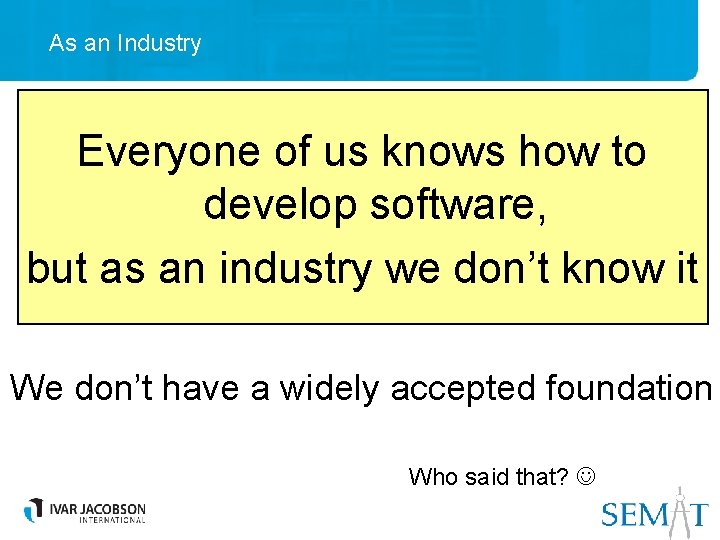
As an Industry Everyone of us knows how to develop software, but as an industry we don’t know it We don’t have a widely accepted foundation Who said that?
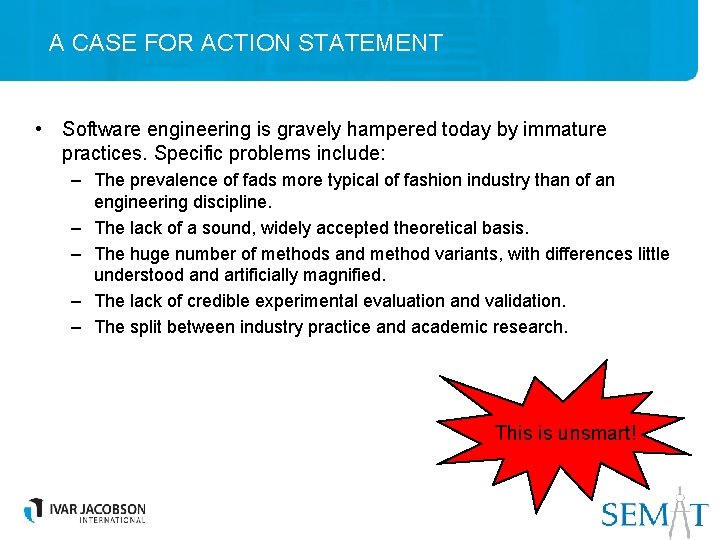
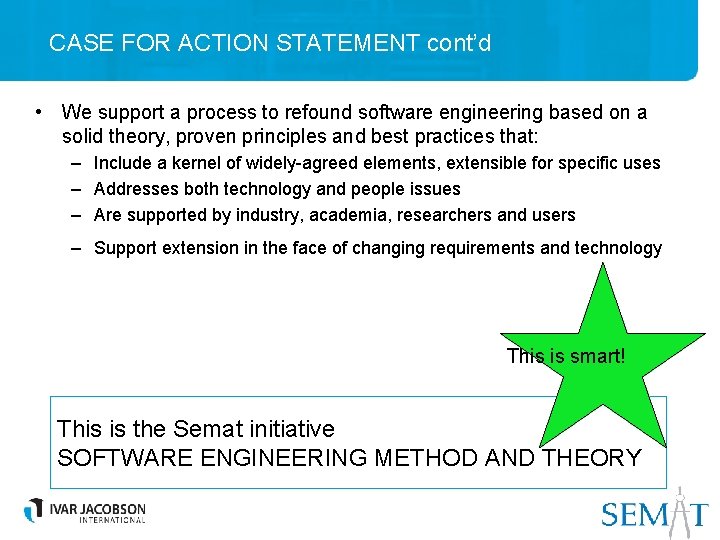
A CASE FOR ACTION STATEMENT • Software engineering is gravely hampered today by immature practices. Specific problems include: – The prevalence of fads more typical of fashion industry than of an engineering discipline. – The lack of a sound, widely accepted theoretical basis. – The huge number of methods and method variants, with differences little understood and artificially magnified. – The lack of credible experimental evaluation and validation. – The split between industry practice and academic research. This is unsmart!
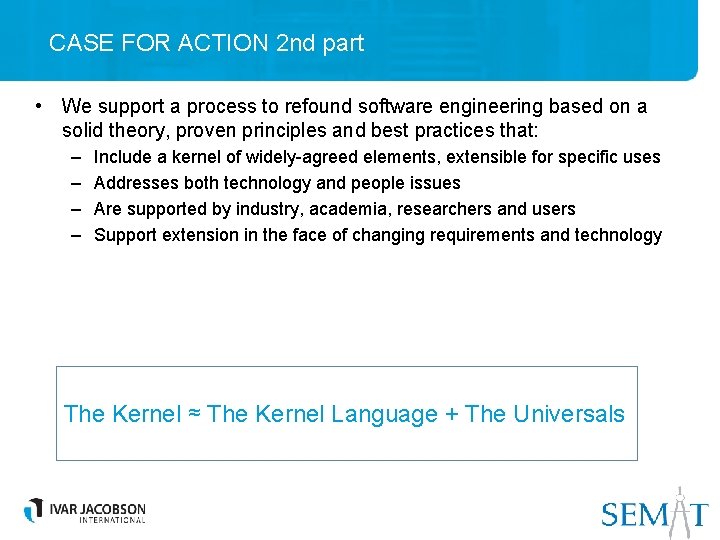
CASE FOR ACTION STATEMENT cont’d • We support a process to refound software engineering based on a solid theory, proven principles and best practices that: – Include a kernel of widely-agreed elements, extensible for specific uses – Addresses both technology and people issues – Are supported by industry, academia, researchers and users – Support extension in the face of changing requirements and technology This is smart! This is the Semat initiative SOFTWARE ENGINEERING METHOD AND THEORY
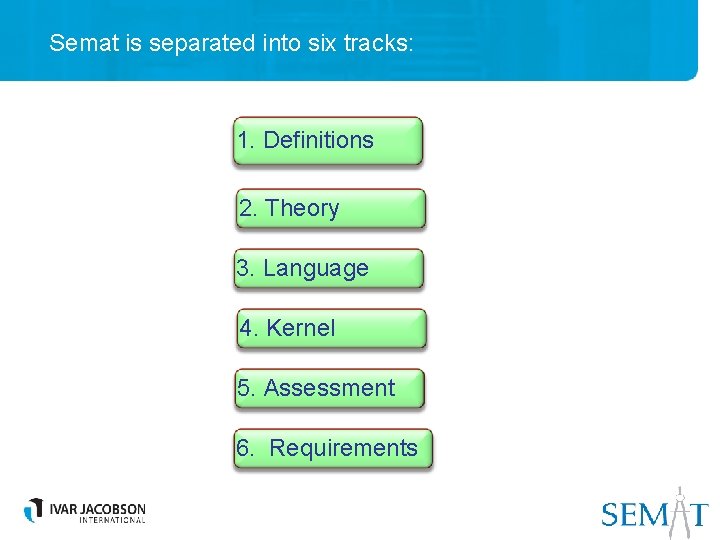
Semat is separated into six tracks: 1. Definitions 2. Theory 3. Language 4. Kernel 5. Assessment 6. Requirements
This talk focus on the Kernel It draws on my personal experience. It suggests a goal we need to find. It shows it can be found. Reaching the goal, it will have dramatic impact on the whole software community o o o the industry, the developers, the academics, the educators, the methodologists, etc. Watts Humphrey on the meeting in Zurich March 17 -18: “This meeting in Zurich is likely to be an historic occasion much like the 1968 NATO session in Garmish. ”
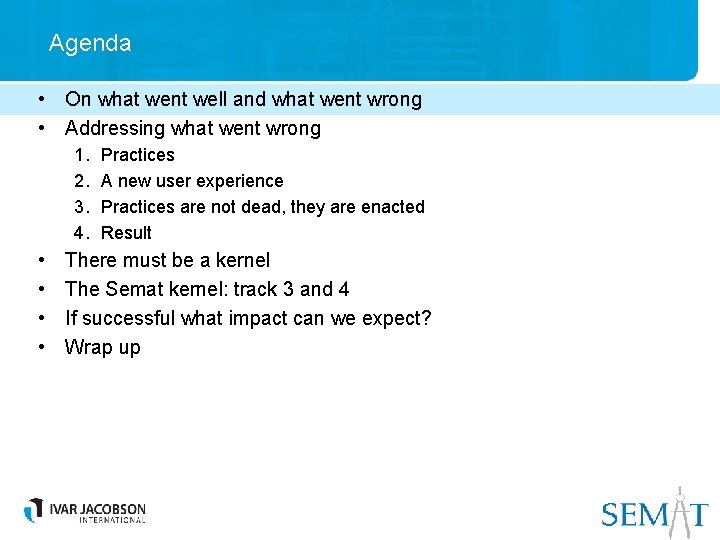
Agenda • On what went well and what went wrong • Addressing what went wrong 1. 2. 3. 4. • • Practices A new user experience Practices are not dead, they are enacted Result There must be a kernel The Semat kernel: track 3 and 4 If successful what impact can we expect? Wrap up
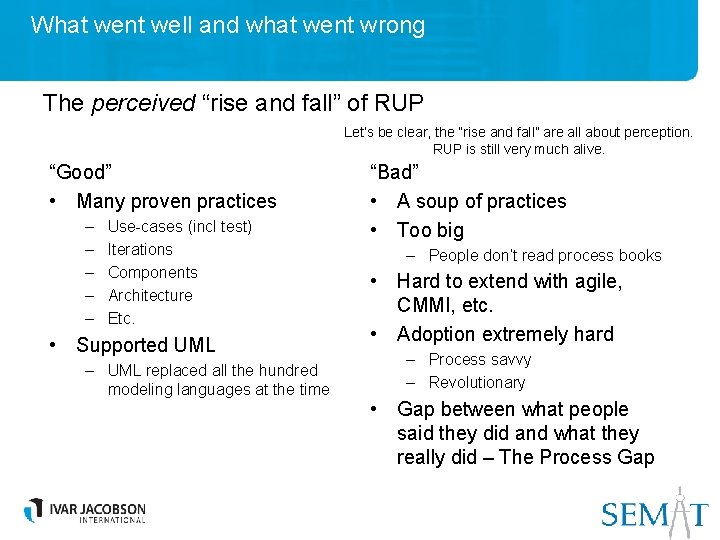
What went well and what went wrong The perceived “rise and fall” of RUP Let’s be clear, the “rise and fall” are all about perception. RUP is still very much alive. “Good” • Many proven practices – – – Use-cases (incl test) Iterations Components Architecture Etc. • Supported UML – UML replaced all the hundred modeling languages at the time “Bad” • A soup of practices • Too big – People don’t read process books • Hard to extend with agile, CMMI, etc. • Adoption extremely hard – Process savvy – Revolutionary • Gap between what people said they did and what they really did – The Process Gap
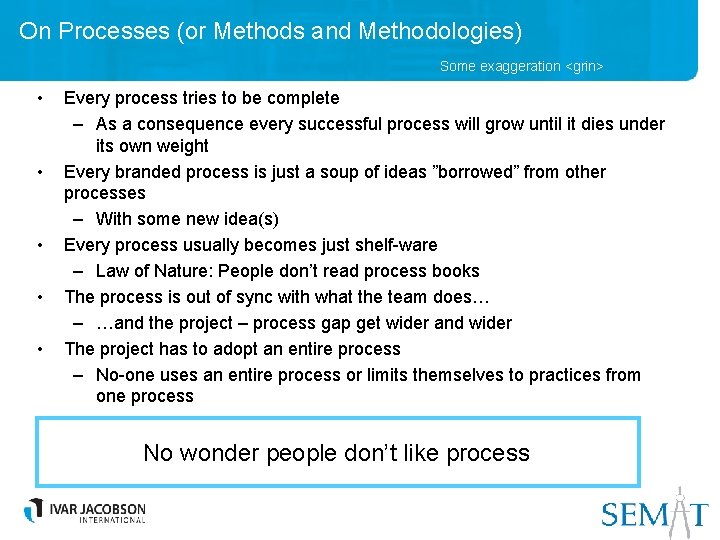
On Processes (or Methods and Methodologies) Some exaggeration <grin> • • • Every process tries to be complete – As a consequence every successful process will grow until it dies under its own weight Every branded process is just a soup of ideas ”borrowed” from other processes – With some new idea(s) Every process usually becomes just shelf-ware – Law of Nature: People don’t read process books The process is out of sync with what the team does… – …and the project – process gap get wider and wider The project has to adopt an entire process – No-one uses an entire process or limits themselves to practices from one process No wonder people don’t like process
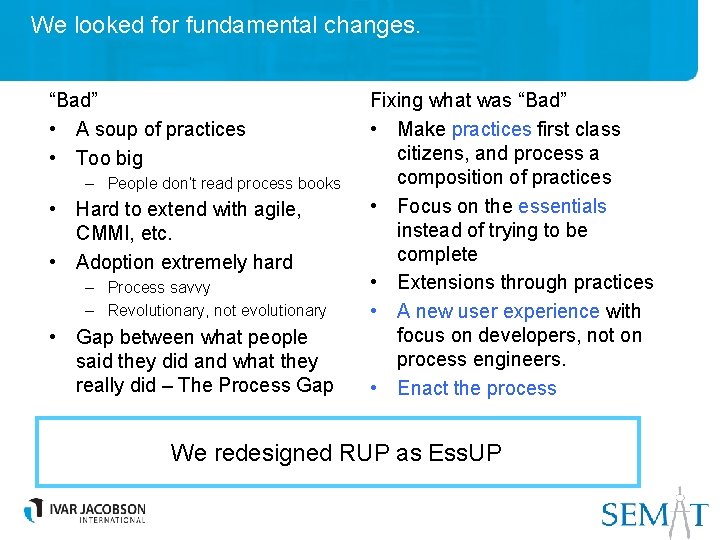
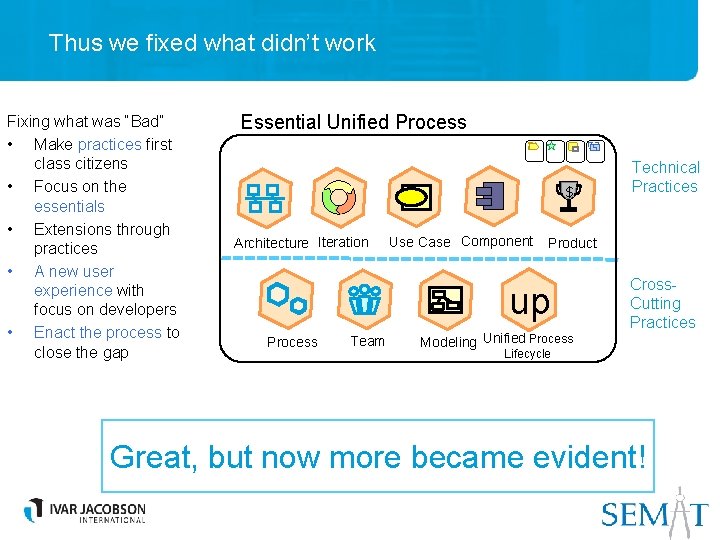
We looked for fundamental changes. “Bad” • A soup of practices • Too big – People don’t read process books • Hard to extend with agile, CMMI, etc. • Adoption extremely hard – Process savvy – Revolutionary, not evolutionary • Gap between what people said they did and what they really did – The Process Gap Fixing what was “Bad” • Make practices first class citizens, and process a composition of practices • Focus on the essentials instead of trying to be complete • Extensions through practices • A new user experience with focus on developers, not on process engineers. • Enact the process We redesigned RUP as Ess. UP
Agenda • On what went well and what went wrong • Addressing what went wrong 1. 2. 3. 4. • • Practices A new user experience Practices are not dead, they are enacted Result There must be a kernel The Semat kernel: track 3 and 4 If successful what impact can we expect? Wrap up
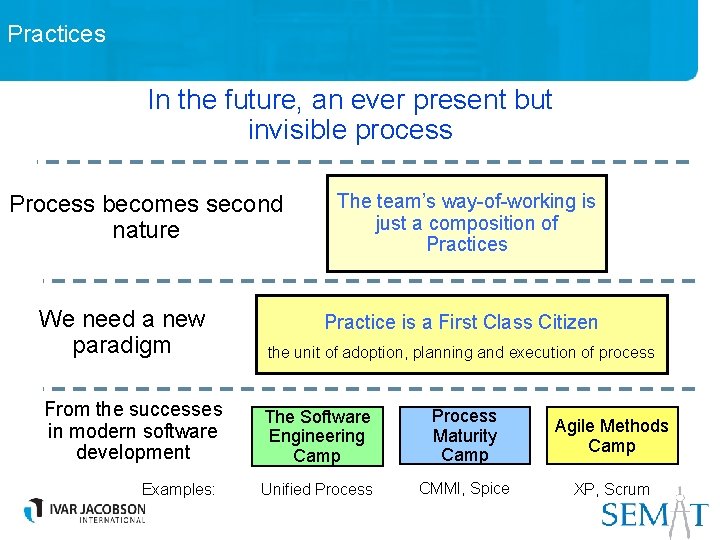
Practices In the future, an ever present but invisible process Process becomes second nature The team’s way-of-working is just a composition of Practices We need a new paradigm the unit of adoption, planning and execution of process From the successes in modern software development The Software Engineering Camp Process Maturity Camp Agile Methods Camp Unified Process CMMI, Spice XP, Scrum Examples: Practice is a First Class Citizen
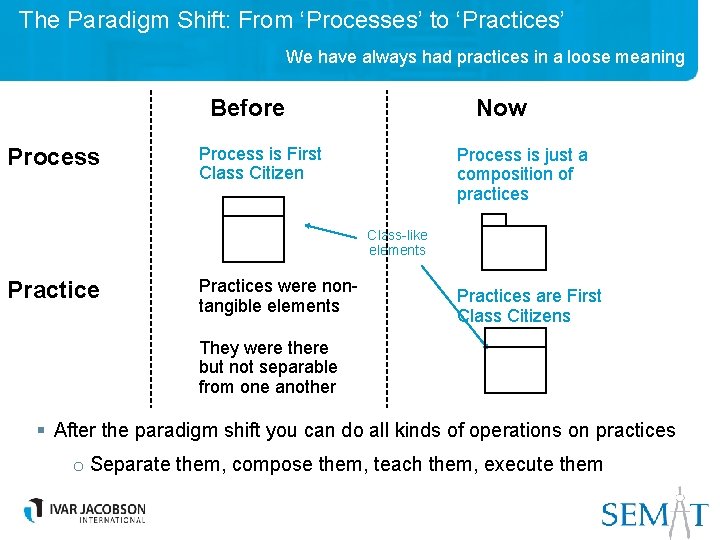
The Paradigm Shift: From ‘Processes’ to ‘Practices’ We have always had practices in a loose meaning Now Before Process is First Class Citizen Process is just a composition of practices Class-like elements Practices were nontangible elements Practices are First Class Citizens They were there but not separable from one another § After the paradigm shift you can do all kinds of operations on practices o Separate them, compose them, teach them, execute them
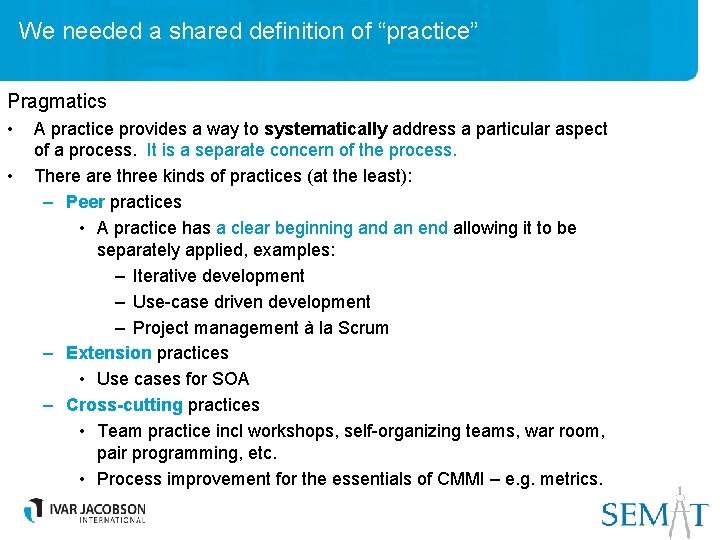
We needed a shared definition of “practice” Pragmatics • • A practice provides a way to systematically address a particular aspect of a process. It is a separate concern of the process. There are three kinds of practices (at the least): – Peer practices • A practice has a clear beginning and an end allowing it to be separately applied, examples: – Iterative development – Use-case driven development – Project management à la Scrum – Extension practices • Use cases for SOA – Cross-cutting practices • Team practice incl workshops, self-organizing teams, war room, pair programming, etc. • Process improvement for the essentials of CMMI – e. g. metrics.
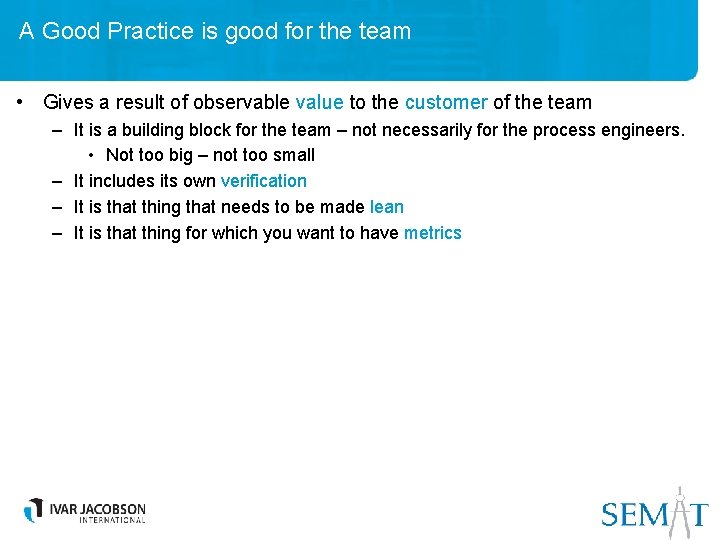
A Good Practice is good for the team • Gives a result of observable value to the customer of the team – It is a building block for the team – not necessarily for the process engineers. • Not too big – not too small – It includes its own verification – It is that thing that needs to be made lean – It is that thing for which you want to have metrics
Agenda • On what went well and what went wrong • Addressing what went wrong 1. 2. 3. 4. • • Practices A new user experience Practices are not dead, they are enacted Result There must be a kernel The Semat kernel: track 3 and 4 If successful what impact can we expect? Wrap up
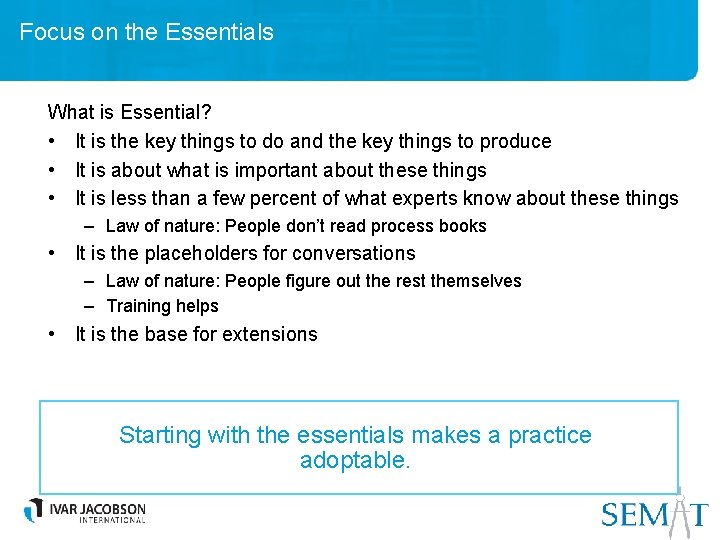
Focus on the Essentials What is Essential? • It is the key things to do and the key things to produce • It is about what is important about these things • It is less than a few percent of what experts know about these things – Law of nature: People don’t read process books • It is the placeholders for conversations – Law of nature: People figure out the rest themselves – Training helps • It is the base for extensions Starting with the essentials makes a practice adoptable.
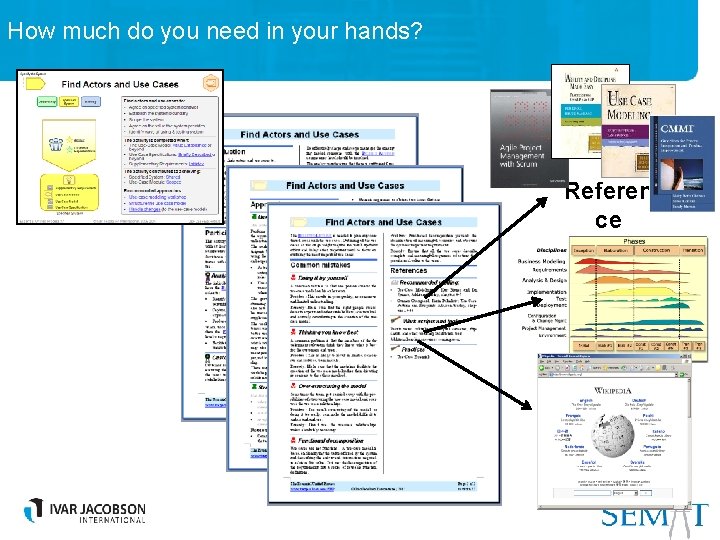
How much do you need in your hands? Referen ce books
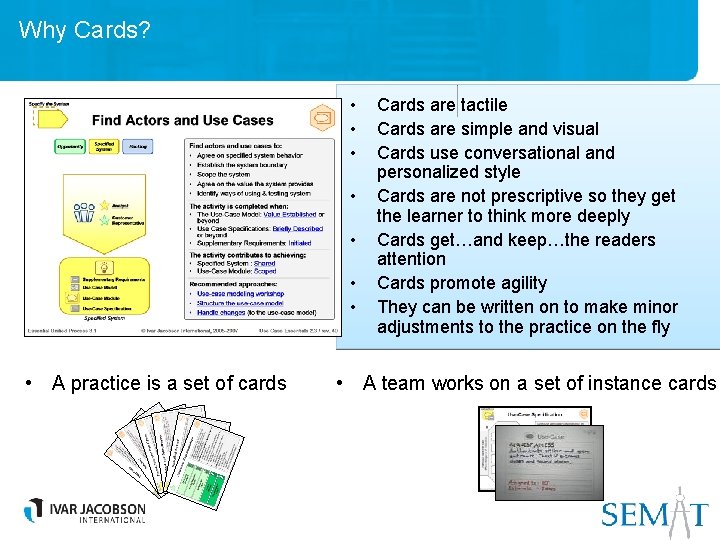
Why Cards? • • A practice is a set of cards Cards are tactile Cards are simple and visual Cards use conversational and personalized style Cards are not prescriptive so they get the learner to think more deeply Cards get…and keep…the readers attention Cards promote agility They can be written on to make minor adjustments to the practice on the fly • A team works on a set of instance cards
Agenda • On what went well and what went wrong • Addressing what went wrong 1. 2. 3. 4. • • Practices A new user experience Practices are not dead, they are enacted Result There must be a kernel The Semat kernel: track 3 and 4 If successful what impact can we expect? Wrap up
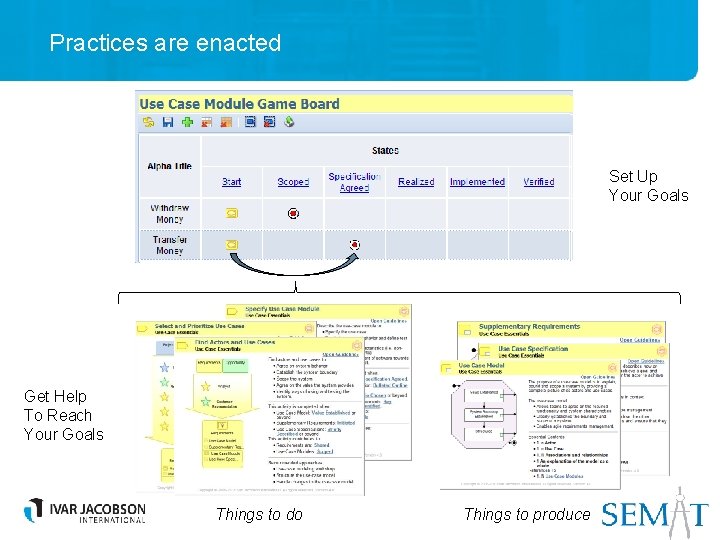
Practices are enacted Set Up Your Goals Get Help To Reach Your Goals Things to do Things to produce
Agenda • On what went well and what went wrong • Addressing what went wrong 1. 2. 3. 4. • • Practices A new user experience Practices are not dead, they are enacted Result There must be a kernel The Semat kernel: track 3 and 4 If successful what impact can we expect? Wrap up
Thus we fixed what didn’t work Fixing what was “Bad” • Make practices first class citizens • Focus on the essentials • Extensions through practices • A new user experience with focus on developers • Enact the process to close the gap Essential Unified Process $ Architecture Iteration Use Case Component Product up up Process Team Technical Practices Modeling Unified Process Cross. Cutting Practices Lifecycle Great, but now more became evident!
Agenda • On what went well and what went wrong • Addressing what went wrong 1. 2. 3. 4. • • Practices A new user experience Practices are not dead, they are enacted Result There must be a kernel The Semat kernel: track 3 and 4 If successful what impact can we expect? Wrap up
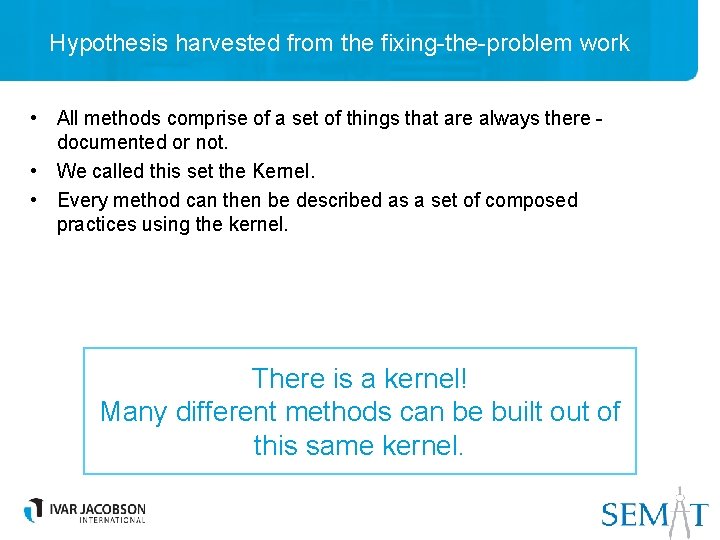
Hypothesis harvested from the fixing-the-problem work • All methods comprise of a set of things that are always there documented or not. • We called this set the Kernel. • Every method can then be described as a set of composed practices using the kernel. There is a kernel! Many different methods can be built out of this same kernel.
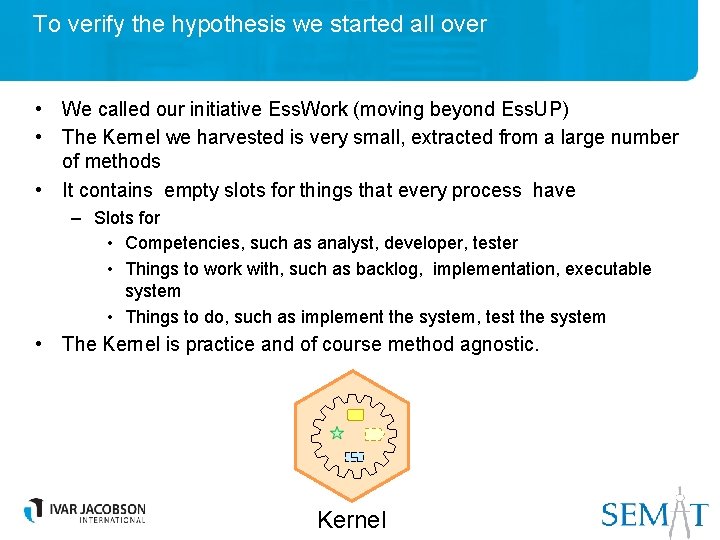
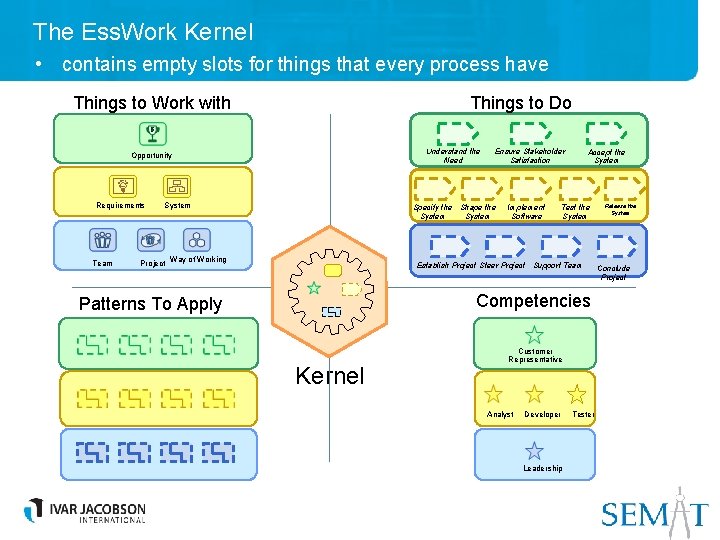
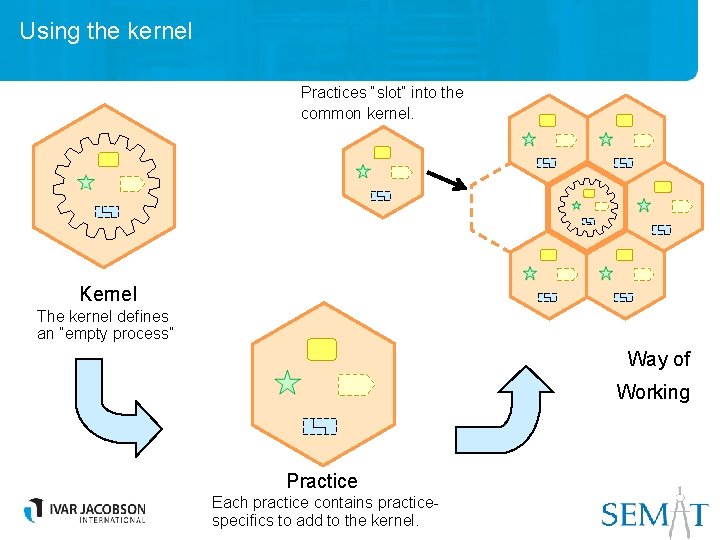
To verify the hypothesis we started all over • We called our initiative Ess. Work (moving beyond Ess. UP) • The Kernel we harvested is very small, extracted from a large number of methods • It contains empty slots for things that every process have – Slots for • Competencies, such as analyst, developer, tester • Things to work with, such as backlog, implementation, executable system • Things to do, such as implement the system, test the system • The Kernel is practice and of course method agnostic. Kernel
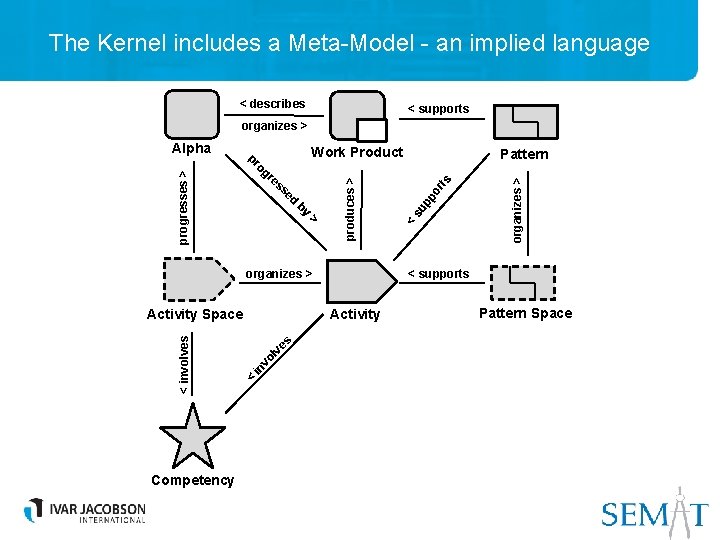
The Kernel includes a Meta-Model - an implied language < describes < supports organizes > Work Product by > < supports organizes > Competency in vo lv es Activity < < involves Activity Space organizes > ed rts ss pp o progresses > re Pattern su og < pr produces > Alpha Pattern Space
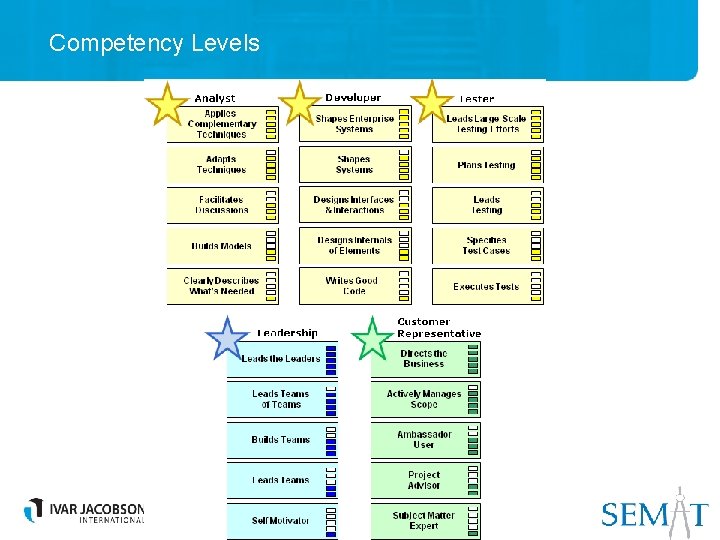
The Ess. Work Kernel • contains empty slots for things that every process have Things to Work with Things to Do Understand the Need Opportunity Requirements Team System Ensure Stakeholder Satisfaction Specify the Shape the System Project Way of Working Implement Software Accept the System Test the System Establish Project Steer Project Support Team Competencies Patterns To Apply Kernel Customer Representative Analyst Developer Leadership Tester Release the System Conclude Project
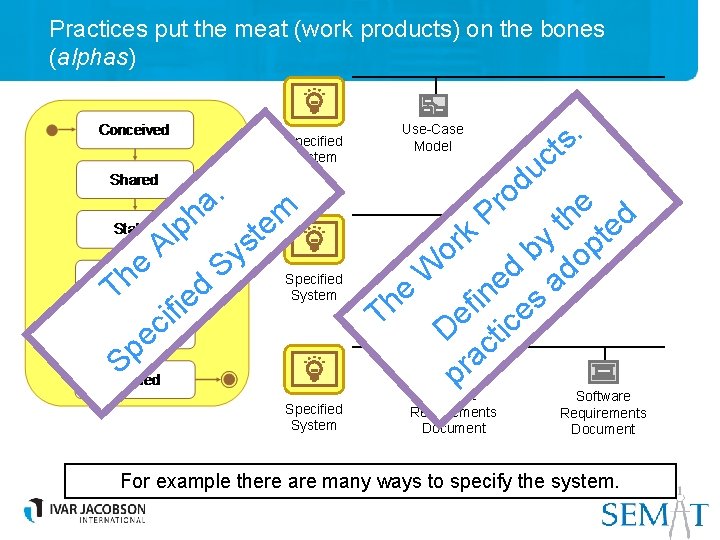
Practices put the meat (work products) on the bones (alphas) Specified System . a h e h T p l A c e Sp d e ifi t s Sy em Specified System . s t Use-Case Model c u d o r P e d h t te k y p r b o o User Stories d d W e a e n i es h f T e D ctic a r p Product Software Requirements Document For example there are many ways to specify the system.
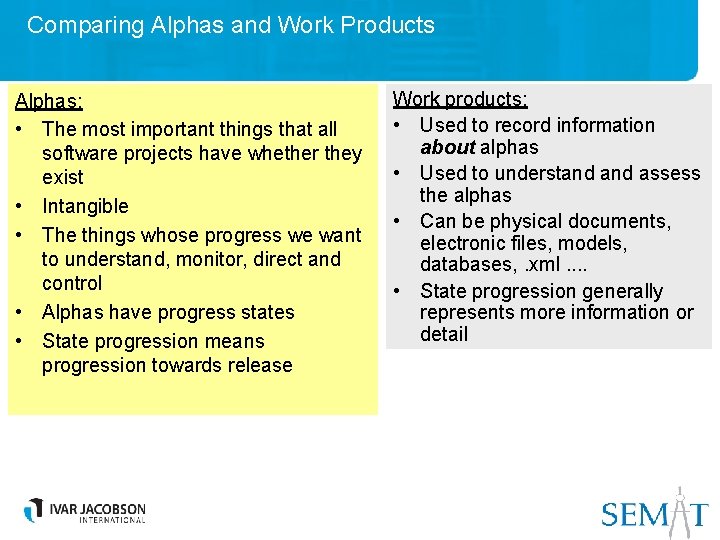
Comparing Alphas and Work Products Alphas: • The most important things that all software projects have whether they exist • Intangible • The things whose progress we want to understand, monitor, direct and control • Alphas have progress states • State progression means progression towards release Work products: • Used to record information about alphas • Used to understand assess the alphas • Can be physical documents, electronic files, models, databases, . xml. . • State progression generally represents more information or detail
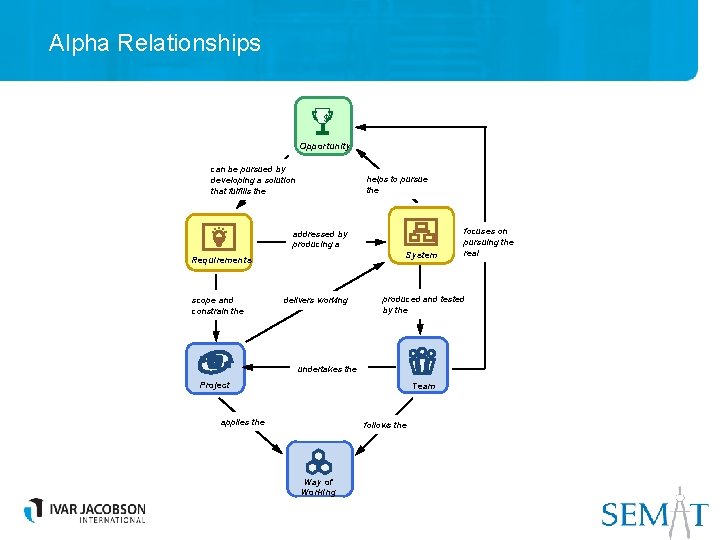
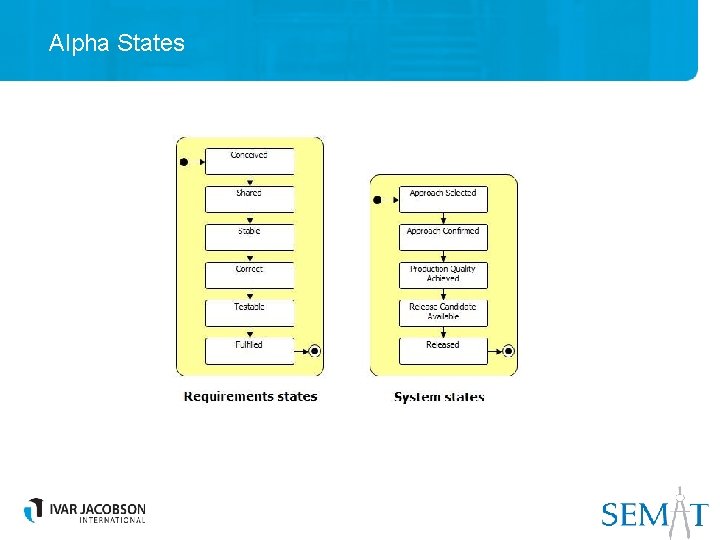
Things to Work with: Alphas and Work Products These are the alphas:
Alpha Relationships $ Opportunity can be pursued by developing a solution that fulfills the helps to pursue the addressed by producing a System Requirements scope and constrain the delivers working produced and tested by the undertakes the Project Team applies the follows the Way of Working focuses on pursuing the real
Alpha States
Competency Levels
Using the kernel Practices “slot” into the common kernel. Kernel The kernel defines an “empty process” Way of Working Practice Each practice contains practicespecifics to add to the kernel.
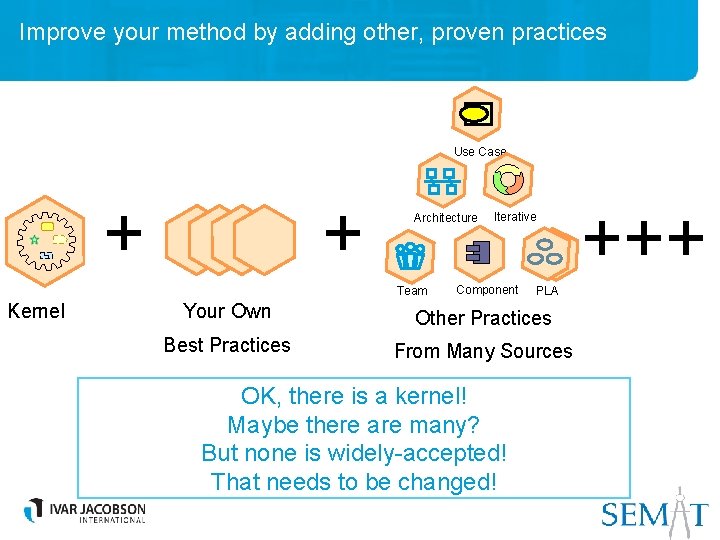
Change starts by harvesting your best practices from your own method + Kernel Your Own Best Practices
Improve your method by adding other, proven practices Use Case + + Architecture Team Kernel Iterative Component PLA Your Own Other Practices Best Practices From Many Sources OK, there is a kernel! Maybe there are many? But none is widely-accepted! That needs to be changed! +++
Agenda • On what went well and what went wrong • Addressing what went wrong 1. 2. 3. 4. • • Practices A new user experience Practices are not dead, they are enacted Result There must be a kernel The Semat kernel: track 3 and 4 If successful what impact can we expect? Wrap up
CASE FOR ACTION 2 nd part • We support a process to refound software engineering based on a solid theory, proven principles and best practices that: – – Include a kernel of widely-agreed elements, extensible for specific uses Addresses both technology and people issues Are supported by industry, academia, researchers and users Support extension in the face of changing requirements and technology The Kernel ≈ The Kernel Language + The Universals
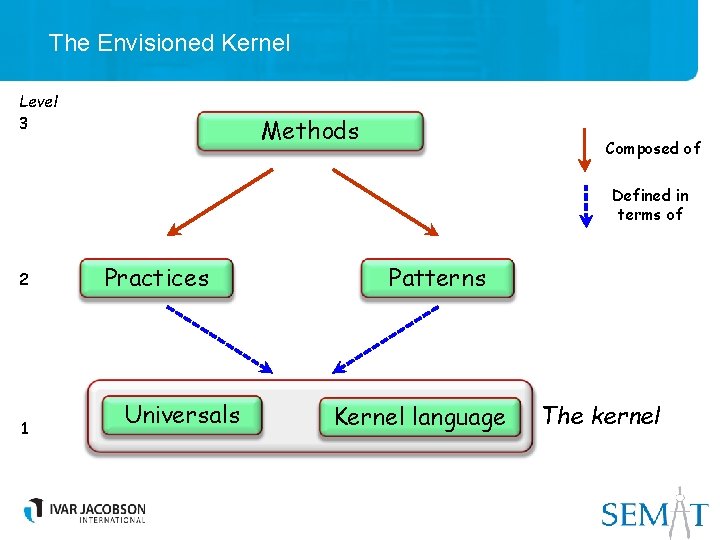
The Envisioned Kernel Level 3 Methods Composed of Defined in terms of 2 1 Practices Universals Patterns Kernel language The kernel
Agenda • On what went well and what went wrong • Addressing what went wrong 1. 2. 3. 4. • • Practices A new user experience Practices are not dead, they are enacted Result There must be a kernel The Semat kernel: track 3 and 4 If successful what impact can we expect? Wrap up
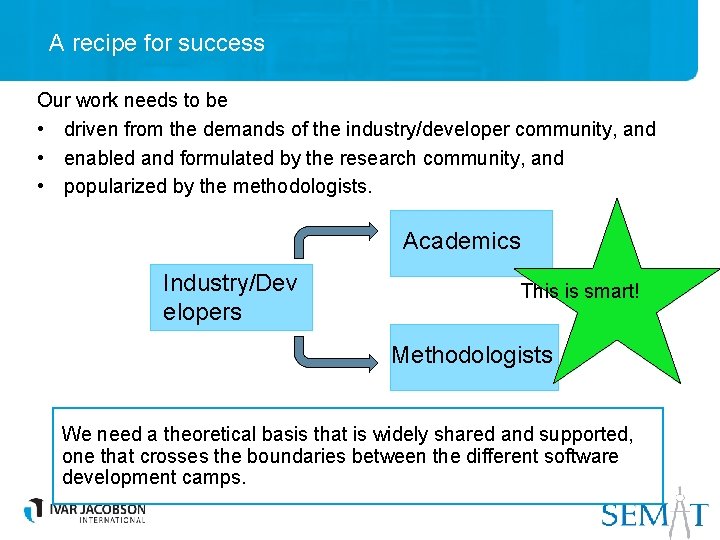
A recipe for success Our work needs to be • driven from the demands of the industry/developer community, and • enabled and formulated by the research community, and • popularized by the methodologists. Academics Industry/Dev elopers This is smart! Methodologists We need a theoretical basis that is widely shared and supported, one that crosses the boundaries between the different software development camps.
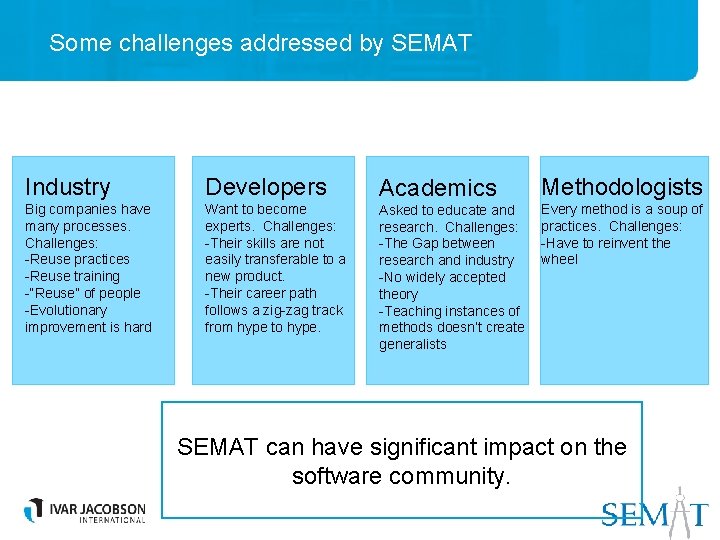
Some challenges addressed by SEMAT Industry Developers Academics Methodologists Big companies have many processes. Challenges: -Reuse practices -Reuse training -“Reuse” of people -Evolutionary improvement is hard Want to become experts. Challenges: -Their skills are not easily transferable to a new product. -Their career path follows a zig-zag track from hype to hype. Asked to educate and research. Challenges: -The Gap between research and industry -No widely accepted theory -Teaching instances of methods doesn’t create generalists Every method is a soup of practices. Challenges: -Have to reinvent the wheel SEMAT can have significant impact on the software community.
Signatories as of March 24, 2010 For current list, please see www. semat. org • • • • Pekka Abrahamsson, Scott Ambler, Victor Basili, Jean Bézivin, Dines Bjorner, Barry Boehm, Alan W. Brown, Larry Constantine, Bill Curtis, Donald Firesmith, Erich Gamma, Carlo Ghezzi, Tom Gilb, Ellen Gottesdiener, Sam Guckenheimer, David Harel • • • • Brian Henderson-Sellers, Watts Humphrey, Martin Griss, Capers Jones, Ivar Jacobson, Philippe Kruchten, Robert Martin, Stephen Mellor, Bertrand Meyer, James Odell, Meilir Page-Jones, Dieter Rombach, Ken Schwaber, Alec Sharp, Richard Soley. Ed Yourdan
Signatories as of March 24, 2010 For current list, please see www. semat. org • • • • Pekka Abrahamsson, Scott Ambler, Victor Basili, Jean Bézivin, Dines Bjorner, Barry Boehm, Alan W. Brown, Larry Constantine, Bill Curtis, Donald Firesmith, Erich Gamma, Carlo Ghezzi, Tom Gilb, Ellen Gottesdiener, Sam Guckenheimer, David Harel • • • • Brian Henderson-Sellers, Watts Humphrey, Martin Griss, Agile, Capers Jones, Ivar Jacobson, Iterative, Philippe Kruchten, RUP, Robert Martin, Computer Stephen Mellor, science, Bertrand Meyer, Metrics, James Odell, CMMI, Meilir Page-Jones, Etc. Dieter Rombach, Ken Schwaber, Alec Sharp, Richard Soley. Ed Yourdan
Corporate Signatories as of March 24, 2010 • ABB • Software Engineering Center Korea • Ericsson • Telecom Italia • Fujitsu UK • City of Toronto, Ontario • Microsoft, Spain • Wellpoint • SAAB • Samsung SDS For current list, please see www. semat. org
Agenda • On what went well and what went wrong • Addressing what went wrong 1. 2. 3. 4. • • Practices A new user experience Practices are not dead, they are enacted Result There must be a kernel The Semat kernel: track 3 and 4 If successful what impact can we expect? Wrap up
Final Words Semat is a fundamentally new way to address the needs of the industry, which needs enough governance but not more the developers, who need to select the practices they want the academics, who need to understand what the industry really needs the educators, who need to train software engineering in general and not just specific methods o the methodologists, who want to create new practices without reinventing the wheel. o o This is smart! Semat will refound software engineering as a mature discipline
ivar@ivarjacobson. com