
Software Engineering Institute Peking University An Architecture Based
| Software Engineering Institute | Peking University An Architecture Based Round-trip Approach towards Component Composition --Plan, Progress and Problems 2022/1/26
Agenda § An Overview of ABC Method § Round-trip Component Composition § Plan and Progress § Discussion sei@pku 2
Terminologies § ABC method – General: Architecture centric development, deployment and management of component based systems – Special: Architecture based component composition § Software Architecture (SA) – The structure of a software system – A bridge between requirements and implementation § Component Composition – Composing qualified, adapted or developed components into an application sei@pku 3
Motivation § From the perspective of Software Architecture research – A proper way to bring SA into implementation § From the perspective of component composition – A high-level guidance for composition – A bridge between requirements and implementation – An early inspection of the system sei@pku 4

Challenges for Component Composition § Technical challenges – Components interoperability – Resource management – Security, transaction… Component standards and middleware (J 2 EE) § Methodological challenges – How to get a right composition sei@pku 5
Right Composition § High-level constraints – Requirements – Design decision § Low-level constraints – Component standard – Middleware constraints – Assets limitation sei@pku 6
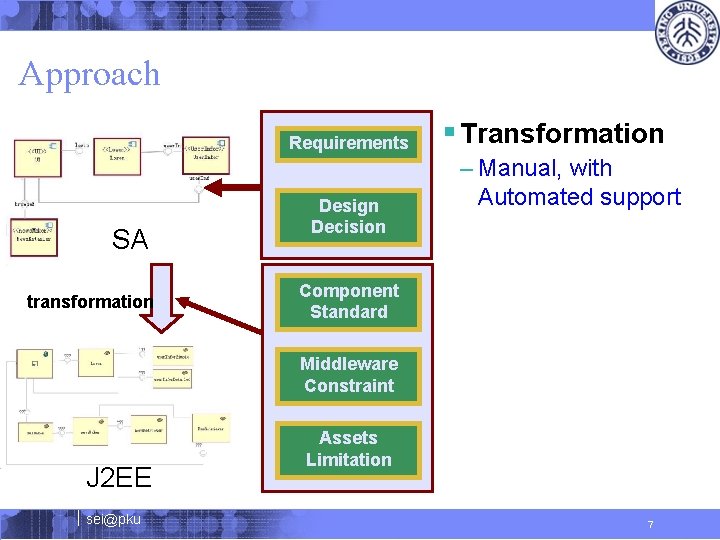
Approach Requirements SA transformation Design Decision § Transformation – Manual, with Automated support Component Standard Middleware Constraint J 2 EE sei@pku Assets Limitation 7
Discussion (1) § Ideally: a top-down approach – Designers concentrate on meeting requirements – “Composers” concentrate on meeting the design and in the mean time satisfying the low level constraints § Practically: some problems – Sometimes the design may be hard to well implement – Not well reuse component standard and middleware • “A language affects the way you think about programming”. So component standard and middleware also affect the design – Not considering the reusable implementation sei@pku 8
Discussion (2) § Previous solutions – Component adaptation and SA refactoring • By designers or composers? – Abstracting middleware elements into SA • Hard to construct the design model § Industrial approach – Designing directly on component standard – Using patterns to guide the designing A difficult task for a large system, but well for not-toolarge cases sei@pku 9
Agenda § An Overview of ABC Method § Round-trip Component Composition § Plan and Progress § Discussion sei@pku 10
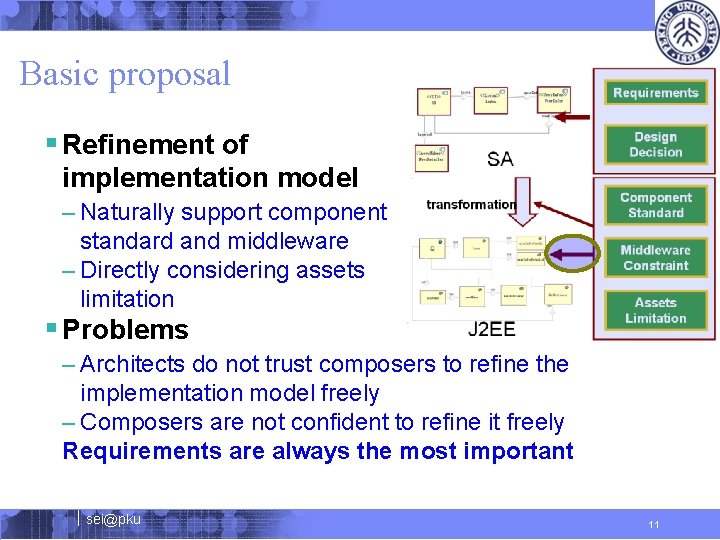
Basic proposal § Refinement of implementation model – Naturally support component standard and middleware – Directly considering assets limitation § Problems – Architects do not trust composers to refine the implementation model freely – Composers are not confident to refine it freely Requirements are always the most important sei@pku 11
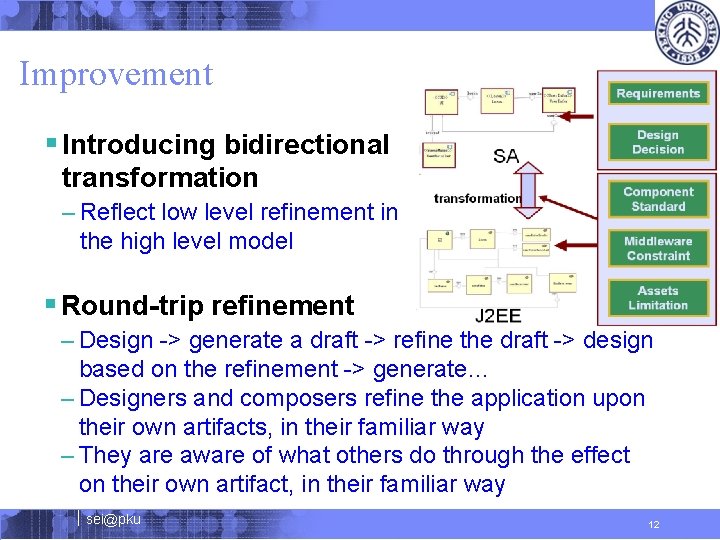
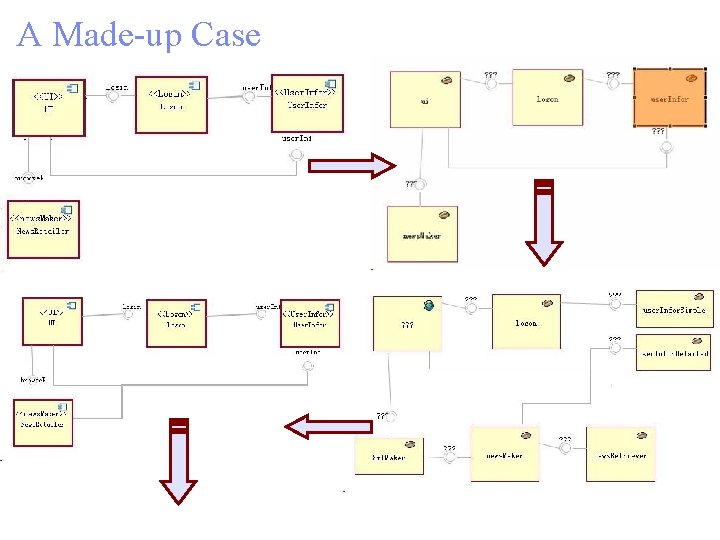
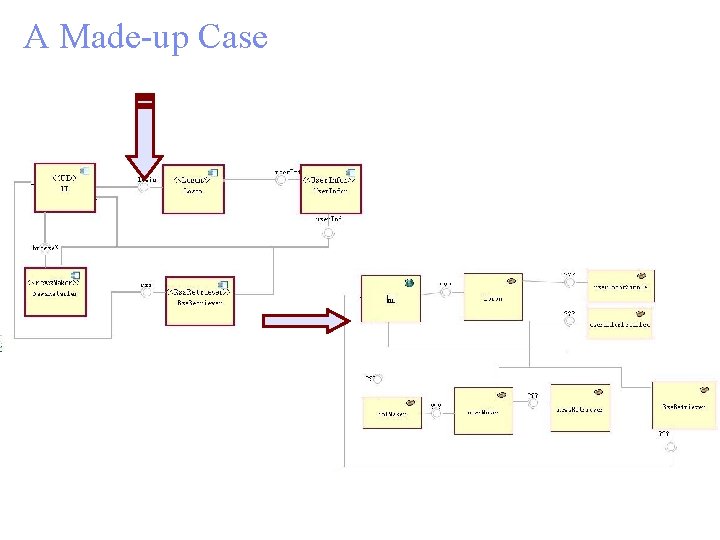
Improvement § Introducing bidirectional transformation – Reflect low level refinement in the high level model § Round-trip refinement – Design -> generate a draft -> refine the draft -> design based on the refinement -> generate… – Designers and composers refine the application upon their own artifacts, in their familiar way – They are aware of what others do through the effect on their own artifact, in their familiar way sei@pku 12
A Round-Trip Refinement Process § From the architect’s perspective – There may be some detailed decisions he need not to or can not consider, and he can leave them to composers – Review and reevaluate the reflected results from composer’s refinement and make further decision based on them § From the composer’s perspective – Refine the generated, draft implementation model according to implementation-level knowledge – Ask the architect to review or reevaluate his refinement sei@pku 13
A Made-up Case 14
A Made-up Case 15
Technology (1) § Bi-transformation between SA and J 2 EE – Language, tool, and rules § Why bi-transformation – Write forward and backward behavior at once – Guarantee that the user-defined rule be correct and stable • The two basic properties (GETPUT, PUTGET) sei@pku 16
Technology (2) § Cooperation between architects and composers – Based on a collaborative ABCTool • One user changes the model and commits it into CVS • Tool records relevant information with changes, like rationale • For other users, the tool checkout and encapsulate the changes into a special kind of elements, and the users can use these elements to understand the change – Using bi-transformation to support cooperation based on different artifacts • Reflect changes on one model into the other sei@pku 17
Agenda § An Overview of ABC Method § Round-trip Component Composition § Plan and Progress – Short-term plan – Current progress – Long-term plan § Discussion sei@pku 18
A Short-term Plan § A nontrivial case from architecture design to component composition (without round-trip) – Object application (Java Pet. Store) • The application may not affect the transformation very much – Software architecture model • ABC/ADL – Implementation model • J 2 EE component model – Transformation • ATL sei@pku 19
Current Progress § SA model – The current ABC/ADL carries little information – Need to extend it • Domain specific information (? ) § J 2 EE Model – From Eclipse Standard J 2 EE Tool • A component of Eclipse Web Technology Project – Directly mapped to J 2 EE deployment descriptor – Still need to investigate the ability of the tool § A prototype transformation sei@pku 20
Long-term Plan § A Round-trip refinement process between design model and implementation model – A bi-transformation language – A proper method – Experience § Investigate a similar way towards Bitransformation between requirement model and design model sei@pku 21
Agenda § An Overview of ABC Method § Round-trip Component Composition § Plan and Progress § Discussion – Technical problems we meet so far – Discussion about ongoing and further work sei@pku 22
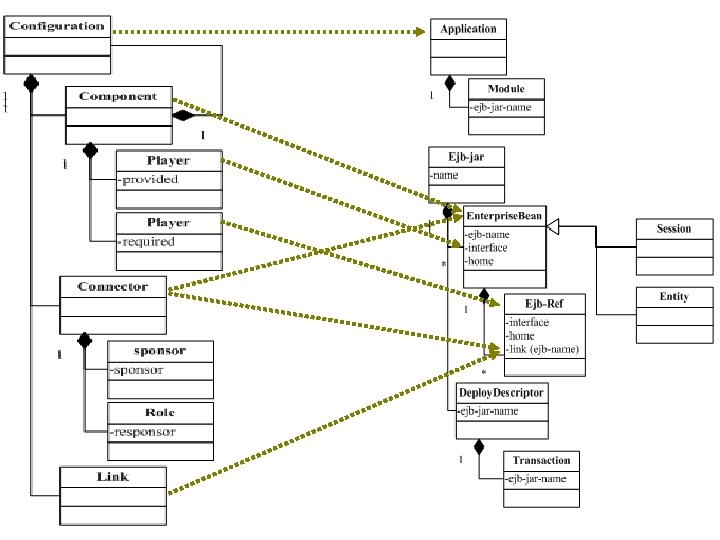
Technical Problems Overview § Technical Problems – Arise during our initial attempts – Mainly caused by the strange format of J 2 EE model • Directly mapped to J 2 EE description xml files – May be useful for designing synchronization mechanism between models § Overview – File split, Name reference, Many to one, One to Many, Hierarchical source model… sei@pku 23
24
Common Refinements § The obtained target model is just a draft § Composers may need such refinements – Complement attributes – Change attributes (adapt to the actual implementation) – Replace one draft ejb with more actual ones (each for a partial of the original function) – Introduce extra ejbs • For dependency of the selected ejb • For adaptation of the selected ejbs – Change the type of elements • Entity bean to session bean – Add extra links sei@pku 25
File Split § Cause – For J 2 EE model, each ejb-jar is described by an independent file – Transforming one file for SA model into many files for J 2 EE § Potential solution – Introducing an intermediate file sei@pku 26
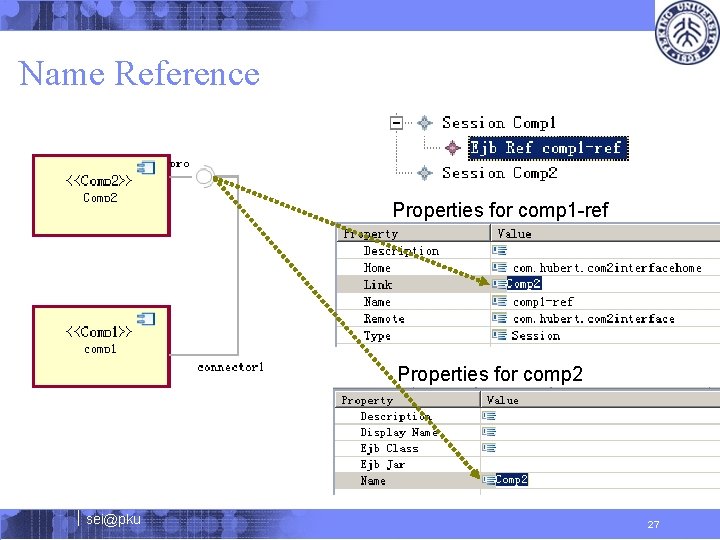
Name Reference Properties for comp 1 -ref Properties for comp 2 sei@pku 27
Name Reference § The Problem – Use attribute (not “id”) to express associations – Common in XML files § Implementation model – No mechanism to maintain the dependency between “link” and “name” • These two attributes have no dependency in J 2 EE model • Their dependency is defined by SA and the transformation – Use bi-transformation to maintain the dependency? • Change “name”? • Change “link”? sei@pku 28
Many to One and One to Many § Different types of source element may map to the same type of target elements – Components map to Enterprise. Beans – Complex Connectors map to Enterprise. Beans § The same type of source elements may map to different types of target elements – Components can map to Session or Entity – Connectors can map to Session or just Link attribute § How about the backward transformation? sei@pku 29
Hierarchical Source Model § Forward transformation: “flatten the SA” – Ignore combined components • Just transform the primitive components into ejbs • Maintain the correct connection – Transform combined components into proxy ejbs • The “inner” ejbs communicate with “outer” ones through this proxy § Backward transformation – Depends on the intention of composers sei@pku 30
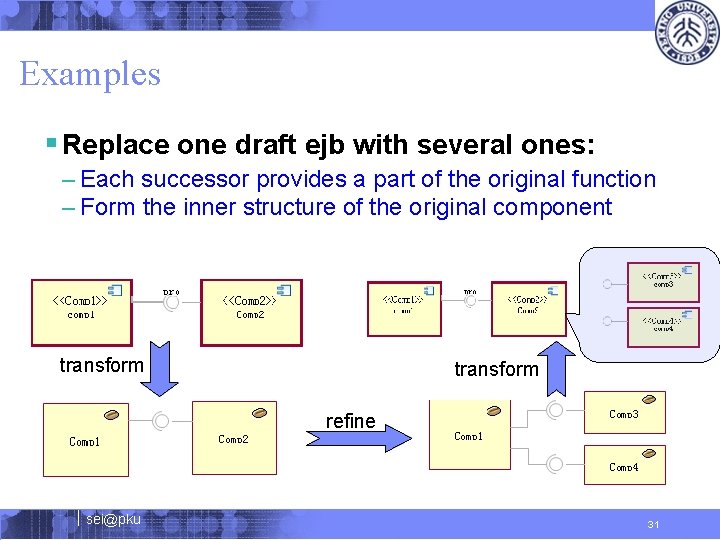
Examples § Replace one draft ejb with several ones: – Each successor provides a part of the original function – Form the inner structure of the original component transform refine sei@pku 31
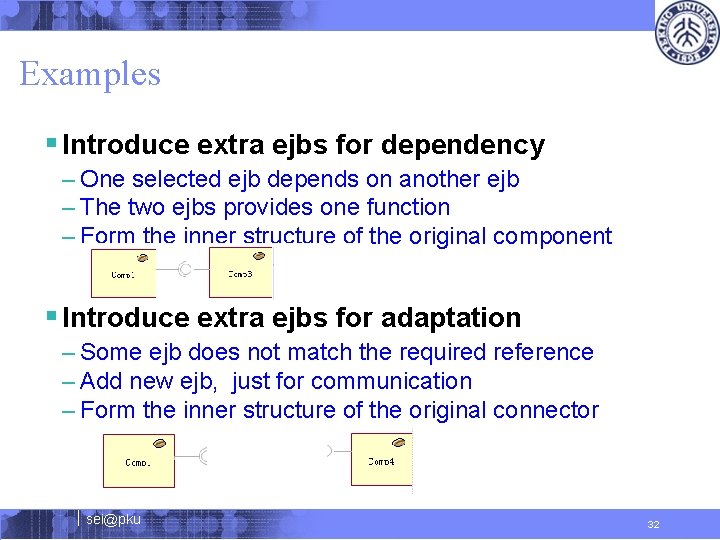
Examples § Introduce extra ejbs for dependency – One selected ejb depends on another ejb – The two ejbs provides one function – Form the inner structure of the original component § Introduce extra ejbs for adaptation – Some ejb does not match the required reference – Add new ejb, just for communication – Form the inner structure of the original connector sei@pku 32
Discussion on the Further Work § Primary task – Complete the current transformation § Further Work – Try to achieve a usable round-trip refinement process between SA and J 2 EE • SA is still not so practical (to add much information) • J 2 EE is hard to use (consider other implementation platform? ) • The whole process is hard to formalize and generalize – An architecture guided J 2 EE development tool? • Base on an existing J 2 EE development environment sei@pku 33
Discussion on the Further Work § Further work (continue. . . ) – Turn to common round-trip engineering between PIM and PSM • Extract some general problems for common round-trip engineering in MDA • Support cooperation based on heterogeneous artifacts – Focus on some of the technical problems • Name reference or hierarchy relevant problems • Try to find formal description and novel solution § Need further discussions sei@pku 34

| Software Engineering Institute | Peking University Thank you! 2022/1/26
- Slides: 35