
Software Engineering COMP 201 Lecturer Sebastian Coope Ashton
Software Engineering COMP 201 Lecturer: Sebastian Coope Ashton Building, Room G. 18 E-mail: coopes@liverpool. ac. uk COMP 201 web-page: http: //www. csc. liv. ac. uk/~coopes/comp 201 Lecture 12 – Formal Specifications COMP 201 - Software Engineering 1
Recap on Formal Specification Objectives: �To explain why formal specification techniques help discover problems in system requirements �To describe the use of: �algebraic techniques (for interface specification) and �model-based techniques (for behavioural specification) �To introduce Abstract State Machine Model (ASML) COMP 201 - Software Engineering 2
Behavioural Specification �Algebraic specification can be cumbersome when the object operations are not independent of the object state �Model-based specification exposes the system state and defines the operations in terms of changes to that state COMP 201 - Software Engineering 3
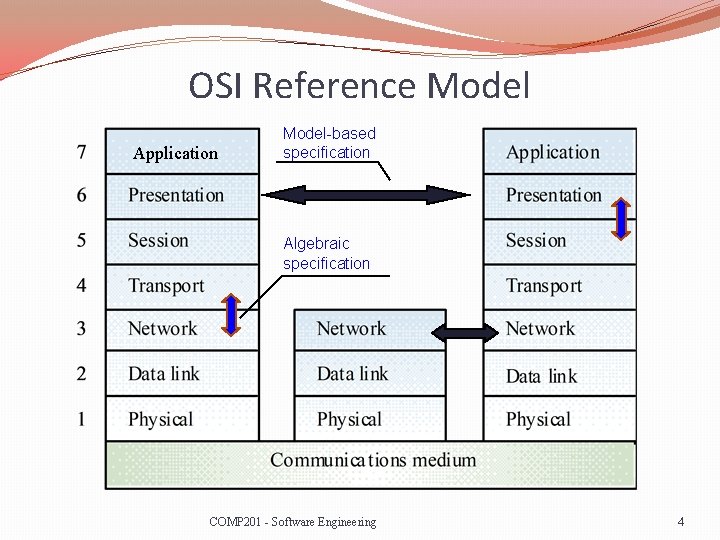
OSI Reference Model Application Model-based specification Algebraic specification COMP 201 - Software Engineering 4
Abstract State Machine Language (Asm. L) �Asm. L is a language for modelling the structure and behaviour of digital systems. We will see a basic introduction to ASML and how some concepts can be encoded formally. � (We will not go into too many details but just see the overall format ASML uses). �Asm. L can be used to faithfully capture the abstract structure and step-wise behaviour of any discrete systems, including very complex ones such as: �Integrated circuits �Software components �Devices that combine both hardware and software COMP 201 - Software Engineering 5
Abstract State Machine Language �An Asm. L model is said to be abstract because it encodes only those aspects of the system’s structure that affect the behaviour being modelled The goal is to use the minimum amount of detail that accurately reproduces (or predicts) the behaviour of the system that we wish to model �This means we may obtain an overview of the system without becoming bogged down in irrelevant implementation details and concentrate on important concerns such as concurrency. COMP 201 - Software Engineering 6
Abstract State Machine Language �Abstraction helps us reduce complex problems into manageable units and prevents us from getting lost in a sea of details Asm. L provides a variety of features that allows us to describe the relevant state of a system in a very economical and high-level way COMP 201 - Software Engineering 7
Abstract State Machines and Turing Machines �An abstract state machine is a particular kind of mathematical machine, like a Turing machine (TM) �But unlike a TM, abstract state machines may be defined by a very high level of abstraction �An easy way to understand ASMs is to see them as defining a succession of states that may follow an initial state COMP 201 - Software Engineering 8
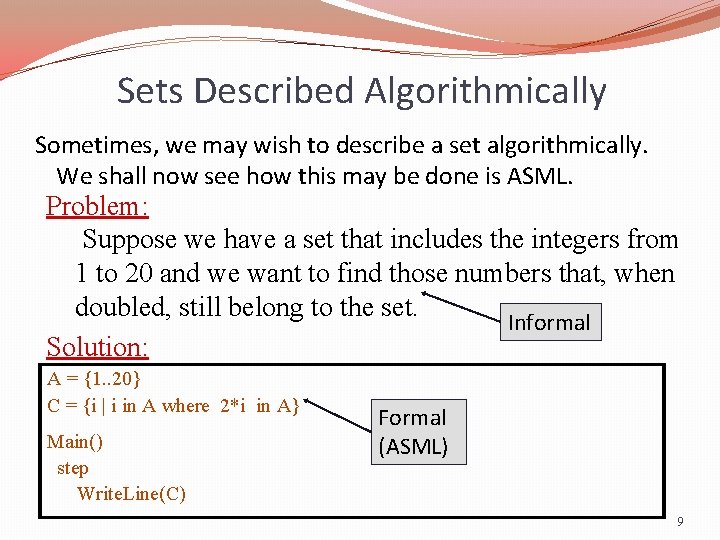
Sets Described Algorithmically Sometimes, we may wish to describe a set algorithmically. We shall now see how this may be done is ASML. Problem: Suppose we have a set that includes the integers from 1 to 20 and we want to find those numbers that, when doubled, still belong to the set. Informal Solution: A = {1. . 20} C = {i | i in A where 2*i in A} Main() step Write. Line(C) Formal (ASML) 9
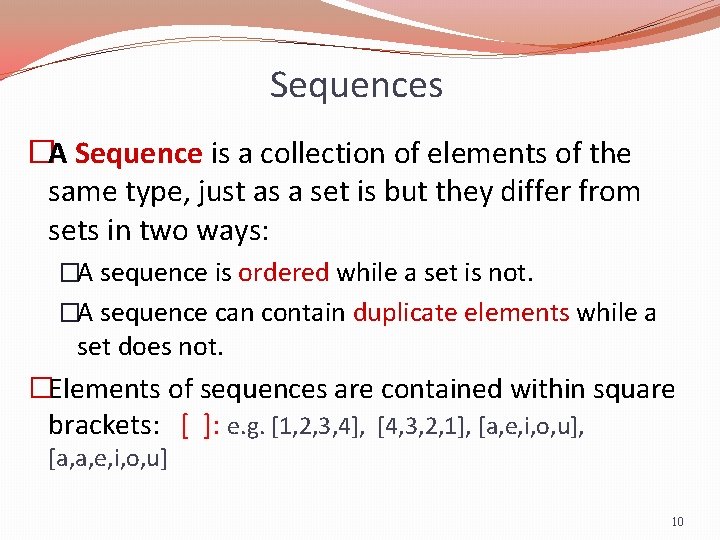
Sequences �A Sequence is a collection of elements of the same type, just as a set is but they differ from sets in two ways: �A sequence is ordered while a set is not. �A sequence can contain duplicate elements while a set does not. �Elements of sequences are contained within square brackets: [ ]: e. g. [1, 2, 3, 4], [4, 3, 2, 1], [a, e, i, o, u], [a, a, e, i, o, u] 10
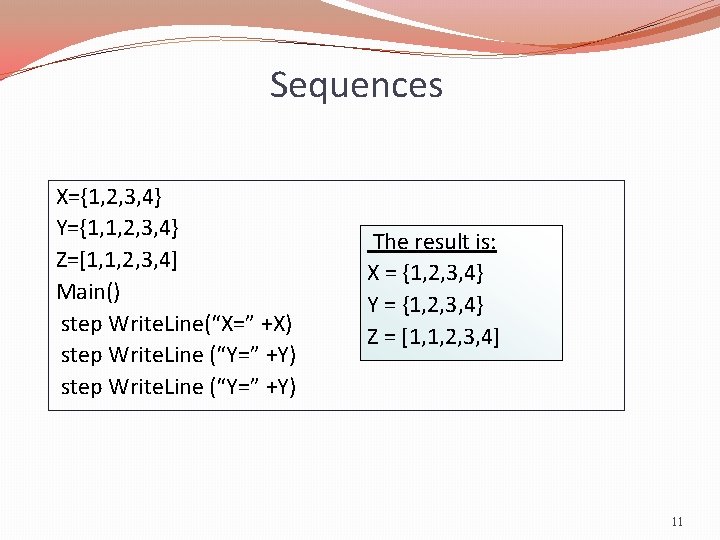
Sequences X={1, 2, 3, 4} Y={1, 1, 2, 3, 4} Z=[1, 1, 2, 3, 4] Main() step Write. Line(“X=” +X) step Write. Line (“Y=” +Y) The result is: X = {1, 2, 3, 4} Y = {1, 2, 3, 4} Z = [1, 1, 2, 3, 4] 11
SORT Algorithm We shall now consider a simple specification of a one-swapat-a-time sorting algorithm and how it can be written in ASML. COMP 201 - Software Engineering 12
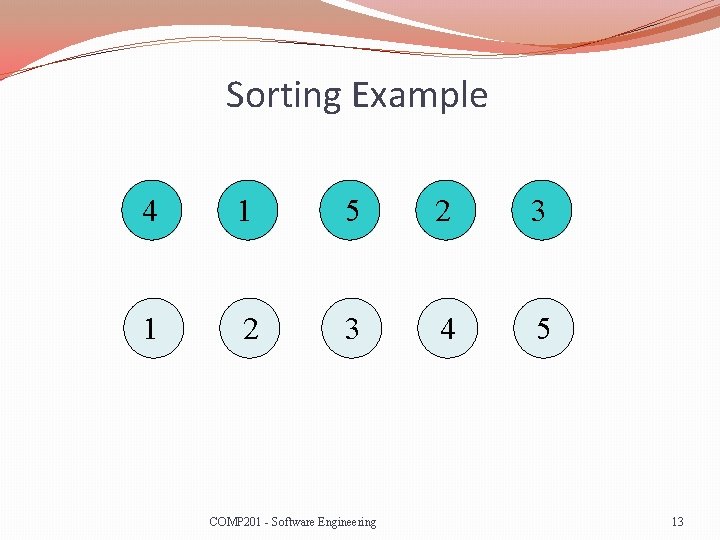
Sorting Example 4 1 5 2 3 1 2 3 4 5 COMP 201 - Software Engineering 13
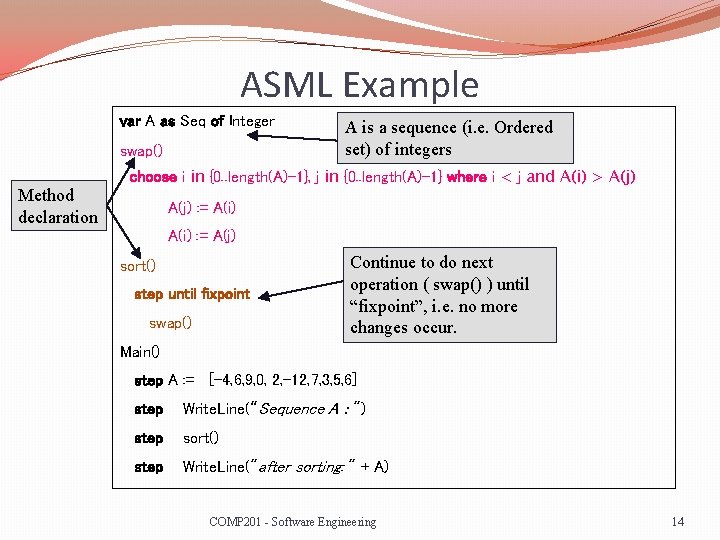
ASML Example var A as Seq of Integer swap() Method declaration A is a sequence (i. e. Ordered set) of integers choose i in {0. . length(A)-1}, j in {0. . length(A)-1} where i < j and A(i) > A(j) : = A(i) : = A(j) sort() step until fixpoint swap() Continue to do next operation ( swap() ) until “fixpoint”, i. e. no more changes occur. Main() step A : = [-4, 6, 9, 0, 2, -12, 7, 3, 5, 6] step Write. Line(“Sequence A : ") step sort() step Write. Line("after sorting: " + A) COMP 201 - Software Engineering 14
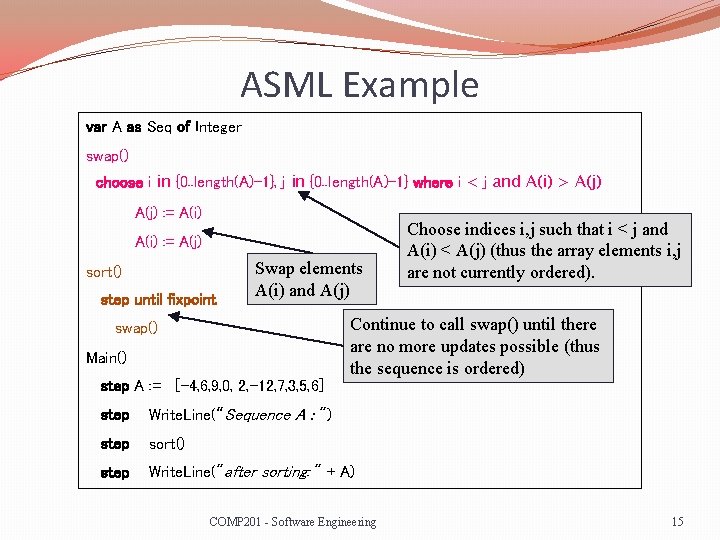
ASML Example var A as Seq of Integer swap() choose i in {0. . length(A)-1}, j in {0. . length(A)-1} where i < j and A(i) > A(j) : = A(i) : = A(j) sort() step until fixpoint Swap elements A(i) and A(j) swap() Main() step A : = [-4, 6, 9, 0, 2, -12, 7, 3, 5, 6] Choose indices i, j such that i < j and A(i) < A(j) (thus the array elements i, j are not currently ordered). Continue to call swap() until there are no more updates possible (thus the sequence is ordered) step Write. Line(“Sequence A : ") step sort() step Write. Line("after sorting: " + A) COMP 201 - Software Engineering 15
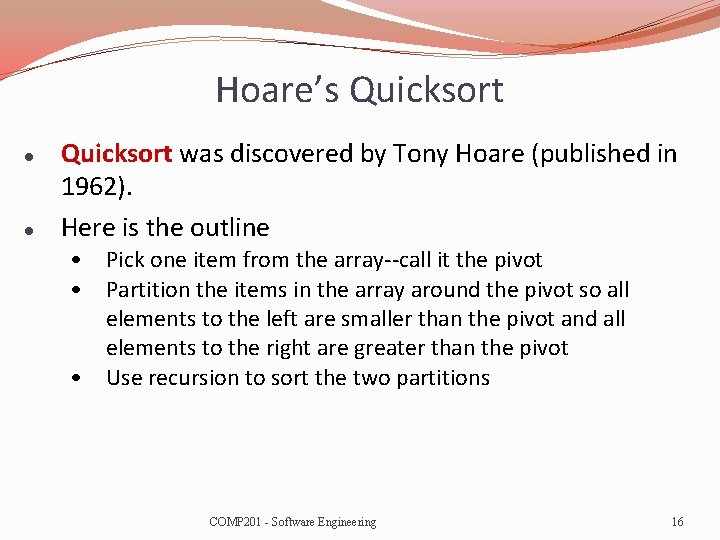
Hoare’s Quicksort l l Quicksort was discovered by Tony Hoare (published in 1962). Here is the outline • Pick one item from the array--call it the pivot • Partition the items in the array around the pivot so all elements to the left are smaller than the pivot and all elements to the right are greater than the pivot • Use recursion to sort the two partitions COMP 201 - Software Engineering 16
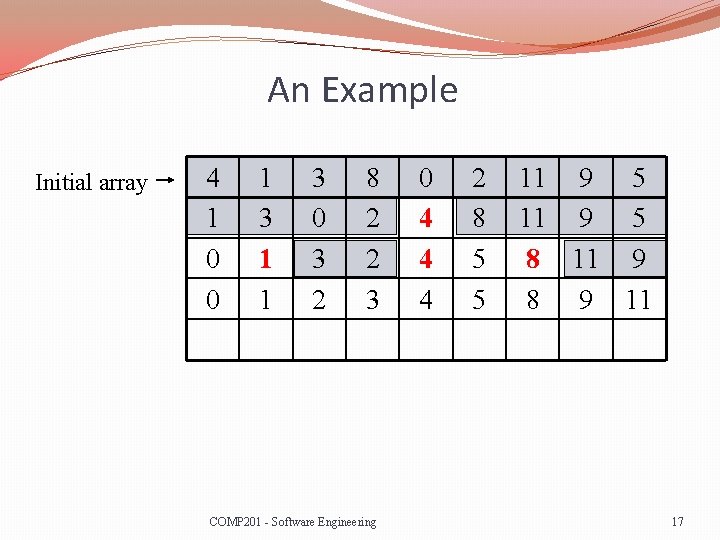
An Example Initial array 4 1 0 0 1 3 1 1 3 0 3 2 8 2 2 3 COMP 201 - Software Engineering 0 4 4 4 2 8 5 5 11 9 5 8 11 9 8 9 11 17
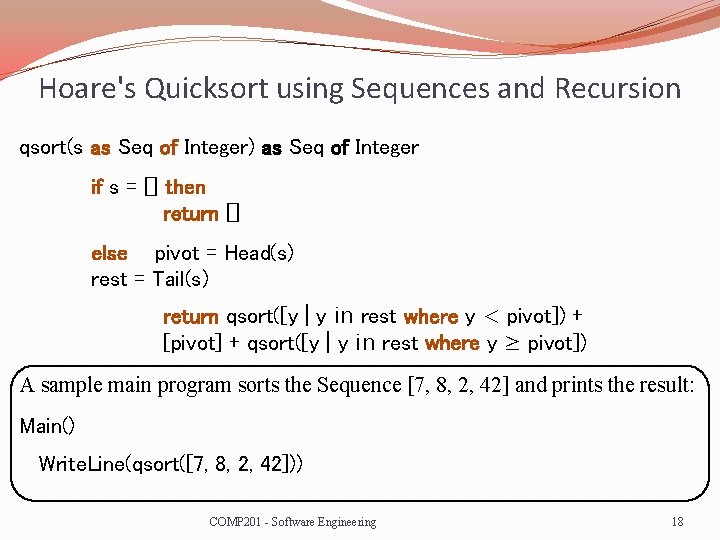
Hoare's Quicksort using Sequences and Recursion qsort(s as Seq of Integer) as Seq of Integer if s = [] then return [] else pivot = Head(s) rest = Tail(s) return qsort([y | y in rest where y < pivot]) + [pivot] + qsort([y | y in rest where y ≥ pivot]) A sample main program sorts the Sequence [7, 8, 2, 42] and prints the result: Main() Write. Line(qsort([7, 8, 2, 42])) COMP 201 - Software Engineering 18
Shortest Paths Algorithm l l l Specification of Shortest Paths from a given node s. The nodes of the graph are given as a set N. The distances between adjacent nodes are given by a map D, where D(n, m)=infinity denotes that the two nodes are not adjacent. COMP 201 - Software Engineering 19
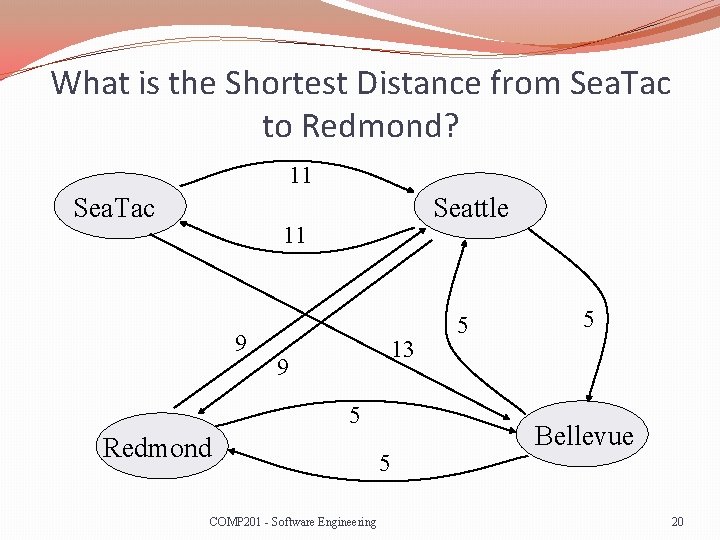
What is the Shortest Distance from Sea. Tac to Redmond? 11 Sea. Tac Seattle 11 9 13 9 5 Redmond COMP 201 - Software Engineering 5 5 5 Bellevue 20
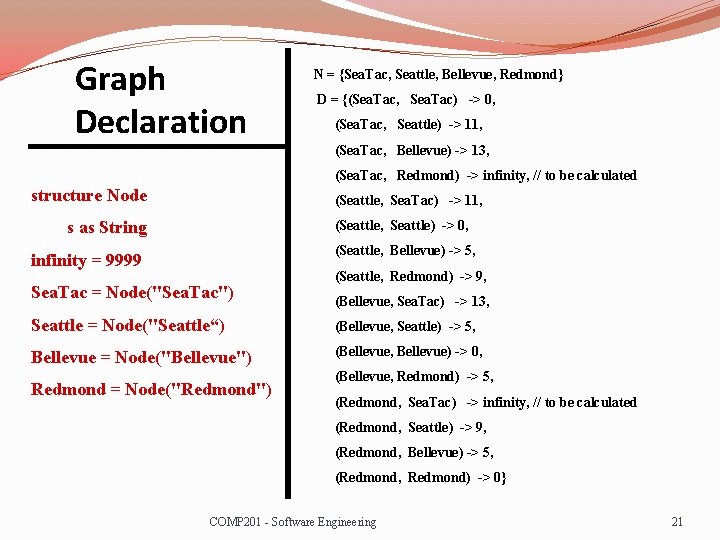
Graph Declaration N = {Sea. Tac, Seattle, Bellevue, Redmond} D = {(Sea. Tac, Sea. Tac) -> 0, (Sea. Tac, Seattle) -> 11, (Sea. Tac, Bellevue) -> 13, (Sea. Tac, Redmond) -> infinity, // to be calculated structure Node (Seattle, Sea. Tac) -> 11, s as String (Seattle, Seattle) -> 0, (Seattle, Bellevue) -> 5, infinity = 9999 Sea. Tac = Node("Sea. Tac") (Seattle, Redmond) -> 9, (Bellevue, Sea. Tac) -> 13, Seattle = Node("Seattle“) (Bellevue, Seattle) -> 5, Bellevue = Node("Bellevue") (Bellevue, Bellevue) -> 0, Redmond = Node("Redmond") (Bellevue, Redmond) -> 5, (Redmond, Sea. Tac) -> infinity, // to be calculated (Redmond, Seattle) -> 9, (Redmond, Bellevue) -> 5, (Redmond, Redmond) -> 0} COMP 201 - Software Engineering 21
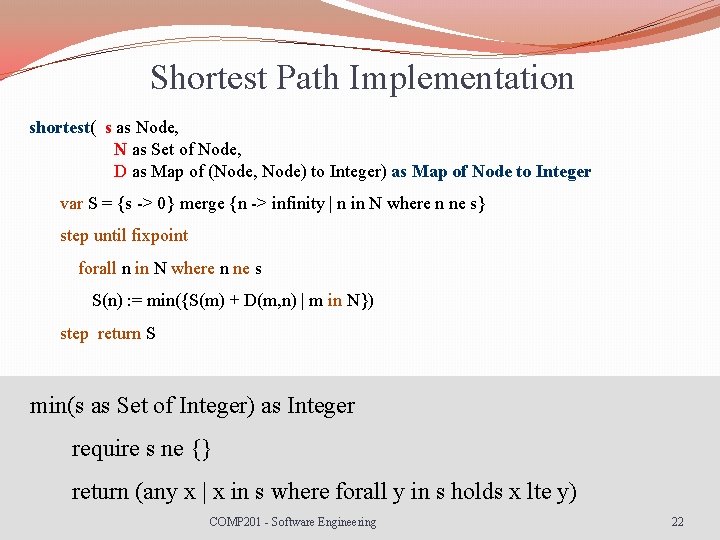
Shortest Path Implementation shortest( s as Node, N as Set of Node, D as Map of (Node, Node) to Integer) as Map of Node to Integer var S = {s -> 0} merge {n -> infinity | n in N where n ne s} step until fixpoint forall n in N where n ne s S(n) : = min({S(m) + D(m, n) | m in N}) step return S min(s as Set of Integer) as Integer require s ne {} return (any x | x in s where forall y in s holds x lte y) COMP 201 - Software Engineering 22
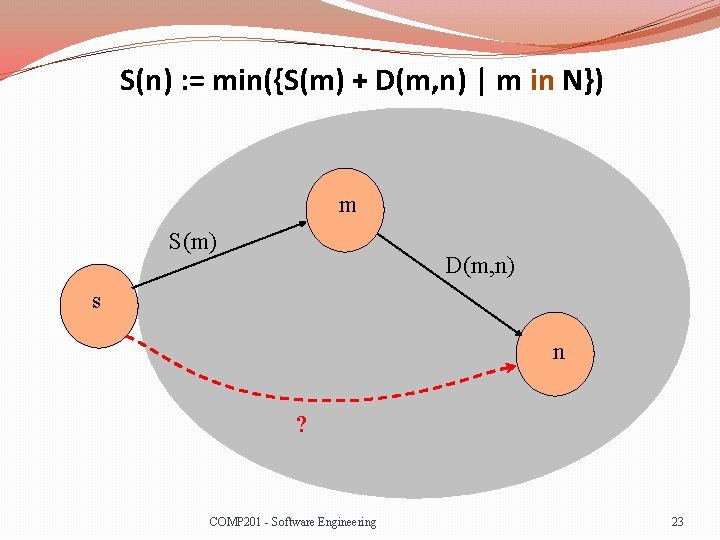
S(n) : = min({S(m) + D(m, n) | m in N}) m S(m) D(m, n) s n ? COMP 201 - Software Engineering 23
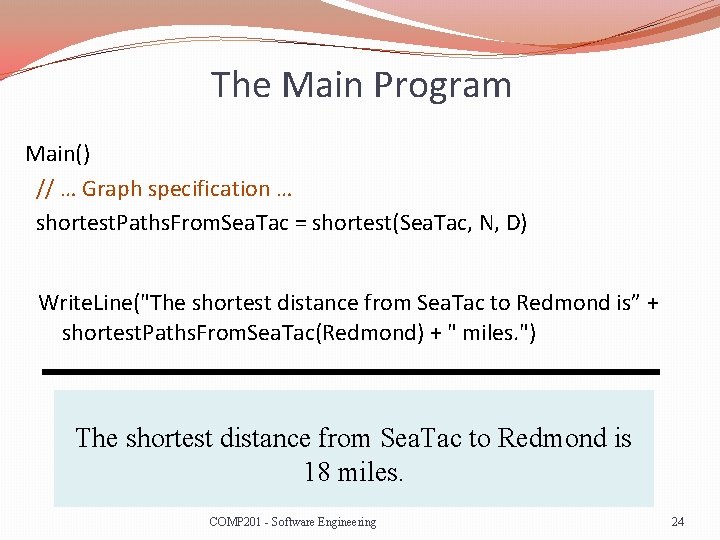
The Main Program Main() // … Graph specification … shortest. Paths. From. Sea. Tac = shortest(Sea. Tac, N, D) Write. Line("The shortest distance from Sea. Tac to Redmond is” + shortest. Paths. From. Sea. Tac(Redmond) + " miles. ") The shortest distance from Sea. Tac to Redmond is 18 miles. COMP 201 - Software Engineering 24
Lecture Key Points �Formal system specification complements informal specification techniques. �Formal specifications are precise and unambiguous. They remove areas of doubt in a specification. �Formal specification forces an analysis of the system requirements at an early stage. Correcting errors at this stage is cheaper than modifying a delivered system. �Formal specification techniques are most applicable in the development of critical systems and standards. COMP 201 - Software Engineering 25
Lecture Key Points �Algebraic techniques are suited to interface specification where the interface is defined as a set of object classes. �Model-based techniques model the system using sets and functions. This simplifies some types of behavioural specification. �Operations are defined in a model-based spec. by defining pre and post conditions on the system state. �Asm. L is a language for modelling the structure and behaviour of digital systems. COMP 201 - Software Engineering 26
- Slides: 26