
Software Engineering Classes and objects Object Oriented paradigm
Software Engineering Classes and objects
Object Oriented paradigm An approach to the solution of problems in which all computations are performed in the context of objects. • The objects are instances of classes, which: • A running program can be seen as a collection of objects collaborating to perform a given task © Lethbridge/Laganière 2001 Chapter 2: Review of Object Orientation 2
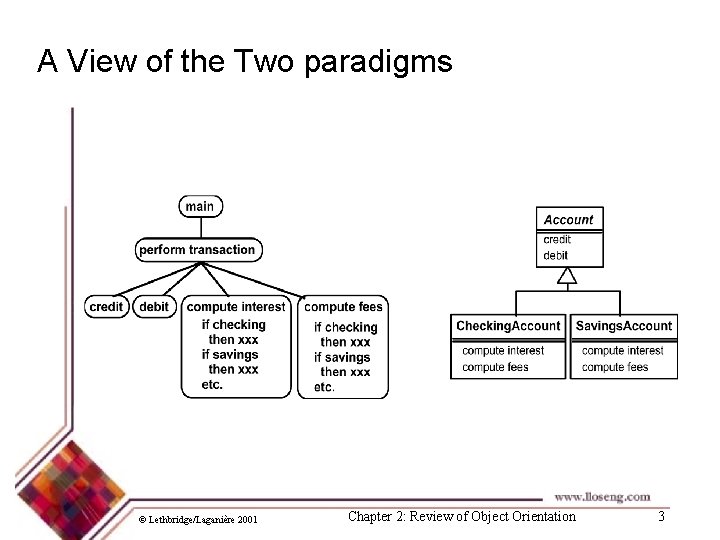
A View of the Two paradigms © Lethbridge/Laganière 2001 Chapter 2: Review of Object Orientation 3
2. 2 Classes and Objects Object • A chunk of structured data in a running software system • Has properties —Represent its state • Has behaviour —How it acts and reacts —May simulate the behaviour of an object in the real world © Lethbridge/Laganière 2001 Chapter 2: Review of Object Orientation 4
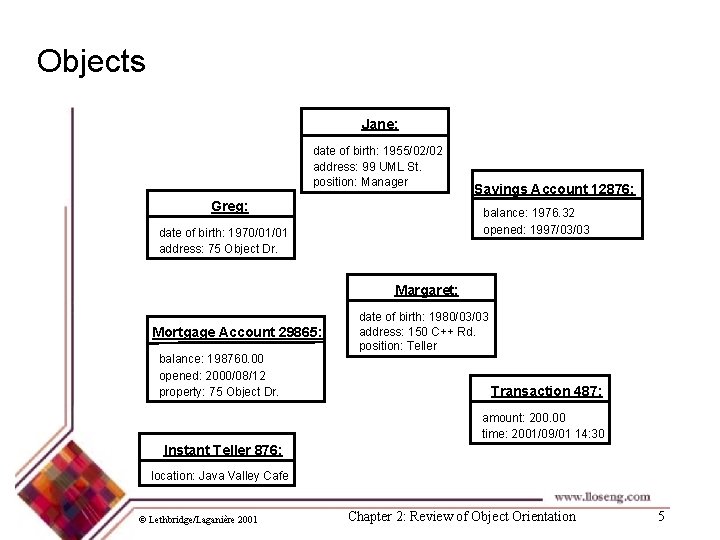
Objects Jane: date of birth: 1955/02/02 address: 99 UML St. position: Manager Greg: Savings Account 12876: balance: 1976. 32 opened: 1997/03/03 date of birth: 1970/01/01 address: 75 Object Dr. Margaret: Mortgage Account 29865: balance: 198760. 00 opened: 2000/08/12 property: 75 Object Dr. date of birth: 1980/03/03 address: 150 C++ Rd. position: Teller Transaction 487: amount: 200. 00 time: 2001/09/01 14: 30 Instant Teller 876: location: Java Valley Cafe © Lethbridge/Laganière 2001 Chapter 2: Review of Object Orientation 5
Classes A class: • Represents similar objects —Its instances • Is a kind of software module —Describes its instances’ structure (properties) —Contains methods to implement their behaviour © Lethbridge/Laganière 2001 Chapter 2: Review of Object Orientation 6
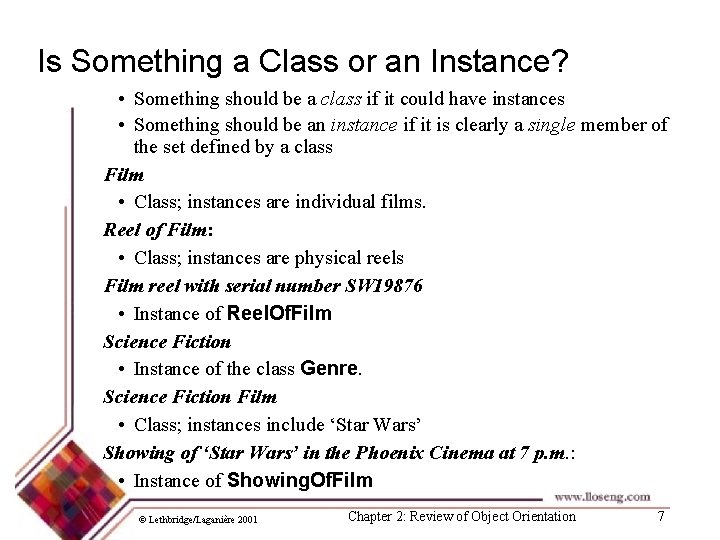
Is Something a Class or an Instance? • Something should be a class if it could have instances • Something should be an instance if it is clearly a single member of the set defined by a class Film • Class; instances are individual films. Reel of Film: • Class; instances are physical reels Film reel with serial number SW 19876 • Instance of Reel. Of. Film Science Fiction • Instance of the class Genre. Science Fiction Film • Class; instances include ‘Star Wars’ Showing of ‘Star Wars’ in the Phoenix Cinema at 7 p. m. : • Instance of Showing. Of. Film © Lethbridge/Laganière 2001 Chapter 2: Review of Object Orientation 7
Naming classes • Use capital letters —E. g. Bank. Account not bank. Account • Use singular nouns • Make sure the name has only one meaning —E. g. ‘bus’ has several meanings © Lethbridge/Laganière 2001 Chapter 2: Review of Object Orientation 8
2. 3 Instance Variables defined inside a class corresponding to data present in each instance • Attributes —Simple data —E. g. name, date. Of. Birth • Associations —Relationships to other important classes —E. g. supervisor, courses. Taken —More on these in Chapter 5 © Lethbridge/Laganière 2001 Chapter 2: Review of Object Orientation 9

Variables vs. Objects A variable • Refers to an object • May refer to different objects at different points in time An object can be referred to by several different variables at the same time Type of a variable • Determines what classes of objects it may contain © Lethbridge/Laganière 2001 Chapter 2: Review of Object Orientation 10
Class variables A class variable’s value is shared by all instances of a class. • Also called a static variable • If one instance sets the value of a class variable, then all the other instances see the same changed value. • Class variables are useful for: —Default or ‘constant’ values (e. g. PI) —Lookup tables and similar structures Caution: do not over-use class variables © Lethbridge/Laganière 2001 Chapter 2: Review of Object Orientation 11
2. 4 Methods, Operations and Polymorphism Operatio�n • A higher-level procedural abstraction that specifies a type of behaviour • Independent of any code which implements that behaviour —E. g. , calculating area (in general) © Lethbridge/Laganière 2001 Chapter 2: Review of Object Orientation 12
Methods, Operations and Polymorphism Method • A procedural abstraction used to implement the behaviour of a class. • Several different classes can have methods with the same name —They implement the same abstract operation in ways suitable to each class —E. g, calculating area in a rectangle is done differently from in a circle © Lethbridge/Laganière 2001 Chapter 2: Review of Object Orientation 13
2. 5 Organizing Classes into Inheritance Hierarchies Superclasses • Contain features common to a set of subclasses Inheritance hierarchies • Show the relationships among superclasses and subclasses • A triangle shows a generalization Inheritance • The implicit possession by all subclasses of features defined in its superclasses © Lethbridge/Laganière 2001 Chapter 2: Review of Object Orientation 14
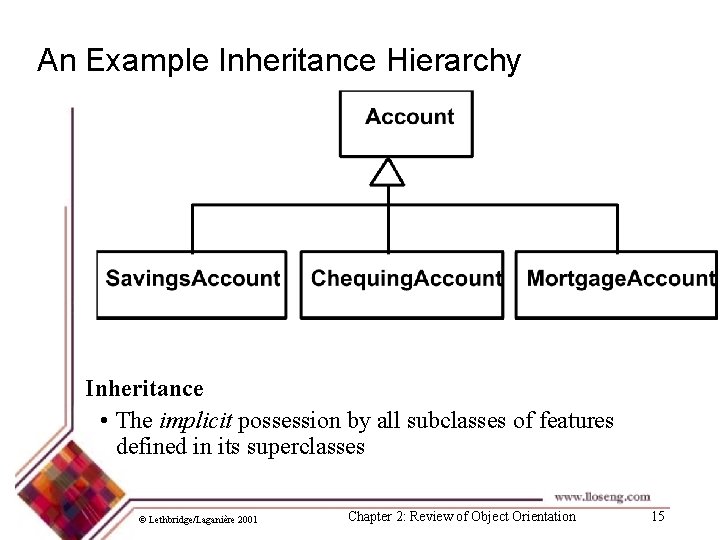
An Example Inheritance Hierarchy Inheritance • The implicit possession by all subclasses of features defined in its superclasses © Lethbridge/Laganière 2001 Chapter 2: Review of Object Orientation 15
The Isa Rule Always check generalizations to ensure they obey the isa rule • “A checking account is an account” • “An employee is a person” © Lethbridge/Laganière 2001 Chapter 2: Review of Object Orientation 16
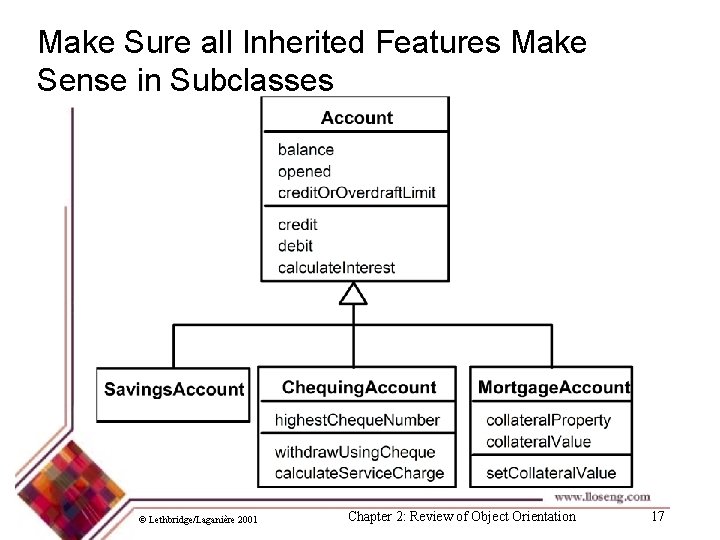
Make Sure all Inherited Features Make Sense in Subclasses © Lethbridge/Laganière 2001 Chapter 2: Review of Object Orientation 17
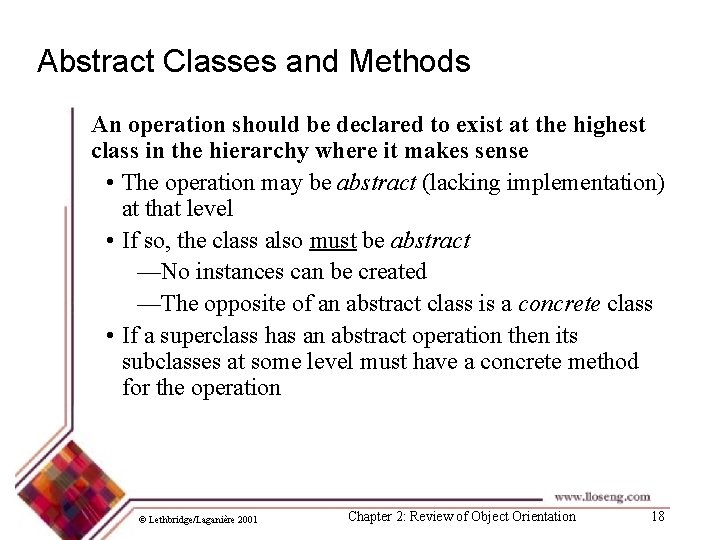
Abstract Classes and Methods An operation should be declared to exist at the highest class in the hierarchy where it makes sense • The operation may be abstract (lacking implementation) at that level • If so, the class also must be abstract —No instances can be created —The opposite of an abstract class is a concrete class • If a superclass has an abstract operation then its subclasses at some level must have a concrete method for the operation © Lethbridge/Laganière 2001 Chapter 2: Review of Object Orientation 18
Overriding A method would be inherited, but a subclass contains a new version instead © Lethbridge/Laganière 2001 Chapter 2: Review of Object Orientation 19
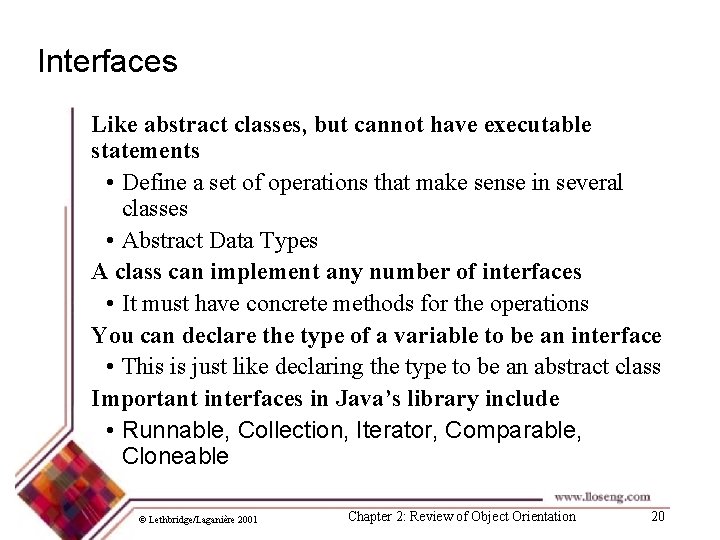
Interfaces Like abstract classes, but cannot have executable statements • Define a set of operations that make sense in several classes • Abstract Data Types A class can implement any number of interfaces • It must have concrete methods for the operations You can declare the type of a variable to be an interface • This is just like declaring the type to be an abstract class Important interfaces in Java’s library include • Runnable, Collection, Iterator, Comparable, Cloneable © Lethbridge/Laganière 2001 Chapter 2: Review of Object Orientation 20
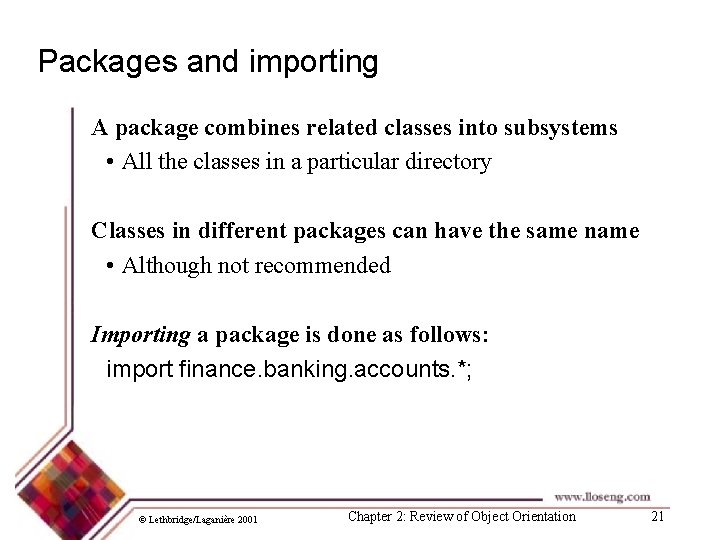
Packages and importing A package combines related classes into subsystems • All the classes in a particular directory Classes in different packages can have the same name • Although not recommended Importing a package is done as follows: import finance. banking. accounts. *; © Lethbridge/Laganière 2001 Chapter 2: Review of Object Orientation 21
Access control Applies to methods and variables • public —Any class can access • protected —Only code in the package, or subclasses can access • private —Only code written in the class can access —Inheritance still occurs! © Lethbridge/Laganière 2001 Chapter 2: Review of Object Orientation 22
- Slides: 22