
Software Engineering Basics 1 SE Basics 1 Progression
Software Engineering Basics 1. S/E Basics 1 Progression of Roles Design Strategies in OO Programming Abstraction Practical Abstraction Better Abstractions Mapping Abstraction to Software Separation of Interface from Implementation Interchangeability of Implementations Specificity of Interface Mapping Abstraction to Software in OO General Structure of a Class General Structure of an Object Multiple Instances of a Class Software Engineering Goals Computer Science Dept Va Tech January 2000 OO Software Design and Construction © 2000 Mc. Quain WD
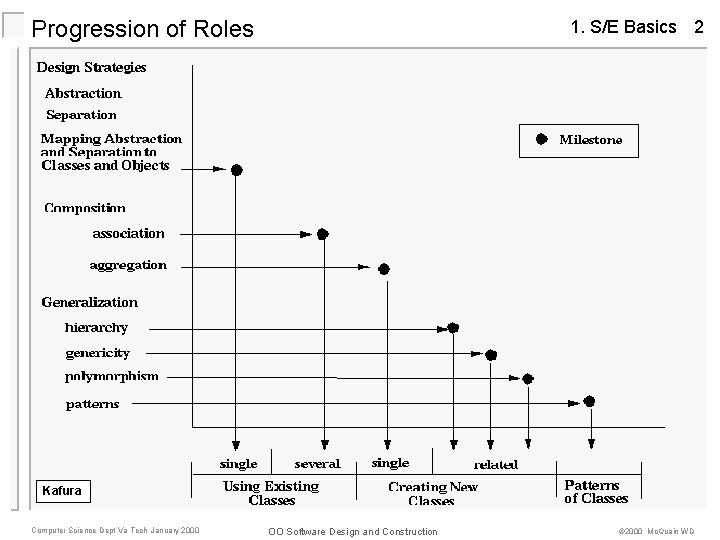
Progression of Roles 1. S/E Basics 2 Kafura Computer Science Dept Va Tech January 2000 OO Software Design and Construction © 2000 Mc. Quain WD
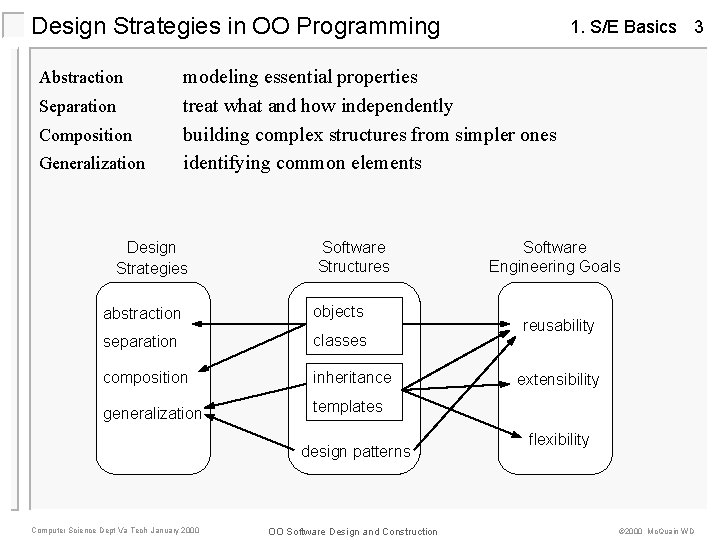
Design Strategies in OO Programming Abstraction Separation Composition Generalization 1. S/E Basics 3 modeling essential properties treat what and how independently building complex structures from simpler ones identifying common elements Design Strategies Software Structures abstraction objects separation classes composition inheritance generalization templates design patterns Computer Science Dept Va Tech January 2000 OO Software Design and Construction Software Engineering Goals reusability extensibility flexibility © 2000 Mc. Quain WD
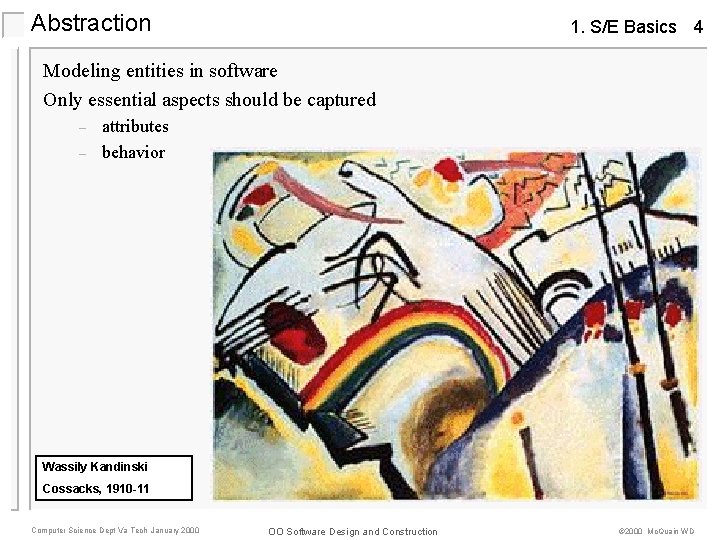
Abstraction 1. S/E Basics 4 Modeling entities in software Only essential aspects should be captured – – attributes behavior Wassily Kandinski Cossacks, 1910 -11 Computer Science Dept Va Tech January 2000 OO Software Design and Construction © 2000 Mc. Quain WD
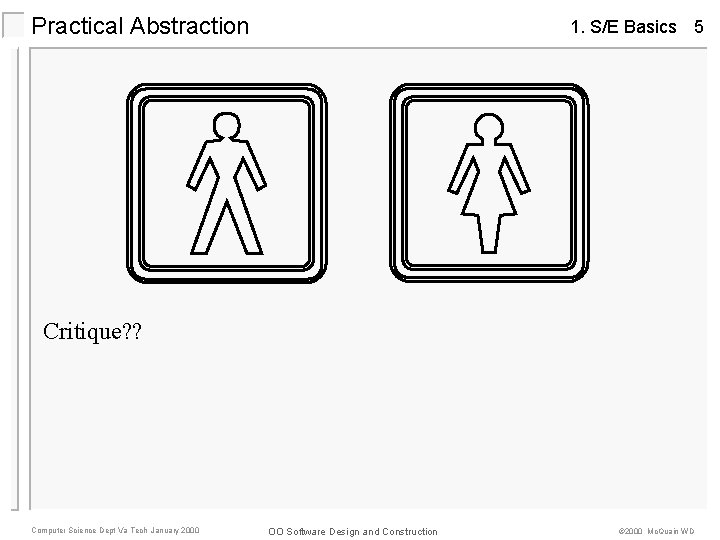
Practical Abstraction 1. S/E Basics 5 Critique? ? Computer Science Dept Va Tech January 2000 OO Software Design and Construction © 2000 Mc. Quain WD

Abstraction 1. S/E Basics 6 A named collection of attributes and behavior relevant to modeling a given entity for some particular purpose. Desirable Properties: well named name conveys aspects of the abstraction coherent makes sense accurate contains only attributes modeled entity contains minimal contains only attributes needed for the purpose complete contains all attributes and behavior needed for the purpose Computer Science Dept Va Tech January 2000 OO Software Design and Construction © 2000 Mc. Quain WD
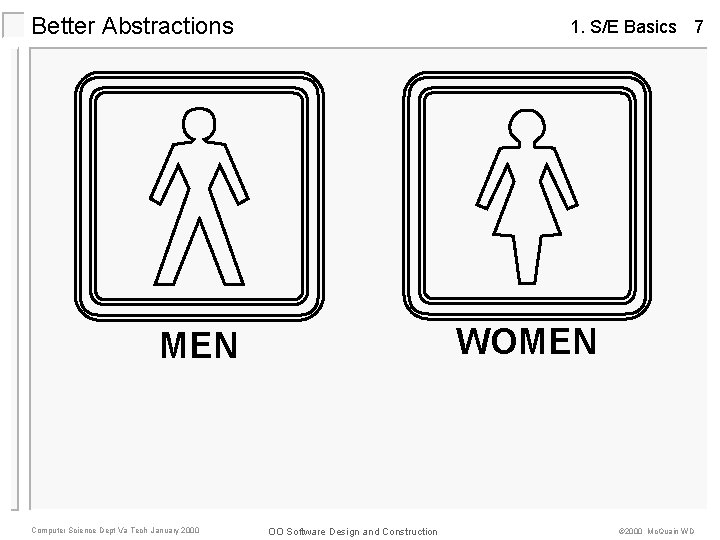
Better Abstractions 1. S/E Basics 7 WOMEN Computer Science Dept Va Tech January 2000 OO Software Design and Construction © 2000 Mc. Quain WD

Mapping Abstraction to Software real-world abstraction attributes 1. S/E Basics 8 software {data, …} entity behavior Computer Science Dept Va Tech January 2000 OO Software Design and Construction {method, …} © 2000 Mc. Quain WD
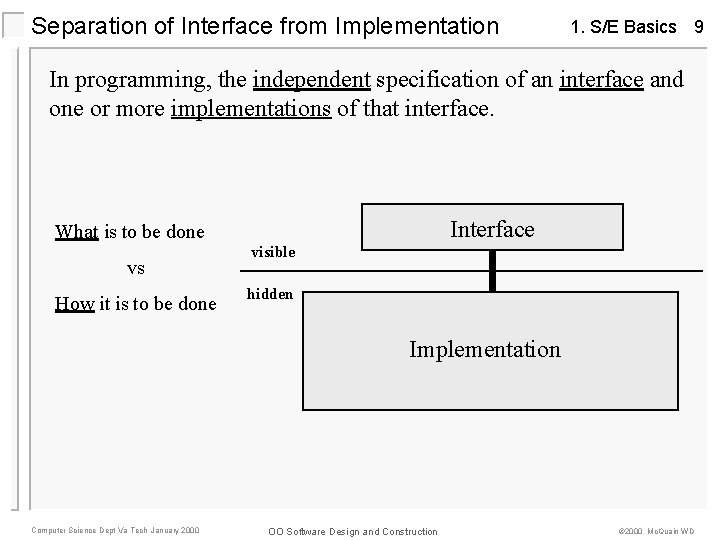
Separation of Interface from Implementation 1. S/E Basics 9 In programming, the independent specification of an interface and one or more implementations of that interface. Interface What is to be done vs How it is to be done visible hidden Implementation Computer Science Dept Va Tech January 2000 OO Software Design and Construction © 2000 Mc. Quain WD
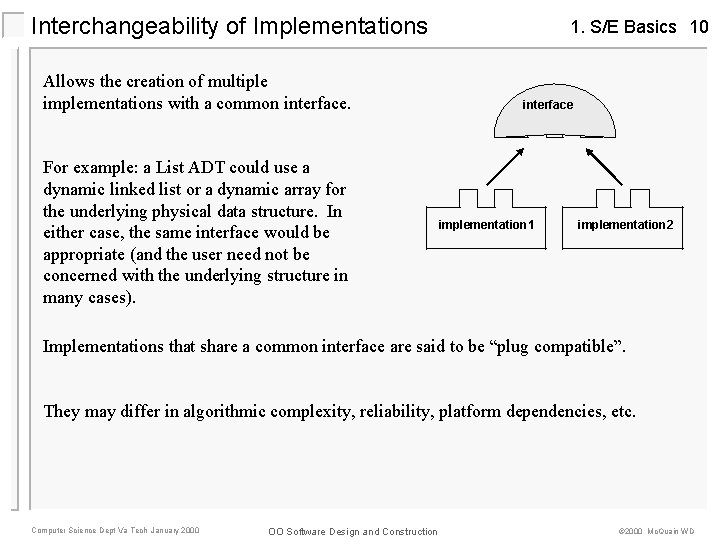
Interchangeability of Implementations Allows the creation of multiple implementations with a common interface. For example: a List ADT could use a dynamic linked list or a dynamic array for the underlying physical data structure. In either case, the same interface would be appropriate (and the user need not be concerned with the underlying structure in many cases). 1. S/E Basics 10 interface implementation 1 implementation 2 Implementations that share a common interface are said to be “plug compatible”. They may differ in algorithmic complexity, reliability, platform dependencies, etc. Computer Science Dept Va Tech January 2000 OO Software Design and Construction © 2000 Mc. Quain WD
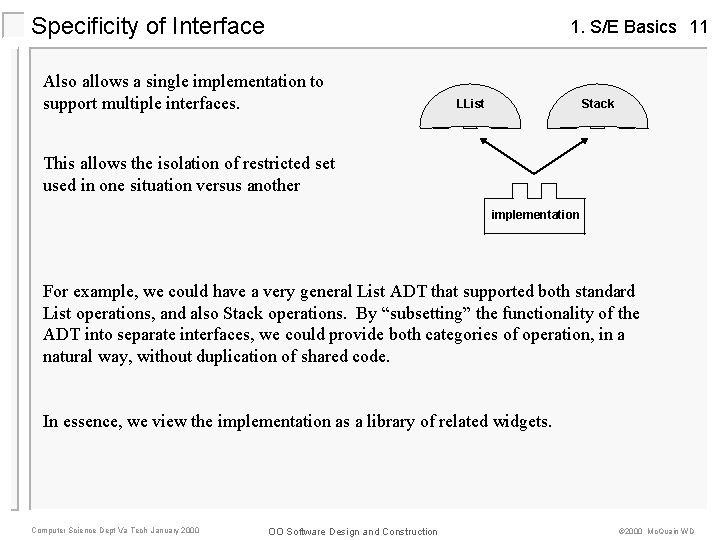
Specificity of Interface 1. S/E Basics 11 Also allows a single implementation to support multiple interfaces. LList Stack This allows the isolation of restricted set used in one situation versus another implementation For example, we could have a very general List ADT that supported both standard List operations, and also Stack operations. By “subsetting” the functionality of the ADT into separate interfaces, we could provide both categories of operation, in a natural way, without duplication of shared code. In essence, we view the implementation as a library of related widgets. Computer Science Dept Va Tech January 2000 OO Software Design and Construction © 2000 Mc. Quain WD
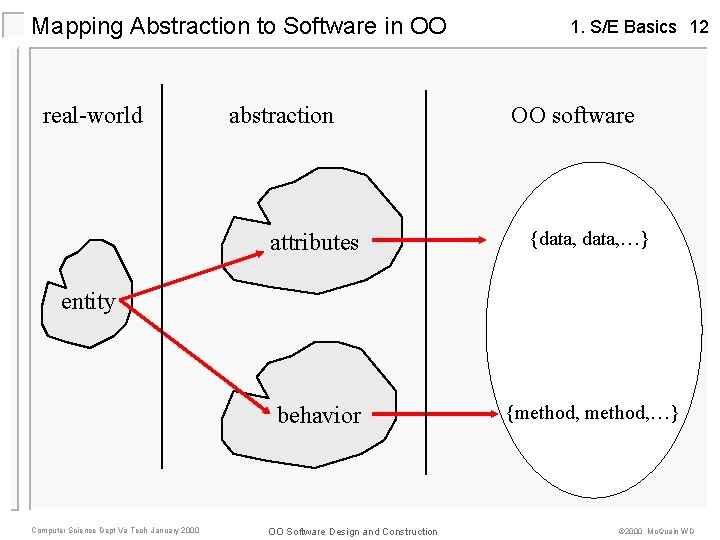
Mapping Abstraction to Software in OO real-world abstraction 1. S/E Basics 12 OO software attributes {data, …} behavior {method, …} entity Computer Science Dept Va Tech January 2000 OO Software Design and Construction © 2000 Mc. Quain WD
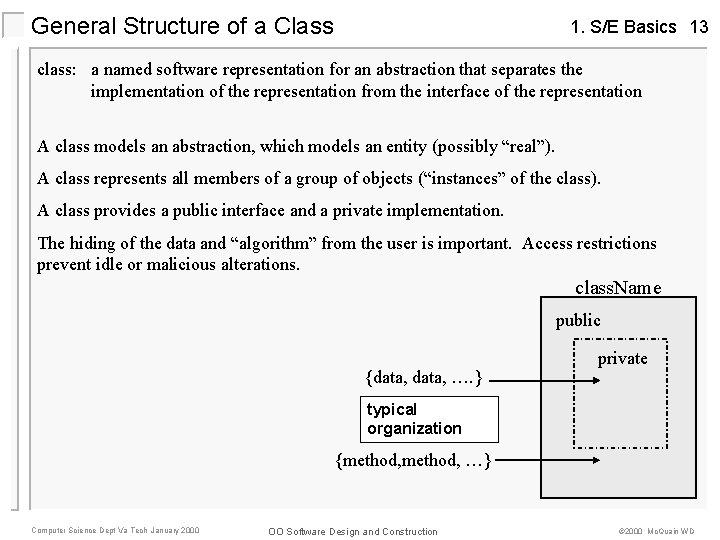
General Structure of a Class 1. S/E Basics 13 class: a named software representation for an abstraction that separates the implementation of the representation from the interface of the representation A class models an abstraction, which models an entity (possibly “real”). A class represents all members of a group of objects (“instances” of the class). A class provides a public interface and a private implementation. The hiding of the data and “algorithm” from the user is important. Access restrictions prevent idle or malicious alterations. class. Name public {data, …. } private typical organization {method, …} Computer Science Dept Va Tech January 2000 OO Software Design and Construction © 2000 Mc. Quain WD
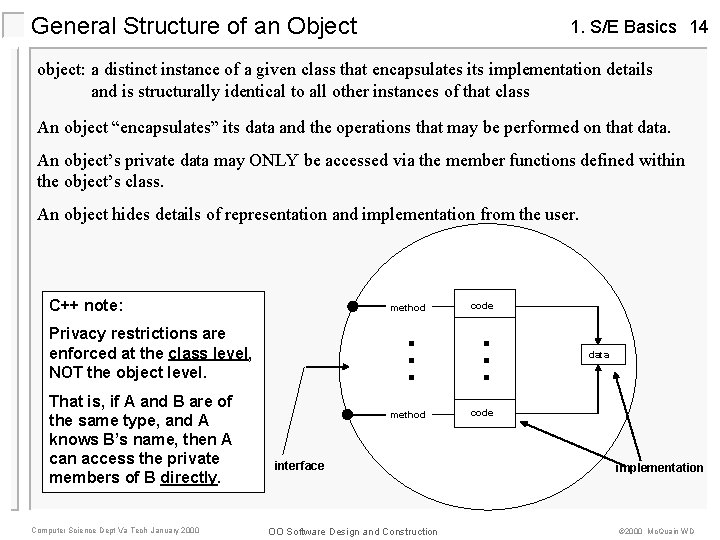
General Structure of an Object 1. S/E Basics 14 object: a distinct instance of a given class that encapsulates its implementation details and is structurally identical to all other instances of that class An object “encapsulates” its data and the operations that may be performed on that data. An object’s private data may ONLY be accessed via the member functions defined within the object’s class. An object hides details of representation and implementation from the user. C++ note: method . . . Privacy restrictions are enforced at the class level, NOT the object level. That is, if A and B are of the same type, and A knows B’s name, then A can access the private members of B directly. Computer Science Dept Va Tech January 2000 method interface OO Software Design and Construction code . . . data code implementation © 2000 Mc. Quain WD
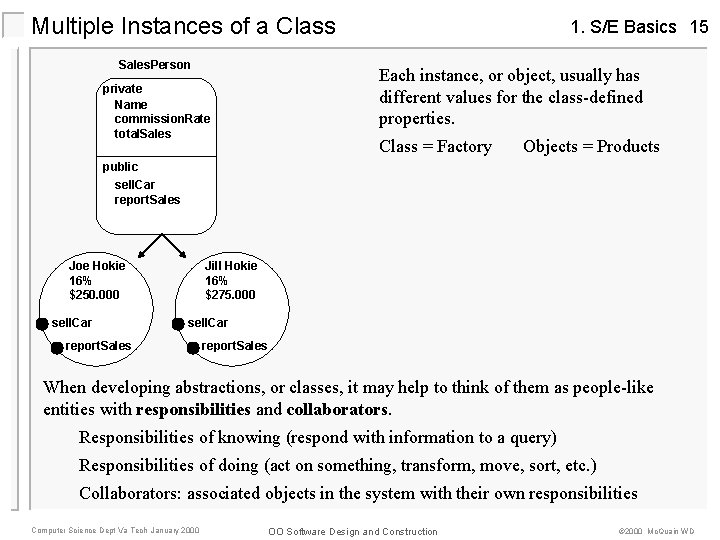
Multiple Instances of a Class Sales. Person 1. S/E Basics 15 Each instance, or object, usually has different values for the class-defined properties. private Name commission. Rate total. Sales Class = Factory Objects = Products public sell. Car report. Sales Joe Hokie 16% $250. 000 sell. Car Jill Hokie 16% $275. 000 sell. Car report. Sales When developing abstractions, or classes, it may help to think of them as people-like entities with responsibilities and collaborators. Responsibilities of knowing (respond with information to a query) Responsibilities of doing (act on something, transform, move, sort, etc. ) Collaborators: associated objects in the system with their own responsibilities Computer Science Dept Va Tech January 2000 OO Software Design and Construction © 2000 Mc. Quain WD
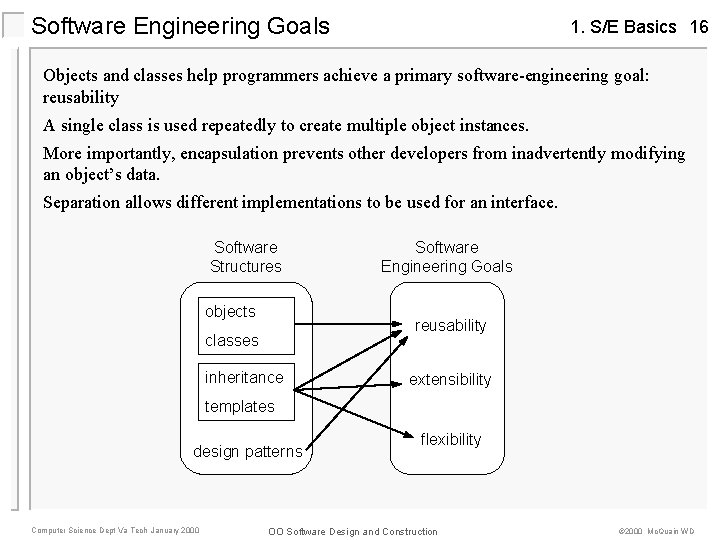
Software Engineering Goals 1. S/E Basics 16 Objects and classes help programmers achieve a primary software-engineering goal: reusability A single class is used repeatedly to create multiple object instances. More importantly, encapsulation prevents other developers from inadvertently modifying an object’s data. Separation allows different implementations to be used for an interface. Software Structures objects Software Engineering Goals reusability classes inheritance extensibility templates design patterns Computer Science Dept Va Tech January 2000 flexibility OO Software Design and Construction © 2000 Mc. Quain WD
- Slides: 16