
Software Engineering and Architecture Systematic Testing Equivalence Class

![Process step 4 • Generate, using Myers [y 3 c] • Conclusion: Only 8](https://slidetodoc.com/presentation_image_h2/a43e93f9ff844c400b4aa7837b2f9121/image-51.jpg "Process step 4 • Generate, using Myers [y 3 c] • Conclusion: Only 8")
![My analysis 0. 0 <= x < 1000. 0 [a 3] CS@AU Henrik Bærbak](https://slidetodoc.com/presentation_image_h2/a43e93f9ff844c400b4aa7837b2f9121/image-55.jpg "My analysis 0. 0 <= x < 1000. 0 [a 3] CS@AU Henrik Bærbak")
![Complements EP analysis • Ex. Formatting has a strong boundary between EC [a 1]](https://slidetodoc.com/presentation_image_h2/a43e93f9ff844c400b4aa7837b2f9121/image-65.jpg "Complements EP analysis • Ex. Formatting has a strong boundary between EC [a 1]")
- Slides: 74
Software Engineering and Architecture Systematic Testing Equivalence Class Partitioning
What is reliability? • If there is a defect, it may fail and is thus not reliable. • Thus: – Reduce number of defects – … will reduce number of failures – … will increase reliability CS@AU Henrik Bærbak Christensen 2
Discussion • True? – Find example of removing a defect does not increase the system’s reliability at all – Find example of removing defect 1 increase reliability dramatically while removing defect 2 does not CS@AU Henrik Bærbak Christensen 3
All defects are not equal! • So – given a certain amount of time to find defects (you need to sell things to earn money!): • What kind of defects should you correct to get best return on investment? CS@AU Henrik Bærbak Christensen 4
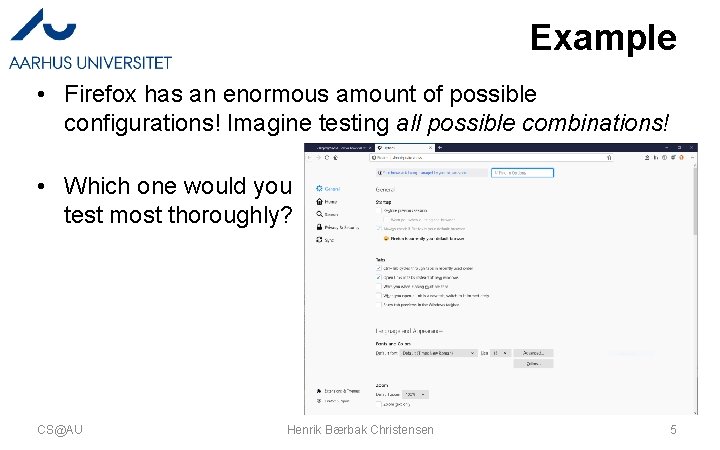
Example • Firefox has an enormous amount of possible configurations! Imagine testing all possible combinations! • Which one would you test most thoroughly? CS@AU Henrik Bærbak Christensen 5
Testing Techniques CS@AU Henrik Bærbak Christensen 6
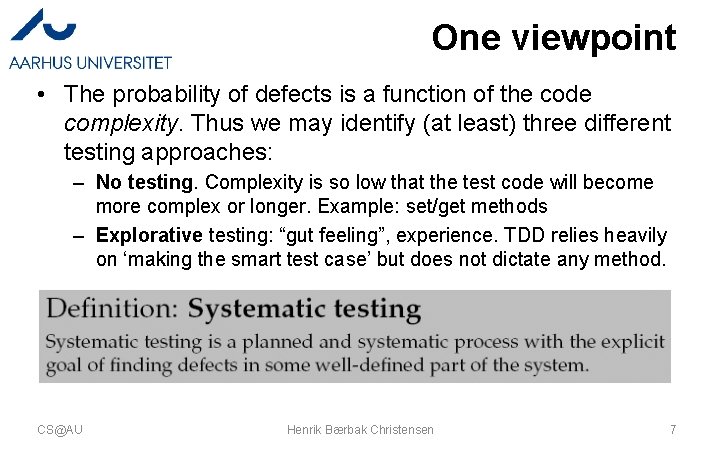
One viewpoint • The probability of defects is a function of the code complexity. Thus we may identify (at least) three different testing approaches: – No testing. Complexity is so low that the test code will become more complex or longer. Example: set/get methods – Explorative testing: “gut feeling”, experience. TDD relies heavily on ‘making the smart test case’ but does not dictate any method. CS@AU Henrik Bærbak Christensen 7
Destructive! • Testing is a destructive process!!! – In contrast to almost all other SW processes which are constructive! • Human psychology – I want to be a success • The brain will deliver! – (ok, X-factor shows this is not always the case…) • I will prove my software works • I will prove my software is really lousy CS@AU Henrik Bærbak Christensen 8
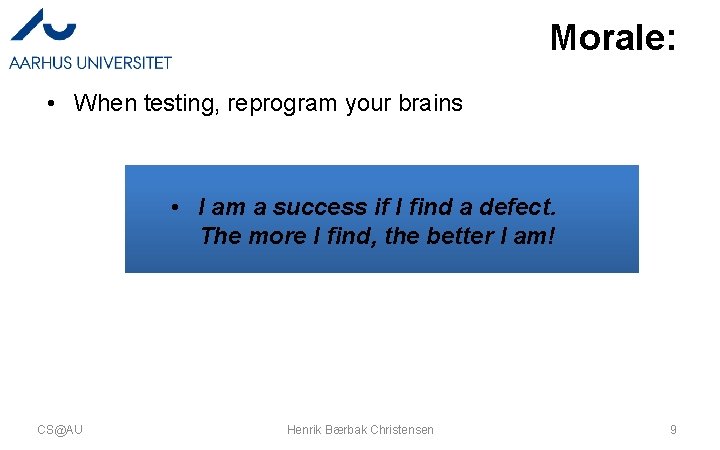
Morale: • When testing, reprogram your brains • I am a success if I find a defect. The more I find, the better I am! CS@AU Henrik Bærbak Christensen 9
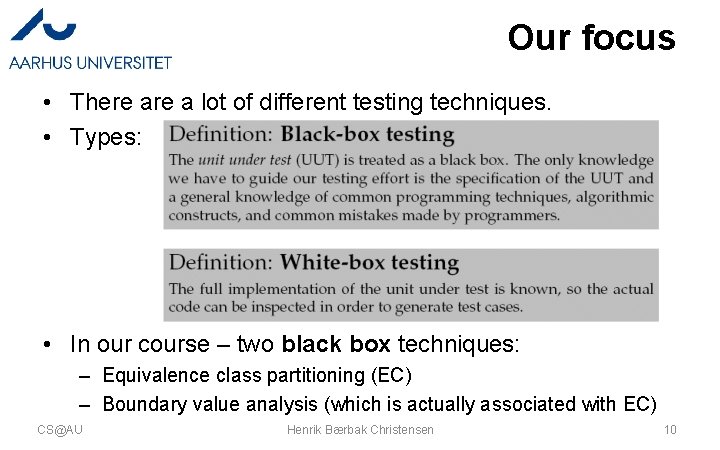
Our focus • There a lot of different testing techniques. • Types: • In our course – two black box techniques: – Equivalence class partitioning (EC) – Boundary value analysis (which is actually associated with EC) CS@AU Henrik Bærbak Christensen 10
Equivalence Class Partitioning Often just called EC testing…
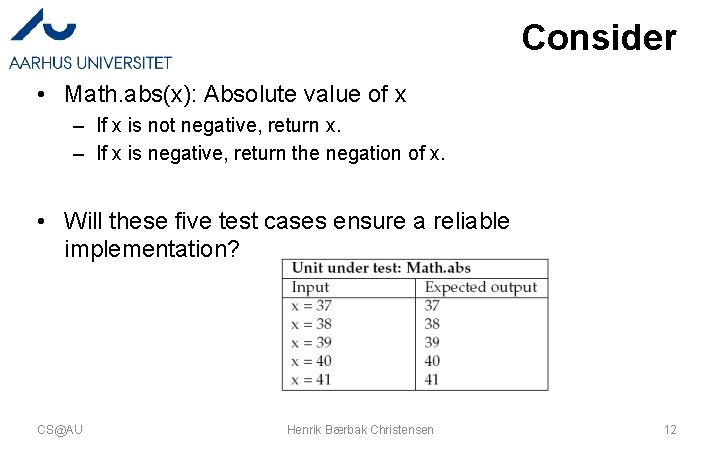
Consider • Math. abs(x): Absolute value of x – If x is not negative, return x. – If x is negative, return the negation of x. • Will these five test cases ensure a reliable implementation? CS@AU Henrik Bærbak Christensen 12
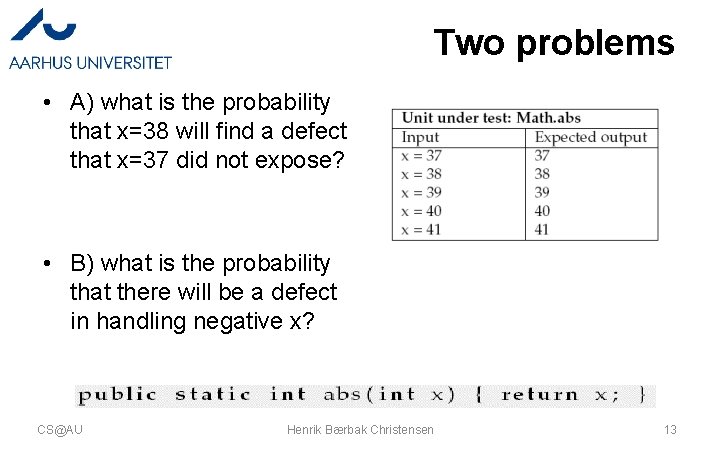
Two problems • A) what is the probability that x=38 will find a defect that x=37 did not expose? • B) what is the probability that there will be a defect in handling negative x? CS@AU Henrik Bærbak Christensen 13
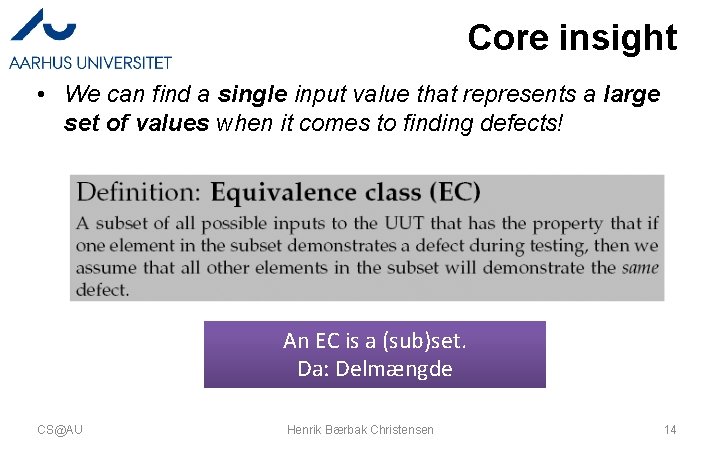
Core insight • We can find a single input value that represents a large set of values when it comes to finding defects! An EC is a (sub)set. Da: Delmængde CS@AU Henrik Bærbak Christensen 14
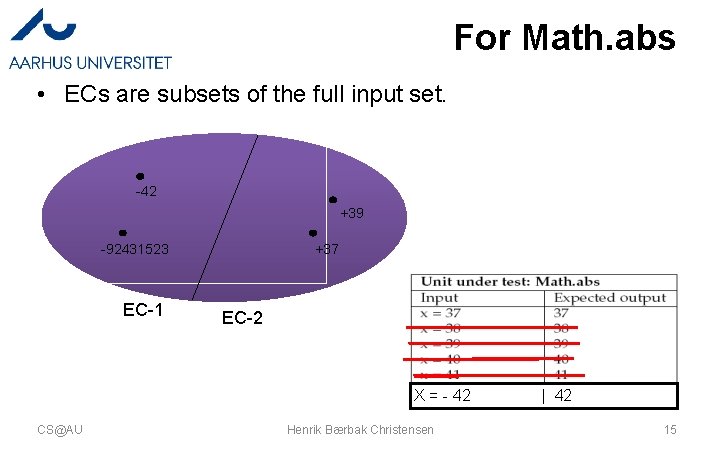
For Math. abs • ECs are subsets of the full input set. -42 +39 +37 -92431523 EC-1 EC-2 X = - 42 CS@AU Henrik Bærbak Christensen | 42 15
The argumentation • The specification will force an implementation where (most likely!) all positive arguments are treated by one code fragment and all negative arguments by another. – Thus we only need two test cases: • 1) one that tests the positive argument handling code • 2) one that tests the negative argument handling code • For 1) x=37 is just as good as x=1232, etc. Thus we simply select a representative element from each EC and generate a test case based upon it. CS@AU Henrik Bærbak Christensen 16
Note • Systematic testing. . . • does not mean – Systematically find all defects and guaranty none are left!!! • does mean – Systematically derive a small set of test cases with high probability of finding many defects!!! CS@AU Henrik Bærbak Christensen 17
Specifically • Systematic testing cannot in any way counter malicious programming – Virus, easter eggs, evil-minded programmers – (really lousy programmers) CS@AU Henrik Bærbak Christensen 18
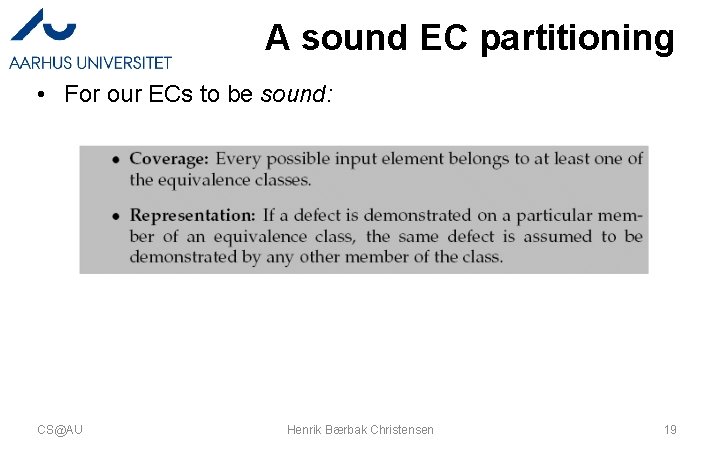
A sound EC partitioning • For our ECs to be sound: CS@AU Henrik Bærbak Christensen 19
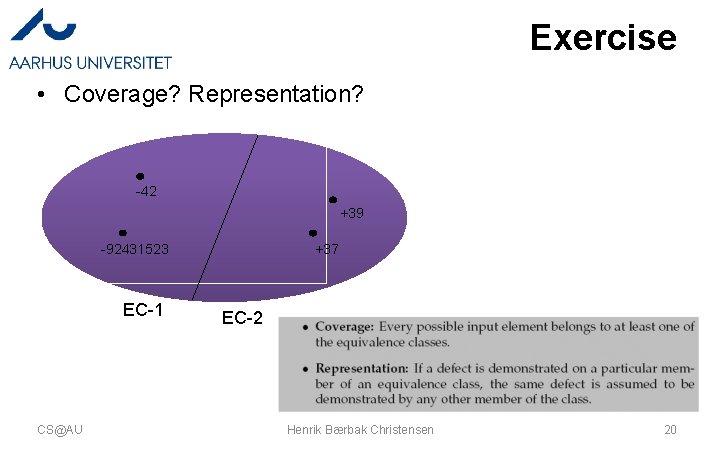
Exercise • Coverage? Representation? -42 +39 +37 -92431523 EC-1 CS@AU EC-2 Henrik Bærbak Christensen 20
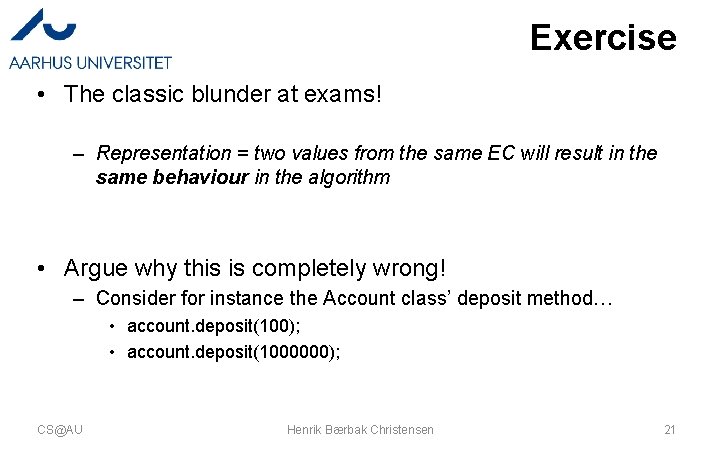
Exercise • The classic blunder at exams! – Representation = two values from the same EC will result in the same behaviour in the algorithm • Argue why this is completely wrong! – Consider for instance the Account class’ deposit method… • account. deposit(100); • account. deposit(1000000); CS@AU Henrik Bærbak Christensen 21
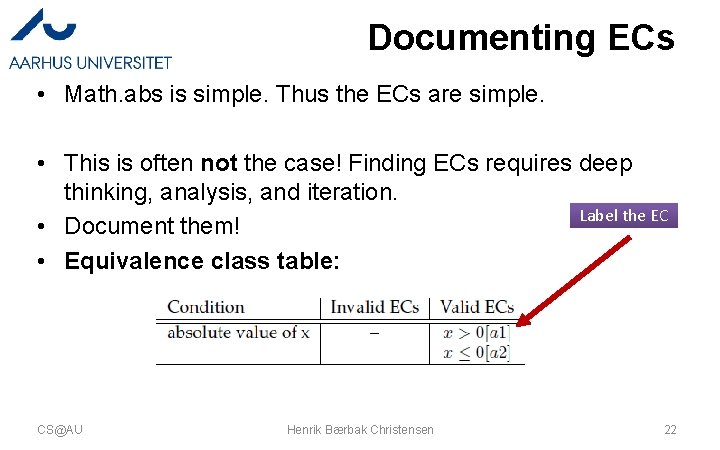
Documenting ECs • Math. abs is simple. Thus the ECs are simple. • This is often not the case! Finding ECs requires deep thinking, analysis, and iteration. Label the EC • Document them! • Equivalence class table: CS@AU Henrik Bærbak Christensen 22
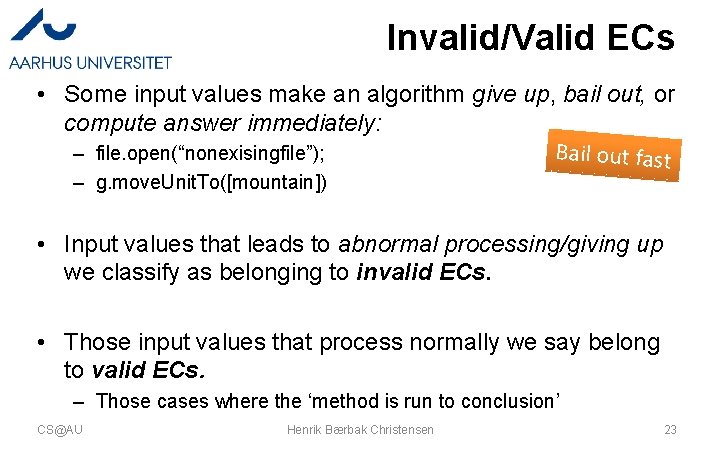
Invalid/Valid ECs • Some input values make an algorithm give up, bail out, or compute answer immediately: Bail out fast – file. open(“nonexisingfile”); – g. move. Unit. To([mountain]) • Input values that leads to abnormal processing/giving up we classify as belonging to invalid ECs. • Those input values that process normally we say belong to valid ECs. – Those cases where the ‘method is run to conclusion’ CS@AU Henrik Bærbak Christensen 23
Finding the ECs Often tricky…
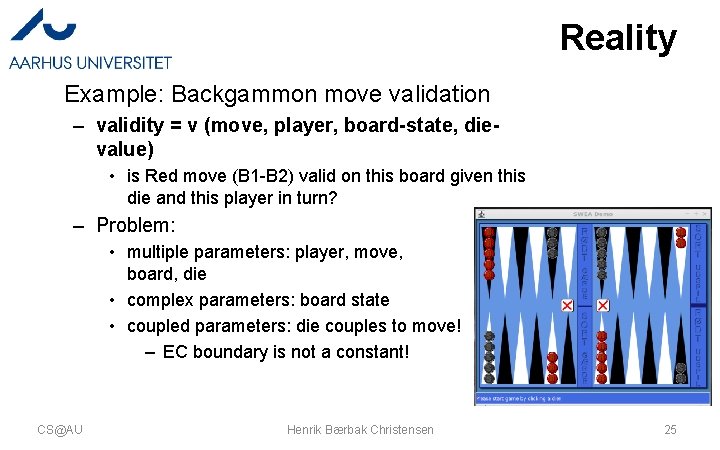
Reality Example: Backgammon move validation – validity = v (move, player, board-state, dievalue) • is Red move (B 1 -B 2) valid on this board given this die and this player in turn? – Problem: • multiple parameters: player, move, board, die • complex parameters: board state • coupled parameters: die couples to move! – EC boundary is not a constant! CS@AU Henrik Bærbak Christensen 25
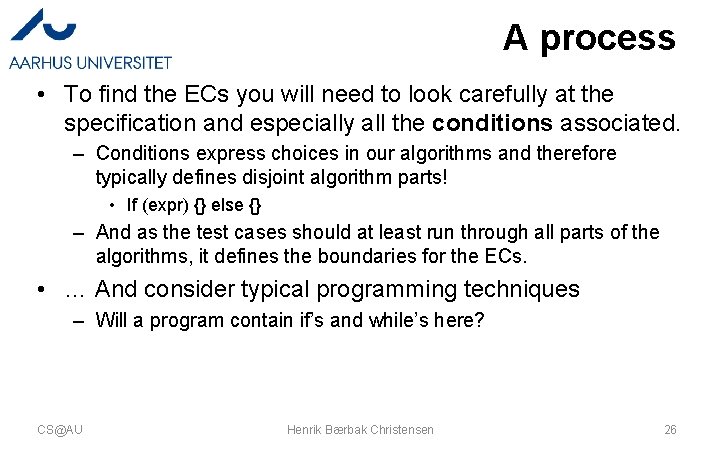
A process • To find the ECs you will need to look carefully at the specification and especially all the conditions associated. – Conditions express choices in our algorithms and therefore typically defines disjoint algorithm parts! • If (expr) {} else {} – And as the test cases should at least run through all parts of the algorithms, it defines the boundaries for the ECs. • … And consider typical programming techniques – Will a program contain if’s and while’s here? CS@AU Henrik Bærbak Christensen 26
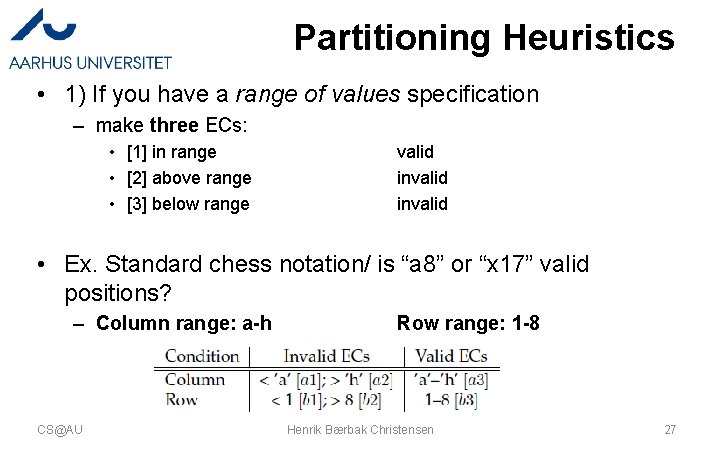
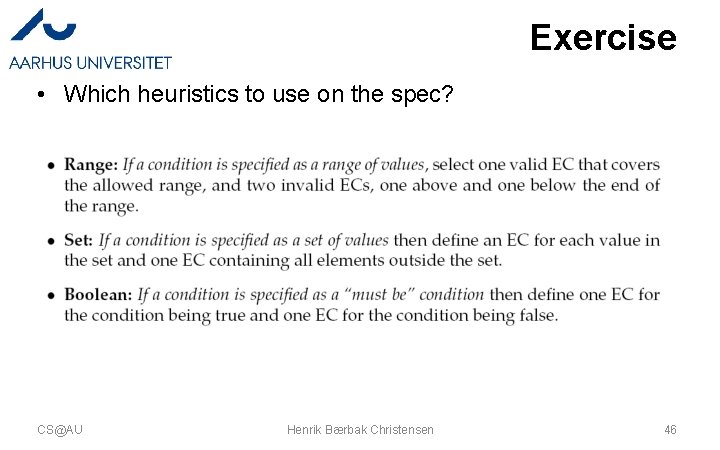
Partitioning Heuristics • 1) If you have a range of values specification – make three ECs: • [1] in range • [2] above range • [3] below range valid invalid • Ex. Standard chess notation/ is “a 8” or “x 17” valid positions? – Column range: a-h CS@AU Row range: 1 -8 Henrik Bærbak Christensen 27
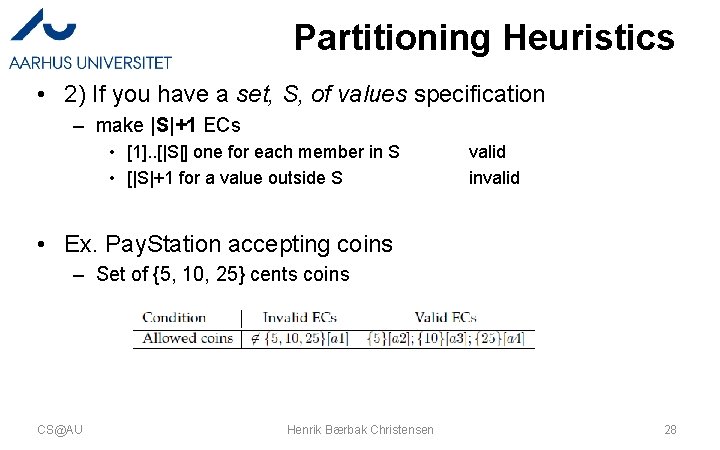
Partitioning Heuristics • 2) If you have a set, S, of values specification – make |S|+1 ECs • [1]. . [|S|] one for each member in S • [|S|+1 for a value outside S valid invalid • Ex. Pay. Station accepting coins – Set of {5, 10, 25} cents coins CS@AU Henrik Bærbak Christensen 28
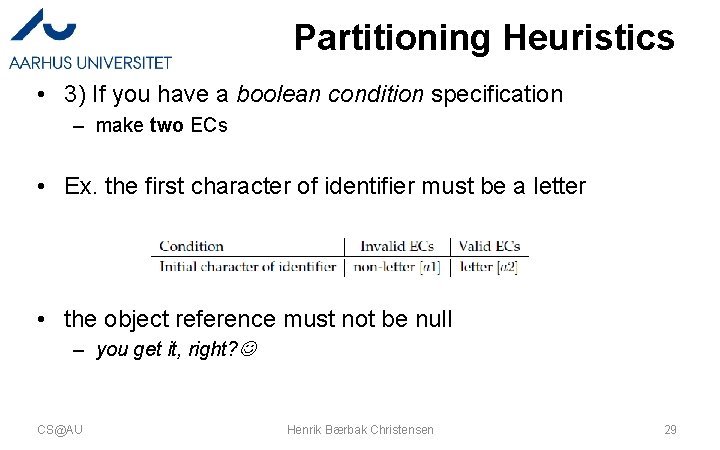
Partitioning Heuristics • 3) If you have a boolean condition specification – make two ECs • Ex. the first character of identifier must be a letter • the object reference must not be null – you get it, right? CS@AU Henrik Bærbak Christensen 29
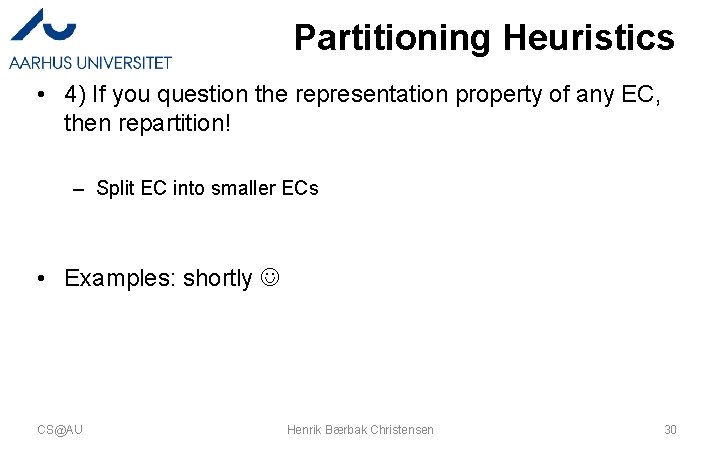
Partitioning Heuristics • 4) If you question the representation property of any EC, then repartition! – Split EC into smaller ECs • Examples: shortly CS@AU Henrik Bærbak Christensen 30
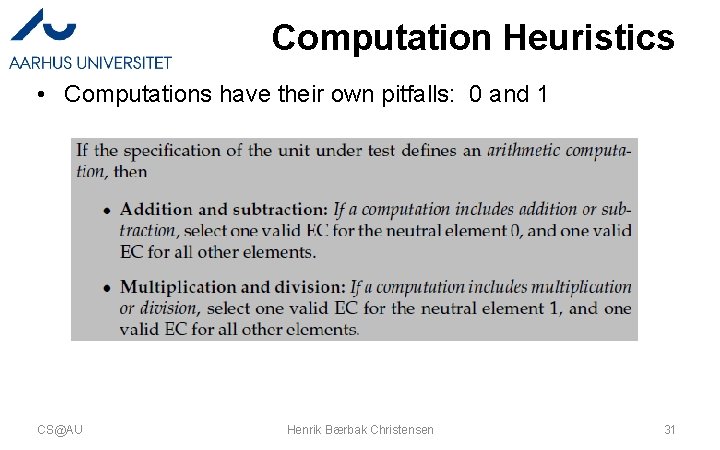
Computation Heuristics • Computations have their own pitfalls: 0 and 1 CS@AU Henrik Bærbak Christensen 31
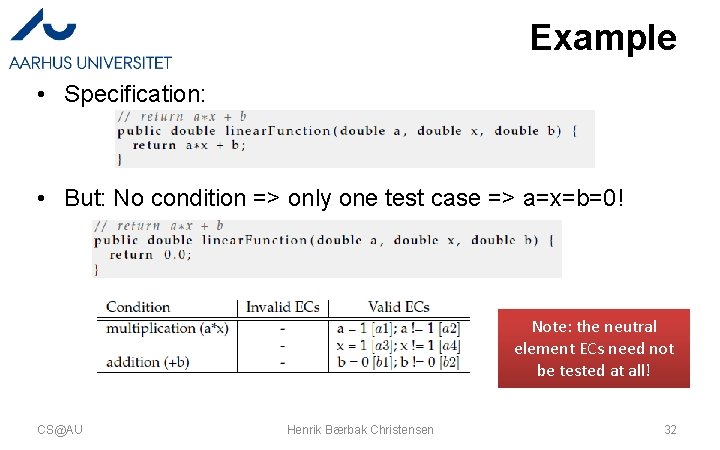
Example • Specification: • But: No condition => only one test case => a=x=b=0! Note: the neutral element ECs need not be tested at all! CS@AU Henrik Bærbak Christensen 32
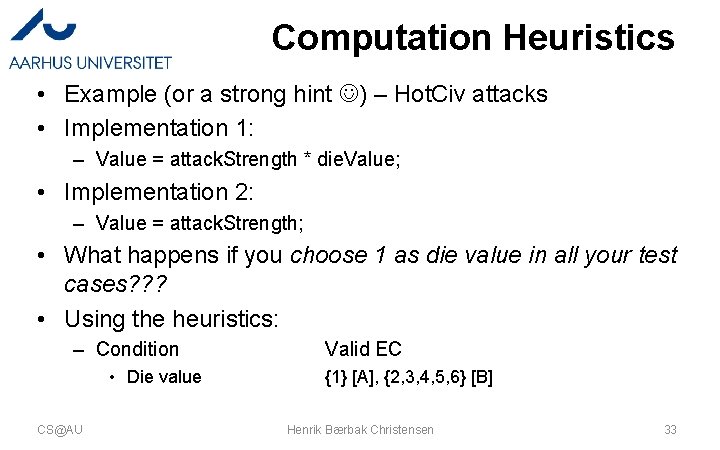
Computation Heuristics • Example (or a strong hint ) – Hot. Civ attacks • Implementation 1: – Value = attack. Strength * die. Value; • Implementation 2: – Value = attack. Strength; • What happens if you choose 1 as die value in all your test cases? ? ? • Using the heuristics: – Condition • Die value CS@AU Valid EC {1} [A], {2, 3, 4, 5, 6} [B] Henrik Bærbak Christensen 33
From ECs to Test cases
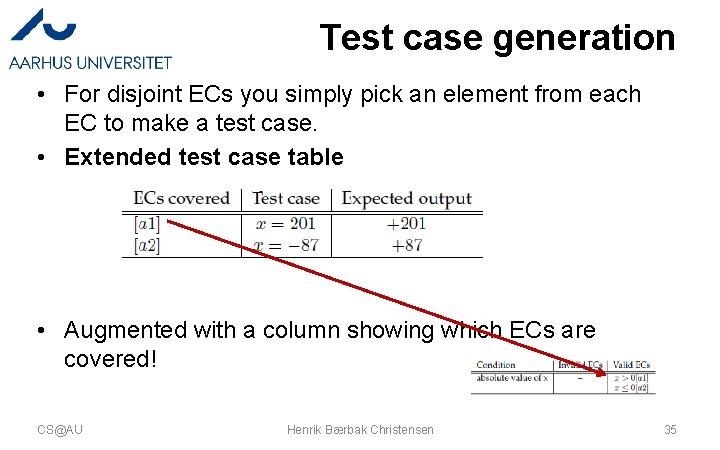
Test case generation • For disjoint ECs you simply pick an element from each EC to make a test case. • Extended test case table • Augmented with a column showing which ECs are covered! CS@AU Henrik Bærbak Christensen 35
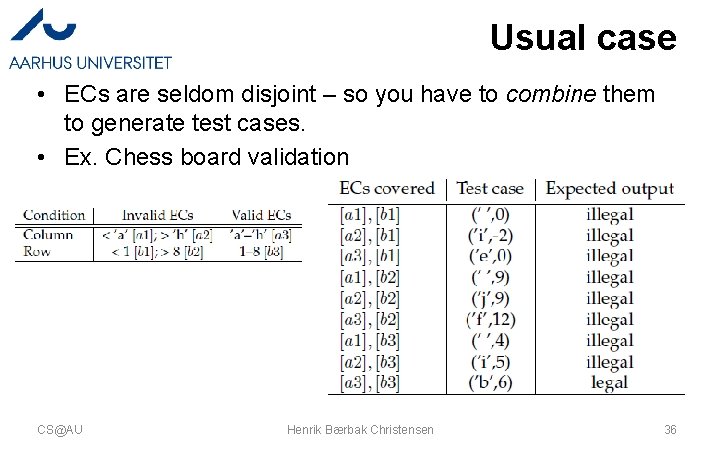
Usual case • ECs are seldom disjoint – so you have to combine them to generate test cases. • Ex. Chess board validation CS@AU Henrik Bærbak Christensen 36
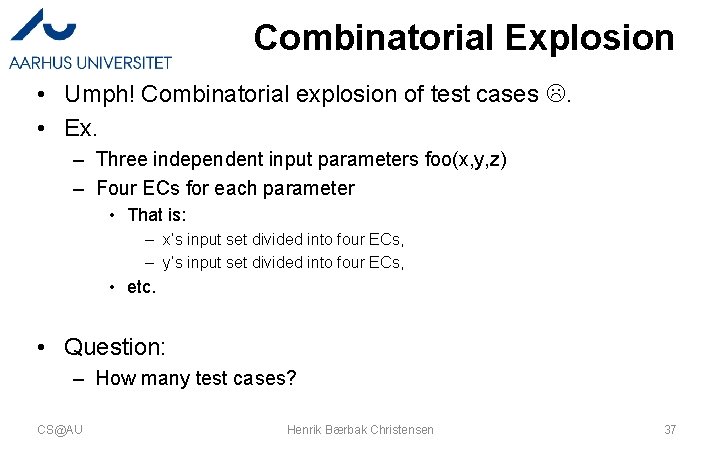
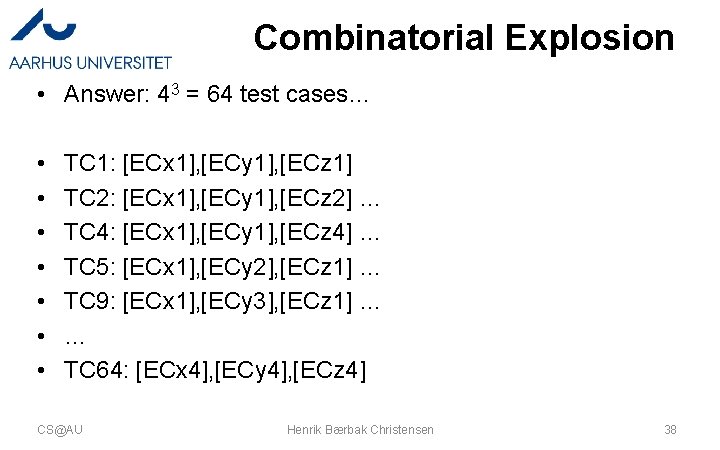
Combinatorial Explosion • Umph! Combinatorial explosion of test cases . • Ex. – Three independent input parameters foo(x, y, z) – Four ECs for each parameter • That is: – x’s input set divided into four ECs, – y’s input set divided into four ECs, • etc. • Question: – How many test cases? CS@AU Henrik Bærbak Christensen 37
Combinatorial Explosion • Answer: 43 = 64 test cases… • • TC 1: [ECx 1], [ECy 1], [ECz 1] TC 2: [ECx 1], [ECy 1], [ECz 2] … TC 4: [ECx 1], [ECy 1], [ECz 4] … TC 5: [ECx 1], [ECy 2], [ECz 1] … TC 9: [ECx 1], [ECy 3], [ECz 1] … … TC 64: [ECx 4], [ECy 4], [ECz 4] CS@AU Henrik Bærbak Christensen 38
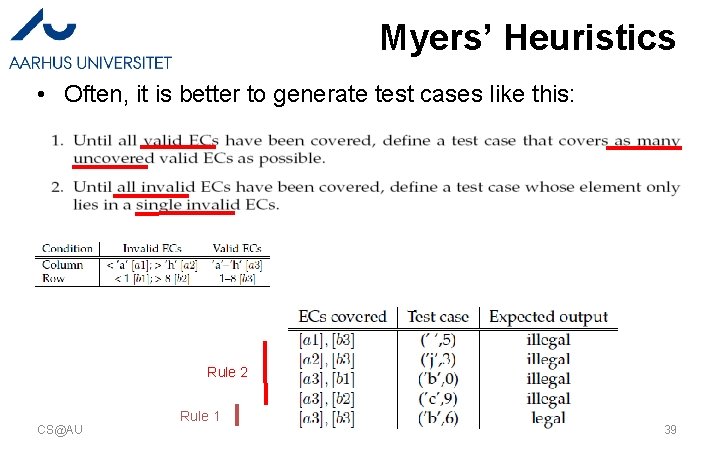
Myers’ Heuristics • Often, it is better to generate test cases like this: Rule 2 CS@AU Rule 1 Henrik Bærbak Christensen 39
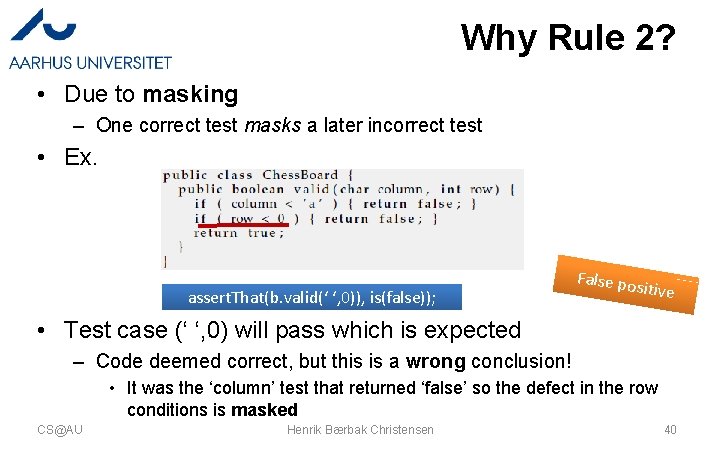
Why Rule 2? • Due to masking – One correct test masks a later incorrect test • Ex. assert. That(b. valid(‘ ‘, 0)), is(false)); False po s itive • Test case (‘ ‘, 0) will pass which is expected – Code deemed correct, but this is a wrong conclusion! • It was the ‘column’ test that returned ‘false’ so the defect in the row conditions is masked CS@AU Henrik Bærbak Christensen 40
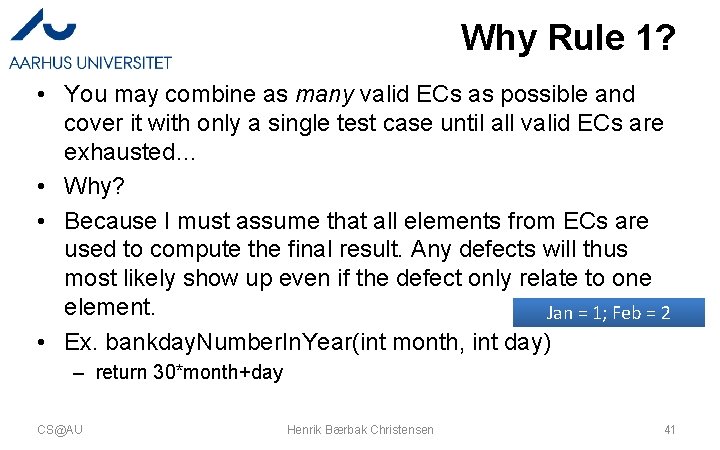
Why Rule 1? • You may combine as many valid ECs as possible and cover it with only a single test case until all valid ECs are exhausted… • Why? • Because I must assume that all elements from ECs are used to compute the final result. Any defects will thus most likely show up even if the defect only relate to one element. Jan = 1; Feb = 2 • Ex. bankday. Number. In. Year(int month, int day) – return 30*month+day CS@AU Henrik Bærbak Christensen 41
The Process
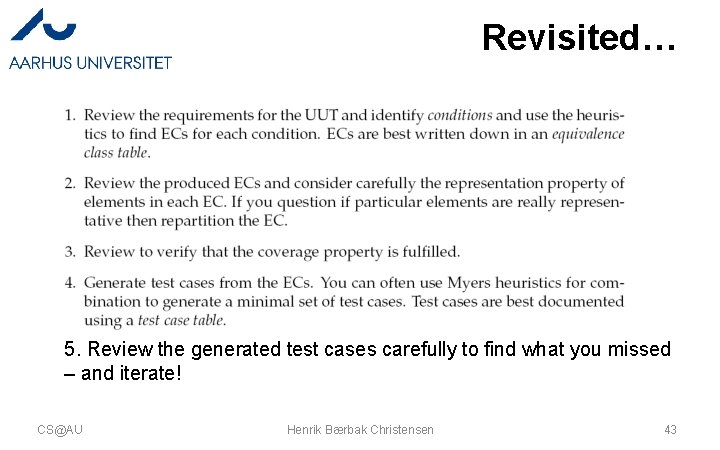
Revisited… 5. Review the generated test cases carefully to find what you missed – and iterate! CS@AU Henrik Bærbak Christensen 43
An Example Phew – let’s see things in practice
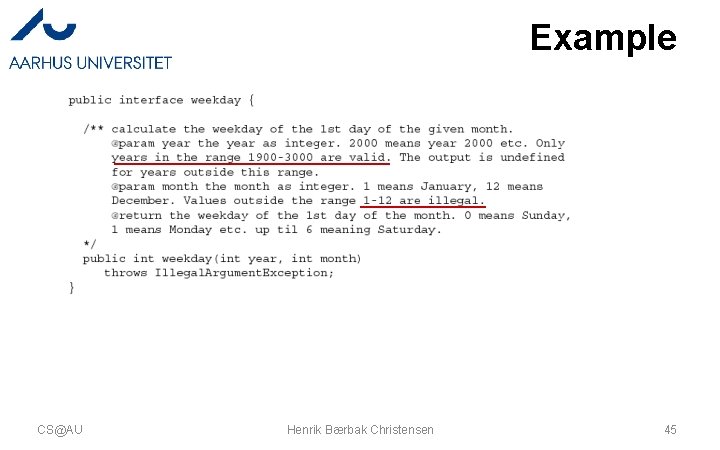
Example CS@AU Henrik Bærbak Christensen 45
Exercise • Which heuristics to use on the spec? CS@AU Henrik Bærbak Christensen 46
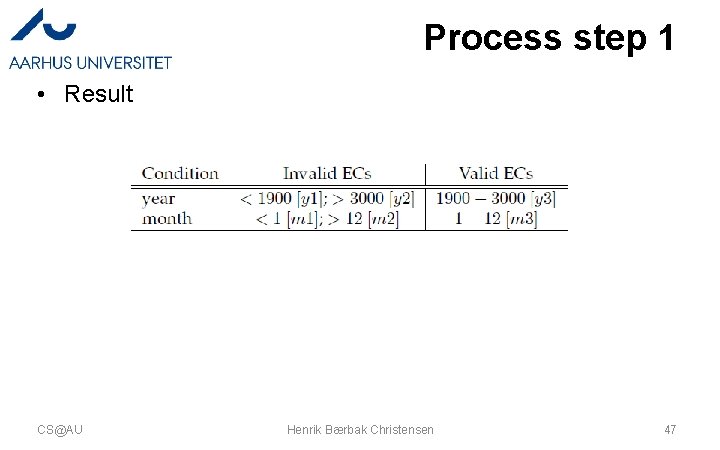
Process step 1 • Result CS@AU Henrik Bærbak Christensen 47
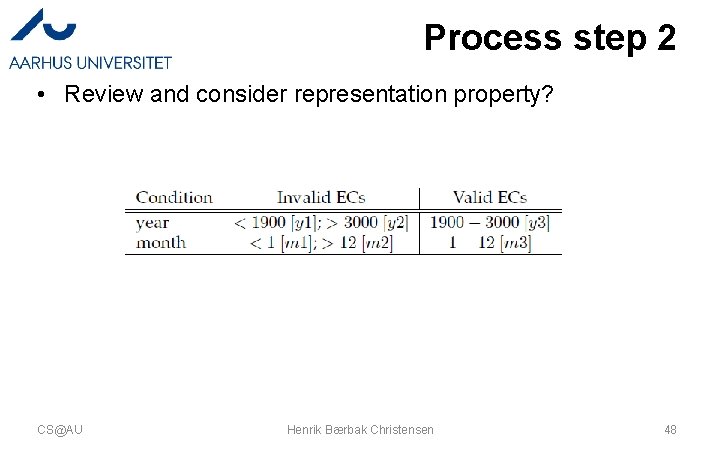
Process step 2 • Review and consider representation property? CS@AU Henrik Bærbak Christensen 48
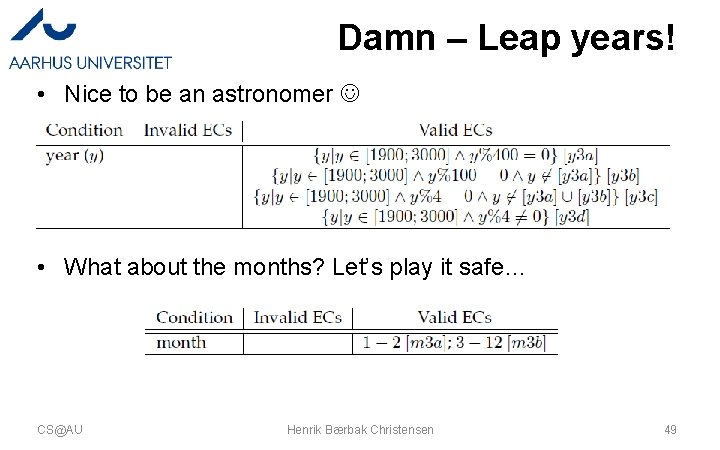
Damn – Leap years! • Nice to be an astronomer (as before) • What about the months? Let’s play it safe… CS@AU Henrik Bærbak Christensen 49
Process step 3 • Coverage? CS@AU Henrik Bærbak Christensen 50
Process step 4 • Generate, using Myers [y 3 c] • Conclusion: Only 8 test cases for a rather tricky alg. CS@AU Henrik Bærbak Christensen 51
Example 2
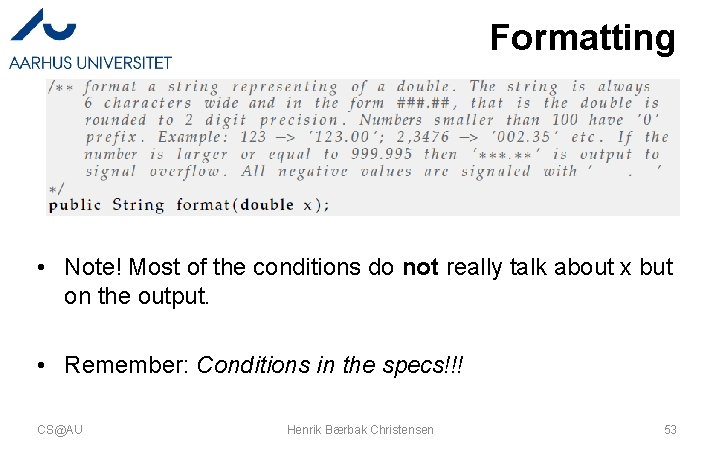
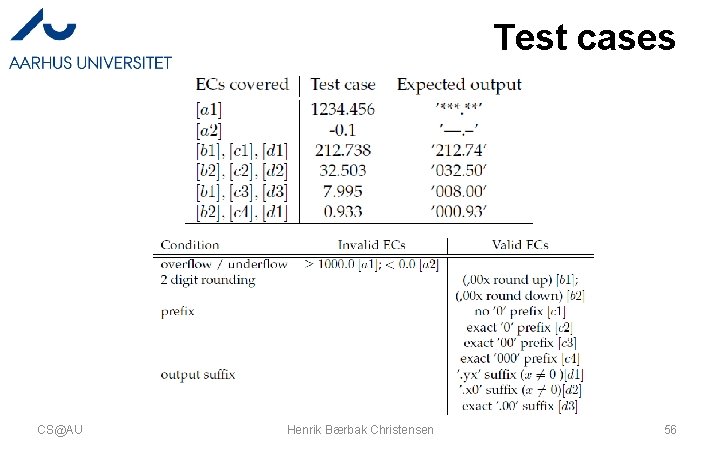
Formatting • Note! Most of the conditions do not really talk about x but on the output. • Remember: Conditions in the specs!!! CS@AU Henrik Bærbak Christensen 53
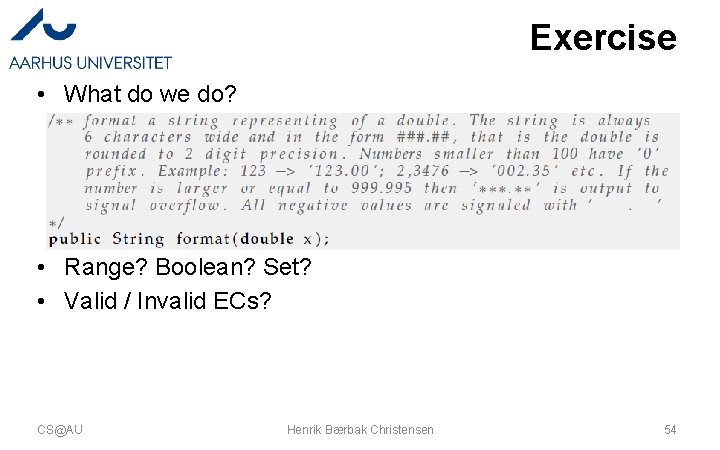
Exercise • What do we do? • Range? Boolean? Set? • Valid / Invalid ECs? CS@AU Henrik Bærbak Christensen 54
My analysis 0. 0 <= x < 1000. 0 [a 3] CS@AU Henrik Bærbak Christensen 55
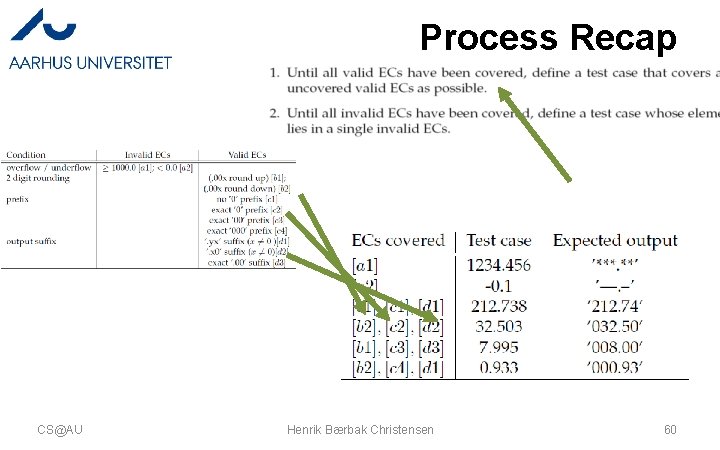
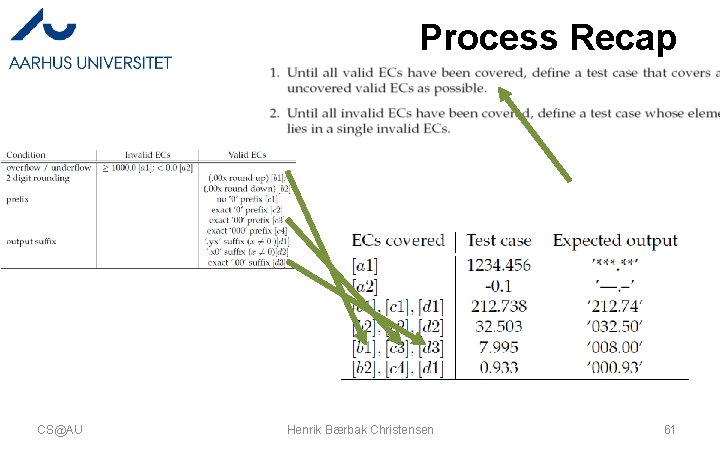
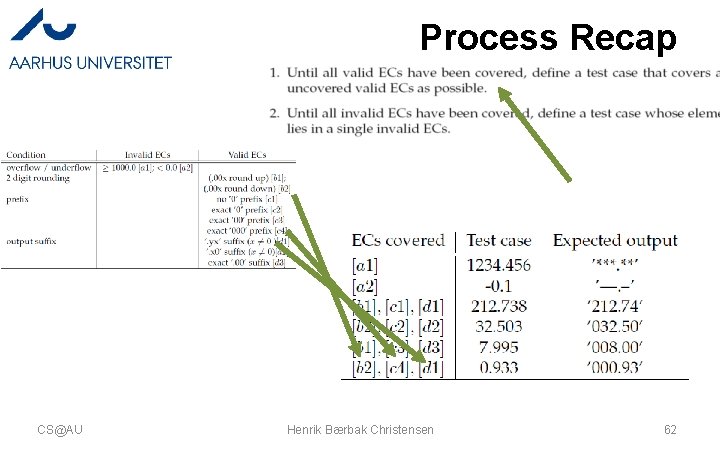
Test cases CS@AU Henrik Bærbak Christensen 56
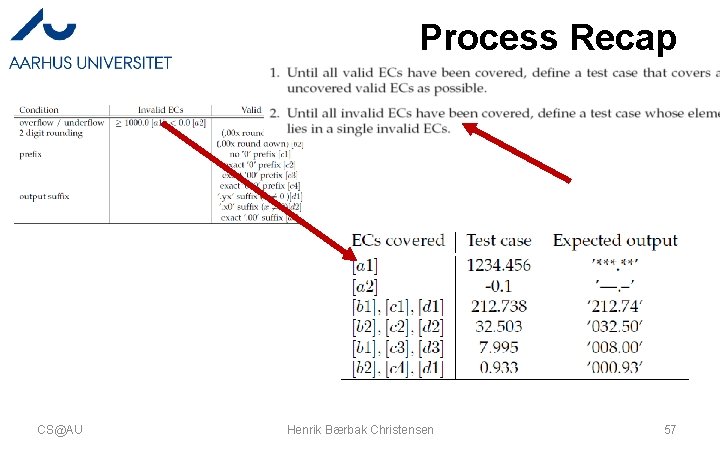
Process Recap CS@AU Henrik Bærbak Christensen 57
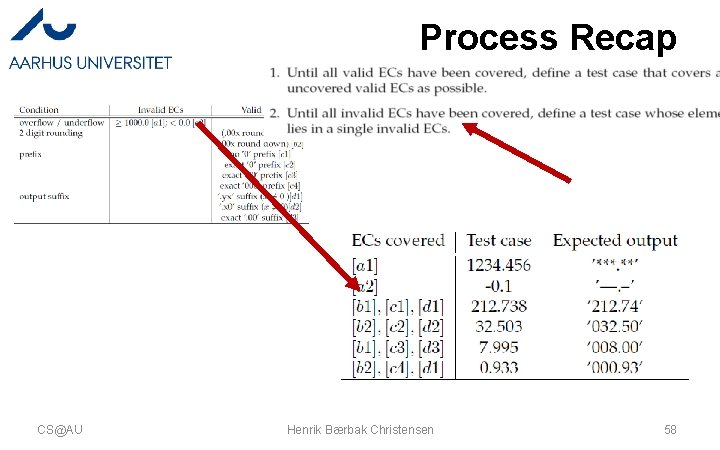
Process Recap CS@AU Henrik Bærbak Christensen 58
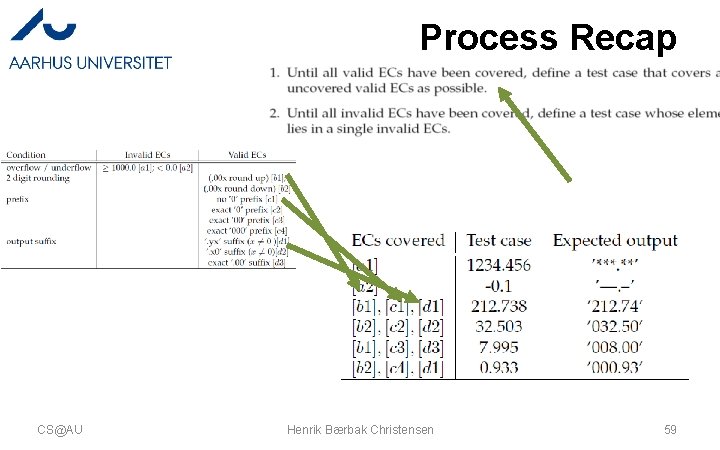
Process Recap CS@AU Henrik Bærbak Christensen 59
Process Recap CS@AU Henrik Bærbak Christensen 60
Process Recap CS@AU Henrik Bærbak Christensen 61
Process Recap CS@AU Henrik Bærbak Christensen 62
Boundary value analysis CS@AU Henrik Bærbak Christensen 63
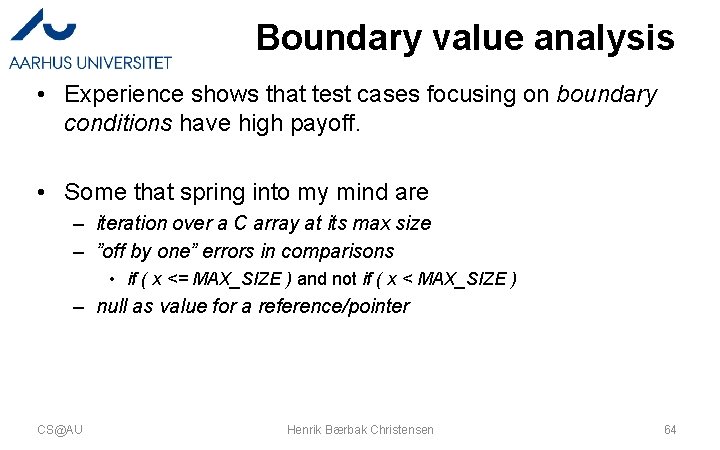
Boundary value analysis • Experience shows that test cases focusing on boundary conditions have high payoff. • Some that spring into my mind are – iteration over a C array at its max size – ”off by one” errors in comparisons • if ( x <= MAX_SIZE ) and not if ( x < MAX_SIZE ) – null as value for a reference/pointer CS@AU Henrik Bærbak Christensen 64
Complements EP analysis • Ex. Formatting has a strong boundary between EC [a 1] and [a 2] – 0. 0 (-> ‘ 000. 00’) and -0. 000001 (-> ‘---. --’) • It is thus very interesting to test x=0. 0 as boundary. CS@AU Henrik Bærbak Christensen 65
Other Reliability Techniques Testing is not the only way…
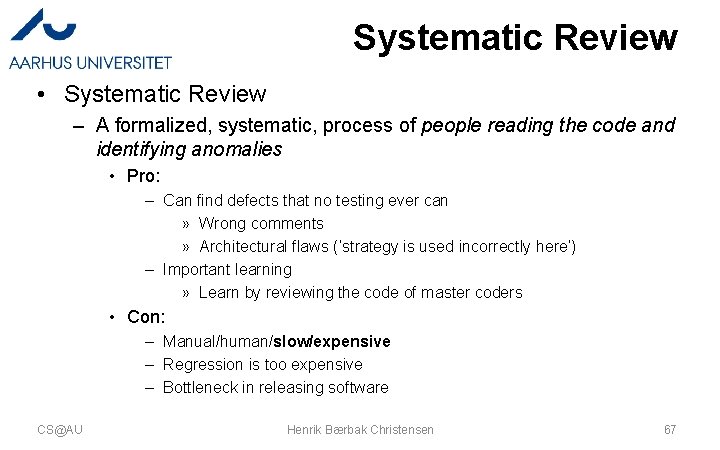
Systematic Review • Systematic Review – A formalized, systematic, process of people reading the code and identifying anomalies • Pro: – Can find defects that no testing ever can » Wrong comments » Architectural flaws (‘strategy is used incorrectly here’) – Important learning » Learn by reviewing the code of master coders • Con: – Manual/human/slow/expensive – Regression is too expensive – Bottleneck in releasing software CS@AU Henrik Bærbak Christensen 67
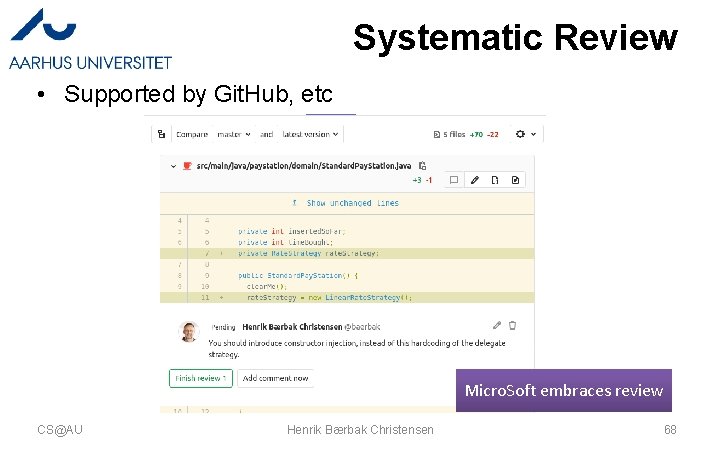
Systematic Review • Supported by Git. Hub, etc Micro. Soft embraces review CS@AU Henrik Bærbak Christensen 68
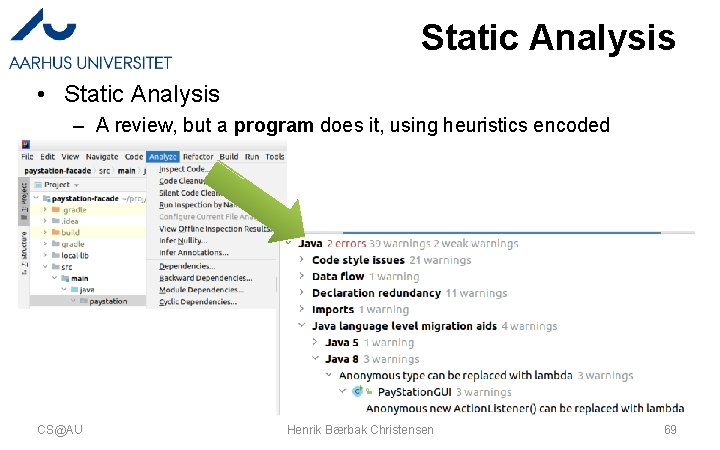
Static Analysis • Static Analysis – A review, but a program does it, using heuristics encoded CS@AU Henrik Bærbak Christensen 69
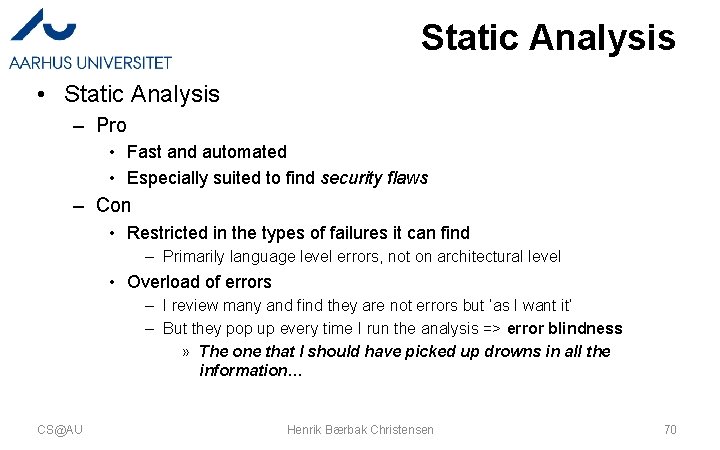
Static Analysis • Static Analysis – Pro • Fast and automated • Especially suited to find security flaws – Con • Restricted in the types of failures it can find – Primarily language level errors, not on architectural level • Overload of errors – I review many and find they are not errors but ‘as I want it’ – But they pop up every time I run the analysis => error blindness » The one that I should have picked up drowns in all the information… CS@AU Henrik Bærbak Christensen 70
Formal Methods • The biggest gun in the cupboard • Mathematical proof that our algorithm is correct • Much research (also here at CS), but so far (I think) – Techniques do not scale – Math may be even harder to read than code • That is, the error may be in the proof! – Math is a model, often ignoring physical properties • No, the Stack is not infinite! CS@AU Henrik Bærbak Christensen 71
Discussion
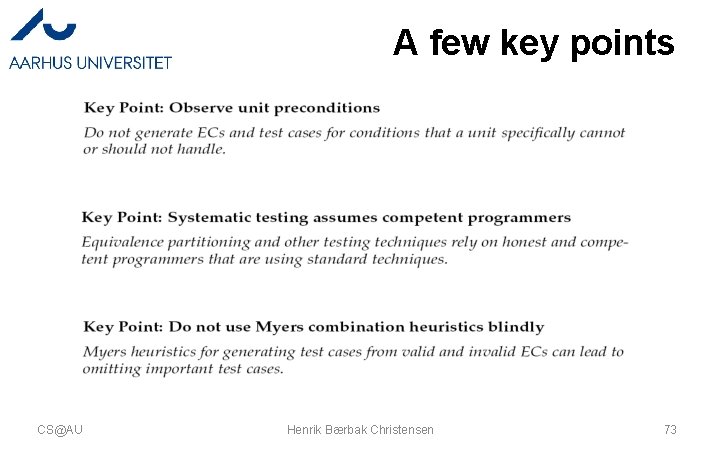
A few key points CS@AU Henrik Bærbak Christensen 73
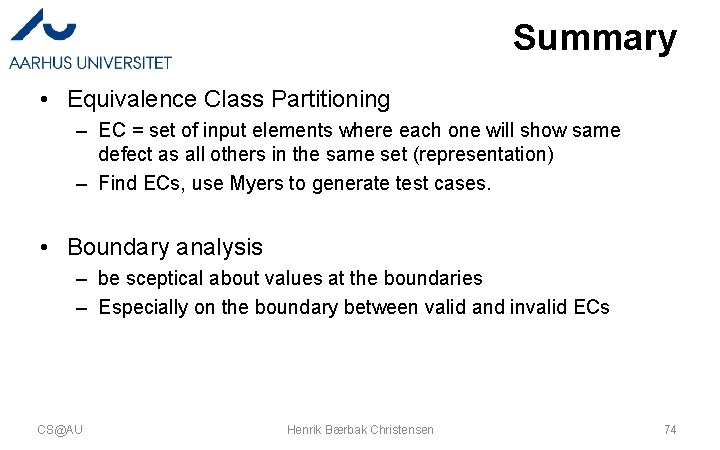
Summary • Equivalence Class Partitioning – EC = set of input elements where each one will show same defect as all others in the same set (representation) – Find ECs, use Myers to generate test cases. • Boundary analysis – be sceptical about values at the boundaries – Especially on the boundary between valid and invalid ECs CS@AU Henrik Bærbak Christensen 74