
Software Development Management A simplistic howto Mathieu Lacage
- Slides: 20
Software Development Management A simplistic howto Mathieu Lacage <lacage@sophia. inria. fr> service DREAM
What is software ? • Examples: - excel macros javascript graphical user interface for a database real-time control of an articulated arm numerical computation The goals, requirements, and knowhow are extremely different
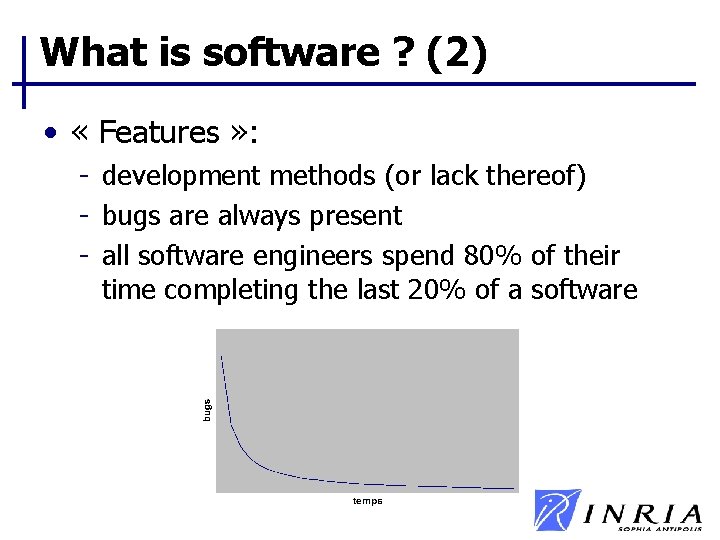
What is software ? (2) • « Features » : - development methods (or lack thereof) - bugs are always present - all software engineers spend 80% of their time completing the last 20% of a software
What are the goals ? • • Complete current project ASAP As few bugs as possible Complete next project ASAP (maybe) Means to achieve these goals: - reuse of libraries and/or programs write reusable code write bug-free code (? !). . .
How to achieve these goals • Software development « management » - keep in mind the ultimate goal during technical discussions or when you must take a decision on your own: complete the projet asap within the given constraints - none of this is technically challenging. It is a (not so simple) matter of communication and organization • Each and every project, small or big, can save time with such « management »
Decisions • Macro-decisions: - will library X be used ? - when do you want to complete the project ? - what features must be implemented ? • Micro-decisions: - how do you add featurelet Y to the project ? • hack into object A, B, or C ? • create a new clean object D ?
Macro-decisions • Features: - end-user: feature list, user documentation - developer side: documentation • Deadlines: prototype, final version, hard deadlines ? • Development environment: - libraries, compiler, and OS versions • Production environment: - different from development environment ?
Macro-decisions (2) • Each decision has a direct and fundamental influence on: - architecture maintainance cost reuse cost initial cost • Each decision must be weighed against its consequences This requires experience to get right
Micro-decisions • Every day, every second, small decisions must be made on how to build the software, how to add a function: - language-specific: requires knowledge of the language idioms - language-independent: requires knowledge of many development idioms to pick the right one If you have experience, it ’s easy. If you do not you can learn easily
How to acquire experience ? • No need to be a level 5 guru (gurus always start at level 0) • A few ideas: - be very rigorous question yourself discuss your decisions with others read the code of others obey the following 7 basic rules
Rule n° 1 • Source server - CVS, arch, subversion, bitkeeper, perforce - yes, zip archives are worthless - must allow concurrent work on the same file with easy merging - must allow branch creation and merging - must allow history browsing
Rule n° 2 • Tag/Branch the source repository for each release • Yes, numbered zip archives are worthless • This is the only reliable way to reproduce bugs reported by users
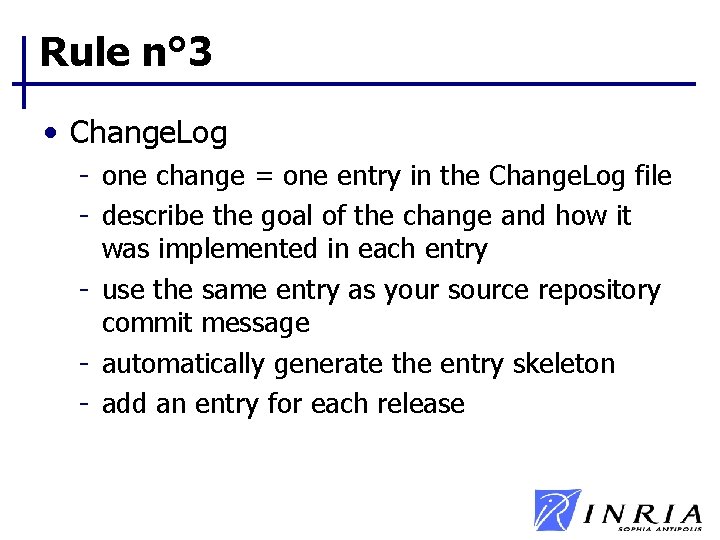
Rule n° 3 • Change. Log - one change = one entry in the Change. Log file - describe the goal of the change and how it was implemented in each entry - use the same entry as your source repository commit message - automatically generate the entry skeleton - add an entry for each release
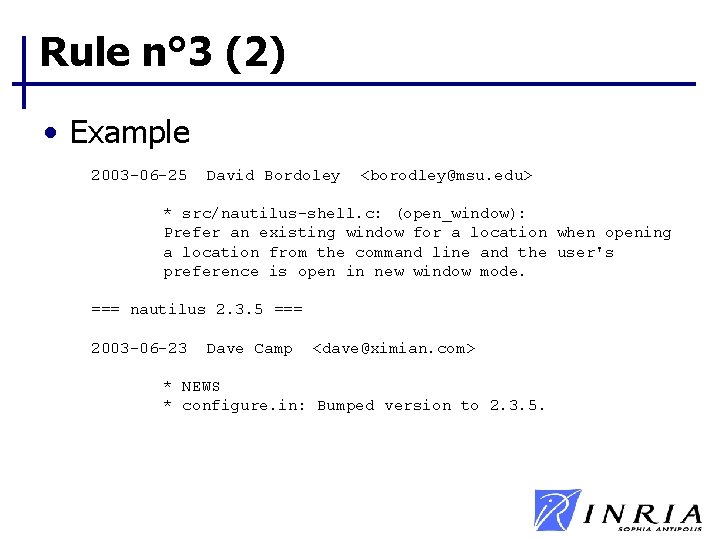
Rule n° 3 (2) • Example 2003 -06 -25 David Bordoley <borodley@msu. edu> * src/nautilus-shell. c: (open_window): Prefer an existing window for a location when opening a location from the command line and the user's preference is open in new window mode. === nautilus 2. 3. 5 === 2003 -06 -23 Dave Camp <dave@ximian. com> * NEWS * configure. in: Bumped version to 2. 3. 5.
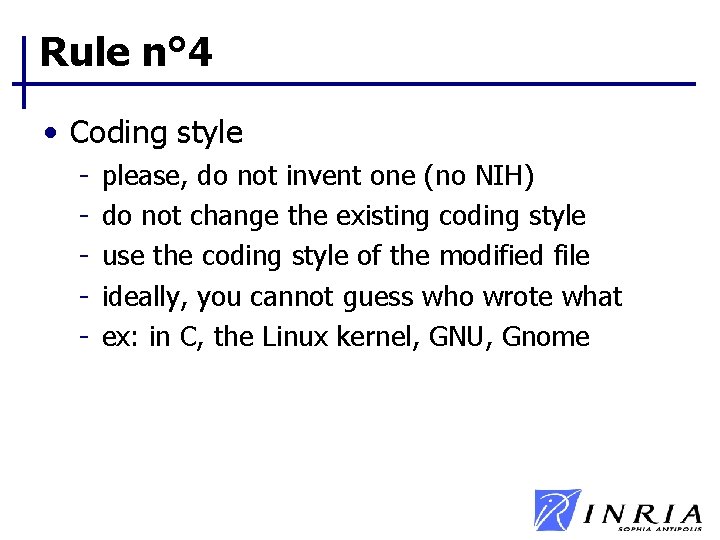
Rule n° 4 • Coding style - please, do not invent one (no NIH) do not change the existing coding style use the coding style of the modified file ideally, you cannot guess who wrote what ex: in C, the Linux kernel, GNU, Gnome
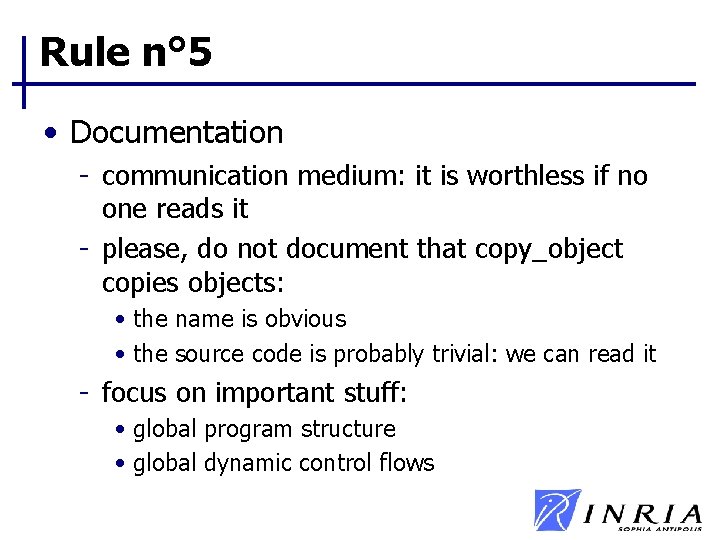
Rule n° 5 • Documentation - communication medium: it is worthless if no one reads it - please, do not document that copy_object copies objects: • the name is obvious • the source code is probably trivial: we can read it - focus on important stuff: • global program structure • global dynamic control flows
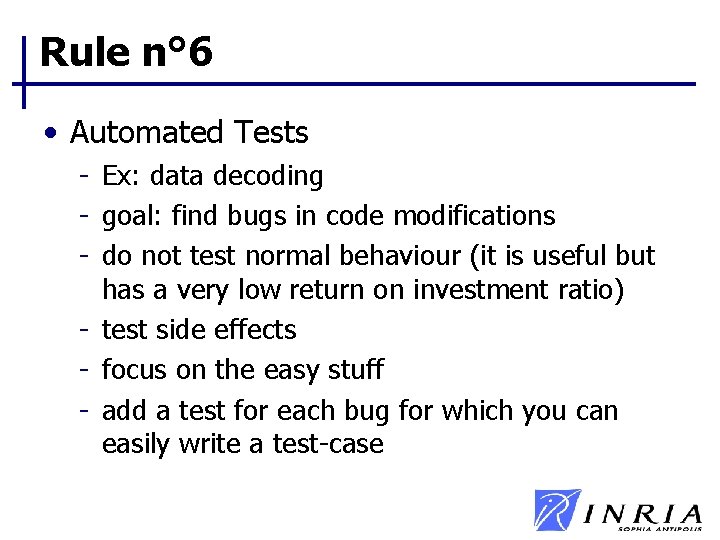
Rule n° 6 • Automated Tests - Ex: data decoding - goal: find bugs in code modifications - do not test normal behaviour (it is useful but has a very low return on investment ratio) - test side effects - focus on the easy stuff - add a test for each bug for which you can easily write a test-case
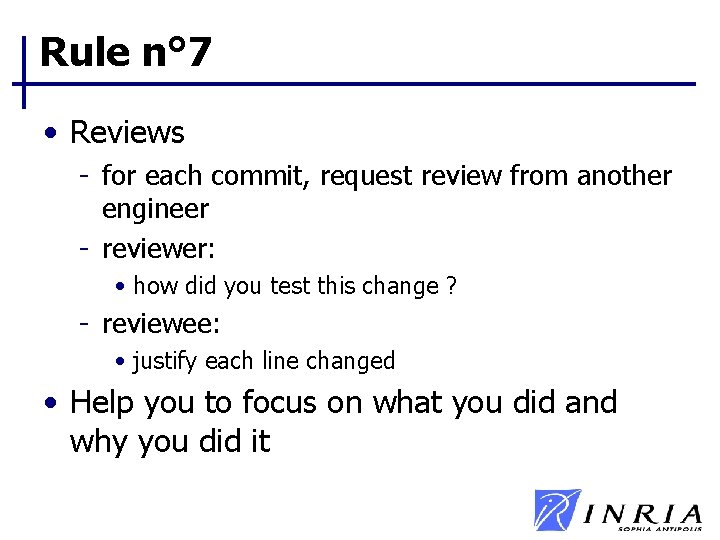
Rule n° 7 • Reviews - for each commit, request review from another engineer - reviewer: • how did you test this change ? - reviewee: • justify each line changed • Help you to focus on what you did and why you did it
Recommended reading • Books: - « Refactoring: Improving the Design of Existing Code » , by Martin Fowler, Addison Wesley - « The mythical man month » , by Frederick P. Brooks, Addison Wesley • Papers: - http: //www. inf. vtt. fi/pdf/publications/2002/P 478. pdf - http: //alistair. cockburn. us/crystal/articles/alistairsarticles. htm
Conclusion (2) • I am no crook: - I can review two people - I can provide Change. Log generation scripts for C, C++, and Java - I can help CVS server configuration (not administration) - I answer all emails: lacage@sophia. inria. fr • DREAM answers all emails too: - dream. permanents@sophia. inria. fr