
Software Development LifeCycle Model Prepared By Dr Maher
Software Development Life-Cycle Model Prepared By Dr. Maher Abuhamdeh These slides prepared by Prof. Bob Keller of Harvery Mudd College and printed for ERAU/Prescott SE 300 usage with his kind permission. Slides avaialble online at http: //www. cs. hmc. edu/courses/2005/spring/cs 121/slides 05. ppt
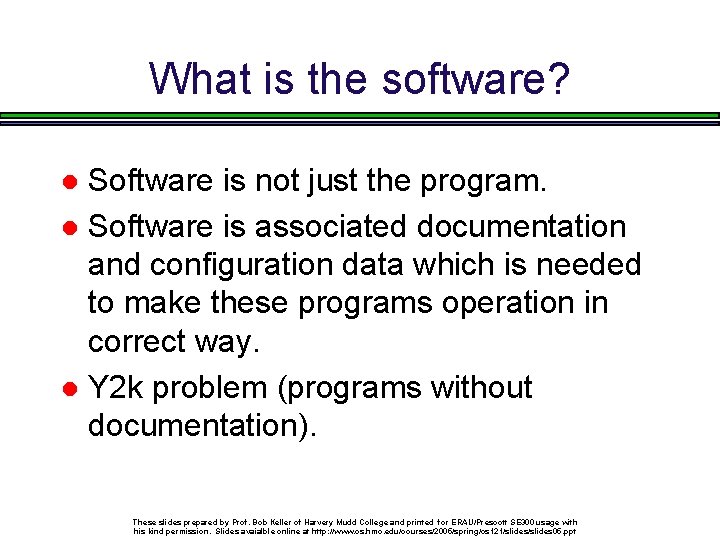
What is the software? Software is not just the program. Software is associated documentation and configuration data which is needed to make these programs operation in correct way. Y 2 k problem (programs without documentation). These slides prepared by Prof. Bob Keller of Harvery Mudd College and printed for ERAU/Prescott SE 300 usage with his kind permission. Slides avaialble online at http: //www. cs. hmc. edu/courses/2005/spring/cs 121/slides 05. ppt
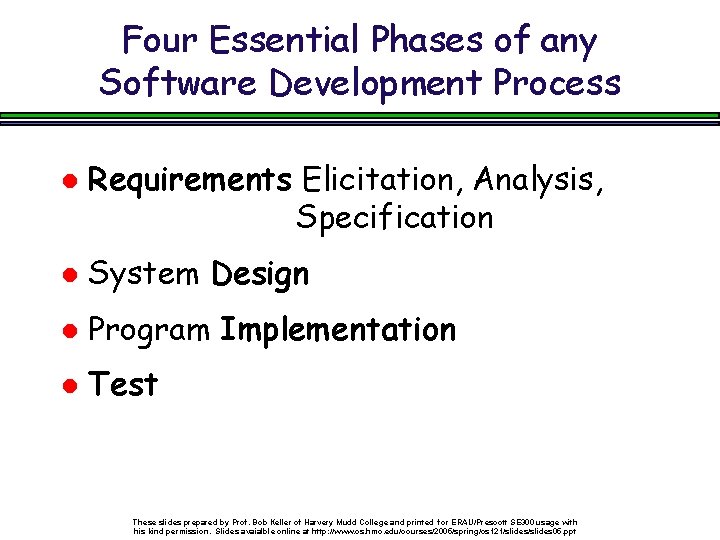
Four Essential Phases of any Software Development Process Requirements Elicitation, Analysis, Specification System Design Program Implementation Test These slides prepared by Prof. Bob Keller of Harvery Mudd College and printed for ERAU/Prescott SE 300 usage with his kind permission. Slides avaialble online at http: //www. cs. hmc. edu/courses/2005/spring/cs 121/slides 05. ppt
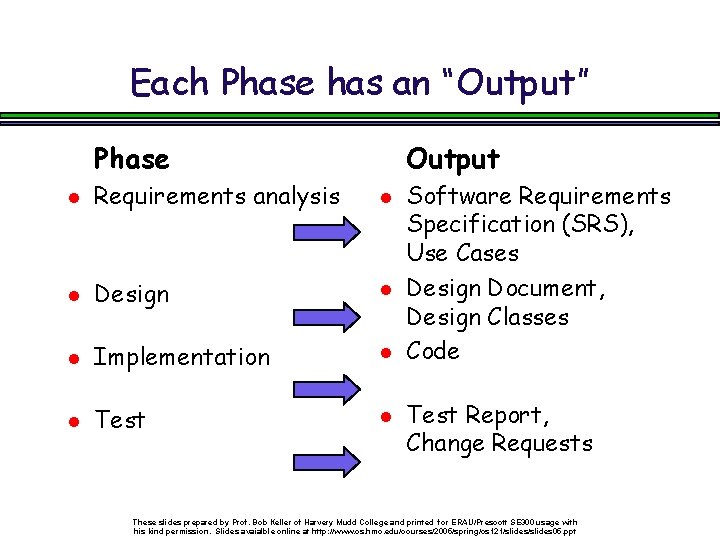
Each Phase has an “Output” Phase Output Requirements analysis Design Implementation Test Software Requirements Specification (SRS), Use Cases Design Document, Design Classes Code Test Report, Change Requests These slides prepared by Prof. Bob Keller of Harvery Mudd College and printed for ERAU/Prescott SE 300 usage with his kind permission. Slides avaialble online at http: //www. cs. hmc. edu/courses/2005/spring/cs 121/slides 05. ppt
Features of Waterfall Model A Water Fall Model is easy to flow. It can be implemented for any size of project. Every stage has to be done separately at the right time so you cannot jump stages These slides prepared by Prof. Bob Keller of Harvery Mudd College and printed for ERAU/Prescott SE 300 usage with his kind permission. Slides avaialble online at http: //www. cs. hmc. edu/courses/2005/spring/cs 121/slides 05. ppt
Features of Waterfall Model (Cont. ) Documentation is produced at every stage of a waterfall model allowing people to understand what has been done. Testing is done at every stage. These slides prepared by Prof. Bob Keller of Harvery Mudd College and printed for ERAU/Prescott SE 300 usage with his kind permission. Slides avaialble online at http: //www. cs. hmc. edu/courses/2005/spring/cs 121/slides 05. ppt
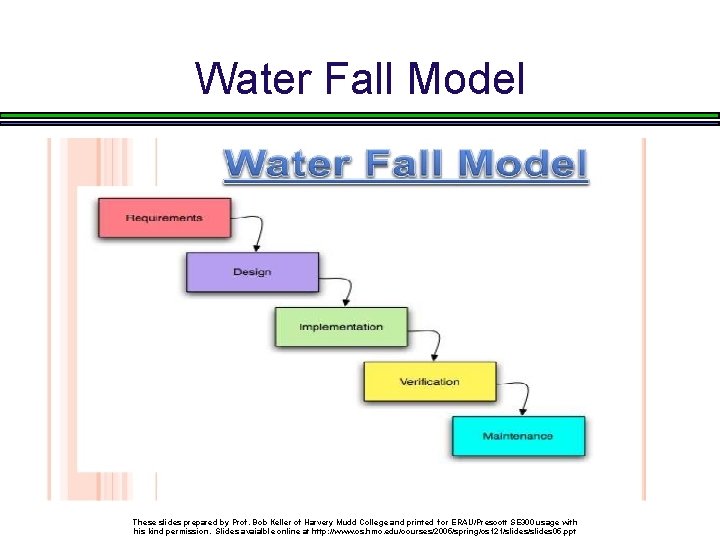
Water Fall Model These slides prepared by Prof. Bob Keller of Harvery Mudd College and printed for ERAU/Prescott SE 300 usage with his kind permission. Slides avaialble online at http: //www. cs. hmc. edu/courses/2005/spring/cs 121/slides 05. ppt
Waterfall model has 5 different phases Which are following. 1)Requirement gathering and Analysis. 2)Design. 3)Coding. 4)Testing. 5)Maintenance. These slides prepared by Prof. Bob Keller of Harvery Mudd College and printed for ERAU/Prescott SE 300 usage with his kind permission. Slides avaialble online at http: //www. cs. hmc. edu/courses/2005/spring/cs 121/slides 05. ppt
Brief description for each phase 1 -Requirement gathering and Analysis: v This is the first phase of waterfall model which includes a meeting with the customer to understand his requirements. v The software definition must be detailed and accurate with no ambiguities. These slides prepared by Prof. Bob Keller of Harvery Mudd College and printed for ERAU/Prescott SE 300 usage with his kind permission. Slides avaialble online at http: //www. cs. hmc. edu/courses/2005/spring/cs 121/slides 05. ppt
Requirement gathering and Analysis (Cont. ) v It is very important to understand the customer requirements and expectations so that the end product meets his specifications. v Requirement gathering and Analysis phase the basic requirements of the system must be understood by software engineer, who is also called ANALYST. These slides prepared by Prof. Bob Keller of Harvery Mudd College and printed for ERAU/Prescott SE 300 usage with his kind permission. Slides avaialble online at http: //www. cs. hmc. edu/courses/2005/spring/cs 121/slides 05. ppt
Output for Requirement gathering and Analysis All this requirements are then well documented and discussed further with the customer for reviewing. Software Requirements Specification document is called (SRS). These slides prepared by Prof. Bob Keller of Harvery Mudd College and printed for ERAU/Prescott SE 300 usage with his kind permission. Slides avaialble online at http: //www. cs. hmc. edu/courses/2005/spring/cs 121/slides 05. ppt
2 - Design v The customer requirements are broken down into logical modules for the ease of implementation. Hardware and software requirements for every module are Identified and designed accordingly. v Also the inter relation between the various logical modules is established at this stage. v Algorithms and diagrams defining the scope and objective of each logical model are developed These slides prepared by Prof. Bob Keller of Harvery Mudd College and printed for ERAU/Prescott SE 300 usage with his kind permission. Slides avaialble online at http: //www. cs. hmc. edu/courses/2005/spring/cs 121/slides 05. ppt
Design(Cont. ) In short, this phase lays a fundamental for actual programming and implementation. v It is a intermediate step between requirements analysis and coding. Design focuses on program attribute such as Data Structure, Algorithm Details etc… The requirements are translated in some easy to represent form using which coding can be done effectively and efficiently. The design needs to be documented for further use. v These slides prepared by Prof. Bob Keller of Harvery Mudd College and printed for ERAU/Prescott SE 300 usage with his kind permission. Slides avaialble online at http: //www. cs. hmc. edu/courses/2005/spring/cs 121/slides 05. ppt
3 - Coding v Coding is a step in which design is translated into machine-readable form If design is done in sufficient detail then coding can be done effectively. Programs are created in this phase. In this phase all software divided into small module then after doing coding for that small module rather than do coding whole software. . These slides prepared by Prof. Bob Keller of Harvery Mudd College and printed for ERAU/Prescott SE 300 usage with his kind permission. Slides avaialble online at http: //www. cs. hmc. edu/courses/2005/spring/cs 121/slides 05. ppt
3 - Coding (Cont. ) v According to design programmers do code and make class and structure of whole software. These slides prepared by Prof. Bob Keller of Harvery Mudd College and printed for ERAU/Prescott SE 300 usage with his kind permission. Slides avaialble online at http: //www. cs. hmc. edu/courses/2005/spring/cs 121/slides 05. ppt
4 - Testing v In this stage, both individual components and the integrated whole are methodically verified to ensure that they are error-free and fully meet the requirements outlined in the first step. In this phase testing whole software into two parts 1 -HARDWARE 2 - SOFTWARE Type of testing is 2 -types Inside test and Outside test. These slides prepared by Prof. Bob Keller of Harvery Mudd College and printed for ERAU/Prescott SE 300 usage with his kind permission. Slides avaialble online at http: //www. cs. hmc. edu/courses/2005/spring/cs 121/slides 05. ppt
5 - Maintenance v This is the final phase of the waterfall model, in which the completed software product is handed over to the client after alpha, beta testing. After the software has been deployed on the client site, it is the duty of the software development team to undertake routine maintenance activities by visiting the client site. requirement analysis These slides prepared by Prof. Bob Keller of Harvery Mudd College and printed for ERAU/Prescott SE 300 usage with his kind permission. Slides avaialble online at http: //www. cs. hmc. edu/courses/2005/spring/cs 121/slides 05. ppt
5 – Maintenance (Cont. ) v If the customer suggests changes or enhancements the software process has to be followed all over again right from the first phase. These slides prepared by Prof. Bob Keller of Harvery Mudd College and printed for ERAU/Prescott SE 300 usage with his kind permission. Slides avaialble online at http: //www. cs. hmc. edu/courses/2005/spring/cs 121/slides 05. ppt
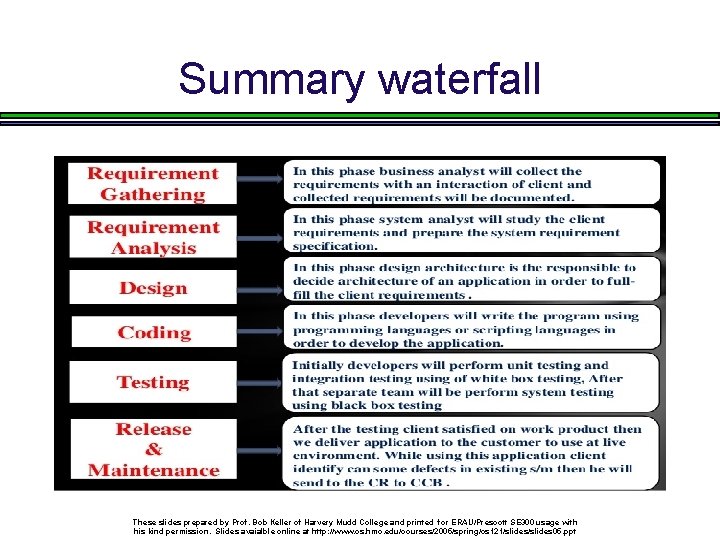
Summary waterfall These slides prepared by Prof. Bob Keller of Harvery Mudd College and printed for ERAU/Prescott SE 300 usage with his kind permission. Slides avaialble online at http: //www. cs. hmc. edu/courses/2005/spring/cs 121/slides 05. ppt
Advantages of waterfall model Simple and easy to understand use. Easy to manage due to the rigidity of the model. Phases are processed and completed one at a time. Works well for smaller projects where requirements are very well understood These slides prepared by Prof. Bob Keller of Harvery Mudd College and printed for ERAU/Prescott SE 300 usage with his kind permission. Slides avaialble online at http: //www. cs. hmc. edu/courses/2005/spring/cs 121/slides 05. ppt
Disadvantages of waterfall model You cannot go back a step; if the design phase has gone wrong, things can get very complicated in the implementation phase. High amounts of risk and uncertainty. Not a good model for complex and object-oriented projects. These slides prepared by Prof. Bob Keller of Harvery Mudd College and printed for ERAU/Prescott SE 300 usage with his kind permission. Slides avaialble online at http: //www. cs. hmc. edu/courses/2005/spring/cs 121/slides 05. ppt
Disadvantages of waterfall model (Cont. ) Poor model for long and on-going projects. Not suitable for the projects where requirements are at a moderate to high risk of changing. These slides prepared by Prof. Bob Keller of Harvery Mudd College and printed for ERAU/Prescott SE 300 usage with his kind permission. Slides avaialble online at http: //www. cs. hmc. edu/courses/2005/spring/cs 121/slides 05. ppt
- Slides: 22