
Software Development Infrastructure for Sensor Networks Operating systems
- Slides: 25
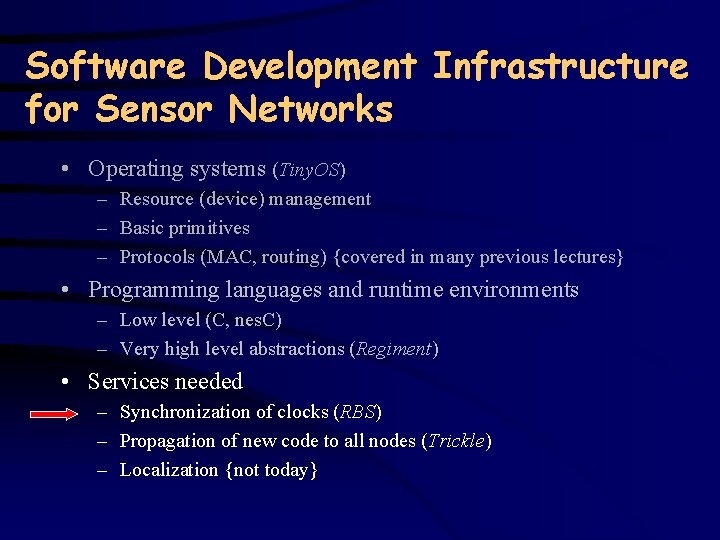
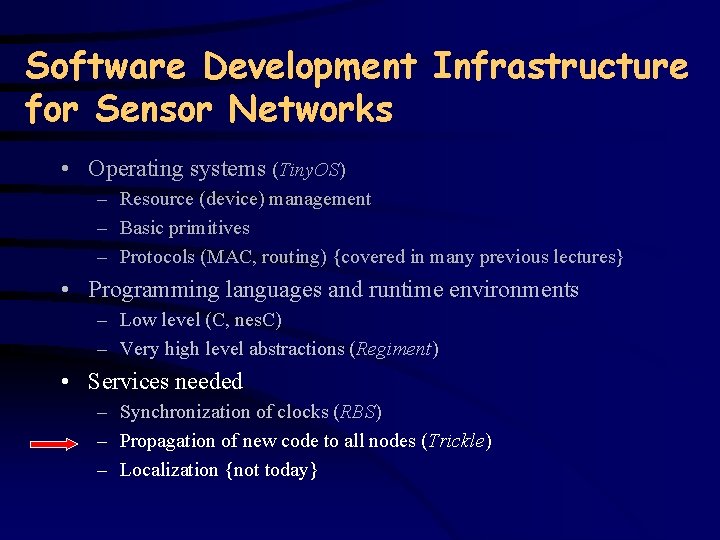
Software Development Infrastructure for Sensor Networks • Operating systems (Tiny. OS) – Resource (device) management – Basic primitives – Protocols (MAC, routing) {covered in many previous lectures} • Programming languages and runtime environments – Low level (C, nes. C) – Very high level abstractions (Regiment) • Services needed – Synchronization of clocks (RBS) – Propagation of new code to all nodes (Trickle) – Localization {not today}
Fine-Grained Network Time Synchronization Using Reference Broadcasts Jeremy Elson, Lew Girod, and Deborah Estrin University of California, Los Angeles OSDI 2002 - Boston, MA Used with permission of author
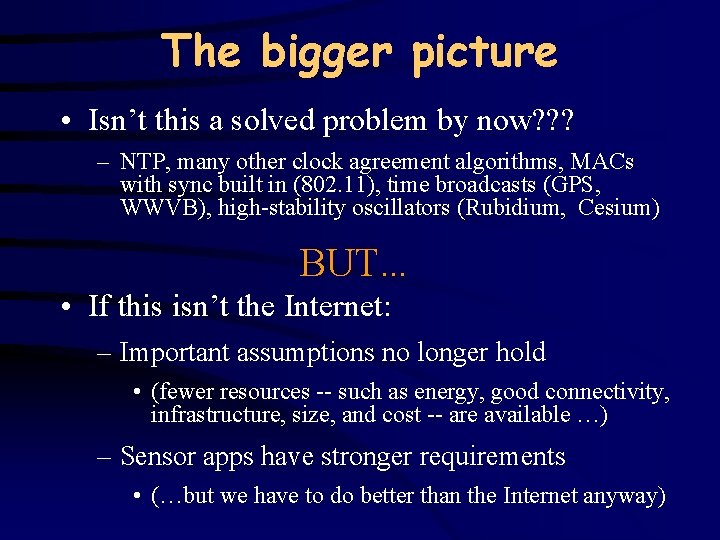
The bigger picture • Isn’t this a solved problem by now? ? ? – NTP, many other clock agreement algorithms, MACs with sync built in (802. 11), time broadcasts (GPS, WWVB), high-stability oscillators (Rubidium, Cesium) BUT. . . • If this isn’t the Internet: – Important assumptions no longer hold • (fewer resources -- such as energy, good connectivity, infrastructure, size, and cost -- are available …) – Sensor apps have stronger requirements • (…but we have to do better than the Internet anyway)
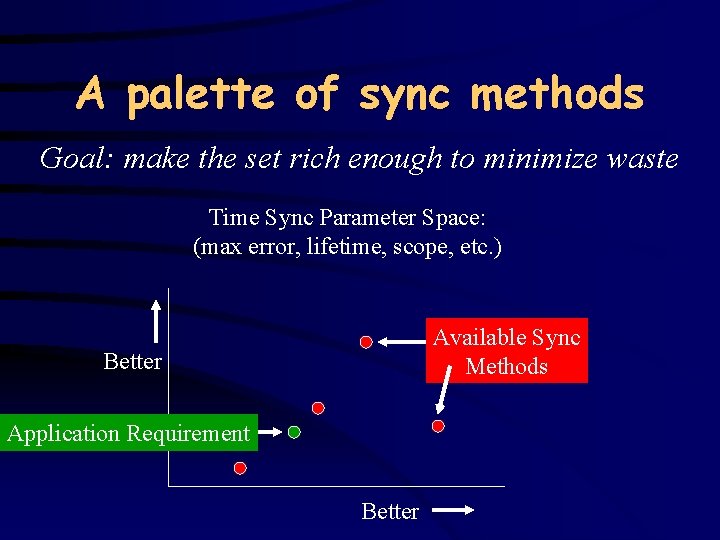
A palette of sync methods Goal: make the set rich enough to minimize waste Time Sync Parameter Space: (max error, lifetime, scope, etc. ) Available Sync Methods Better Application Requirement Better
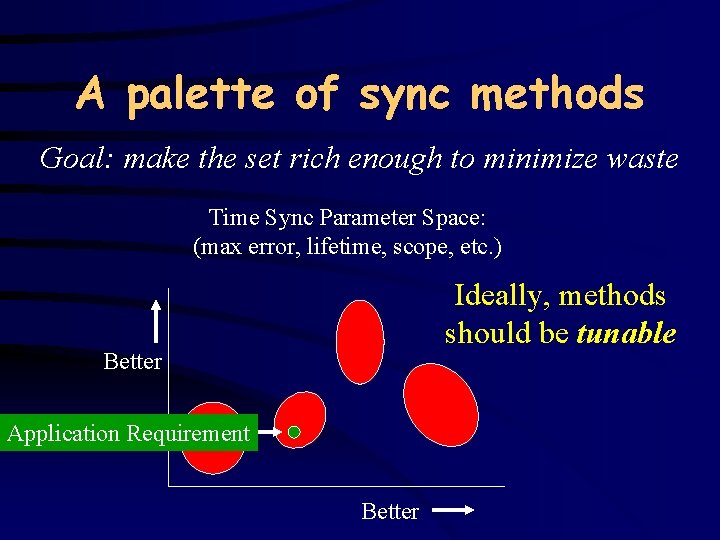
A palette of sync methods Goal: make the set rich enough to minimize waste Time Sync Parameter Space: (max error, lifetime, scope, etc. ) Ideally, methods should be tunable Better Application Requirement Better
Time Definitions • Clock stability – how well it maintains a constant frequency – Short term – temperature – Long term – aging of oscillator • Clock accuracy – how well its frequency and time compare with standard • Offset – time difference between 2 clocks • Skew – frequency difference between 2 clocks
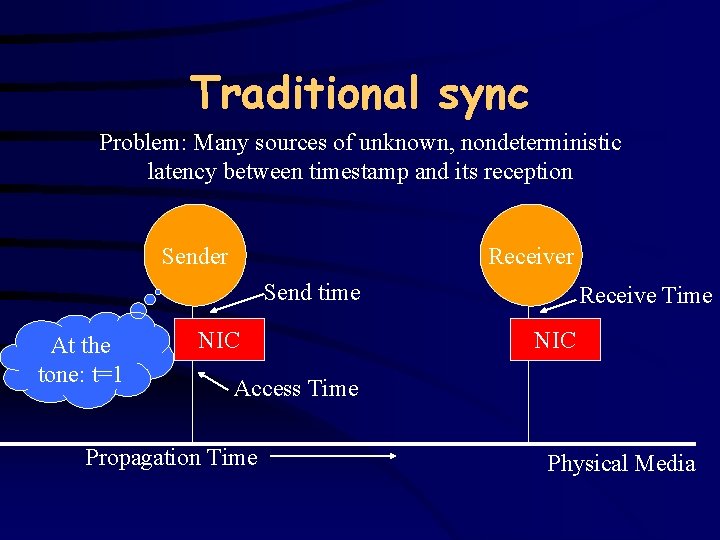
Traditional sync Problem: Many sources of unknown, nondeterministic latency between timestamp and its reception Sender Receiver Send time At the tone: t=1 NIC Receive Time NIC Access Time Propagation Time Physical Media
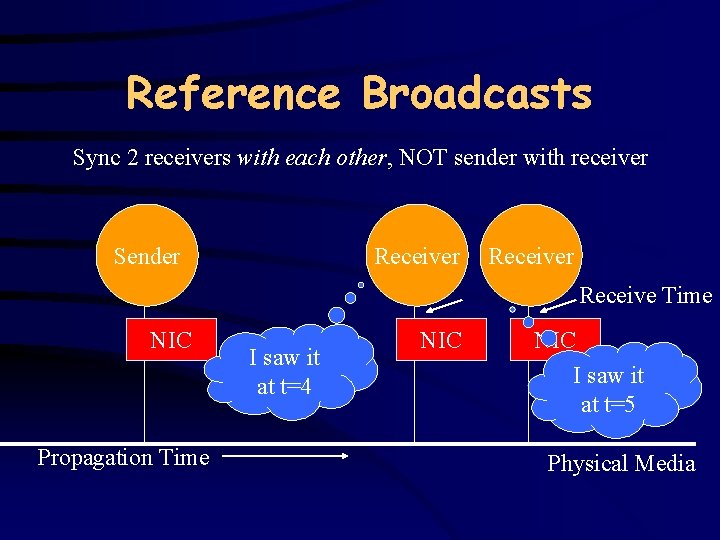
Reference Broadcasts Sync 2 receivers with each other, NOT sender with receiver Sender Receiver Receive Time NIC Propagation Time I saw it at t=4 NIC I saw it at t=5 Physical Media
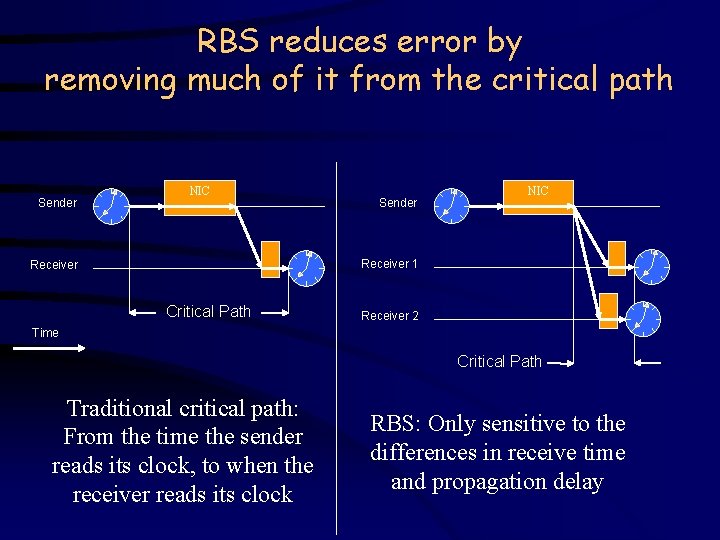
RBS reduces error by removing much of it from the critical path Sender NIC Receiver 1 Receiver Critical Path Receiver 2 Time Critical Path Traditional critical path: From the time the sender reads its clock, to when the receiver reads its clock RBS: Only sensitive to the differences in receive time and propagation delay
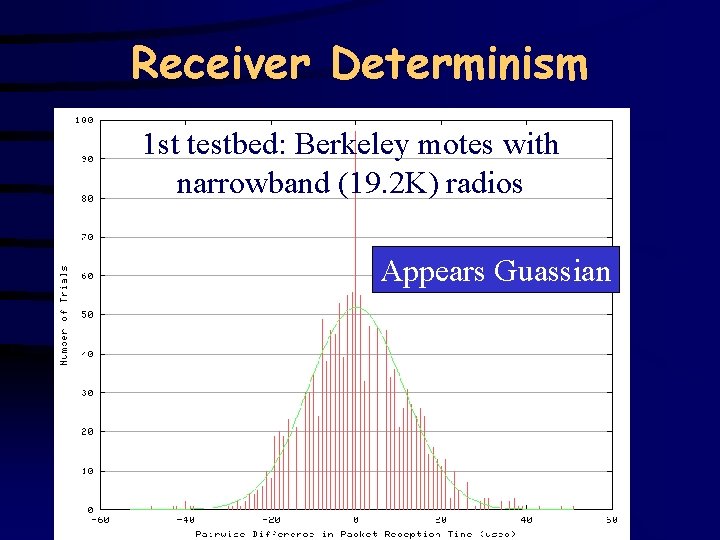
Receiver Determinism 1 st testbed: Berkeley motes with narrowband (19. 2 K) radios Appears Guassian
Well-Behaved = Good • Well behaved distributions are useful – Error can be reduced statistically, by sending multiple pulses over time and averaging – Also, easier to model/simulate
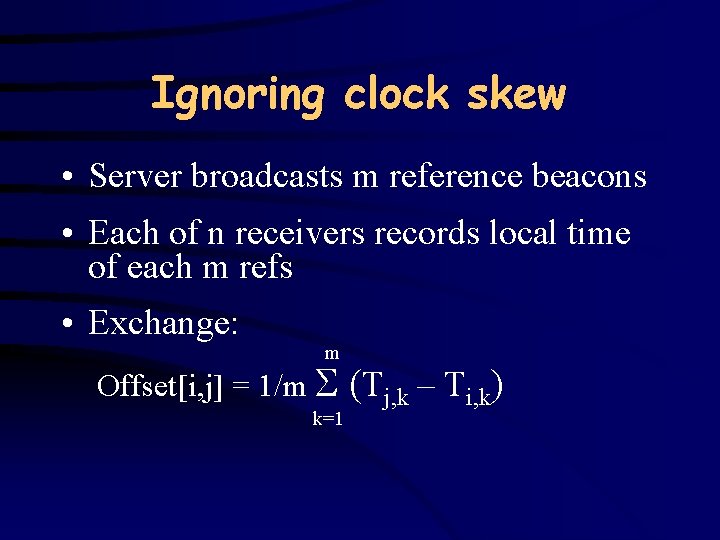
Ignoring clock skew • Server broadcasts m reference beacons • Each of n receivers records local time of each m refs • Exchange: m Offset[i, j] = 1/m S (Tj, k – Ti, k) k=1
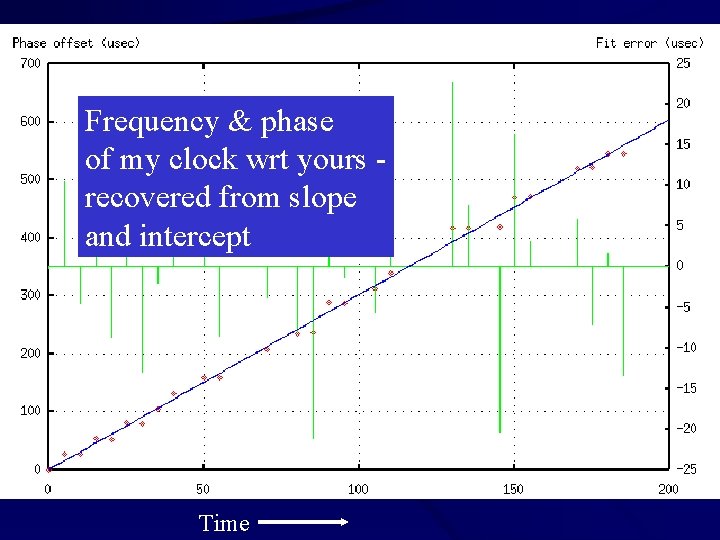
Problem: Clock Skew • It takes time to send multiple pulses • By the time we do, clocks will have drifted • So: don’t average; fit a line instead
Frequency & phase of my clock wrt yours recovered from slope and intercept Time
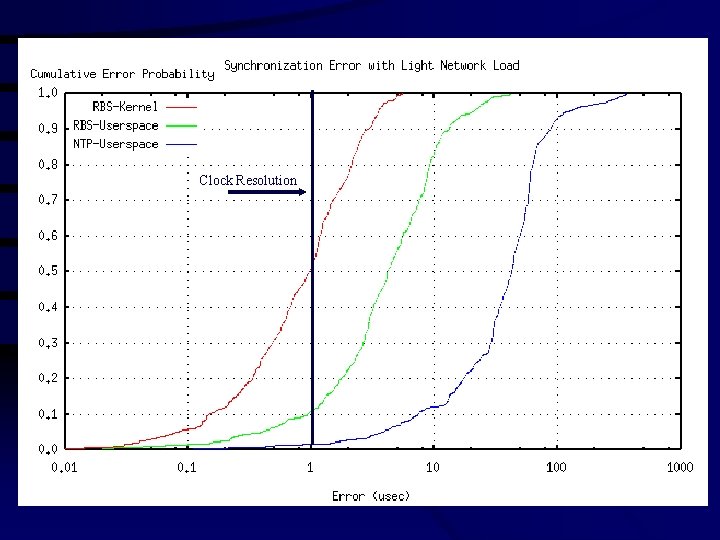
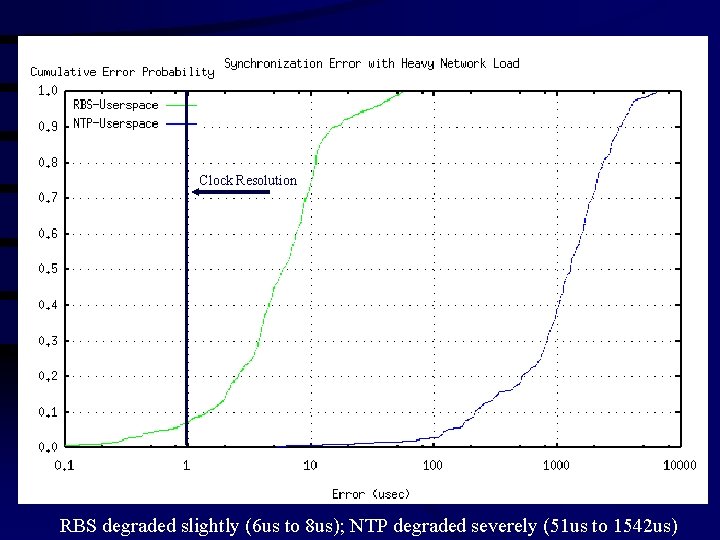
Comparison to NTP • Second implementation: – Compaq IPAQs (small Linux machines) – 11 mbit 802. 11 PCMCIA cards • Ran NTP, RBS-Userspace, RBS-Kernel – NTP synced to GPS clock every 16 secs – NTP with phase correction, too; it did worse (!) • In each case, asked 2 IPAQs to raise a GPIO line high at the same time; differences measured with logic analyzer
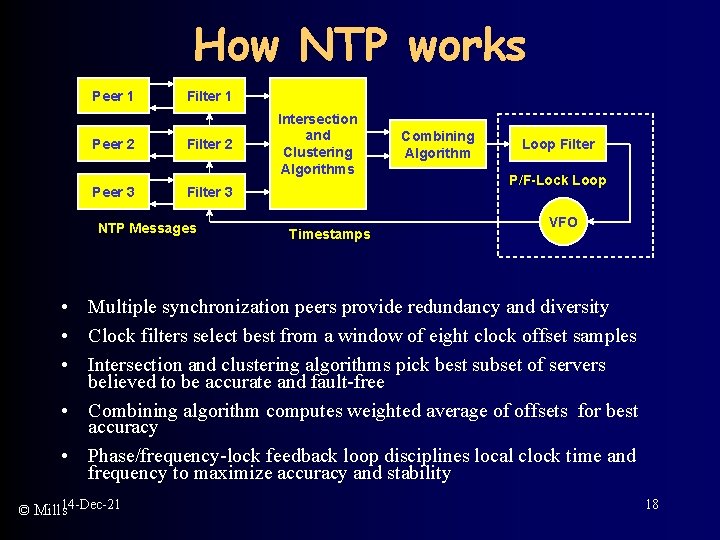
How NTP works Peer 1 Filter 1 Peer 2 Filter 2 Peer 3 Filter 3 NTP Messages Intersection and Clustering Algorithms Timestamps Combining Algorithm Loop Filter P/F-Lock Loop VFO • Multiple synchronization peers provide redundancy and diversity • Clock filters select best from a window of eight clock offset samples • Intersection and clustering algorithms pick best subset of servers believed to be accurate and fault-free • Combining algorithm computes weighted average of offsets for best accuracy • Phase/frequency-lock feedback loop disciplines local clock time and frequency to maximize accuracy and stability © Mills 14 -Dec-21 18
Clock Resolution
Clock Resolution RBS degraded slightly (6 us to 8 us); NTP degraded severely (51 us to 1542 us)
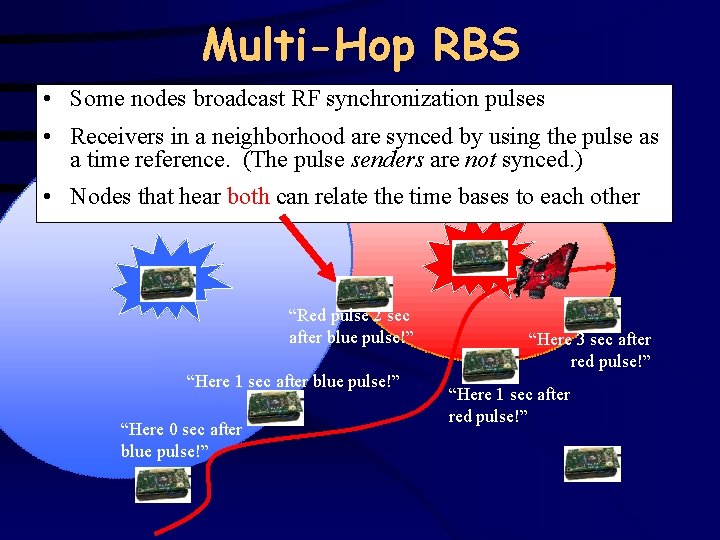
Multi-Hop RBS • Some nodes broadcast RF synchronization pulses • Receivers in a neighborhood are synced by using the pulse as a time reference. (The pulse senders are not synced. ) • Nodes that hear both can relate the time bases to each other “Red pulse 2 sec after blue pulse!” “Here 1 sec after blue pulse!” “Here 0 sec after blue pulse!” “Here 3 sec after red pulse!” “Here 1 sec after red pulse!”
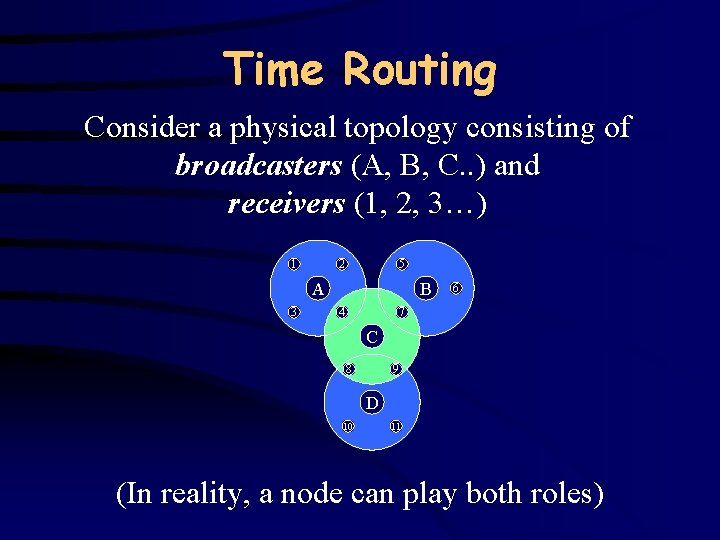
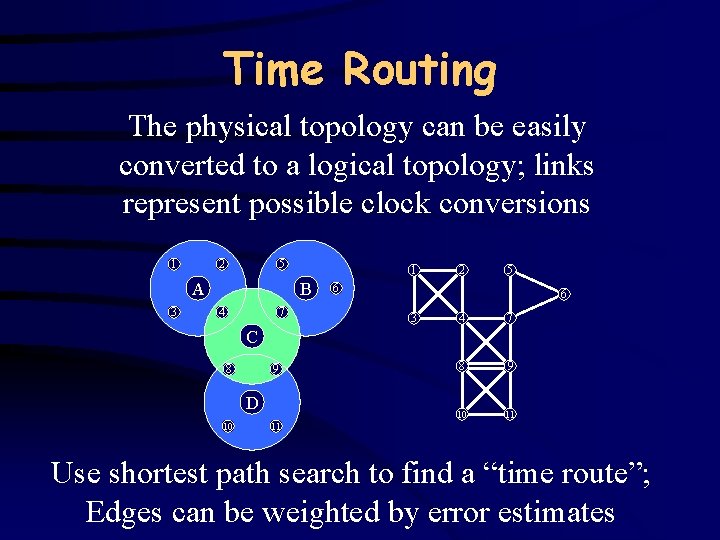
Time Routing Consider a physical topology consisting of broadcasters (A, B, C. . ) and receivers (1, 2, 3…) 1 2 5 A 3 B 4 6 7 C 8 9 D 10 11 (In reality, a node can play both roles)
Time Routing The physical topology can be easily converted to a logical topology; links represent possible clock conversions 1 2 5 A 3 1 B 4 7 2 5 6 6 3 4 7 8 9 10 11 C 8 9 D 10 11 Use shortest path search to find a “time route”; Edges can be weighted by error estimates
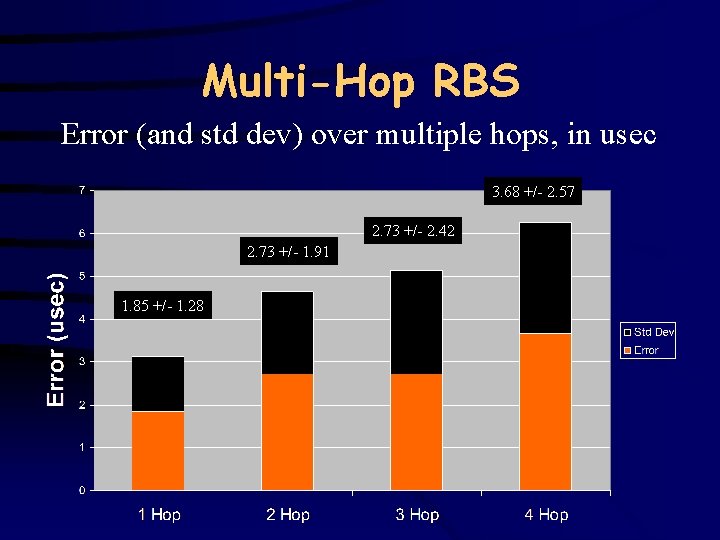
Multi-Hop RBS Error (and std dev) over multiple hops, in usec 3. 68 +/- 2. 57 2. 73 +/- 2. 42 2. 73 +/- 1. 91 1. 85 +/- 1. 28
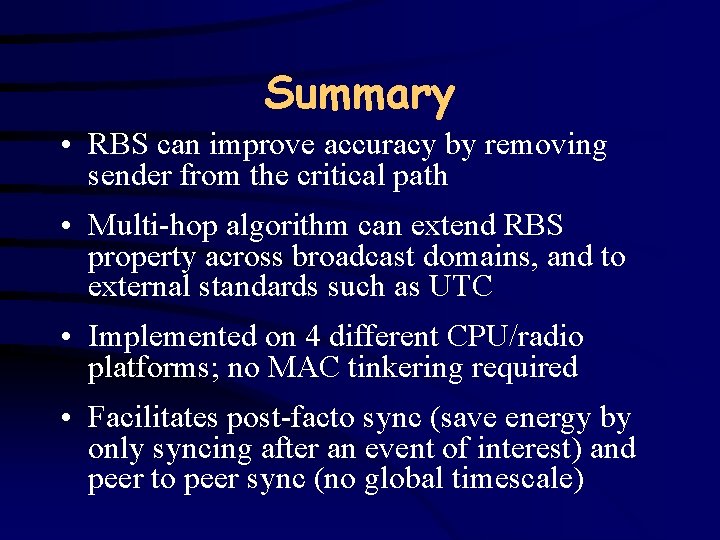
Summary • RBS can improve accuracy by removing sender from the critical path • Multi-hop algorithm can extend RBS property across broadcast domains, and to external standards such as UTC • Implemented on 4 different CPU/radio platforms; no MAC tinkering required • Facilitates post-facto sync (save energy by only syncing after an event of interest) and peer to peer sync (no global timescale)
Applications • Acoustic Ranging • Collaborative Signal Detection • etc. . . • Future work: – Use higher precision clocks (e. g. Pentium TSC) – Better outlier rejection, weighting
Software Development Infrastructure for Sensor Networks • Operating systems (Tiny. OS) – Resource (device) management – Basic primitives – Protocols (MAC, routing) {covered in many previous lectures} • Programming languages and runtime environments – Low level (C, nes. C) – Very high level abstractions (Regiment) • Services needed – Synchronization of clocks (RBS) – Propagation of new code to all nodes (Trickle) – Localization {not today}