
Software Defined Networking DN Benchmarking Methodology for SDN
Software Defined Networking $DN Benchmarking Methodology for SDN Controller Performance draft-bhuvan-bmwg-of-controller-benchmarking-01 91 st IETF, Honolulu Bhuvaneswaran Vengainathan Anton Basil Veryx Technologies Vishwas Manral Ionos Corp Mark Tassinari Hewlett-Packard 12/28/2021 91 st IETF 1
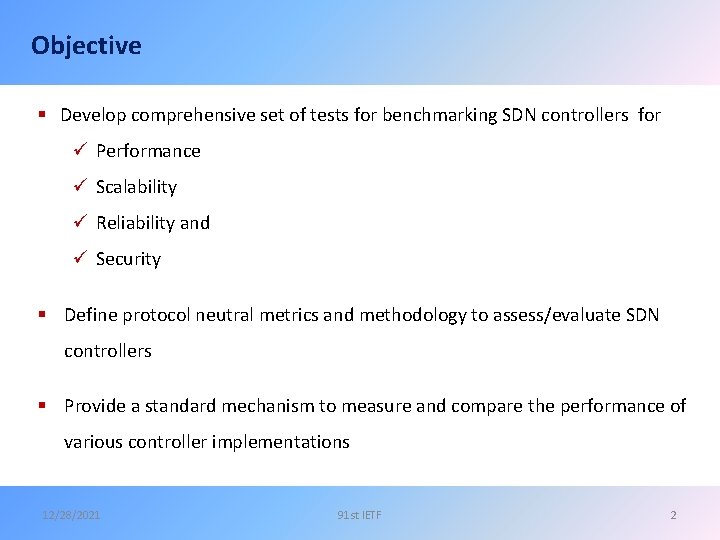
Objective § Develop comprehensive set of tests for benchmarking SDN controllers for ü Performance ü Scalability ü Reliability and ü Security § Define protocol neutral metrics and methodology to assess/evaluate SDN controllers § Provide a standard mechanism to measure and compare the performance of various controller implementations 12/28/2021 91 st IETF 2
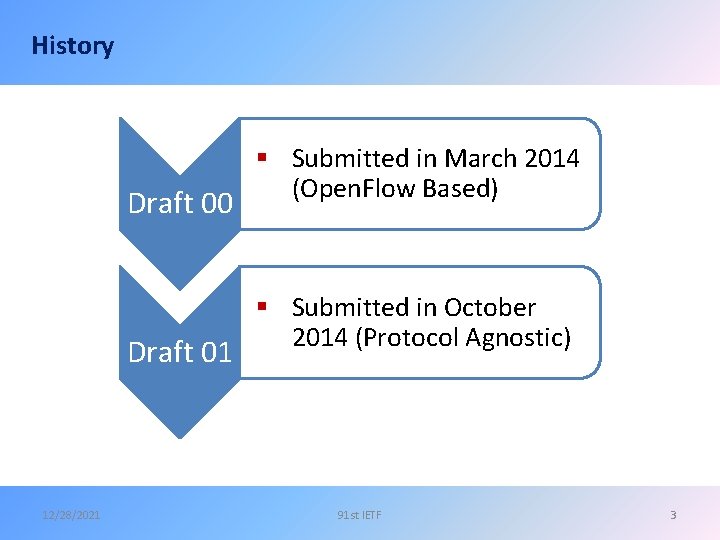
History Draft 00 Draft 01 12/28/2021 § Submitted in March 2014 (Open. Flow Based) § Submitted in October 2014 (Protocol Agnostic) 91 st IETF 3
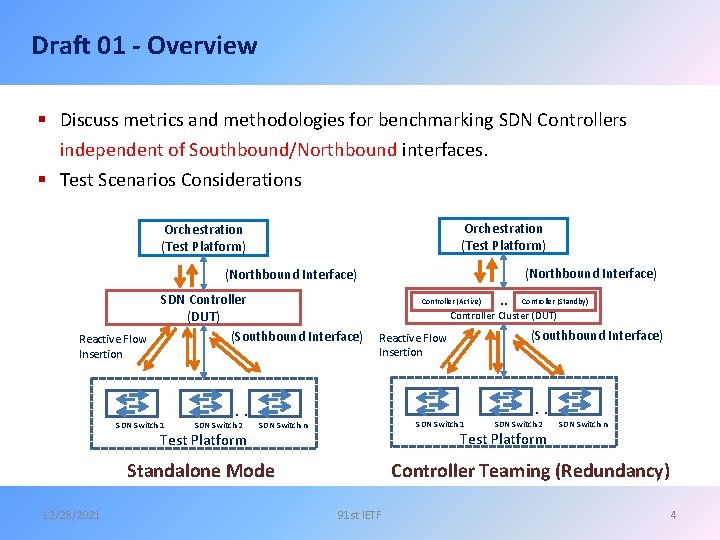
Draft 01 - Overview § Discuss metrics and methodologies for benchmarking SDN Controllers independent of Southbound/Northbound interfaces. § Test Scenarios Considerations Orchestration (Test Platform) (Northbound Interface) Reactive Flow Insertion SDN Controller (DUT) (Southbound Interface) SDN Switch 1 . . SDN Switch 2 Test Platform Controller (Active) Controller (Standby) (Southbound Interface) Reactive Flow Insertion SDN Switch 1 SDN Switch n . . SDN Switch 2 Test Platform SDN Switch n Controller Teaming (Redundancy) Standalone Mode 12/28/2021 . . Controller Cluster (DUT) 91 st IETF 4
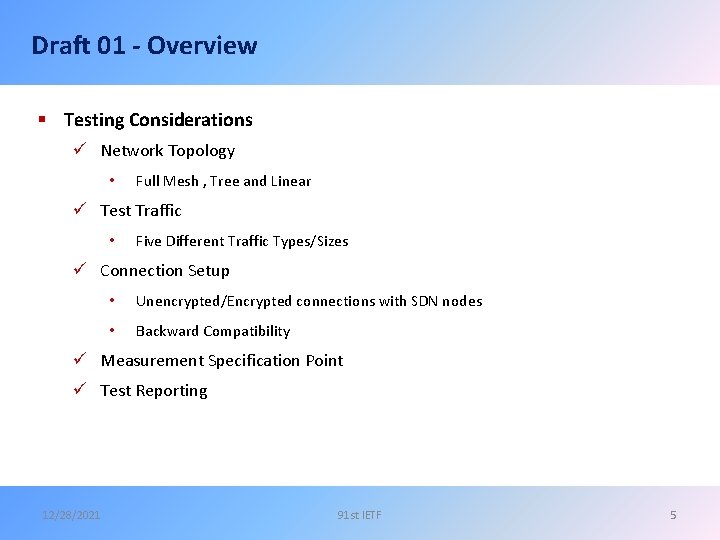
Draft 01 - Overview § Testing Considerations ü Network Topology • Full Mesh , Tree and Linear ü Test Traffic • Five Different Traffic Types/Sizes ü Connection Setup • Unencrypted/Encrypted connections with SDN nodes • Backward Compatibility ü Measurement Specification Point ü Test Reporting 12/28/2021 91 st IETF 5
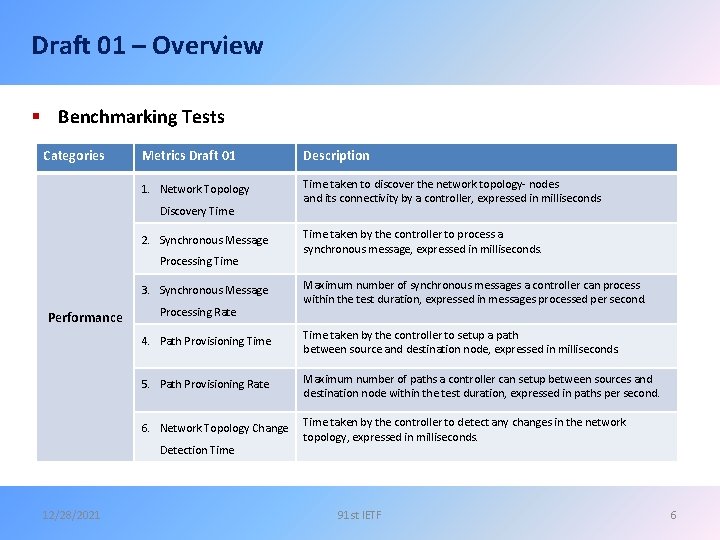
Draft 01 – Overview § Benchmarking Tests Categories Metrics Draft 01 Description 1. Network Topology Time taken to discover the network topology- nodes and its connectivity by a controller, expressed in milliseconds Discovery Time 2. Synchronous Message Processing Time 3. Synchronous Message Performance Processing Rate Maximum number of synchronous messages a controller can process within the test duration, expressed in messages processed per second. 4. Path Provisioning Time taken by the controller to setup a path between source and destination node, expressed in milliseconds. 5. Path Provisioning Rate Maximum number of paths a controller can setup between sources and destination node within the test duration, expressed in paths per second. 6. Network Topology Change Time taken by the controller to detect any changes in the network topology, expressed in milliseconds. Detection Time 12/28/2021 Time taken by the controller to process a synchronous message, expressed in milliseconds. 91 st IETF 6
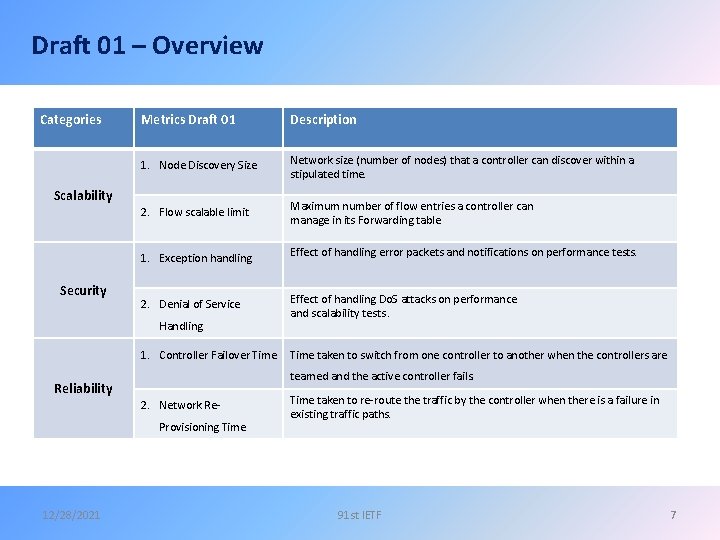
Draft 01 – Overview Categories Metrics Draft 01 Description 1. Node Discovery Size Network size (number of nodes) that a controller can discover within a stipulated time. 2. Flow scalable limit Maximum number of flow entries a controller can manage in its Forwarding table 1. Exception handling Effect of handling error packets and notifications on performance tests. 2. Denial of Service Effect of handling Do. S attacks on performance and scalability tests. Scalability Security Handling 1. Controller Failover Time teamed and the active controller fails. Reliability 2. Network Re. Provisioning Time 12/28/2021 Time taken to switch from one controller to another when the controllers are Time taken to re-route the traffic by the controller when there is a failure in existing traffic paths. 91 st IETF 7
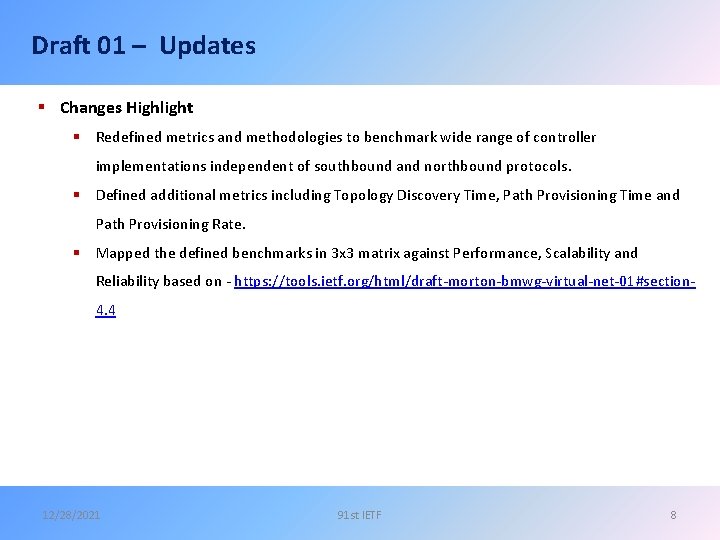
Draft 01 – Updates § Changes Highlight § Redefined metrics and methodologies to benchmark wide range of controller implementations independent of southbound and northbound protocols. § Defined additional metrics including Topology Discovery Time, Path Provisioning Time and Path Provisioning Rate. § Mapped the defined benchmarks in 3 x 3 matrix against Performance, Scalability and Reliability based on - https: //tools. ietf. org/html/draft-morton-bmwg-virtual-net-01#section 4. 4 12/28/2021 91 st IETF 8
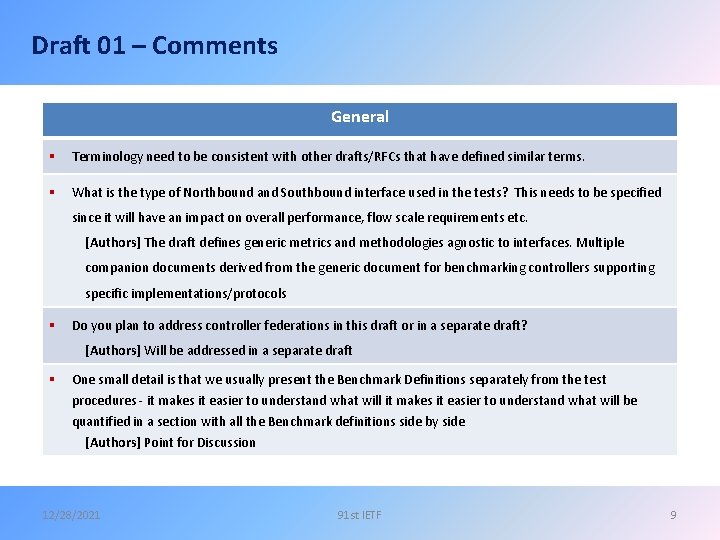
Draft 01 – Comments General § Terminology need to be consistent with other drafts/RFCs that have defined similar terms. § What is the type of Northbound and Southbound interface used in the tests? This needs to be specified since it will have an impact on overall performance, flow scale requirements etc. [Authors] The draft defines generic metrics and methodologies agnostic to interfaces. Multiple companion documents derived from the generic document for benchmarking controllers supporting specific implementations/protocols § Do you plan to address controller federations in this draft or in a separate draft? [Authors] Will be addressed in a separate draft § One small detail is that we usually present the Benchmark Definitions separately from the test procedures - it makes it easier to understand what will be quantified in a section with all the Benchmark definitions side by side [Authors] Point for Discussion 12/28/2021 91 st IETF 9
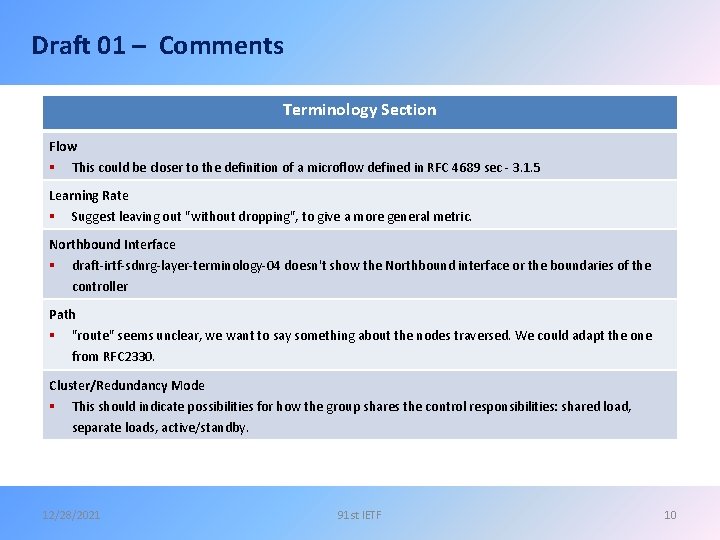
Draft 01 – Comments Terminology Section Flow § This could be closer to the definition of a microflow defined in RFC 4689 sec - 3. 1. 5 Learning Rate § Suggest leaving out "without dropping", to give a more general metric. Northbound Interface § draft-irtf-sdnrg-layer-terminology-04 doesn't show the Northbound interface or the boundaries of the controller Path § "route" seems unclear, we want to say something about the nodes traversed. We could adapt the one from RFC 2330. Cluster/Redundancy Mode § This should indicate possibilities for how the group shares the control responsibilities: shared load, separate loads, active/standby. 12/28/2021 91 st IETF 10
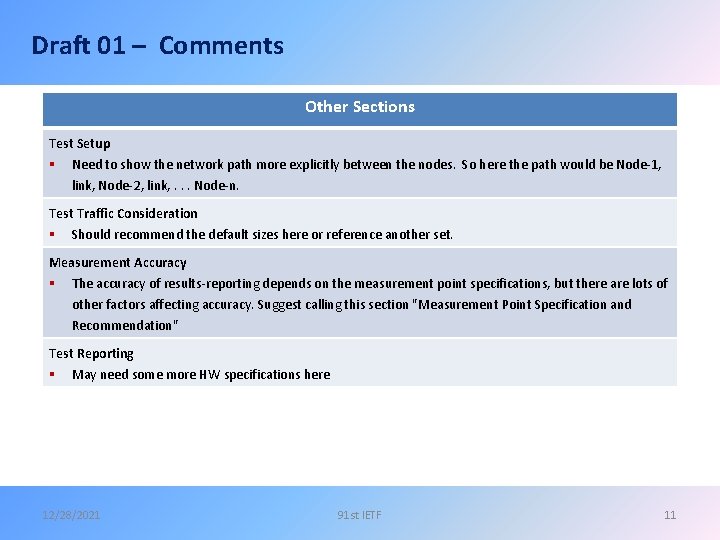
Draft 01 – Comments Other Sections Test Setup § Need to show the network path more explicitly between the nodes. So here the path would be Node-1, link, Node-2, link, . . . Node-n. Test Traffic Consideration § Should recommend the default sizes here or reference another set. Measurement Accuracy § The accuracy of results-reporting depends on the measurement point specifications, but there are lots of other factors affecting accuracy. Suggest calling this section "Measurement Point Specification and Recommendation" Test Reporting § May need some more HW specifications here 12/28/2021 91 st IETF 11
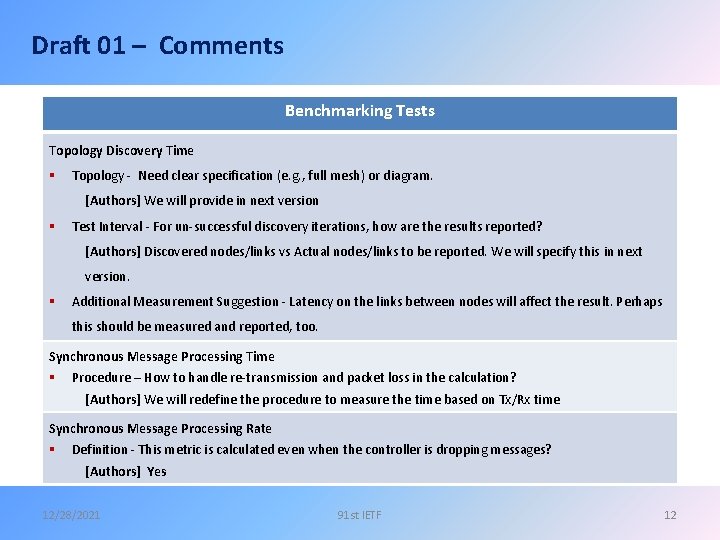
Draft 01 – Comments Benchmarking Tests Topology Discovery Time § Topology - Need clear specification (e. g. , full mesh) or diagram. [Authors] We will provide in next version § Test Interval - For un-successful discovery iterations, how are the results reported? [Authors] Discovered nodes/links vs Actual nodes/links to be reported. We will specify this in next version. § Additional Measurement Suggestion - Latency on the links between nodes will affect the result. Perhaps this should be measured and reported, too. Synchronous Message Processing Time § Procedure – How to handle re-transmission and packet loss in the calculation? [Authors] We will redefine the procedure to measure the time based on Tx/Rx time Synchronous Message Processing Rate § Definition - This metric is calculated even when the controller is dropping messages? [Authors] Yes 12/28/2021 91 st IETF 12
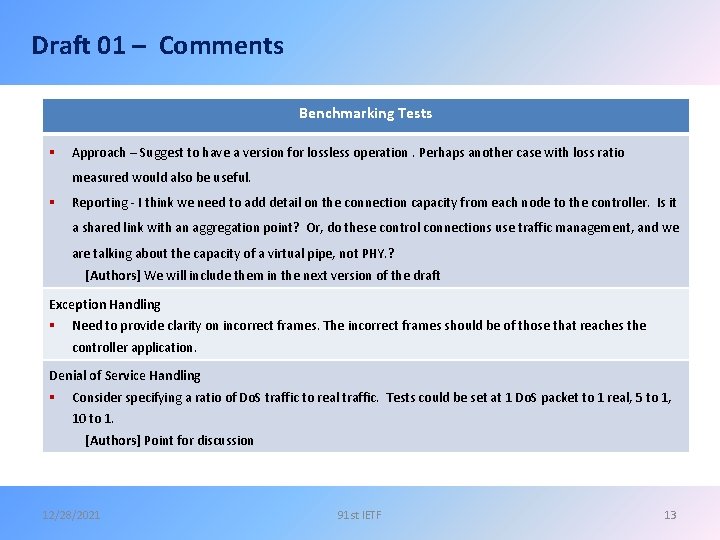
Draft 01 – Comments Benchmarking Tests § Approach – Suggest to have a version for lossless operation. Perhaps another case with loss ratio measured would also be useful. § Reporting - I think we need to add detail on the connection capacity from each node to the controller. Is it a shared link with an aggregation point? Or, do these control connections use traffic management, and we are talking about the capacity of a virtual pipe, not PHY. ? [Authors] We will include them in the next version of the draft Exception Handling § Need to provide clarity on incorrect frames. The incorrect frames should be of those that reaches the controller application. Denial of Service Handling § Consider specifying a ratio of Do. S traffic to real traffic. Tests could be set at 1 Do. S packet to 1 real, 5 to 1, 10 to 1. [Authors] Point for discussion 12/28/2021 91 st IETF 13
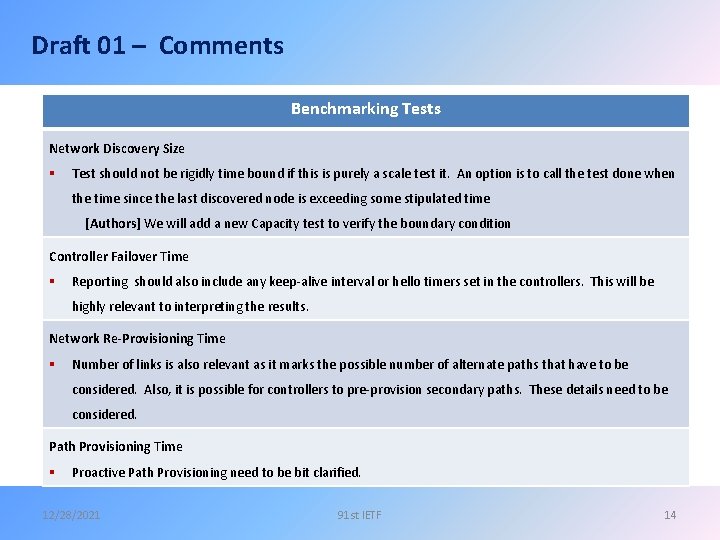
Draft 01 – Comments Benchmarking Tests Network Discovery Size § Test should not be rigidly time bound if this is purely a scale test it. An option is to call the test done when the time since the last discovered node is exceeding some stipulated time [Authors] We will add a new Capacity test to verify the boundary condition Controller Failover Time § Reporting should also include any keep-alive interval or hello timers set in the controllers. This will be highly relevant to interpreting the results. Network Re-Provisioning Time § Number of links is also relevant as it marks the possible number of alternate paths that have to be considered. Also, it is possible for controllers to pre-provision secondary paths. These details need to be considered. Path Provisioning Time § Proactive Path Provisioning need to be bit clarified. 12/28/2021 91 st IETF 14
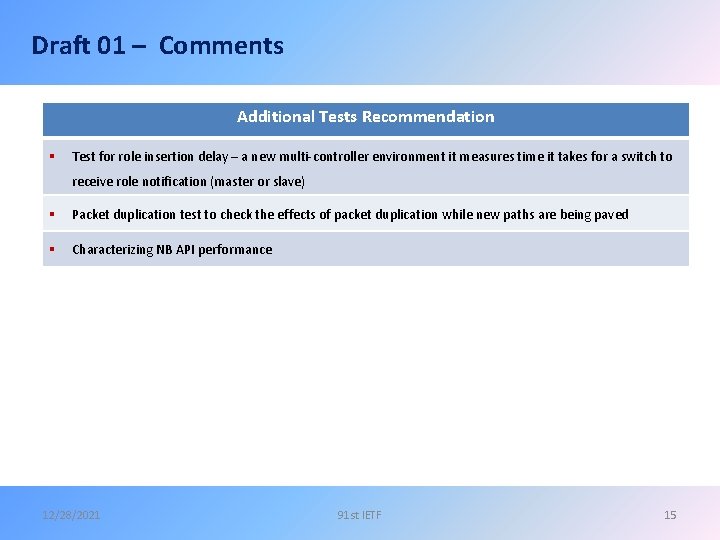
Draft 01 – Comments Additional Tests Recommendation § Test for role insertion delay – a new multi-controller environment it measures time it takes for a switch to receive role notification (master or slave) § Packet duplication test to check the effects of packet duplication while new paths are being paved § Characterizing NB API performance 12/28/2021 91 st IETF 15
Draft 01 – Next Steps § Submit next version of the draft addressing all the comments § Adopt the draft as WG item? ? 12/28/2021 91 st IETF 16
§ Thanks to Al Morton(AT&T), Sandeep Gangadharan(HP), Ramakrishnan (Brocade), Jay Karthik (Cisco) for sharing valuable feedback on the mailing list. Thank You!!! The authors of draft-bhuvan-bmwg-of-controller-benchmarking-01 12/28/2021 91 st IETF 17
- Slides: 17