
Software Citation Principles Implementation and Impact Daniel S

![Use cases [20] FORCE 11 Software Citation Working Group. Software citation use cases. https:](https://slidetodoc.com/presentation_image_h2/5493365dfc4aead1b73dbdb401149073/image-13.jpg "Use cases [20] FORCE 11 Software Citation Working Group. Software citation use cases. https:")
- Slides: 19
Software Citation: Principles, Implementation, and Impact Daniel S. Katz Associate Director for Scientific Software & Applications, NCSA Research Associate Professor, ECE Research Associate Professor, i. School dskatz@illinois. edu, d. katz@ieee. org, @danielskatz with Arfon M. Smith, Kyle E. Niemeyer & F 11 SCWG National Center for Supercomputing Applications University of Illinois at Urbana–Champaign
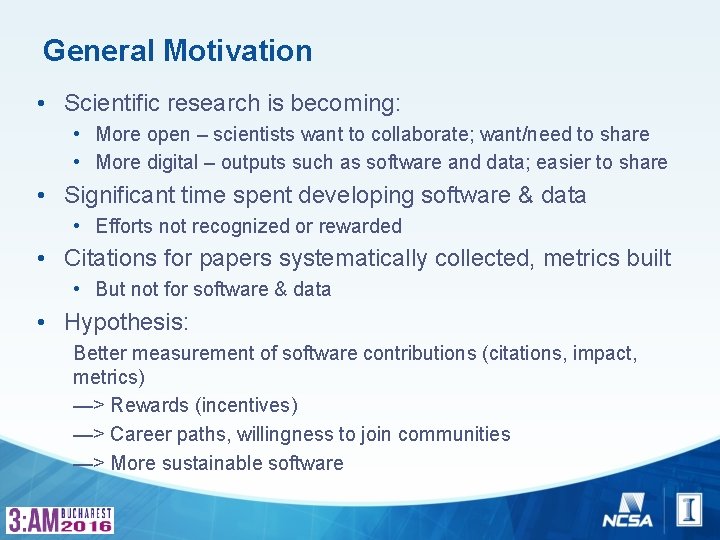
General Motivation • Scientific research is becoming: • More open – scientists want to collaborate; want/need to share • More digital – outputs such as software and data; easier to share • Significant time spent developing software & data • Efforts not recognized or rewarded • Citations for papers systematically collected, metrics built • But not for software & data • Hypothesis: Better measurement of software contributions (citations, impact, metrics) —> Rewards (incentives) —> Career paths, willingness to join communities —> More sustainable software
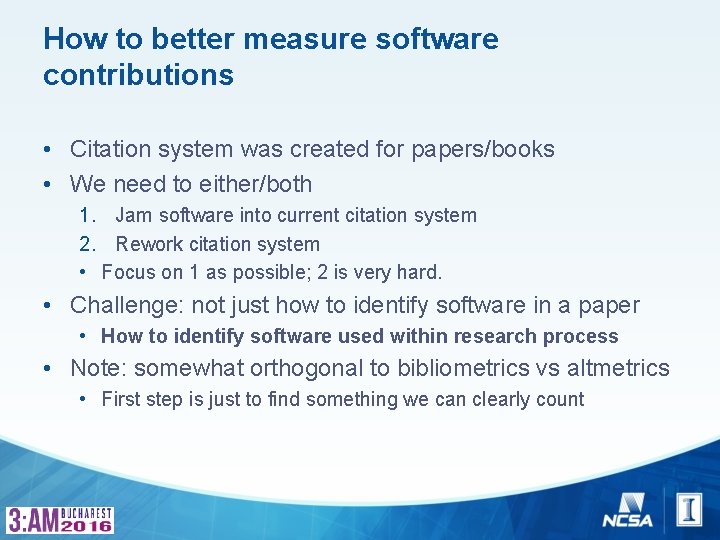
How to better measure software contributions • Citation system was created for papers/books • We need to either/both 1. Jam software into current citation system 2. Rework citation system • Focus on 1 as possible; 2 is very hard. • Challenge: not just how to identify software in a paper • How to identify software used within research process • Note: somewhat orthogonal to bibliometrics vs altmetrics • First step is just to find something we can clearly count
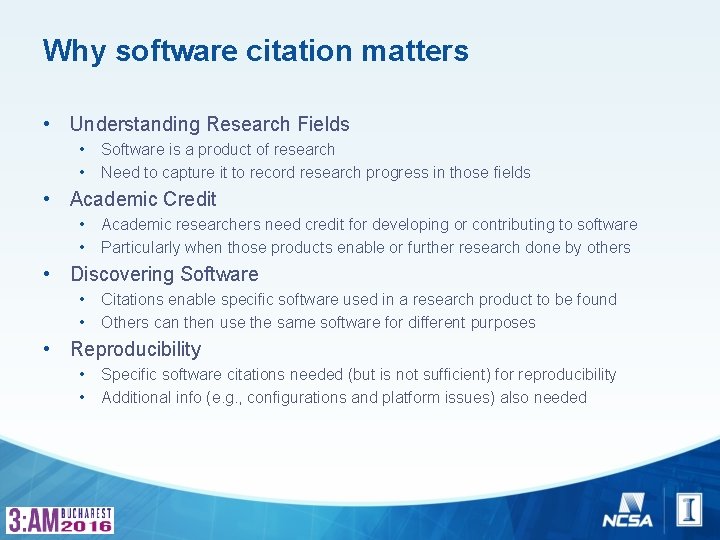
Why software citation matters • Understanding Research Fields • Software is a product of research • Need to capture it to record research progress in those fields • Academic Credit • Academic researchers need credit for developing or contributing to software • Particularly when those products enable or further research done by others • Discovering Software • Citations enable specific software used in a research product to be found • Others can then use the same software for different purposes • Reproducibility • Specific software citations needed (but is not sufficient) for reproducibility • Additional info (e. g. , configurations and platform issues) also needed
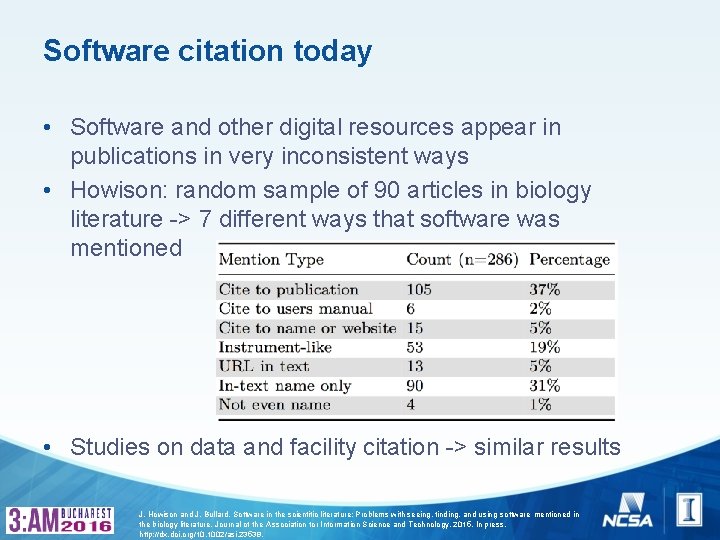
Software citation today • Software and other digital resources appear in publications in very inconsistent ways • Howison: random sample of 90 articles in biology literature -> 7 different ways that software was mentioned • Studies on data and facility citation -> similar results J. Howison and J. Bullard. Software in the scientific literature: Problems with seeing, finding, and using software mentioned in the biology literature. Journal of the Association for Information Science and Technology, 2015. In press. http: //dx. doi. org/10. 1002/asi. 23538.
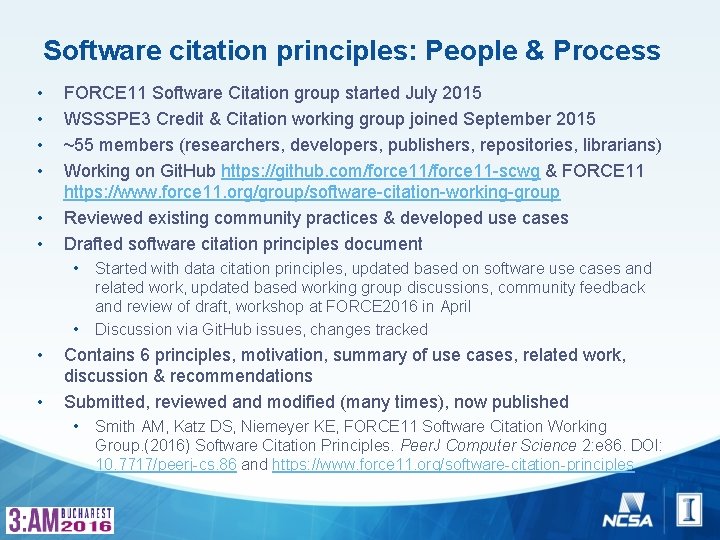
Software citation principles: People & Process • • • FORCE 11 Software Citation group started July 2015 WSSSPE 3 Credit & Citation working group joined September 2015 ~55 members (researchers, developers, publishers, repositories, librarians) Working on Git. Hub https: //github. com/force 11 -scwg & FORCE 11 https: //www. force 11. org/group/software-citation-working-group Reviewed existing community practices & developed use cases Drafted software citation principles document • Started with data citation principles, updated based on software use cases and related work, updated based working group discussions, community feedback and review of draft, workshop at FORCE 2016 in April • Discussion via Git. Hub issues, changes tracked • • Contains 6 principles, motivation, summary of use cases, related work, discussion & recommendations Submitted, reviewed and modified (many times), now published • Smith AM, Katz DS, Niemeyer KE, FORCE 11 Software Citation Working Group. (2016) Software Citation Principles. Peer. J Computer Science 2: e 86. DOI: 10. 7717/peerj-cs. 86 and https: //www. force 11. org/software-citation-principles
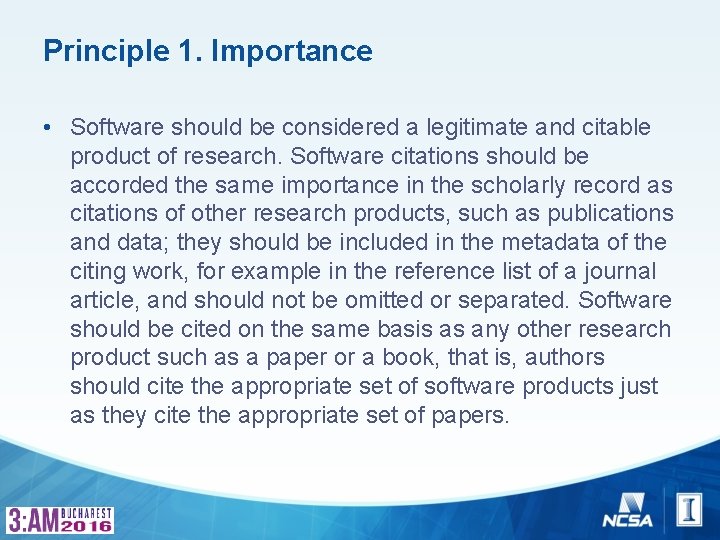
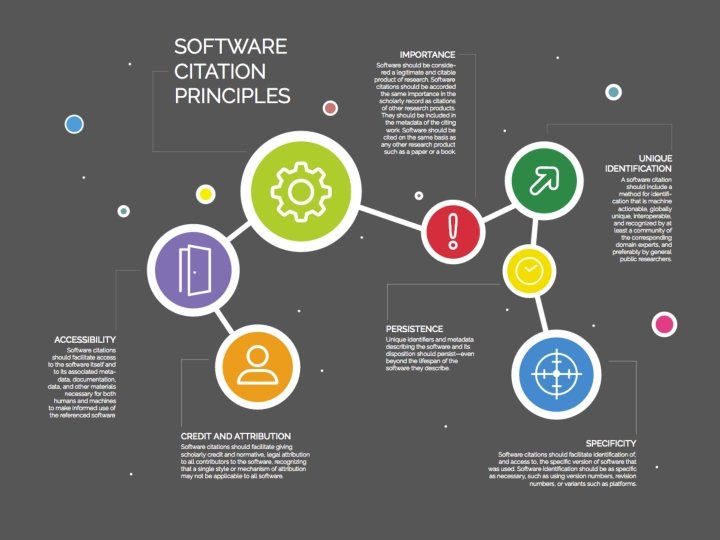
Principle 1. Importance • Software should be considered a legitimate and citable product of research. Software citations should be accorded the same importance in the scholarly record as citations of other research products, such as publications and data; they should be included in the metadata of the citing work, for example in the reference list of a journal article, and should not be omitted or separated. Software should be cited on the same basis as any other research product such as a paper or a book, that is, authors should cite the appropriate set of software products just as they cite the appropriate set of papers.
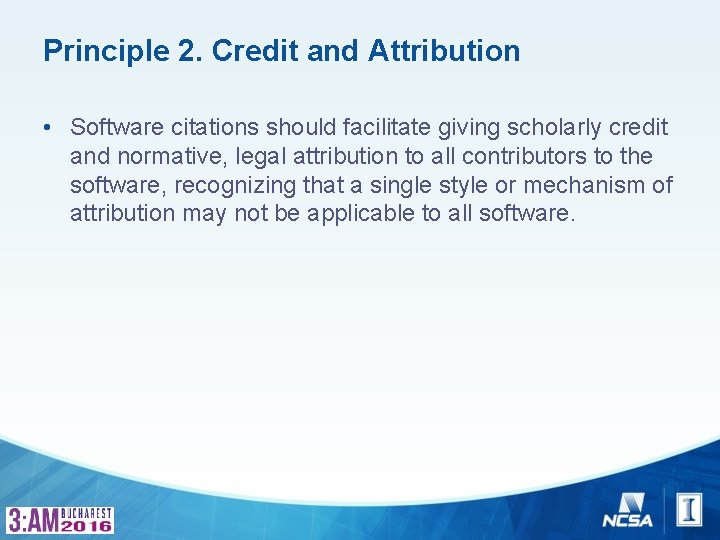
Principle 2. Credit and Attribution • Software citations should facilitate giving scholarly credit and normative, legal attribution to all contributors to the software, recognizing that a single style or mechanism of attribution may not be applicable to all software.
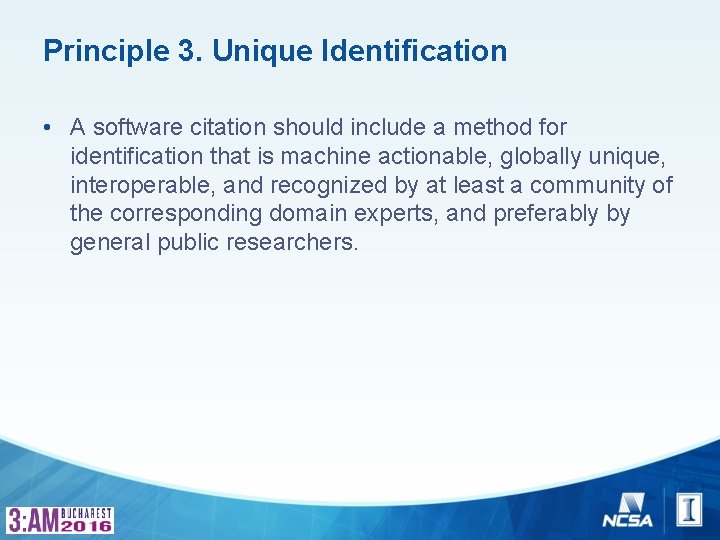
Principle 3. Unique Identification • A software citation should include a method for identification that is machine actionable, globally unique, interoperable, and recognized by at least a community of the corresponding domain experts, and preferably by general public researchers.
Principle 4. Persistence • Unique identifiers and metadata describing the software and its disposition should persist – even beyond the lifespan of the software they describe.
Principle 5. Accessibility • Software citations should facilitate access to the software itself and to its associated metadata, documentation, data, and other materials necessary for both humans and machines to make informed use of the referenced software.
Principle 6. Specificity • Software citations should facilitate identification of, and access to, the specific version of software that was used. Software identification should be as specific as necessary, such as using version numbers, revision numbers, or variants such as platforms.
Use cases [20] FORCE 11 Software Citation Working Group. Software citation use cases. https: //docs. google. com/document/d/ 1. 1 d. S 0 Sq. Go. BIFw. LB 5 G 3 Hi. LLEOSAAg. Mdo 8 QPEpj. YUa. WCv. IU
Example 1: Make your software citable • Publish it – if it’s on Git. Hub, follow steps in https: //guides. github. com/activities/citable-code/ • Otherwise, submit it to zenodo or figshare, with appropriate metadata (including authors, title, …, citations of … & software that you use) • Get a DOI • Create a CITATION file, update your README, tell people how to cite • Also, can write a software paper and ask people to cite that (but this is secondary, just since our current system doesn’t work well)
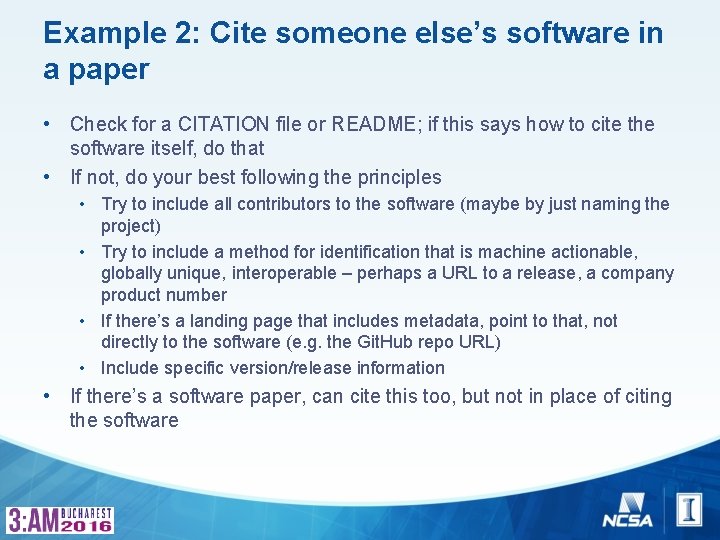
Example 2: Cite someone else’s software in a paper • Check for a CITATION file or README; if this says how to cite the software itself, do that • If not, do your best following the principles • Try to include all contributors to the software (maybe by just naming the project) • Try to include a method for identification that is machine actionable, globally unique, interoperable – perhaps a URL to a release, a company product number • If there’s a landing page that includes metadata, point to that, not directly to the software (e. g. the Git. Hub repo URL) • Include specific version/release information • If there’s a software paper, can cite this too, but not in place of citing the software
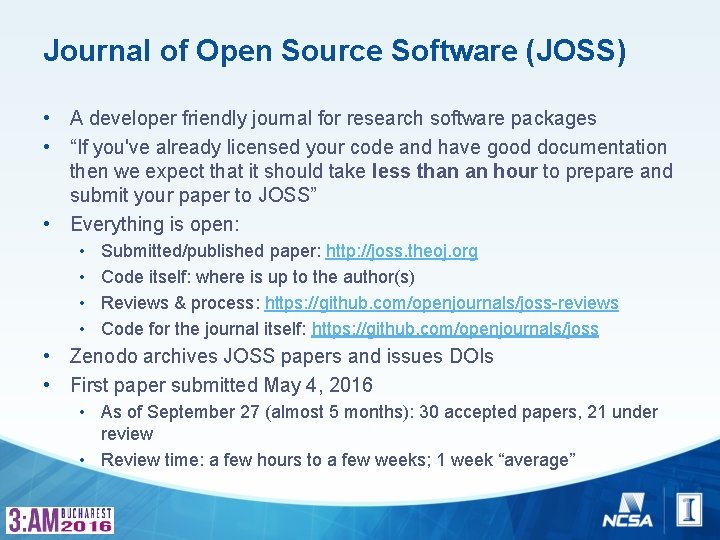
Journal of Open Source Software (JOSS) • A developer friendly journal for research software packages • “If you've already licensed your code and have good documentation then we expect that it should take less than an hour to prepare and submit your paper to JOSS” • Everything is open: • • Submitted/published paper: http: //joss. theoj. org Code itself: where is up to the author(s) Reviews & process: https: //github. com/openjournals/joss-reviews Code for the journal itself: https: //github. com/openjournals/joss • Zenodo archives JOSS papers and issues DOIs • First paper submitted May 4, 2016 • As of September 27 (almost 5 months): 30 accepted papers, 21 under review • Review time: a few hours to a few weeks; 1 week “average”
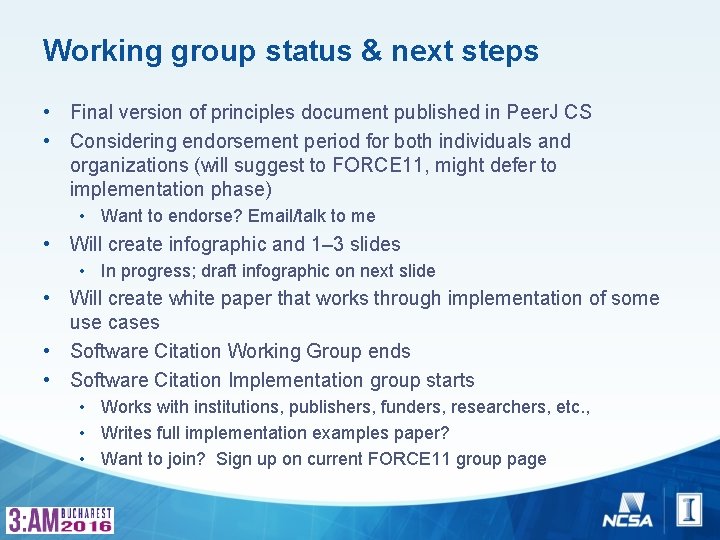
Working group status & next steps • Final version of principles document published in Peer. J CS • Considering endorsement period for both individuals and organizations (will suggest to FORCE 11, might defer to implementation phase) • Want to endorse? Email/talk to me • Will create infographic and 1– 3 slides • In progress; draft infographic on next slide • Will create white paper that works through implementation of some use cases • Software Citation Working Group ends • Software Citation Implementation group starts • Works with institutions, publishers, funders, researchers, etc. , • Writes full implementation examples paper? • Want to join? Sign up on current FORCE 11 group page
Software Citation: Principles, Implementation, and Impact Daniel S. Katz Associate Director for Scientific Software & Applications, NCSA Research Associate Professor, ECE Research Associate Professor, i. School dskatz@illinois. edu, d. katz@ieee. org, @danielskatz with Arfon M. Smith, Kyle E. Niemeyer & F 11 SCWG National Center for Supercomputing Applications University of Illinois at Urbana–Champaign