
Software Architecture Kevin Scannell David Ferry CSCI 5030
- Slides: 13
Software Architecture Kevin Scannell, David Ferry CSCI 5030 – Principles of Software Development Saint Louis University St. Louis, MO 63103 1
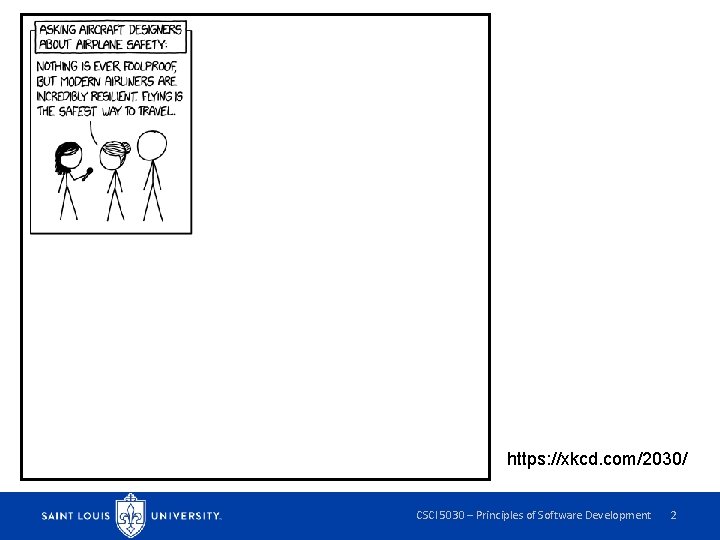
https: //xkcd. com/2030/ CSCI 5030 – Principles of Software Development 2
What is Software Architecture? • Still an infant discipline • Little understood by practitioners, teachers, and especially students Some basic questions are not answered: – – What problems does an architect solve? What are the tools that are used? What are the constraints that are considered? Is there an underlying consistent theory? • And yet… “you know it when you see it” • Lots of individual approaches and “silos” of knowledge, no unified theory CSCI 5030 – Principles of Software Development 3
What Problems Does an Architect Solve? • How do customer requirements map into technology needs? • How is a high-level task divided into low-level software units? • How are software components connected? • How do software components map to hardware components? • How are business objectives met and how do stakeholders interact with the software? • How are non-functional attributes achieved? CSCI 5030 – Principles of Software Development 4
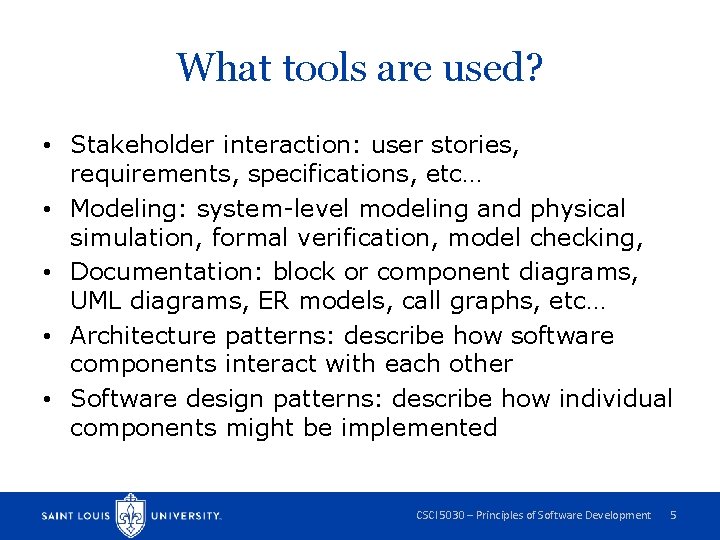
What tools are used? • Stakeholder interaction: user stories, requirements, specifications, etc… • Modeling: system-level modeling and physical simulation, formal verification, model checking, • Documentation: block or component diagrams, UML diagrams, ER models, call graphs, etc… • Architecture patterns: describe how software components interact with each other • Software design patterns: describe how individual components might be implemented CSCI 5030 – Principles of Software Development 5
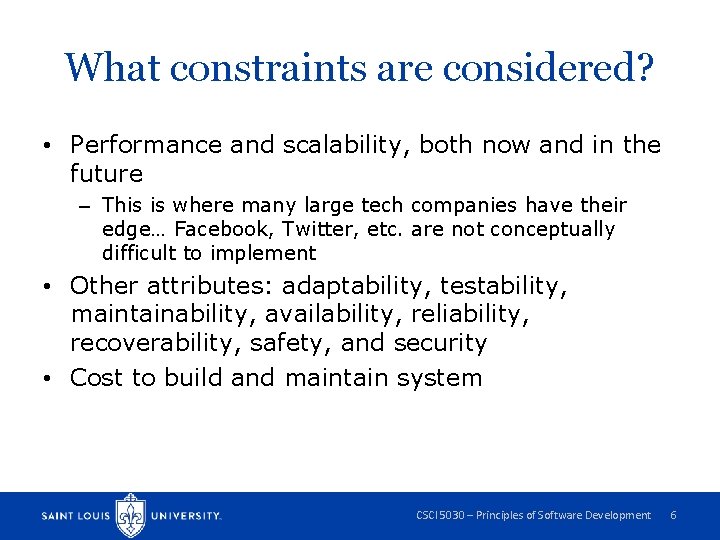
What constraints are considered? • Performance and scalability, both now and in the future – This is where many large tech companies have their edge… Facebook, Twitter, etc. are not conceptually difficult to implement • Other attributes: adaptability, testability, maintainability, availability, reliability, recoverability, safety, and security • Cost to build and maintain system CSCI 5030 – Principles of Software Development 6
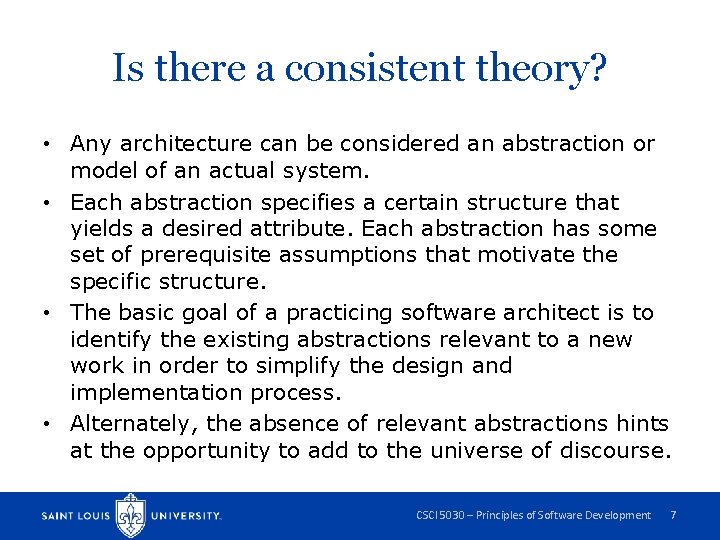
Is there a consistent theory? • Any architecture can be considered an abstraction or model of an actual system. • Each abstraction specifies a certain structure that yields a desired attribute. Each abstraction has some set of prerequisite assumptions that motivate the specific structure. • The basic goal of a practicing software architect is to identify the existing abstractions relevant to a new work in order to simplify the design and implementation process. • Alternately, the absence of relevant abstractions hints at the opportunity to add to the universe of discourse. CSCI 5030 – Principles of Software Development 7
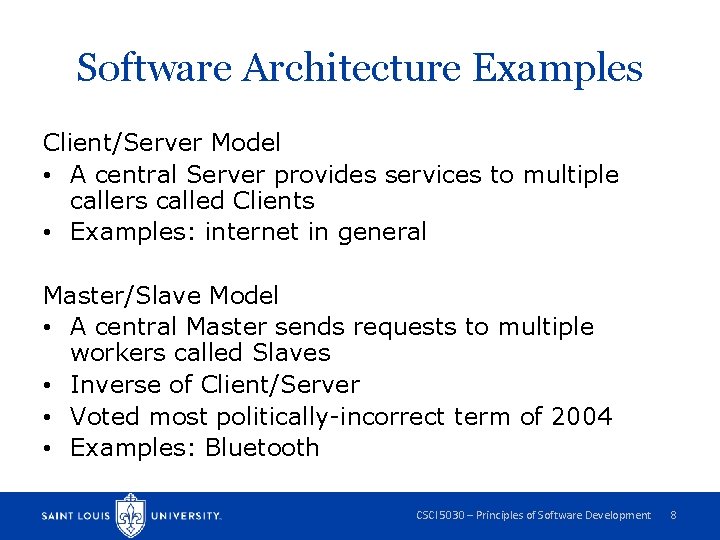
Software Architecture Examples Client/Server Model • A central Server provides services to multiple callers called Clients • Examples: internet in general Master/Slave Model • A central Master sends requests to multiple workers called Slaves • Inverse of Client/Server • Voted most politically-incorrect term of 2004 • Examples: Bluetooth CSCI 5030 – Principles of Software Development 8
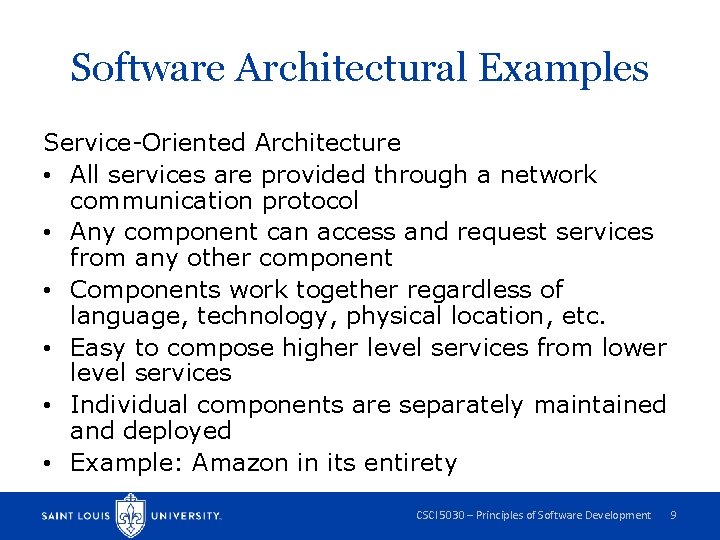
Software Architectural Examples Service-Oriented Architecture • All services are provided through a network communication protocol • Any component can access and request services from any other component • Components work together regardless of language, technology, physical location, etc. • Easy to compose higher level services from lower level services • Individual components are separately maintained and deployed • Example: Amazon in its entirety CSCI 5030 – Principles of Software Development 9
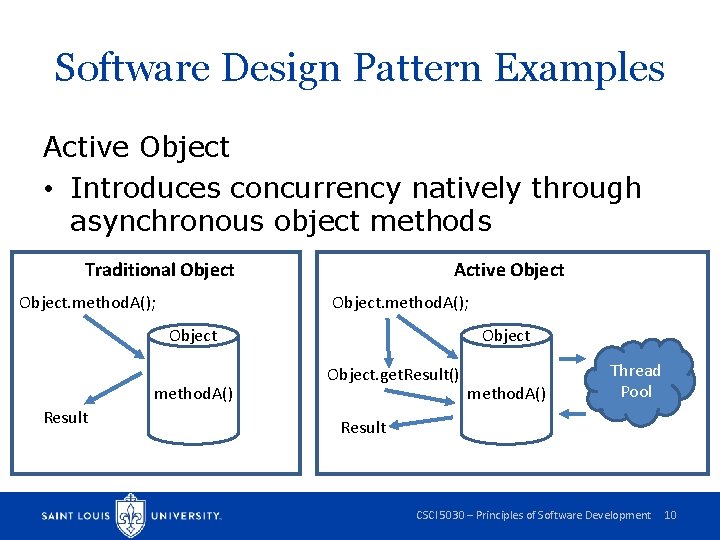
Software Design Pattern Examples Active Object • Introduces concurrency natively through asynchronous object methods Traditional Object. method. A(); Active Object. method. A(); Object method. A() Result Object. get. Result() method. A() Thread Pool Result CSCI 5030 – Principles of Software Development 10
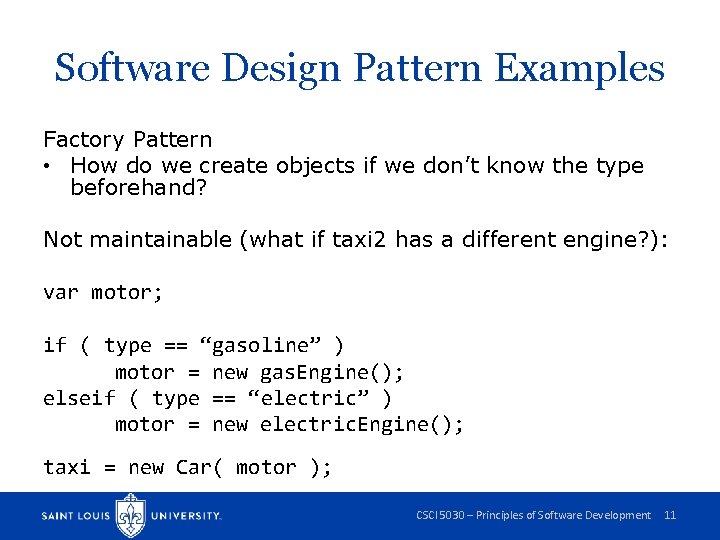
Software Design Pattern Examples Factory Pattern • How do we create objects if we don’t know the type beforehand? Not maintainable (what if taxi 2 has a different engine? ): var motor; if ( type == “gasoline” ) motor = new gas. Engine(); elseif ( type == “electric” ) motor = new electric. Engine(); taxi = new Car( motor ); CSCI 5030 – Principles of Software Development 11
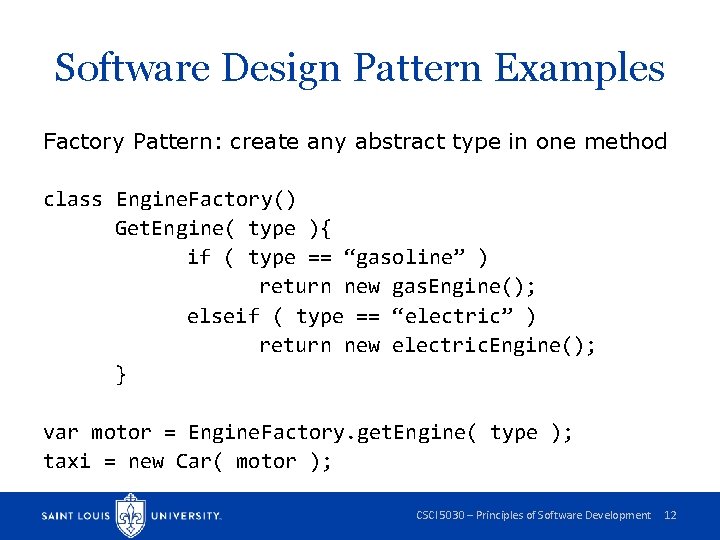
Software Design Pattern Examples Factory Pattern: create any abstract type in one method class Engine. Factory() Get. Engine( type ){ if ( type == “gasoline” ) return new gas. Engine(); elseif ( type == “electric” ) return new electric. Engine(); } var motor = Engine. Factory. get. Engine( type ); taxi = new Car( motor ); CSCI 5030 – Principles of Software Development 12
What next? You could spend multiple semesters looking at a veritable zoo of architectural artifacts. • Software architecture is more than just having a catalogue of existing patterns • It’s analyzing and understanding the key challenges in a software project • It’s seeing how existing abstractions do and don’t solve those challenges Our approach: case studies- Mozilla and Twitter CSCI 5030 – Principles of Software Development 13