
Software Architecture in Practice Microservices Software Reuse If

- Slides: 32
Software Architecture in Practice Microservices
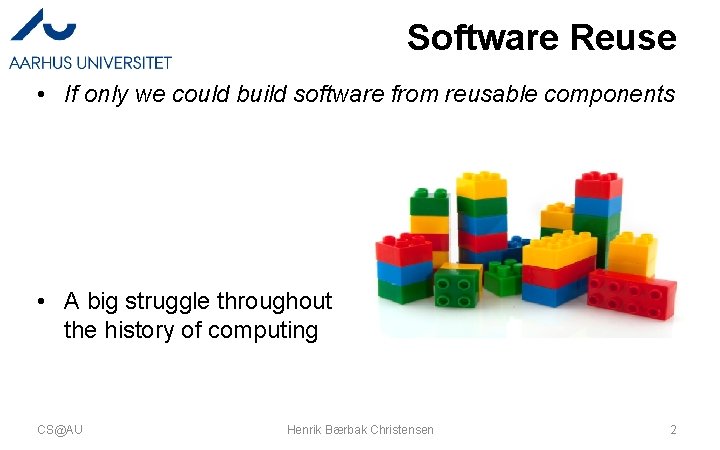
Software Reuse • If only we could build software from reusable components • A big struggle throughout the history of computing CS@AU Henrik Bærbak Christensen 2
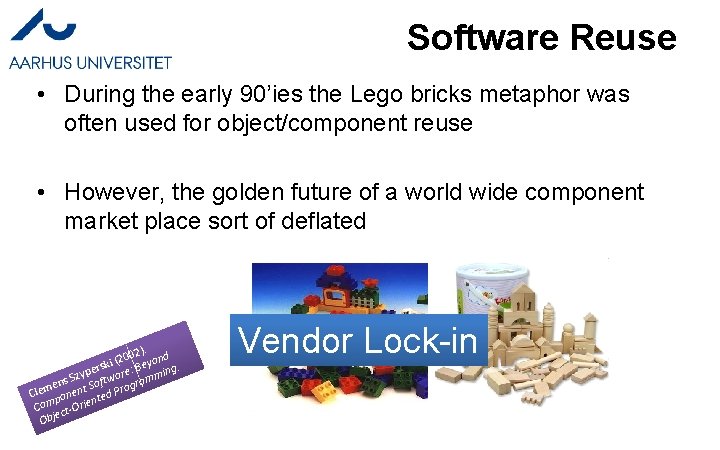
Software Reuse • During the early 90’ies the Lego bricks metaphor was often used for object/component reuse • However, the golden future of a world wide component market place sort of deflated ). 002 ond 2 ( i y ersk are: Be ming. p y Sz w ens nt Soft rogram m e P Cl pone ted n e m i Co ct-Or e Obj Vendor Lock-in
Software Reuse • In the 00’ the web exploded and allowed a different deployment model – Component based reuse: • A static / module viewpoint - get a DLL/jar file • “libraries” in [Lewis et al. 2014] – Linked in, and called by in-memory function calls – Service oriented architecture: • A dynamic / C&C viewpoint - connect to a service • “services” in [Lewis et al. 2014] – Out-of-process, communicate using RPC or web service CS@AU Henrik Bærbak Christensen 4
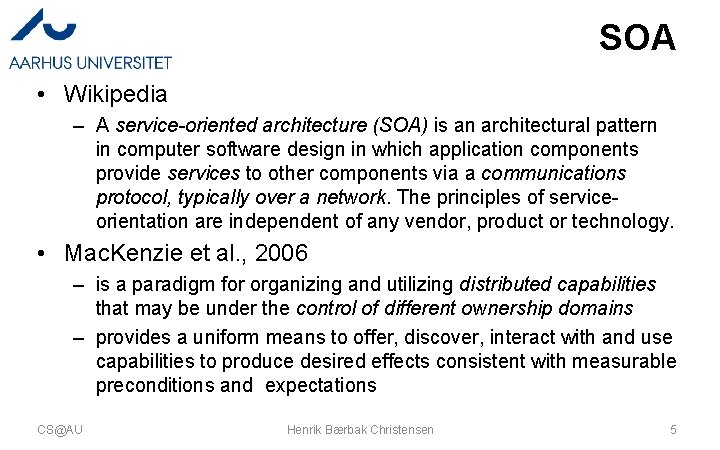
SOA • Wikipedia – A service-oriented architecture (SOA) is an architectural pattern in computer software design in which application components provide services to other components via a communications protocol, typically over a network. The principles of serviceorientation are independent of any vendor, product or technology. • Mac. Kenzie et al. , 2006 – is a paradigm for organizing and utilizing distributed capabilities that may be under the control of different ownership domains – provides a uniform means to offer, discover, interact with and use capabilities to produce desired effects consistent with measurable preconditions and expectations CS@AU Henrik Bærbak Christensen 5
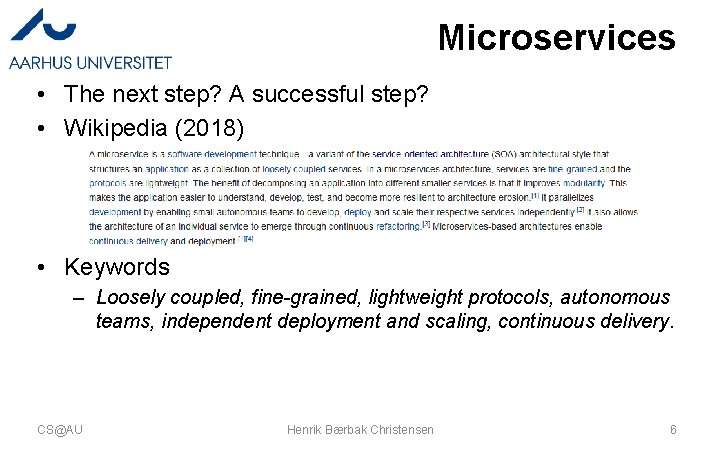
Microservices • The next step? A successful step? • Wikipedia (2018) • Keywords – Loosely coupled, fine-grained, lightweight protocols, autonomous teams, independent deployment and scaling, continuous delivery. CS@AU Henrik Bærbak Christensen 6
So – Our Take • We will look at two takes on the concept. . . – James Lewis and Martin Fowler – Sam Newman • And compare CS@AU Henrik Bærbak Christensen 7
Lewis and Fowler
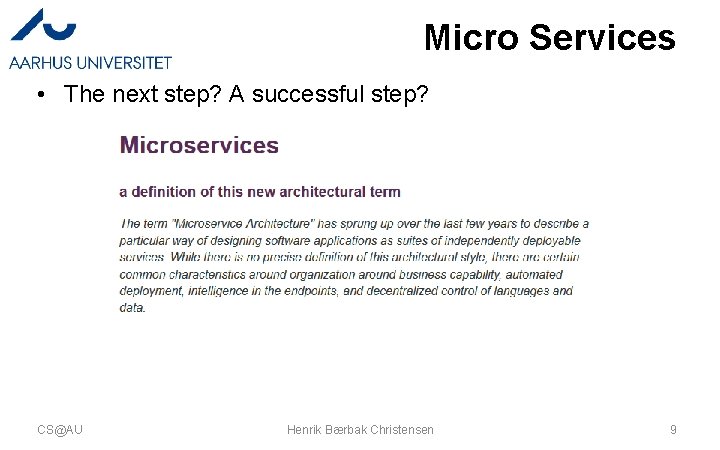
Micro Services • The next step? A successful step? CS@AU Henrik Bærbak Christensen 9
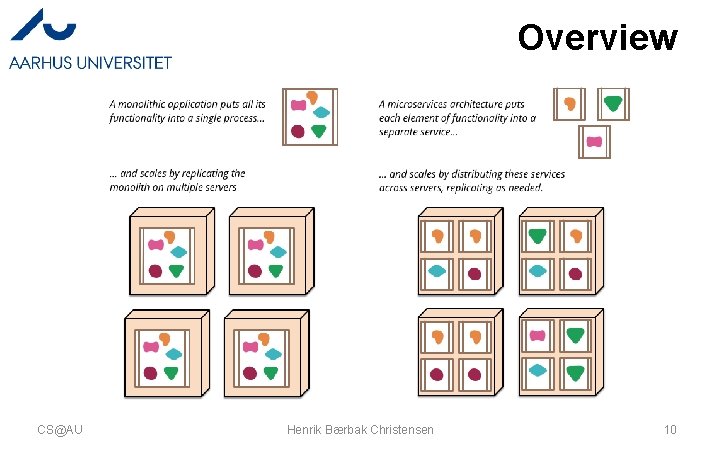
Overview CS@AU Henrik Bærbak Christensen 10
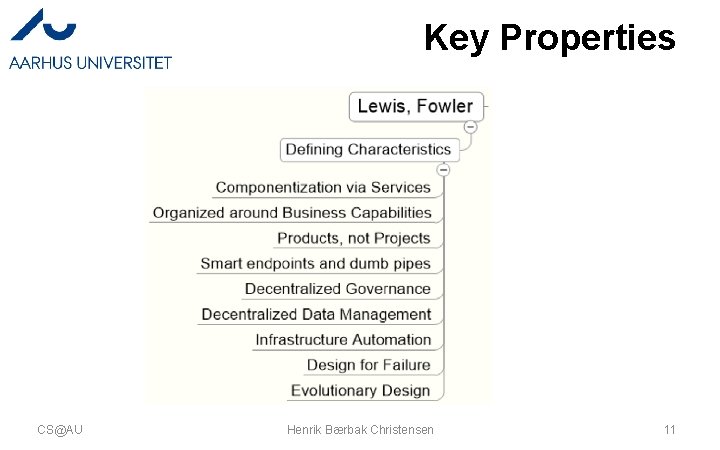
Key Properties CS@AU Henrik Bærbak Christensen 11
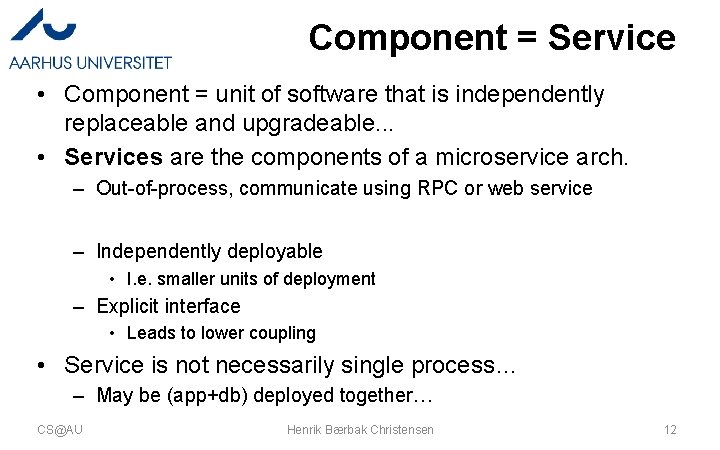
Component = Service • Component = unit of software that is independently replaceable and upgradeable. . . • Services are the components of a microservice arch. – Out-of-process, communicate using RPC or web service – Independently deployable • I. e. smaller units of deployment – Explicit interface • Leads to lower coupling • Service is not necessarily single process… – May be (app+db) deployed together… CS@AU Henrik Bærbak Christensen 12
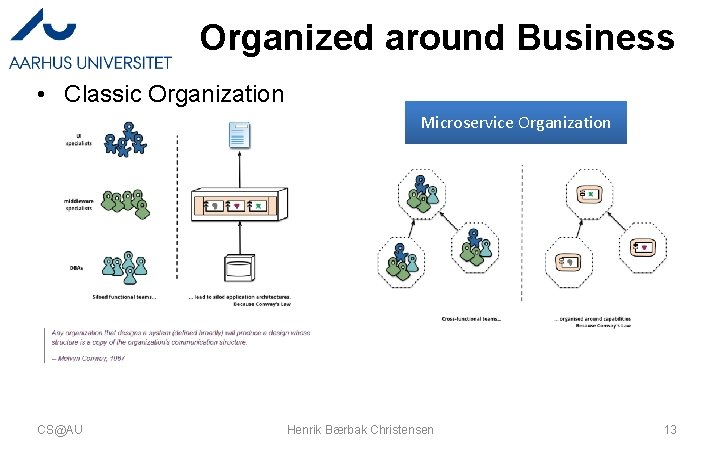
Organized around Business • Classic Organization Microservice Organization CS@AU Henrik Bærbak Christensen 13
Products, not Projects • Classic project organization – Develop piece of software, upon completion, hand over to maintenance, project dissolve. . . • Product organization – You build it, you run it • That is the team designs, builds, tests, deploys, and maintains it. . . – Full lifecycle ownership CS@AU Henrik Bærbak Christensen 14
Smart endpoints, dumb pipes • The logic lives in the services, not in the communication – CC viewpoint: Smart Components, dumb Connectors – Opposite: • Enterprise service bus – Allows filtering, processing, of messages while being transmitted • Typical message protocols – HTTP / REST Api’s – Lightweight messaging • Rabbit. MQ, etc. , with no message processing CS@AU Henrik Bærbak Christensen 15
Decentralized Governance • Choice of language and technology stack is open – Use C++ for that performant service; choose Node. js for a reports service – Opposite: Company-wide adoption of Microsoft tech stack • Often companies adopt building useful tools for other teams with similar problems CS@AU Henrik Bærbak Christensen 16
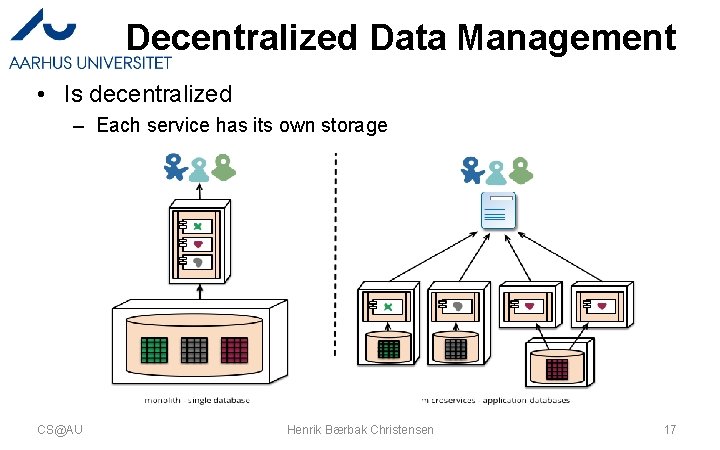
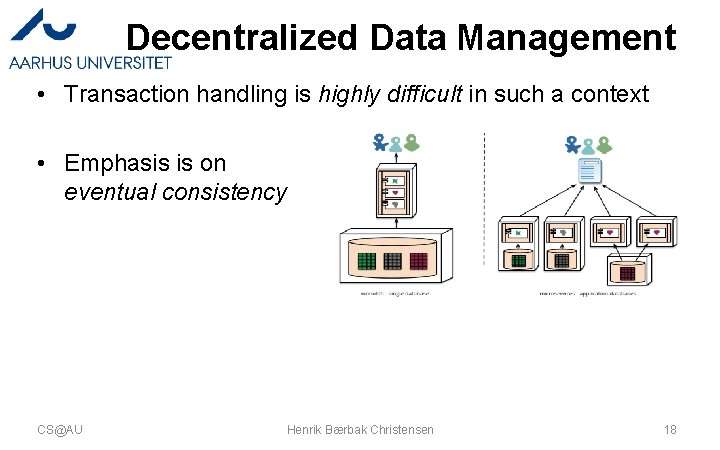
Decentralized Data Management • Is decentralized – Each service has its own storage CS@AU Henrik Bærbak Christensen 17
Decentralized Data Management • Transaction handling is highly difficult in such a context • Emphasis is on eventual consistency CS@AU Henrik Bærbak Christensen 18
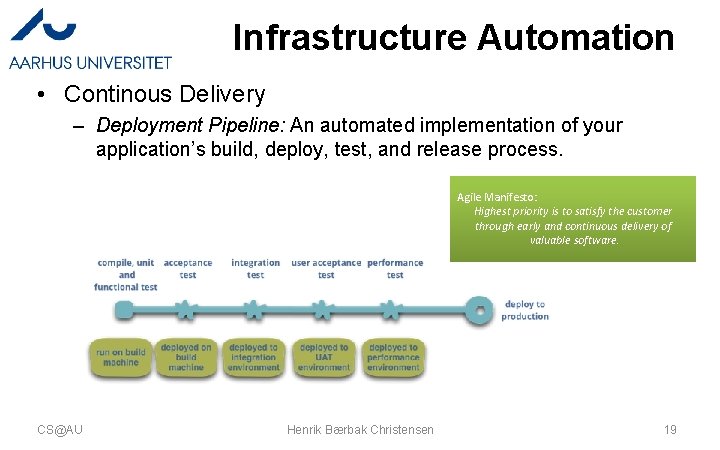
Infrastructure Automation • Continous Delivery – Deployment Pipeline: An automated implementation of your application’s build, deploy, test, and release process. Agile Manifesto: Highest priority is to satisfy the customer through early and continuous delivery of valuable software. CS@AU Henrik Bærbak Christensen 19
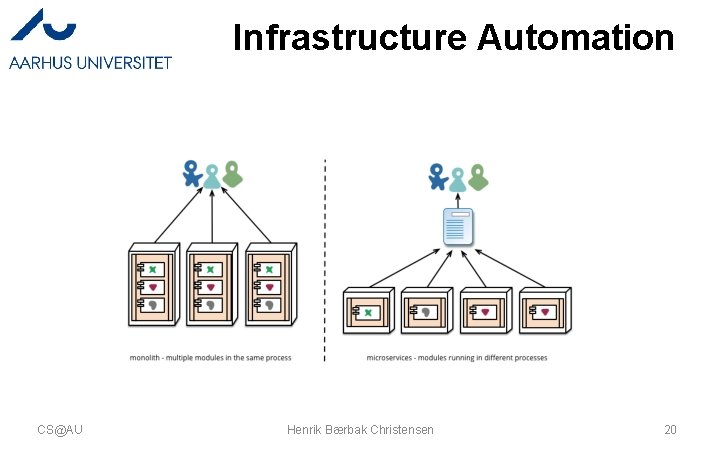
Infrastructure Automation CS@AU Henrik Bærbak Christensen 20
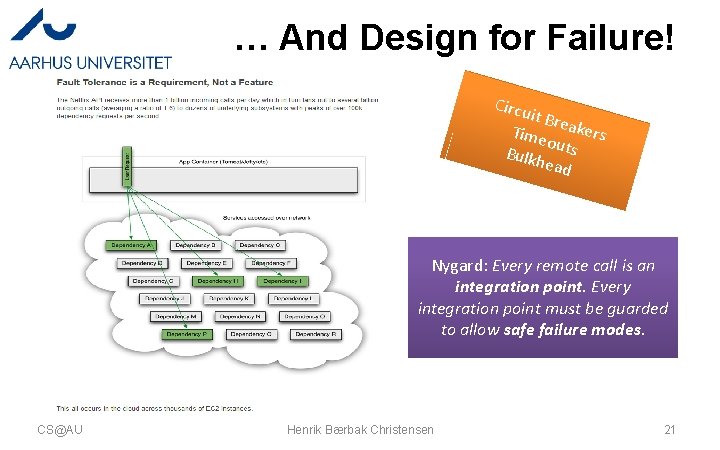
… And Design for Failure! Circu it Bre Time akers o Bulkh uts ead Nygard: Every remote call is an integration point. Every integration point must be guarded to allow safe failure modes. CS@AU Henrik Bærbak Christensen 21
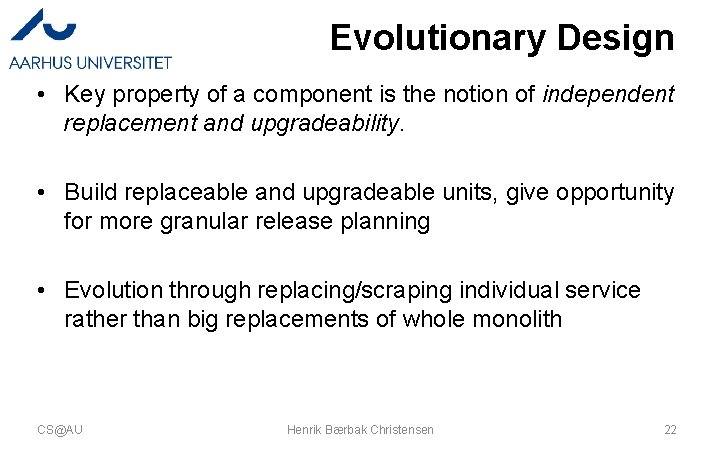
Evolutionary Design • Key property of a component is the notion of independent replacement and upgradeability. • Build replaceable and upgradeable units, give opportunity for more granular release planning • Evolution through replacing/scraping individual service rather than big replacements of whole monolith CS@AU Henrik Bærbak Christensen 22
Newman
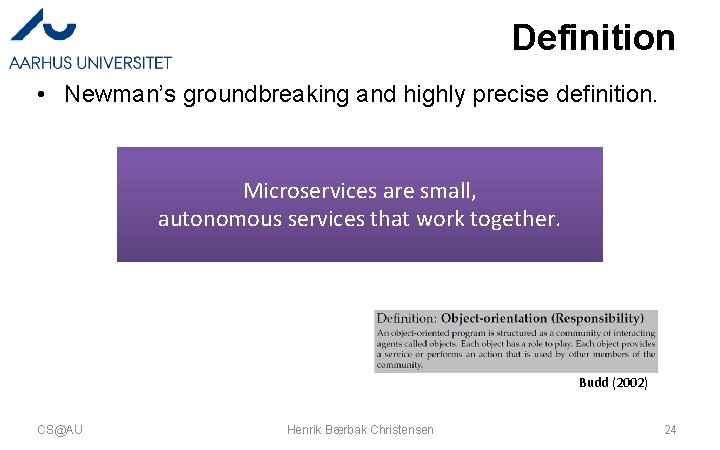
Definition • Newman’s groundbreaking and highly precise definition. Microservices are small, autonomous services that work together. Budd (2002) CS@AU Henrik Bærbak Christensen 24
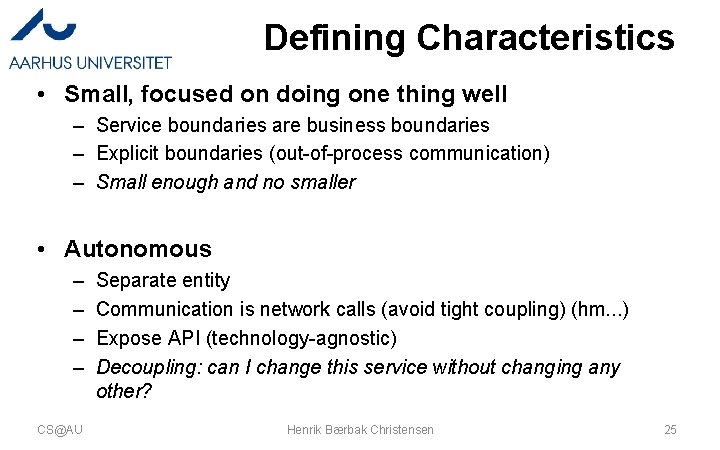
Defining Characteristics • Small, focused on doing one thing well – Service boundaries are business boundaries – Explicit boundaries (out-of-process communication) – Small enough and no smaller • Autonomous – – CS@AU Separate entity Communication is network calls (avoid tight coupling) (hm. . . ) Expose API (technology-agnostic) Decoupling: can I change this service without changing any other? Henrik Bærbak Christensen 25
Key Benefits • Technological Heterogenity – Each service may use its own technology stack • Pick the right tool for each job – May choose data storage techology independently – Quick technology adaption • Lower risk by selecting new technology for given service – Counterpoint • Overhead in maintaining many technologies • Company ‘Technology Decisions’ may restrict that – Net. Flix and Twitter: Only JVM based systems CS@AU Henrik Bærbak Christensen 26
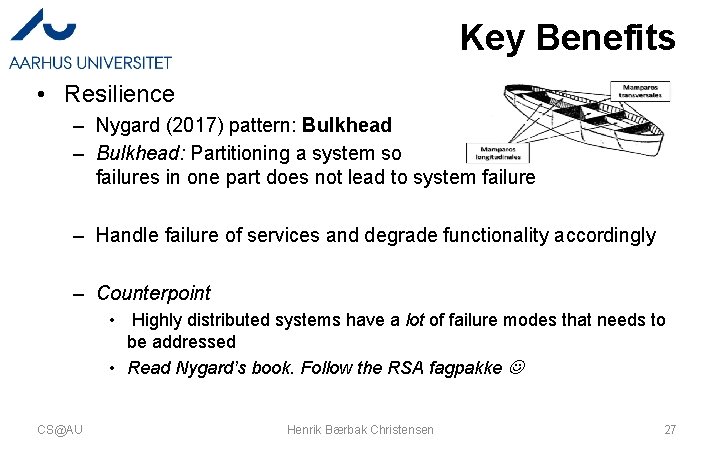
Key Benefits • Resilience – Nygard (2017) pattern: Bulkhead – Bulkhead: Partitioning a system so failures in one part does not lead to system failure – Handle failure of services and degrade functionality accordingly – Counterpoint • Highly distributed systems have a lot of failure modes that needs to be addressed • Read Nygard’s book. Follow the RSA fagpakke CS@AU Henrik Bærbak Christensen 27
Key Benefits • Scaling – Just scale the microservice that needs scaling • Opposite monolith system: all things scale together – Utilize on-demand provisioning of VMs to scale automatically • Ease of Deployment – A one-line bug fix in one service only means one service to redeploy • And rollback is also much easier • Opposite monolith system: full redeployment of monolith – Fear of breaking stuff => changes accumulate CS@AU Henrik Bærbak Christensen 28
Key Benefits • Organization Alignment – Small teams on small service – align organization and architecture • Smaller teams on smaller code bases are more efficient • Composability – Functionality consumed in different ways for different purposes • Optimizing for Replacability – Out of date services are easier to replace because its small size • Opposite: That monster COBOL system everybody is afraid of. . . CS@AU Henrik Bærbak Christensen 29
Comparison Lewis vs Newman CS@AU Henrik Bærbak Christensen
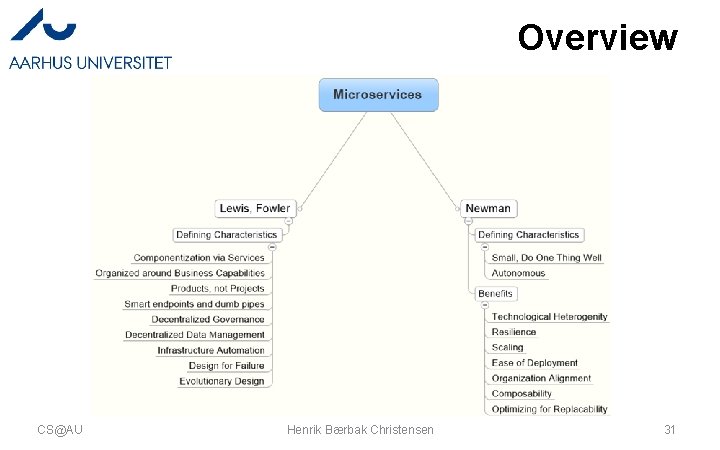
Overview CS@AU Henrik Bærbak Christensen 31
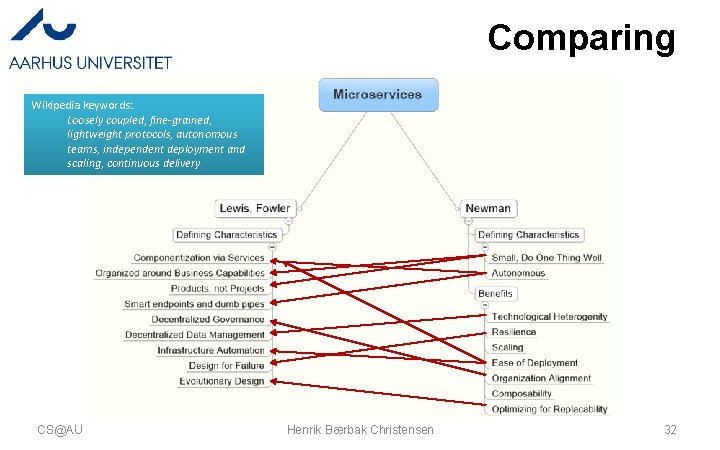
Comparing Wikipedia keywords: Loosely coupled, fine-grained, lightweight protocols, autonomous teams, independent deployment and scaling, continuous delivery. CS@AU Henrik Bærbak Christensen 32