
Soft Xray line reflection in NLS 1 galaxies

- Slides: 23
Soft X-ray line reflection in NLS 1 galaxies Th. Boller, A. Müller, A. Ibarra MPE Garching Excellence Cluster Universe Munich XMM SOC, Villa Franca, Spain 1. The relativistic RM: Compton- and GR line broadening predictions 2. Reliability of spectral fitting in the limited RGS energy band 3. Results in the strong and weak field limit 4. Predictions for IXO
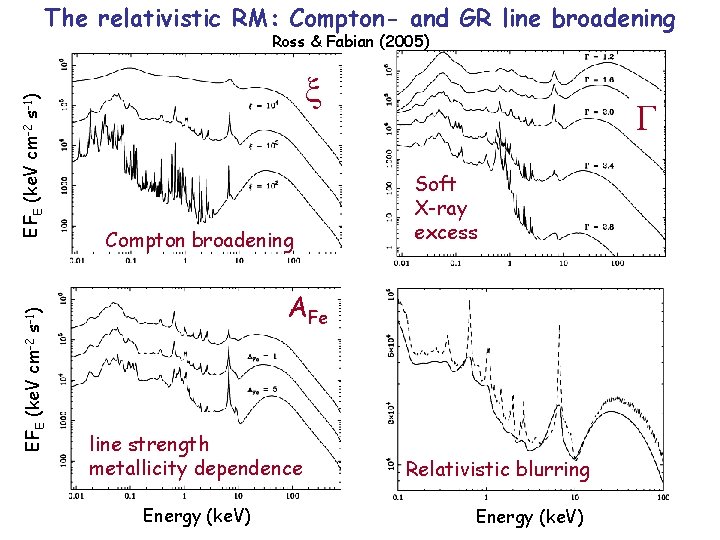
The relativistic RM: Compton- and GR line broadening EFE (ke. V cm-2 s-1) Ross & Fabian (2005) x Compton broadening G Soft X-ray excess AFe line strength metallicity dependence Energy (ke. V) Relativistic blurring Energy (ke. V)
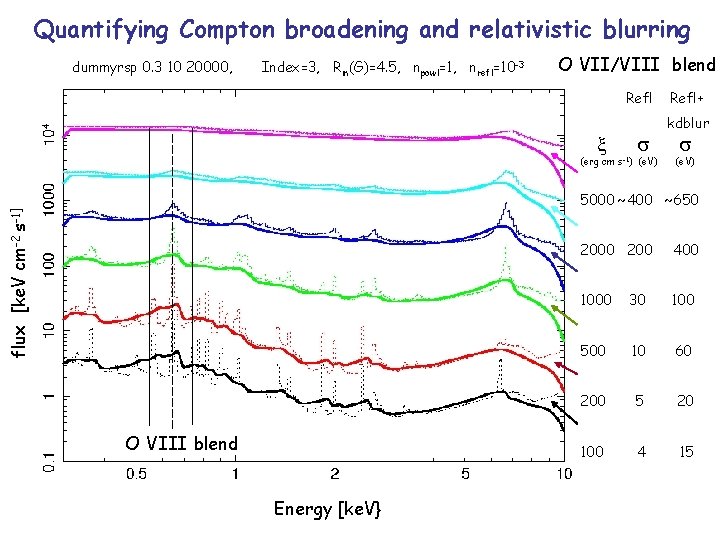
Quantifying Compton broadening and relativistic blurring dummyrsp 0. 3 10 20000, Index=3, Rin(G)=4. 5, npowl=1, nrefl=10 -3 O VII/VIII blend Refl x (erg cm s-1) s (e. V) Refl+ kdblur s (e. V) flux [ke. V cm-2 s-1] 5000 ~400 ~650 O VIII blend Energy [ke. V} 2000 200 400 1000 30 100 500 10 60 200 5 20 100 4 15
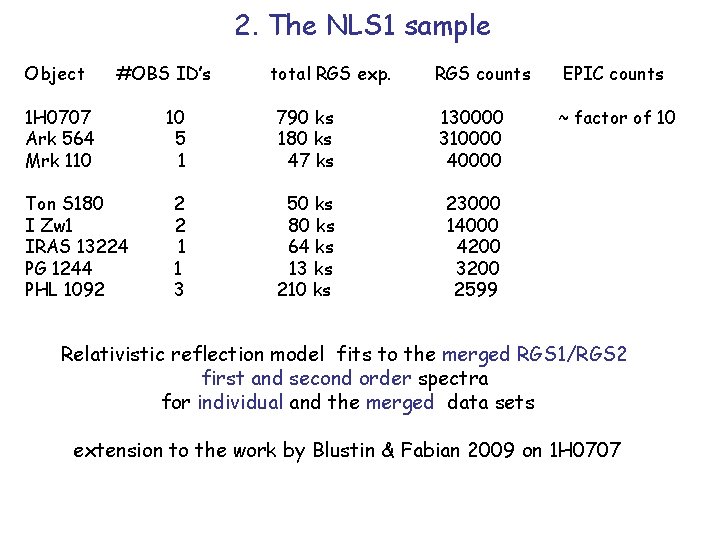
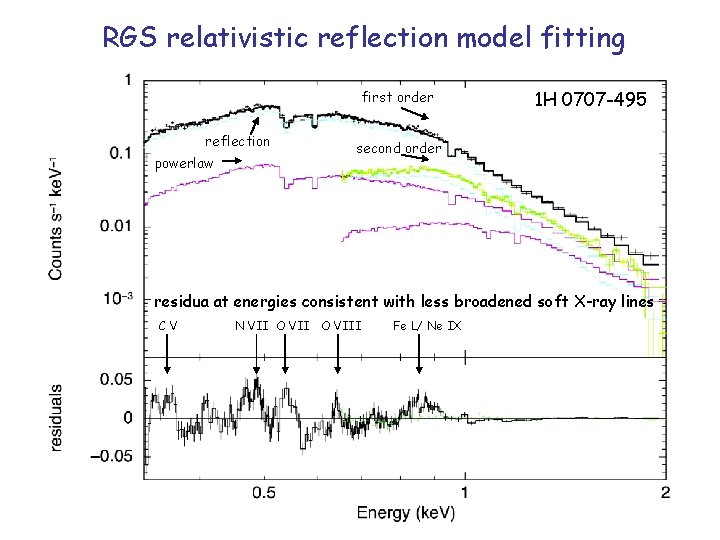
2. The NLS 1 sample Object #OBS ID’s 1 H 0707 Ark 564 Mrk 110 Ton S 180 I Zw 1 IRAS 13224 PG 1244 PHL 1092 total RGS exp. RGS counts EPIC counts ~ factor of 10 10 5 1 790 ks 180 ks 47 ks 130000 310000 40000 2 2 1 1 3 50 ks 80 ks 64 ks 13 ks 210 ks 23000 14000 4200 3200 2599 Relativistic reflection model fits to the merged RGS 1/RGS 2 first and second order spectra for individual and the merged data sets extension to the work by Blustin & Fabian 2009 on 1 H 0707
RGS relativistic reflection model fitting first order reflection powerlaw 1 H 0707 -495 second order residua at energies consistent with less broadened soft X-ray lines CV N VII O VIII Fe L/ Ne IX
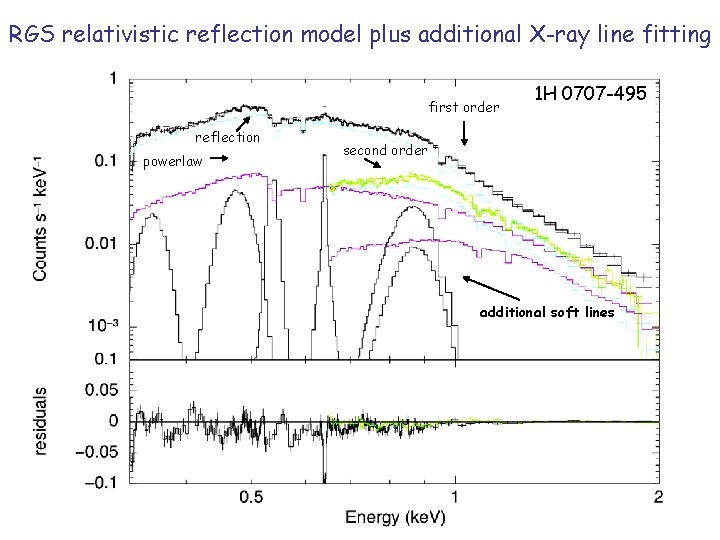
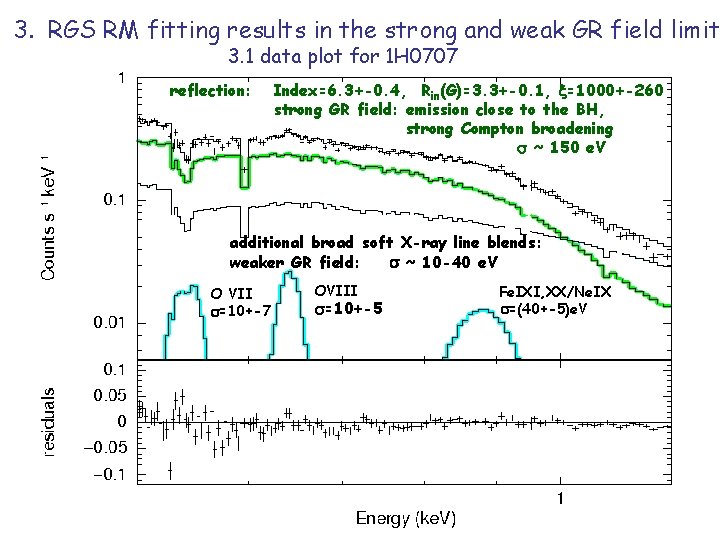
RGS relativistic reflection model plus additional X-ray line fitting first order reflection powerlaw 1 H 0707 -495 second order additional soft lines
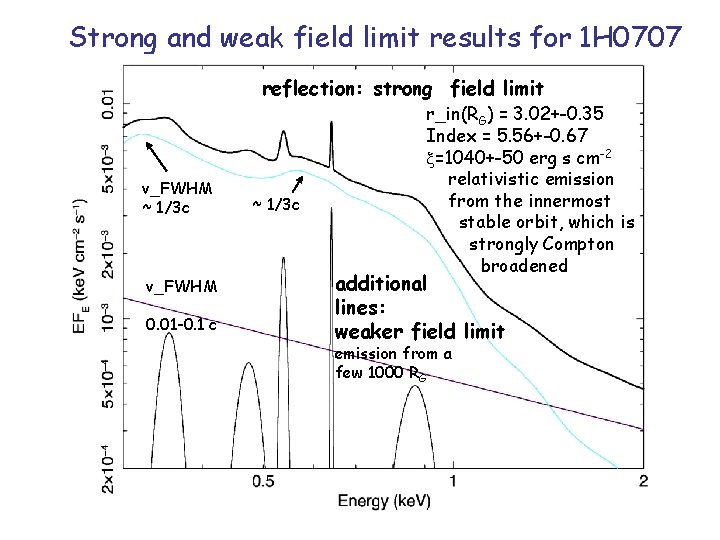
Strong and weak field limit results for 1 H 0707 reflection: strong field limit v_FWHM ~ 1/3 c v_FWHM 0. 01 -0. 1 c ~ 1/3 c r_in(RG) = 3. 02+-0. 35 Index = 5. 56+-0. 67 x=1040+-50 erg s cm-2 relativistic emission from the innermost stable orbit, which is strongly Compton broadened additional lines: weaker field limit emission from a few 1000 RG
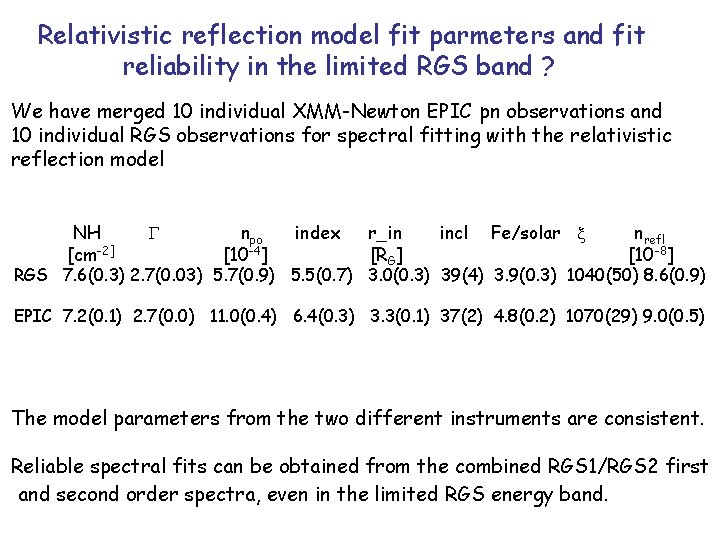
Relativistic reflection model fit parmeters and fit reliability in the limited RGS band ? We have merged 10 individual XMM-Newton EPIC pn observations and 10 individual RGS observations for spectral fitting with the relativistic reflection model NH [cm-2] G npo [10 -4] index r_in [RG] incl Fe/solar x nrefl [10 -8] RGS 7. 6(0. 3) 2. 7(0. 03) 5. 7(0. 9) 5. 5(0. 7) 3. 0(0. 3) 39(4) 3. 9(0. 3) 1040(50) 8. 6(0. 9) EPIC 7. 2(0. 1) 2. 7(0. 0) 11. 0(0. 4) 6. 4(0. 3) 3. 3(0. 1) 37(2) 4. 8(0. 2) 1070(29) 9. 0(0. 5) The model parameters from the two different instruments are consistent. Reliable spectral fits can be obtained from the combined RGS 1/RGS 2 first and second order spectra, even in the limited RGS energy band.
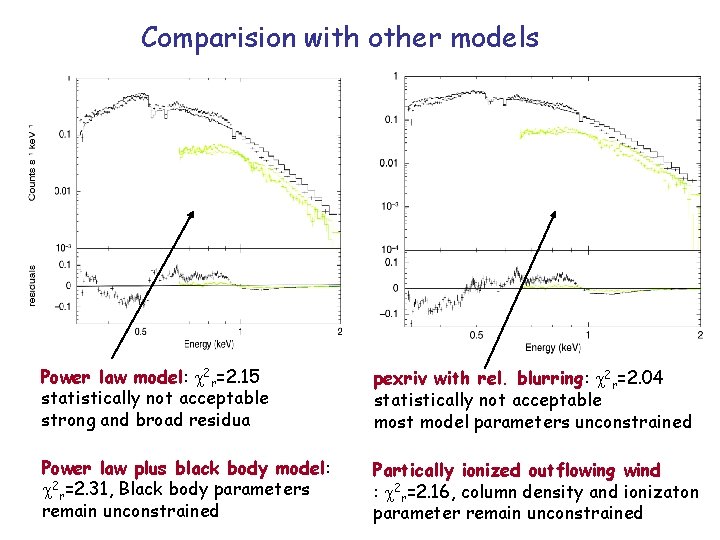
Comparision with other models Power law model: c 2 r=2. 15 statistically not acceptable strong and broad residua pexriv with rel. blurring: c 2 r=2. 04 statistically not acceptable most model parameters unconstrained Power law plus black body model: c 2 r=2. 31, Black body parameters remain unconstrained Partically ionized outflowing wind : c 2 r=2. 16, column density and ionizaton parameter remain unconstrained
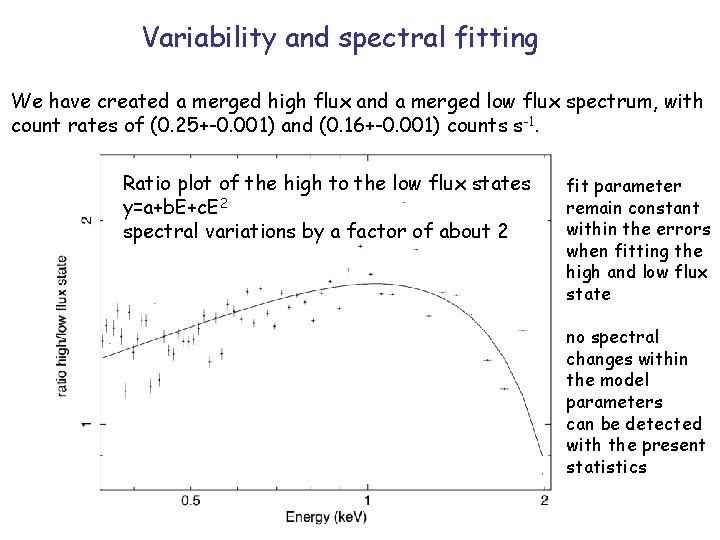
Variability and spectral fitting We have created a merged high flux and a merged low flux spectrum, with count rates of (0. 25+-0. 001) and (0. 16+-0. 001) counts s-1. Ratio plot of the high to the low flux states y=a+b. E+c. E 2 spectral variations by a factor of about 2 fit parameter remain constant within the errors when fitting the high and low flux state no spectral changes within the model parameters can be detected with the present statistics
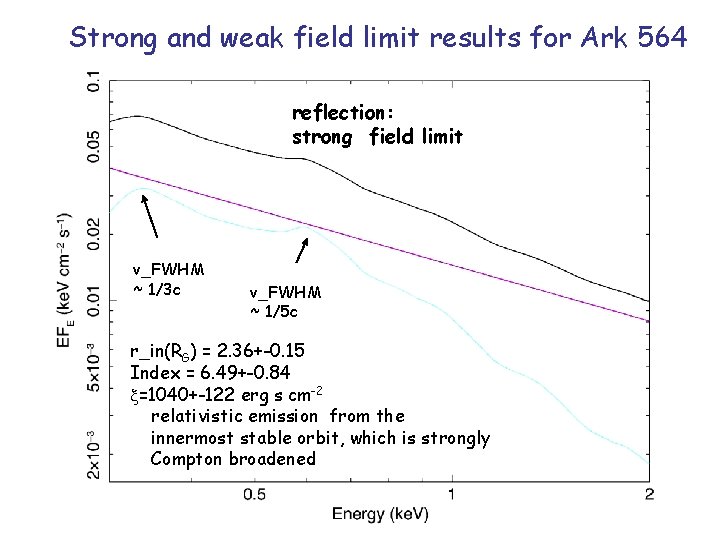
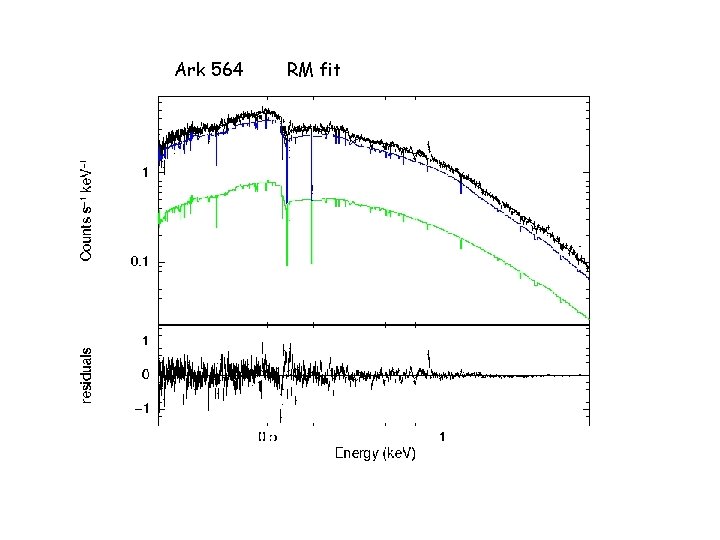
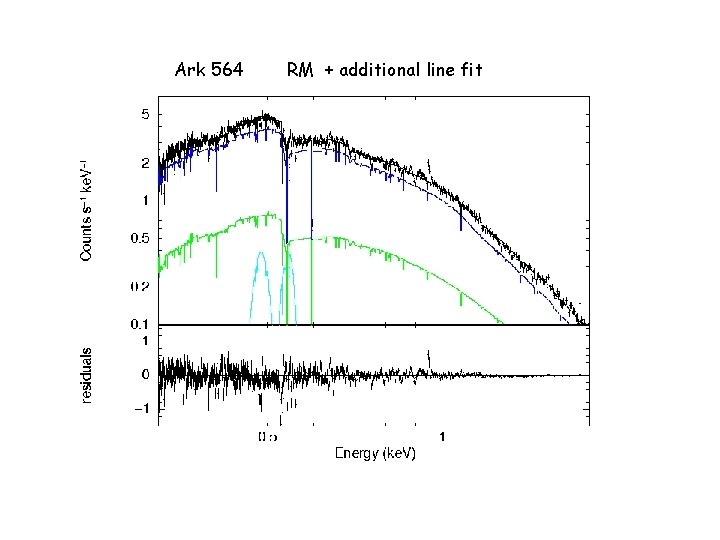
Strong and weak field limit results for Ark 564 reflection: strong field limit v_FWHM ~ 1/3 c v_FWHM ~ 1/5 c r_in(RG) = 2. 36+-0. 15 Index = 6. 49+-0. 84 x=1040+-122 erg s cm-2 relativistic emission from the innermost stable orbit, which is strongly Compton broadened
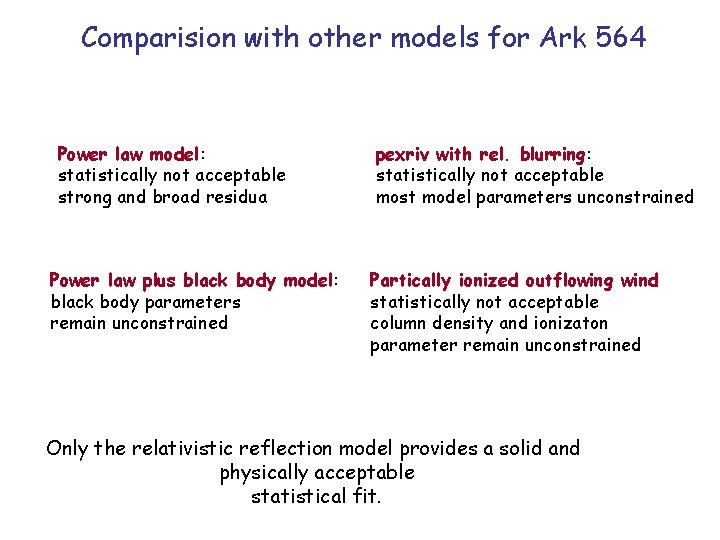
Comparision with other models for Ark 564 Power law model: statistically not acceptable strong and broad residua Power law plus black body model: black body parameters remain unconstrained pexriv with rel. blurring: statistically not acceptable most model parameters unconstrained Partically ionized outflowing wind statistically not acceptable column density and ionizaton parameter remain unconstrained Only the relativistic reflection model provides a solid and physically acceptable statistical fit.
Strong and weaker field limit fitting results 1 H 0707 and Ark 564 The obtained parameters from the relativistic reflection model suggest that the observe emission originates very close to the central black hole. The inner radius of the emitting disc is ~3 RG , resulting into a black hole spin of about 0. 8. The relativistic reflection model accounts for emission from the inner parts only, probing the strong gravity field. Strong gravity effects and strong Compton broadening affects this emission. The ionization parameter is x ~1000 The combination of emission close to the central black hole and ionization results into strong broadening of the lines included in the Ross & Fabian relativistic reflection model. Furthermore, an acceptable data fit requires additional less broadened soft X-ray lines which are farther away from the black hole, a few 1000 RG, and which probe the weaker field limit. These lines are not accounted for the relativistic reflection model and are most probably due to the high metallicity values obtained for NLS 1 s.
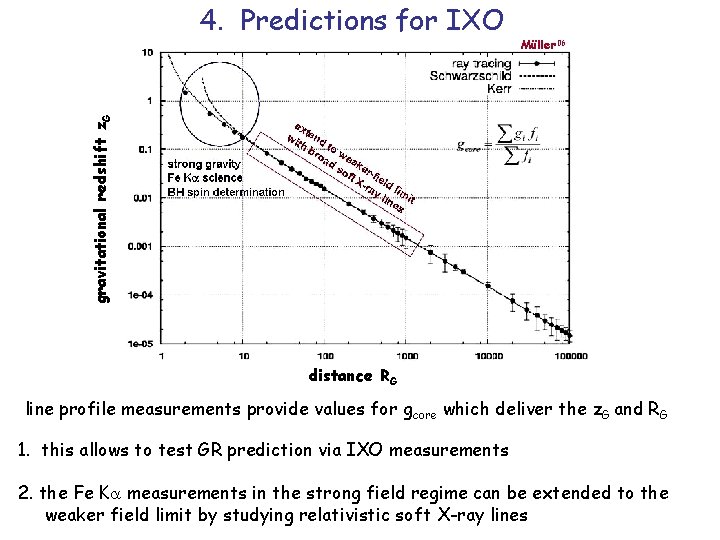
Müller 06 gravitational redshift z. G 4. Predictions for IXO distance RG line profile measurements provide values for gcore which deliver the z. G and RG 1. this allows to test GR prediction via IXO measurements 2. the Fe Ka measurements in the strong field regime can be extended to the weaker field limit by studying relativistic soft X-ray lines
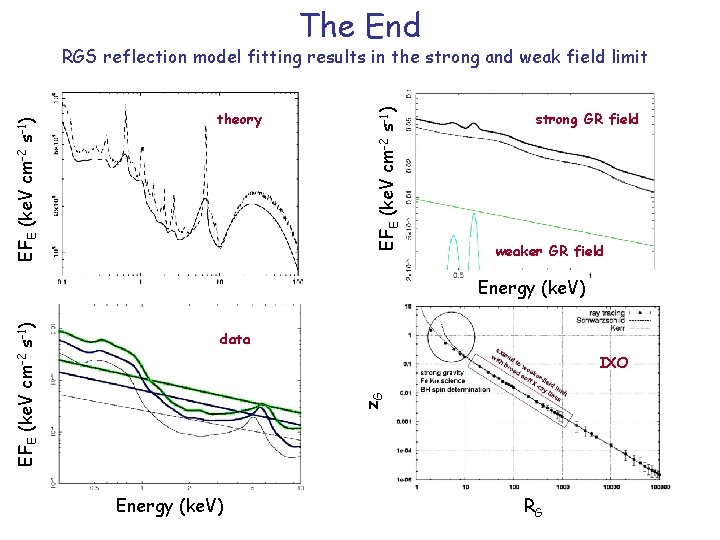
The End theory EFE (ke. V cm-2 s-1) RGS reflection model fitting results in the strong and weak field limit strong GR field weaker GR field data IXO z. G EFE (ke. V cm-2 s-1) Energy (ke. V) RG
Appendix material
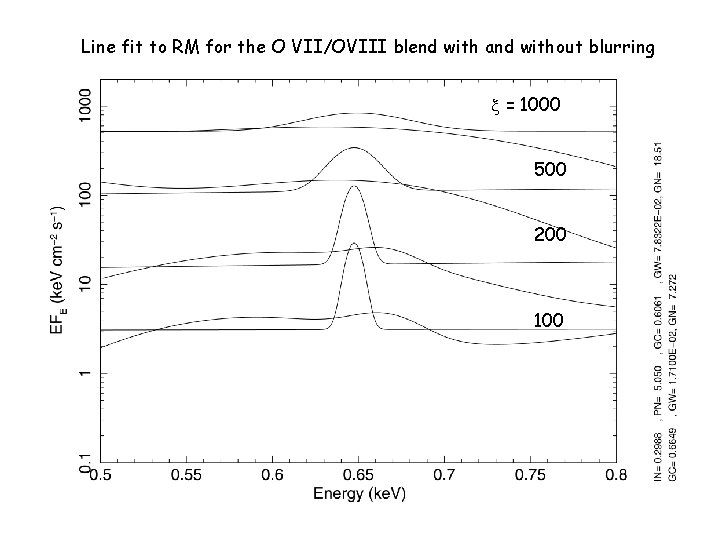
Line fit to RM for the O VII/OVIII blend with and without blurring x = 1000 500 200 100
3. RGS RM fitting results in the strong and weak GR field limit 3. 1 data plot for 1 H 0707 reflection: Index=6. 3+-0. 4, Rin(G)=3. 3+-0. 1, x=1000+-260 strong GR field: emission close to the BH, strong Compton broadening s ~ 150 e. V additional broad soft X-ray line blends: weaker GR field: s ~ 10 -40 e. V O VII s=10+-7 OVIII s=10+-5 Fe. IXI, XX/Ne. IX s=(40+-5)e. V
Ark 564 RM fit
Ark 564 RM + additional line fit
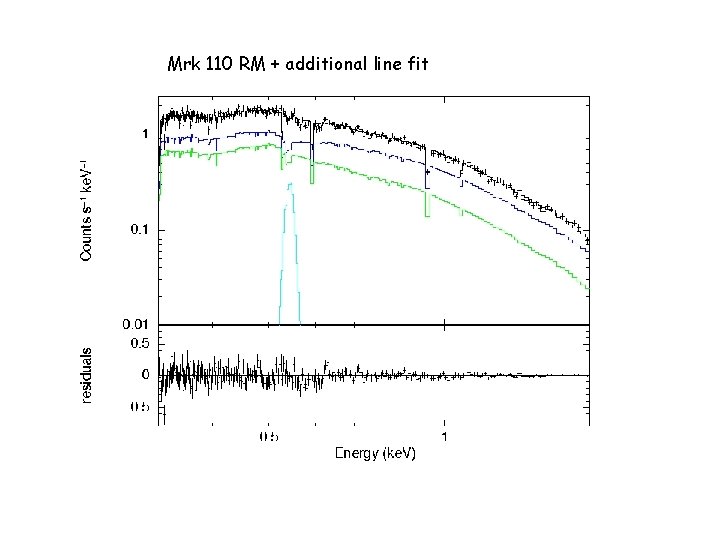
Mrk 110 RM + additional line fit
Basic results 1. RGS RM spectral fitting the line emission from the RM is arising at the innermost stable orbit at ~ 3 RG and is strongly comptonized the FWHM values are about 1/3 c RM RGS fitting probes General Relativity in the strong gravity field limit 2. additional soft X-ray lines emission arising from larger distances ~1000 RG soft X-ray lines are extending GR to the to weaker gravity field limit
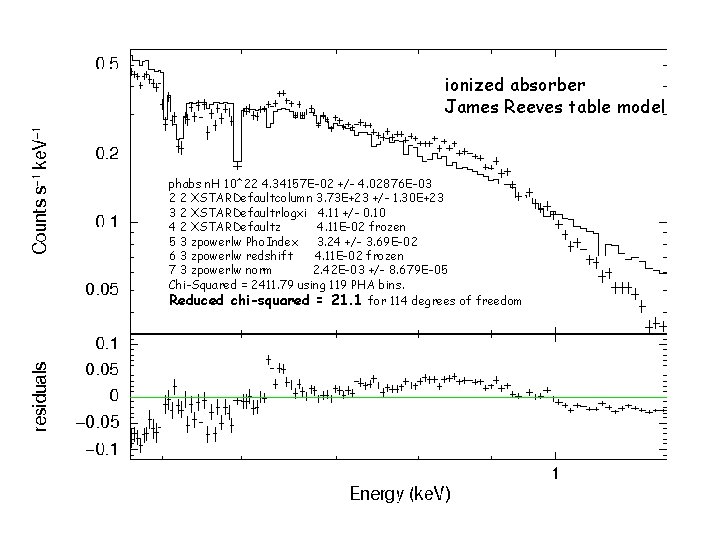
ionized absorber James Reeves table model phabs n. H 10^22 4. 34157 E-02 +/- 4. 02876 E-03 2 2 XSTARDefaultcolumn 3. 73 E+23 +/- 1. 30 E+23 3 2 XSTARDefaultrlogxi 4. 11 +/- 0. 10 4 2 XSTARDefaultz 4. 11 E-02 frozen 5 3 zpowerlw Pho. Index 3. 24 +/- 3. 69 E-02 6 3 zpowerlw redshift 4. 11 E-02 frozen 7 3 zpowerlw norm 2. 42 E-03 +/- 8. 679 E-05 Chi-Squared = 2411. 79 using 119 PHA bins. Reduced chi-squared = 21. 1 for 114 degrees of freedom