
Soft Tissue Rheumatism Prof Dr ansn Tzn l



- Slides: 54
Soft Tissue Rheumatism Prof. Dr. Şansın Tüzün
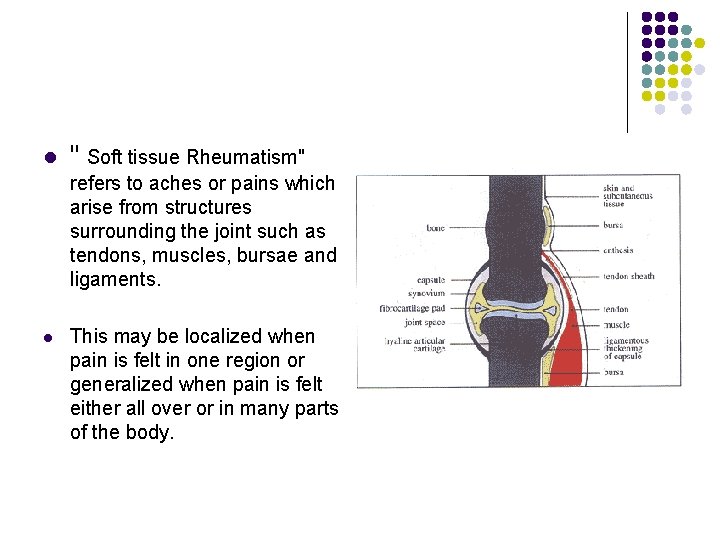
l " Soft tissue Rheumatism" refers to aches or pains which arise from structures surrounding the joint such as tendons, muscles, bursae and ligaments. l This may be localized when pain is felt in one region or generalized when pain is felt either all over or in many parts of the body.
FIBROMYALGIA l Chronic musculoskeletal syndrome characterized by diffuse pain and tender points l No evidence that synovitis or myositis are causes l Occurs in the context of unrevealing physical examination, labaratory and radiologic examination l % 80 -90 of patients are women, peak age is 30 -50 years
Clinical Features l Generalized chronic musculoskeletal pain l Diffuse tenderness at discrete anatomic locations termed tender points l Other features, diagnostic utility but not essential for classification of fibromyalgia are; fatique, sleep disturbances, headaches, irritable bowel syndrome, paresthesias, Raynaud’s-like syndromes, depression and anxiety
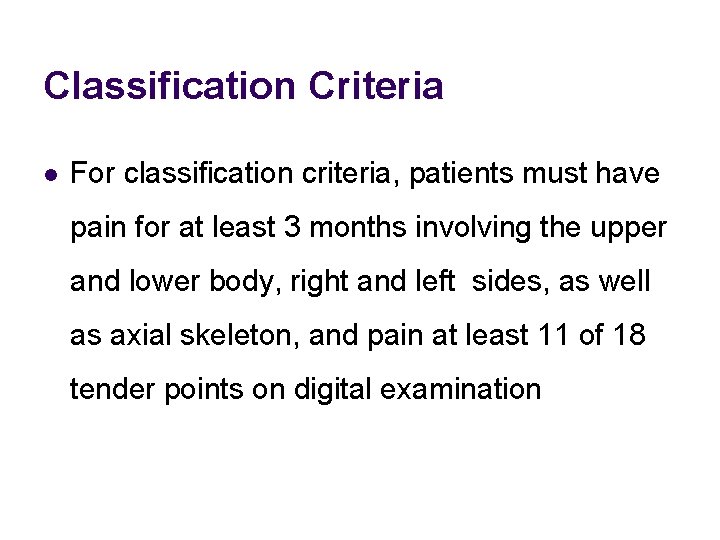
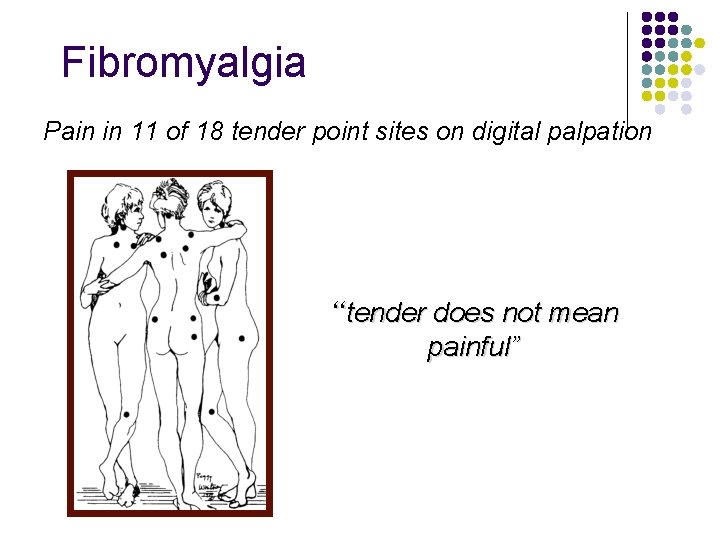
Classification Criteria l For classification criteria, patients must have pain for at least 3 months involving the upper and lower body, right and left sides, as well as axial skeleton, and pain at least 11 of 18 tender points on digital examination
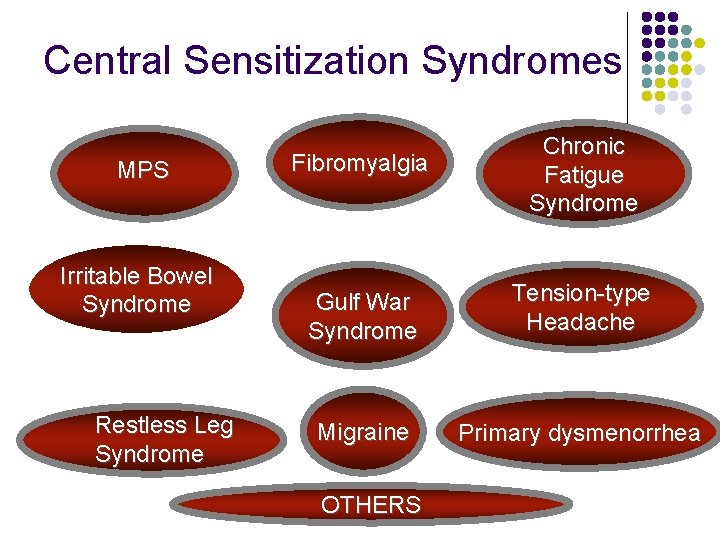
Central Sensitization Syndromes MPS Irritable Bowel Syndrome Restless Leg Syndrome Fibromyalgia Chronic Fatigue Syndrome Gulf War Syndrome Tension-type Headache Migraine Primary dysmenorrhea OTHERS
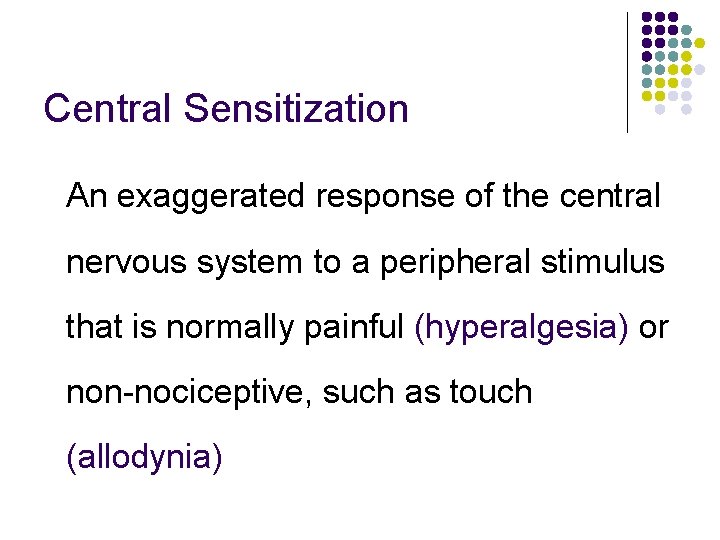
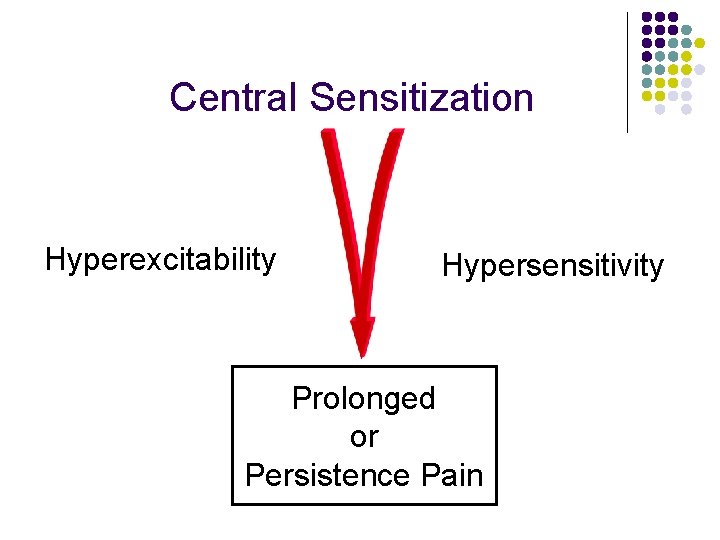
Central Sensitization An exaggerated response of the central nervous system to a peripheral stimulus that is normally painful (hyperalgesia) or non-nociceptive, such as touch (allodynia)
Central Sensitization Hyperexcitability Hypersensitivity Prolonged or Persistence Pain
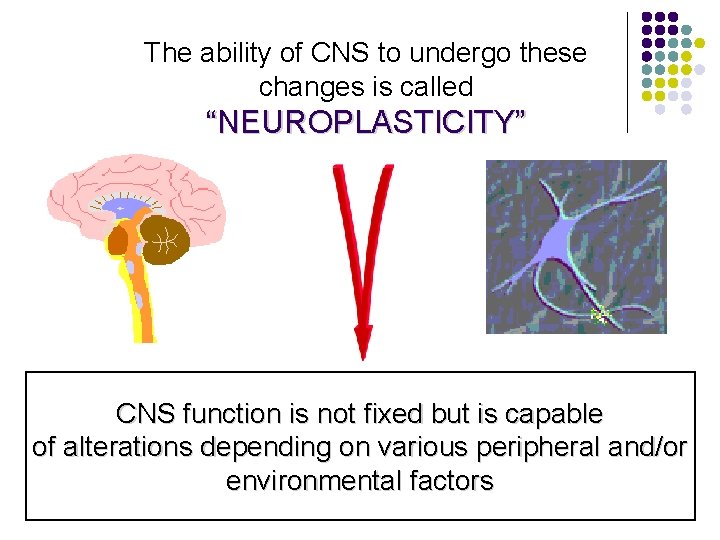
The ability of CNS to undergo these changes is called “NEUROPLASTICITY” CNS function is not fixed but is capable of alterations depending on various peripheral and/or environmental factors
“Common”s among CSSs Gender (Female) Family history Chronic pain/fatigue Abnormal neuroendocrine functions Absence of pathological findings
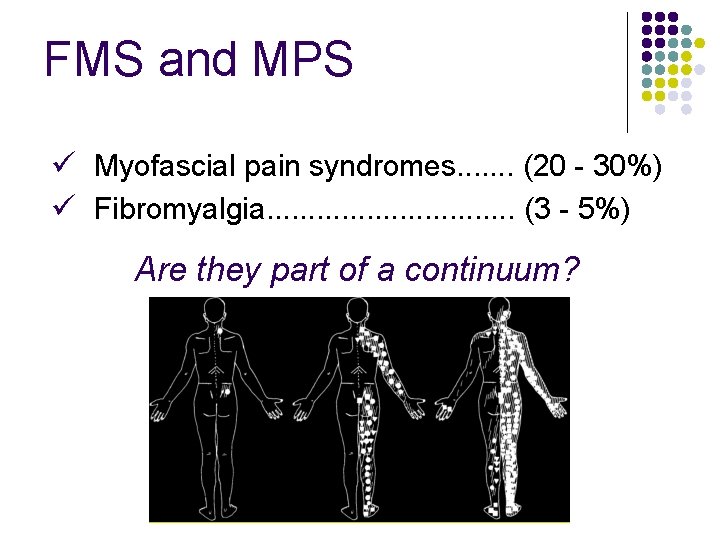
FMS and MPS Myofascial pain syndromes. . . . (20 - 30%) Fibromyalgia. . . . (3 - 5%) Are they part of a continuum?
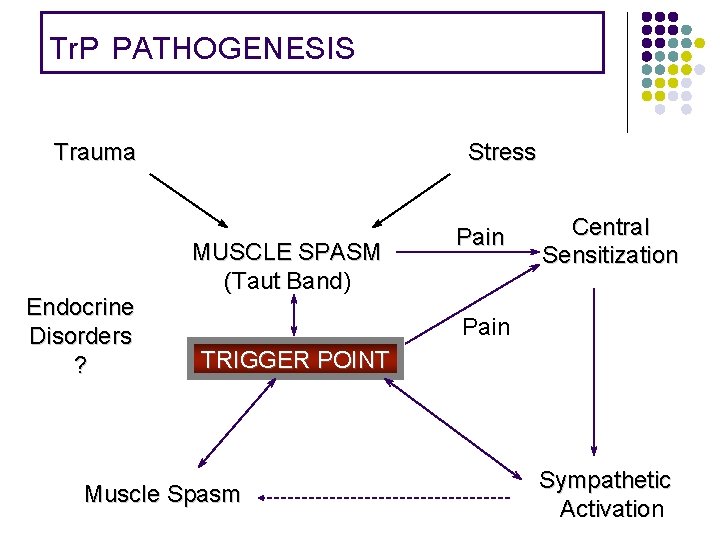
Tr. P PATHOGENESIS Trauma Endocrine Disorders ? Stress MUSCLE SPASM (Taut Band) Pain Central Sensitization Pain TRIGGER POINT Muscle Spasm Sympathetic Activation
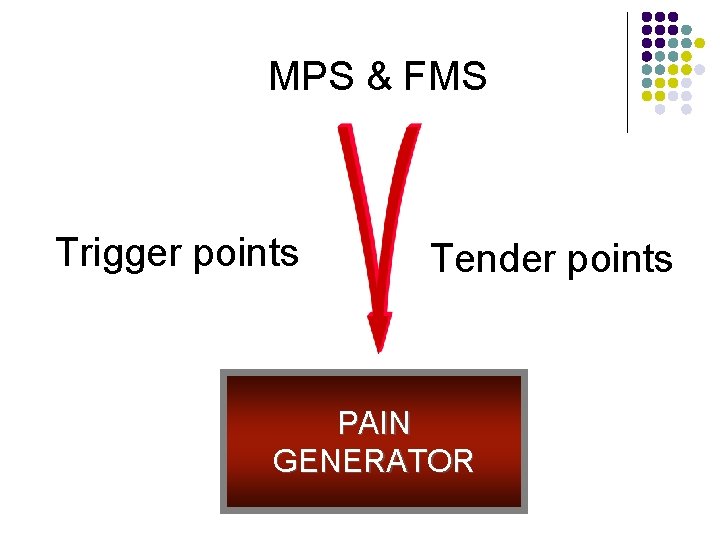
MPS & FMS Trigger points Tender points PAIN GENERATOR
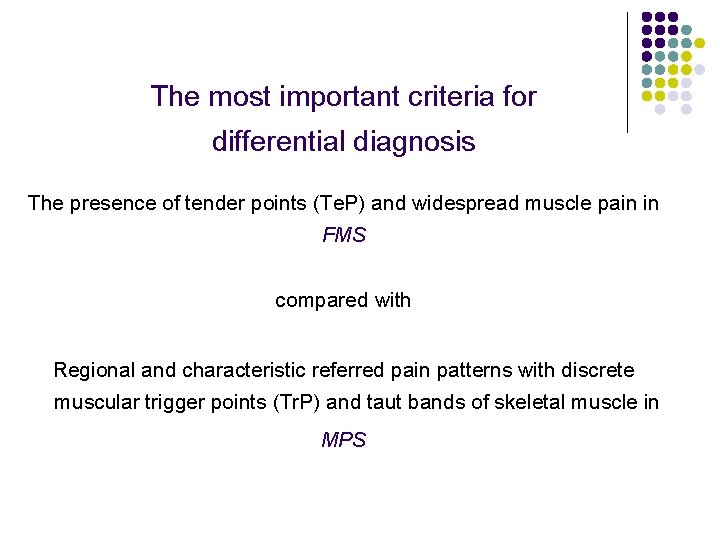
The most important criteria for differential diagnosis The presence of tender points (Te. P) and widespread muscle pain in FMS compared with Regional and characteristic referred pain patterns with discrete muscular trigger points (Tr. P) and taut bands of skeletal muscle in MPS
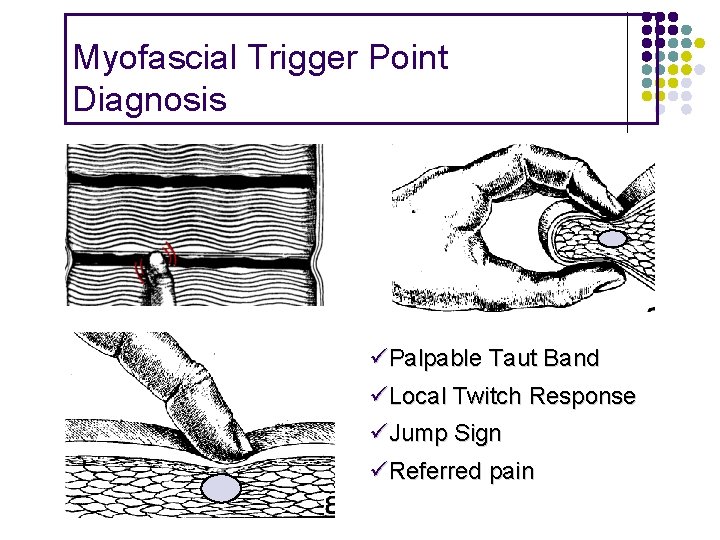
Myofascial Trigger Point Diagnosis Palpable Taut Band Local Twitch Response Jump Sign Referred pain
Fibromyalgia Pain in 11 of 18 tender point sites on digital palpation “tender does not mean painful”
Fibromyalgia Tender Points
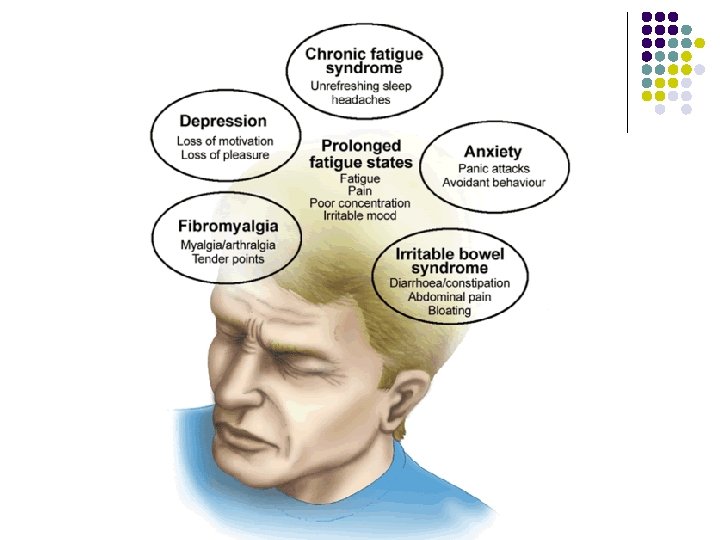
CHRONIC FATIGUE SYNDROME CFS has recently emerged as a popular diagnostic label for a centuries-old disorders of fatigue and multiple somatic complaints. “ Yuppie flue “ It shares many features with fibromyalgia including the lack of objective physical or laboratory abnormalities.
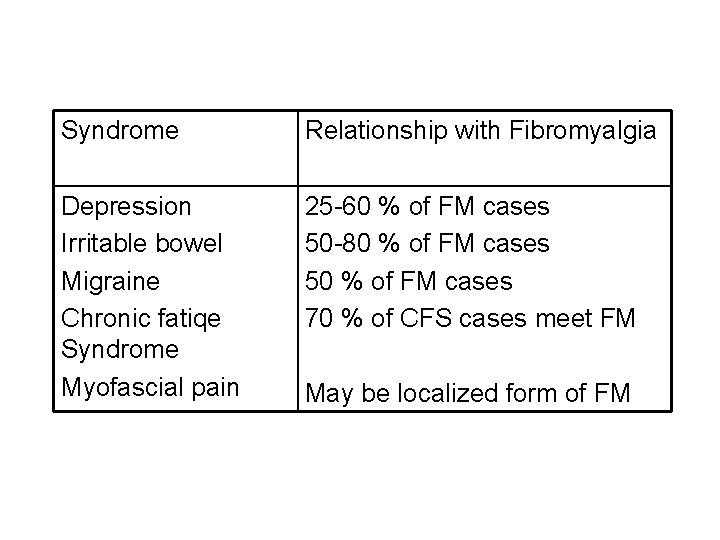
Syndrome Relationship with Fibromyalgia Depression Irritable bowel Migraine Chronic fatiqe Syndrome Myofascial pain 25 -60 % of FM cases 50 -80 % of FM cases 50 % of FM cases 70 % of CFS cases meet FM May be localized form of FM
Classify as CFS if; l l Fatique persists or relapse for > 6 months History, physical examination and appropriate laboratory tests exclude any other cause for the chronic fatique
Additionally; l Impaired memory of concentration, sore throat, tender cervical or axillary lymph nodes, muscle pain, multijoint pain, new headaches and unrefreshing sleep
Treatment l Tricyclic antidepresants ( i. e. amitriptyline, desipramine 1 -3 h before bedtime) l Cardiovasculer fitness training l Biofeedback l Hypnotherapy l Cognitive behavioral therapy l Educating patient
MYOFASCIAL PAIN SYNDROMES l Presence of trigger points, which include a localized area of deep muscle tenderness, located in a taut band in the muscle, and a characteristic reference zone of the perceived pain that is aggravated by the palpation of the trigger point
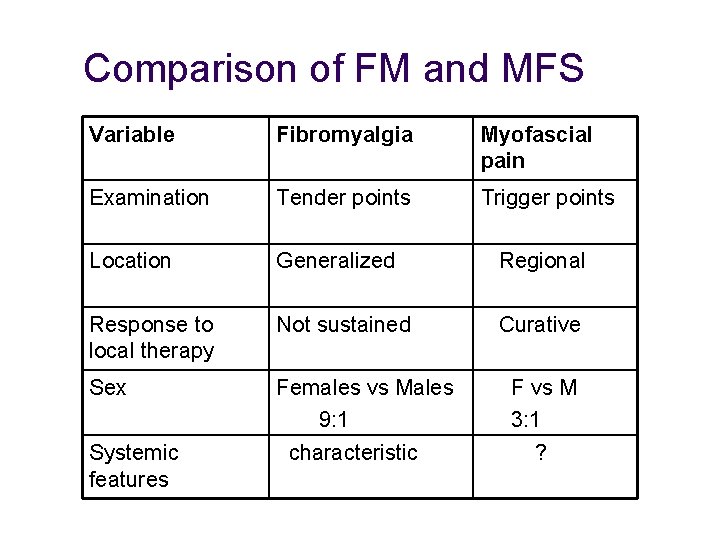
Comparison of FM and MFS Variable Fibromyalgia Myofascial pain Examination Tender points Trigger points Location Generalized Regional Response to local therapy Not sustained Curative Sex Females vs Males 9: 1 Systemic features characteristic F vs M 3: 1 ?
Treatment l Physical therapy l "Stretch and spray" technique: This treatment involves spraying the muscle and trigger point with a coolant and then slowly stretching the muscle. l Massage therapy l Trigger point injection
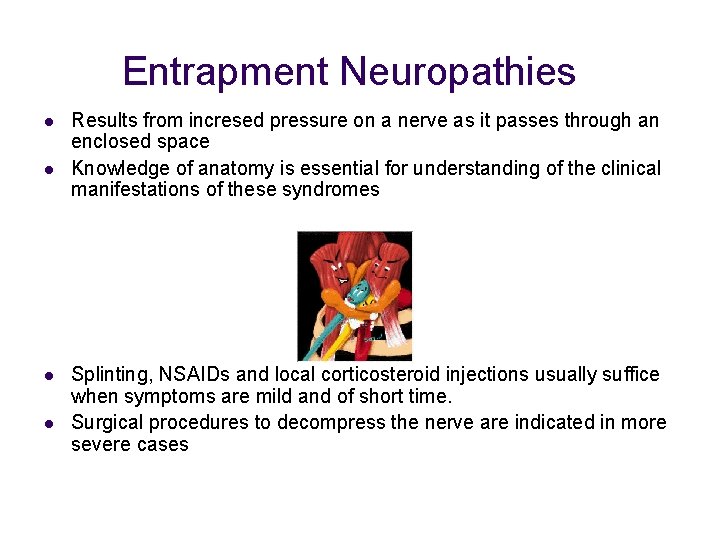
Entrapment Neuropathies l l Results from incresed pressure on a nerve as it passes through an enclosed space Knowledge of anatomy is essential for understanding of the clinical manifestations of these syndromes Splinting, NSAIDs and local corticosteroid injections usually suffice when symptoms are mild and of short time. Surgical procedures to decompress the nerve are indicated in more severe cases
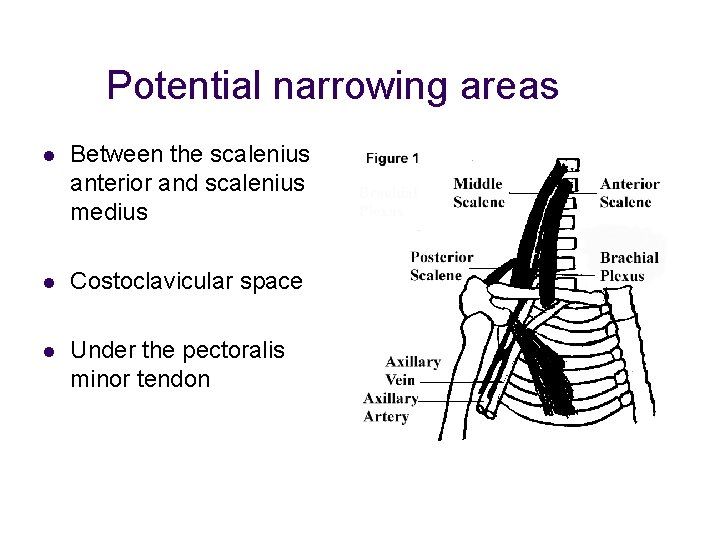
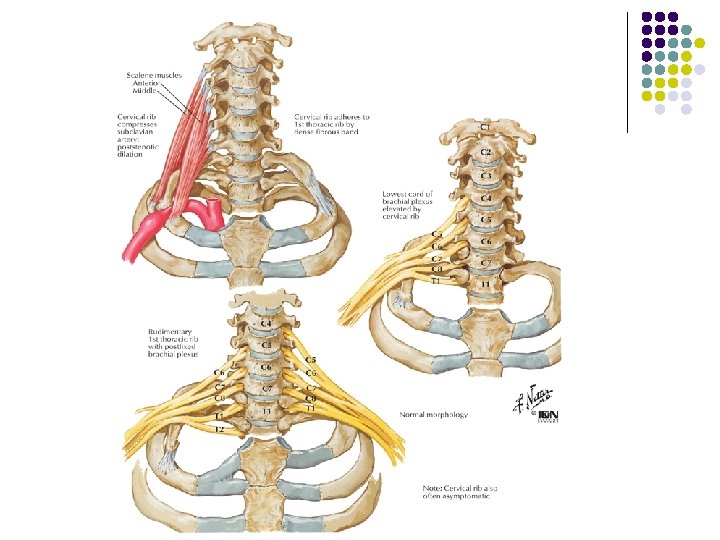
Thoracic Outlet Syndrome l Results from compression of one or more of the neurovasculer elements that pass through the superior thoracic aperture l Anatomic abnormalities and trauma to the shoulder girdle region play a far more pivotal role
Potential narrowing areas l Between the scalenius anterior and scalenius medius l Costoclavicular space l Under the pectoralis minor tendon
Signs and Symptoms l l Paresthesias Pain, radiating to the neck, shoulder and arm l Motor weakness l Atrophy of thenar, hypotenar and intrinsic muscles of the hand l Vasomotor disturbances
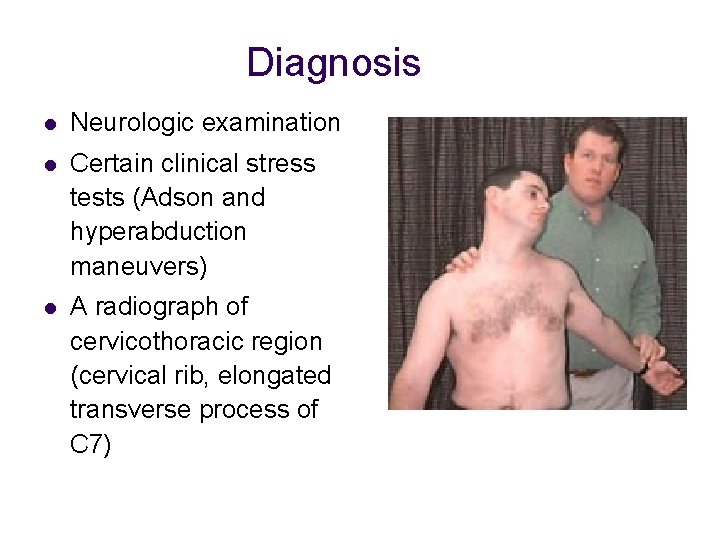
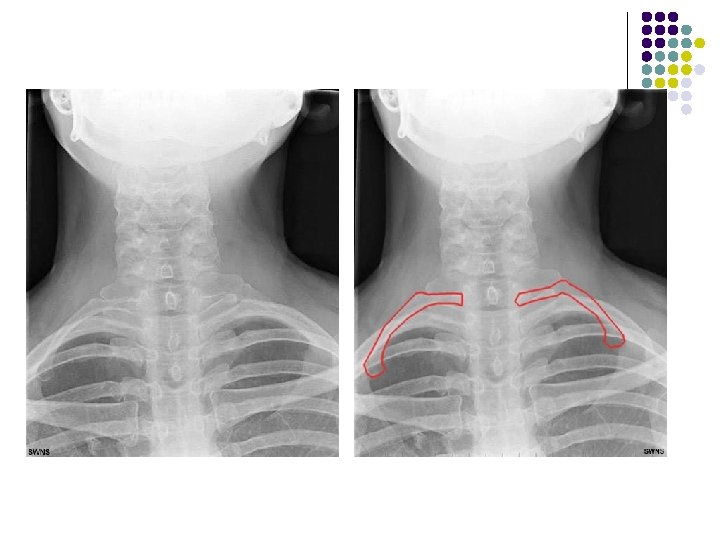
Diagnosis l Neurologic examination l Certain clinical stress tests (Adson and hyperabduction maneuvers) l A radiograph of cervicothoracic region (cervical rib, elongated transverse process of C 7)
Treatment l Exercise designed to improve posture by strengthening muscles l Avoidance of hyperabduction l Surgical intervention if; muscle wasting, paresthesias replaced by continous sensory loss, incapacitating pain, worsening of circulatory impairment
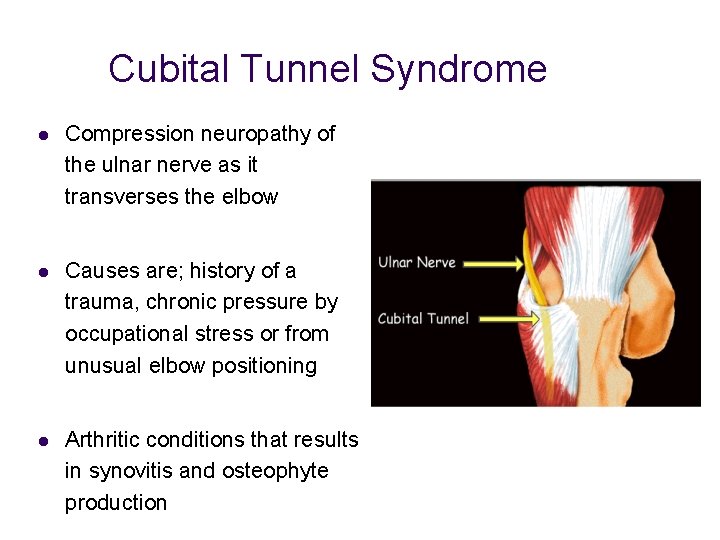
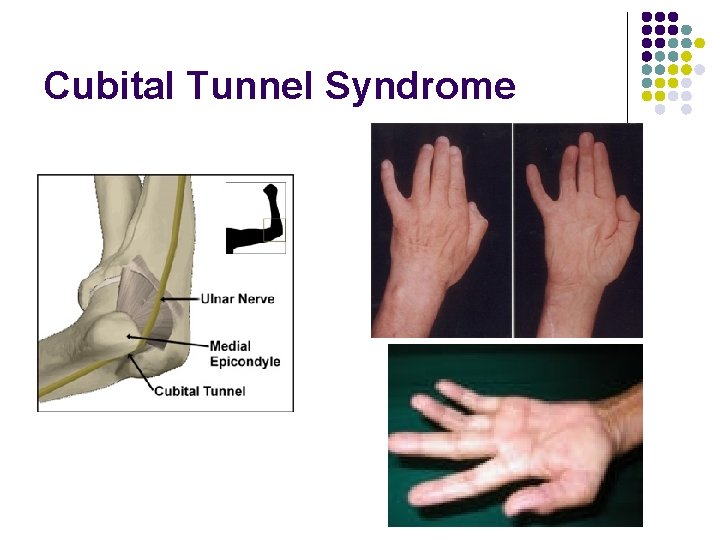
Cubital Tunnel Syndrome l Compression neuropathy of the ulnar nerve as it transverses the elbow l Causes are; history of a trauma, chronic pressure by occupational stress or from unusual elbow positioning l Arthritic conditions that results in synovitis and osteophyte production
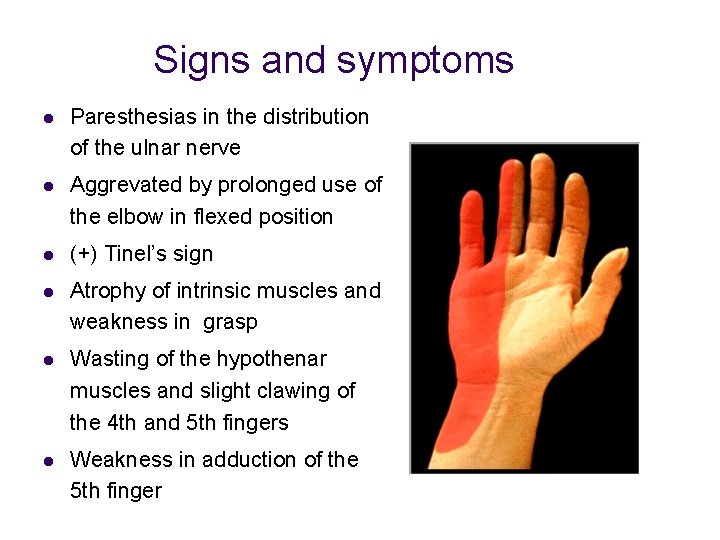
Signs and symptoms l Paresthesias in the distribution of the ulnar nerve l Aggrevated by prolonged use of the elbow in flexed position l (+) Tinel’s sign l Atrophy of intrinsic muscles and weakness in grasp l Wasting of the hypothenar muscles and slight clawing of the 4 th and 5 th fingers l Weakness in adduction of the 5 th finger
Cubital Tunnel Syndrome
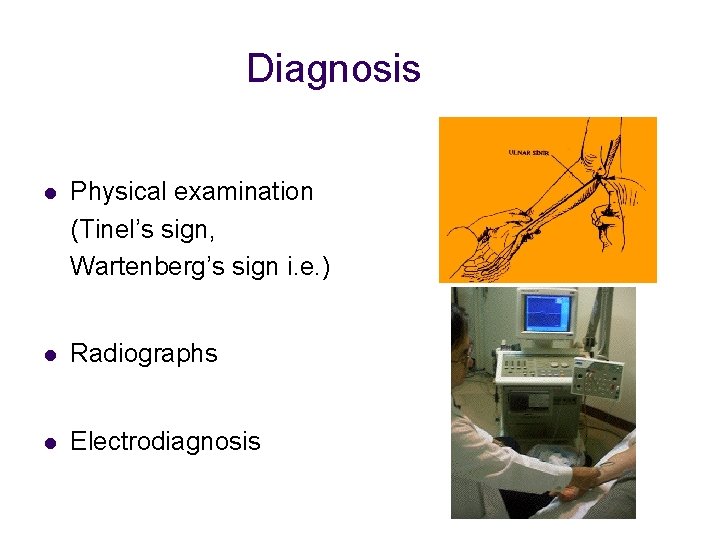
Diagnosis l Physical examination (Tinel’s sign, Wartenberg’s sign i. e. ) l Radiographs l Electrodiagnosis
Treatment l Avoidance of prolonged elbow flexion l Local steroid injection along the ulnar groove l Surgical procedures to decompress the nerve
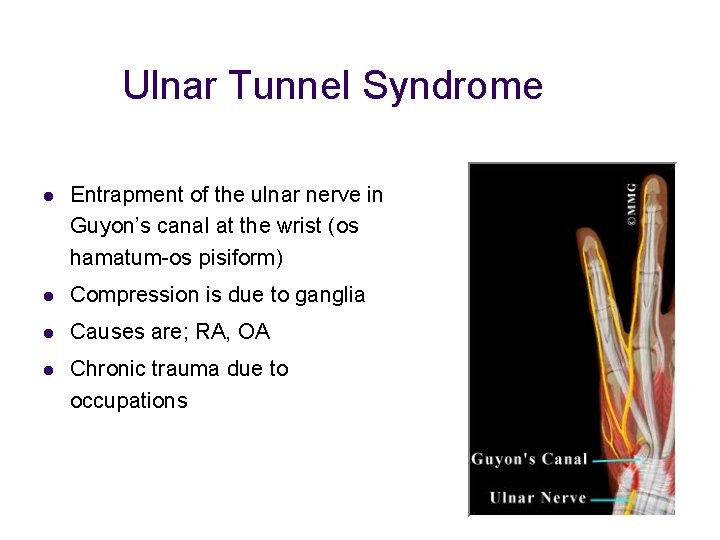
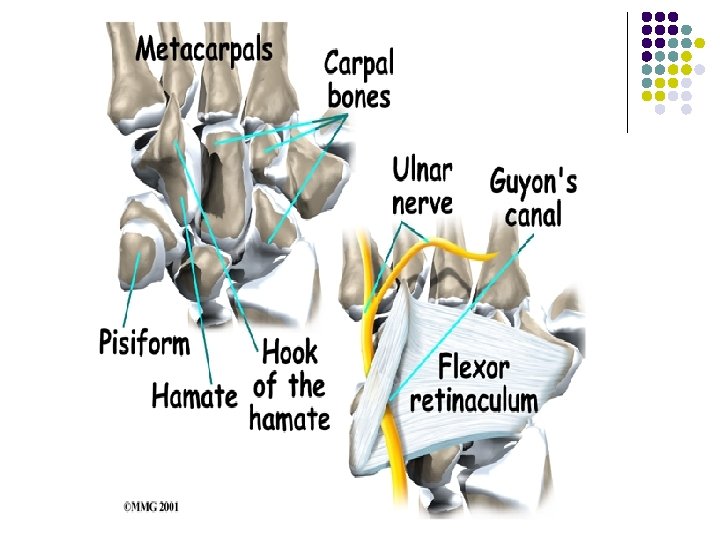
Ulnar Tunnel Syndrome l Entrapment of the ulnar nerve in Guyon’s canal at the wrist (os hamatum-os pisiform) l Compression is due to ganglia l Causes are; RA, OA l Chronic trauma due to occupations
Signs and Symptoms l Combined sensory and motor deficits l Hypoesthesia in the hypothenar region and 4 th and 5 th fingers l Weakness of the intrinsic muscles of the hand
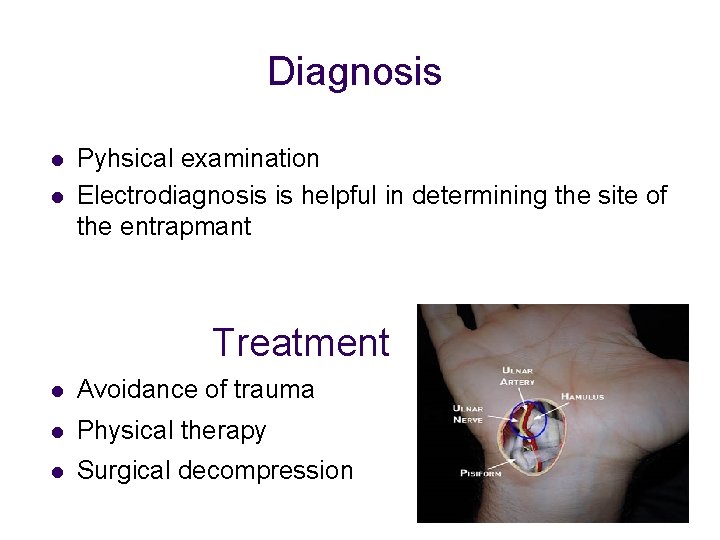
Diagnosis l l Pyhsical examination Electrodiagnosis is helpful in determining the site of the entrapmant Treatment l Avoidance of trauma l Physical therapy l Surgical decompression
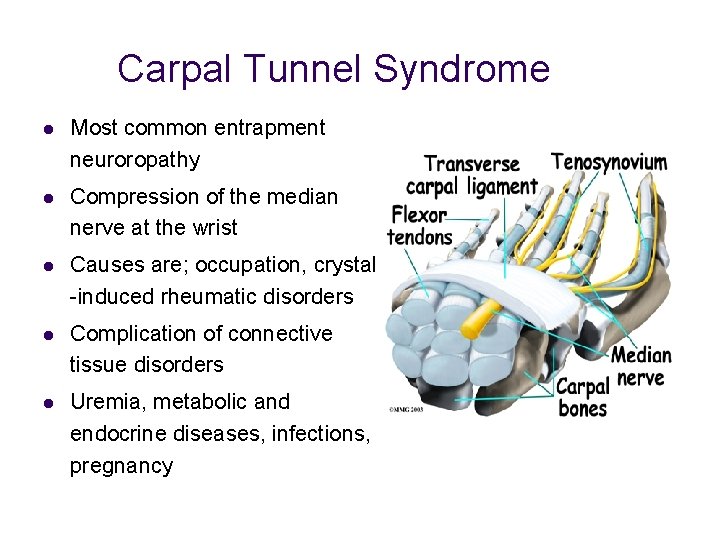
Carpal Tunnel Syndrome l Most common entrapment neuroropathy l Compression of the median nerve at the wrist l Causes are; occupation, crystal -induced rheumatic disorders l Complication of connective tissue disorders l Uremia, metabolic and endocrine diseases, infections, pregnancy
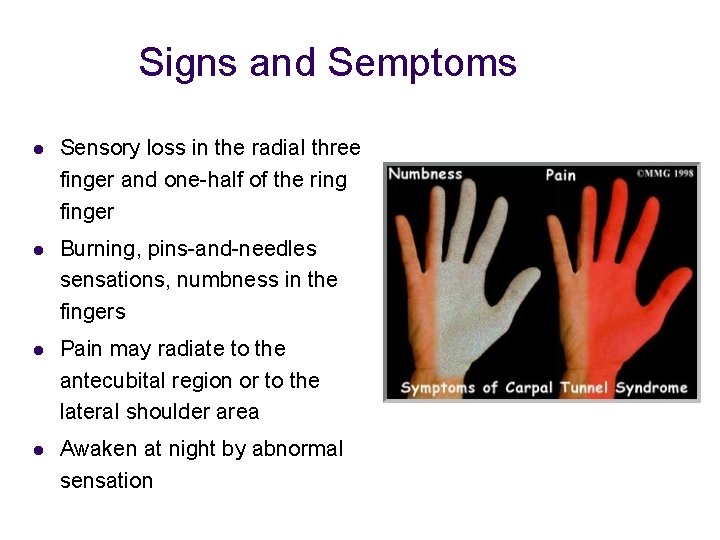
Signs and Semptoms l Sensory loss in the radial three finger and one-half of the ring finger l Burning, pins-and-needles sensations, numbness in the fingers l Pain may radiate to the antecubital region or to the lateral shoulder area l Awaken at night by abnormal sensation
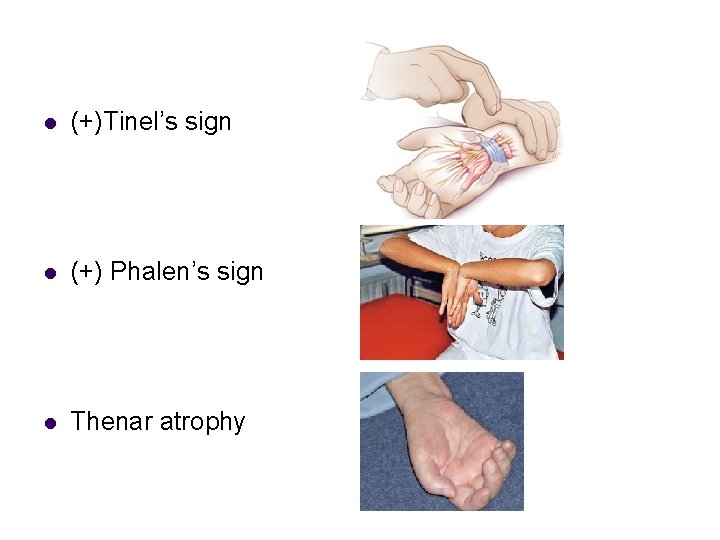
l (+)Tinel’s sign l (+) Phalen’s sign l Thenar atrophy
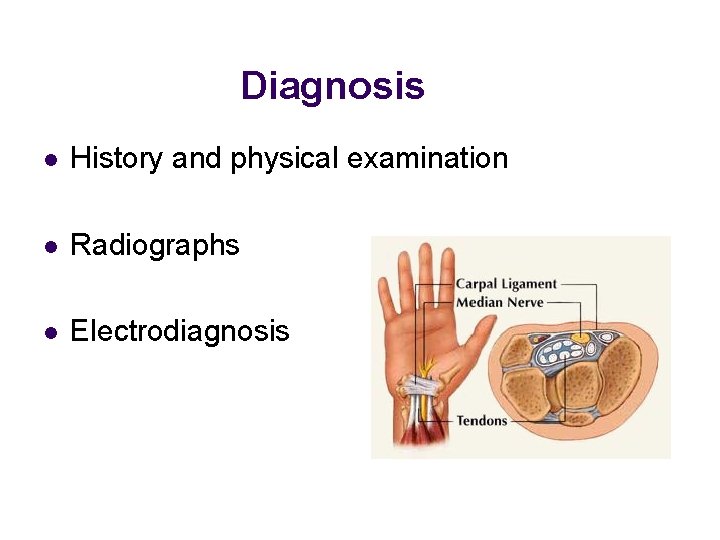
Diagnosis l History and physical examination l Radiographs l Electrodiagnosis
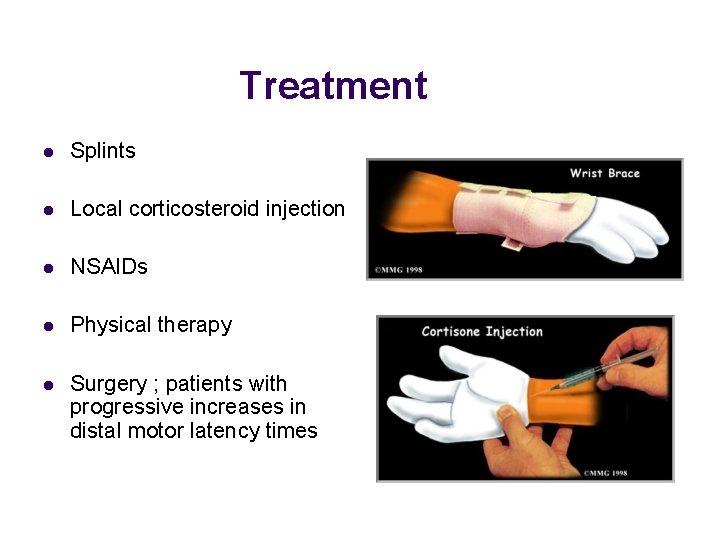
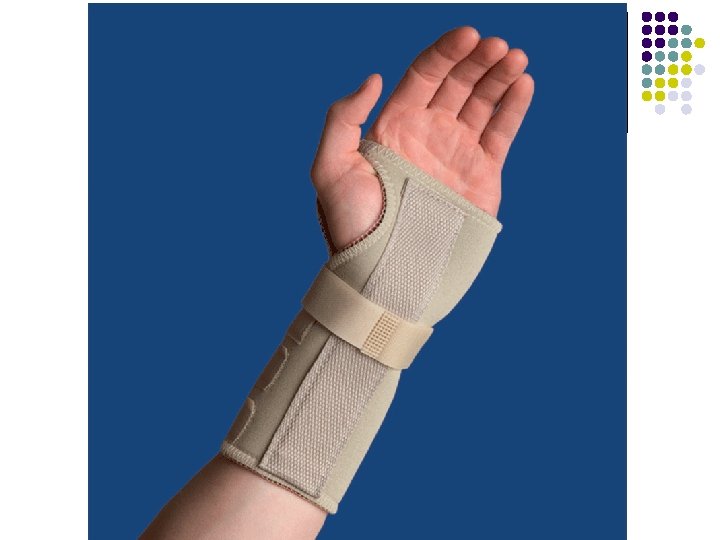
Treatment l Splints l Local corticosteroid injection l NSAIDs l Physical therapy l Surgery ; patients with progressive increases in distal motor latency times
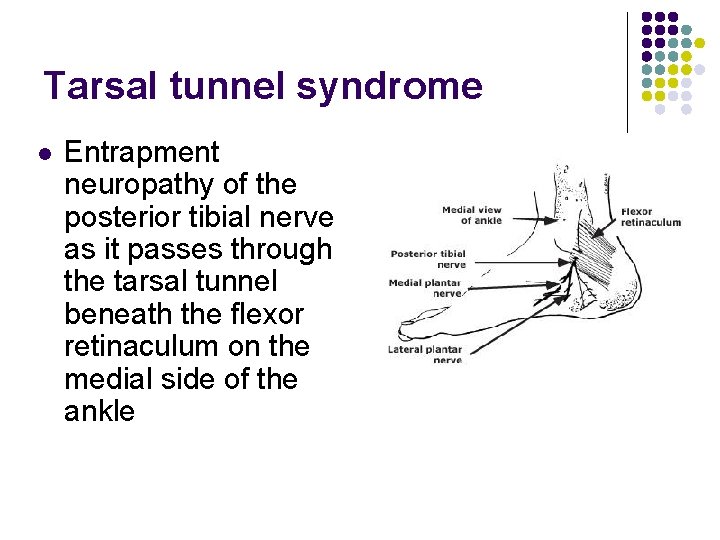
Tarsal tunnel syndrome l Entrapment neuropathy of the posterior tibial nerve as it passes through the tarsal tunnel beneath the flexor retinaculum on the medial side of the ankle
Tarsal tunnel syndrome …Etiology l Fracture or dislocation involving the talus calcaneus, or medial malleolus l Rheumatoid arthritis l Tumors l Pronation related to the loss of the plantar arch
Tarsal tunnel syndrome…. Presentation l Burning or aching foot pain usually around the plantar surface, distal foot, toes l May radiate up to the calf l Worse at night, when standing l Feels better when barefoot
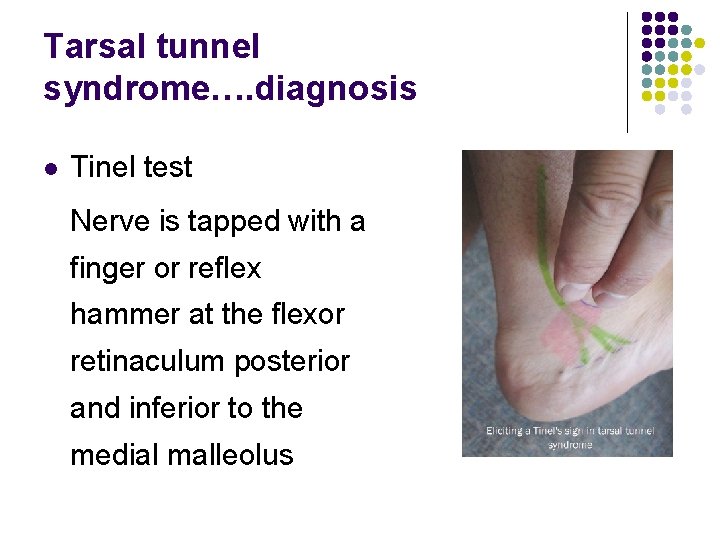
Tarsal tunnel syndrome…. diagnosis l Tinel test Nerve is tapped with a finger or reflex hammer at the flexor retinaculum posterior and inferior to the medial malleolus
Tarsal tunnel syndrome… Management l Conservative l l l NSAIDs Arch support Orthoses to correct pronation Proper shoes (1 inch heel and cushioned sole) Avoid flat slippers If symptoms persistent l l Local injections Decompression surgery