
Soft Cast Scalable Robust Mobile Video Szymon Jakubczak

+ Soft. Cast Scalable Robust Mobile Video Szymon Jakubczak and Dina Katabi
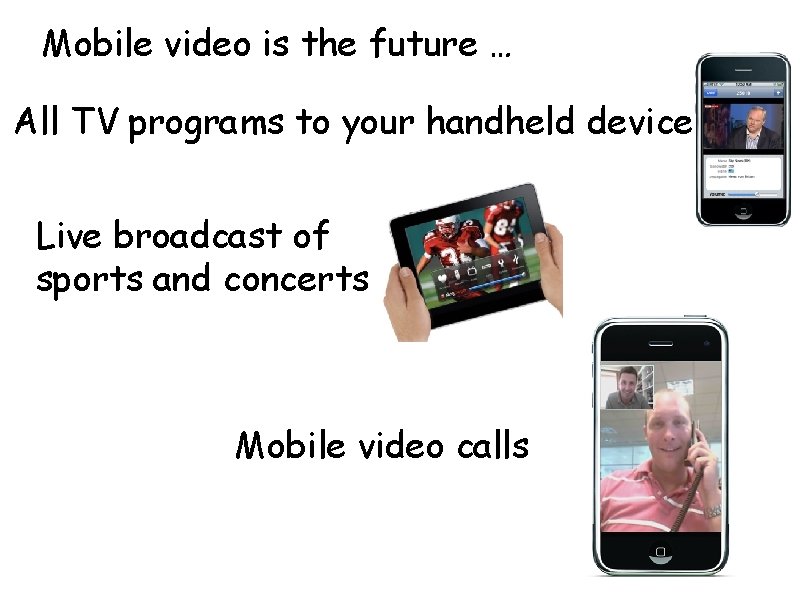
Mobile video is the future … All TV programs to your handheld device Live broadcast of sports and concerts Mobile video calls

Cisco Visual Networking Index predicts the incoming 5 years will show 66 x increase in mobile traffic mainly mobile video Can Wi. Fi, Wi. Max, or LTE deal with such growth?
Today’s Wireless Video Is Unscalable
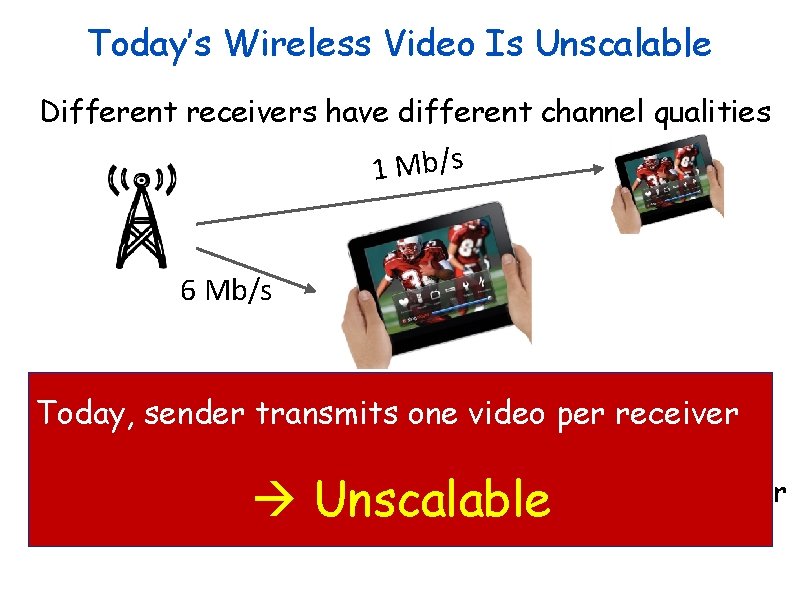
Today’s Wireless Video Is Unscalable Different receivers have different channel qualities 1 Mb/s 6 Mb/s In current wireless, sender has to pick one bitrate Today, sender transmits one video per receiver Broadcast one stream to all receiver Reduce all to the performance of worst receiver Unscalable
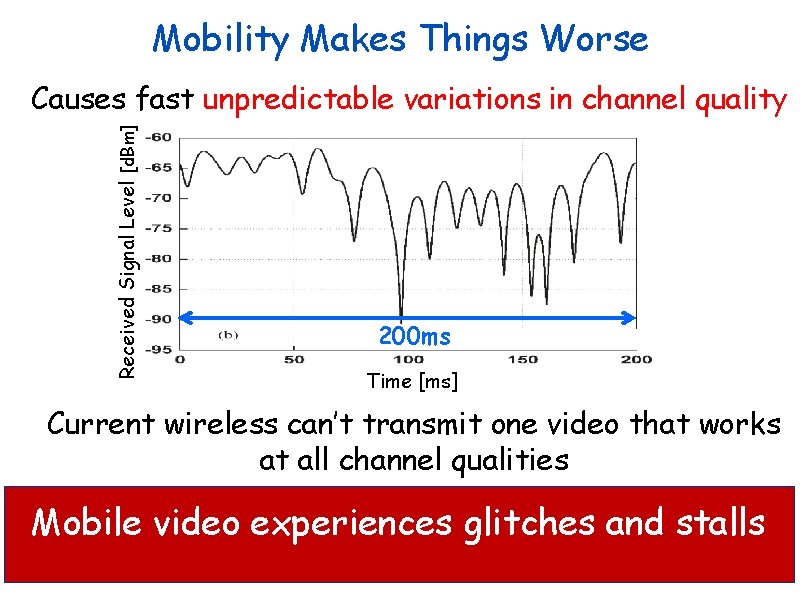
Mobility Makes Things Worse Received Signal Level [d. Bm] Causes fast unpredictable variations in channel quality 200 ms Time [ms] Current wireless can’t transmit one video that works at all channel qualities Mobile video experiences glitches and stalls
Video Quality [PSNR in d. B] Performance Cliff 50 45 40 35 MPEG 18 Mbps 30 25 20 0 5 10 15 20 Channel Quality [SNR in d. B] 25 30
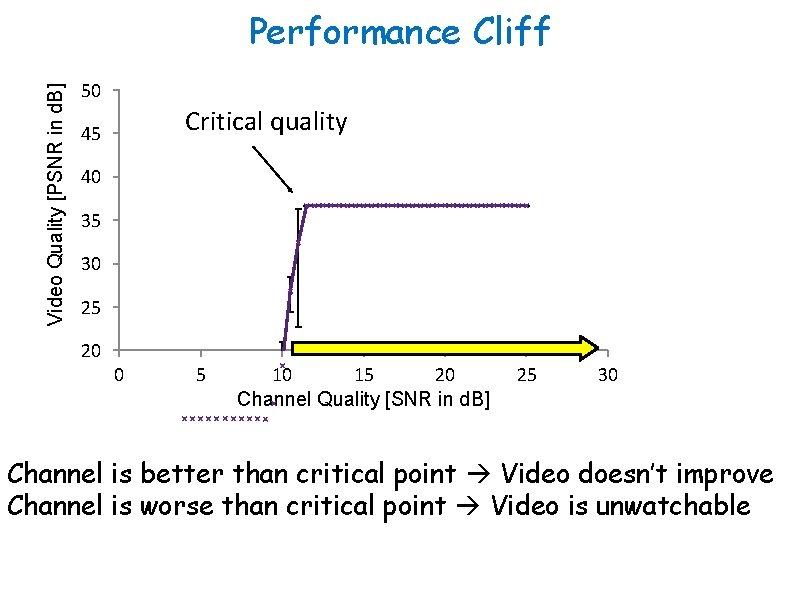
Video Quality [PSNR in d. B] Performance Cliff 50 Critical quality 45 40 35 MPEG 18 Mbps 30 25 20 0 5 10 15 20 Channel Quality [SNR in d. B] 25 30 Channel is better than critical point Video doesn’t improve Channel is worse than critical point Video is unwatchable
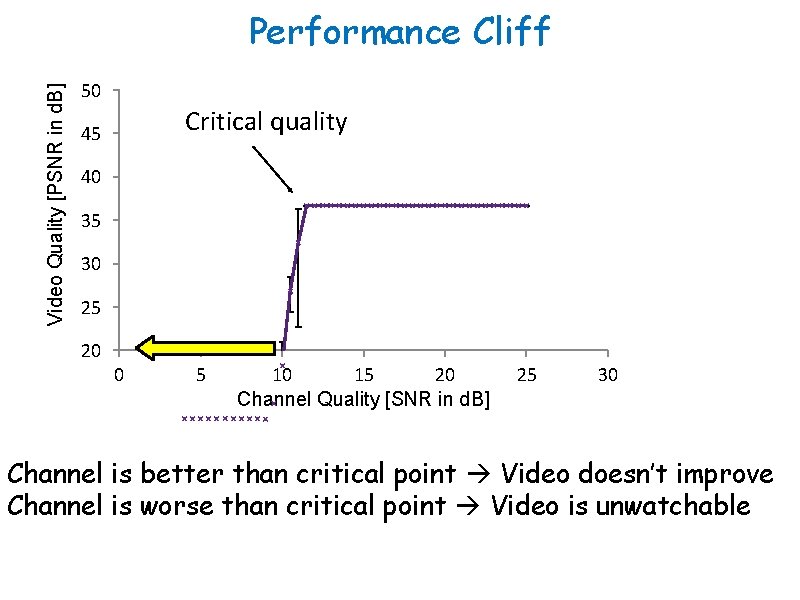
Video Quality [PSNR in d. B] Performance Cliff 50 Critical quality 45 40 35 MPEG 18 Mbps 30 25 20 0 5 10 15 20 Channel Quality [SNR in d. B] 25 30 Channel is better than critical point Video doesn’t improve Channel is worse than critical point Video is unwatchable
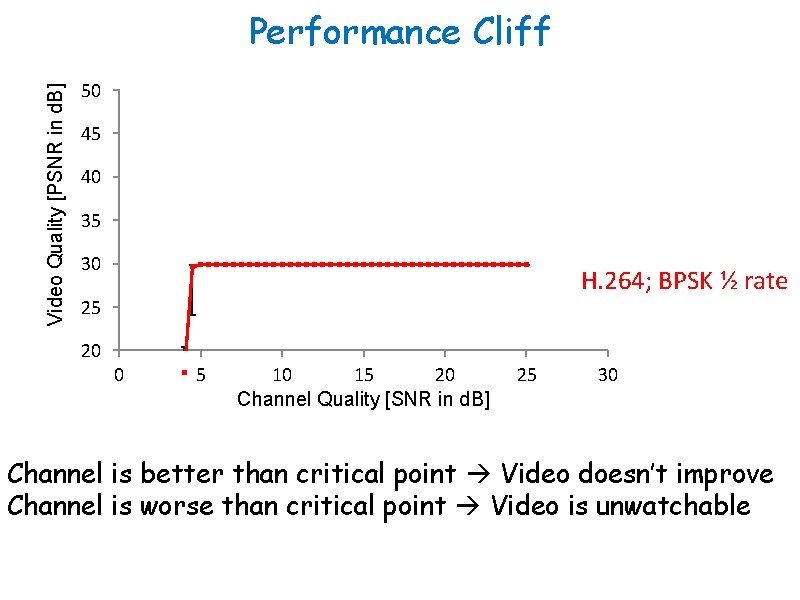
Video Quality [PSNR in d. B] Performance Cliff 50 45 40 35 MPEG 6 Mbps 30 H. 264; BPSK ½ rate 25 20 0 5 10 15 20 Channel Quality [SNR in d. B] 25 30 Channel is better than critical point Video doesn’t improve Channel is worse than critical point Video is unwatchable
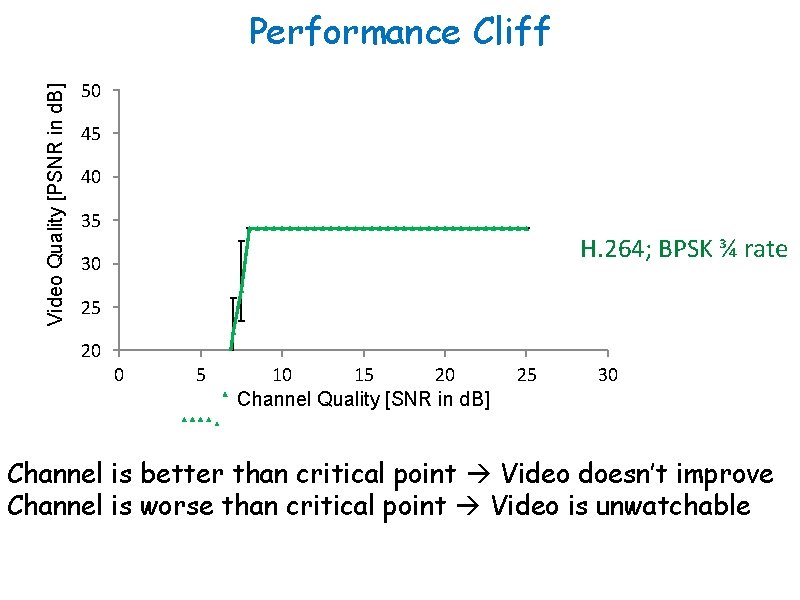
Video Quality [PSNR in d. B] Performance Cliff 50 45 40 35 MPEG 12 Mbps H. 264; BPSK ¾ rate 30 25 20 0 5 10 15 20 Channel Quality [SNR in d. B] 25 30 Channel is better than critical point Video doesn’t improve Channel is worse than critical point Video is unwatchable
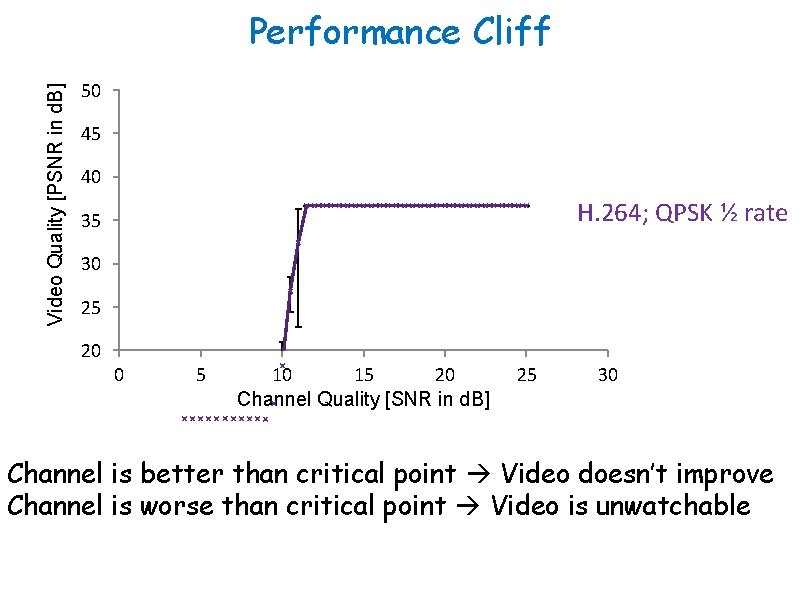
Video Quality [PSNR in d. B] Performance Cliff 50 45 40 H. 264; QPSK ½ rate MPEG 18 Mbps 35 30 25 20 0 5 10 15 20 Channel Quality [SNR in d. B] 25 30 Channel is better than critical point Video doesn’t improve Channel is worse than critical point Video is unwatchable
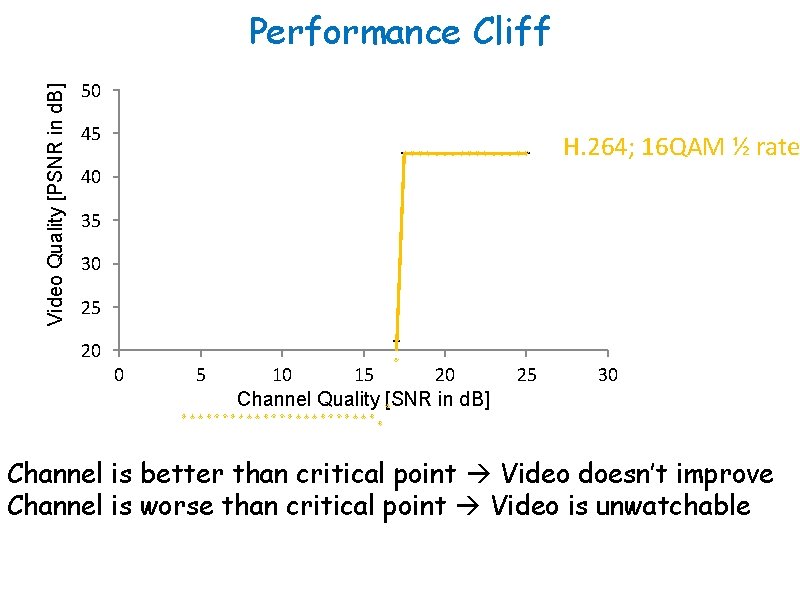
Video Quality [PSNR in d. B] Performance Cliff 50 45 H. 264; 16 QAM ½ rate 40 35 MPEG 36 Mbps 30 25 20 0 5 10 15 20 Channel Quality [SNR in d. B] 25 30 Channel is better than critical point Video doesn’t improve Channel is worse than critical point Video is unwatchable
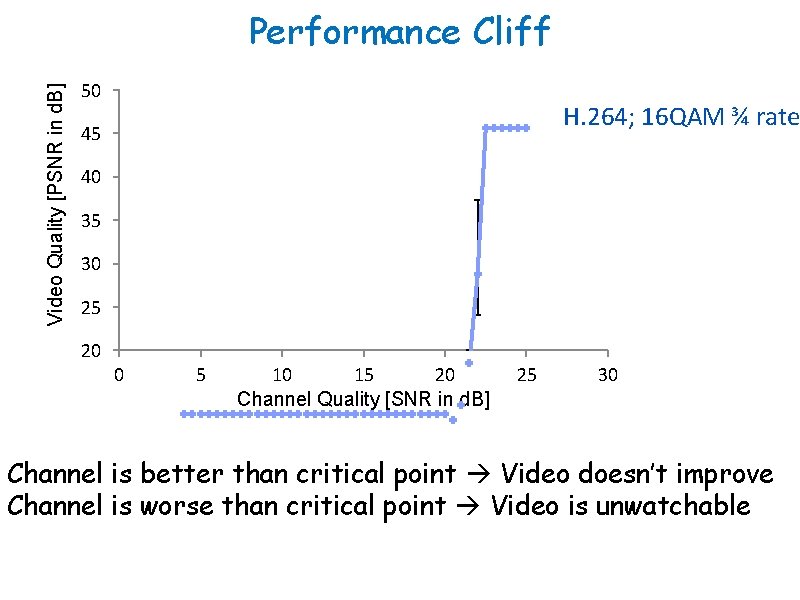
Video Quality [PSNR in d. B] Performance Cliff 50 H. 264; 16 QAM ¾ rate 45 40 35 MPEG 48 Mbps 30 25 20 0 5 10 15 20 Channel Quality [SNR in d. B] 25 30 Channel is better than critical point Video doesn’t improve Channel is worse than critical point Video is unwatchable
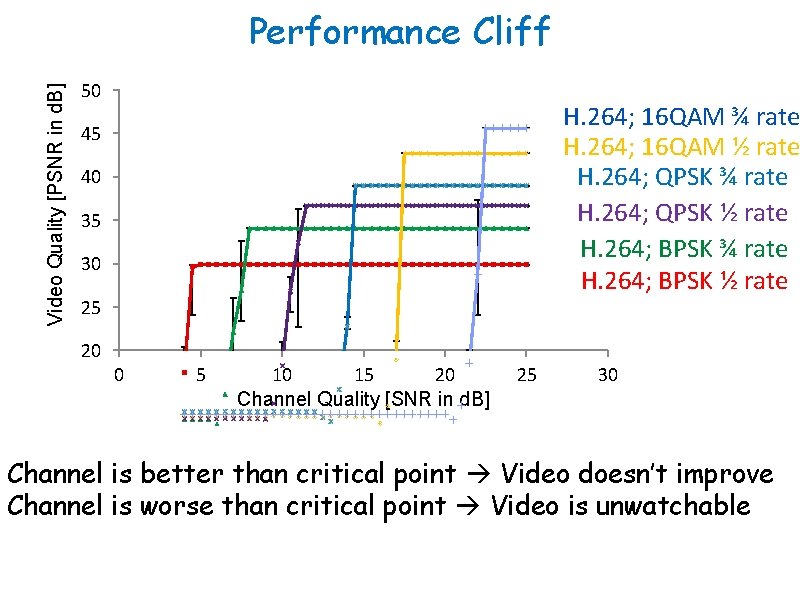
Video Quality [PSNR in d. B] Performance Cliff 50 H. 264; 16 QAM ¾ rate 6 Mbps H. 264; MPEG 16 QAM ½ rate MPEG 12 Mbps H. 264; QPSK ¾ rate MPEG 18 Mbps H. 264; QPSK ½ rate MPEG 24 Mbps H. 264; BPSK ¾ rate MPEG 36 Mbps H. 264; BPSK ½ rate 45 40 35 30 MPEG 48 Mbps 25 20 0 5 10 15 20 Channel Quality [SNR in d. B] 25 30 Channel is better than critical point Video doesn’t improve Channel is worse than critical point Video is unwatchable
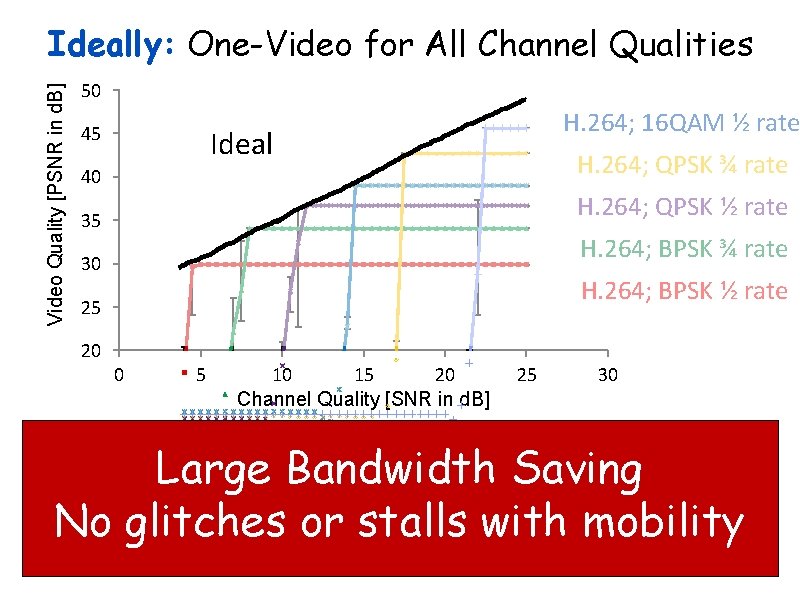
Video Quality [PSNR in d. B] Ideally: One-Video for All Channel Qualities 50 45 H. 264; MPEG 16 QAM ½ rate 6 Mbps Ideal H. 264; QPSK ¾ rate MPEG 12 Mbps 40 MPEG 18 Mbps H. 264; QPSK ½ rate 35 MPEG 24 Mbps H. 264; BPSK ¾ rate 30 MPEG 36 Mbps H. 264; BPSK ½ rate MPEG 48 Mbps 25 20 0 5 10 15 20 Channel Quality [SNR in d. B] 25 30 • Transmitter broadcasts one video Large Bandwidth Saving • Each receiver decodes a video quality No glitches with or stalls with mobility commensurate its channel quality
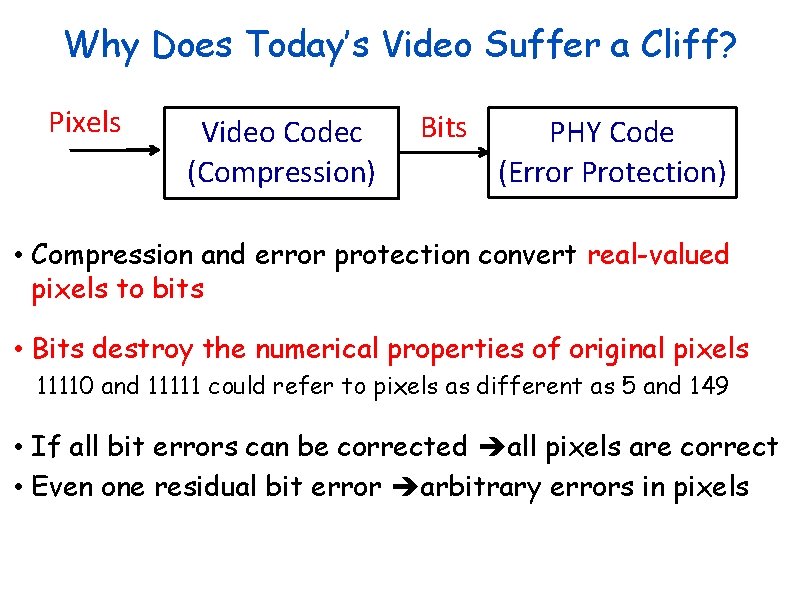
Why Does Today’s Video Suffer a Cliff? Pixels Video Codec (Compression) Bits PHY Code (Error Protection) • Compression and error protection convert real-valued pixels to bits • Bits destroy the numerical properties of original pixels 11110 and 11111 could refer to pixels as different as 5 and 149 • If all bit errors can be corrected all pixels are correct • Even one residual bit error arbitrary errors in pixels
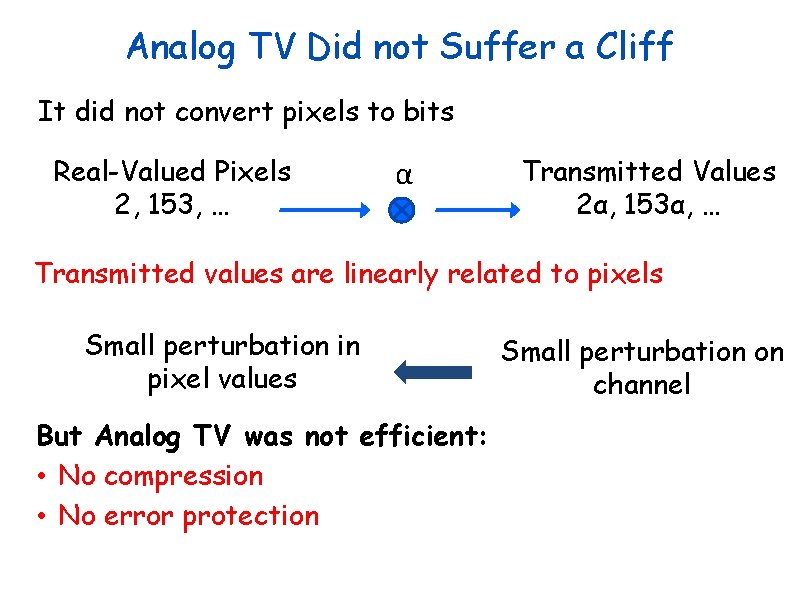
Analog TV Did not Suffer a Cliff It did not convert pixels to bits Real-Valued Pixels 2, 153, … α Transmitted Values 2α, 153α, … Transmitted values are linearly related to pixels Small perturbation in pixel values But Analog TV was not efficient: • No compression • No error protection Small perturbation on channel
+ Soft. Cast • Soft. Cast combines the best of both worlds • Is as efficient as digital video • Has no cliff effect, like analog video
+ Soft. Cast
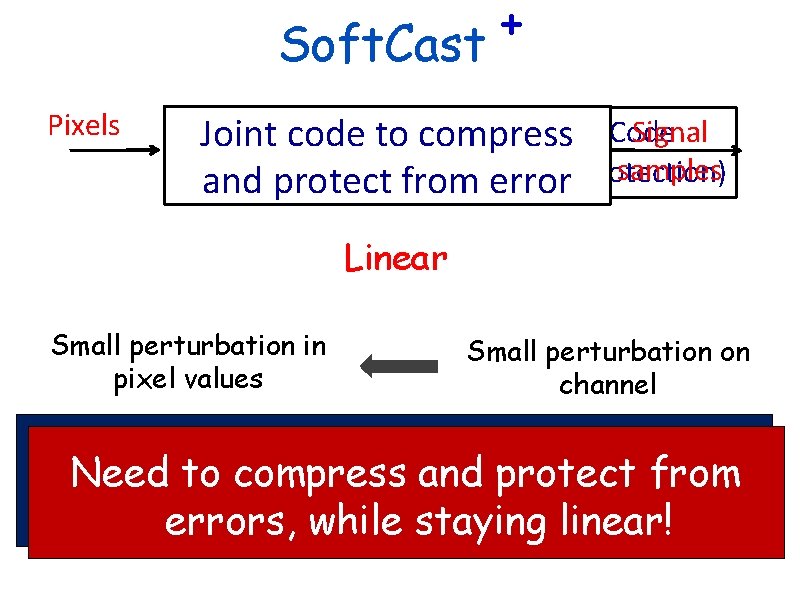
+ Soft. Cast Pixels Bits Signal PHY Code Video Codec Joint code to compress samples (Error Protection) (Compression) and protect from error Linear Small perturbation in pixel values Small perturbation on channel No Cliff Effect Need to compress and protect from errors, while staying linear!
Challenge 1 Existing compression is not linear
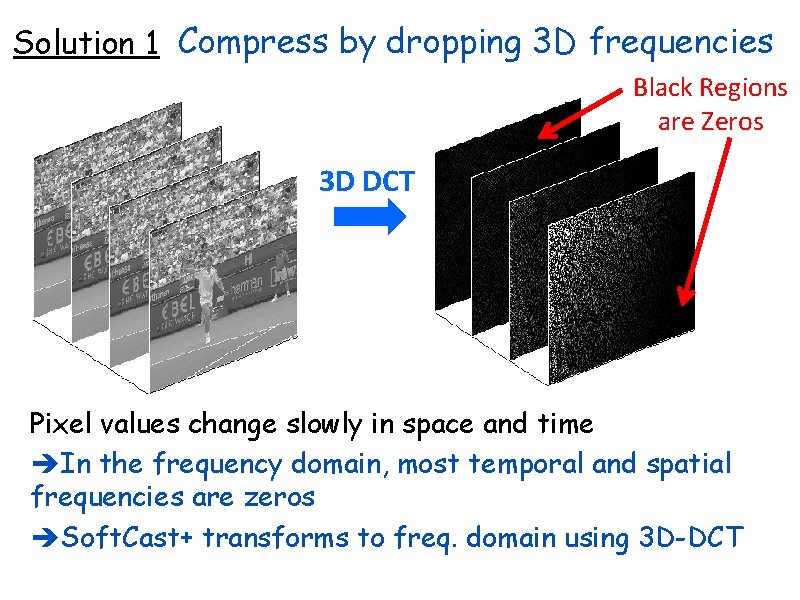
Solution 1 Compress by dropping 3 D frequencies Black Regions are Zeros 3 D DCT Pixel values change slowly in space and time In the frequency domain, most temporal and spatial frequencies are zeros Soft. Cast+ transforms to freq. domain using 3 D-DCT
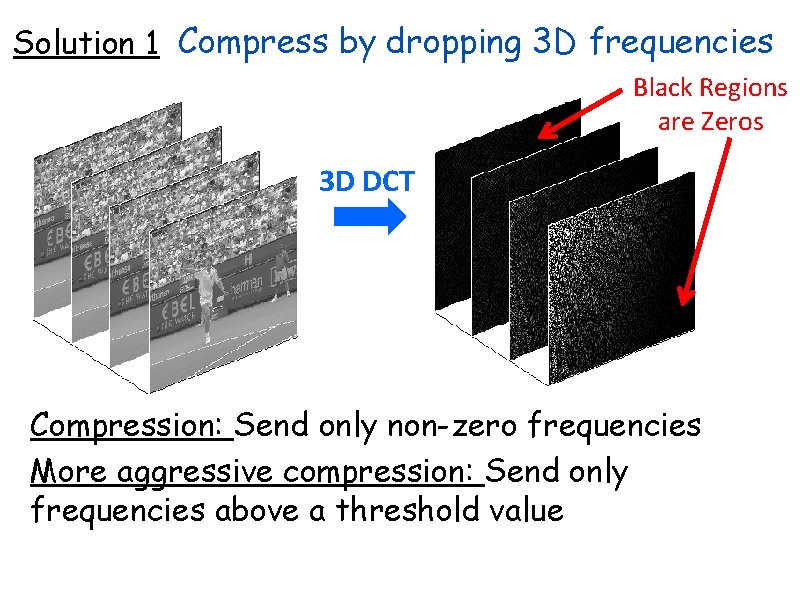
Solution 1 Compress by dropping 3 D frequencies Black Regions are Zeros 3 D DCT Compression: Send only non-zero frequencies More aggressive compression: Send only frequencies above a threshold value
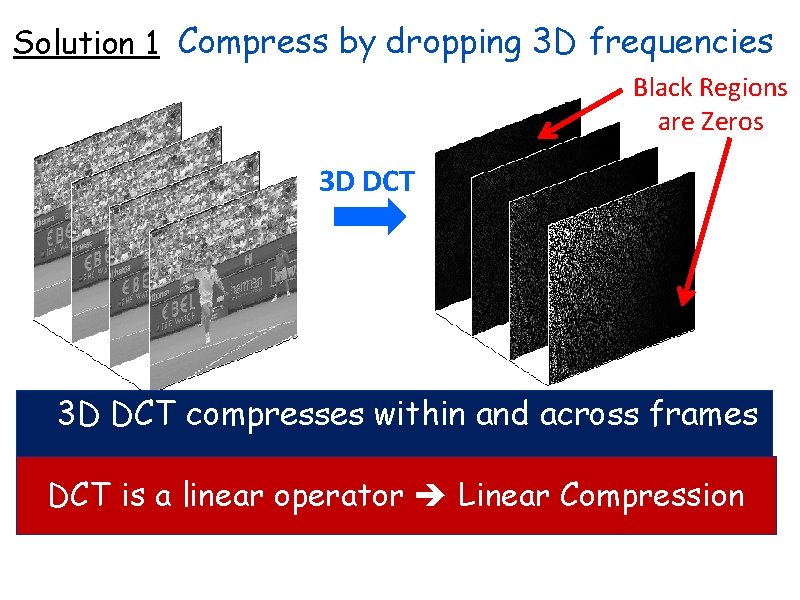
Solution 1 Compress by dropping 3 D frequencies Black Regions are Zeros 3 D DCT compresses andfrequencies across frames Compression: Send onlywithin non-zero More aggressive compression: Send only DCT is a linear operator Linear Compression frequencies above a threshold value
Challenge 2 Existing error protection codes operate on bits not reals
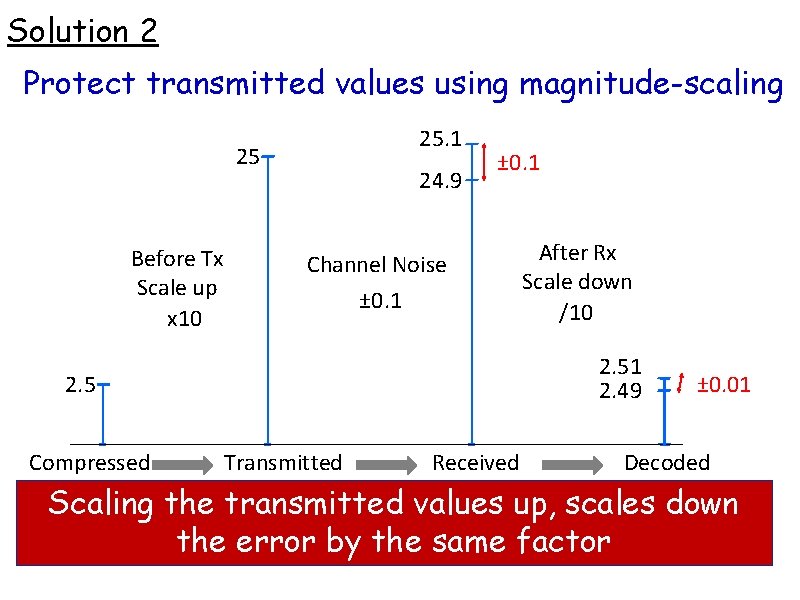
Solution 2 Protect transmitted values using magnitude-scaling 25. 1 25 Before Tx Scale up x 10 24. 9 ± 0. 1 Channel Noise ± 0. 1 2. 51 2. 49 2. 5 Compressed value After Rx Scale down /10 Transmitted Received ± 0. 01 Decoded Scaling the transmitted values up, scales down the error by the same factor
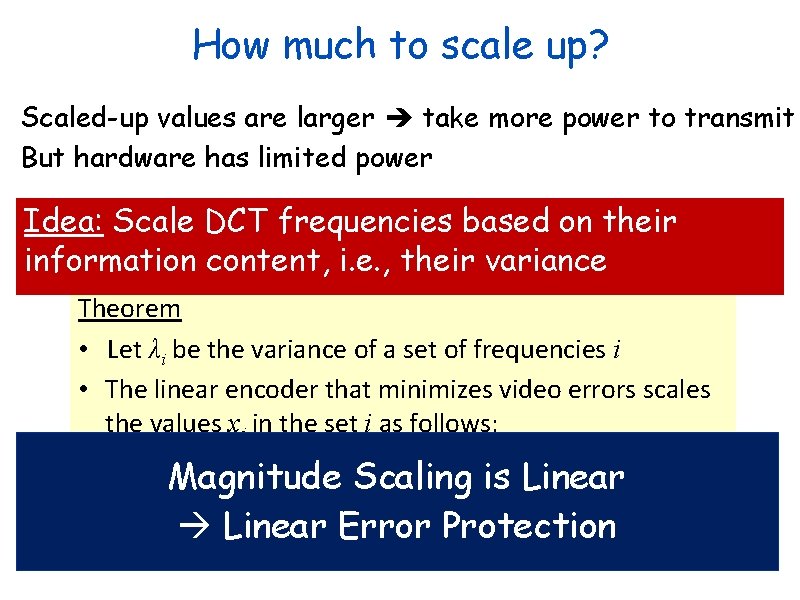
How much to scale up? Scaled-up values are larger take more power to transmit But hardware has limited power Formulate it as. DCT an optimization that findson thetheir scaling Idea: Scale frequencies based factors that minimize received video errors information content, i. e. , their variance Theorem • Let λi be the variance of a set of frequencies i • The linear encoder that minimizes video errors scales the values xi in the set i as follows: -1/4 y. Magnitude = g x where g ~ λ Scaling is Linear i i i Linear Error Protection
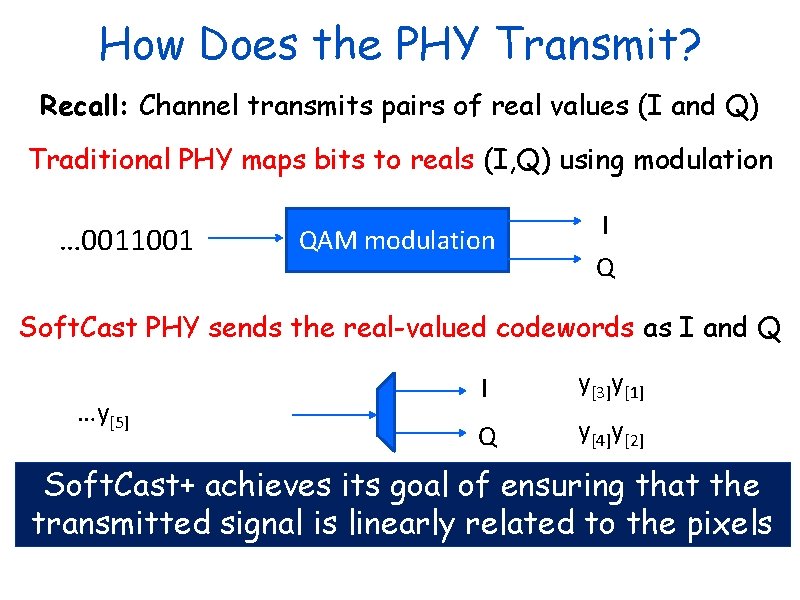
How Does the PHY Transmit? Recall: Channel transmits pairs of real values (I and Q) Traditional PHY maps bits to reals (I, Q) using modulation … 0011001 QAM modulation I Q Soft. Cast PHY sends the real-valued codewords as I and Q …y[5]y[4]y[3]y[2]y[1] I y[3]y[1] Q y[4]y[2] Soft. Cast+ achieves its goal of ensuring that the transmitted signal is linearly related to the pixels
Performance
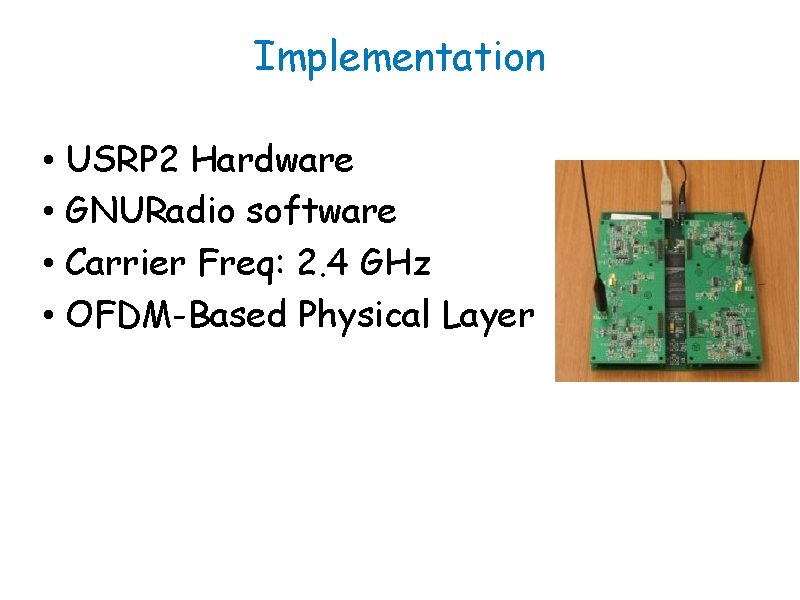
Implementation • USRP 2 Hardware • GNURadio software • Carrier Freq: 2. 4 GHz • OFDM-Based Physical Layer
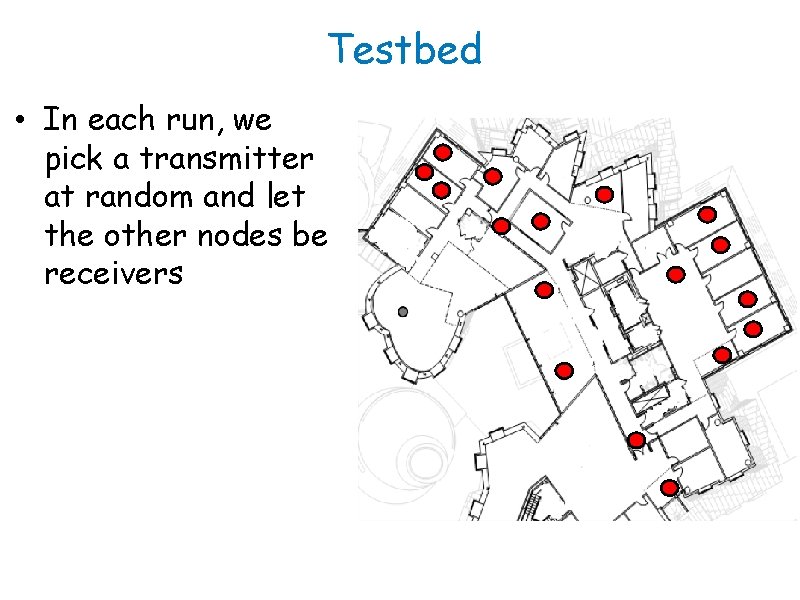
Testbed • In each run, we pick a transmitter at random and let the other nodes be receivers
Compared Schemes + • Soft. Cast • H. 264/MPEG 4 over 802. 11 -like OFDM physical layer • Layered video (i. e. , SCV) over Hierarchical Modulation
Video Quality [PSNR in d. B] Video Quality as Function of Channel Quality 50 45 40 35 30 25 20 0 5 10 15 20 Channel Quality [SNR in d. B] 25 30
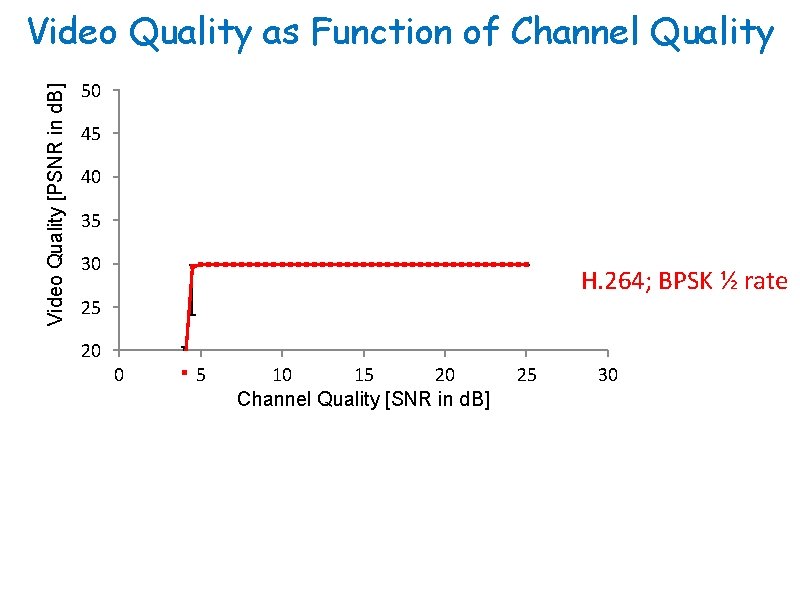
Video Quality [PSNR in d. B] Video Quality as Function of Channel Quality 50 45 40 35 MPEG 6 Mbps 30 H. 264; BPSK ½ rate 25 20 0 5 10 15 20 Channel Quality [SNR in d. B] 25 30
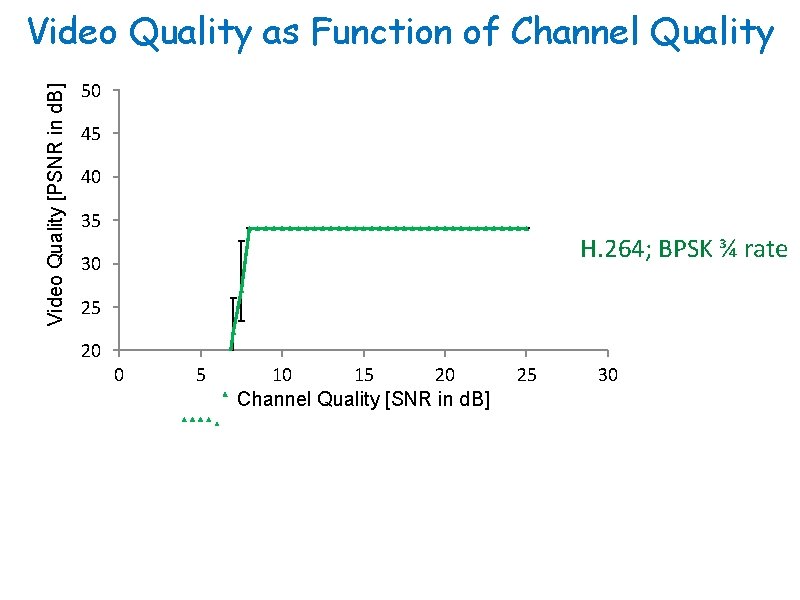
Video Quality [PSNR in d. B] Video Quality as Function of Channel Quality 50 45 40 35 MPEG 12 Mbps H. 264; BPSK ¾ rate 30 25 20 0 5 10 15 20 Channel Quality [SNR in d. B] 25 30
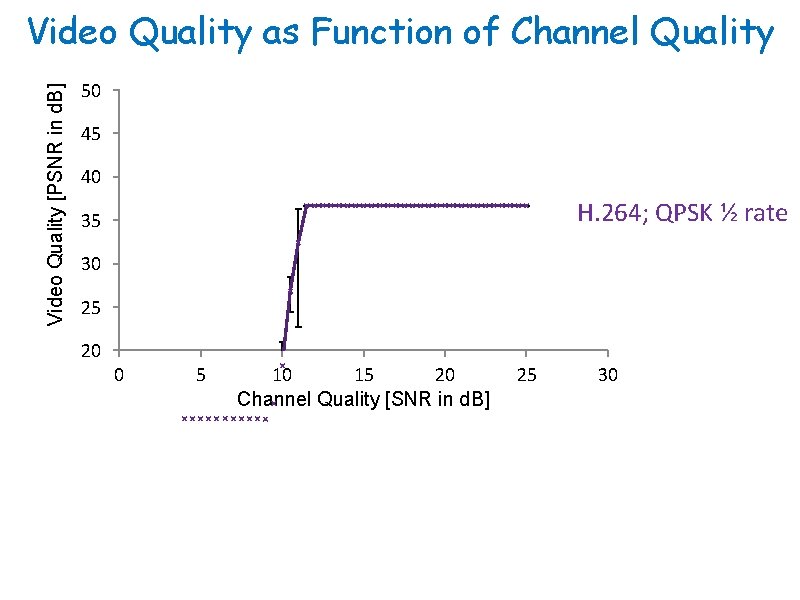
Video Quality [PSNR in d. B] Video Quality as Function of Channel Quality 50 45 40 H. 264; QPSK ½ rate MPEG 18 Mbps 35 30 25 20 0 5 10 15 20 Channel Quality [SNR in d. B] 25 30
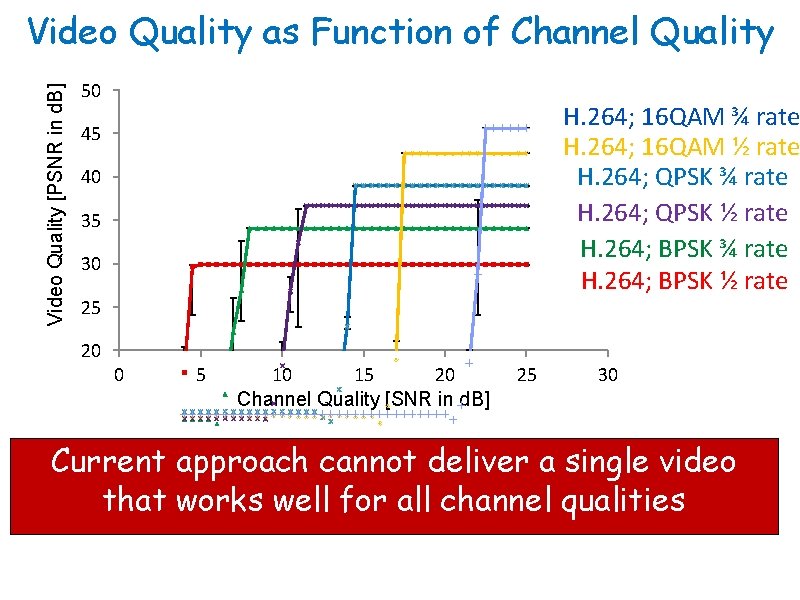
Video Quality [PSNR in d. B] Video Quality as Function of Channel Quality 50 H. 264; 16 QAM ¾ rate 6 Mbps H. 264; MPEG 16 QAM ½ rate MPEG 12 Mbps H. 264; QPSK ¾ rate MPEG 18 Mbps H. 264; QPSK ½ rate MPEG 24 Mbps H. 264; BPSK ¾ rate MPEG 36 Mbps H. 264; BPSK ½ rate 45 40 35 30 MPEG 48 Mbps 25 20 0 5 10 15 20 Channel Quality [SNR in d. B] 25 30 Current approach cannot deliver a single video that works well for all channel qualities
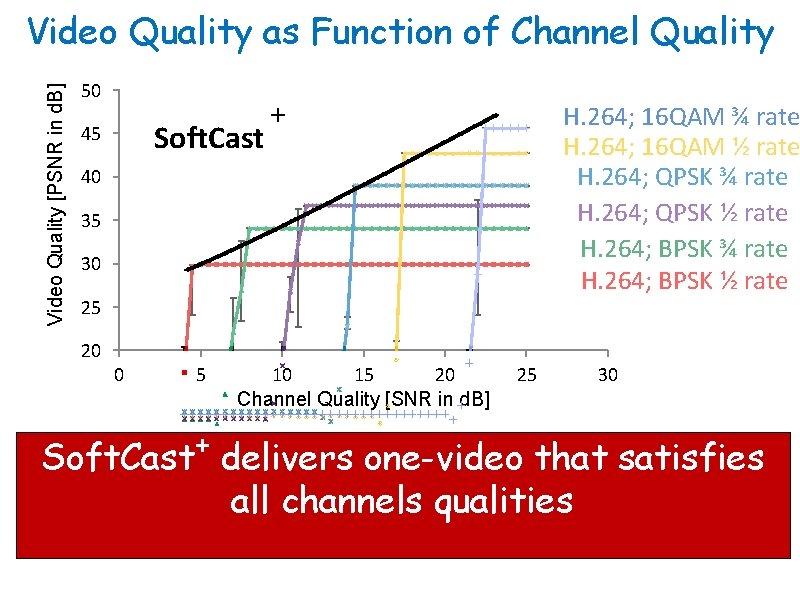
Video Quality [PSNR in d. B] Video Quality as Function of Channel Quality 50 Soft. Cast 45 + H. 264; 16 QAM ¾ rate 6 Mbps H. 264; MPEG 16 QAM ½ rate MPEG 12 Mbps H. 264; QPSK ¾ rate MPEG 18 Mbps H. 264; QPSK ½ rate MPEG 24 Mbps H. 264; BPSK ¾ rate MPEG 36 Mbps H. 264; BPSK ½ rate 40 35 30 MPEG 48 Mbps 25 20 0 5 10 15 20 Channel Quality [SNR in d. B] 25 30 + Soft. Cast delivers one-video that satisfies all channels qualities
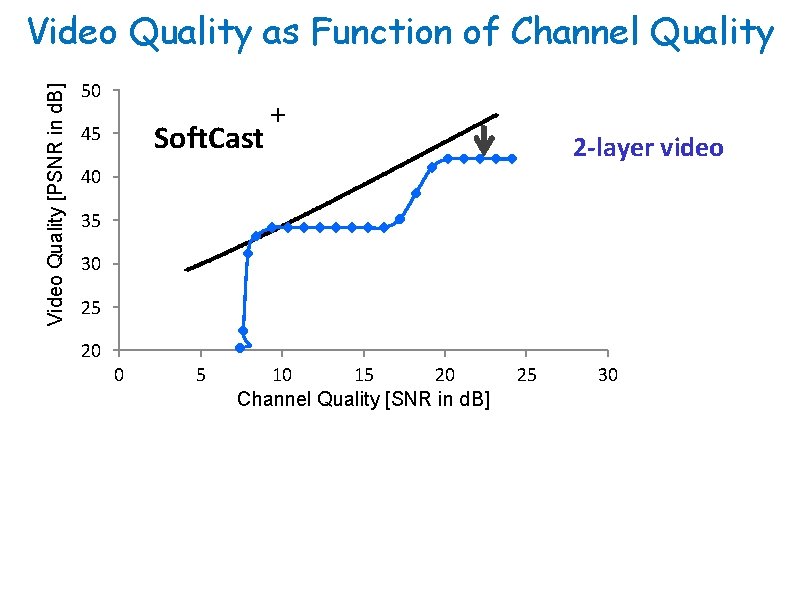
Video Quality [PSNR in d. B] Video Quality as Function of Channel Quality 50 Soft. Cast 45 + 2 -layer video 40 35 30 25 20 0 5 10 15 20 Channel Quality [SNR in d. B] 25 30
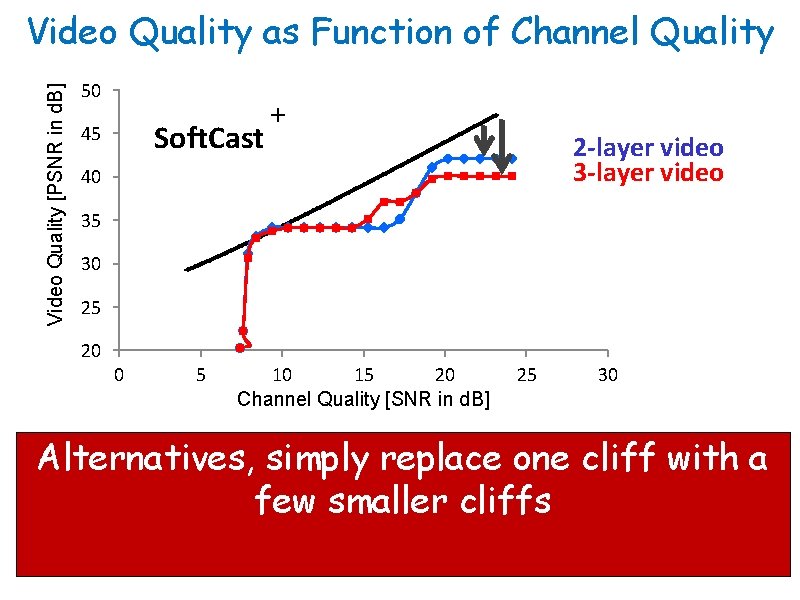
Video Quality [PSNR in d. B] Video Quality as Function of Channel Quality 50 Soft. Cast 45 + 2 -layer video 3 -layer video 40 35 30 25 20 0 5 10 15 20 Channel Quality [SNR in d. B] 25 30 Alternatives, simply replace one cliff with a few smaller cliffs
Mobility Demo + Soft. Cast is beneficial even with a single mobile receiver http: //people. csail. mit. edu/szym/softcast/single. swf? config=data/te nnis. xml&chart=0
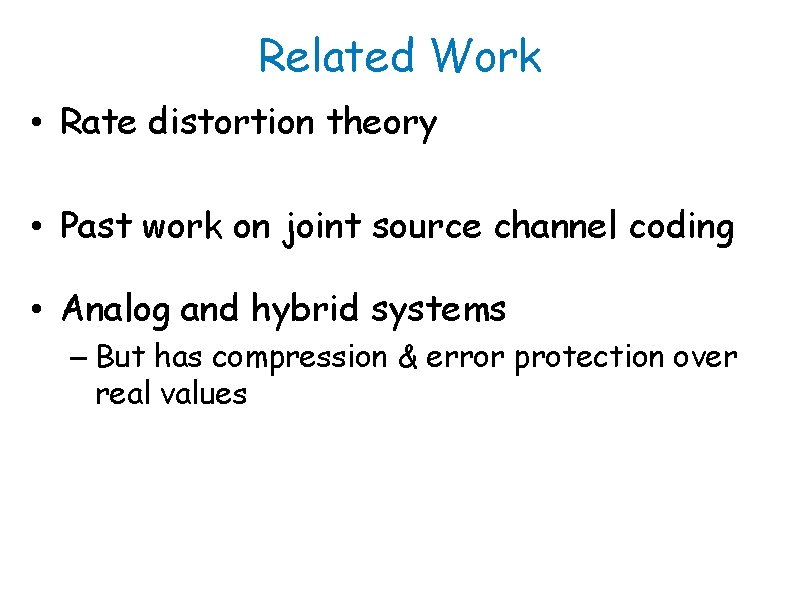
Related Work • Rate distortion theory • Past work on joint source channel coding • Analog and hybrid systems – But has compression & error protection over real values
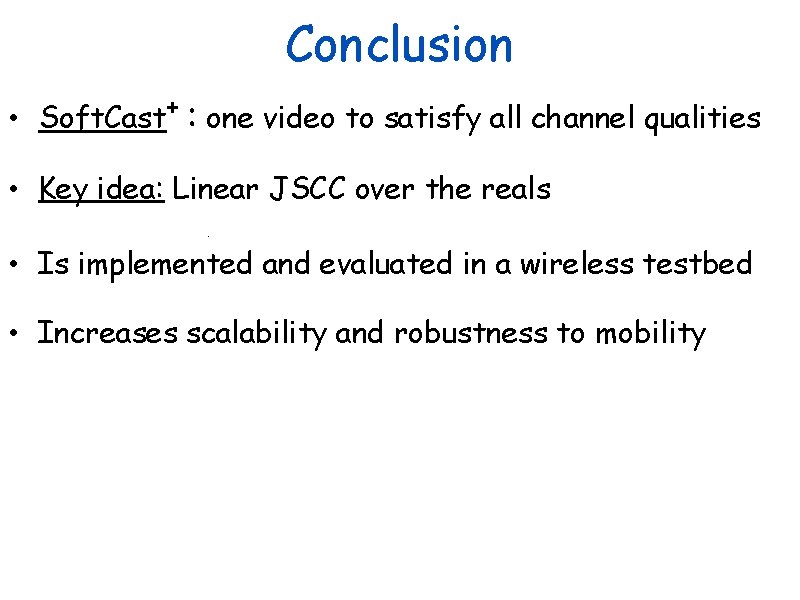
Conclusion • Soft. Cast+ : one video to satisfy all channel qualities • Key idea: Linear JSCC over the reals • • Is implemented and evaluated in a wireless testbed • Increases scalability and robustness to mobility
- Slides: 44