
SOES 3015 Modelling Practical The GENIE Climate Simulator
- Slides: 9
SOES 3015 Modelling Practical The GENIE Climate Simulator: Introduction, Getting Started & CO 2 Expts Bob Marsh National Oceanography Centre University of Southampton
Ø The GENIE model has been recently adapted for teaching by colleagues at the Open University Ø With appropriate setup (see practical notes) The application runs under Windows Ø Read this introductory talk before commencing on the practicals Ø Work may be carried out individually or in pairs, running GENIE in a small range of CO 2 experiments Ø The practical is designed to give you some direct experience of: • • • what an EMIC looks like how fast it runs the kind of data that is produced
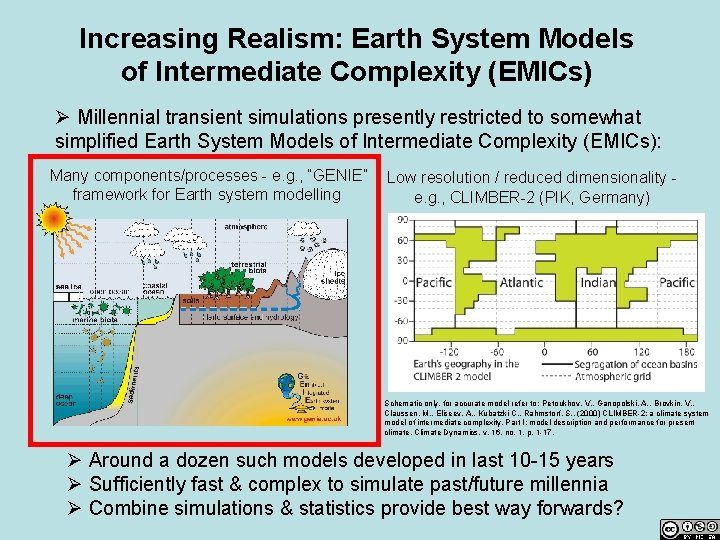
Increasing Realism: Earth System Models of Intermediate Complexity (EMICs) Ø Millennial transient simulations presently restricted to somewhat simplified Earth System Models of Intermediate Complexity (EMICs): Many components/processes - e. g. , “GENIE” Low resolution / reduced dimensionality - framework for Earth system modelling e. g. , CLIMBER-2 (PIK, Germany) Schematic only, for accurate model refer to: Petoukhov, V. , Ganopolski, A. , Brovkin, V. , Claussen, M. , Eliseev, A. , Kubatzki C. , Rahmstorf, S. , (2000) CLIMBER-2: a climate system model of intermediate complexity. Part I: model description and performance for present climate. Climate Dynamics, v. 16, no. 1, p. 1 -17. Ø Around a dozen such models developed in last 10 -15 years Ø Sufficiently fast & complex to simulate past/future millennia Ø Combine simulations & statistics provide best way forwards?
Five Stages (approximate times - depends on machine speed): Ø Getting Started (2. 30 -2. 40) Ø Ø Initial State (2. 40 -2. 50) Idealized CO 2 forcing (2. 50 -3. 00) Anthropogenic CO 2 forcing (3. 00 -3. 30) Climate Sensitivity Experiments (3. 30 -5. 00) • Proceed stage by stage • Be patient! • While waiting for longer expts to complete, look at data you have already produced • Organize yourselves to tackle stage 5 • Health Warning: First time this practical has been tried (second time GENIE used in Uo. S teaching - previously went OK!)
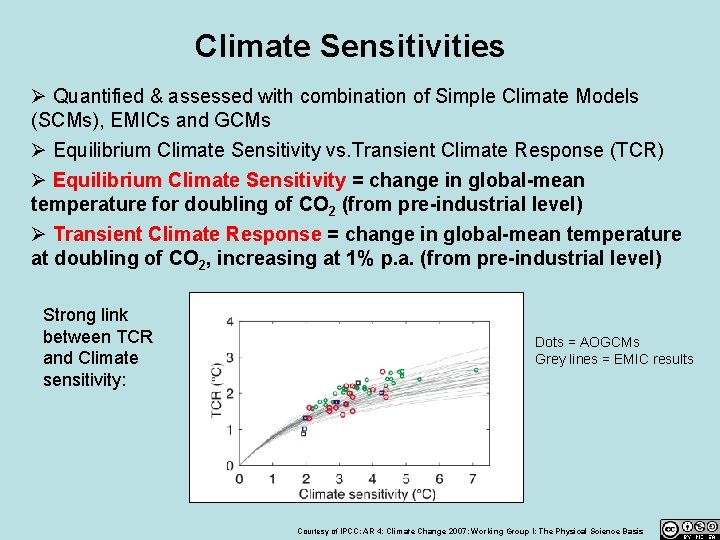
Climate Sensitivities Ø Quantified & assessed with combination of Simple Climate Models (SCMs), EMICs and GCMs Ø Equilibrium Climate Sensitivity vs. Transient Climate Response (TCR) Ø Equilibrium Climate Sensitivity = change in global-mean temperature for doubling of CO 2 (from pre-industrial level) Ø Transient Climate Response = change in global-mean temperature at doubling of CO 2, increasing at 1% p. a. (from pre-industrial level) Strong link between TCR and Climate sensitivity: Dots = AOGCMs Grey lines = EMIC results Courtesy of IPCC: AR 4: Climate Change 2007: Working Group I: The Physical Science Basis
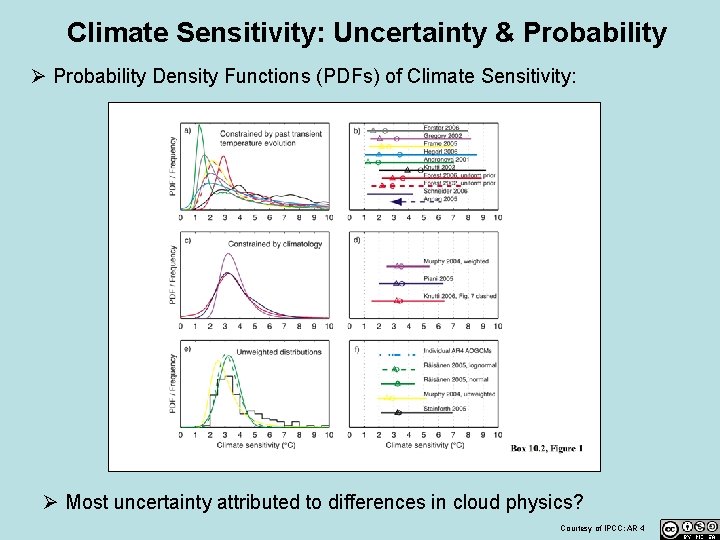
Climate Sensitivity: Uncertainty & Probability Ø Probability Density Functions (PDFs) of Climate Sensitivity: Ø Most uncertainty attributed to differences in cloud physics? Courtesy of IPCC: AR 4
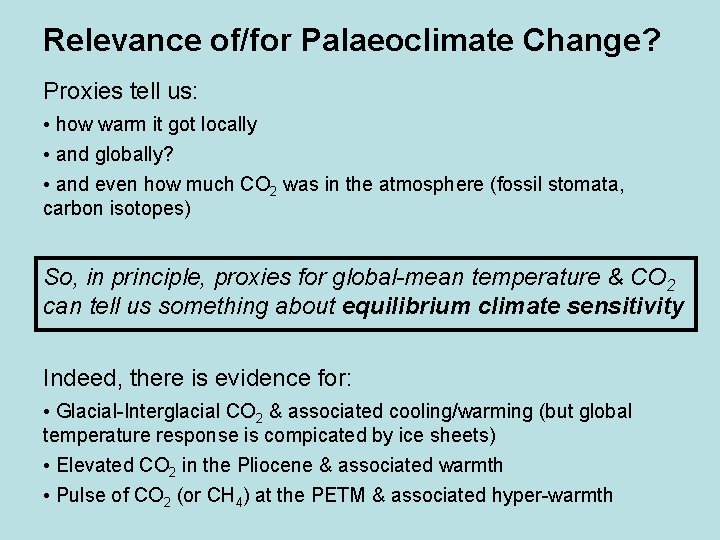
Relevance of/for Palaeoclimate Change? Proxies tell us: • how warm it got locally • and globally? • and even how much CO 2 was in the atmosphere (fossil stomata, carbon isotopes) So, in principle, proxies for global-mean temperature & CO 2 can tell us something about equilibrium climate sensitivity Indeed, there is evidence for: • Glacial-Interglacial CO 2 & associated cooling/warming (but global temperature response is compicated by ice sheets) • Elevated CO 2 in the Pliocene & associated warmth • Pulse of CO 2 (or CH 4) at the PETM & associated hyper-warmth
Why we need Models? Earth system models, incorporating synthetic proxies, provide a means of interpreting measured proxies, and testing the extent to which different processes (e. g. , climate sensitivity) can be inferred from multi-proxy datasets
Copyright statement • This resource was created by the University of Southampton and released as an open educational resource through the 'C-change in GEES' project exploring the open licensing of climate change and sustainability resources in the Geography, Earth and Environmental Sciences. The C-change in GEES project was funded by HEFCE as part of the JISC/HE Academy UKOER programme and coordinated by the GEES Subject Centre. • This resource is licensed under the terms of the Attribution-Non-Commercial. Share Alike 2. 0 UK: England & Wales license (http: //creativecommons. org/licenses/by-nc-sa/2. 0/uk/). • However the resource, where specified below, contains other 3 rd party materials under their own licenses. The licenses and attributions are outlined below: • The University of Southampton and the National Oceanography Centre, Southampton and its logos are registered trade marks of the University. The University reserves all rights to these items beyond their inclusion in these CC resources. • The JISC logo, the C-change logo and the logo of the Higher Education Academy Subject Centre for the Geography, Earth and Environmental Sciences are licensed under the terms of the Creative Commons Attribution -non-commercial-No Derivative Works 2. 0 UK England & Wales license. All reproductions must comply with the terms of that license.