
Sodium hydroxide Preferred IUPAC name Sodium hydroxide Systematic
- Slides: 6
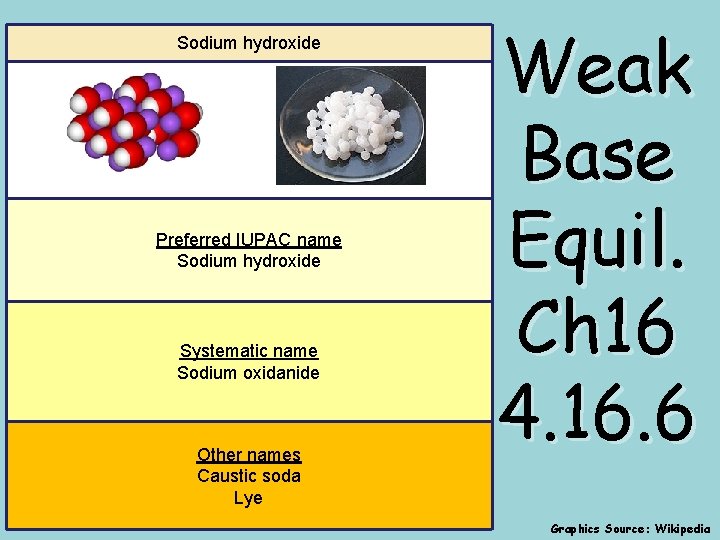
Sodium hydroxide Preferred IUPAC name Sodium hydroxide Systematic name Sodium oxidanide Other names Caustic soda Lye Weak Base Equil. Ch 16 4. 16. 6 Graphics Source: Wikipedia
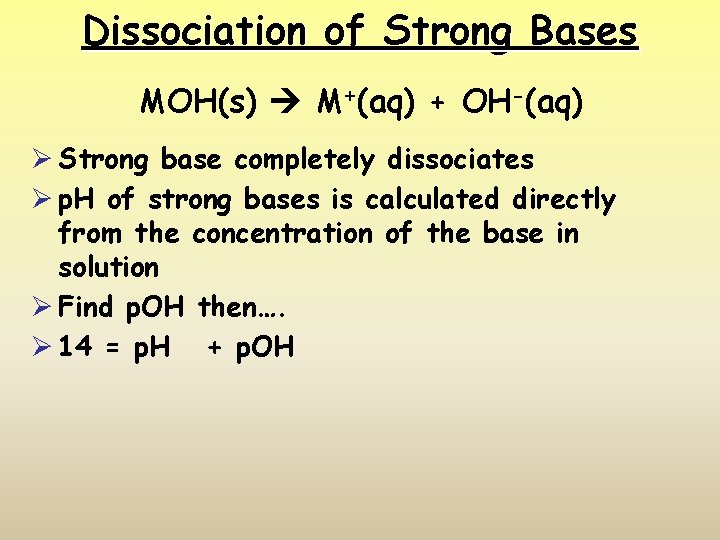
Dissociation of Strong Bases MOH(s) M+(aq) + OH-(aq) Ø Strong base completely dissociates Ø p. H of strong bases is calculated directly from the concentration of the base in solution Ø Find p. OH then…. Ø 14 = p. H + p. OH
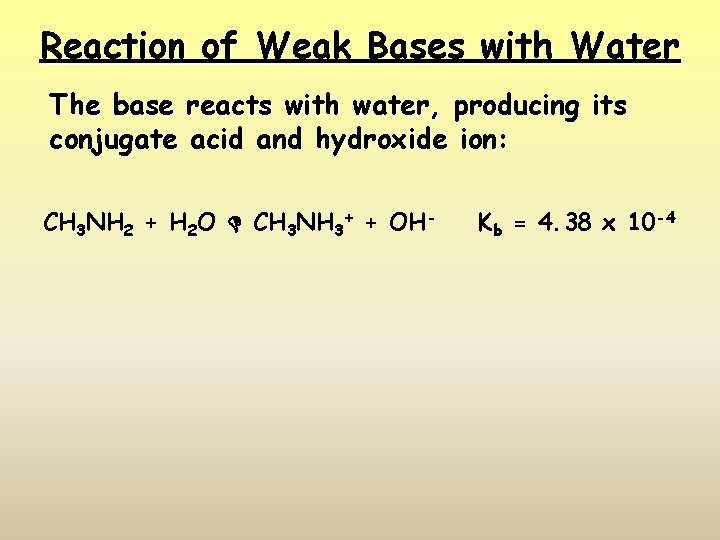
Reaction of Weak Bases with Water The base reacts with water, producing its conjugate acid and hydroxide ion: CH 3 NH 2 + H 2 O CH 3 NH 3+ + OH- Kb = 4. 38 x 10 -4
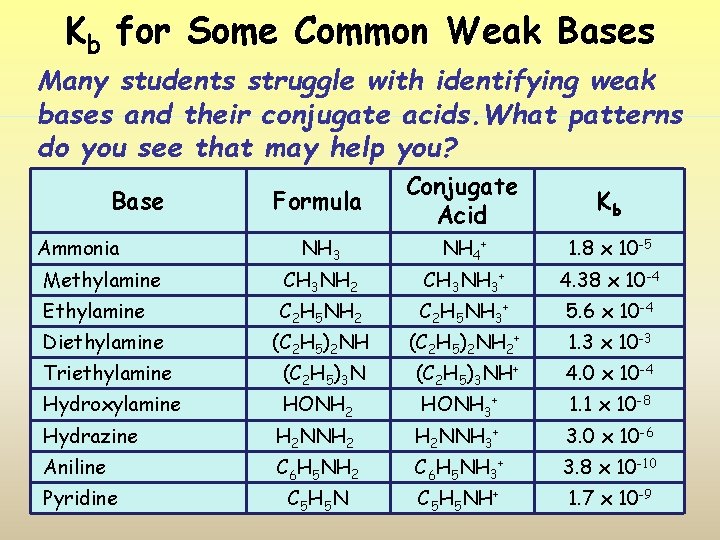
Kb for Some Common Weak Bases Many students struggle with identifying weak bases and their conjugate acids. What patterns do you see that may help you? Formula Conjugate Acid Kb NH 3 NH 4+ 1. 8 x 10 -5 Methylamine CH 3 NH 2 CH 3 NH 3+ 4. 38 x 10 -4 Ethylamine C 2 H 5 NH 2 C 2 H 5 NH 3+ 5. 6 x 10 -4 Diethylamine (C 2 H 5)2 NH 2+ 1. 3 x 10 -3 Triethylamine (C 2 H 5)3 NH+ 4. 0 x 10 -4 Hydroxylamine HONH 2 HONH 3+ 1. 1 x 10 -8 Base Ammonia Hydrazine H 2 NNH 2 H 2 NNH 3+ 3. 0 x 10 -6 Aniline C 6 H 5 NH 2 C 6 H 5 NH 3+ 3. 8 x 10 -10 Pyridine C 5 H 5 NH+ 1. 7 x 10 -9
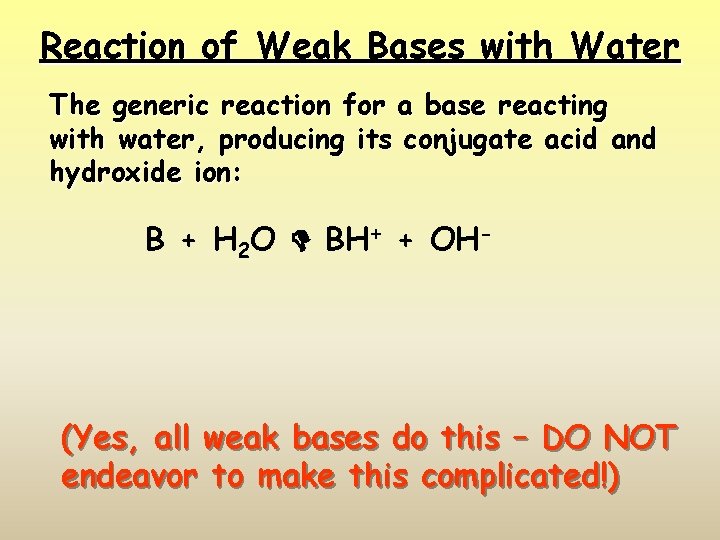
Reaction of Weak Bases with Water The generic reaction for a base reacting with water, producing its conjugate acid and hydroxide ion: B + H 2 O BH+ + OH- (Yes, all weak bases do this – DO NOT endeavor to make this complicated!)
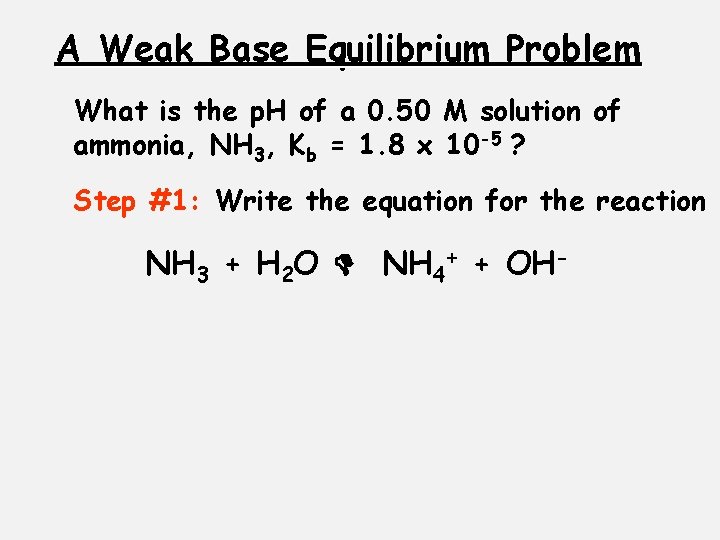
A Weak Base Equilibrium Problem What is the p. H of a 0. 50 M solution of ammonia, NH 3, Kb = 1. 8 x 10 -5 ? Step #1: Write the equation for the reaction NH 3 + H 2 O NH 4+ + OH-