
Socket Programming 15 441 Computer Networks Spring 2010




- Slides: 35
Socket Programming 15 -441 Computer Networks, Spring 2010 Your TAs
Lecture Today • • • Motivation for sockets What’s in a socket? Working with socket Concurrent network applications Project 1
Why Socket? • – – – How can I program a network application? Share data Send messages Finish course projects. . . • IPC - Interprocess Communication
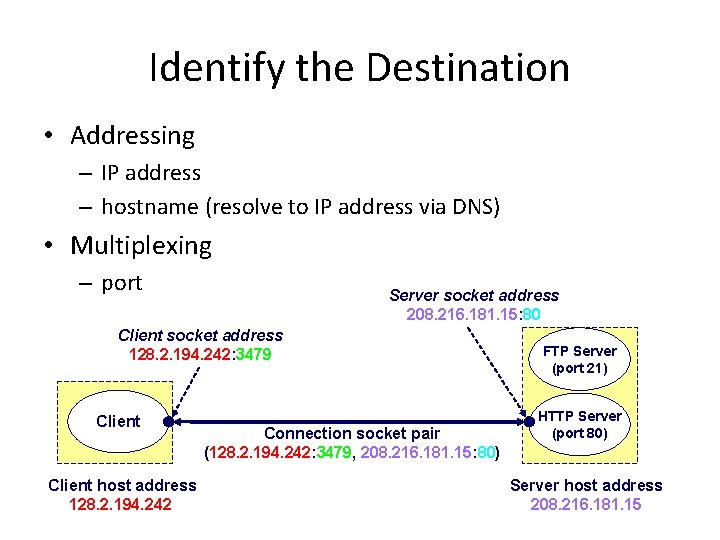
Identify the Destination • Addressing – IP address – hostname (resolve to IP address via DNS) • Multiplexing – port Server socket address 208. 216. 181. 15: 80 Client socket address 128. 2. 194. 242: 3479 Client host address 128. 2. 194. 242 Connection socket pair (128. 2. 194. 242: 3479, 208. 216. 181. 15: 80) FTP Server (port 21) HTTP Server (port 80) Server host address 208. 216. 181. 15
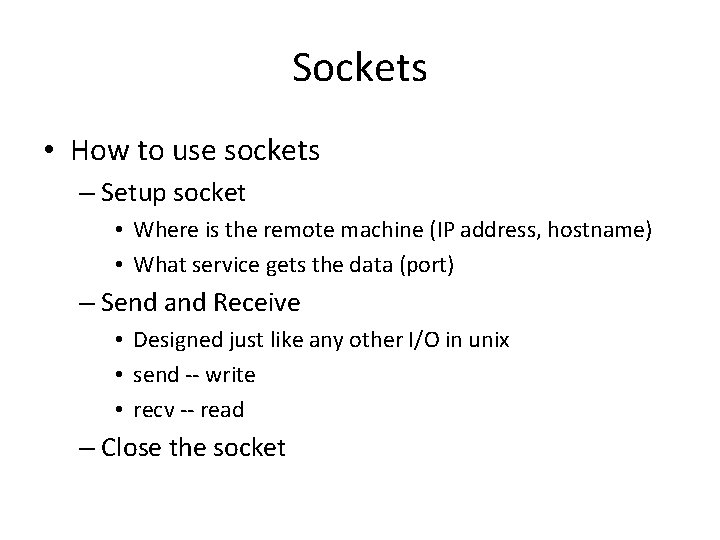
Sockets • How to use sockets – Setup socket • Where is the remote machine (IP address, hostname) • What service gets the data (port) – Send and Receive • Designed just like any other I/O in unix • send -- write • recv -- read – Close the socket
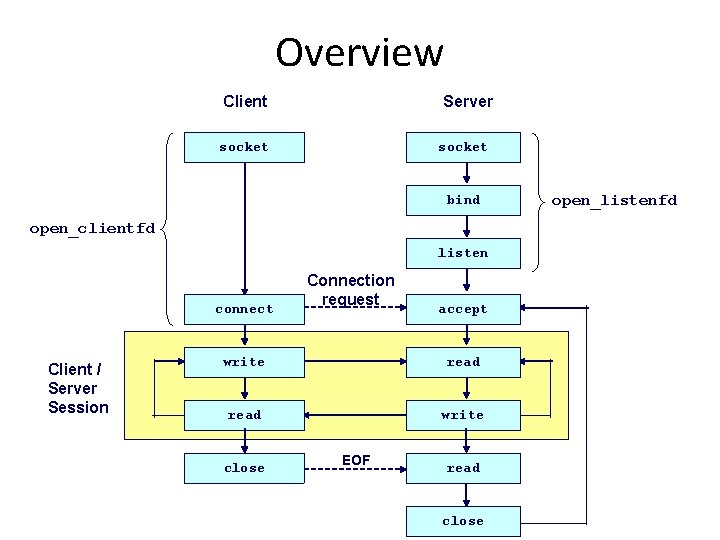
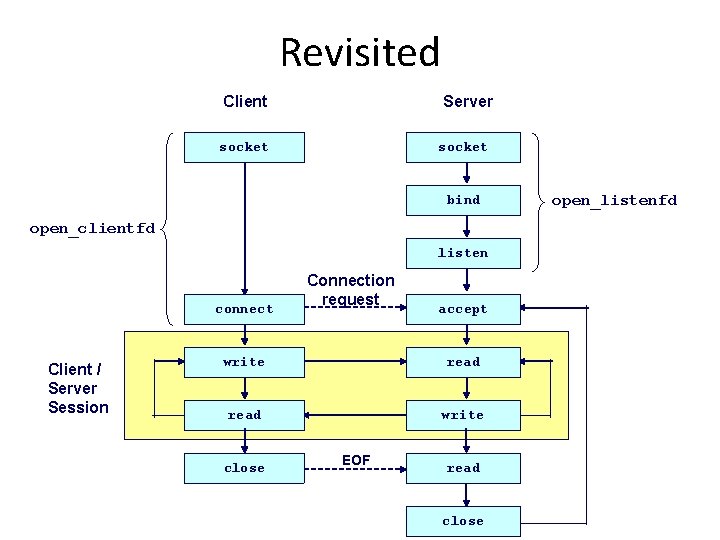
Overview Client Server socket bind open_clientfd listen connect Client / Server Session Connection request accept write read write close EOF read close open_listenfd
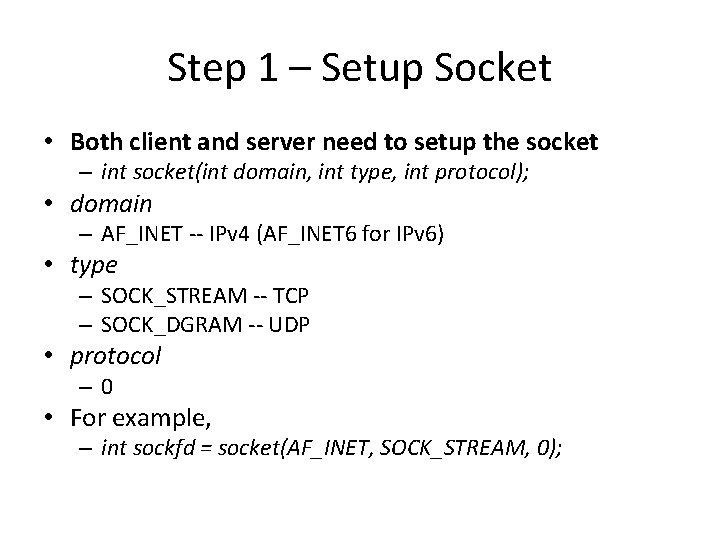
Step 1 – Setup Socket • Both client and server need to setup the socket – int socket(int domain, int type, int protocol); • domain – AF_INET -- IPv 4 (AF_INET 6 for IPv 6) • type – SOCK_STREAM -- TCP – SOCK_DGRAM -- UDP • protocol – 0 • For example, – int sockfd = socket(AF_INET, SOCK_STREAM, 0);
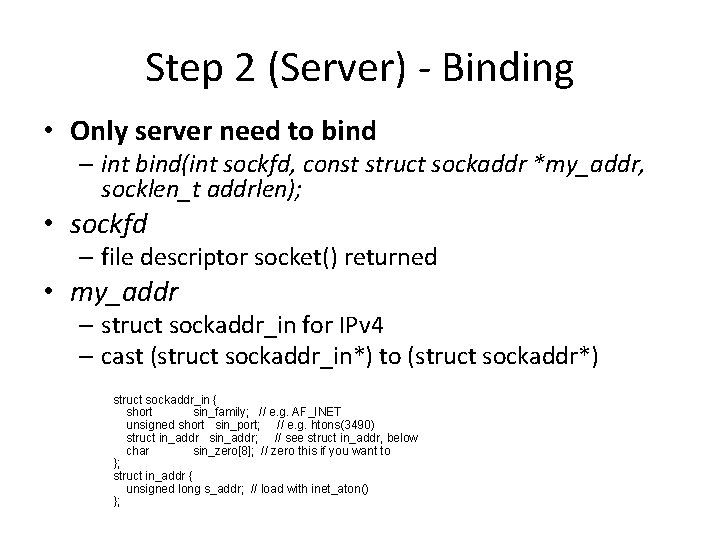
Step 2 (Server) - Binding • Only server need to bind – int bind(int sockfd, const struct sockaddr *my_addr, socklen_t addrlen); • sockfd – file descriptor socket() returned • my_addr – struct sockaddr_in for IPv 4 – cast (struct sockaddr_in*) to (struct sockaddr*) struct sockaddr_in { short sin_family; // e. g. AF_INET unsigned short sin_port; // e. g. htons(3490) struct in_addr sin_addr; // see struct in_addr, below char sin_zero[8]; // zero this if you want to }; struct in_addr { unsigned long s_addr; // load with inet_aton() };
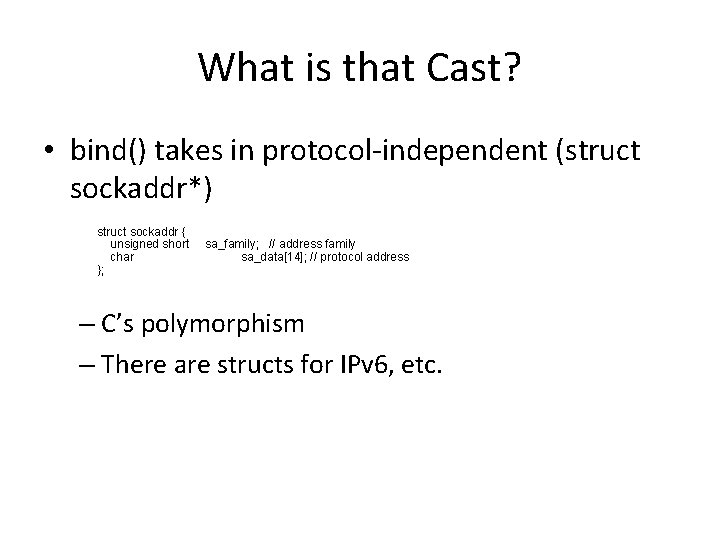
What is that Cast? • bind() takes in protocol-independent (struct sockaddr*) struct sockaddr { unsigned short char }; sa_family; // address family sa_data[14]; // protocol address – C’s polymorphism – There are structs for IPv 6, etc.
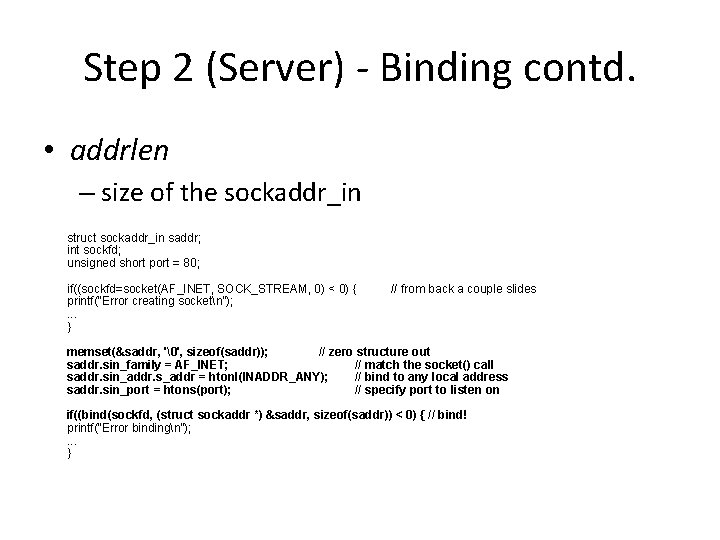
Step 2 (Server) - Binding contd. • addrlen – size of the sockaddr_in struct sockaddr_in saddr; int sockfd; unsigned short port = 80; if((sockfd=socket(AF_INET, SOCK_STREAM, 0) < 0) { printf(“Error creating socketn”); . . . } // from back a couple slides memset(&saddr, '', sizeof(saddr)); // zero structure out saddr. sin_family = AF_INET; // match the socket() call saddr. sin_addr. s_addr = htonl(INADDR_ANY); // bind to any local address saddr. sin_port = htons(port); // specify port to listen on if((bind(sockfd, (struct sockaddr *) &saddr, sizeof(saddr)) < 0) { // bind! printf(“Error bindingn”); . . . }
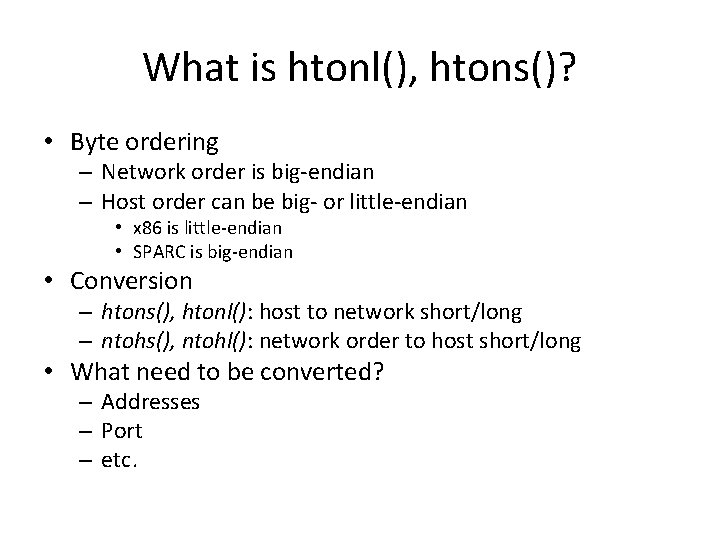
What is htonl(), htons()? • Byte ordering – Network order is big-endian – Host order can be big- or little-endian • x 86 is little-endian • SPARC is big-endian • Conversion – htons(), htonl(): host to network short/long – ntohs(), ntohl(): network order to host short/long • What need to be converted? – Addresses – Port – etc.
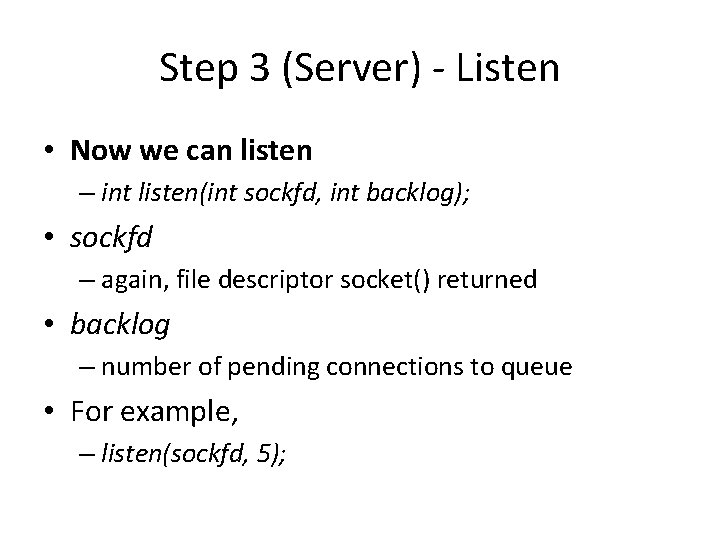
Step 3 (Server) - Listen • Now we can listen – int listen(int sockfd, int backlog); • sockfd – again, file descriptor socket() returned • backlog – number of pending connections to queue • For example, – listen(sockfd, 5);
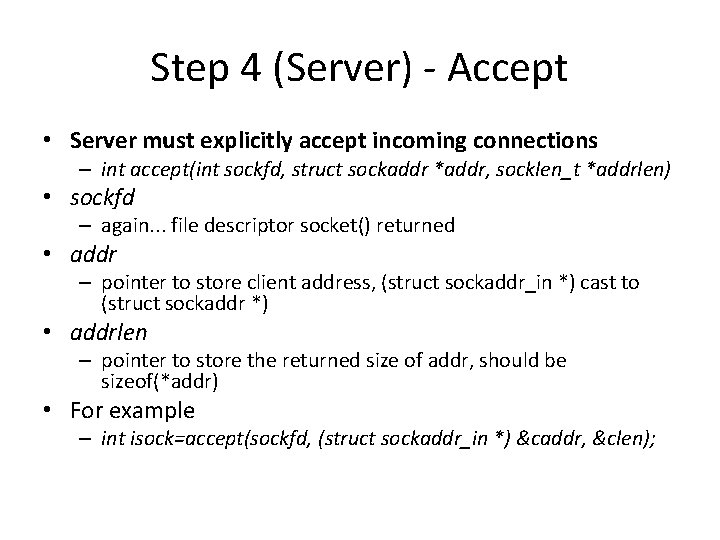
Step 4 (Server) - Accept • Server must explicitly accept incoming connections – int accept(int sockfd, struct sockaddr *addr, socklen_t *addrlen) • sockfd – again. . . file descriptor socket() returned • addr – pointer to store client address, (struct sockaddr_in *) cast to (struct sockaddr *) • addrlen – pointer to store the returned size of addr, should be sizeof(*addr) • For example – int isock=accept(sockfd, (struct sockaddr_in *) &caddr, &clen);
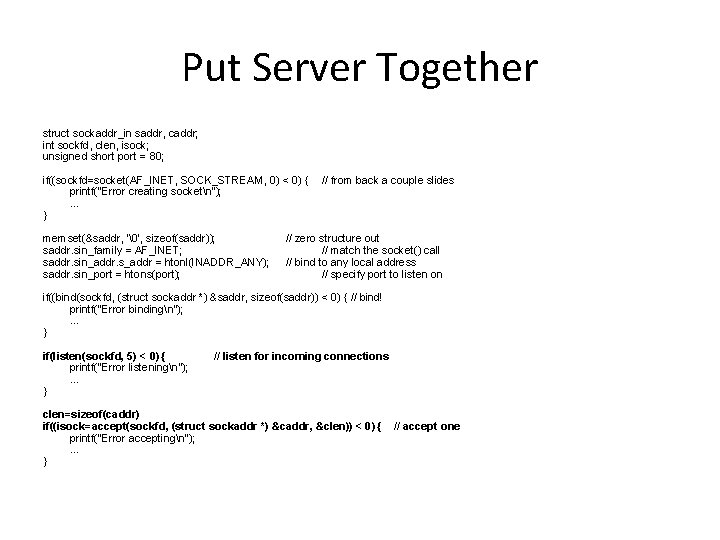
Put Server Together struct sockaddr_in saddr, caddr; int sockfd, clen, isock; unsigned short port = 80; if((sockfd=socket(AF_INET, SOCK_STREAM, 0) < 0) { printf(“Error creating socketn”); . . . } memset(&saddr, '', sizeof(saddr)); saddr. sin_family = AF_INET; saddr. sin_addr. s_addr = htonl(INADDR_ANY); saddr. sin_port = htons(port); // from back a couple slides // zero structure out // match the socket() call // bind to any local address // specify port to listen on if((bind(sockfd, (struct sockaddr *) &saddr, sizeof(saddr)) < 0) { // bind! printf(“Error bindingn”); . . . } if(listen(sockfd, 5) < 0) { printf(“Error listeningn”); . . . } // listen for incoming connections clen=sizeof(caddr) if((isock=accept(sockfd, (struct sockaddr *) &caddr, &clen)) < 0) { printf(“Error acceptingn”); . . . } // accept one
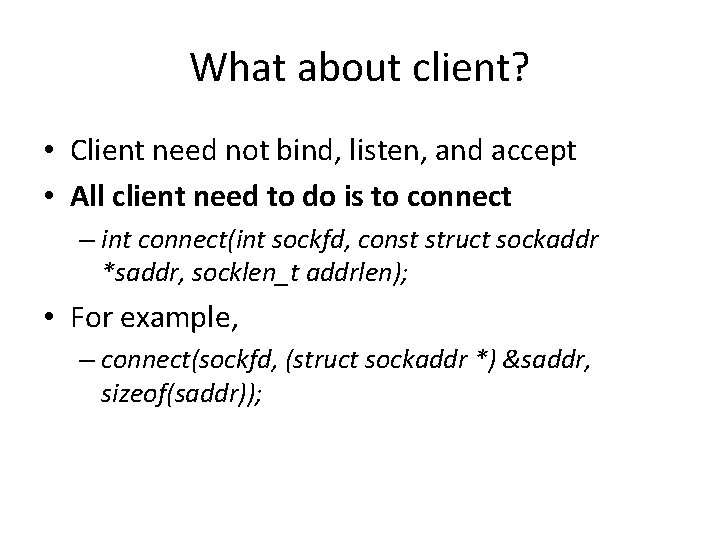
What about client? • Client need not bind, listen, and accept • All client need to do is to connect – int connect(int sockfd, const struct sockaddr *saddr, socklen_t addrlen); • For example, – connect(sockfd, (struct sockaddr *) &saddr, sizeof(saddr));
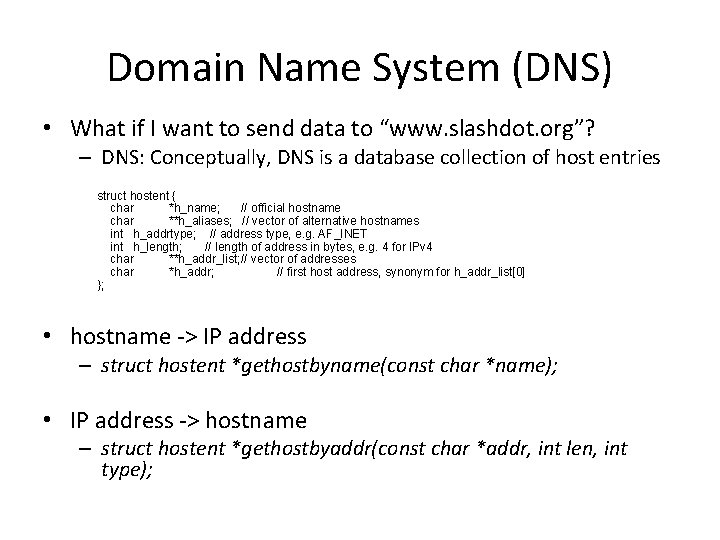
Domain Name System (DNS) • What if I want to send data to “www. slashdot. org”? – DNS: Conceptually, DNS is a database collection of host entries struct hostent { char *h_name; // official hostname char **h_aliases; // vector of alternative hostnames int h_addrtype; // address type, e. g. AF_INET int h_length; // length of address in bytes, e. g. 4 for IPv 4 char **h_addr_list; // vector of addresses char *h_addr; // first host address, synonym for h_addr_list[0] }; • hostname -> IP address – struct hostent *gethostbyname(const char *name); • IP address -> hostname – struct hostent *gethostbyaddr(const char *addr, int len, int type);
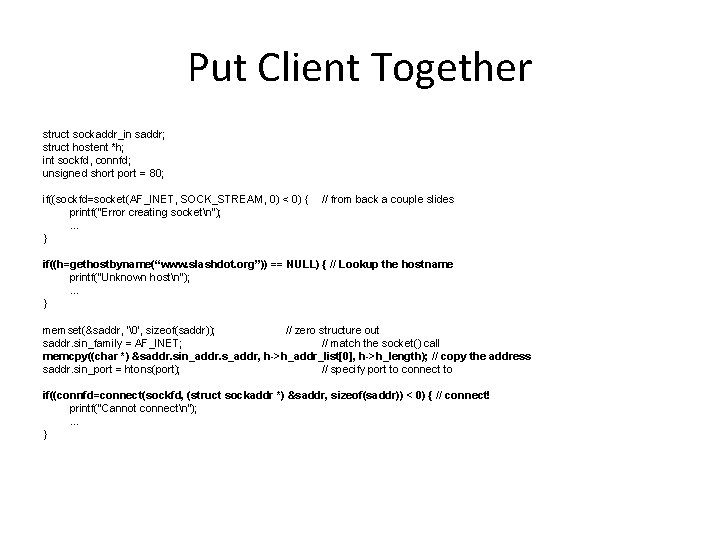
Put Client Together struct sockaddr_in saddr; struct hostent *h; int sockfd, connfd; unsigned short port = 80; if((sockfd=socket(AF_INET, SOCK_STREAM, 0) < 0) { printf(“Error creating socketn”); . . . } // from back a couple slides if((h=gethostbyname(“www. slashdot. org”)) == NULL) { // Lookup the hostname printf(“Unknown hostn”); . . . } memset(&saddr, '', sizeof(saddr)); // zero structure out saddr. sin_family = AF_INET; // match the socket() call memcpy((char *) &saddr. sin_addr. s_addr, h->h_addr_list[0], h->h_length); // copy the address saddr. sin_port = htons(port); // specify port to connect to if((connfd=connect(sockfd, (struct sockaddr *) &saddr, sizeof(saddr)) < 0) { // connect! printf(“Cannot connectn”); . . . }
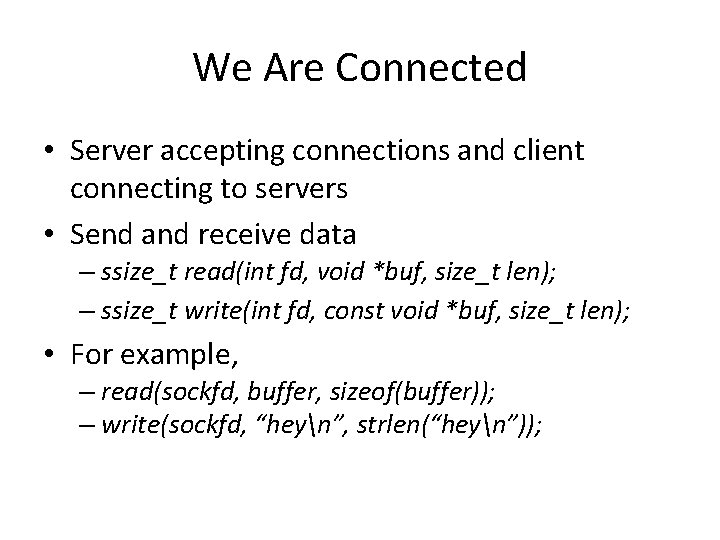
We Are Connected • Server accepting connections and client connecting to servers • Send and receive data – ssize_t read(int fd, void *buf, size_t len); – ssize_t write(int fd, const void *buf, size_t len); • For example, – read(sockfd, buffer, sizeof(buffer)); – write(sockfd, “heyn”, strlen(“heyn”));
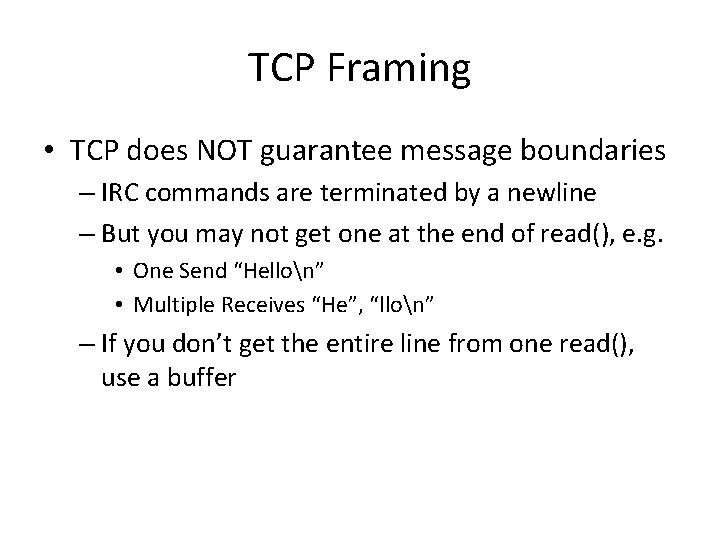
TCP Framing • TCP does NOT guarantee message boundaries – IRC commands are terminated by a newline – But you may not get one at the end of read(), e. g. • One Send “Hellon” • Multiple Receives “He”, “llon” – If you don’t get the entire line from one read(), use a buffer
Revisited Client Server socket bind open_clientfd listen connect Client / Server Session Connection request accept write read write close EOF read close open_listenfd
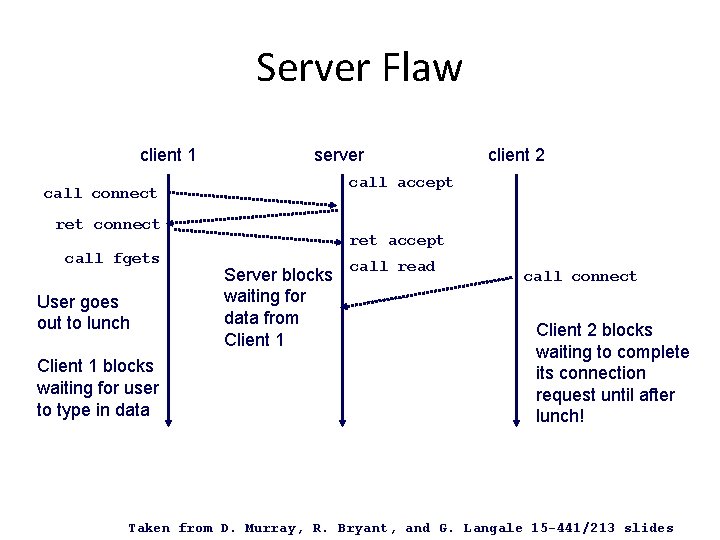
Close the Socket • Don’t forget to close the socket descriptor, like a file – int close(int sockfd); • Now server can loop around accept a new connection when the old one finishes • What’s wrong here?
Server Flaw client 1 server call accept call connect ret connect call fgets User goes out to lunch Client 1 blocks waiting for user to type in data client 2 ret accept Server blocks waiting for data from Client 1 call read call connect Client 2 blocks waiting to complete its connection request until after lunch! Taken from D. Murray, R. Bryant, and G. Langale 15 -441/213 slides
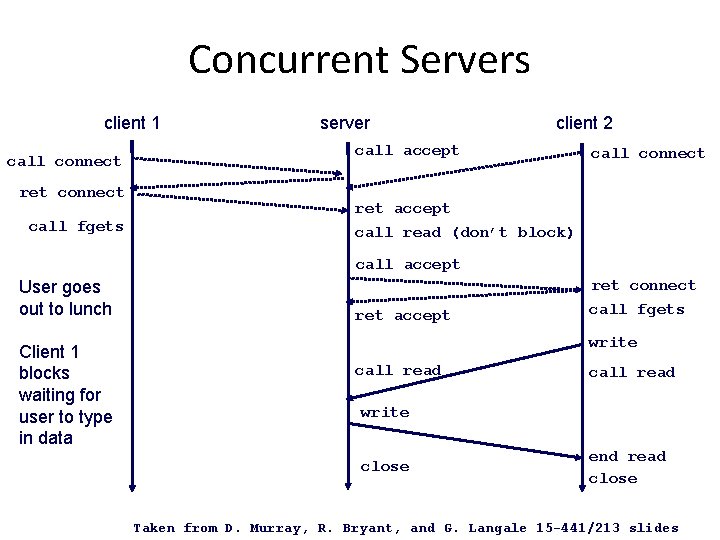
Concurrent Servers client 1 call connect ret connect call fgets server client 2 call accept call connect ret accept call read (don’t block) call accept User goes out to lunch Client 1 blocks waiting for user to type in data ret accept ret connect call fgets write call read write close end read close Taken from D. Murray, R. Bryant, and G. Langale 15 -441/213 slides
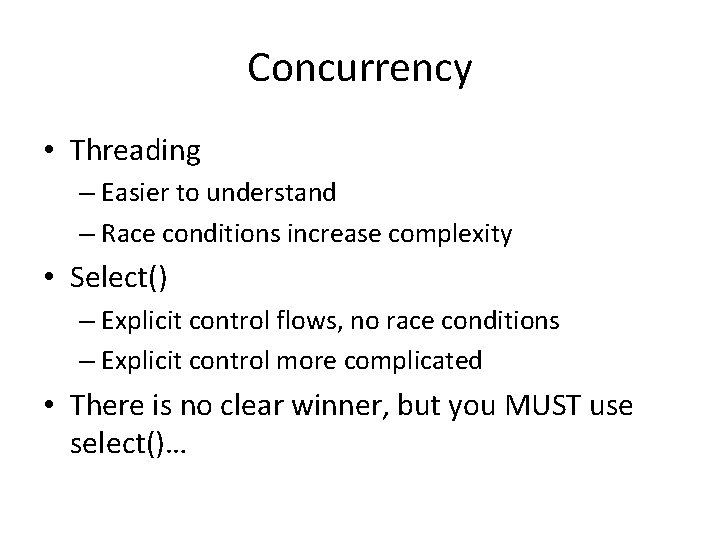
Concurrency • Threading – Easier to understand – Race conditions increase complexity • Select() – Explicit control flows, no race conditions – Explicit control more complicated • There is no clear winner, but you MUST use select()…
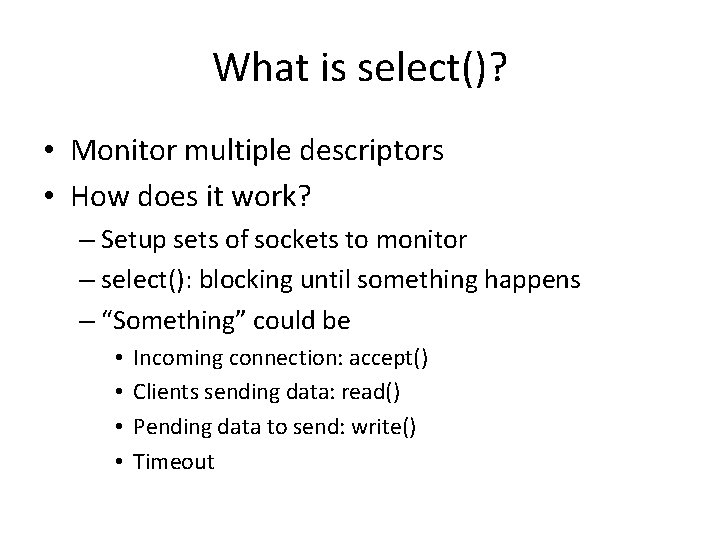
What is select()? • Monitor multiple descriptors • How does it work? – Setup sets of sockets to monitor – select(): blocking until something happens – “Something” could be • • Incoming connection: accept() Clients sending data: read() Pending data to send: write() Timeout
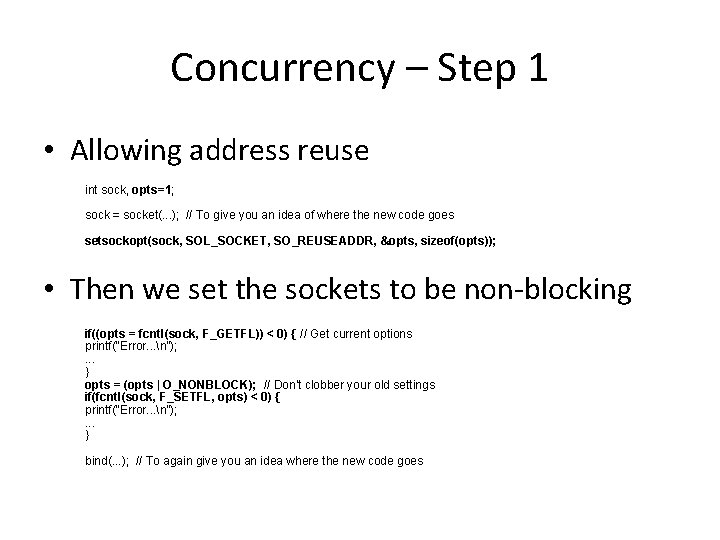
Concurrency – Step 1 • Allowing address reuse int sock, opts=1; sock = socket(. . . ); // To give you an idea of where the new code goes setsockopt(sock, SOL_SOCKET, SO_REUSEADDR, &opts, sizeof(opts)); • Then we set the sockets to be non-blocking if((opts = fcntl(sock, F_GETFL)) < 0) { // Get current options printf(“Error. . . n”); . . . } opts = (opts | O_NONBLOCK); // Don't clobber your old settings if(fcntl(sock, F_SETFL, opts) < 0) { printf(“Error. . . n”); . . . } bind(. . . ); // To again give you an idea where the new code goes
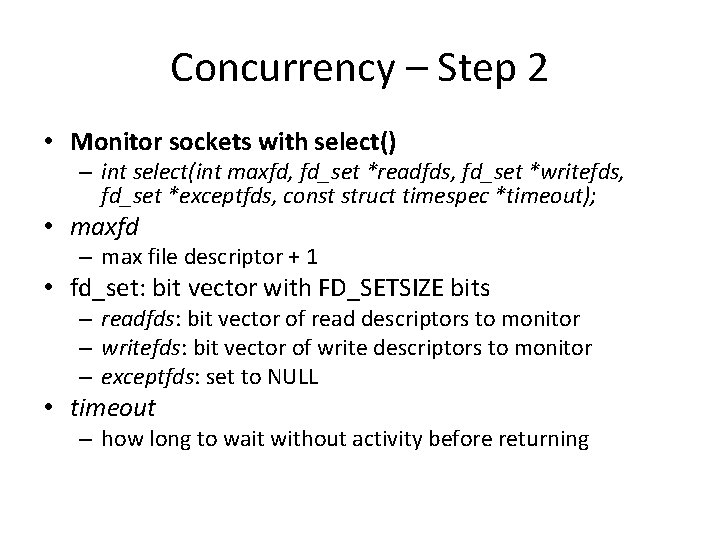
Concurrency – Step 2 • Monitor sockets with select() – int select(int maxfd, fd_set *readfds, fd_set *writefds, fd_set *exceptfds, const struct timespec *timeout); • maxfd – max file descriptor + 1 • fd_set: bit vector with FD_SETSIZE bits – readfds: bit vector of read descriptors to monitor – writefds: bit vector of write descriptors to monitor – exceptfds: set to NULL • timeout – how long to wait without activity before returning
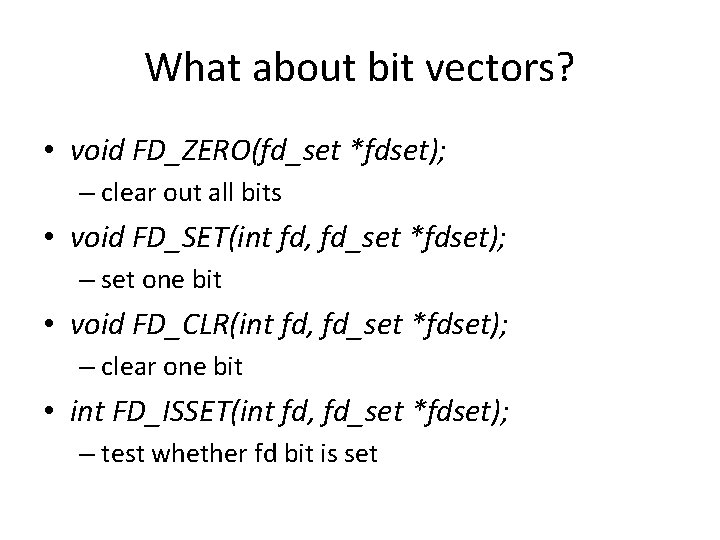
What about bit vectors? • void FD_ZERO(fd_set *fdset); – clear out all bits • void FD_SET(int fd, fd_set *fdset); – set one bit • void FD_CLR(int fd, fd_set *fdset); – clear one bit • int FD_ISSET(int fd, fd_set *fdset); – test whether fd bit is set
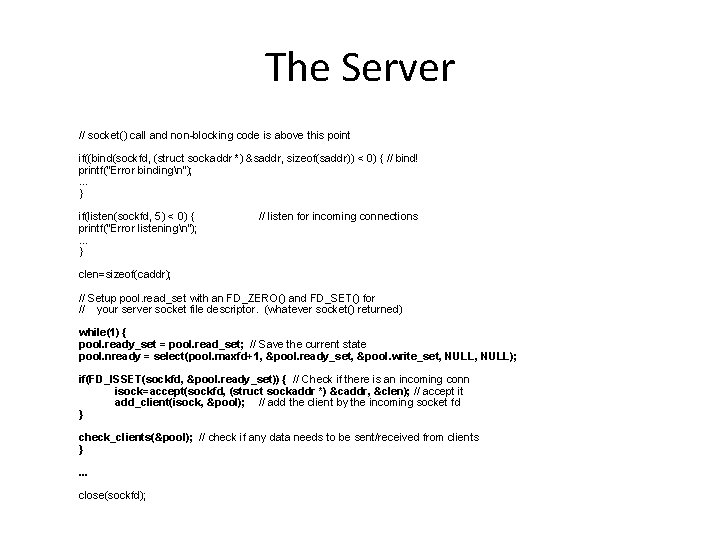
The Server // socket() call and non-blocking code is above this point if((bind(sockfd, (struct sockaddr *) &saddr, sizeof(saddr)) < 0) { // bind! printf(“Error bindingn”); . . . } if(listen(sockfd, 5) < 0) { printf(“Error listeningn”); . . . } // listen for incoming connections clen=sizeof(caddr); // Setup pool. read_set with an FD_ZERO() and FD_SET() for // your server socket file descriptor. (whatever socket() returned) while(1) { pool. ready_set = pool. read_set; // Save the current state pool. nready = select(pool. maxfd+1, &pool. ready_set, &pool. write_set, NULL); if(FD_ISSET(sockfd, &pool. ready_set)) { // Check if there is an incoming conn isock=accept(sockfd, (struct sockaddr *) &caddr, &clen); // accept it add_client(isock, &pool); // add the client by the incoming socket fd } check_clients(&pool); // check if any data needs to be sent/received from clients }. . . close(sockfd);
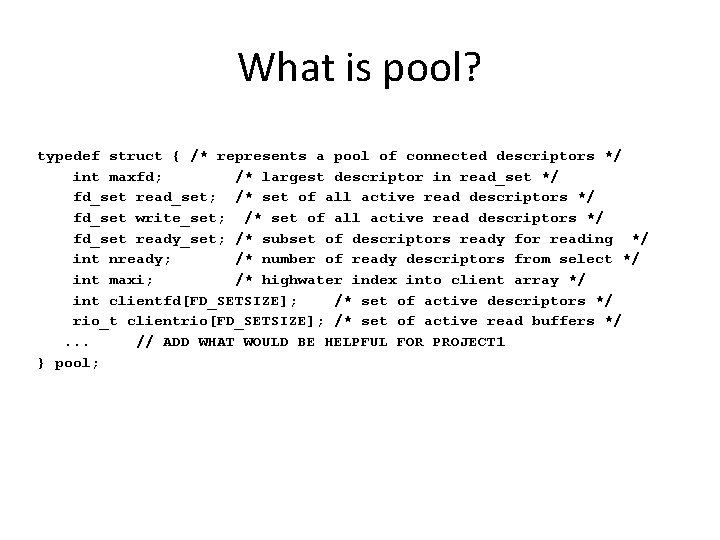
What is pool? typedef struct { /* represents a pool of connected descriptors */ int maxfd; /* largest descriptor in read_set */ fd_set read_set; /* set of all active read descriptors */ fd_set write_set; /* set of all active read descriptors */ fd_set ready_set; /* subset of descriptors ready for reading */ int nready; /* number of ready descriptors from select */ int maxi; /* highwater index into client array */ int clientfd[FD_SETSIZE]; /* set of active descriptors */ rio_t clientrio[FD_SETSIZE]; /* set of active read buffers */. . . // ADD WHAT WOULD BE HELPFUL FOR PROJECT 1 } pool;
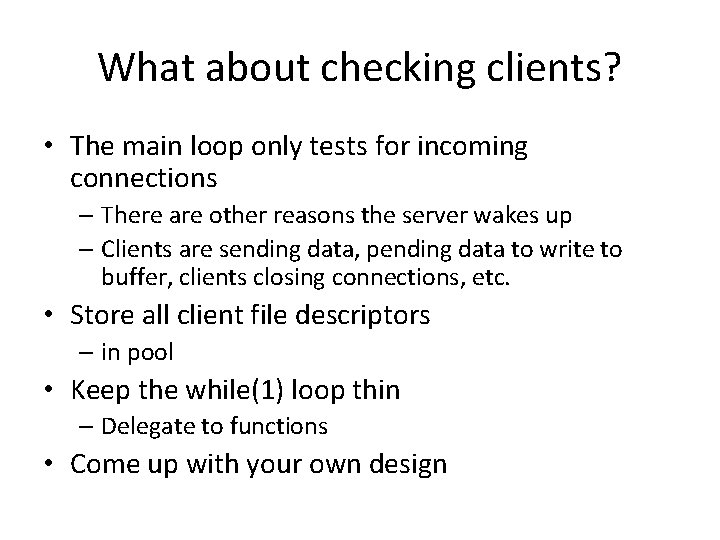
What about checking clients? • The main loop only tests for incoming connections – There are other reasons the server wakes up – Clients are sending data, pending data to write to buffer, clients closing connections, etc. • Store all client file descriptors – in pool • Keep the while(1) loop thin – Delegate to functions • Come up with your own design
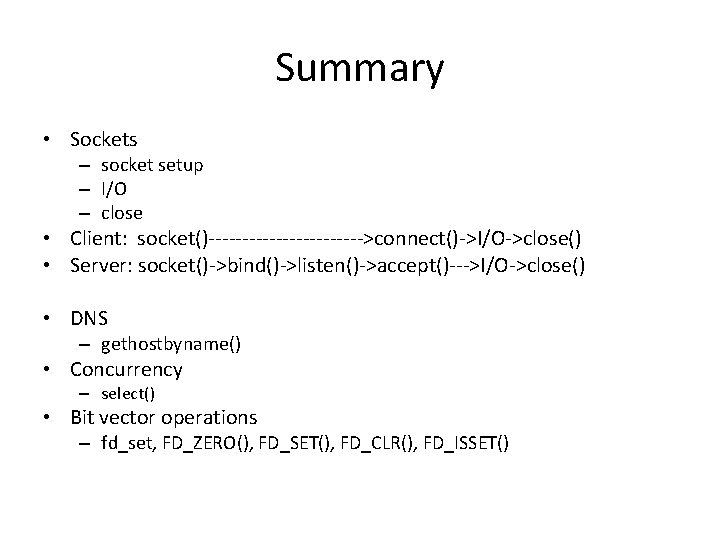
Summary • Sockets – socket setup – I/O – close • Client: socket()------------>connect()->I/O->close() • Server: socket()->bind()->listen()->accept()--->I/O->close() • DNS – gethostbyname() • Concurrency – select() • Bit vector operations – fd_set, FD_ZERO(), FD_SET(), FD_CLR(), FD_ISSET()
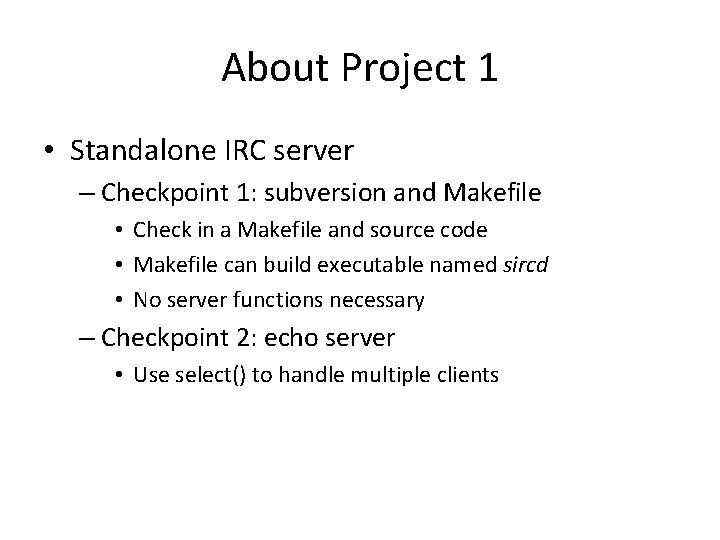
About Project 1 • Standalone IRC server – Checkpoint 1: subversion and Makefile • Check in a Makefile and source code • Makefile can build executable named sircd • No server functions necessary – Checkpoint 2: echo server • Use select() to handle multiple clients
Suggestions • Start early! – Work ahead of checkpoints • Read the man pages • Email Kaushik (kaushik AT cs DOT cmu DOT edu) if you didn’t get a svn username and password
Reference for Socket Programming • http: //www. lowtek. com/sockets/ • Feel free to share your reference on the bboard!