
Socket Options getsockopt and setsockopt functions Check options



- Slides: 16
Socket Options • • getsockopt and setsockopt functions Check options and obtain default values Generic socket options IPv 4 socket options IPv 6 socket options TCP socket options fcntl function Summary 1
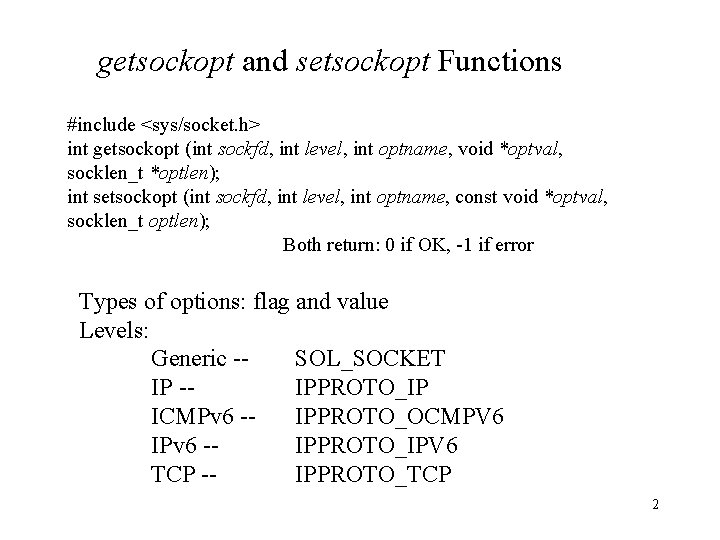
getsockopt and setsockopt Functions #include <sys/socket. h> int getsockopt (int sockfd, int level, int optname, void *optval, socklen_t *optlen); int setsockopt (int sockfd, int level, int optname, const void *optval, socklen_t optlen); Both return: 0 if OK, -1 if error Types of options: flag and value Levels: Generic -SOL_SOCKET IP -IPPROTO_IP ICMPv 6 -IPPROTO_OCMPV 6 IPv 6 -IPPROTO_IPV 6 TCP -IPPROTO_TCP 2
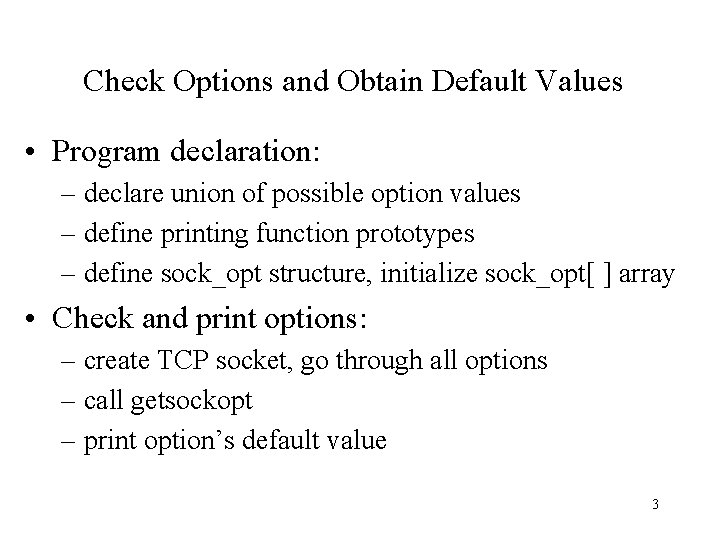
Check Options and Obtain Default Values • Program declaration: – declare union of possible option values – define printing function prototypes – define sock_opt structure, initialize sock_opt[ ] array • Check and print options: – create TCP socket, go through all options – call getsockopt – print option’s default value 3
Declaration for Socket Options (see figure 7. 2) Program to Check and Print Socket Options (see figure 7. 3 and 7. 4) 4
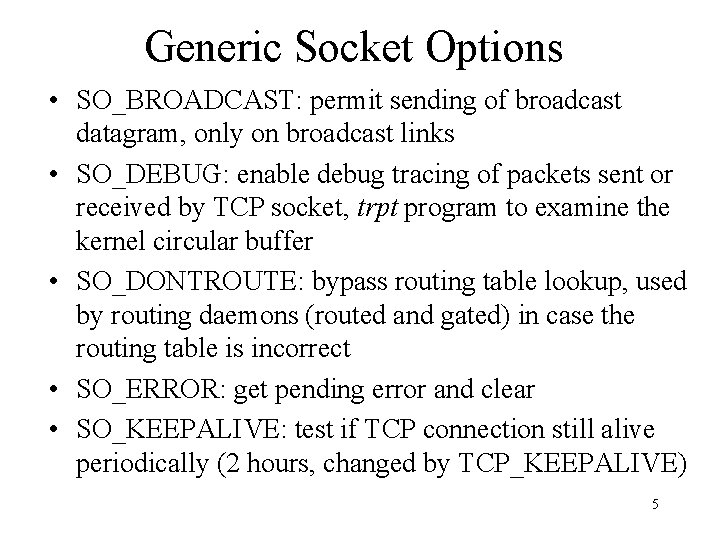
Generic Socket Options • SO_BROADCAST: permit sending of broadcast datagram, only on broadcast links • SO_DEBUG: enable debug tracing of packets sent or received by TCP socket, trpt program to examine the kernel circular buffer • SO_DONTROUTE: bypass routing table lookup, used by routing daemons (routed and gated) in case the routing table is incorrect • SO_ERROR: get pending error and clear • SO_KEEPALIVE: test if TCP connection still alive periodically (2 hours, changed by TCP_KEEPALIVE) 5
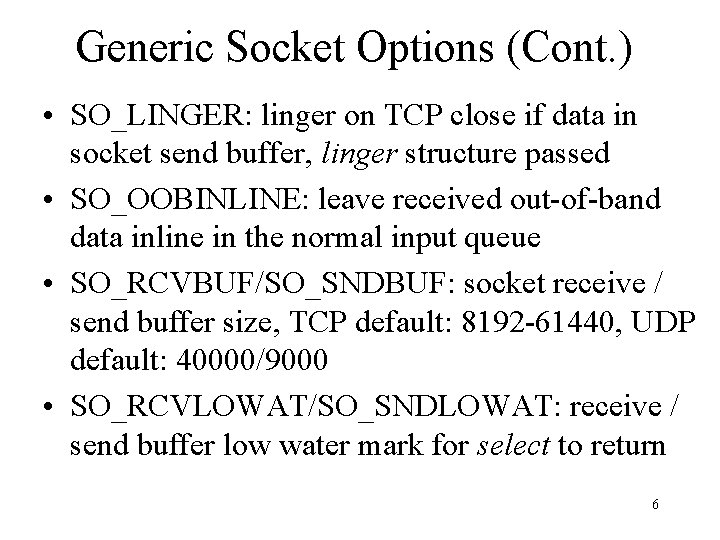
Generic Socket Options (Cont. ) • SO_LINGER: linger on TCP close if data in socket send buffer, linger structure passed • SO_OOBINLINE: leave received out-of-band data inline in the normal input queue • SO_RCVBUF/SO_SNDBUF: socket receive / send buffer size, TCP default: 8192 -61440, UDP default: 40000/9000 • SO_RCVLOWAT/SO_SNDLOWAT: receive / send buffer low water mark for select to return 6
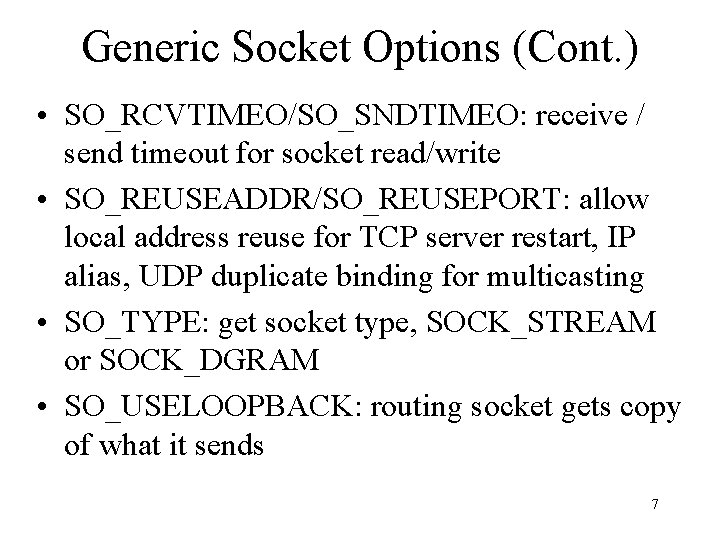
Generic Socket Options (Cont. ) • SO_RCVTIMEO/SO_SNDTIMEO: receive / send timeout for socket read/write • SO_REUSEADDR/SO_REUSEPORT: allow local address reuse for TCP server restart, IP alias, UDP duplicate binding for multicasting • SO_TYPE: get socket type, SOCK_STREAM or SOCK_DGRAM • SO_USELOOPBACK: routing socket gets copy of what it sends 7
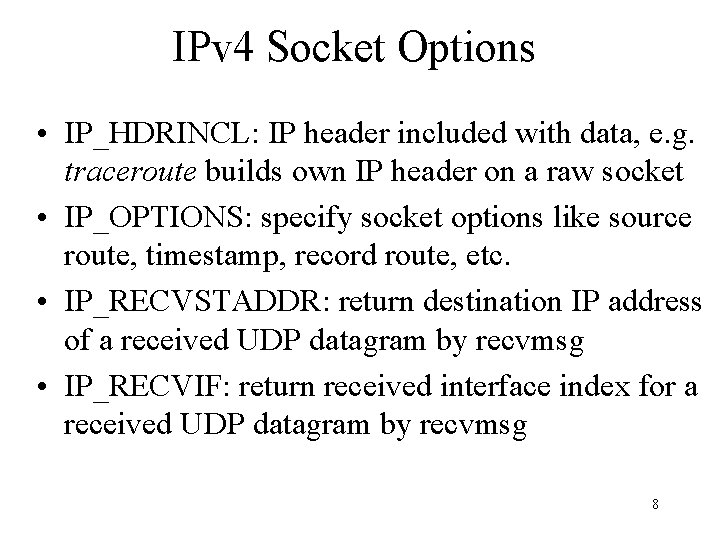
IPv 4 Socket Options • IP_HDRINCL: IP header included with data, e. g. traceroute builds own IP header on a raw socket • IP_OPTIONS: specify socket options like source route, timestamp, record route, etc. • IP_RECVSTADDR: return destination IP address of a received UDP datagram by recvmsg • IP_RECVIF: return received interface index for a received UDP datagram by recvmsg 8
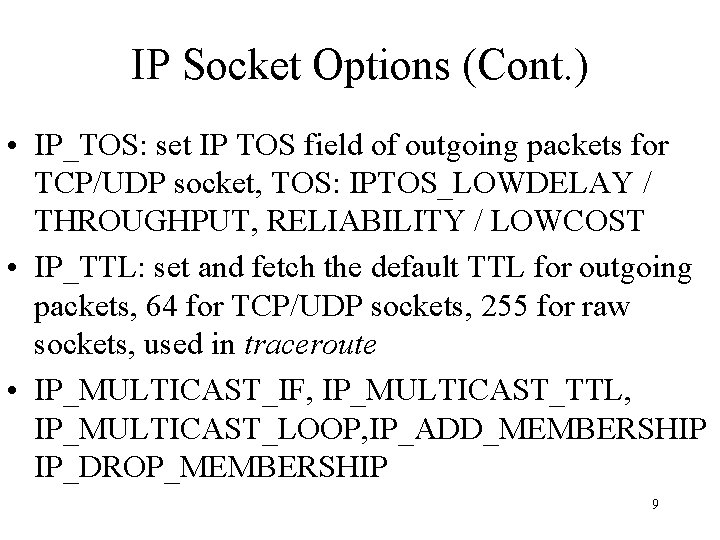
IP Socket Options (Cont. ) • IP_TOS: set IP TOS field of outgoing packets for TCP/UDP socket, TOS: IPTOS_LOWDELAY / THROUGHPUT, RELIABILITY / LOWCOST • IP_TTL: set and fetch the default TTL for outgoing packets, 64 for TCP/UDP sockets, 255 for raw sockets, used in traceroute • IP_MULTICAST_IF, IP_MULTICAST_TTL, IP_MULTICAST_LOOP, IP_ADD_MEMBERSHIP IP_DROP_MEMBERSHIP 9
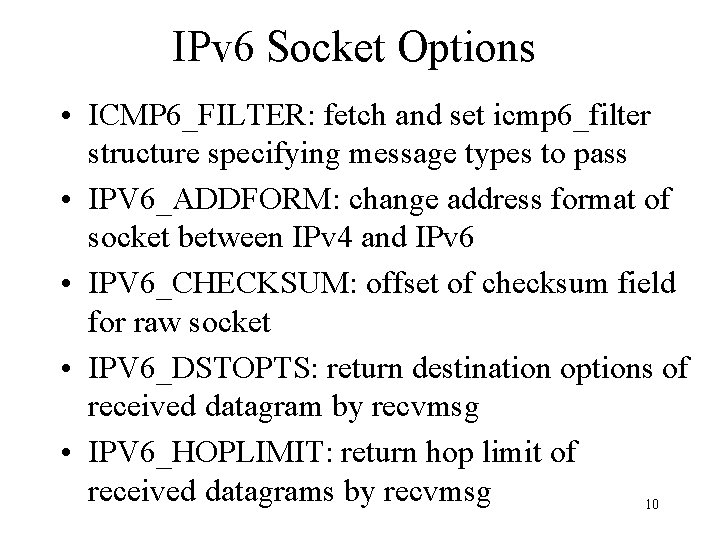
IPv 6 Socket Options • ICMP 6_FILTER: fetch and set icmp 6_filter structure specifying message types to pass • IPV 6_ADDFORM: change address format of socket between IPv 4 and IPv 6 • IPV 6_CHECKSUM: offset of checksum field for raw socket • IPV 6_DSTOPTS: return destination options of received datagram by recvmsg • IPV 6_HOPLIMIT: return hop limit of received datagrams by recvmsg 10
IPv 6 Socket Options (Cont. ) • IPV 6_HOPOPS: return hop-by-hop options of received datagrams by recvmsg • IPV 6_NEXTHOP: specify next hop address as a socket address structure for a datagram • IPV 6_PKTINFO: return packet info, dest IPv 6 and arriving interface, of received datagrams 11
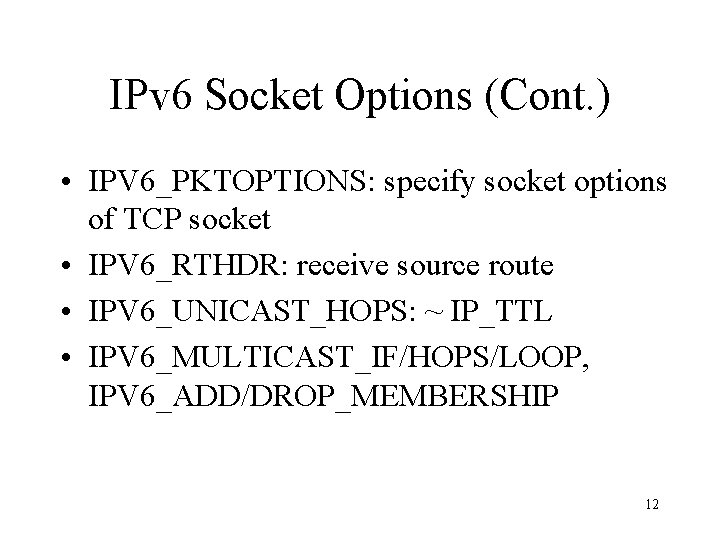
IPv 6 Socket Options (Cont. ) • IPV 6_PKTOPTIONS: specify socket options of TCP socket • IPV 6_RTHDR: receive source route • IPV 6_UNICAST_HOPS: ~ IP_TTL • IPV 6_MULTICAST_IF/HOPS/LOOP, IPV 6_ADD/DROP_MEMBERSHIP 12
TCP Socket Options • • TCP_KEEPALIVE: seconds between probes TCP_MAXRT: TCP max retx time TCP_MAXSEG: TCP max segment size TCP_NODELAY: disable Nagle algorithm, to reduce the number of small packets • TCP_STDURG: interpretation of TCP’s urgent pointer, used with out-of-band data 13
fcntl Function #include <fcntl. h> int fcntl (int fd, int cmd, . . . /* int arg */ ); returns: depends on cmd if OK, -1 on error Two flags that affect a socket: (fetch by F_GETFL, set by F_SETFL) O_NONBLOCK (nonblocking I/O) O_ASYNC (signal-driven I/O notification) To set a flag : fetch, OR/AND~, set int flags; if ( (flags = fcntl (fd, F_GETFL, 0) ) < 0) error_sys (“F_GETFL error”); flags |= O_NONBLOCK; /* turn on */ ( or flags &= ~O_NONBLOCK; /* turn off */ ) if (fcntl(fd, F_SETFL, flags) < 0) error_sys (“F_SETFL error”); 14
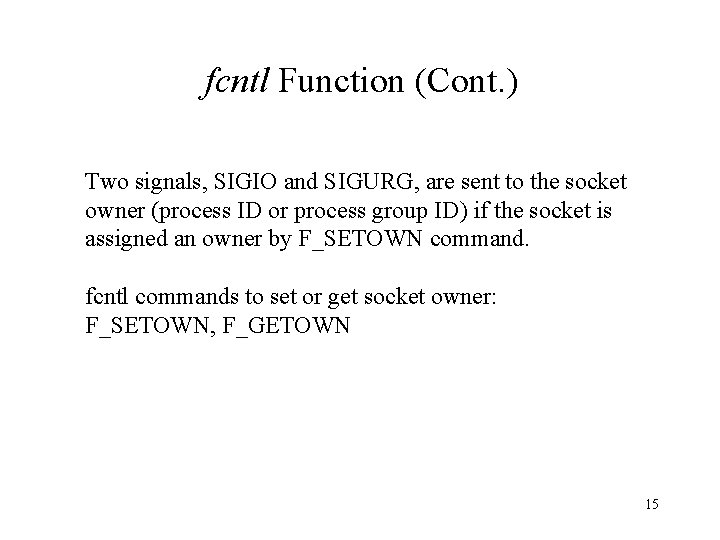
fcntl Function (Cont. ) Two signals, SIGIO and SIGURG, are sent to the socket owner (process ID or process group ID) if the socket is assigned an owner by F_SETOWN command. fcntl commands to set or get socket owner: F_SETOWN, F_GETOWN 15
Summary • Commonly used socket options: SO_KEEPALIVE, SO_RCVBUF, SO_SNDBUF, SO_REUSEADDR • SO_REUSEADDR set in TCP server before calling bind • SO_LINGER gives more control over when close returns and forces RST to be sent • SO_RCVBUF/SO_SNDBUF for bulk data transfer across long fat pipes 16