
Sociology Introductory Days Welcome to Sociology at SSFC

- Slides: 38
Sociology Introductory Days
Welcome to Sociology at SSFC Over the next two lessons we hope to: Introduce you to the Sociology course here at Stockton Sixth Form College. Provide you with a taster of two genuine lessons on gender and identity – from unit one – (Culture and Identity). Answer any questions you may have about the course.
What is Sociology? SOCIOLOGY is a really challenging and exciting subject. It is the study of Societies. It looks at how people live, behave and work together in groups. It asks questions about the world that we live in and tries to explain why it is the way it is.
Is it hard? It requires students to ask questions such as - why is society like it is? You will start to dig underneath the surface of what you already thought you understood. The subject is challenging, but you’ll be given all the support and advice you need to do well. One thing sociology is not is common sense. In fact it aims to question ‘common-sense’ views. You will be expected to write long essays in the exams – so a good GCSE grade in English is desirable
Why should I take it? Sociology compliments many subjects here at SSFC such as Psychology, History, Law, Government and Politics, Health and Social Care, Religious Studies, Media Studies, Business studies, and many more. It will help you develop your communication skills, debating skills, analysis and evaluation skills. It can help you enter into professions such as social work, teaching, police, law, journalism, and the list goes on and on.
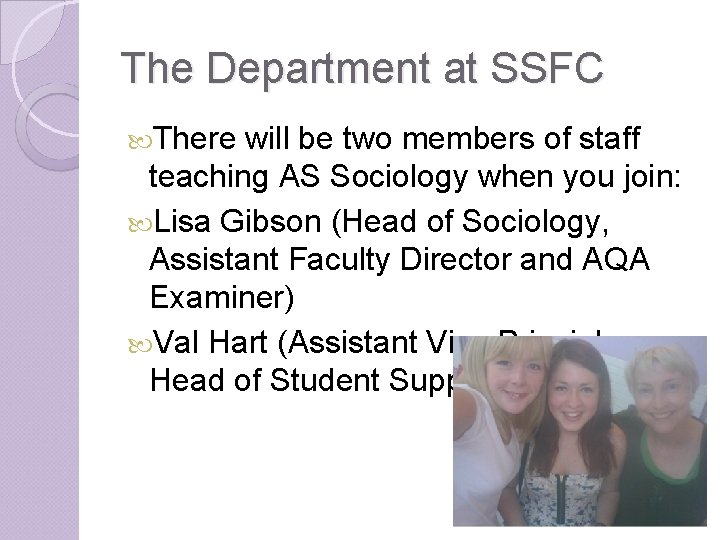
The Department at SSFC There will be two members of staff teaching AS Sociology when you join: Lisa Gibson (Head of Sociology, Assistant Faculty Director and AQA Examiner) Val Hart (Assistant Vice Principle – Head of Student Support.
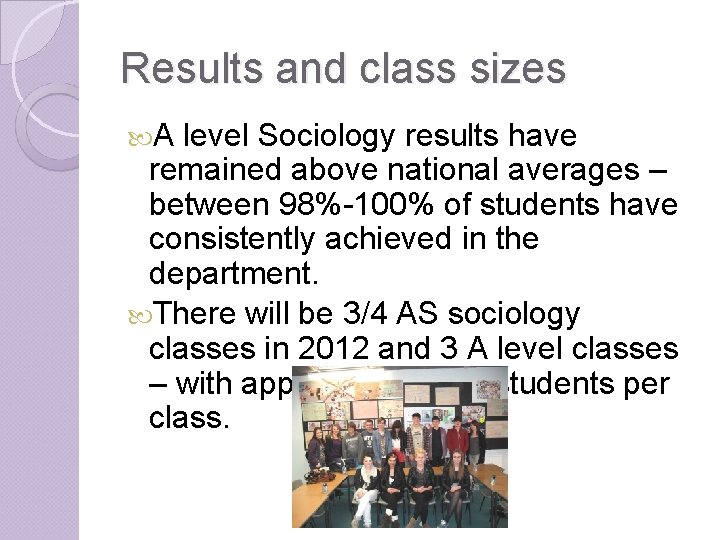
Results and class sizes A level Sociology results have remained above national averages – between 98%-100% of students have consistently achieved in the department. There will be 3/4 AS sociology classes in 2012 and 3 A level classes – with approximately 17 students per class.
Resources We have created extensive resources within the department – detailed, up-to -date and interactive class notes. Extension booklets and exercises on the Virtual Learning Environment. Each year we consider student comments carefully from focus group meetings and student questionnaires we give out– (please see our boards). But we welcome feedback throughout the year.
Support There is plenty of support within the department. Each week there is a Sociology support session put on where you can get one-toone support. You will only have one teacher for your five sessions a week and so this will help you get the help you need. Our A level students will also be as available student mentors. We also use the homework forums and sociology@ssfc facebook will be launched in Sept 2012.
If you have any questions? . . If you do have questions – not answered in this Power. Point – please ask over the next two days or jot your questions down in the welcome booklet for when you return in September. We both hope you enjoy the next two days!
Lesson one Objectives for this lesson: To introduce you to the main arguments surrounding gender and identity Consider arguments for the idea that gender is socially constructed- backed up with evidence from historical and crosscultural differences in gender. Put forward arguments that suggest traditional gender identity is learnt.
Identity refers to the way we see ourselves in relation to other people – what makes us similar to some people and different to others. Activity one – what groups do you belong to? Now identify contrasting groups in society
Gender and Identity Being male or female is one form of identity which you may have stated in activity one. In Sociology we use the term gender to differentiate between males and females. What do you think the difference is between the word sex and gender?
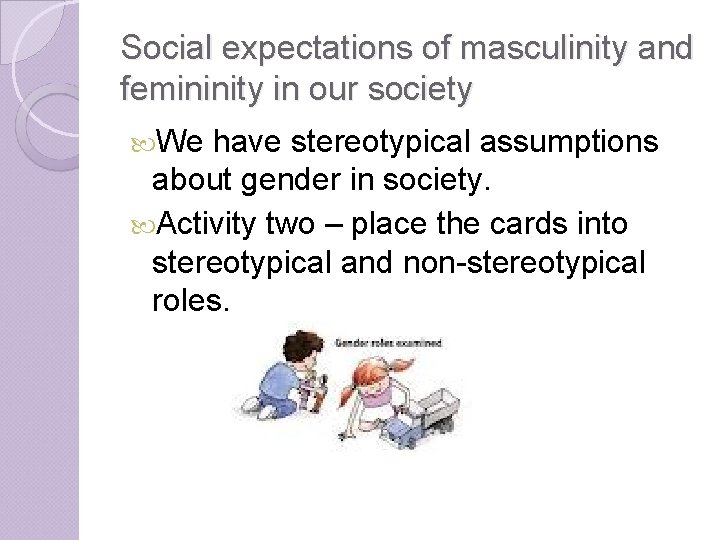
Social expectations of masculinity and femininity in our society We have stereotypical assumptions about gender in society. Activity two – place the cards into stereotypical and non-stereotypical roles.
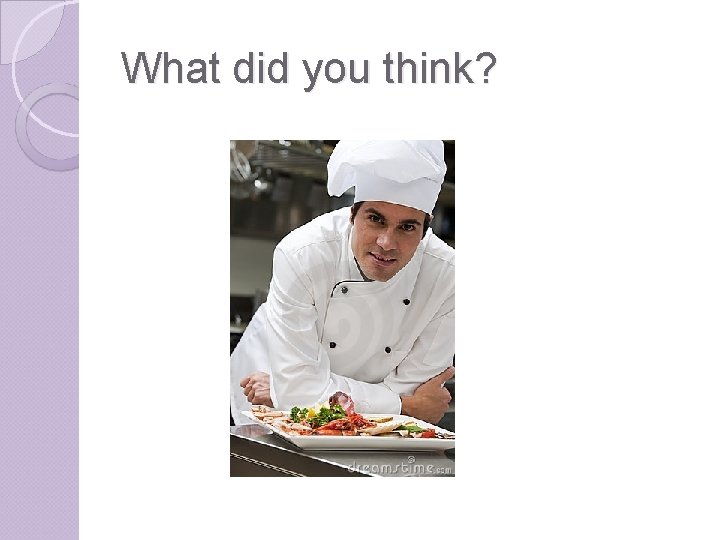
What did you think?
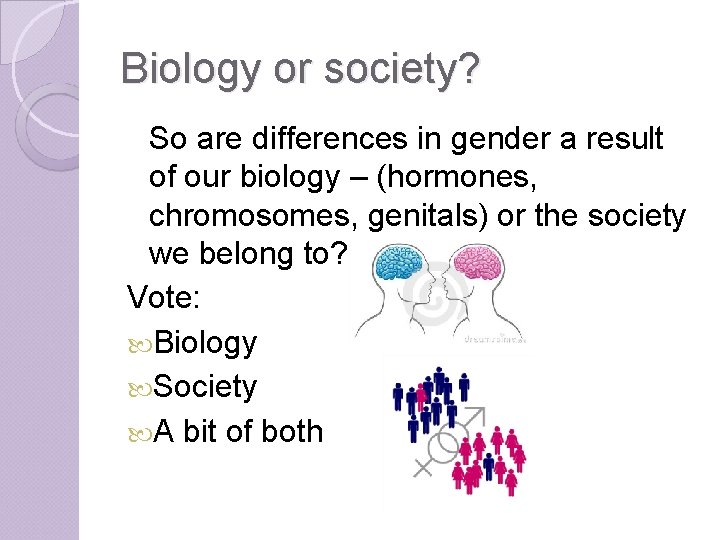
Biology or society? So are differences in gender a result of our biology – (hormones, chromosomes, genitals) or the society we belong to? Vote: Biology Society A bit of both
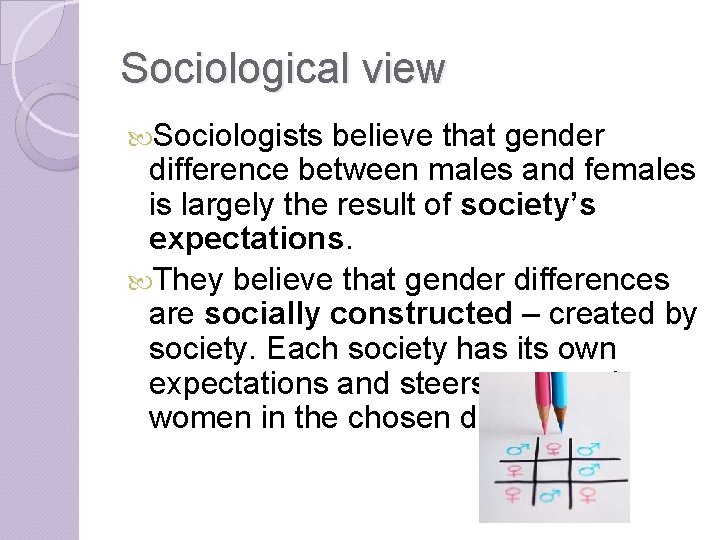
Sociological view Sociologists believe that gender difference between males and females is largely the result of society’s expectations. They believe that gender differences are socially constructed – created by society. Each society has its own expectations and steers men and women in the chosen directions
The proof! How do sociologists know that gender is created within society and not just biological – where do these assumptions come from? We can prove to some extent that gender is shaped by our society by looking at differences historically and cross culturally. If it was mainly about biology then there shouldn’t be any real differences.
Historical differences of gender identity Activity four Watch the good house wife guide published in 1955 How have women’s roles within the family changed since the 1950’s? How does this demonstrate the point that gender is socially constructed and not biologically determined?
Cross culturally differences Read the extract from the research conducted by Margaret Mead Activity five How does the work of Margaret Mead demonstrate that gender identity is created within society and not biology?
Check your understanding What have you learnt so far about Identity and in particular gender? Jot down the answer to the following questions on your whiteboard
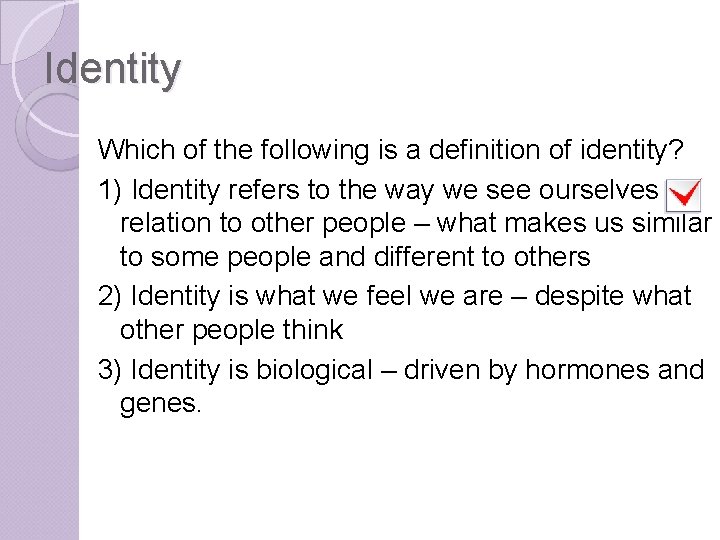
Identity Which of the following is a definition of identity? 1) Identity refers to the way we see ourselves in relation to other people – what makes us similar to some people and different to others 2) Identity is what we feel we are – despite what other people think 3) Identity is biological – driven by hormones and genes.
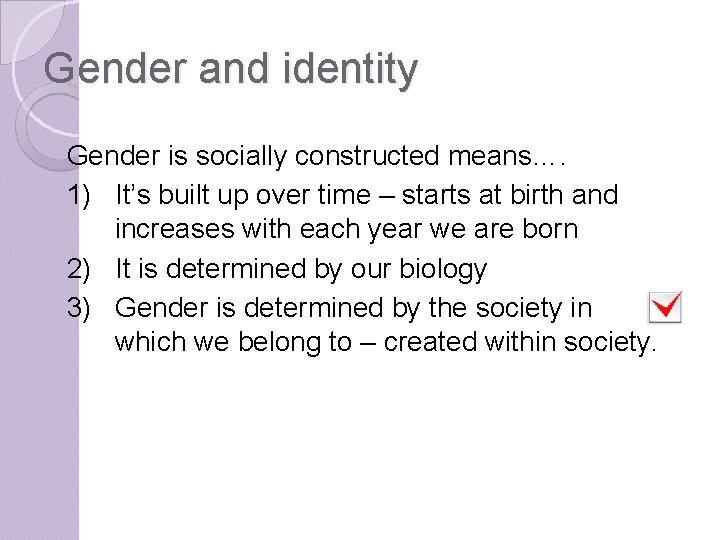
Gender and identity Gender is socially constructed means…. 1) It’s built up over time – starts at birth and increases with each year we are born 2) It is determined by our biology 3) Gender is determined by the society in which we belong to – created within society.
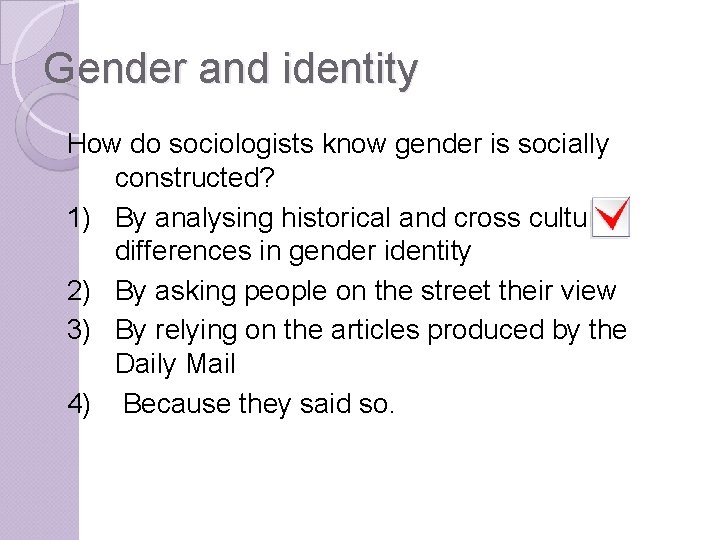
Gender and identity How do sociologists know gender is socially constructed? 1) By analysing historical and cross cultural differences in gender identity 2) By asking people on the street their view 3) By relying on the articles produced by the Daily Mail 4) Because they said so.
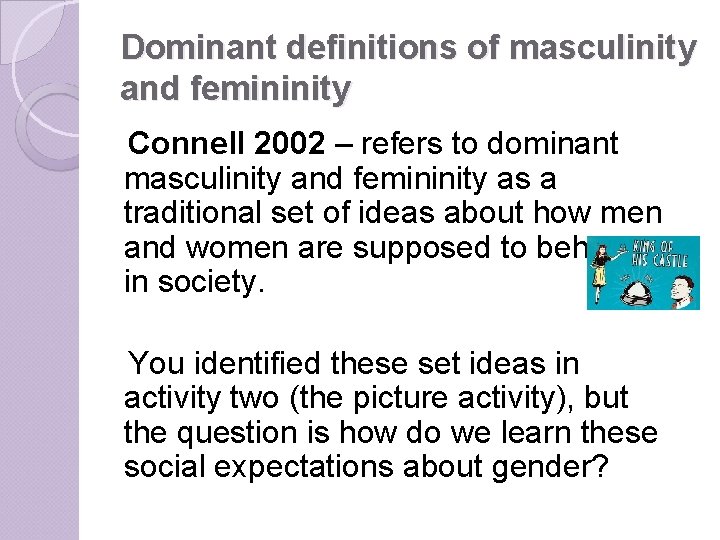
Dominant definitions of masculinity and femininity Connell 2002 – refers to dominant masculinity and femininity as a traditional set of ideas about how men and women are supposed to behave in society. You identified these set ideas in activity two (the picture activity), but the question is how do we learn these social expectations about gender?
Gender-role socialisation Gender codes A feminist called Anne Oakley looked specifically into gender-role socialisation within the family and she came up with the idea of codes. Colour codes - they dress girls and boys in different colour clothes. Toy codes - they give them different toys Play codes – boys are expected to play actively whilst girls are expected to be quiet and docile. Control codes – boys are subjected to far less control from their parents.
Activity six What toys did you play with as a child? Did you notice you were treated differently by your parents because you are a boy/girl?
Statham (1986) – stated that by the age of 5, most children have acquired a clear gender identity. They already have a good idea of what is acceptable for a man or a woman to be like in society. Activity seven Watch the following clip ‘Children’s gender stereotypes’. Are you surprised by this clip?
Media - Disney The media also influences our view of gender Activity Watch the following Disney clip and consider what gender identities are being portrayed? Do you think it has an impact on young children’s view of gender identity?
Check your understanding Please complete the questions in you handout for tomorrow’s lesson and we will go through at the beginning.
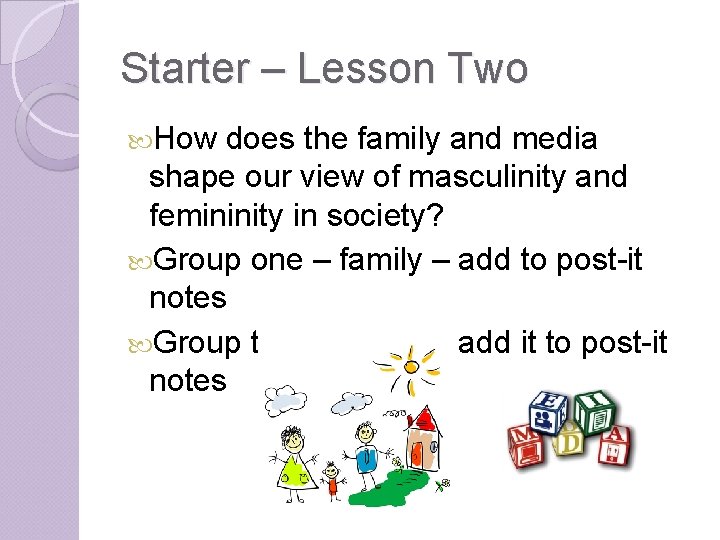
Starter – Lesson Two How does the family and media shape our view of masculinity and femininity in society? Group one – family – add to post-it notes Group two – media – add it to post-it notes
Lesson two Some sociological research considers the view that gender roles and identities are changing. Last lesson we spent some time suggesting that within society there are fixed and traditional expectations of women and men in society. These expectations are transmitted to us by our family and the media, but also education, religion, peer groups and workplaces. So the main objective for this lesson is to challenge the ideas of traditional
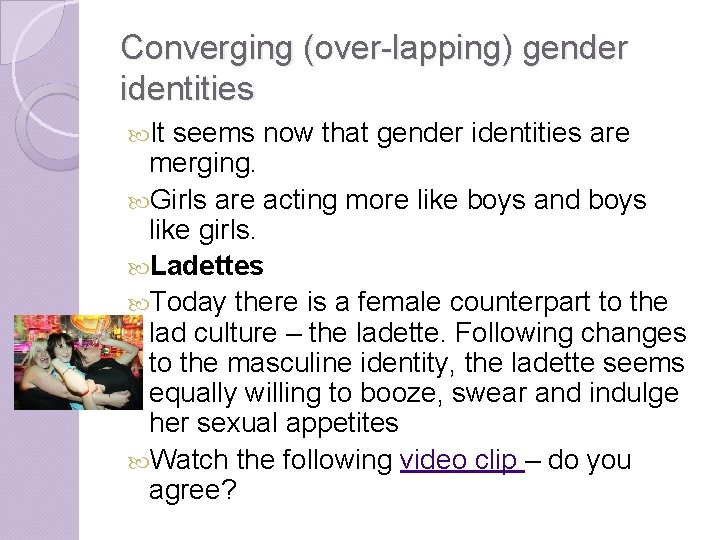
Converging (over-lapping) gender identities It seems now that gender identities are merging. Girls are acting more like boys and boys like girls. Ladettes Today there is a female counterpart to the lad culture – the ladette. Following changes to the masculine identity, the ladette seems equally willing to booze, swear and indulge her sexual appetites Watch the following video clip – do you agree?
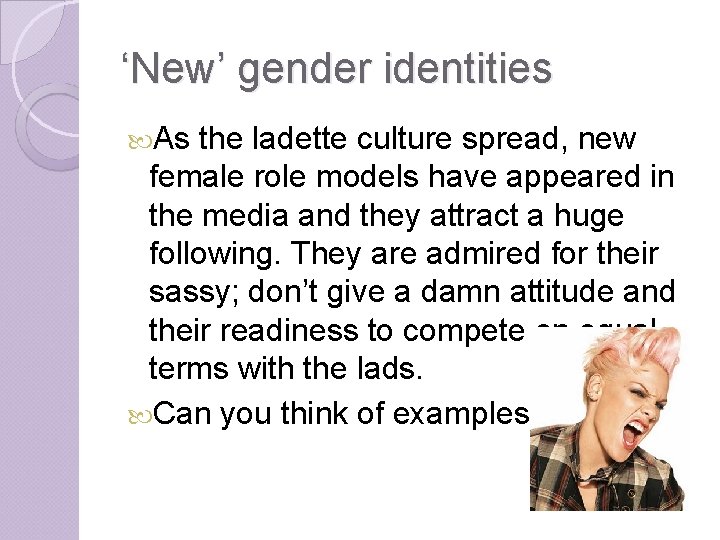
‘New’ gender identities As the ladette culture spread, new female role models have appeared in the media and they attract a huge following. They are admired for their sassy; don’t give a damn attitude and their readiness to compete on equal terms with the lads. Can you think of examples?
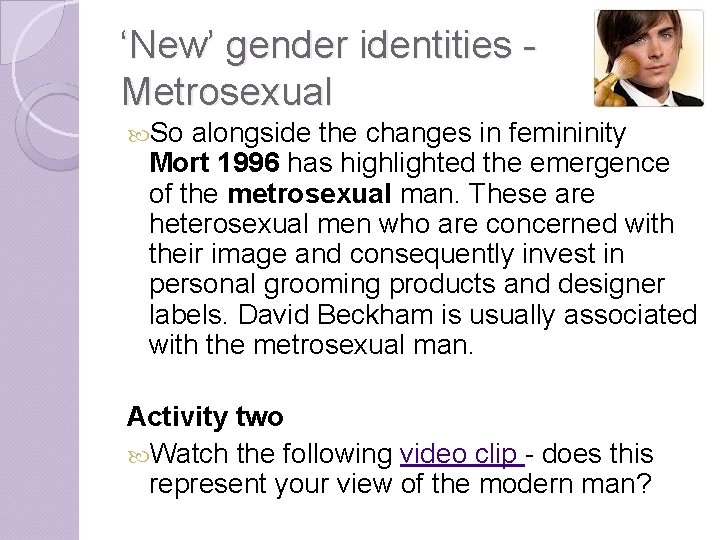
‘New’ gender identities Metrosexual So alongside the changes in femininity Mort 1996 has highlighted the emergence of the metrosexual man. These are heterosexual men who are concerned with their image and consequently invest in personal grooming products and designer labels. David Beckham is usually associated with the metrosexual man. Activity two Watch the following video clip - does this represent your view of the modern man?
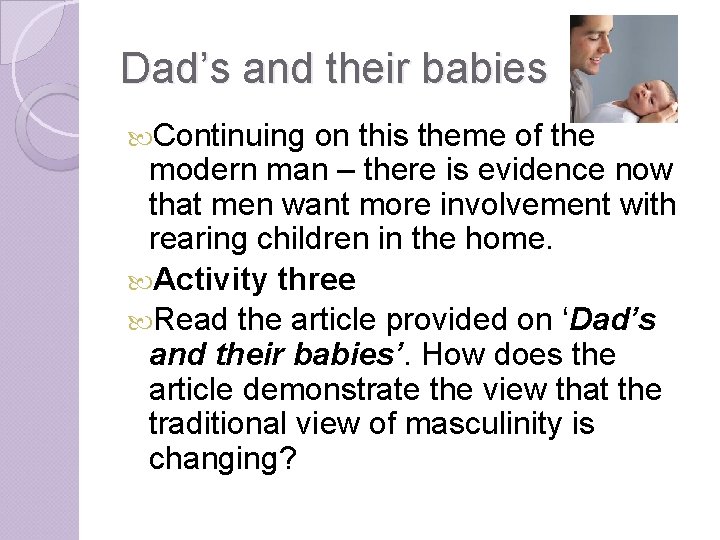
Dad’s and their babies Continuing on this theme of the modern man – there is evidence now that men want more involvement with rearing children in the home. Activity three Read the article provided on ‘Dad’s and their babies’. How does the article demonstrate the view that the traditional view of masculinity is changing?
Help with your summer work In your groups write down (on post-it notes) arguments for: A) there are still very traditional expectations of gender identity and B) gender identity has now changed – it is more a matter of personal choice. Once you have written down enough arguments for A and B please add to the board.
Plenary – Easy as one, two, three! Now think of one thing you already knew about the content of the lessons before you started Two things you have now understood Three things you would still like to find out