
Sociology Chapter 7 The Adult in Society Preview

- Slides: 18
Sociology Chapter 7 The Adult in Society Preview Section 1: Early and Middle Adulthood Section 2: The World of Work Section 3: The Later Years Chapter Wrap-Up
Sociology Chapter 7 Section 1: Early and Middle Adulthood Read to Discover • What is Daniel Levinson’s theory of adult male development? • What are the stages of adult female development?
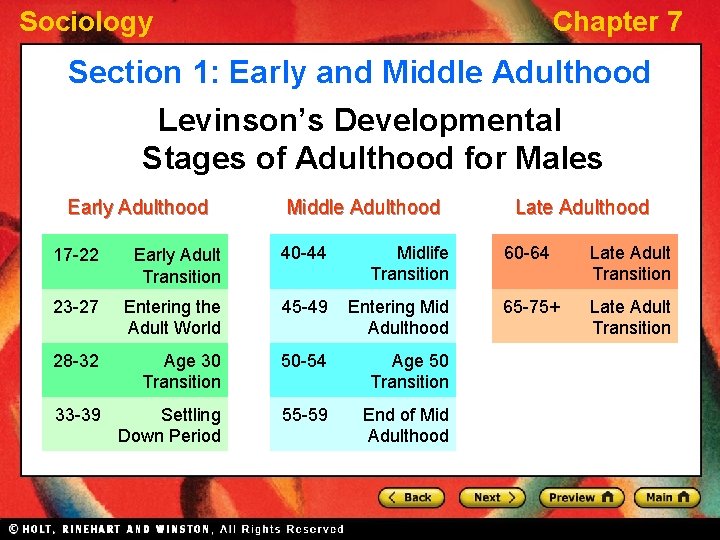
Sociology Chapter 7 Section 1: Early and Middle Adulthood Levinson’s Developmental Stages of Adulthood for Males Early Adulthood Middle Adulthood 17 -22 Early Adult Transition 40 -44 Midlife Transition 23 -27 Entering the Adult World 45 -49 Entering Mid Adulthood 28 -32 Age 30 Transition 50 -54 Age 50 Transition 33 -39 Settling Down Period 55 -59 End of Mid Adulthood Late Adulthood 60 -64 Late Adult Transition 65 -75+ Late Adult Transition
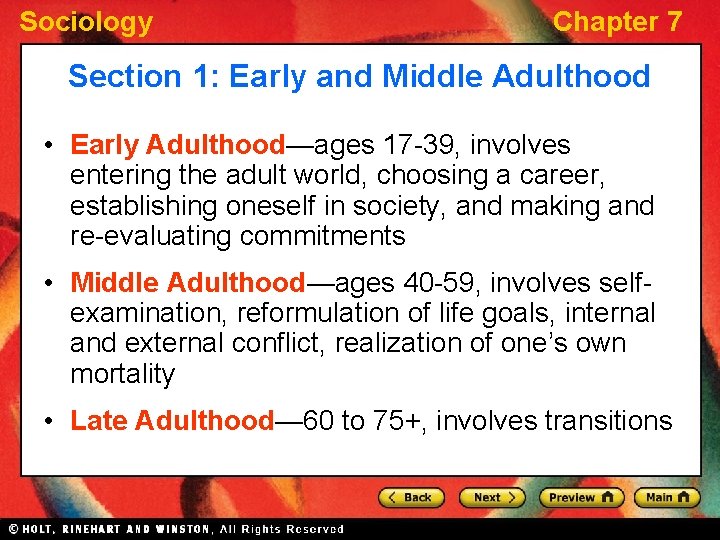
Sociology Chapter 7 Section 1: Early and Middle Adulthood • Early Adulthood—ages 17 -39, involves entering the adult world, choosing a career, establishing oneself in society, and making and re-evaluating commitments • Middle Adulthood—ages 40 -59, involves selfexamination, reformulation of life goals, internal and external conflict, realization of one’s own mortality • Late Adulthood— 60 to 75+, involves transitions
Sociology Chapter 7 Section 1: Early and Middle Adulthood Question What are the stages of adult female development?
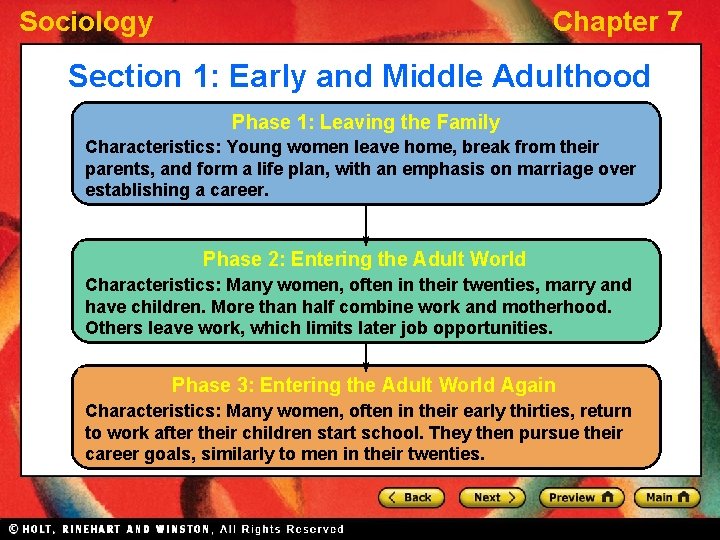
Sociology Chapter 7 Section 1: Early and Middle Adulthood Phase 1: Leaving the Family Characteristics: Young women leave home, break from their parents, and form a life plan, with an emphasis on marriage over establishing a career. Phase 2: Entering the Adult World Characteristics: Many women, often in their twenties, marry and have children. More than half combine work and motherhood. Others leave work, which limits later job opportunities. Phase 3: Entering the Adult World Again Characteristics: Many women, often in their early thirties, return to work after their children start school. They then pursue their career goals, similarly to men in their twenties.
Sociology Chapter 7 Section 2: The World of Work Read to Discover • How has the nature of work in the United States changed? • How has the composition of the labor force in the United States changed?
Sociology Chapter 7 Section 2: The World of Work Question How have the nature of work and the composition of the labor force changed in the United States?
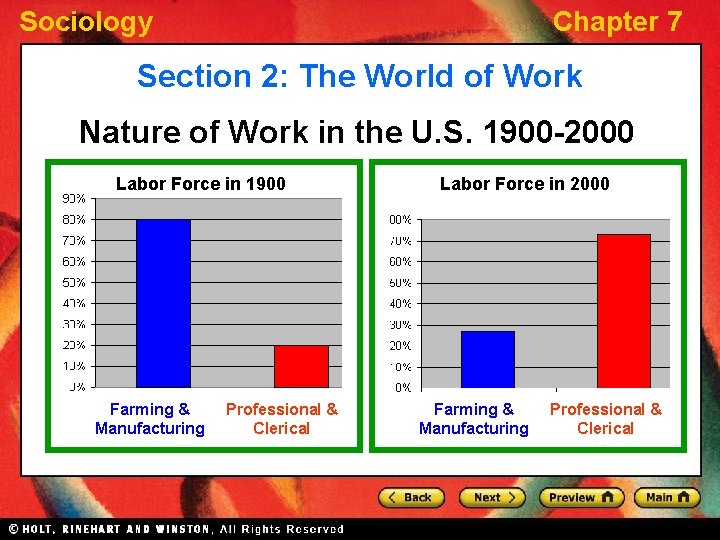
Sociology Chapter 7 Section 2: The World of Work Nature of Work in the U. S. 1900 -2000 Labor Force in 1900 Farming & Manufacturing Professional & Clerical Labor Force in 2000 Farming & Manufacturing Professional & Clerical
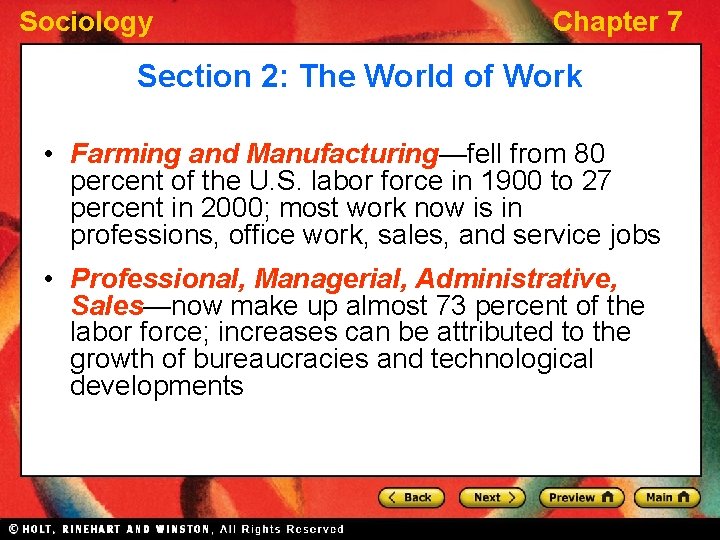
Sociology Chapter 7 Section 2: The World of Work • Farming and Manufacturing—fell from 80 percent of the U. S. labor force in 1900 to 27 percent in 2000; most work now is in professions, office work, sales, and service jobs • Professional, Managerial, Administrative, Sales—now make up almost 73 percent of the labor force; increases can be attributed to the growth of bureaucracies and technological developments
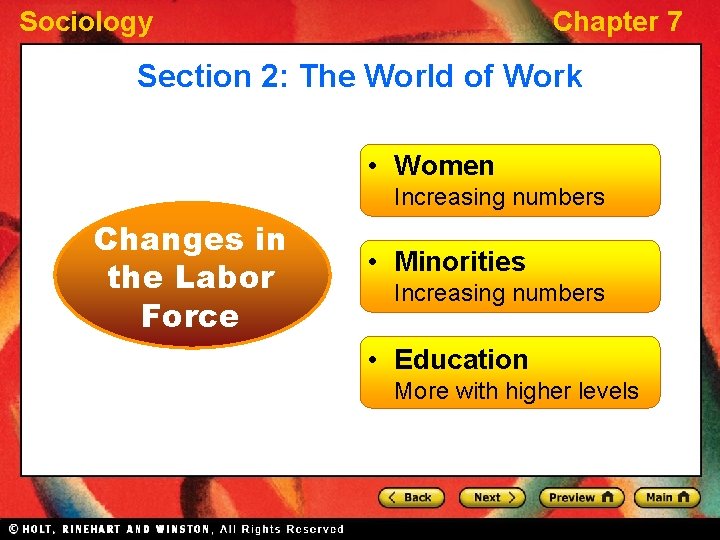
Sociology Chapter 7 Section 2: The World of Work • Women Increasing numbers Changes in the Labor Force • Minorities Increasing numbers • Education More with higher levels
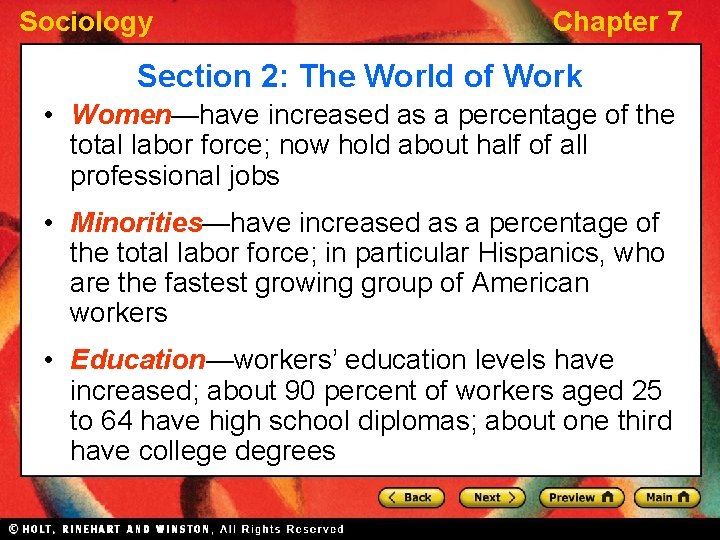
Sociology Chapter 7 Section 2: The World of Work • Women—have increased as a percentage of the total labor force; now hold about half of all professional jobs • Minorities—have increased as a percentage of the total labor force; in particular Hispanics, who are the fastest growing group of American workers • Education—workers’ education levels have increased; about 90 percent of workers aged 25 to 64 have high school diplomas; about one third have college degrees
Sociology Chapter 7 Section 3: The Later Years Read to Discover • What are the characteristics of life during late adulthood? • What new challenges do older Americans face?
Sociology Chapter 7 Section 3: The Later Years Question What are characteristics of each stage of late adulthood?
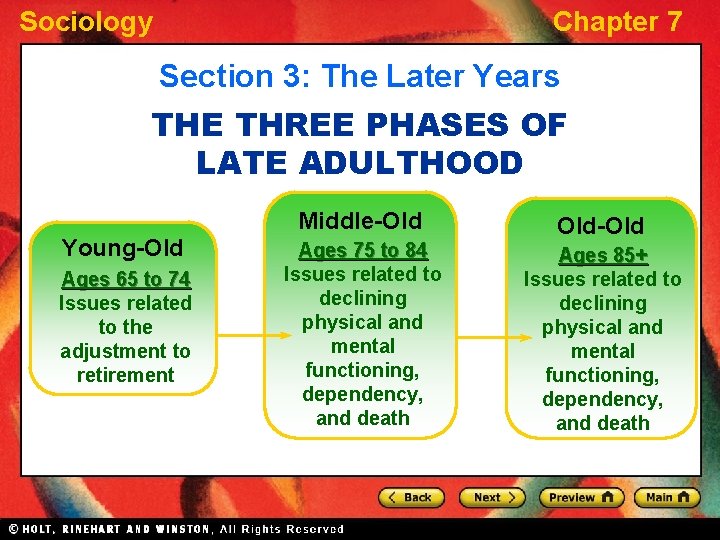
Sociology Chapter 7 Section 3: The Later Years THE THREE PHASES OF LATE ADULTHOOD Middle-Old Young-Old Ages 65 to 74 Issues related to the adjustment to retirement Ages 75 to 84 Issues related to declining physical and mental functioning, dependency, and death Old-Old Ages 85+ Issues related to declining physical and mental functioning, dependency, and death
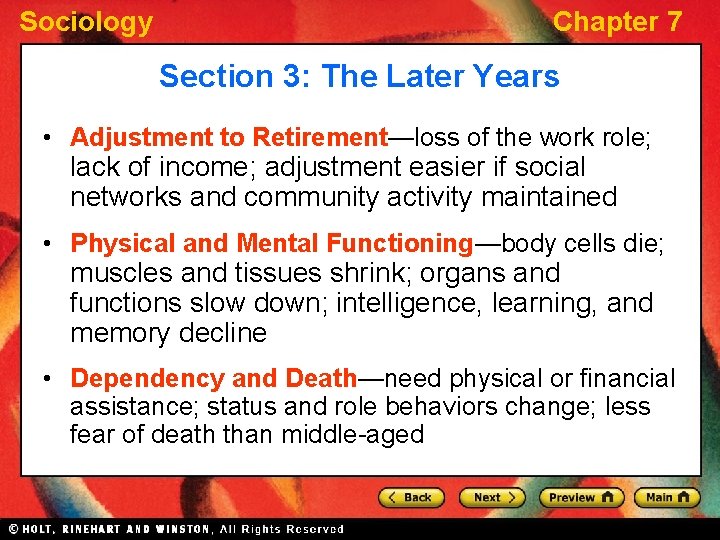
Sociology Chapter 7 Section 3: The Later Years • Adjustment to Retirement—loss of the work role; lack of income; adjustment easier if social networks and community activity maintained • Physical and Mental Functioning—body cells die; muscles and tissues shrink; organs and functions slow down; intelligence, learning, and memory decline • Dependency and Death—need physical or financial assistance; status and role behaviors change; less fear of death than middle-aged
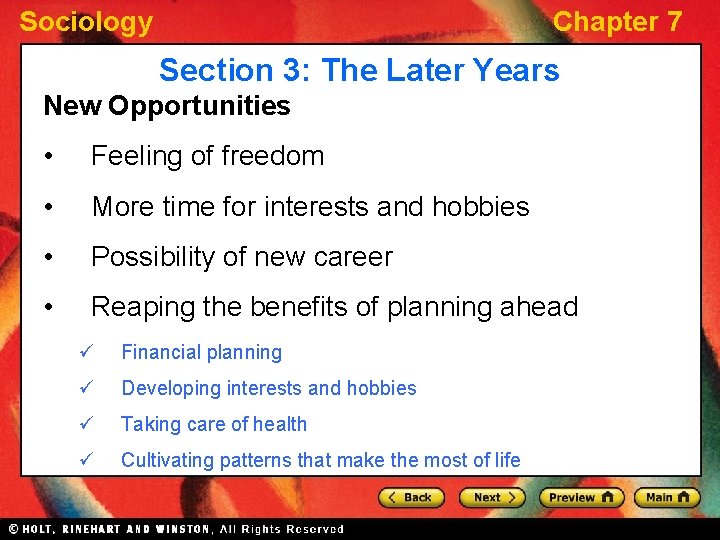
Sociology Chapter 7 Section 3: The Later Years New Opportunities • Feeling of freedom • More time for interests and hobbies • Possibility of new career • Reaping the benefits of planning ahead ü Financial planning ü Developing interests and hobbies ü Taking care of health ü Cultivating patterns that make the most of life
Sociology Chapter 7 Chapter Wrap-Up Understanding Main Ideas 1. Briefly describe Daniel Levinson’s views on adult male development. 2. How does adult female development differ from adult male development? 3. How has the composition of the American labor force changed? 4. In what ways did the nature of work in the United States change during the 1900 s? 5. What challenges and opportunities are associated with the later stages of life? 6. What are the main characteristics of each stage of life during the later years of adulthood?