
Sociology Chapter 4 Section 3 Agents of Socialization
- Slides: 10
Sociology Chapter 4 Section 3 Agents of Socialization
Agents of Socialization Specific individuals, groups, and institutions that enable socialization to take place What do you think are the biggest agents of socialization in the U. S. ? ◦ ◦ Family Peer Groups School Mass Media
Family First group in which children learn values, norms, and beliefs of society ◦ Deliberate Lessons parents try to teach children How to spend money/tell the truth ◦ Unintended Lessons children pick up by watching Do as I say, not as I do
Process of socialization changes from family to family ◦ Size of family ◦ One parent family ◦ Relationships among family Subgroups are important as well ◦ ◦ Race Social class Religion Geographic region
Peer Group Individuals of roughly equal age and similar social characteristics ◦ Biggest impact: pre-teen to teenage years People will shape themselves to be the person they think the group wants them to be Peer groups goals may go against the rules of society
School From ages 5 -18, roughly 36 weeks/year are spent in school Classes teach the 3 R’s Extracurricular activities Patriotism, responsibility, good citizenship Unintentional socialization: ◦ Peer groups ◦ Teachers may become models
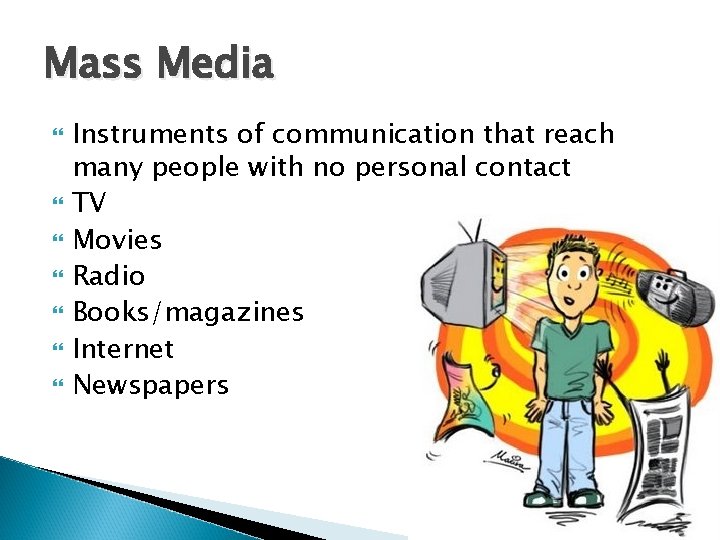
Mass Media Instruments of communication that reach many people with no personal contact TV Movies Radio Books/magazines Internet Newspapers
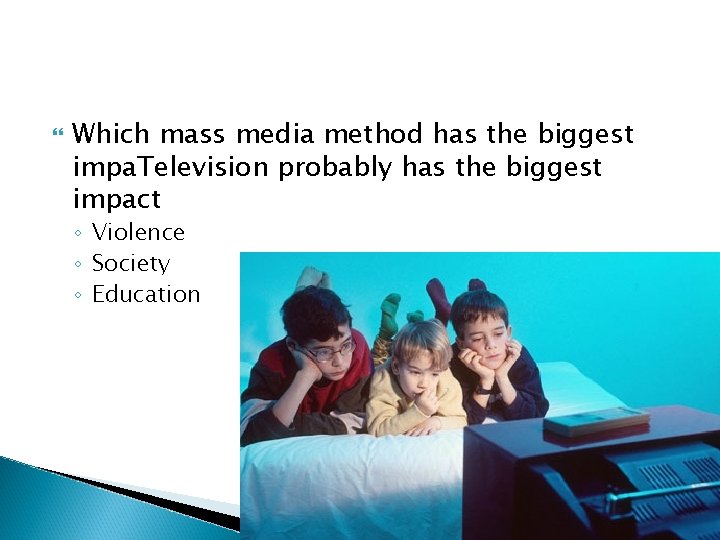
Which mass media method has the biggest impa. Television probably has the biggest impact ◦ Violence ◦ Society ◦ Education
Resocialization Break from past experience and learning new values and norms ◦ Voluntary Choose to learn new norms that differ from our previous experiences College ◦ Involuntary Learning new norms occurs against a persons will Total institutions
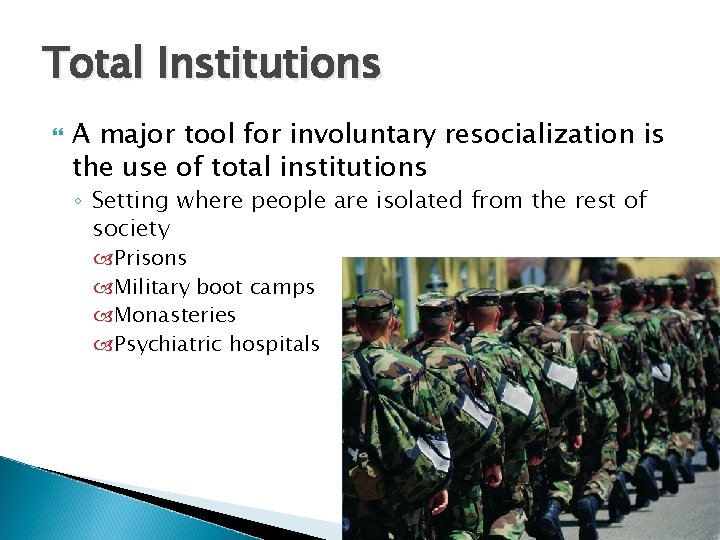
Total Institutions A major tool for involuntary resocialization is the use of total institutions ◦ Setting where people are isolated from the rest of society Prisons Military boot camps Monasteries Psychiatric hospitals