
SOCIOLOGY AS A HUMANISTIC AND SCIENTIFIC DISCIPLINE CHAPTER






- Slides: 18
SOCIOLOGY AS A HUMANISTIC AND SCIENTIFIC DISCIPLINE CHAPTER 1
DEFINITION AND NATURE OF SOCIOLOGY ü ü The science that deals with the study of society and the social interactions taking place therein is termed SOCIOLOGY. Sociology is derived from the Latin word “logos”, a Greek word for “study”.
ESSENTIAL CHARACTERISTICS OF SOCIOLOGY 1. 2. 3. Sociology is neutral – it describes society “as it is, ” not what “it ought to be. ” Sociology is concerned w/the study of human social life – the study of human interactions and social relationships, social processes, group life, factors that affect group living. Sociology is a science – it utilizes scientific methods and techniques to develop a body of organized, systematized and verifiable knowledge about human societies.
AREAS OF SOCIOLOGY 1. 2. 3. Social Organization – study of social groups, social institutions, social stratification and mobility, ethnic relations and bureaucracy. Social Psychology – study of human nature as the outcome of group life, personality formation, and collective behaviour. Social Change – social organization and social disorganization. This area involves the study of change in culture and on going social problems.
. Human Ecology – study the behaviour of a given population and its relationship to the group’s social institutions and natural resources. � 5. Population Studies – is concerned with the population size, composition, change, and quality as they influence the economic, political, and social systems and vice versa. � 6. Sociological Theory and Research – is concerned with the discovery, development, and replication of research tools. � 7. Applied Sociology – is concerned with the application of the findings of pure sociological research. �
PIONEERS/FORERUNNERS OF SOCIOLOGY EARLY PRACTITIONERS OF SOCIOLOGY : 1. 2. 3. 4. 5. 6. Henri Saint(1760 -1825) wrote his ideas on the science of society based on the assumption that the law of human behaviour could be determined in the same manner that the law of nature had been arrived at by natural scientist. Auguste Comte(1798 -1857)was a French philosopher who advocated the idea of “positivism” Herbert Spencer(1830 -1903) was a British philosopher-scientist who argued that human societies go through an evolutionary process and who coined the concept “survival of the fittest. ” Karl Marx (1818 -1883)was a German philosopher who believed that the misery and exploitation of working lower classes in society was caused by capitalism the existing industrial order. Emile Durkheim(1858 -1917)was a French sociologist who focused on the characteristics of social groups, particularly the cohesion or non-cohesion of religious groups. Max Weber(1864 -1920)was a Germany economist-lawyer whose works dwelt on significance of subjective meanings people give to their interactions with others.
OTHER PIONEERS 1. 2. 3. 4. Achille Loria(1857 -1943, Italian)- Economic evolutionism: his thesis; Gradual decrease of free land is the basic factor in the emergence of social classes. Adolphe Coste(1842 -1901, French)- Demographic evolutionism; the increasing density of population determines the evolution of society. Benjamin Kid(1858 -1916, English)- Religious evolutionism; religion with its social cohesion is the basic fore in social evolution. William Graham Summer(1840 -1913, American)analytical of discourse on folkways and mores, ethnocentrism and social norms.
THE CLASSICAL WRITERS 1. 2. 3. 4. 5. 6. 7. 8. 9. Emile Durkheim(1858 -1917, French)he advanced theory of growth from mechanical to organic solidarity. George Simmel(1858 -1918, German)he posited the process of social interaction as the focus of sociology; Vifrado Pareto(1848 -1923, Italian)he posited that society is a social system in dynamic equilibrium Max Weber(1864 -1920, German)he introduced verstehen or sympathetic introspection. Charles Cooley(1864 -1929, American)he posited the “organic theory of society”, theory of the looking glass self. ” William I. Thomas(1863 -1947, American)the situational approach and the study of action; definition of the situation by the actor. Ferdinand Toennies(1885 -1936, Gemarn)he introduced typology of society as gemeinshacft and gesellshacft. Gabriel Trde(1843 -1904, French) “Theory of imitation. ” Thorstein Veblen(1857 -1929, American) technology evolutionism and human social relations and culture are shaped by technology, “Theory of the leisure class behaviour”.
RELATIONSHIP OF SOCIOLOGY TO THE OTHER SCIENCES 1. 2. 3. 4. 5. Sociology and Economics – is concerned w/human activities related to the production, consumption, and distribution of goods, services, and wealth w/in societies for the satisfaction of material needs and wants. Sociology and Anthropology – is the science which studies man both as an animal and as living in society, his origins, development, distribution, social habits and culture. Sociology and History-is concerned with the presentation of a more or less complete narrative of human experience, a description of the significant past events, man’s record of the past. Sociology and Psychology- is the science that deals with the study of human behaviour which aims to understand human behaviour, to predict human behaviour. Sociology and Political Science- is concerned with political processes, power struggle and governments.
CAREERS IN SOCIOLOGY 1. 2. 3. 4. 5. 6. 7. 8. 9. 10. 11. 12. 13. 14. Community Organizers and Development Workers Community Outreach Social Worker Welfare and Rehabilitation Worker Census Enumerators Program Implements Social Researchers(Universities, Corporations, GO’s and NGO’s. Analysts of Social Development Programs Human Resources Development Training Officers Teachers in the Social Science Labour Relations Officer Consultants in Community Development Projects Parole and Probation Officers Administrative Aides
Theoretical Paradigms on Society and Social Behaviour CHAPTER 2
THEORETICAL PARADIGMS 1. a. b. DEFINITION OF TERMS Theory – it refers to an organized body of ideas as to the truth of something, usually derived from the study of facts related to it, but sometimes a result of exercising the speculative imagination. Theoretical Paradigm- a basic image of society that guides thinking and research.
� FOUR THEORETICAL PARADIGMS � 1. The Evolutionary Theory – proposes that societies, like biological organisms, undergo different stages in the development cycle, and that societies passed through different phases growth and development, from simple -primitive archaic society to complex-modern society. � 2. Structural-Functional Paradigm- is a framework for building theory that envisions society as a complex system whose parts work together to promote solidarity and stability
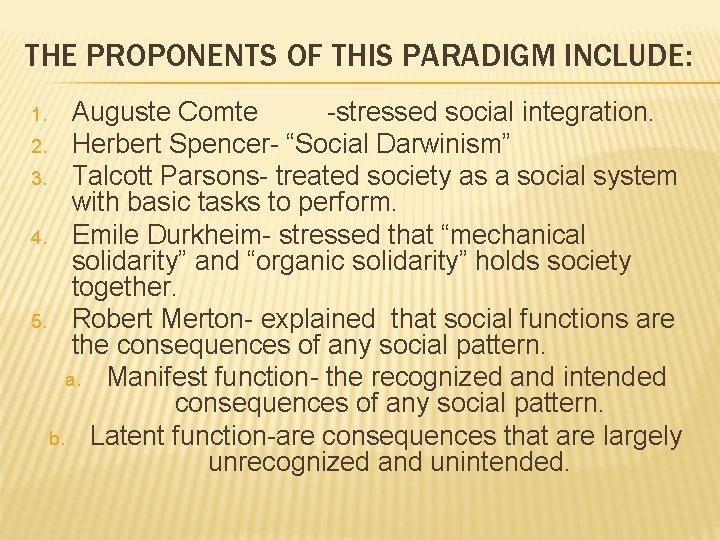
THE PROPONENTS OF THIS PARADIGM INCLUDE: Auguste Comte -stressed social integration. 2. Herbert Spencer- “Social Darwinism” 3. Talcott Parsons- treated society as a social system with basic tasks to perform. 4. Emile Durkheim- stressed that “mechanical solidarity” and “organic solidarity” holds society together. 5. Robert Merton- explained that social functions are the consequences of any social pattern. a. Manifest function- the recognized and intended consequences of any social pattern. b. Latent function-are consequences that are largely unrecognized and unintended. 1.
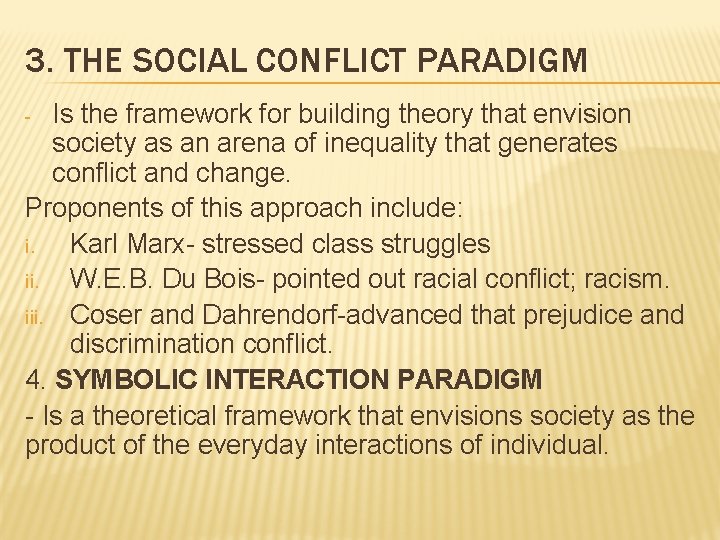
3. THE SOCIAL CONFLICT PARADIGM Is the framework for building theory that envision society as an arena of inequality that generates conflict and change. Proponents of this approach include: i. Karl Marx- stressed class struggles ii. W. E. B. Du Bois- pointed out racial conflict; racism. iii. Coser and Dahrendorf-advanced that prejudice and discrimination conflict. 4. SYMBOLIC INTERACTION PARADIGM - Is a theoretical framework that envisions society as the product of the everyday interactions of individual. -
THE PROPONENTS OF THE S-I PARADIGM INCLUDES; a. b. c. d. e. George Herbert Mead(1934)- his major interest is everyday human interactions. W. I. Thomas(1937)-he pointed out that we continuously sixe up the “here and now” context In which we find ourselves and assign meaning to it. Erving Goffman(1959)-he advanced dramaturgy as a related theory to the symbolic-interactionist paradigm. Harold Garfinkel(1967)-he focused attention on the taken-for-granted routine activities of our daily lives and the understandings that lie behind them. Peter M. Blau(1964) and George C. Homans(1947)-they advanced the social exchange approach to portray social interaction.
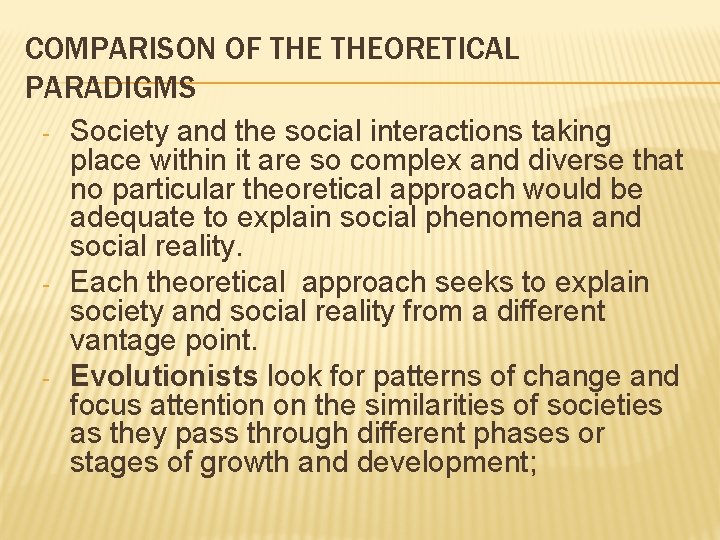
COMPARISON OF THEORETICAL PARADIGMS - - - Society and the social interactions taking place within it are so complex and diverse that no particular theoretical approach would be adequate to explain social phenomena and social reality. Each theoretical approach seeks to explain society and social reality from a different vantage point. Evolutionists look for patterns of change and focus attention on the similarities of societies as they pass through different phases or stages of growth and development;
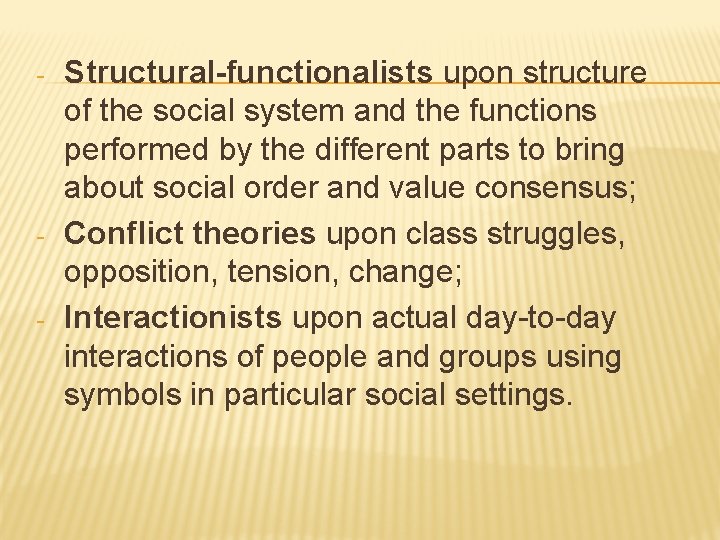
- - - Structural-functionalists upon structure of the social system and the functions performed by the different parts to bring about social order and value consensus; Conflict theories upon class struggles, opposition, tension, change; Interactionists upon actual day-to-day interactions of people and groups using symbols in particular social settings.