
Sociological Research Methods 1 Research Methods n Methodology



- Slides: 24
Sociological Research Methods 1
Research Methods n Methodology n n A system of rules and procedures that guide scientific investigation; research guidelines. Characteristics of scientific methodology 1. concerned with objectivity or exclusion of bias n 2. strict rules for admissible evidence n 3. careful records n 4. replication of findings n 2
Scientific Methodology n Science Logical systematic accumulation of knowledge based on direct, systematic observation. n Empirical evidence: evidence we can verify with our senses and experiences. n Scientific assumptions: n 1. there is order in the universe n 2. correlation: patterns of relationships n 3. causation: cause and effect relationships n 4. prediction n 3
Scientific Methodology n Variable n Any characteristic that can change or have different levels, rates, or statuses. Typical sociological variables: age, sex, race, education, social class, etc. n To operationalize a variable: specifying exactly what will be measured to indicate the variable. n Two types of influences among variables n 1. independent variable: the one that causes an effect. n 2. dependent variable: the one that is affected by another variable. n 4
Scientific Methodology n Causation n n When a change in the status of the independent variable (variable A) causes a corresponding change in the dependent variable (variable B), then there is causation, or a causal relationship between the two variables. (A B Changes in A cause changes in B). Generalizations n Recurrent relationships among particular variables allow us to make generalizations, or probability statements about the likelihood of future occurrence. 5
Scientific Methodology n Correlation n A regular relationship between 2 or more variables; the beginning point in establishing causation, or cause-effect relationships. High versus Low correlation. n High correlation is when great changes to the independent variable are associated with similarly great changes to the dependent variable. Low correlation is when great changes to the independent variable are associated with only minor changes in status of the dependent variable. Positive versus Negative correlation. n When an increase in the independent variable is associated with an increase in the dependent variable, this is a positive correlation. When an increase in the independent variable is associated with a decrease in the dependent variable, then this is a negative correlation. 6
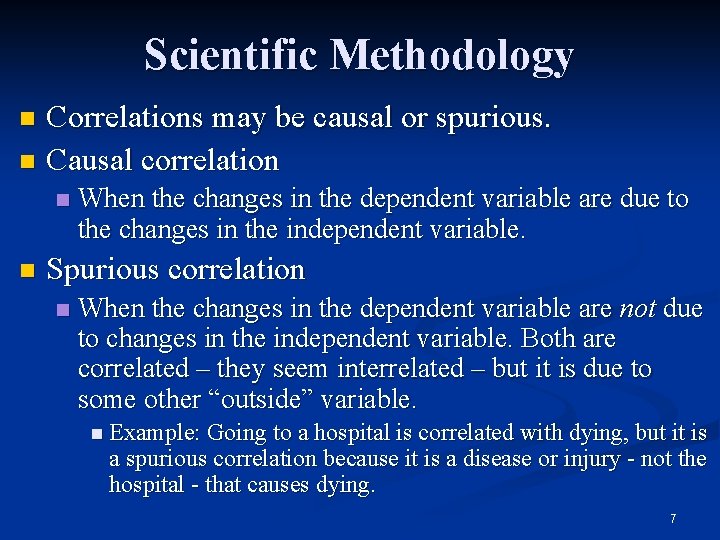
Scientific Methodology Correlations may be causal or spurious. n Causal correlation n When the changes in the dependent variable are due to the changes in the independent variable. Spurious correlation n When the changes in the dependent variable are not due to changes in the independent variable. Both are correlated – they seem interrelated – but it is due to some other “outside” variable. n Example: Going to a hospital is correlated with dying, but it is a spurious correlation because it is a disease or injury - not the hospital - that causes dying. 7
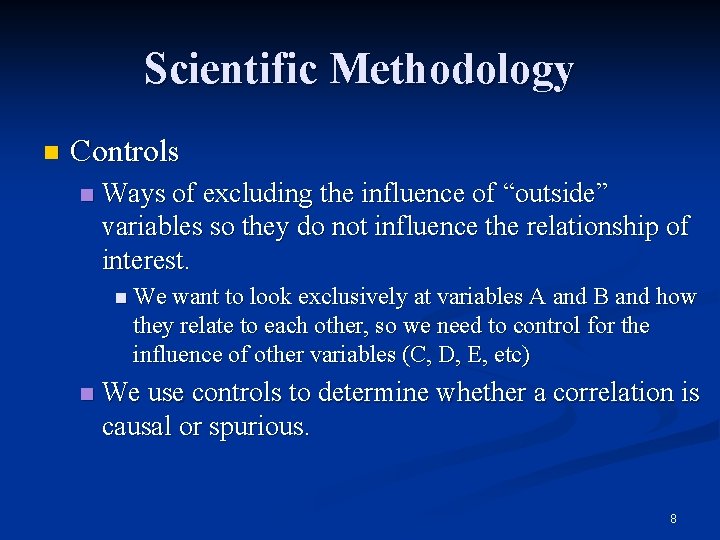
Scientific Methodology n Controls n Ways of excluding the influence of “outside” variables so they do not influence the relationship of interest. n We want to look exclusively at variables A and B and how they relate to each other, so we need to control for the influence of other variables (C, D, E, etc) n We use controls to determine whether a correlation is causal or spurious. 8
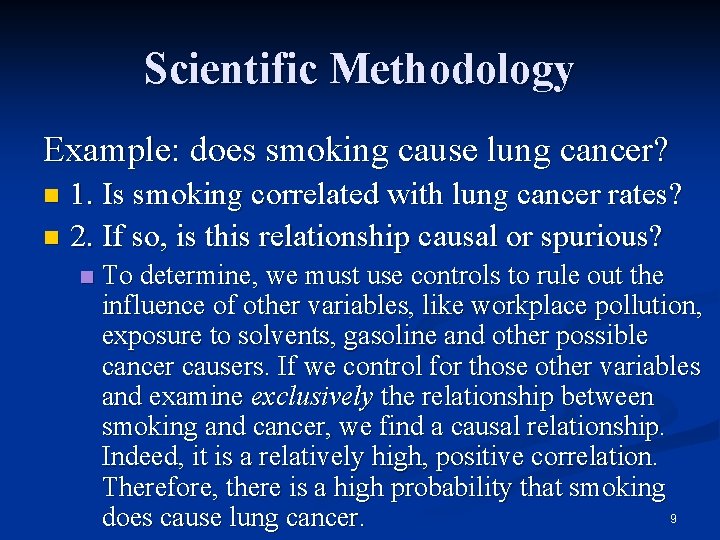
Scientific Methodology Example: does smoking cause lung cancer? 1. Is smoking correlated with lung cancer rates? n 2. If so, is this relationship causal or spurious? n n To determine, we must use controls to rule out the influence of other variables, like workplace pollution, exposure to solvents, gasoline and other possible cancer causers. If we control for those other variables and examine exclusively the relationship between smoking and cancer, we find a causal relationship. Indeed, it is a relatively high, positive correlation. Therefore, there is a high probability that smoking 9 does cause lung cancer.
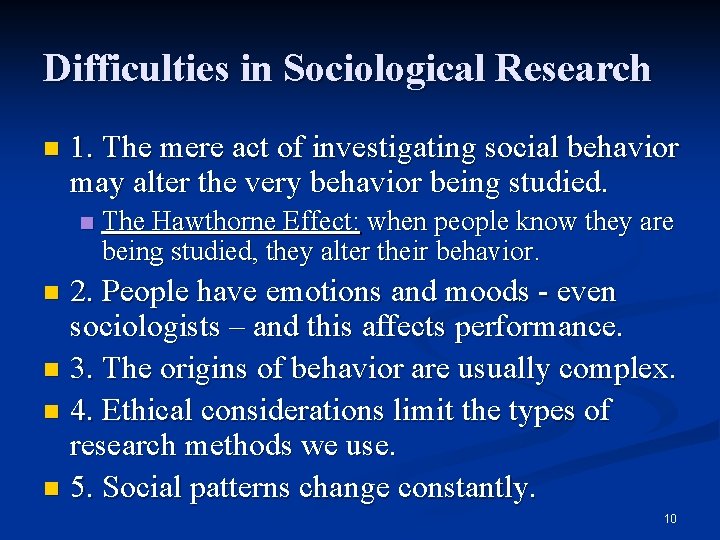
Difficulties in Sociological Research n 1. The mere act of investigating social behavior may alter the very behavior being studied. n The Hawthorne Effect: when people know they are being studied, they alter their behavior. 2. People have emotions and moods - even sociologists – and this affects performance. n 3. The origins of behavior are usually complex. n 4. Ethical considerations limit the types of research methods we use. n 5. Social patterns change constantly. n 10
Methodology split to address these difficulties and theoretical differences n n n Scientific Sociology adopts a quantitative approach, with emphasis on scientific methods, exclusion of bias, and statistical measurement techniques. This is highly precise, but dry. Interpretive Sociology adopts a qualitative approach, with emphasis on verstehen (empathy, or understanding the subjective reality of the research subjects). This is prone to bias, but yields rich insights. Critical Sociology, related to Karl Marx, is a qualitative method that focuses on ethical issues involving the need for social change where the researcher is also an activist. It is prone to bias, but yields rich insights. 11
Four Basic Research Methods 1. Experiment n 2. Survey research n 3. Observational study n 4. Existing sources or secondary data analysis n 12
1. Experiment n n A method of investigating cause-effect relationships under controlled conditions. The idea is to study the relationship between 2 variables while controlling for other factors. Typical technique 1. divide people into 2 identical groups, similar in all respects. One group is the experimental group, the other is the control group. n 2. Introduce the independent variable to the experimental group, but not the control group. n 3. Then, afterwards, compare these 2 groups to see if they are still identical. If not, it is probably due to the independent variable. n Advantages: ability to use controls; ability to perform statistical analysis. n Disadvantages: Hawthorne effect; limited to narrowly defined issues and smaller scale research. 13 n
2. Survey n n n Scientific survey: a method of systematically obtaining accurate, standardized information about a population. Survey population: the total category of people we are interested in. This population must be carefully defined. Census: ask every member of the population; very expensive and time consuming for large populations but very accurate. Sample: ask a small but representative group pulled from the survey population. This is more efficient, but less accurate. Sample size: n 100 -3000 is the typical size for a simple survey. Above 14 3000 is overkill, and below 100 is too small to make
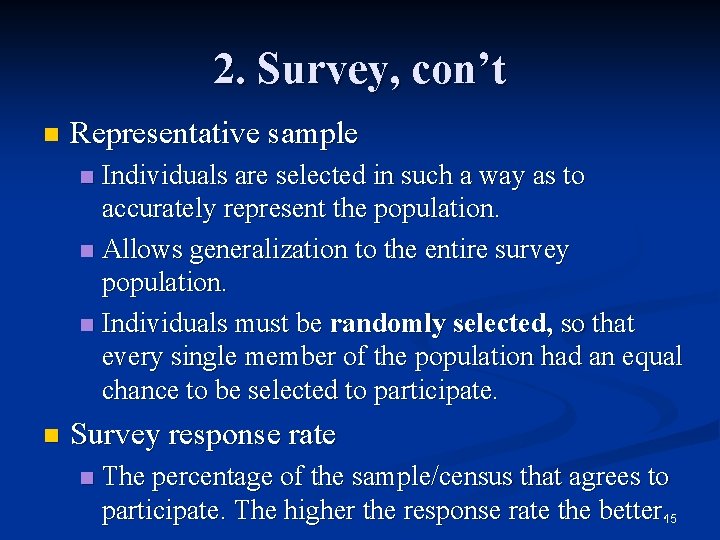
2. Survey, con’t n Representative sample Individuals are selected in such a way as to accurately represent the population. n Allows generalization to the entire survey population. n Individuals must be randomly selected, so that every single member of the population had an equal chance to be selected to participate. n n Survey response rate n The percentage of the sample/census that agrees to participate. The higher the response rate the better. 15
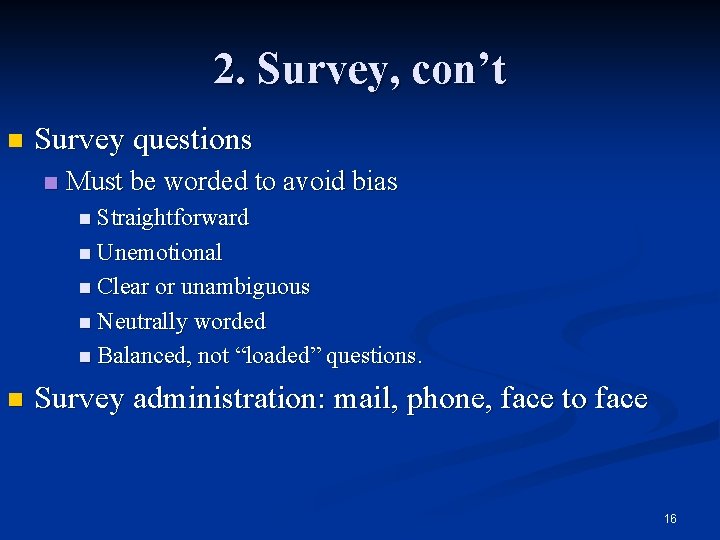
2. Survey, con’t n Survey questions n Must be worded to avoid bias n Straightforward n Unemotional n Clear or unambiguous n Neutrally worded n Balanced, not “loaded” questions. n Survey administration: mail, phone, face to face 16
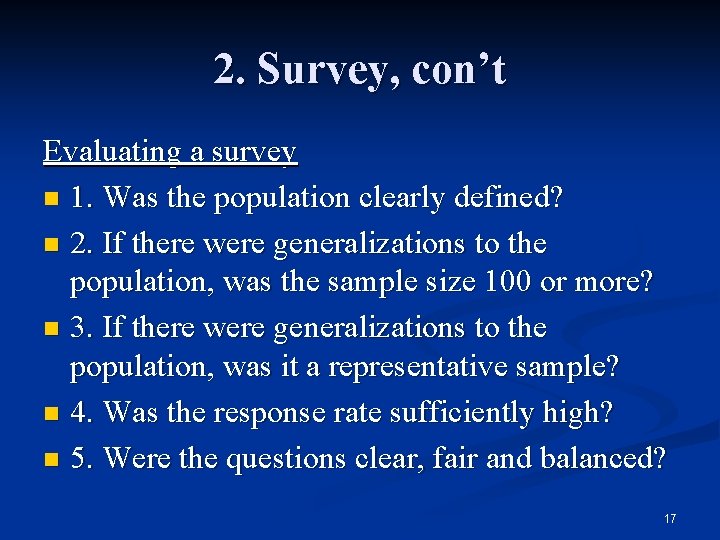
2. Survey, con’t Evaluating a survey n 1. Was the population clearly defined? n 2. If there were generalizations to the population, was the sample size 100 or more? n 3. If there were generalizations to the population, was it a representative sample? n 4. Was the response rate sufficiently high? n 5. Were the questions clear, fair and balanced? 17
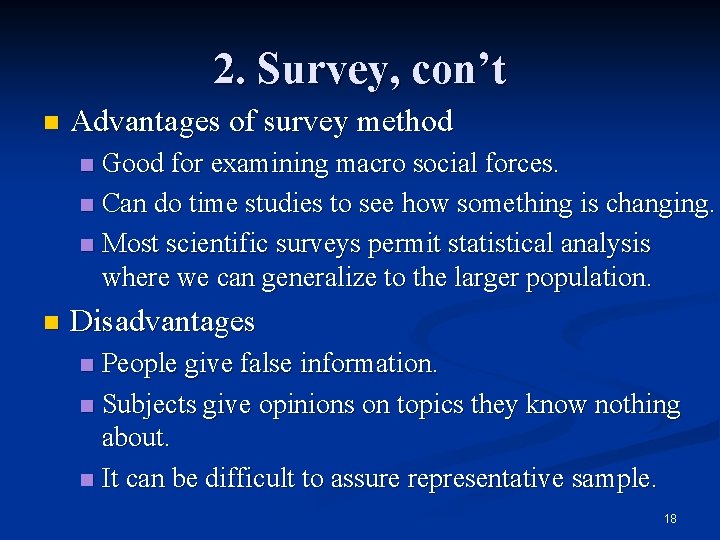
2. Survey, con’t n Advantages of survey method Good for examining macro social forces. n Can do time studies to see how something is changing. n Most scientific surveys permit statistical analysis where we can generalize to the larger population. n n Disadvantages People give false information. n Subjects give opinions on topics they know nothing about. n It can be difficult to assure representative sample. n 18
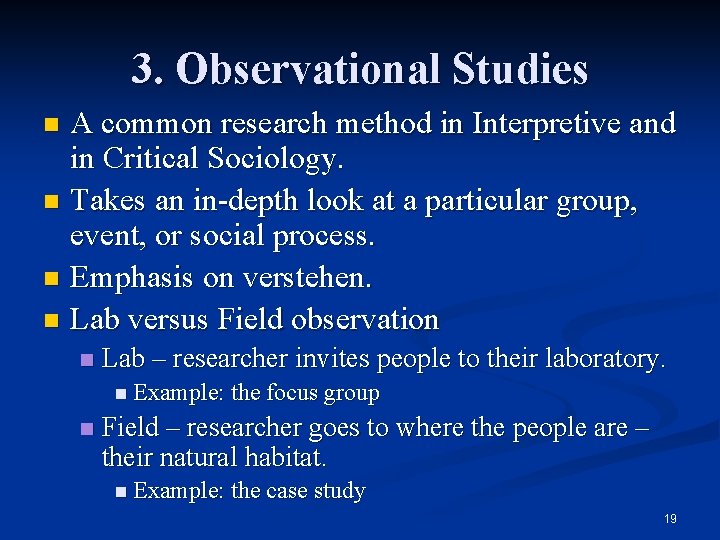
3. Observational Studies A common research method in Interpretive and in Critical Sociology. n Takes an in-depth look at a particular group, event, or social process. n Emphasis on verstehen. n Lab versus Field observation n n Lab – researcher invites people to their laboratory. n Example: the focus group n Field – researcher goes to where the people are – their natural habitat. n Example: the case study 19
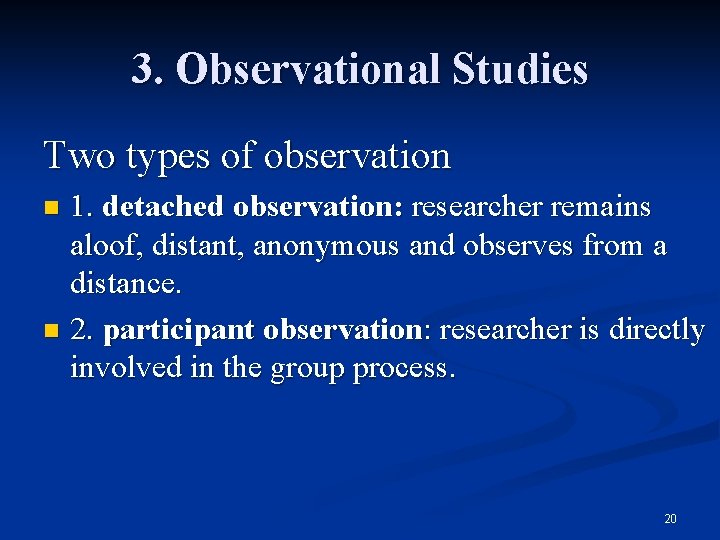
3. Observational Studies Two types of observation 1. detached observation: researcher remains aloof, distant, anonymous and observes from a distance. n 2. participant observation: researcher is directly involved in the group process. n 20
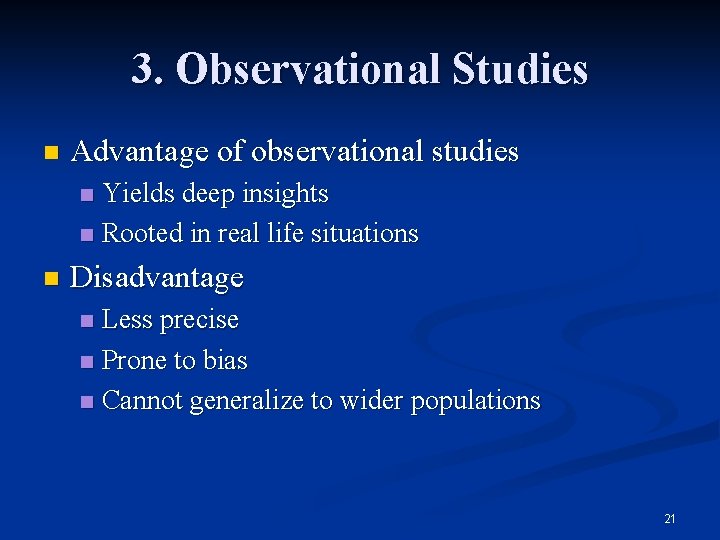
3. Observational Studies n Advantage of observational studies Yields deep insights n Rooted in real life situations n n Disadvantage Less precise n Prone to bias n Cannot generalize to wider populations n 21
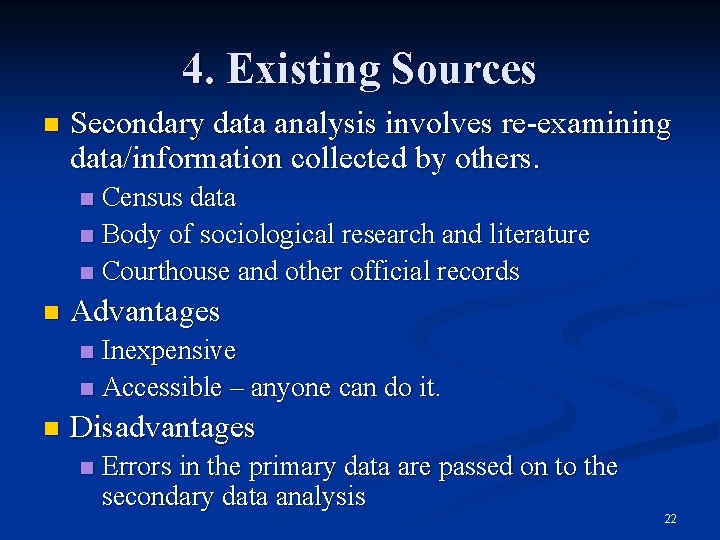
4. Existing Sources n Secondary data analysis involves re-examining data/information collected by others. Census data n Body of sociological research and literature n Courthouse and other official records n n Advantages Inexpensive n Accessible – anyone can do it. n n Disadvantages n Errors in the primary data are passed on to the secondary data analysis 22
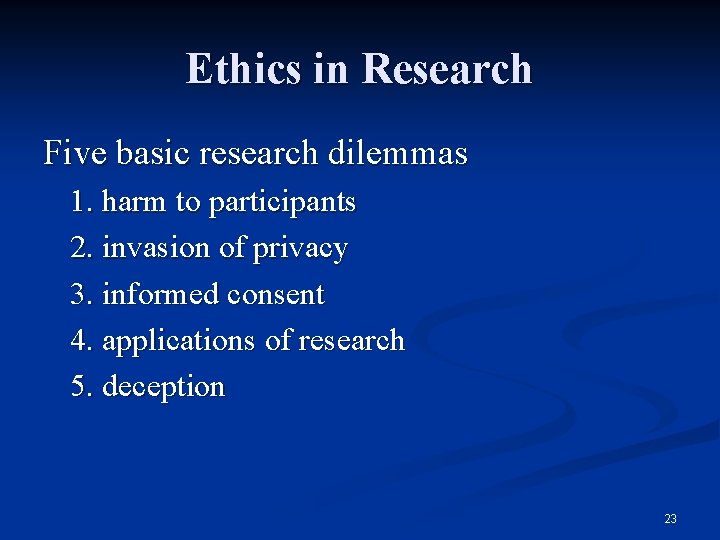
Ethics in Research Five basic research dilemmas 1. harm to participants 2. invasion of privacy 3. informed consent 4. applications of research 5. deception 23
End of Chapter 2 24