
Sociolinguistic Competence A limited view A traditional approach

- Slides: 6
Sociolinguistic Competence A limited view: A traditional approach to sociolinguistic competence is to use and teach language that is appropriate based on the expectations and norms of the inner circle countries, namely Australia, Canada, New Zealand, the UK and the USA. This approach is problematic for two reasons. Firstly, expectations and norms can differ significantly within an inner circle country. Secondly, this approach neglects the role of English in international communications (Alptekin, 2002).
A holistic view: Sociolinguistic competence refers to the ability to use language that is appropriate to social contexts. Alptekin (2002, p. 58) explains that social context refers to culture-specific contexts that include the norms, values, beliefs, and behavioural patterns of a culture. For example, thanking a friend in a formal speech is different from how it is done over a meal. Sociolinguistic competence also refers to the ability to select topics that are appropriate for a communicative event. For example, expressing strong views about politics and religion over dinner is generally avoided. This rule is also moderated depending on the relationship between the guest and the host. If politics and religion are their favourite topics and if they know each other very well, these topics might well be appropriate.
Sociolinguistic competence is the knowledge of sociocultural rules of use, i. e. knowing how to use and respond to language appropriately. The appropriateness depends on the setting of the communication, the topic, and the relationships among the people communicating. Moreover, being appropriate depends on knowing what the taboos of the other culture are, what politeness indices are used in each case, what the politically correct term would be for something, how a specific attitude (authority, friendliness, courtesy, irony etc. ) is expressed etc. Sociolinguistic competence addresses the extent to which utterances are produced and understood appropriately in different sociolinguistic contexts depending on contextual factors such as status of participants, purpose of the interaction, and norms or conventions of interaction.
Theory and practice: Instructional materials should reflect how English is used in both international and local contexts. Situations that reflect international communication should be those that learners are likely to encounter, which include asking for directions during an overseas holiday and introducing oneself at a university exchange programme. A local context example would be giving directions to tourists. It is important for learners to think critically about the notion of politeness (Celce-Murcia, 2007, p. 46). As politeness differs across culture and social contexts, it is important to give others the benefit of the doubt. For example, if a person asks your age, it is worth considering that such a question might be acceptable or even desirable in his or her culture. Another useful strategy is to help learners become analysts themselves. For example, teachers can play a video clip of a dinner conversation and have learners compare the interaction, such as choice of topic and turn taking, with what they are familiar with. Such a clip should be used as a prompt to promote critical reflection rather than as a stereotype of a particular culture.
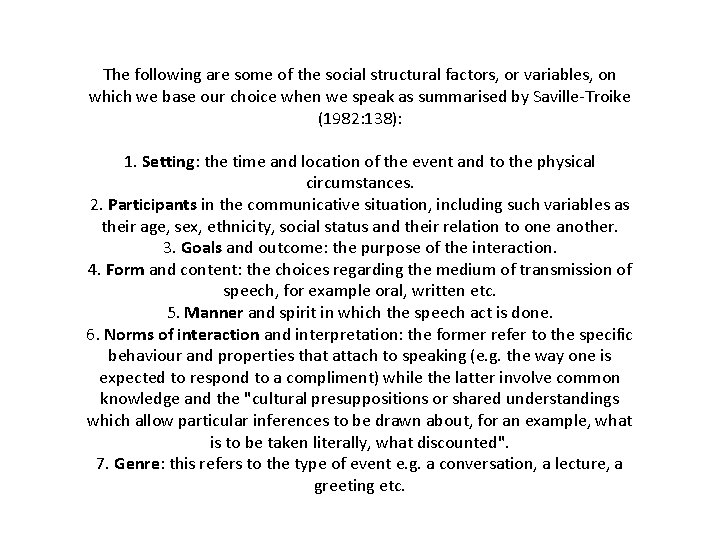
The following are some of the social structural factors, or variables, on which we base our choice when we speak as summarised by Saville-Troike (1982: 138): 1. Setting: the time and location of the event and to the physical circumstances. 2. Participants in the communicative situation, including such variables as their age, sex, ethnicity, social status and their relation to one another. 3. Goals and outcome: the purpose of the interaction. 4. Form and content: the choices regarding the medium of transmission of speech, for example oral, written etc. 5. Manner and spirit in which the speech act is done. 6. Norms of interaction and interpretation: the former refer to the specific behaviour and properties that attach to speaking (e. g. the way one is expected to respond to a compliment) while the latter involve common knowledge and the "cultural presuppositions or shared understandings which allow particular inferences to be drawn about, for an example, what is to be taken literally, what discounted". 7. Genre: this refers to the type of event e. g. a conversation, a lecture, a greeting etc.