
SocioCultural Issues Affecting Performance Sport in Society Emergence

- Slides: 40
Socio-Cultural Issues Affecting Performance Sport in Society Emergence and Evolution of Modern Sport
Learning Objectives Learning Objective: Understand how different factors affected the characteristics, participation, growth and development of sport through pre-industrial, post-industrial, 20 th century and 21 st century Britatin Learning Outcomes: All: Describe characteristics and participation in sport across the different stages Most: Explain the influencing factors on the growth and development of sport throughout the stages Some: Evaluate the effects of a variety of factors on the growth and development of sport throughout the stages
2012 London Olympics opening ceremony • 13 -25 mins • https: //www. youtube. com/watch? v=4 As 0 e 4 d e-r. I&safe=active
Key Terms • Pre-industrial Britain – Britain before 1750, before the industrial revolution. • Industrial Revolution - 1750 – 1850 where major changes occurred to our society and sport relating to society, living, transport, jobs, education, sport • Post-industrial Britain - A term used by social theorists to describe the stage of economic development that follows industrialization. Post-industrial society is the stage of society's development when the service sector generates more wealth than the manufacturing sector of the economy. The economy undergoes a transition from the production of goods to the provision of services. • 20 th Century - 1 Jan 1901 – 31 Dec 2000 • 21 st Century – 1 Jan 2001 - 31 Dec 2100
Pre-industrial Britain sports and pastimes • Mob Football - Shrovetide football https: //www. youtube. com/watch? v=pqtd 7 LOo. RVM • Aim – to get the ball to the centre of the ‘enemy’ village, or a particular point in their town • Lower class sport • Few rules (only no murder) • Played occasionally – religious festivals • Played between villages • Violent
Pre-industrial Britain sports and pastimes • Cock fighting - https: //vimeo. com/10259323 (watch from 2 mins - brutal – may want to look away) • • • 14 -square foot pit with an 8 inch high fence Upper class sport Involved gambling Made illegal in 1849 by Parliament Lower classes often participated in ‘throwing at cocks’ – a traditional Shrove Tuesday activity where a cockerel was tied to a stake and you would have to pay to throw sticks and stones at is from 20 ft (6 m). If you knocked the bird over and picked up the stick before the bird picked itself up you could claim the bird as your own and charge others to throw at it.
Pre-industrial Britain sports and pastimes • Pedestrianism https: //www. youtube. com/watch? v=e 1 Rk 8 szs. Tv. M • Lower classes would compete in running or walking races • Upper classes would be the patrons (sponsors) of lower-class participants. • Thought to have arisen from footmen who attended horsedrawn carriages of the aristocracy
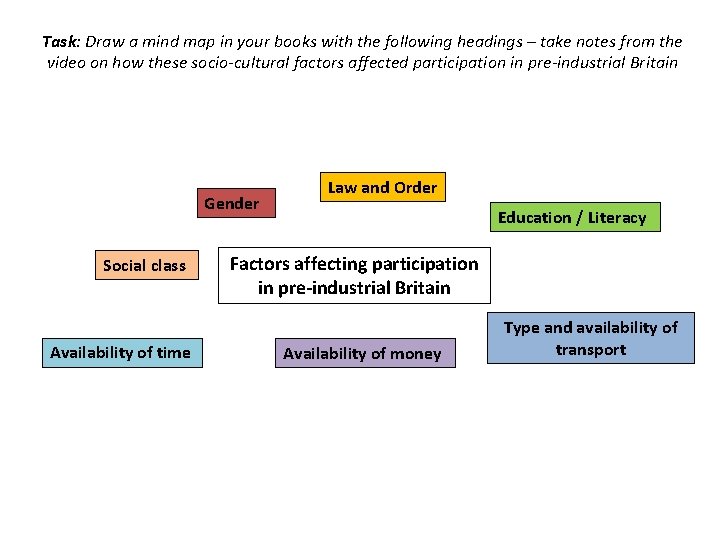
Task: Draw a mind map in your books with the following headings – take notes from the video on how these socio-cultural factors affected participation in pre-industrial Britain Gender Social class Availability of time Law and Order Education / Literacy Factors affecting participation in pre-industrial Britain Availability of money Type and availability of transport
Pre – industrial Britain - factors affecting participation • Socio-cultural factors affecting participation in preindustrial Britain https: //www. youtube. com/watch? v=h. IVqhj 9 d 4 Os&s afe=active • Social class • Gender • Law and order • Education/literacy • Availability of time • Availability of money • Type and availability of transport
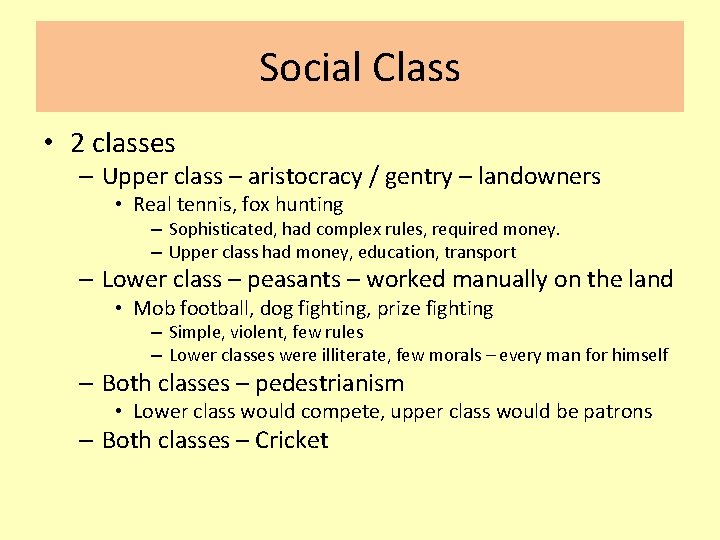
Social Class • 2 classes – Upper class – aristocracy / gentry – landowners • Real tennis, fox hunting – Sophisticated, had complex rules, required money. – Upper class had money, education, transport – Lower class – peasants – worked manually on the land • Mob football, dog fighting, prize fighting – Simple, violent, few rules – Lower classes were illiterate, few morals – every man for himself – Both classes – pedestrianism • Lower class would compete, upper class would be patrons – Both classes – Cricket
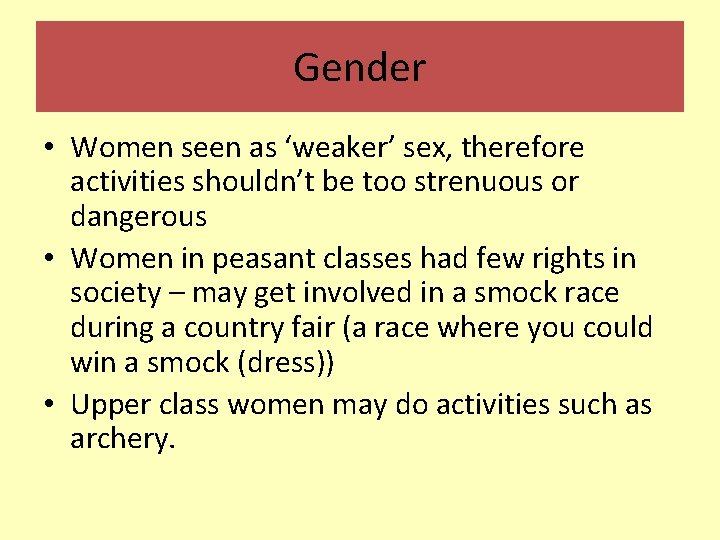
Gender • Women seen as ‘weaker’ sex, therefore activities shouldn’t be too strenuous or dangerous • Women in peasant classes had few rights in society – may get involved in a smock race during a country fair (a race where you could win a smock (dress)) • Upper class women may do activities such as archery.
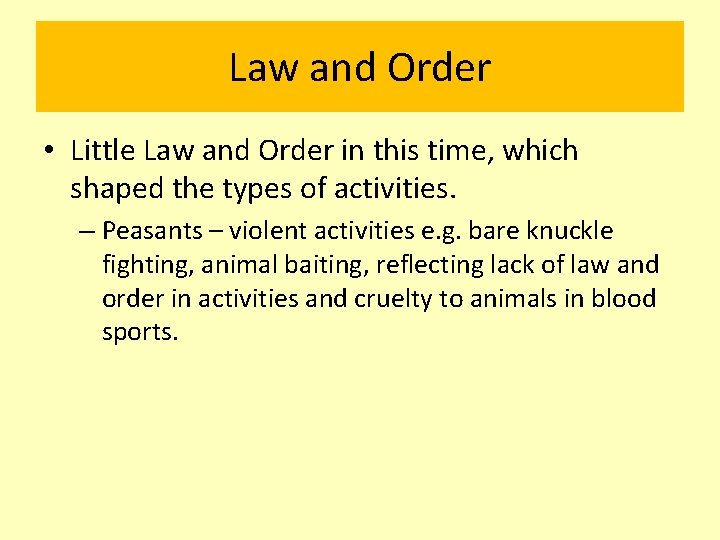
Law and Order • Little Law and Order in this time, which shaped the types of activities. – Peasants – violent activities e. g. bare knuckle fighting, animal baiting, reflecting lack of law and order in activities and cruelty to animals in blood sports.
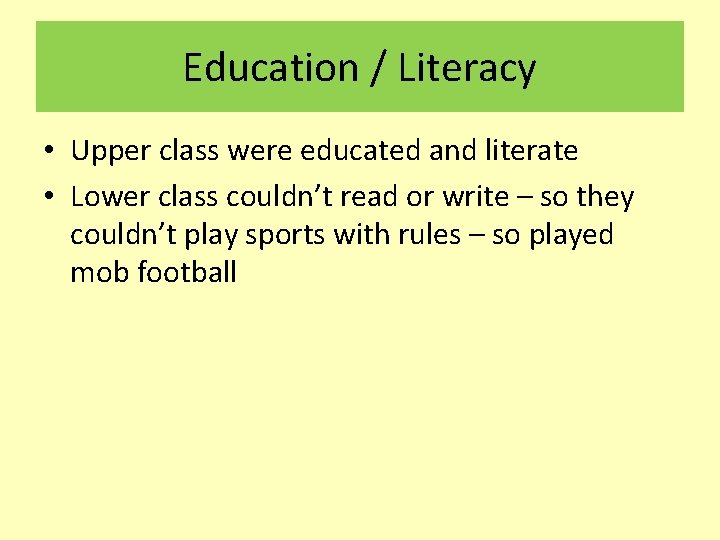
Education / Literacy • Upper class were educated and literate • Lower class couldn’t read or write – so they couldn’t play sports with rules – so played mob football
Availability of time • Lower class – worked very long, exhausting hours labouring on the land. Activities mainly confined to festivals or holy days or those that were based around local public houses e. g. drinking contests, bare knuckle fighting. Activities had to be short lasting, immediately entertaining and localised. • Upper classes had more time on their hands and could be involved in longer lasting activities such as fox hunting
Availability of money • Upper class had much more money - could afford horses, equipment, appropriate clothing for sports such as hunting and real tennis. • Lower class had little money so couldn’t afford to do any sports that required equipment
Type and availability of transport • Mainly horse and cart (gentry), or walking (peasants). • Roads were an appalling state, so prevented most people leaving their immediate village. • Therefore rules were often simple, only local people were aware of. • Gentry had horse and cart so could travel further to tennis courts, or could build thme in their own homes.
Industrial Revolution 1750 – 1850 • What happened during the Industrial Revolution? Industrial Revolution – crash course https: //www. youtube. com/watch? v=zh. L 5 DCizj 5 c&safe=active
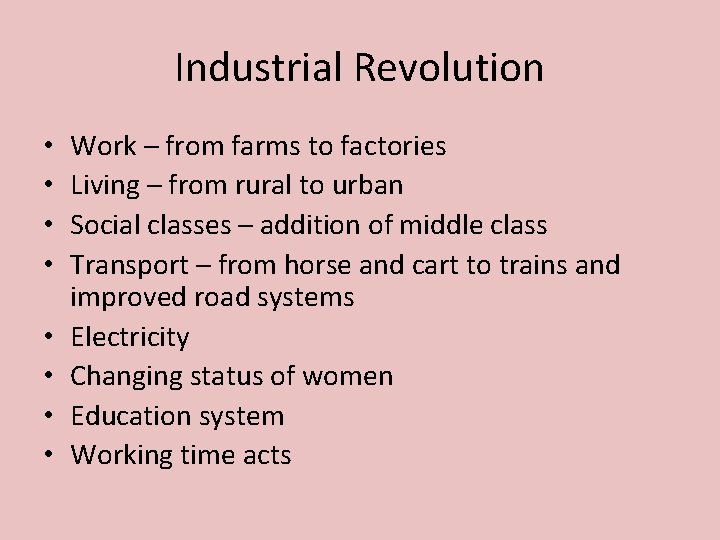
Industrial Revolution • • Work – from farms to factories Living – from rural to urban Social classes – addition of middle class Transport – from horse and cart to trains and improved road systems Electricity Changing status of women Education system Working time acts
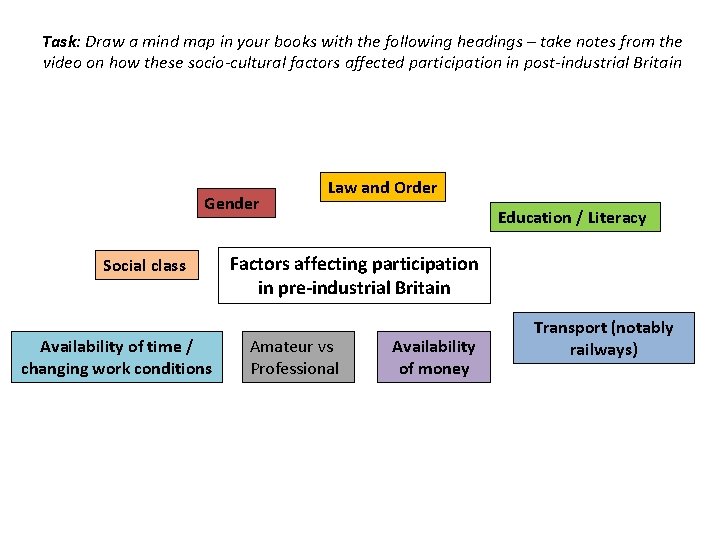
Task: Draw a mind map in your books with the following headings – take notes from the video on how these socio-cultural factors affected participation in post-industrial Britain Gender Social class Availability of time / changing work conditions Law and Order Education / Literacy Factors affecting participation in pre-industrial Britain Amateur vs Professional Availability of money Transport (notably railways)
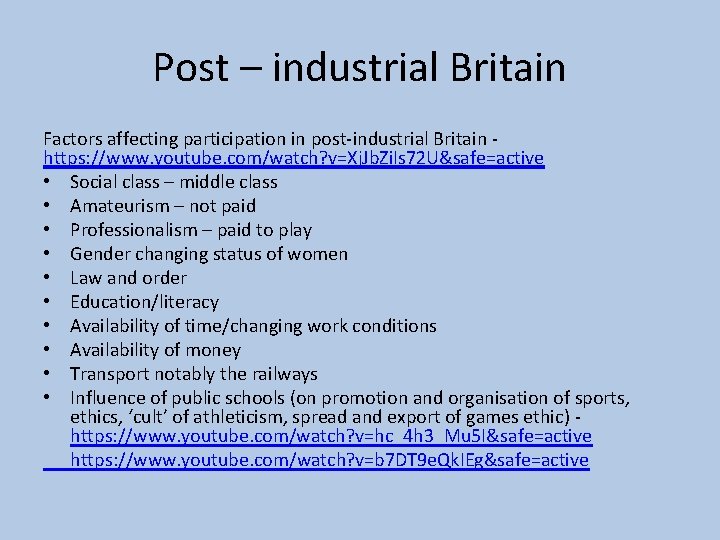
Post – industrial Britain Factors affecting participation in post-industrial Britain https: //www. youtube. com/watch? v=Xj. Jb. Zi. Is 72 U&safe=active • Social class – middle class • Amateurism – not paid • Professionalism – paid to play • Gender changing status of women • Law and order • Education/literacy • Availability of time/changing work conditions • Availability of money • Transport notably the railways • Influence of public schools (on promotion and organisation of sports, ethics, ‘cult’ of athleticism, spread and export of games ethic) https: //www. youtube. com/watch? v=hc_4 h 3_Mu 5 I&safe=active https: //www. youtube. com/watch? v=b 7 DT 9 e. Qk. IEg&safe=active
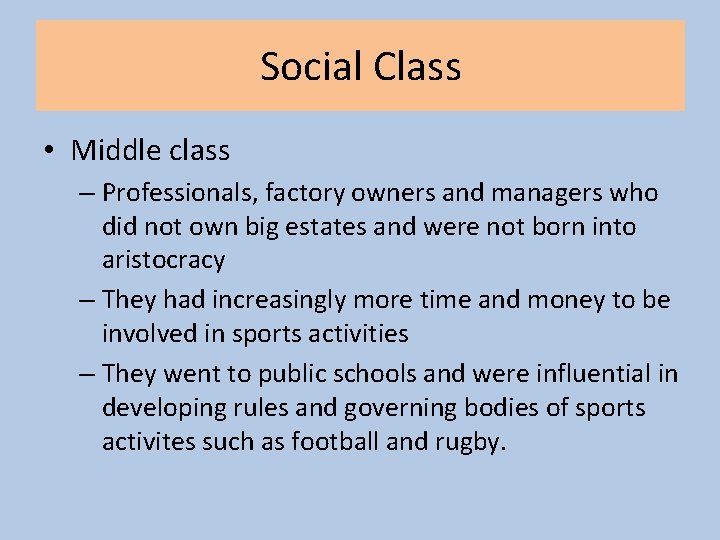
Social Class • Middle class – Professionals, factory owners and managers who did not own big estates and were not born into aristocracy – They had increasingly more time and money to be involved in sports activities – They went to public schools and were influential in developing rules and governing bodies of sports activites such as football and rugby.
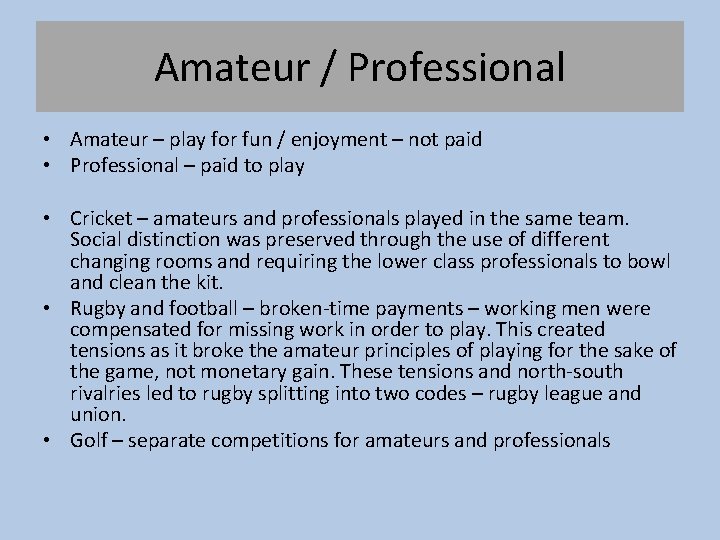
Amateur / Professional • Amateur – play for fun / enjoyment – not paid • Professional – paid to play • Cricket – amateurs and professionals played in the same team. Social distinction was preserved through the use of different changing rooms and requiring the lower class professionals to bowl and clean the kit. • Rugby and football – broken-time payments – working men were compensated for missing work in order to play. This created tensions as it broke the amateur principles of playing for the sake of the game, not monetary gain. These tensions and north-south rivalries led to rugby splitting into two codes – rugby league and union. • Golf – separate competitions for amateurs and professionals
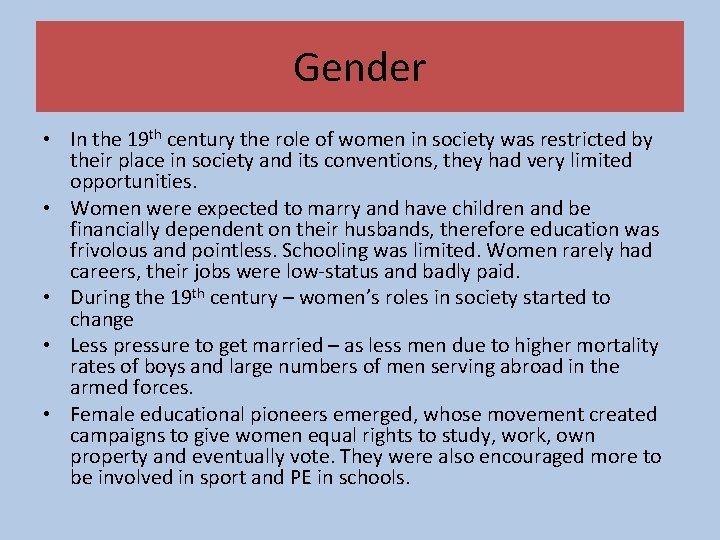
Gender • In the 19 th century the role of women in society was restricted by their place in society and its conventions, they had very limited opportunities. • Women were expected to marry and have children and be financially dependent on their husbands, therefore education was frivolous and pointless. Schooling was limited. Women rarely had careers, their jobs were low-status and badly paid. • During the 19 th century – women’s roles in society started to change • Less pressure to get married – as less men due to higher mortality rates of boys and large numbers of men serving abroad in the armed forces. • Female educational pioneers emerged, whose movement created campaigns to give women equal rights to study, work, own property and eventually vote. They were also encouraged more to be involved in sport and PE in schools.
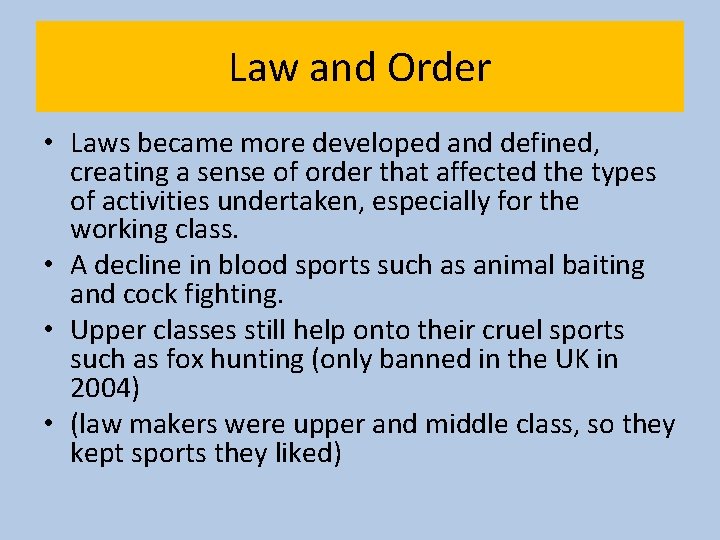
Law and Order • Laws became more developed and defined, creating a sense of order that affected the types of activities undertaken, especially for the working class. • A decline in blood sports such as animal baiting and cock fighting. • Upper classes still help onto their cruel sports such as fox hunting (only banned in the UK in 2004) • (law makers were upper and middle class, so they kept sports they liked)
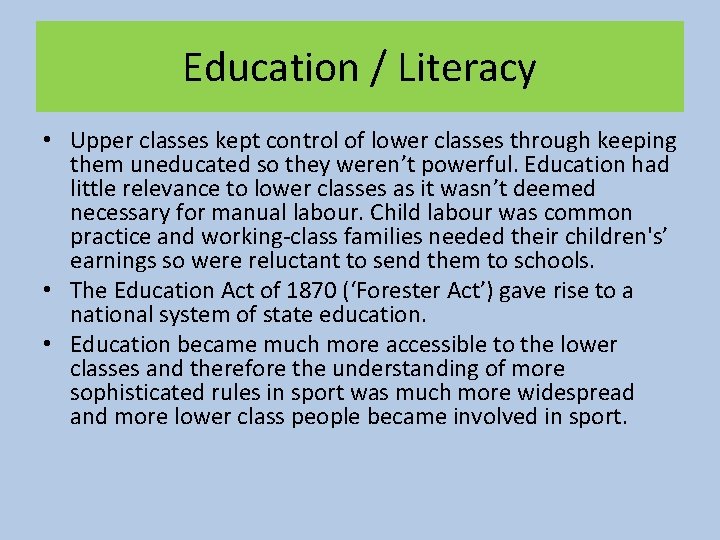
Education / Literacy • Upper classes kept control of lower classes through keeping them uneducated so they weren’t powerful. Education had little relevance to lower classes as it wasn’t deemed necessary for manual labour. Child labour was common practice and working-class families needed their children's’ earnings so were reluctant to send them to schools. • The Education Act of 1870 (‘Forester Act’) gave rise to a national system of state education. • Education became much more accessible to the lower classes and therefore the understanding of more sophisticated rules in sport was much more widespread and more lower class people became involved in sport.
Availability of time / changing work conditions • Factory owners realised the importance of sport to keep workers healthy, happy and loyal so began to encourage the formation of work teams. • Working classes had increased amounts of leisure time due to the Saturday half-day (Factory Act of 1850) • By 1965 a 40 -45 hour working week (from 72 hours) was typical. By the end of the 20 th Century an average working week was 37 -40 hours, making it much easier to be involved in sport. • The law today also states that holidays should be at least 4 weeks per annum.
Availability of money • Although working classes had more time available with fewer working hours and more leisure time, they still found it hard to become more involved in sports due to the lack of disposable income. • In larger factories, the owners would pay for an annual excursion for the workers, such as a trip to the seaside – the beginning of the seaside holiday.
Transport notably the railways • Transport before the 20 th Century was restricted to mainly walking and horseback. • Canals were developed which aided communications • Roads, bicycles and railways led to much easier travel, leading to development of seaside resorts and sports fixtures being played between teams all over the country, also allowing spectators to go and watch. • Cars began to be mass produced in the 20 th century which has greatly affected development of sport as it is so much more readily available.
Influence of public schools (on promotion and organisation of sports, ethics, ‘cult’ of athleticism, spread and export of games ethic) • https: //www. youtube. com/watch? v=b 7 DT 9 e Qk. IEg • https: //www. youtube. com/watch? v=hc_4 h 3_ Mu 5 I
20 th Century Britain 1 Jan 1901 – 31 Dec 2000 Many developments took place during the twentieth century in the UK • There was a massive development of scientific and technological innovation • Many societies become hugely rich, but wealth was swill unequally shared • There was considerable growth of cities (urbanisation) • Communication technology made great advances. This allowed ideas to spread rapidly and sports and pastimes to become more globalised • There was more time for leisure, less time spent on work, and therefore more participated in sport • Stress due to wars and terrorism, the undermining of traditional values and the rapid pace of life took a great toll on people’s general health and well-being
20 th Century Britain Sport in the 20 th Century https: //www. youtube. com/watch? v=dx. Bb. Fa 8 FPd 8&safe =active • • Class Amateurism and Professionalism Gender/changing role and status of women Law and order Education Availability of time and money Transport
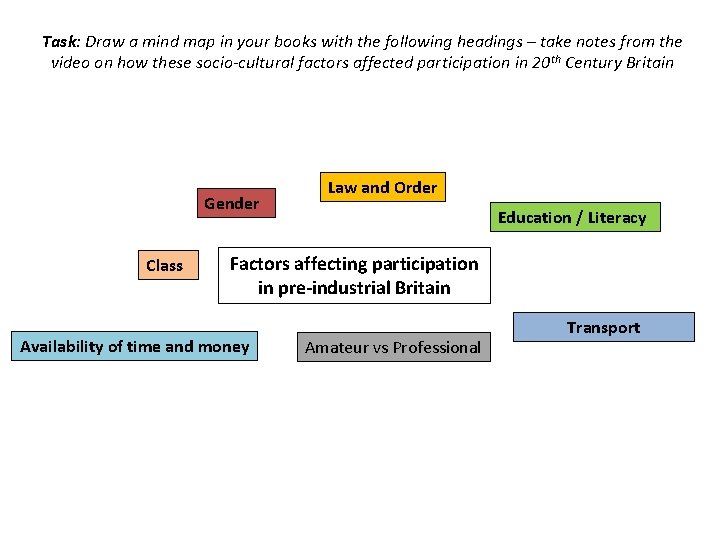
Task: Draw a mind map in your books with the following headings – take notes from the video on how these socio-cultural factors affected participation in 20 th Century Britain Gender Class Law and Order Education / Literacy Factors affecting participation in pre-industrial Britain Availability of time and money Amateur vs Professional Transport
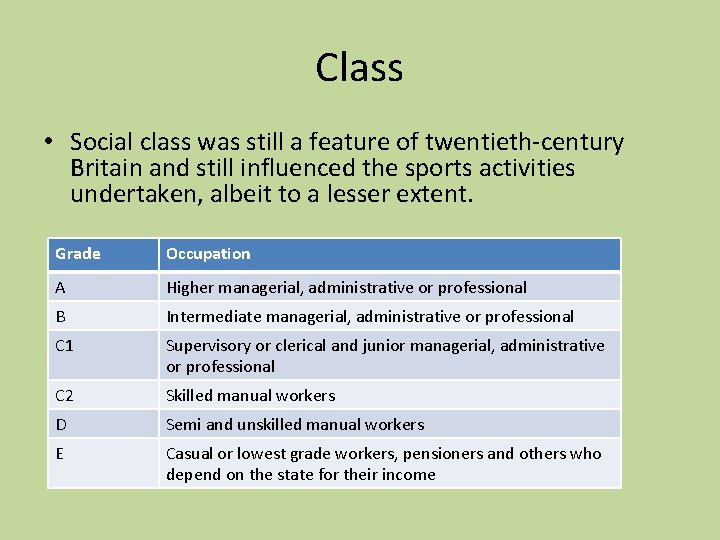
Class • Social class was still a feature of twentieth-century Britain and still influenced the sports activities undertaken, albeit to a lesser extent. Grade Occupation A Higher managerial, administrative or professional B Intermediate managerial, administrative or professional C 1 Supervisory or clerical and junior managerial, administrative or professional C 2 Skilled manual workers D Semi and unskilled manual workers E Casual or lowest grade workers, pensioners and others who depend on the state for their income
Class • • • In horse racing and boxing, upper and middle classes put up the money and the lower classes took part In team sports such as cricket, working and middle classes would compete side by side Working men and women had less free time for sport than middle and upper classes. When soccer played on after the outbreak of war in 1914 the reputation of professional sport went downhill among the middle classes who saw these events as too common and too associated with gambling and drinking Crowds at professional soccer and rugby league games became overwhelmingly male-dominated and showed a shared sense of community and class – predominantly working class. Unemployed and unskilled workers were not well represented in sport because of the cost of spectating. Consequently, as unemployment rocketed in parts of Britain during the inter-war depression, professional sport suffered, some clubs in the hardest hitting industrial regions went bankrupt. The pub was the centre of sporting activity for working-class men and the participation of women in physical recreational activities had fallen drastically in 1900, particularly among the working classes. In the early part of the 20 th century, most sporting activity still took place in a drinking environment. Gambling was still an essential part of sport
Amateur / Professional • There were professionals in team sports such as rugby, football and cricket and there was the development of the sports press • Clubs could afford to pay players because soccer and rugby had become something that people watched as well as played. • Cup and league competitions involved town and area rivalries, which gave added purpose and excitement to sports matches • The growing crowds of spectators began to be charged for watching at purpose built grounds and stadia • Spectatorism started to feature, with more watching than participating. • Spectators now had to pay to watch • Professional sport was mainly watched by male skilled workers, with only a few women and the middle classes. • Some players of team sports had started to wear numbers on their backs to assist the spectator in identification, and there was a fixed number of players per side in most team sports
Gender/changing role and status of women • Early 19 th Century Working class women were excluded from professional sport by the constraints of both time and money.
Law and order Games had more written rules for people to abide by Sports became less violent as they reflected the nature of society Fields of play were enclosed and boundaries were made more formal Games were timetabled There written codes of conduct Most cruel sports had disappeared, apart from hunting and shooting by the gentry • Boxing competitors fought each other with gloves on, without biting or kicking each other • Sport played an important role in maintaining troop morale during the First World War. In the aftermath of war, spectator sport reached new heights of popularity. The largest league games in soccer could attract as many as 60, 000 people – these crowds were mostly well-behaved and opposing supporters showed little hostility to each other. This led to the view that sport was a symbol of orderliness and good nature of the British working class – particularly significant at this post-war time of political and social unrest at home and abroad. • • •
Education • • https: //www. youtube. com/watch? v=h 2 c 1 w. Rb 7 nt. A&safe=active Physical development – a crucial component of the emergence of modern sport – was a feature of a ground-breaking piece of educational legislation – The Education Act (1944), also known as the Butler Act. • • • ‘It shall be the duty of the local education authority for every area, so far as their powers extend, to continue towards the spiritual, mental and physical developments of the community’. Education is now not only to do with communicating academic information but involves the whole of the person: academic ability, spiritual, physical and vocational needs. The Education Reform Act (1988) stated the need for a broad based curriculum which: – Promotes the spiritual, moral, cultural, mental and physical development of pupils at the school and of society. • Before the introduction of comprehensive schools (1965), the state education system in England was made up of: – Grammar schools, Secondary Modern Schools, Secondary Technical Schools • Part of all schools curricula was Physical Education, which often included elements of sport. Grammar schools often emulated the public school provision of sport and ran competitive teams in the major sports. Secondary Modern Schools also ran a range of sports teams. Sport was also promoted through extra-curricular provision in all schools
Availability of time and money • Sports events were held on Saturdays rather than on festival days • With the gradual increase in leisure time and money, men played sport as well as watched and the towns of Britain offered opportunities in many different sports, from water polo in the public baths, to pigeon races from allotments, and quoits in fields behind pubs • The availability of money was also a key factor, and darts, dominoes and billiards flourished inside pubs and cubs. • Space was a key requirement of sport, but it was at a premium and the land that was available was heavily used.
Transport • During the 20 th century transport, both public and private, began to be much more available to everyone. • This enabled an increase in numbers able to travel to participate in sport, as well as to spectate as it was much more accessible. • In the late 1940 s, sport as a spectacle was encouraged by growing radio coverage. • Football, rugby, cricket and boxing all attracted huge crowds. • London 1948 Olympics also attracted large crowds – this was the last Olympics to make a profit until 1984