
Society in Iran postrevolution By Lexi Williams Eden
Society in Iran (post-revolution) By: Lexi Williams, Eden Wenokur, Jennifer Dang, Kelsie Morehead, Isaiah Hannafious, and Kyle Weber
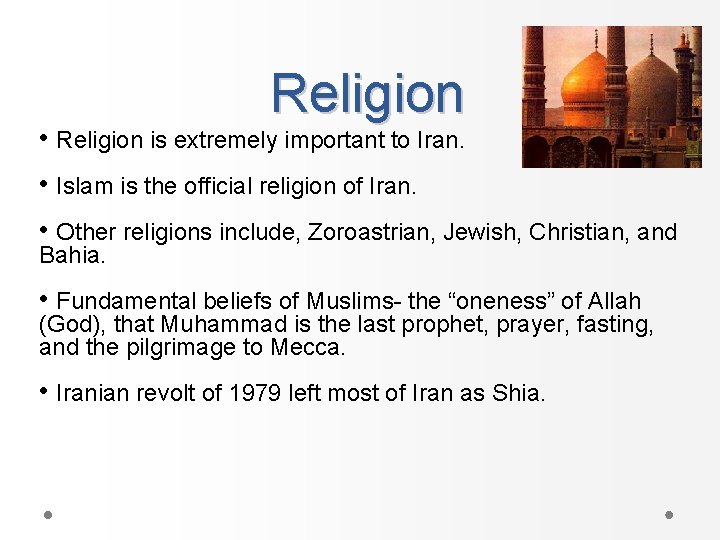
Religion • Religion is extremely important to Iran. • Islam is the official religion of Iran. • Other religions include, Zoroastrian, Jewish, Christian, and Bahia. • Fundamental beliefs of Muslims- the “oneness” of Allah (God), that Muhammad is the last prophet, prayer, fasting, and the pilgrimage to Mecca. • Iranian revolt of 1979 left most of Iran as Shia.
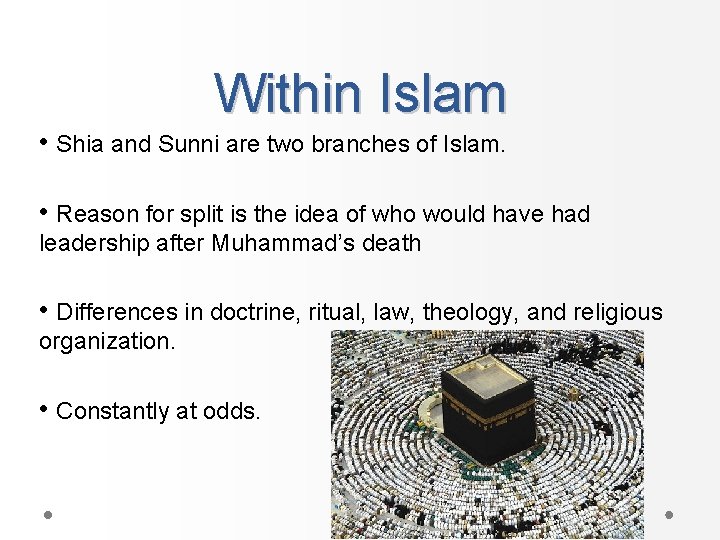
Within Islam • Shia and Sunni are two branches of Islam. • Reason for split is the idea of who would have had leadership after Muhammad’s death • Differences in doctrine, ritual, law, theology, and religious organization. • Constantly at odds.

Shia and Sunni • Sunni regard themselves as the more traditional branch of Islam • Shia sees them selves as discriminated against. • Sunni are the largest branch of Islam. • Only about 10% of Muslims are Shia. • Sunni means” well-trodden path" or "tradition” • Shia means "party" or "partisans" of Ali
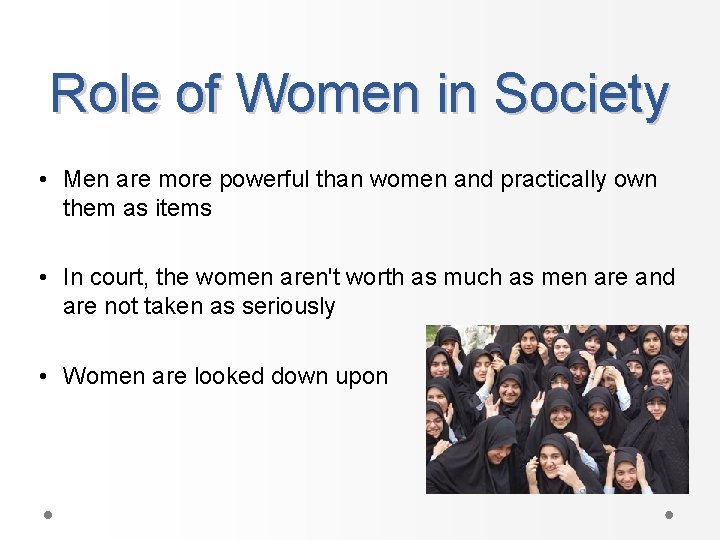
Role of Women in Society • Men are more powerful than women and practically own them as items • In court, the women aren't worth as much as men are and are not taken as seriously • Women are looked down upon
Role of Women in Society • In Iran the gender discrimination is still going strong, segregation is still happening. On the buses women have to sit in the back of the bus by law • Women are still battling for equal rights • Women cannot receive a passport unless her husband or some other male relative gives her permission to 6
Health • Women and men have segregated hospitals • Women’s health is actually controlled by their husband or their father, especially in families where the men are in power • Women usually only have free care access to programs that help them maternally and with birth care 7
Clothing • Usually, a chador is worn to cover all skin and hair of a Muslim woman, the hands and face being acceptable. • Some women who don’t have strict requirements about it do not wear a chador, but instead a veil (hijab) is worn to cover their hair. The veil was worn to show rebellion to being “western” • The veil was also worn to show Islam's accession into Iran and the end to imperialism 8
Clothing • Showing skin and wearing regular clothing was seen to be too “sexy” and too “ western” • Eventually, the government tried to demand the women to cover themselves up with veils and/or chadors, but the women didn't take it easily because the women have always had a problem with equality. 9
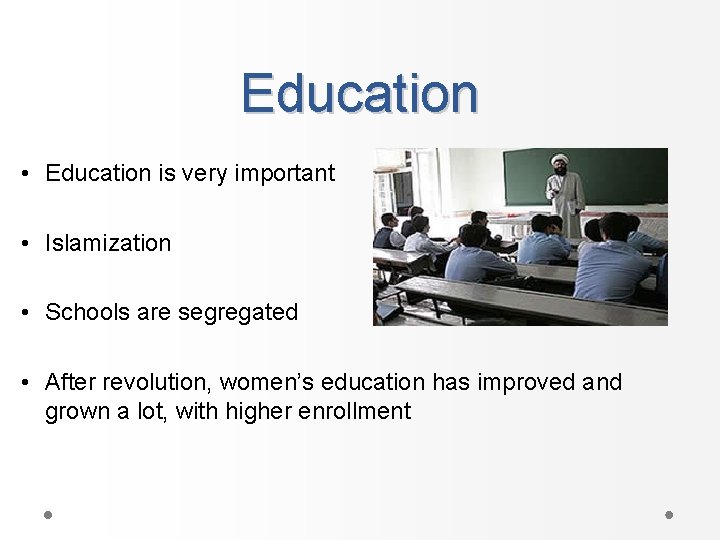
Education • Education is very important • Islamization • Schools are segregated • After revolution, women’s education has improved and grown a lot, with higher enrollment
Education • 1 year pre-school (5 years old), • 5 years primary(6 -10), • 3 years lower secondary(11 -13), • 3 years upper secondary(14 -17), • Vocational school or pre-university • University/other higher education
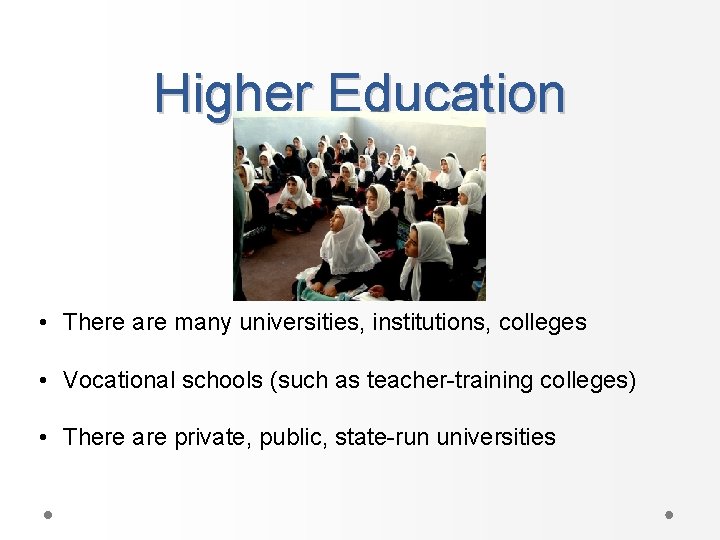
Higher Education • There are many universities, institutions, colleges • Vocational schools (such as teacher-training colleges) • There are private, public, state-run universities
The Family Unit • Family is very important • Father is the head of the family • Children in the family
Family Dynamics • Parental control • Extended family
Daughters and Sons • Double standards • Clothing choice
Government • Islamic Republic (Religion IS a part of the government) • The government takes breaks on religious holidays, and religion influences religious decisions.
Iranian Government Officials • Head of the Government: President Hasan Fereidun Ruhani (instated August 3 rd, 2013) • Vice President: Mohammad Reza Rahimi (elected Sep. 13 th 2009). • Supreme Leader (Chief of State): Ali Hoseini-Khamenei.
The Constitution of the Islamic Republic of Iran • Originally adopted in 1979, replacing the previous constitution, which was made in 1906. • The Constitution was last modified in 1989. • The Constitution’s section on government defines the roles of religion in government, as well as the role of democracy in religion.
Bibliography • "Iran Chamber Society: The Constitution of Islamic Republic of Iran. " Iran Chamber Society: The Constitution of Islamic Republic of Iran Chamber Society, n. d. Web. 24 Sept. 2013 • "Government Profile: Iran. " PBS, 8 Nov. 2005. Web. 24 Sept. 2013. • "Central Intelligence Agency. " The World Factbook. CIA, 11 Sept. 2013. Web. 24 Sept. 2013 • BEEMAN, WILLIAM O. "Countries and Their Cultures. " Culture of Iran. http: //www. everyculture. com/Ge. It/Iran. html#b • Price, Massoume. "Culture of Iran. Patriarchy and Parental Control in Iran. " Culture of Iran. Patriarchy and Parental Control in Iran. N. p. , Oct. 2009 • Helen Chapin Metz, ed. Iran: A Country Study. Washington: GPO for the Library of Congress, 1987. • Kar, Mehrangiz. "Women, the Victims of the Iranian Revolution. " A Forum on Human Rights and Democracy in Iran. 5 Mar. 2010. Gozaar. 24 Sept. 2013 <http: //www. gozaar. org/english/articlesen/Women-the-Victims-of-the-Iranian. Revolution. html>. • Girgis, Monique. "Iran Chamber Society: Iranian Society: Women in pre-revolutionary, revolutionary and postrevolutionary Iran [Chapter Three]. " Iran Chamber Society: Iranian Society: Women in pre-revolutionary, revolutionary and post-revolutionary Iran [Chapter Three]. Iran Chamber Society. 24 Sept. 2013 <http: //www. iranchamber. com/society/articles/women_prepost_revolutionary_iran 3. php>. • • "Women Pre and Post Iranian Revolution. " Sonja. Be. com. 13 Sept. 2011. Sonjabe. com. 24 Sept. 2013 <http: //sonjabe. com/women-pre-and-post-iranian-revolution/%20>. • "Women in Iran. " World Savvy Monitor. 8 Mar. 2009. World Savy Monitor. 24 Sept. 2013 <http: //worldsavvy. org/monitor/index. php? option=com_content>.
Bibliography • "Iran Chamber Society: Education in Iran: The Iranian Educational System. " Iran Chamber Society. N. p. , 24 Sept. 2013. Web. 23 Sept. 2013. <http: //www. iranchamber. com/education/articles/educational_system. php>. • "Education in Post-Revolutionary Iran. " EWENR, Education in Post-Revolutionary Iran. Ed. Robert Sedgwick. World Education Services, n. d. Web. 24 Sept. 2013. <http: //www. wes. org/ewenr/00 may/practical. htm>. • "Educational Attainment in Iran | Middle East Institute. " Middle East Institute. N. p. , 29 Jan. 2009. Web. 24 Sept. 2013. <http: //www. mei. edu/content/educational-attainment-iran>. 20
- Slides: 20