
Society for Social Audit Accountability and Transparency Department
Society for Social Audit, Accountability and Transparency Department of Rural Development Government of Telangana and Andhra Pradesh

What is a Social Audit Participatory process - community members monitor implementation of government programs in their community Social audit complements financial audit FA = Was the money spent correctly? SA = Did the spending make a difference? Powerful tool for social

Why is Social Audit Important? Trains the community on participatory local planning Encourages local democracy Encourages community participation Benefits disadvantaged groups Develops human resources and social capital

Social Audit in Andhra Pradesh and Telangana – Incubation- 2006 -2008 ü Began as a project of Strategies Performance Innovations Unit (Rural Development) under administrative reforms programme. ü No previous social audit experience, however had the will to walk a new path ü In Feb 2006, pilot social audit was conducted on NFFW in 3 villages with the help of MKSS under reform action plan ü Pilot process demonstrated effectiveness of social audit process ü Systematic identification & training of facilitators in each district ü Rules for Social Audit passed through the State Legislative Assembly ü Village Social Auditor (VSA) concept promoted
Institutionalization over 8 years Building up cadre of VSAs (more than 2 lakh people trained) ØGrading ØConstant monitoring ØOpportunities to move up Building up DRPs – 1, 000 Capacity building wing in SSAAT Convergence with APARD (SIRD) IT-Data analytics: identify red zones 5

SSAAT – Systematization 2009 - 2012 Ø SPIU-RD wound up in 2009 - SSAAT established Ø SSAAT is an independent Society Ø Established by the Department of RD in 2009 Ø Facilitates Social Audit of MGNREGS Ø Trained cadre of facilitators & VSAs Ø 0. 5% of the MGNREGS budget set aside for SA Ø Independent of the Implementing Agency
AP Promotion of Social Audit & Prevention of corrupt practices Act 2012 Land mark Act SA recognized as compulsory statutory process Offences proved in SA brought under criminal law ◦ Special mobile courts established ◦ Summary trial in villages ◦ Punishments up to 2 years So far there have been 9 convictions 7
Mobilizing Political will The Prl. Secy convinced the CM that it was an essential tool of efficiency, delivery, and peoples feedback. He also firmly established the administrative mandate. CM was convinced that it was one of the best ways to ensure programs met development and political promises. His office directly monitored the progress Logic given: ◦ Distancing of Govt from irregularities is good politics ◦ Can establish credibility and even help win elections ◦ Chance to interact with large number of people 8
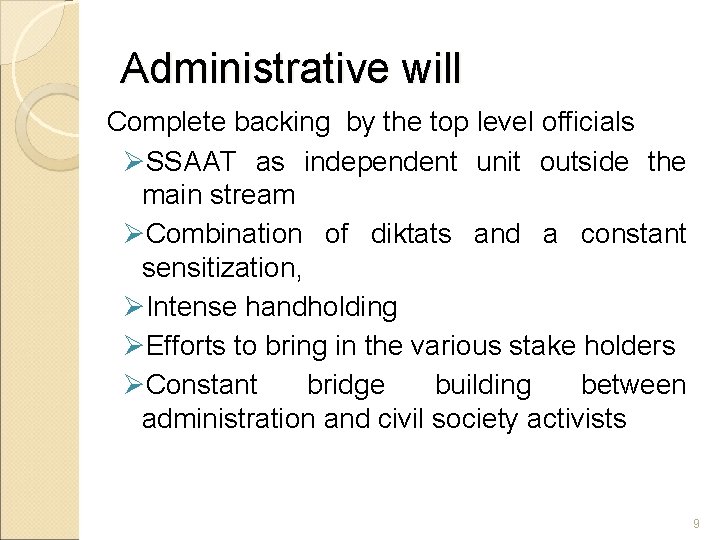
Administrative will Complete backing by the top level officials ØSSAAT as independent unit outside the main stream ØCombination of diktats and a constant sensitization, ØIntense handholding ØEfforts to bring in the various stake holders ØConstant bridge building between administration and civil society activists 9

Process of Social Audit Ø Ø Ø Ø Youth from the stakeholder families identified Trained in reading Scheme related records All records are provided by the administration to the trained youth Youth go in groups to every village ü Verify every work with reference to records ü Verify every payment with reference to pay orders with individual beneficiary ü Prepare and read out report in Gram Sabha All GP reports are read out at a Public Hearing – Block Level chaired by the Project Director Proposed action on each grievance and complaint announced and recorded publicly – through a separate vigilance wing, reports hosted on website Prosecution in all serious cases under the Act through a special Court held in the village by First Class Judicial
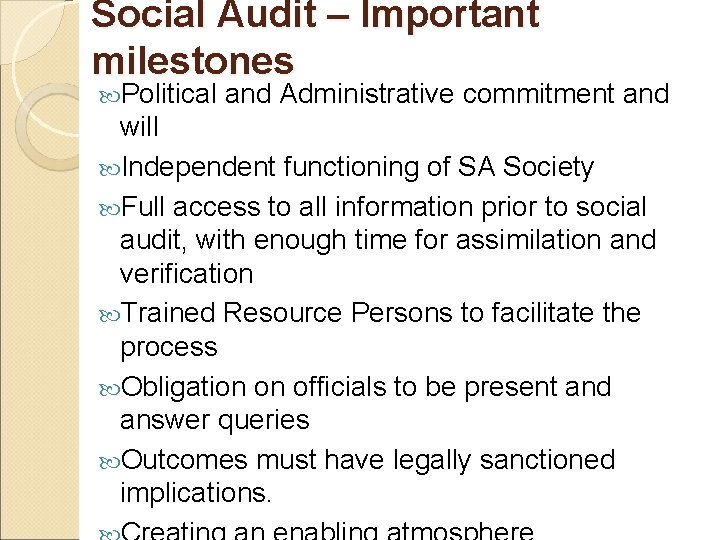
Social Audit – Important milestones Political and Administrative commitment and will Independent functioning of SA Society Full access to all information prior to social audit, with enough time for assimilation and verification Trained Resource Persons to facilitate the process Obligation on officials to be present and answer queries Outcomes must have legally sanctioned implications.
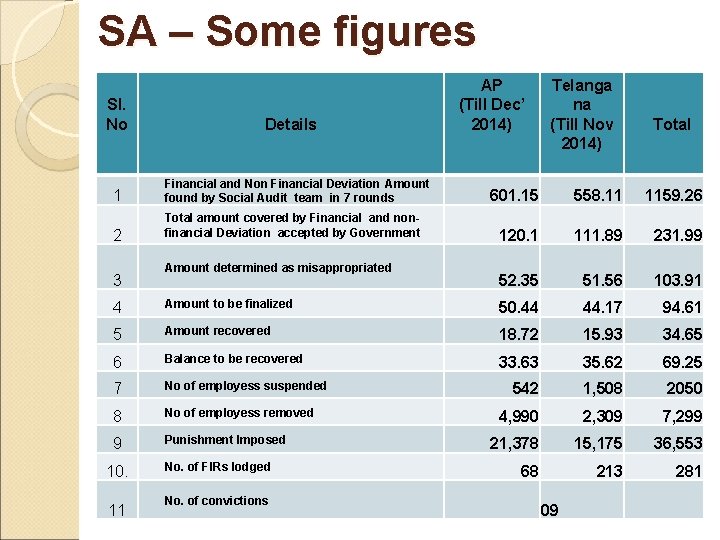
SA – Some figures Sl. No Details 1 Financial and Non Financial Deviation Amount found by Social Audit team in 7 rounds 2 Total amount covered by Financial and nonfinancial Deviation accepted by Government 3 Amount determined as misappropriated AP (Till Dec’ 2014) Telanga na (Till Nov 2014) Total 601. 15 558. 11 1159. 26 120. 1 111. 89 231. 99 52. 35 51. 56 103. 91 4 Amount to be finalized 50. 44 44. 17 94. 61 5 Amount recovered 18. 72 15. 93 34. 65 6 Balance to be recovered 33. 63 35. 62 69. 25 7 No of employess suspended 542 1, 508 2050 8 No of employess removed 4, 990 2, 309 7, 299 9 Punishment Imposed 21, 378 15, 175 36, 553 68 213 281 10. 11 No. of FIRs lodged No. of convictions 09
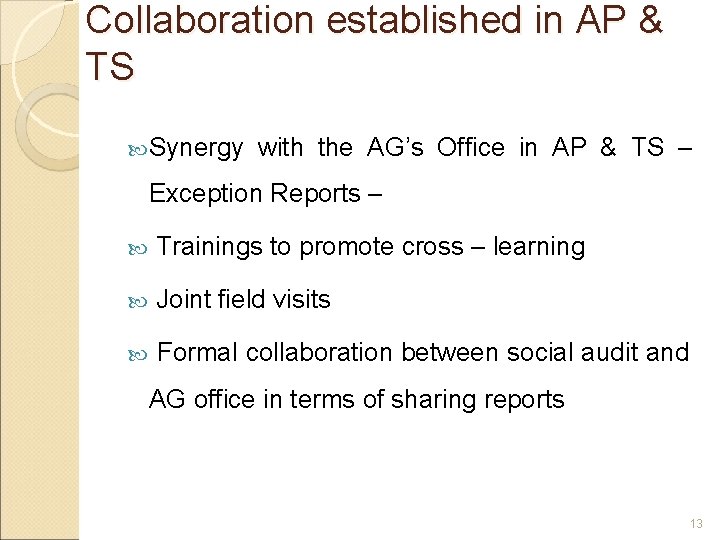
Collaboration established in AP & TS Synergy with the AG’s Office in AP & TS – Exception Reports – Trainings to promote cross – learning Joint field visits Formal collaboration between social audit and AG office in terms of sharing reports 13
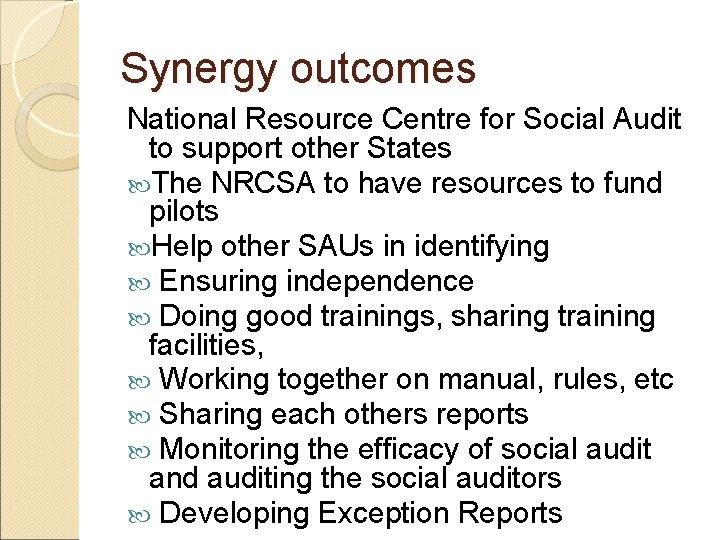
Synergy outcomes National Resource Centre for Social Audit to support other States The NRCSA to have resources to fund pilots Help other SAUs in identifying Ensuring independence Doing good trainings, sharing training facilities, Working together on manual, rules, etc Sharing each others reports Monitoring the efficacy of social audit and auditing the social auditors Developing Exception Reports
- Slides: 14