
Socialization selfidentity and the life Course Introduction Sociological



- Slides: 26
Socialization , self-identity and the life Course
Introduction : Sociological theory has given us an understanding of how individuals may interact with their culture and the world around them to create or be allocated identity. Formation of identity and culture is seen by many as a process that starts at birth and continues throughout our lives through socialization. Our self-identity changes and develops throughout the life course. However, the role of individuals and that of wider society is viewed differently by a range of theorists.
Socialization: Socialization is the process by which individuals learn about the culture , norms , values and expectations of the society they live in. it starts at birth and continues through childhood, which has been argued to be a crucial time for socialization. However, socialization continues throughout our lives through secondary agents of socialization: education , peer groups , the workplace , religion , the mass media and so on. Different types of sociologists see socialization differently:
Goals of socialization: Impulse control and the development of a conscience. Role preparation and performance , including occupational roles , gender roles , and the roles in the institutions such as marriage and parenthood. The cultivation of sources of meaning , or what is important , valued , and to be lived for. § Primary socialization: it takes place early in life as a child or adolescent. § Secondary socialization: it takes place throughout one’s life , both as a child and as one encounters new groups that require additional socialization.
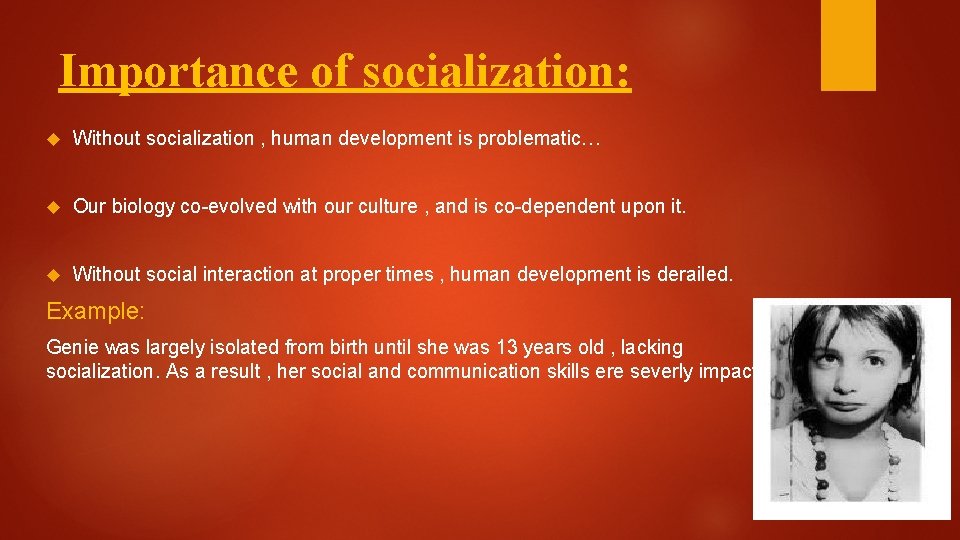
Importance of socialization: Without socialization , human development is problematic… Our biology co-evolved with our culture , and is co-dependent upon it. Without social interaction at proper times , human development is derailed. Example: Genie was largely isolated from birth until she was 13 years old , lacking socialization. As a result , her social and communication skills ere severly impacted.
Functionalist : Such as Talcott Parsons, see socialization as crucial to learning the norms and values of the society , to ensure the individuals fit in with society and to guarantee social solidarity. In addition socialization prepares people for their future role in society as well as enabling the effective functioning of society itself. In short socialization is a lifelong process whereby the individuals learns her culture develops a sense of self , and becomes a member of society. For this to happen, the individual needs sustained, structured interaction with culture & social environment.
Self –identity and social identity : • Self – unique identity • Personality – complex of attitudes, beliefs, behaviors and values. • Personal Identity – comprised of the self and the personality. • Sociologists emphasize the social aspects of identity. Self_identity (symbolic interactionism ): It looks at how individuals interpret the self in everyday situations and create their sense of self from the process of interactions. “The self is something which has a development, it is not initially there, at birth , but arises in the process of social experience and activity , that is , develops in the given individual as a result of his relations to that process as a whole and to other individuals in that process. ”
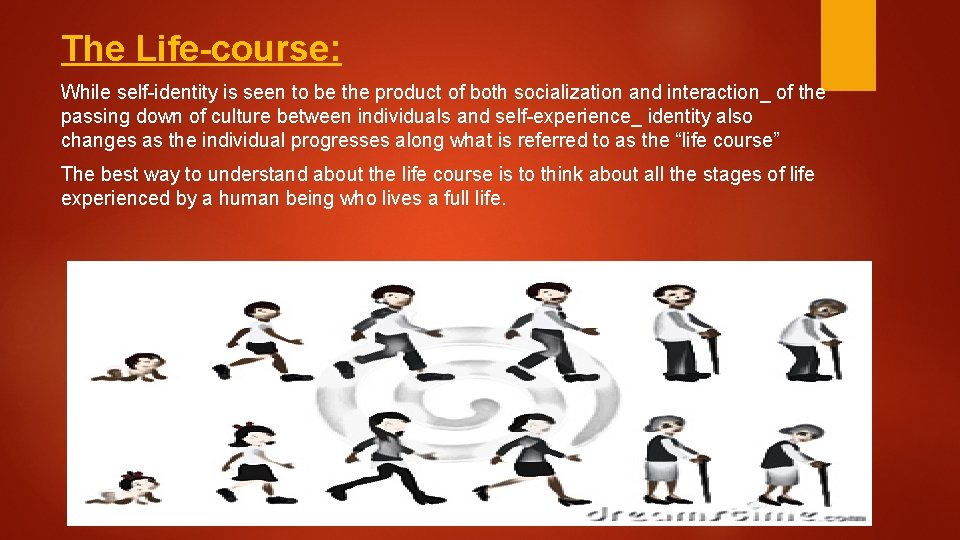
The Life-course: While self-identity is seen to be the product of both socialization and interaction_ of the passing down of culture between individuals and self-experience_ identity also changes as the individual progresses along what is referred to as the “life course” The best way to understand about the life course is to think about all the stages of life experienced by a human being who lives a full life.
Over to Asmat
Self-identity and the map of one’s life : As Linkins (1996) notes , from the moment of birth every individual is placed into a web of identity – defining moments , interactions and processes. These includes : • The naming of the child ( this might even take place before the birth) • The establishment of its sex. • The establishment that the child is “healthy” • The legal and bureaucratic process of birth registration.
What is self: The self is our experience of a distinct , real , personal identity that is separate and different from all other people. Sociologists look at both the individual and society to gain a sense of where the self comes from. Most believe that the self is created and modified through interaction over the course of a lifetime.
v At 12 months , infants begin to recognize objects around them and understand adults’categorization of these objects. v By the age of two a basic familiarity with conversational language has been established. v Children continue to learn about the actions of others- especially through copying play , which represents a form of “abstract thought”. v Between the ages of two and four , children develop and elaborate on notions of community , and identify themselves as sharing group membership with the people in question. v At this point , cultural pressures from others make gender an important factor in the establishment of self-identity. v From about five or six years old , children begin to develop a sense of moral responsibility for their actions and the consequences of their actions. They begin to learn to present a mask of their self to others. v As children move towards adulthood they become members of wider and more varied groups and communities of identification.
THE LIFE COURSE : § All the stage of human life, that he experienced in his full life. § There are stages of life course § Early infancy § Late infancy § Childhood § Youth § Young adulthood § Middle age § Old age
David Morgan (1996) Define life course that how culture define who individual are in each stage He also point that the individual themselves might use the idea of active and reflexive while thinking about their past and future. Morgan said it is biological because based on ageing of human body. Anthropological Research shows that stage of life course vary between the culture to subculture § For example attitude towards ageing § An aspect that people understand that “who they are” are sometime dissatifsied with how they are living their lives
Cohen and Taylor (1992) Said because routine of everyday life, its lose its interest and he call it “ escape attempts” Age and Ageing : § One aspect of life course § Concept of ageing are socially constructed. § Vary between culture to culture Rowe and Kahn (1998) Argued three element of successful ageing § Being healthy § Maintaining mental and physical function § Engaging with social life
For Example: Andrew (2009) reject the dichotomy of optimistic and pessimistic views of ageing , and argued foe exploring of multiple narratives ageing in which cultural setting constrain but do not limit the forms, and experiences of “being elderly” Returning to the relationship between the individual and society : Human are seen as being shaped and manipulated by the social force. Hollis (1977) identified two main approaches. Structural sociologist tend to see human as a victims of culture and structure. He describe as a “plastic (wo)man” approach, relationship between individual and society
Action sociologist : Tend to see humans in a completely opposite way- not plastic but a “autonomous” totally able to make their own decision and to control the course of their own lives. Many contemporary sociologists find both these models too extreme. Individual are not total subjects of culture, but without culture they would not be truly human…
Over to Sana Bibi
Pierre Bourdieu : He has been influenced strongly by action approaches even though ultimatelyhe is seeking a compromise between action and structure. Bourdieu (1990 -1993) concerned with what people “do” in society. COMMON INTERACTION FOCUS § Social practices are more stuructural than simply the expression of free will. § Everyday life is practice § Practice has 4 elements 1. Time 2. Space 3. Unorchestration 4. Improvization Social practice takes place according to the natural rhythms of time, it is culture that makes these rhythms significant in our lives.
§ Practice is also associated with the rhythms. § Different practices have different tempos different amount of time to complete. § Social practice also take place in cultural and physical location. For Example : § Some activities that culture has established to be acceptable in a private bathroom are not acceptable in a public street. § Social practice often appear “just happen” to those, who live in a society. § The way we do things are some patterns. Some patterns are more common in one society than the other.
§ We learn social norms for social interaction. § Self identity is important in competent actor in society. § We should have an idea of who we are and what is our relation with the society. § He rejects both the view that human are free and the opposite view that they are passive victims of culture. He links these two views together though his idea of “habitus” § Man is not totally free, we do have choices, even though we are not always aware of making such choices or conscious that will benefit from the choices we do make. § How we act is based partly on creativity and partly on habit. § We have a general rules and background experience and we can apply them to specific program.
§ we learn to behave, to act with our bodies with experience and requiring no conscious thought tp put into practice in everyday life. § Acting in society is partly determined by the cultural of that society, which is beyond our control and our conscious intentions, desires and motivations. § All our past stored in memory helps us to understand new things in life.
Conclusion : Socialization is seen by sociological theory as being crucial in the formation and acquisition of culture and identity. However , the roles of the individual and of society are interpreted in various ways. Pierre Bourdieu feels that we can act according to our culture and the world around us, but we are not totally free to act as we wish.
Many Thanks