
SOCIALIZATION BUT FIRST SOCIAL DEVELOPMENT CRASH COURSE SOCIOLOGY
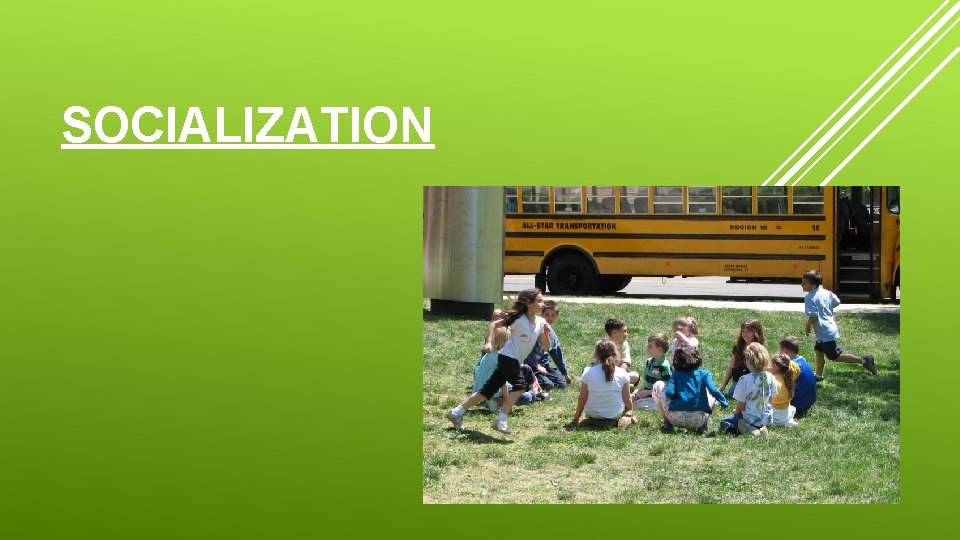
SOCIALIZATION

BUT FIRST…. SOCIAL DEVELOPMENT: CRASH COURSE SOCIOLOGY
SOCIALIZATION Socialization is the lifelong process of social interaction through which individuals acquire a self identity and the physical, mental, and social skills needed for survival in society. What are some possible agents of socialization?
CULTURE BY CLASS? Sociologist Melvin Kohn‘s studies suggest ethnicity and class strongly influence what and how parents teach their children a. working-class parents who are closely supervised typically emphasize the importance of obedience and conformity to their children. b. middle and professional class parents who have greater flexibility and freedom at work tend to give their children more freedom to make their own decisions an be creative.
CULTURE BY CONFLICT? Conflict theorists stress that socialization reproduces the class structure in the next generation rather than challenging the conditions that presently exist. a. poor and low income families may unintentionally socialize children to believe that education goals and future ambitions are meaningless because of existing economic conditions in the family b. middle and upper income families typically instill ideas of monetary and social success in their children. , as well as emphasizing thinking and behaving in socially acceptable ways.
CULTURE BY INTERACTION? Symbolic Interactionist theory focuses on the mutual dynamics of relationships within the family. a. In the context of family life grandparents and other relatives have a strong influence on how parents socialize their children. b. In families with personal conflict the birth of an infant may intensify the discord. c. In families where partners feel personally satisfied the birth of an infant may contribute to marriage success. d. Children’s behaviour may have an effect on how parents, siblings, and grandparents get along with one another.
AGENTS OF SOCIALIZATION Agents of socialization are the persons, groups, or institutions that teach us what we need to know in order to participate in society. They can include: family, peers, education, mass media, religion, work.
AGENTS OF SOCIALIZATION Family is the most important agent of socialization in all societies. Schools continue to play an increasingly important role in the socialization process since the amount of time a child will spend in educational settings has expanded with the amount of specialized technical, and scientific knowledge, modern living demands. Peer groups function as agents of socialization by contributing to our sense of “belonging” and our feelings of self-worth Mass media plays a large role as well. Some see it as a concern, others not so much because of the positive aspects.

VIDEO: AGENT OF SOCIALIZATION CRASH COURSE
WHAT IS FAMILY? To some, the true meaning of family means a group of people related by blood or ancestry. To others, it has nothing to do with genes and everything to do with love, compassion, and support. The definition of the word family can mean many things. In general family is a relationship in which people live together with commitment, form an economic unit, and care for any young, and consider their identity to be significantly attached to the group.
THE FAMILY: Most important agent of socialization Families transmit cultural and social values Families in Canada vary in size and structure Most people form sense of self and acquire most of their beliefs and values within the family context Learn about the dominant culture and primary subcultures to which their parents and other relatives belong Families Family provide primary source of emotional support is where we acquire our specific social position in society
FAMILY The value of initial love and nurturance from our family is central to our cognitive, emotional, and physical development. Learning from our families we acquire most of our beliefs and values, we learn about the larger dominant culture (language, attitudes, beliefs, values, and norms) and the primary subcultures to which our parents and other relatives belong. Emotional support we receive via families includes love, understanding, security, acceptance, intimacy, companionship
SCHOOL The social institution responsible for the systematic transmission of knowledge, skills, and cultural values within a formally organized structure. Why have researchers found that all children may benefit from learning in early childhood programs? Because they may not have had the learning experiences in their homes.
Schools teach specific knowledge and skills; they also have a profound effect on a child’s self-image, beliefs, and values. Daycare and preschool programs are especially beneficial for children from lessadvantaged backgrounds since they may provide valuable learning experiences not available at home. From a functionalist perspective, schools are responsible for: a. socialization — teaching students to be productive members of society b. transmission of culture c. social control and personal development d. the selection, training, and placement of individuals on different rungs in the society. .
ACCORDING TO CONFLICT THEORISTS SUCH STEPHEN RICHER, SUCCESS IN SCHOOL MAY BE BASED ON STUDENTS’ ABILITY TO CONFORM TO A HIDDEN CURRICULUM—THE PROCESS BY WHICH CHILDREN LEARN TO VALUE COMPETITION, MATERIALISM, WORK OVER PLAY, OBEDIENCE TO AUTHORITY, AND ATTENTIVENESS—ATTRIBUTES THAT ARE IMPORTANT FOR LATER ROLES IN THE WORK FORCE
PEER GROUPS A group of people who are linked by common interests, equal social position, and (usually) similar age. Preadolescence (latter part of elementary school years) is the age a child’s peer culture has an important effect on how they perceive themselves and how they internalize society’s expectations. How are peer groups different from families and schools? Provide children and adolescents with some degree of freedom from parents and other authority figures.

How do individuals earn their peers acceptance? 1. Peer groups function as agents of socialization by contributing to our sense of “belonging” and our feelings of self-worth. 2. Individuals must earn acceptance with their peers by meeting the group’s demands (peer pressure) for a high level of conformity to its own norms, attitudes, speech, and dress code. Adults may sometimes contribute to their child’s peer culture because they may buy items desired by their children (items which they are under pressure to obtain b/c of peers - toys, DVDs, clothing…)
MASS MEDIA Large scale organizations that use print or electronic means (ex: radio, television, film, Internet) to communicate with large numbers of people. Several ways the media functions as a socializing agent: 1. Inform us about events 2. Introduce us to a wide variety of people 3. Provide an array of viewpoints on issues 4. Make us aware of products and services that, if we purchase, supposedly will help us be accepted by others 5. they entertain us by providing the opportunity to live vicariously (through other people’s experiences).
According to media educator Arlene Moscovitch media encounters are an inescapable part of everyday family life: a. The average 16 year old will have spent more time in front of a television or computer than attending school. b. Some scholars suggest, wisely used, television can enhance children’s language abilities; concept formation skills; reading skills; and encourage prosocial development. Other studies have shown a correlation between hours spent watching television and lower grades at school; reduced reading; less exercise; obesity (p. 113). While too new for systematic studies, public opinion surveys suggest that many people believe the Internet can negatively affect the socialization process
RESPOND AND 24 HOUR ASSIGNMENT What do you think? What is your opinion about the time that children spend in front of electronic media as compared with time spent in school? Explain why you think this way. (2 pts) Provide three positives and three negatives of watching TV. (3 pts) Read the article entitled Now Playing: Babes in Media Culture and Cyberspace on pages 114 - 115. There a couple of viewpoints about computers and very young children. Should computers be introduced to them at an early age, or do they need to interact with people and play with real objects (blocks, puzzles, toys) at this early age? Can the computers impede their social development? What are your thoughts about this? (2 pts)

24 HOUR ASSIGNMENT 1. Over a period of 24 hours during the “school week”, you are to keep an hour by hour detailed written record of what you do, the people you interact with and the activity you are involved in. Example: Time 09: 00 -10: 00 People Mrs. Guimond (teacher) and other SOC 12 students Activity SOC 12 Class – working on socialization and theories of personality development. 1. After completing the 24 hour record, divide the amount of time in minutes into four categories; time spent with family, time spent with friends, time spent in school, time spent on electronic media (computer / phone / television). Do not include the amount of time you were sleeping. Construct a bar graph to show the results. 2. Analyze your findings. In a short well-written paragraph, reflect on your findings. Is this a typical weekday? Are you surprised with the results? Is there anything you would like to change (if yes, why, and how)?
Negative Effects of Technology on Social Skills PROJECT SOCIALIZE Documentary 2016 Teens, Social Media, and Technology (full film) | FRONTLINE SOCIALIZATION AND TECHNOLOGY
- Slides: 22