
SOCIALIZATION AND THE LIFE COURSE CHAPTER 4 WHY
- Slides: 30
SOCIALIZATION AND THE LIFE COURSE CHAPTER 4
WHY IS SOCIALIZATION IMPORTANT? • Socialization is the lifelong process of social interaction through which individuals come to understand societal norms and expectations, to accept society’s beliefs, and to be aware of societal values. • Socialization enables us to develop our human potential and to learn the ways of thinking, talking, and acting that are necessary for social living. • Socialization is most crucial during childhood. • Socialization is also essential for the survival and stability of society. • Personality: person’s typical patterns of attitudes, needs, characteristics, and behavior
SOCIAL ENVIRONMENT: THE IMPACT OF ISOLATION Extreme Isolation: Isabelle and Extreme Neglect: Romanian Orphans • These two cases underscore the importance of socialization and positive social environments in human development.
WHY SOCIALIZATION MATTERS Socialization is critical both to individuals and to the societies in which they live. • Nature v. Nurture • Nature (heredity) – our temperaments, interests, and talents that are set before birth • Nurture (social environment) - the relationships and caring that surround us
Which do you think is more important – nature or nurture? DISCUSSION What events in your life have had a strong influence on who you are?
SOCIOLOGICAL APPROACHES TO THE SELF
THE DEVELOPMENT OF THE SELF • The self is our experience of a personal identity, which is separate and different from all other people. • View of ourselves comes from contemplation of personal qualities and impressions of how others perceive us • Sociologists believe the self is created and modified through interaction during the lifespan.
MEAD’S STAGES OF SELF • preparatory stage (0 -3 years) – interactions lack meaning; children imitate those around them • play stage (3 -5 years) - usage of language and symbols, making it possible to pretend the roles of specific people, and role taking occurs § Mead’s role-taking is the process by which a person mentally assumes the role of another person or group in order to understand the world from that person’s or group’s point of view.
• game stage (early school years) – aware of their own social position and those around them, as well as being able to consider several actual tasks and relationships simultaneously developing the generalized other • Generalized other: attitudes, viewpoints, and expectations of society as a whole that a child takes into account in his or her behavior
MEAD: THEORY OF THE SELF • Self begins as privileged, central position in a person’s world • As the person matures, the self changes and begins to reflect greater concern about reactions of others • Significant others: individuals most important in the development of the self
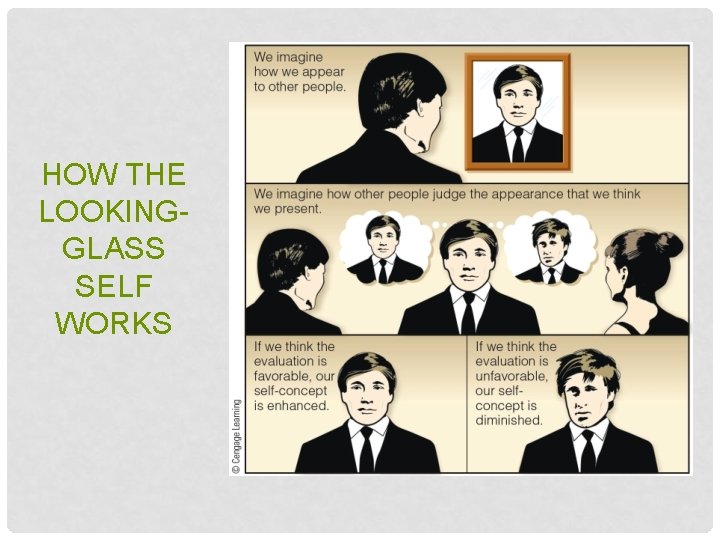
COOLEY’S LOOKING-GLASS SELF Cooley’s looking-glass self refers to the way in which a person’s sense of self is derived from the presentation of others. • the self is product of social interactions with other people 1. We imagine how our personality and appearance will look to other people. 2. We imagine how other people judge the appearance and personality that we think we present. 3. We develop a self-concept.
HOW THE LOOKINGGLASS SELF WORKS
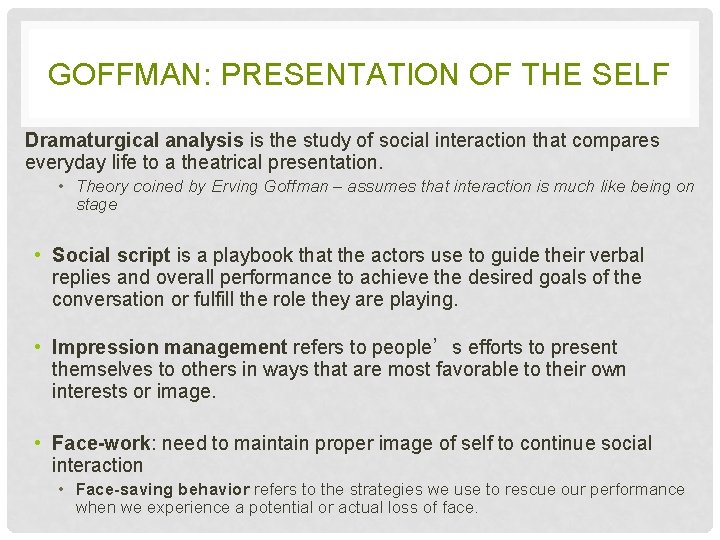
GOFFMAN: PRESENTATION OF THE SELF Dramaturgical analysis is the study of social interaction that compares everyday life to a theatrical presentation. • Theory coined by Erving Goffman – assumes that interaction is much like being on stage • Social script is a playbook that the actors use to guide their verbal replies and overall performance to achieve the desired goals of the conversation or fulfill the role they are playing. • Impression management refers to people’s efforts to present themselves to others in ways that are most favorable to their own interests or image. • Face-work: need to maintain proper image of self to continue social interaction • Face-saving behavior refers to the strategies we use to rescue our performance when we experience a potential or actual loss of face.
PSYCHOLOGICAL APPROACHES TO THE SELF
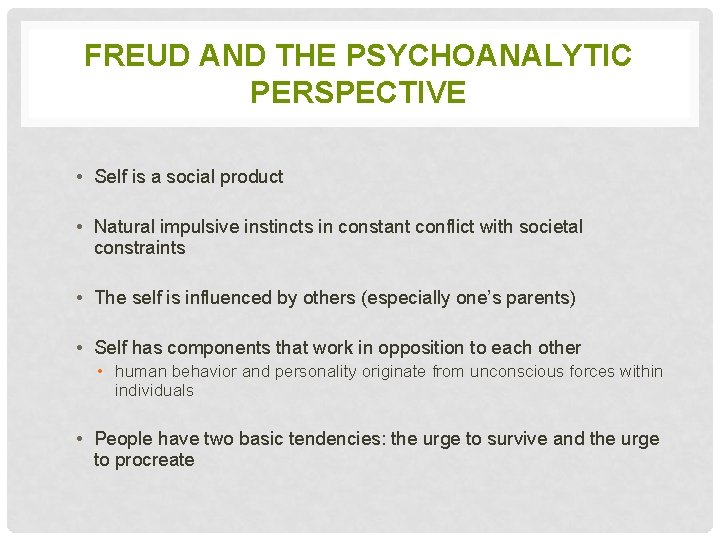
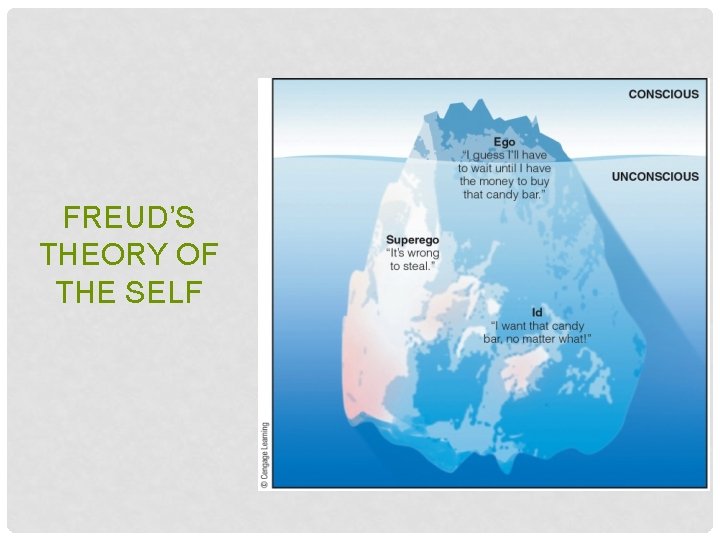
FREUD AND THE PSYCHOANALYTIC PERSPECTIVE • Self is a social product • Natural impulsive instincts in constant conflict with societal constraints • The self is influenced by others (especially one’s parents) • Self has components that work in opposition to each other • human behavior and personality originate from unconscious forces within individuals • People have two basic tendencies: the urge to survive and the urge to procreate
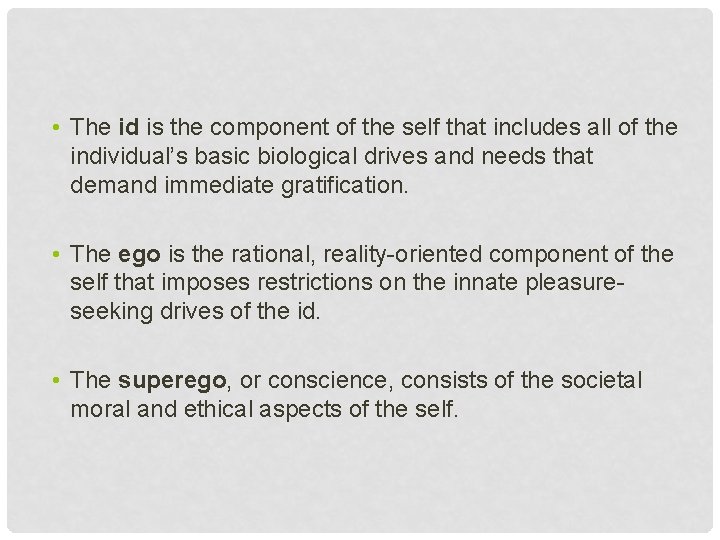
• The id is the component of the self that includes all of the individual’s basic biological drives and needs that demand immediate gratification. • The ego is the rational, reality-oriented component of the self that imposes restrictions on the innate pleasureseeking drives of the id. • The superego, or conscience, consists of the societal moral and ethical aspects of the self.
FREUD’S THEORY OF THE SELF
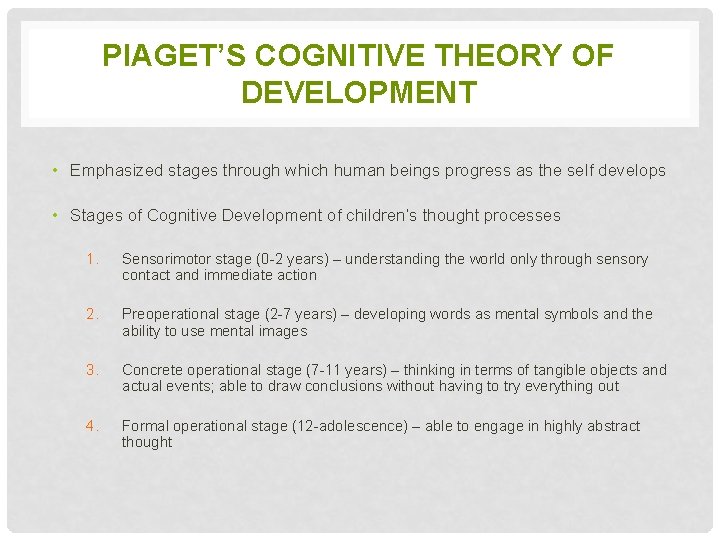
PIAGET’S COGNITIVE THEORY OF DEVELOPMENT • Emphasized stages through which human beings progress as the self develops • Stages of Cognitive Development of children’s thought processes 1. Sensorimotor stage (0 -2 years) – understanding the world only through sensory contact and immediate action 2. Preoperational stage (2 -7 years) – developing words as mental symbols and the ability to use mental images 3. Concrete operational stage (7 -11 years) – thinking in terms of tangible objects and actual events; able to draw conclusions without having to try everything out 4. Formal operational stage (12 -adolescence) – able to engage in highly abstract thought
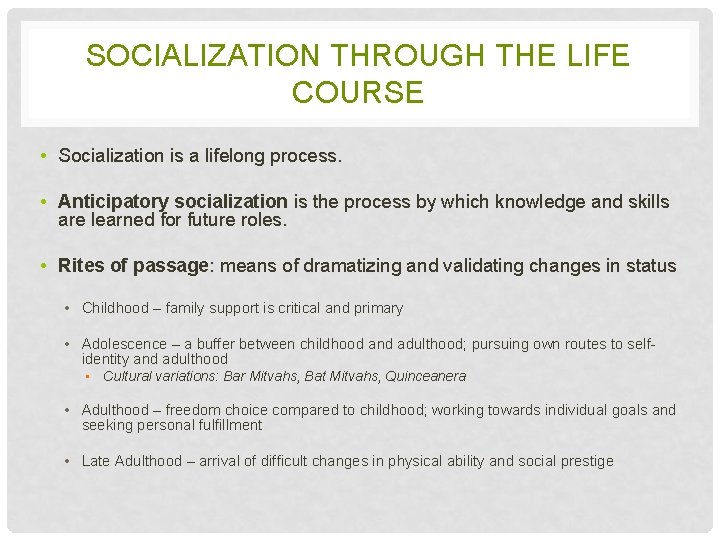
SOCIALIZATION THROUGH THE LIFE COURSE • Socialization is a lifelong process. • Anticipatory socialization is the process by which knowledge and skills are learned for future roles. • Rites of passage: means of dramatizing and validating changes in status • Childhood – family support is critical and primary • Adolescence – a buffer between childhood and adulthood; pursuing own routes to selfidentity and adulthood • Cultural variations: Bar Mitvahs, Bat Mitvahs, Quinceanera • Adulthood – freedom choice compared to childhood; working towards individual goals and seeking personal fulfillment • Late Adulthood – arrival of difficult changes in physical ability and social prestige
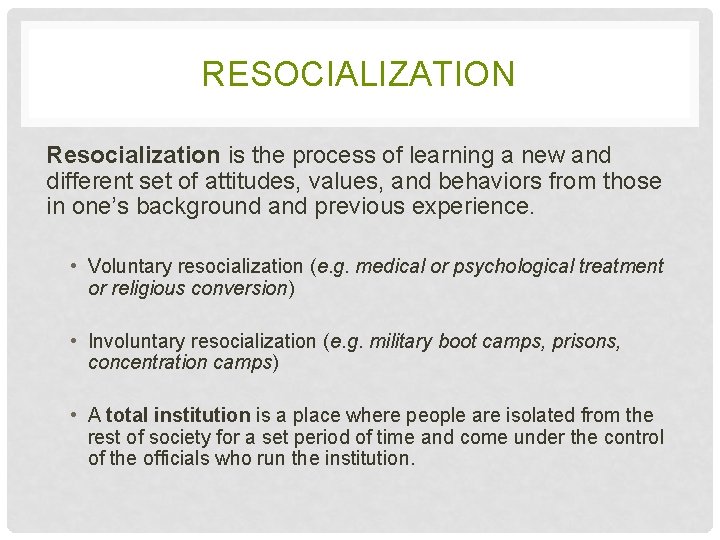
RESOCIALIZATION Resocialization is the process of learning a new and different set of attitudes, values, and behaviors from those in one’s background and previous experience. • Voluntary resocialization (e. g. medical or psychological treatment or religious conversion) • Involuntary resocialization (e. g. military boot camps, prisons, concentration camps) • A total institution is a place where people are isolated from the rest of society for a set period of time and come under the control of the officials who run the institution.
AGENTS OF SOCIALIZATION Agents of socialization are persons, groups, or institutions that teach us what we need to know in order to participate in society. • Social Group Agents • The family • Peer groups • Institutional Agents • • School Workplace Religion and the State Mass media and Technology
The Family • The family is the most important agent of socialization in all societies. • Family teach children what they need to know, initially • Reciprocal socialization is the process by which the feelings, thoughts, appearance, and behavior of individuals who are undergoing socialization also have a direct influence on those agents of socialization who are attempting to influence them. • Sociologists recognize that race, social class, religion, and other societal factors play an important role in socialization. • Ex: poor families usually emphasize obedience and conformity when raising their children, while wealthy families emphasize judgment and creativity • Gender roles: expectations regarding proper behavior, attitudes, and activities of males and females
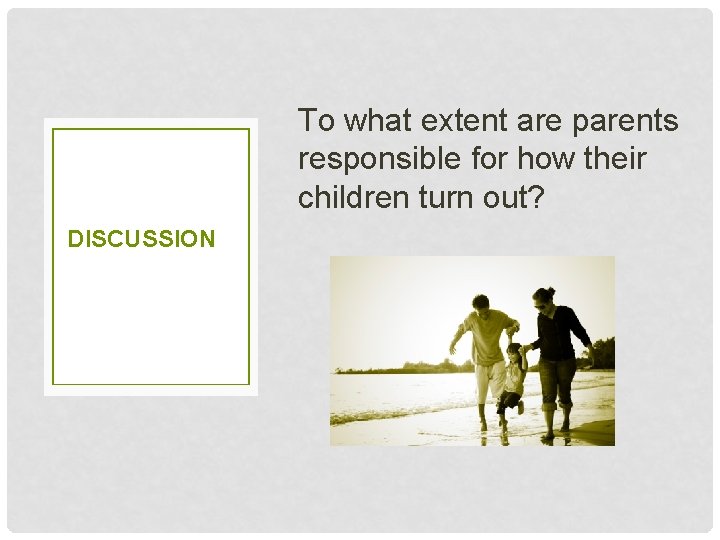
To what extent are parents responsible for how their children turn out? DISCUSSION
School • Children spend significant time in school throughout childhood, adolescence, and even adulthood. • From a functionalist perspective, schools are responsible for • (1) socialization, or teaching students to be productive members of society • (2) transmission of culture • (3) social control and personal development • (4) the selection, training, and placement of individuals on different rungs in the society. • This is also known as the hidden curriculum. • Conflict theorists assert that students have different experiences in the school system depending on their social class, their racial– ethnic background, their gender, and other factors.
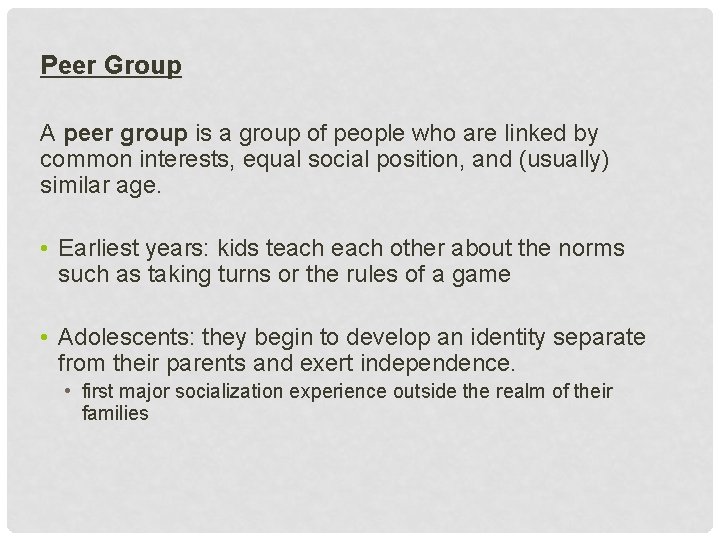
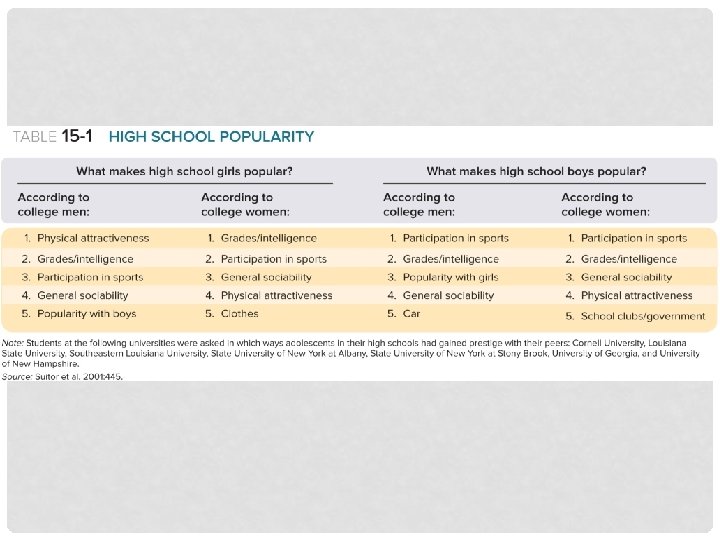
Peer Group A peer group is a group of people who are linked by common interests, equal social position, and (usually) similar age. • Earliest years: kids teach other about the norms such as taking turns or the rules of a game • Adolescents: they begin to develop an identity separate from their parents and exert independence. • first major socialization experience outside the realm of their families
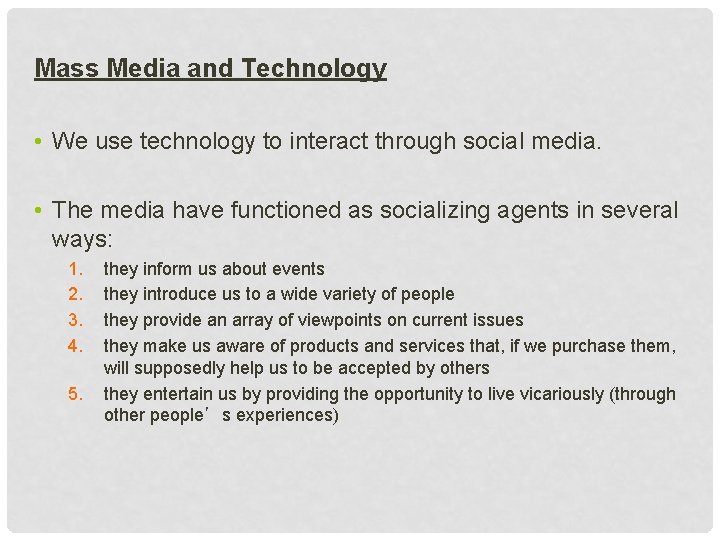
Mass Media and Technology • We use technology to interact through social media. • The media have functioned as socializing agents in several ways: 1. 2. 3. 4. 5. they inform us about events they introduce us to a wide variety of people they provide an array of viewpoints on current issues they make us aware of products and services that, if we purchase them, will supposedly help us to be accepted by others they entertain us by providing the opportunity to live vicariously (through other people’s experiences)
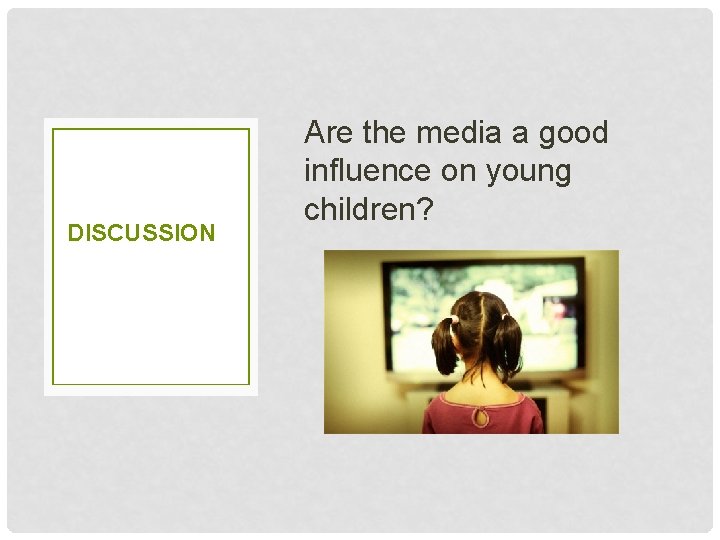
DISCUSSION Are the media a good influence on young children?
The Workplace • Just as children spend much of their day at school, many U. S. adults at some point invest a significant amount of time at a place of employment • Employees require new socialization into a workplace, in terms of both material culture and nonmaterial culture • material culture - how to operate the copy machine • nonmaterial culture - whether it’s okay to speak directly to the boss or how to share the refrigerator
Religion and the State • Religion is an important avenue of socialization for many people • Important ceremonies related to family structure—like marriage and birth—are connected to religious celebrations • Many religious institutions also uphold gender norms and contribute to their enforcement through socialization. • Many of the rites of passage people go through today are based on age norms established by the government • To be defined as an “adult” usually means being eighteen years old, the age at which a person becomes legally responsible for him- or herself • Sixty-five years old is the start of “old age” since most people become eligible for senior benefits at that point.