
Socialization and Interaction Introduction to Sociology Socialization is



- Slides: 33
Socialization and Interaction Introduction to Sociology
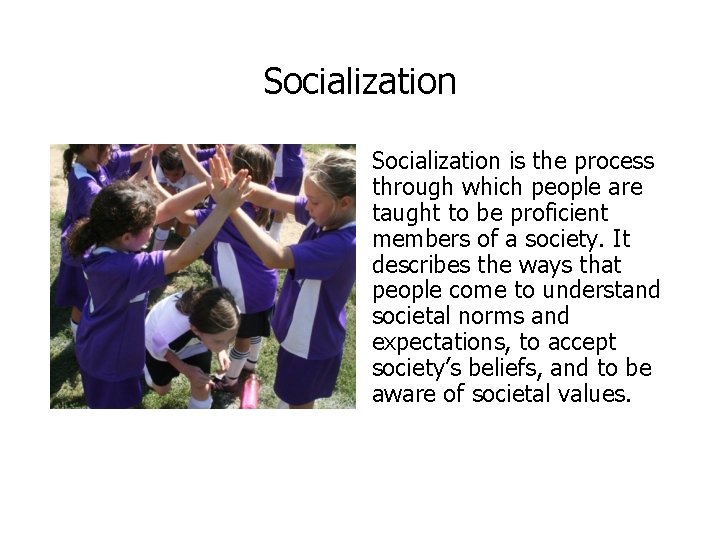
Socialization is the process through which people are taught to be proficient members of a society. It describes the ways that people come to understand societal norms and expectations, to accept society’s beliefs, and to be aware of societal values.
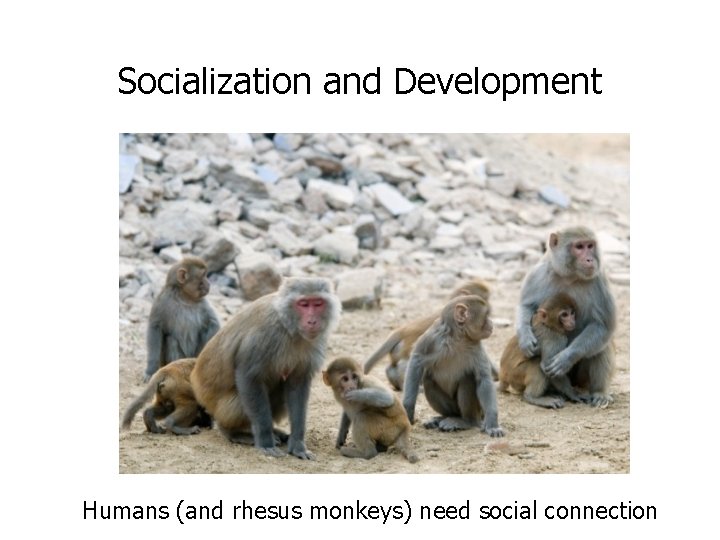
Socialization and Development Humans (and rhesus monkeys) need social connection
Psychological Theories of Selfdevelopment • Freudian • Erikson • Piaget
Freudian Psychosexual Development Children’s pleasure-seeking urges are focused on a different area of the body, called an erogenous zone, at each of the five stages of development: • Oral • Anal • Phallic • Latency • Genital Most of Freud’s ideas have not found support in modern research but he was correct that personality is shaped by childhood experiences.
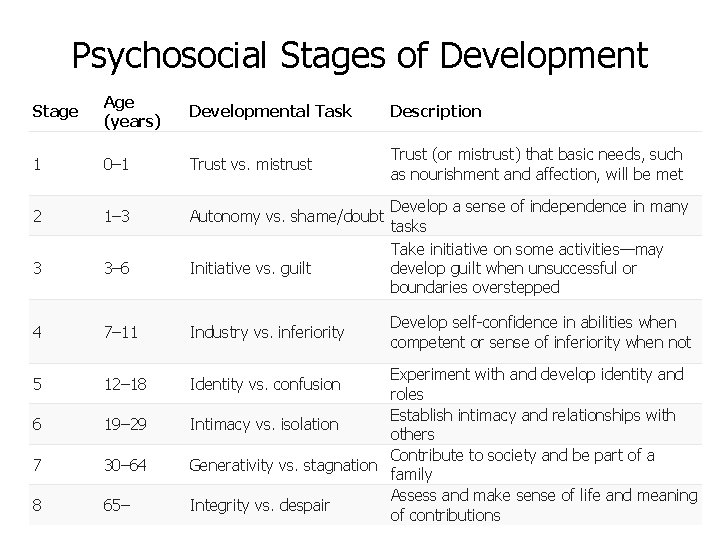
Erikson’s Psychosocial Development Theory • How we interact with others affects our sense of self, or ego identity. • Personality development takes place through the lifespan. • At each stage of life there is a conflict that we need to resolve.
Psychosocial Stages of Development Stage Age (years) Developmental Task Description 1 0– 1 Trust vs. mistrust Trust (or mistrust) that basic needs, such as nourishment and affection, will be met 2 1– 3 Autonomy vs. shame/doubt 3 3– 6 Initiative vs. guilt 4 7– 11 Industry vs. inferiority 5 12– 18 Identity vs. confusion 6 19– 29 7 30– 64 8 65– Develop a sense of independence in many tasks Take initiative on some activities—may develop guilt when unsuccessful or boundaries overstepped Develop self-confidence in abilities when competent or sense of inferiority when not Experiment with and develop identity and roles Establish intimacy and relationships with Intimacy vs. isolation others Contribute to society and be part of a Generativity vs. stagnation family Assess and make sense of life and meaning Integrity vs. despair of contributions
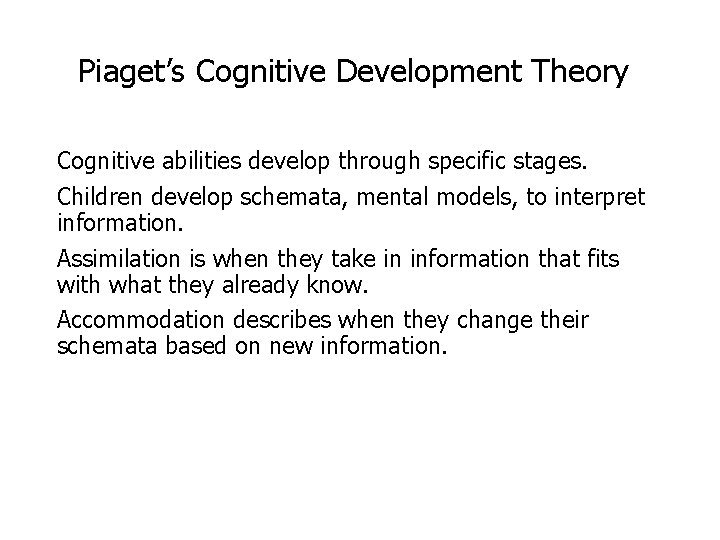
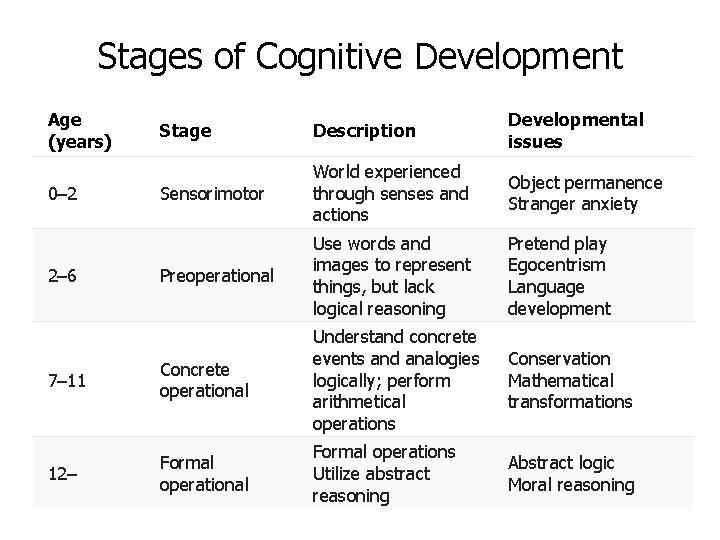
Piaget’s Cognitive Development Theory Cognitive abilities develop through specific stages. Children develop schemata, mental models, to interpret information. Assimilation is when they take in information that fits with what they already know. Accommodation describes when they change their schemata based on new information.
Stages of Cognitive Development Age (years) Stage Description Developmental issues Sensorimotor World experienced through senses and actions Object permanence Stranger anxiety Preoperational Use words and images to represent things, but lack logical reasoning Pretend play Egocentrism Language development 7– 11 Concrete operational Understand concrete events and analogies logically; perform arithmetical operations Conservation Mathematical transformations 12– Formal operational Formal operations Utilize abstract reasoning Abstract logic Moral reasoning 0– 2 2– 6
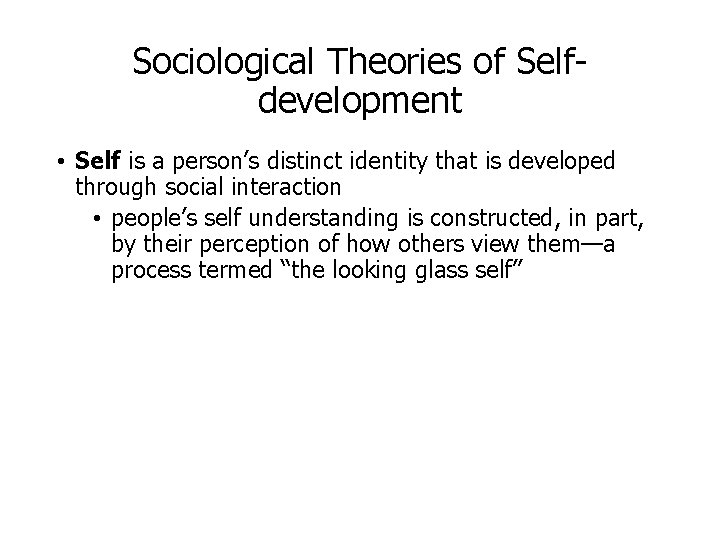
Sociological Theories of Selfdevelopment • Self is a person’s distinct identity that is developed through social interaction • people’s self understanding is constructed, in part, by their perception of how others view them—a process termed “the looking glass self”
Mead’s Stages of Development • Preparatory stage: children are only capable of imitation, they have no ability to imagine how others see things • Play stage: children begin to take on the role that one other person might have. • children learn to consider several roles at the same time and how those roles interact with each other. • Finally, children develop, understand, and learn the idea of the generalized other, the common behavioral expectations of general society. By this stage of development, an individual is able to imagine how he or she is viewed by one or many others—and thus, from a sociological perspective, to have a “self”
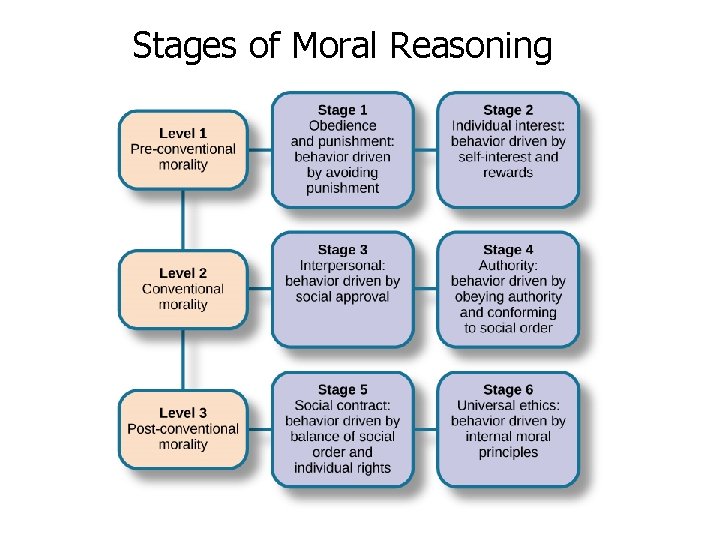
Stages of Moral Reasoning
Issues in Sociology: Nature vs. Nurture Are we who we are because of our genes, or are we who we are because of our environment and culture? Our unique experiences in our environment influence whether and how particular traits are expressed, and at the same time, our genes influence how we interact with our environment
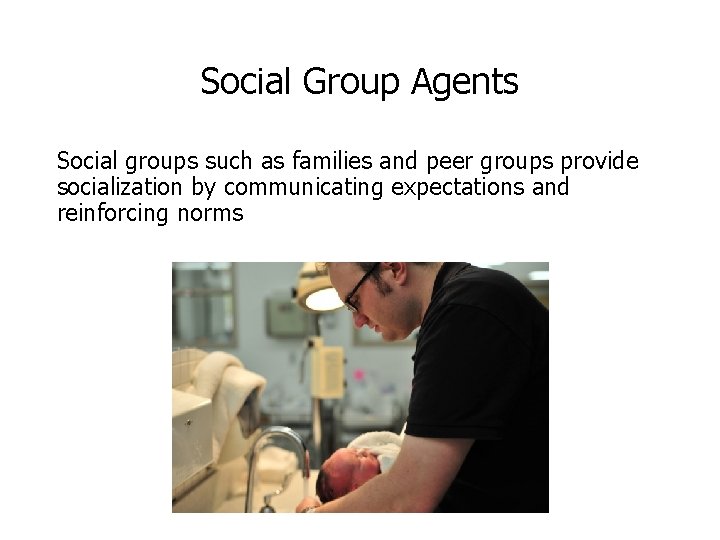
Social Group Agents Social groups such as families and peer groups provide socialization by communicating expectations and reinforcing norms
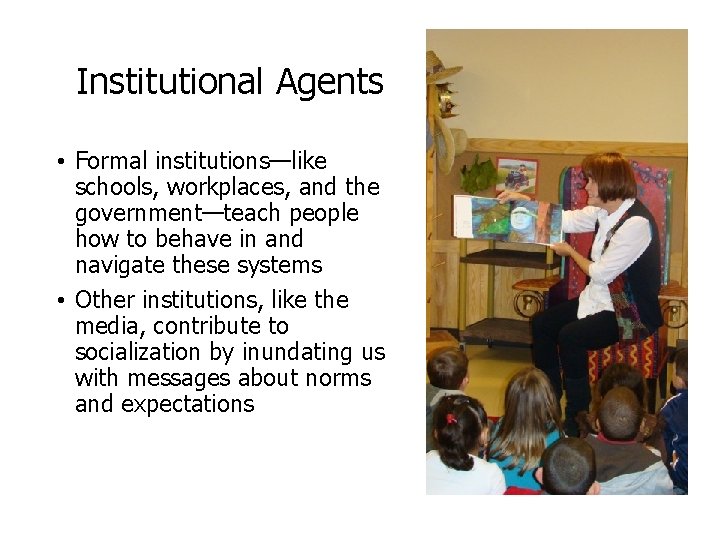
Institutional Agents • Formal institutions—like schools, workplaces, and the government—teach people how to behave in and navigate these systems • Other institutions, like the media, contribute to socialization by inundating us with messages about norms and expectations
Socialization over the Lifespan In the United States, socialization throughout the life course is determined greatly by age norms and “time-related rules and regulations. ” As we grow older, we encounter agerelated transition points that require socialization into a new role, such as: • becoming school age • entering the workforce • retiring
Millenials’ Long Road to Adulthood In the U. S. the five milestones that define adulthood are: • completing school • leaving home • becoming financially independent • marrying • having a child These social milestones are taking longer for millennials to attain, if they’re attained at all. Sociologists wonder what long-term impact this generation’s situation may have on society as a whole.
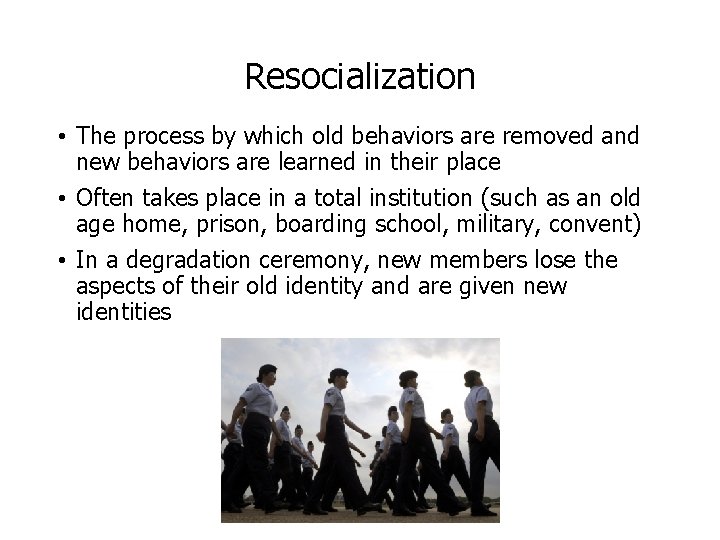
Resocialization • The process by which old behaviors are removed and new behaviors are learned in their place • Often takes place in a total institution (such as an old age home, prison, boarding school, military, convent) • In a degradation ceremony, new members lose the aspects of their old identity and are given new identities
Defining a Group • aggregate: a collection of people who exist in the same place at the same time, but who don’t interact or share a sense of identity • category: people who share similar characteristics but who are not connected in any way • group: any collection of at least two people who interact with some frequency and who share some sense of aligned identity
Types of Groups • in-group: a group a person belongs to and feels is an integral part of his identity • out-group: a group that an individual is not a member of, and may even compete with • primary groups: small, informal groups of people who are closest to us • secondary groups: larger and more impersonal groups that are task-focused and time limited • reference groups: groups to which an individual compares herself
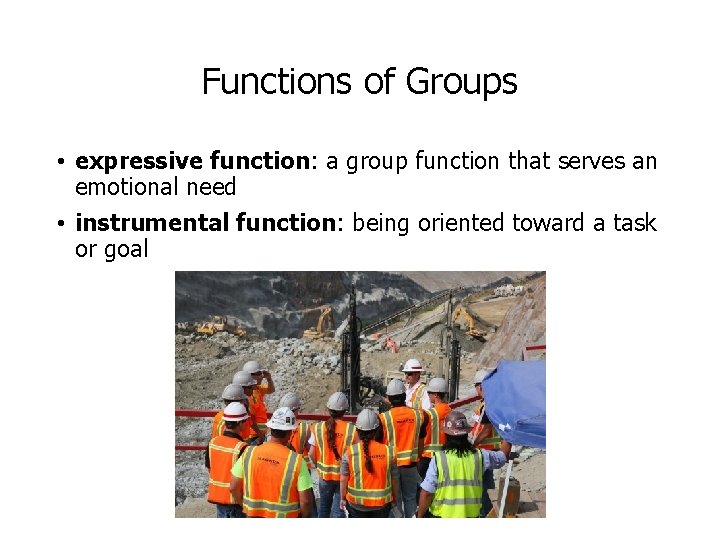
Functions of Groups • expressive function: a group function that serves an emotional need • instrumental function: being oriented toward a task or goal
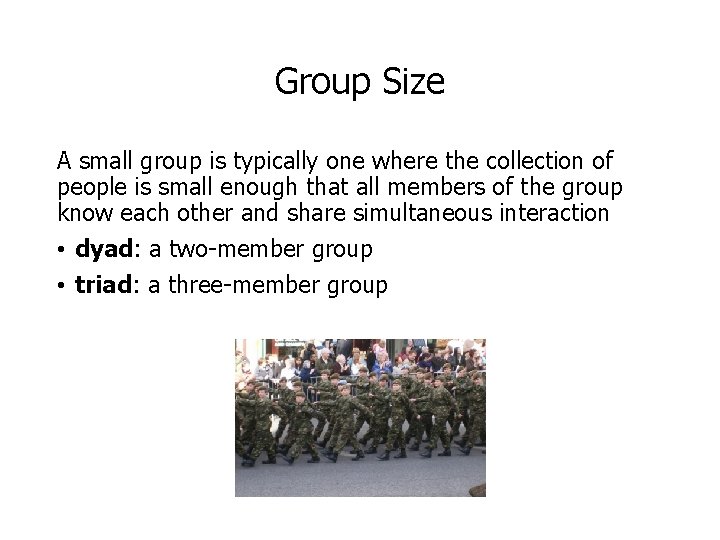
Group Size A small group is typically one where the collection of people is small enough that all members of the group know each other and share simultaneous interaction • dyad: a two-member group • triad: a three-member group
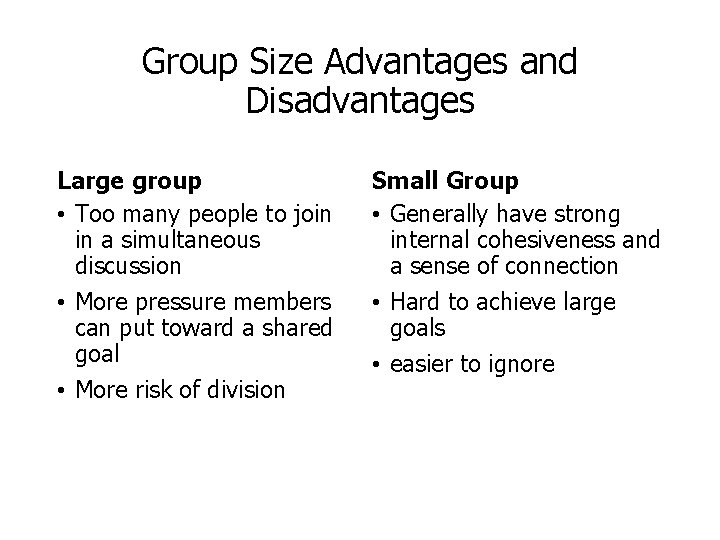
Group Size Advantages and Disadvantages Large group • Too many people to join in a simultaneous discussion • More pressure members can put toward a shared goal • More risk of division Small Group • Generally have strong internal cohesiveness and a sense of connection • Hard to achieve large goals • easier to ignore
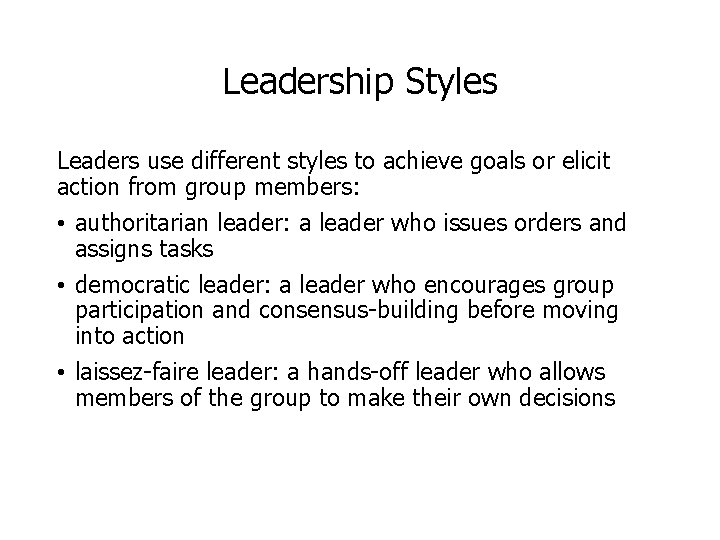
Leadership Styles Leaders use different styles to achieve goals or elicit action from group members: • authoritarian leader: a leader who issues orders and assigns tasks • democratic leader: a leader who encourages group participation and consensus-building before moving into action • laissez-faire leader: a hands-off leader who allows members of the group to make their own decisions
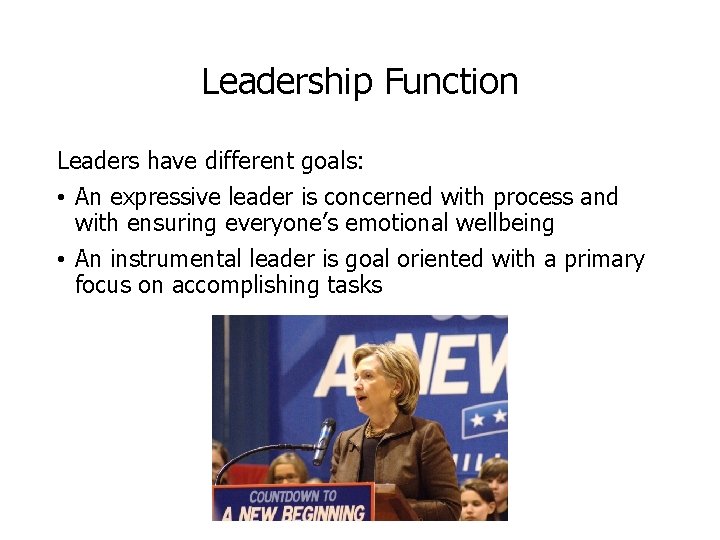
Leadership Function Leaders have different goals: • An expressive leader is concerned with process and with ensuring everyone’s emotional wellbeing • An instrumental leader is goal oriented with a primary focus on accomplishing tasks
Conformity is the extent to which an individual complies with group norms or expectations
Formal Organizations • Large and impersonal secondary organizations • Usually develop bureaucracies
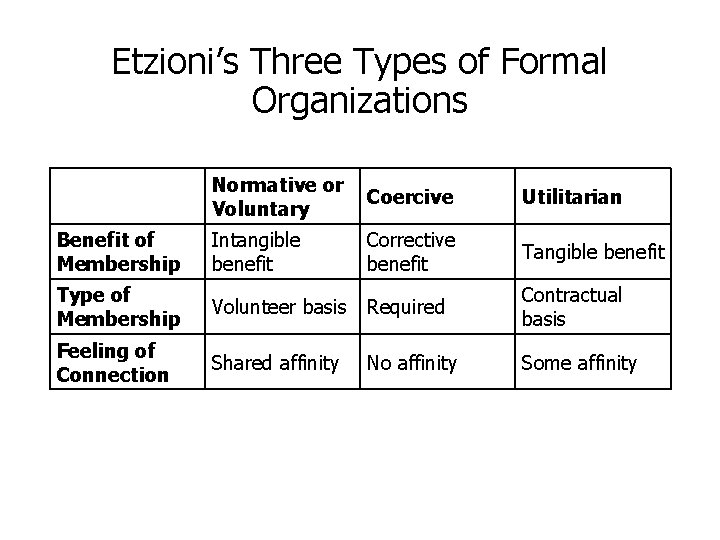
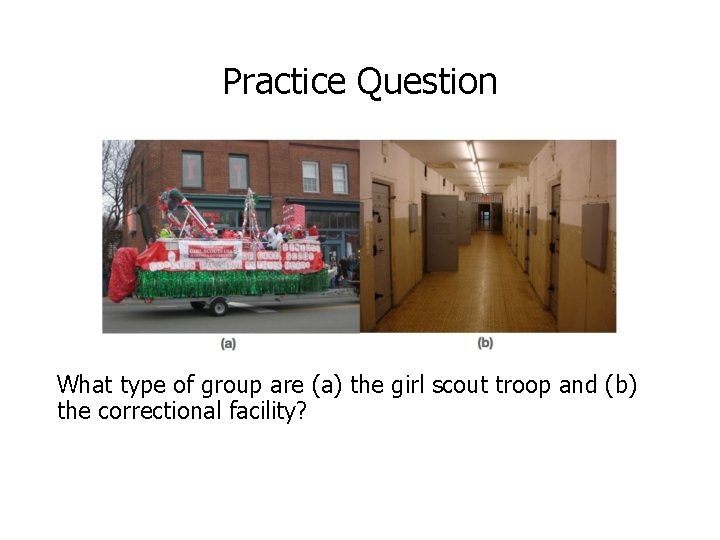
Etzioni’s Three Types of Formal Organizations Normative or Voluntary Coercive Utilitarian Benefit of Membership Intangible benefit Corrective benefit Tangible benefit Type of Membership Volunteer basis Required Contractual basis Feeling of Connection Shared affinity No affinity Some affinity
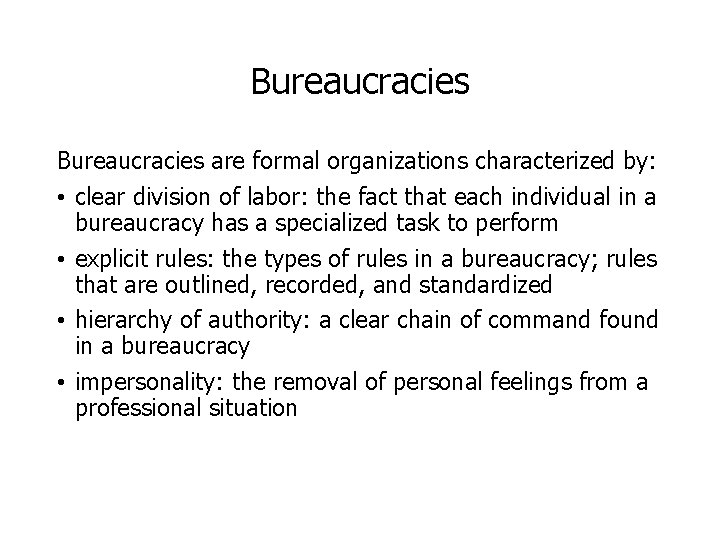
Bureaucracies are formal organizations characterized by: • clear division of labor: the fact that each individual in a bureaucracy has a specialized task to perform • explicit rules: the types of rules in a bureaucracy; rules that are outlined, recorded, and standardized • hierarchy of authority: a clear chain of command found in a bureaucracy • impersonality: the removal of personal feelings from a professional situation
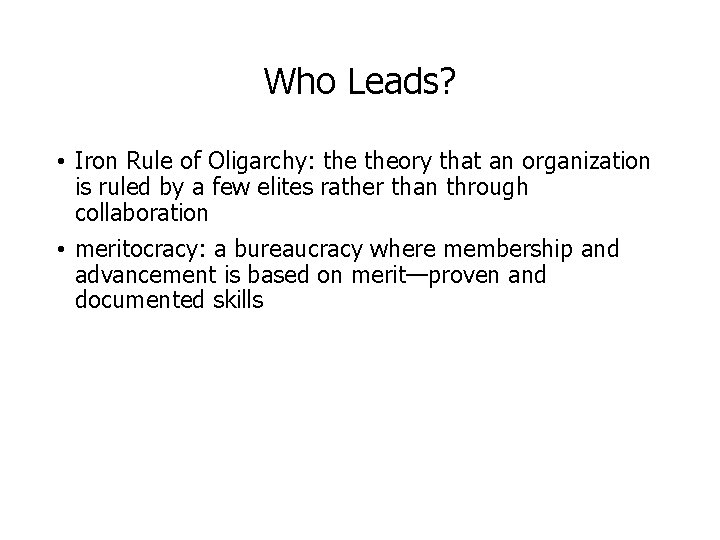
Who Leads? • Iron Rule of Oligarchy: theory that an organization is ruled by a few elites rather than through collaboration • meritocracy: a bureaucracy where membership and advancement is based on merit—proven and documented skills
Practice Question What type of group are (a) the girl scout troop and (b) the correctional facility?
Practice Question How are bureaucracies beneficial?
Quick Review • What are theories of self-development? • Why is socialization is important? • What roles do agents of socialization play in the socialization process? • How does socialization develop across the life course? • What are types of groups and how are group dynamics impacted by leadership, size, and conformity? • What are characteristics of formal organizations?