
Social Thinking and Strategies for Individuals with Autism

- Slides: 45
Social Thinking and Strategies for Individuals with Autism Karen O’Connor, Ph. D, BCBA, LBA
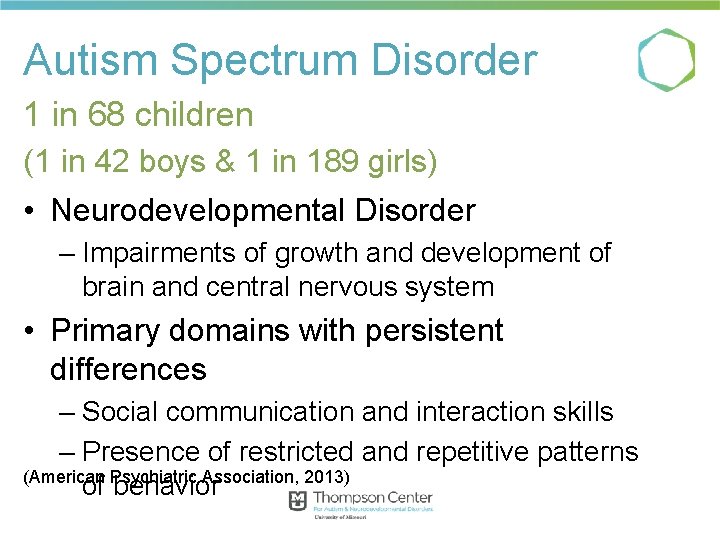
Autism Spectrum Disorder 1 in 68 children (1 in 42 boys & 1 in 189 girls) • Neurodevelopmental Disorder – Impairments of growth and development of brain and central nervous system • Primary domains with persistent differences – Social communication and interaction skills – Presence of restricted and repetitive patterns (American Psychiatric Association, 2013) of behavior
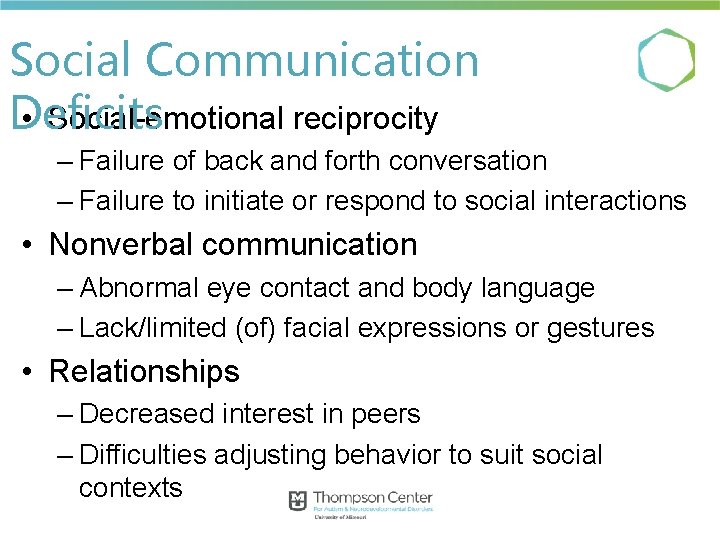
Social Communication • Social-emotional reciprocity Deficits – Failure of back and forth conversation – Failure to initiate or respond to social interactions • Nonverbal communication – Abnormal eye contact and body language – Lack/limited (of) facial expressions or gestures • Relationships – Decreased interest in peers – Difficulties adjusting behavior to suit social contexts
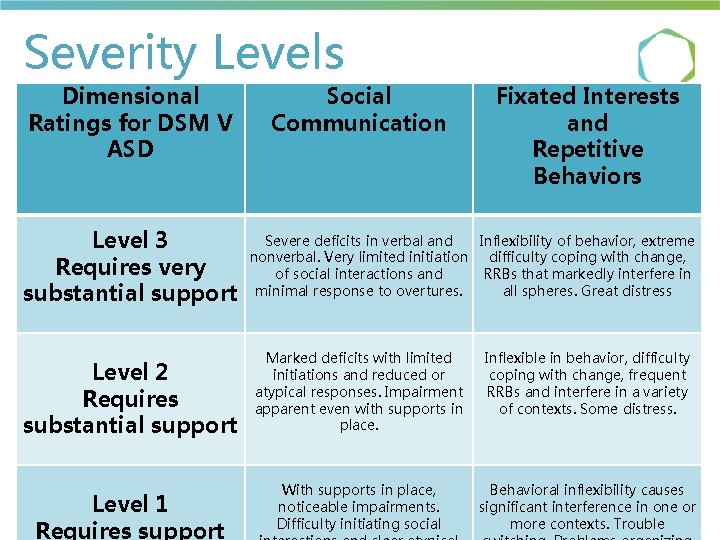
Severity Levels Dimensional Ratings for DSM V ASD Level 3 Requires very substantial support Level 2 Requires substantial support Level 1 Requires support Social Communication Fixated Interests and Repetitive Behaviors Severe deficits in verbal and Inflexibility of behavior, extreme nonverbal. Very limited initiation difficulty coping with change, of social interactions and RRBs that markedly interfere in minimal response to overtures. all spheres. Great distress Marked deficits with limited initiations and reduced or atypical responses. Impairment apparent even with supports in place. Inflexible in behavior, difficulty coping with change, frequent RRBs and interfere in a variety of contexts. Some distress. With supports in place, noticeable impairments. Difficulty initiating social Behavioral inflexibility causes significant interference in one or more contexts. Trouble
Autism Spectrum Disorder Considerations for the “High Functioning Profile” • Difficulties with advanced social contexts and perspective taking • Difficulties with executive functioning skills • Unique language profile • Poor adult outcomes – Lack of independence – Reliance on adult support – Social difficulties
Autism Spectrum Disorder Considerations for the “High Functioning Profile” • May have limited insights into their own difficulties and needs • May be able to tell you what they “should do” • May have comorbid mental health concerns: – Anxiety – Depression
Addressing Social Skills It’s not enough when we only … • Have proximity to peers • See peer models of social skills • Give feedback to correct social faux pas • Stop interactions that are not going well
Directly Teaching Skills
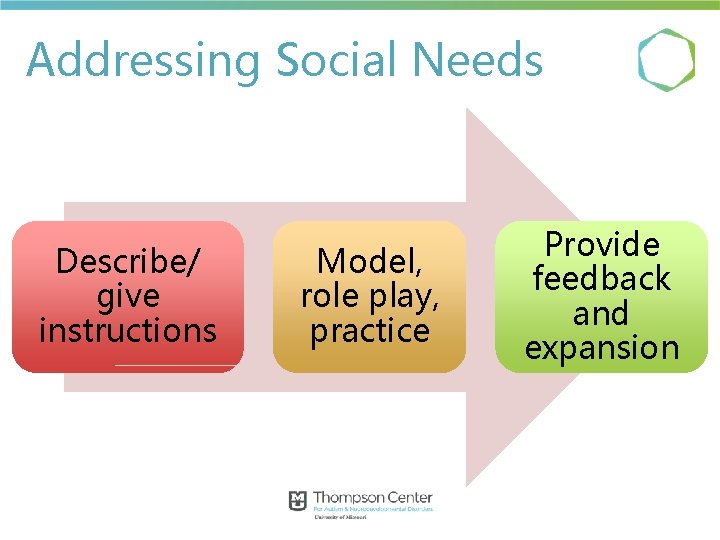
Addressing Social Needs Describe/ give instructions Model, role play, practice Provide feedback and expansion
Teaching Process • The individual is an KEY part of the process • Involved in: goal setting, creation of tools, practice scenarios, instruction • Process is proactive not reactive and corrective
Expected v. Unexpected • Respectful language to directly address social skills • Relate to student’s perspective: – what they expect in situations – how they react when something unexpected happens • Addresses the “why” behind hidden social expectations
Perspective Taking
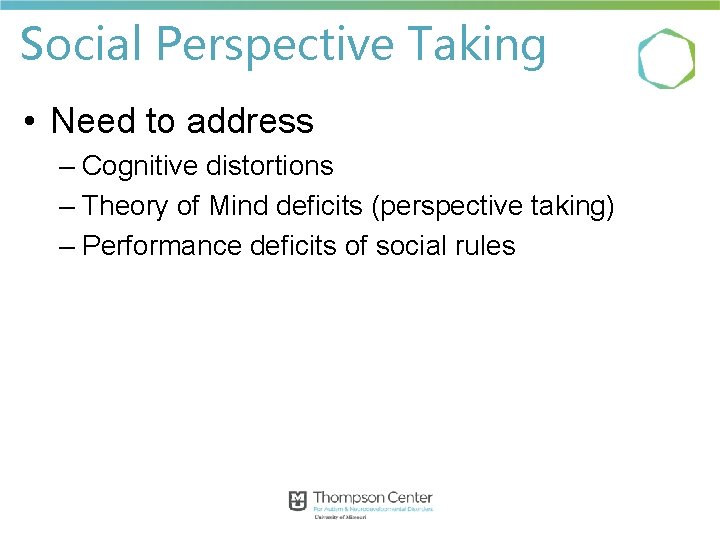
Social Perspective Taking • Need to address – Cognitive distortions – Theory of Mind deficits (perspective taking) – Performance deficits of social rules
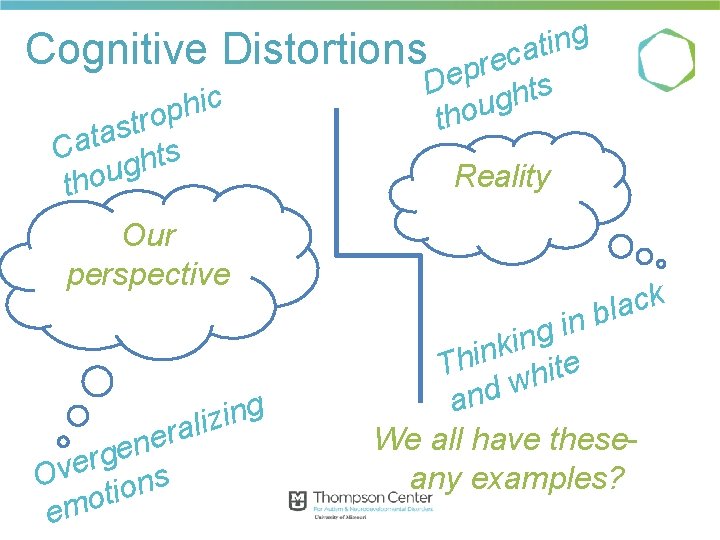
g n i t Cognitive Distortions preca e D ts h c g i u h o p h o t r t s a t Ca s t h g u Reality o th Our perspective g n i z rali e n e g r e Ov ions t o m e k c a bl n i g n i k n e Thi t i h w d n a We all have theseany examples?
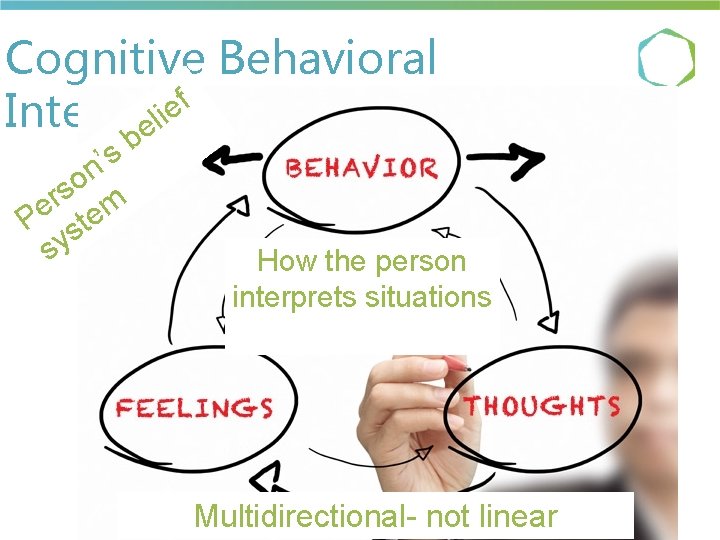
Cognitive Behavioral f e i Intervention l e b s ’ n o s m r Pe ste sy How the person interprets situations Multidirectional- not linear
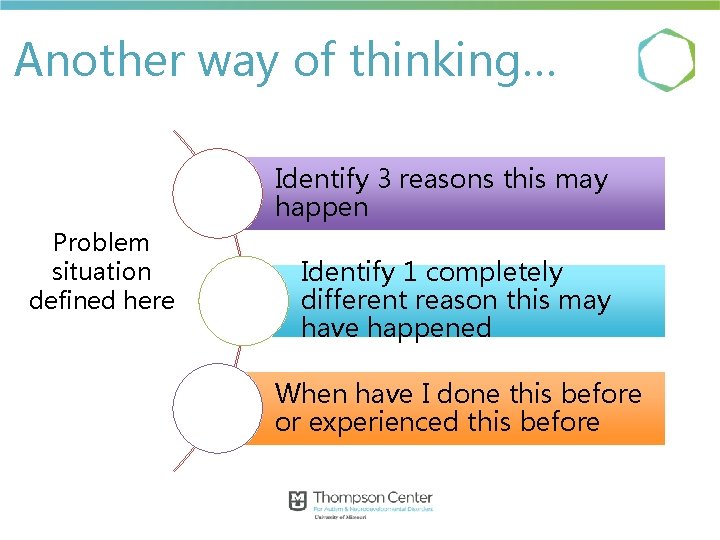
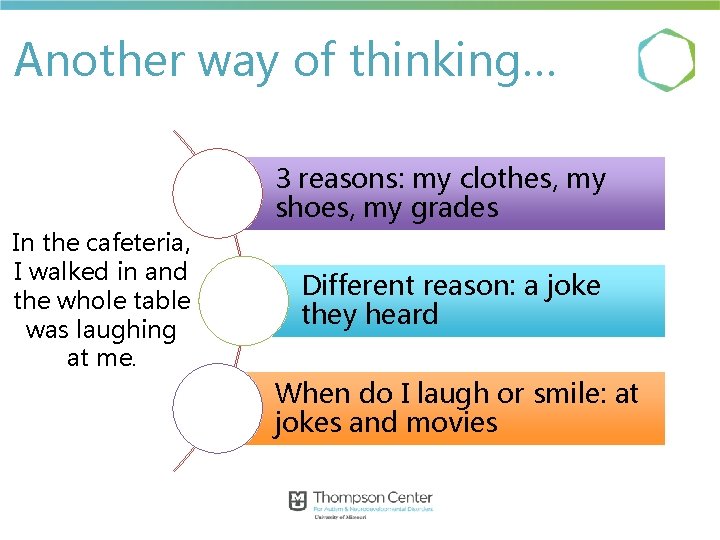
Another way of thinking… Identify 3 reasons this may happen Problem situation defined here Identify 1 completely different reason this may have happened When have I done this before or experienced this before
Another way of thinking… 3 reasons: my clothes, my shoes, my grades In the cafeteria, I walked in and the whole table was laughing at me. Different reason: a joke they heard When do I laugh or smile: at jokes and movies
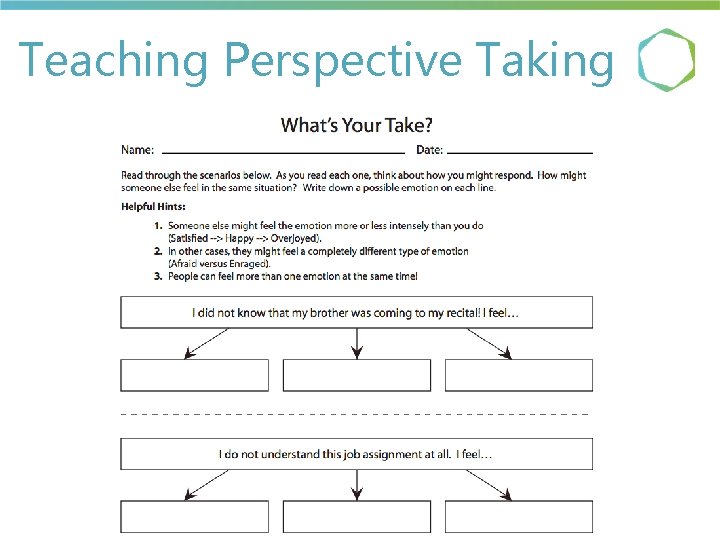
Teaching Perspective Taking
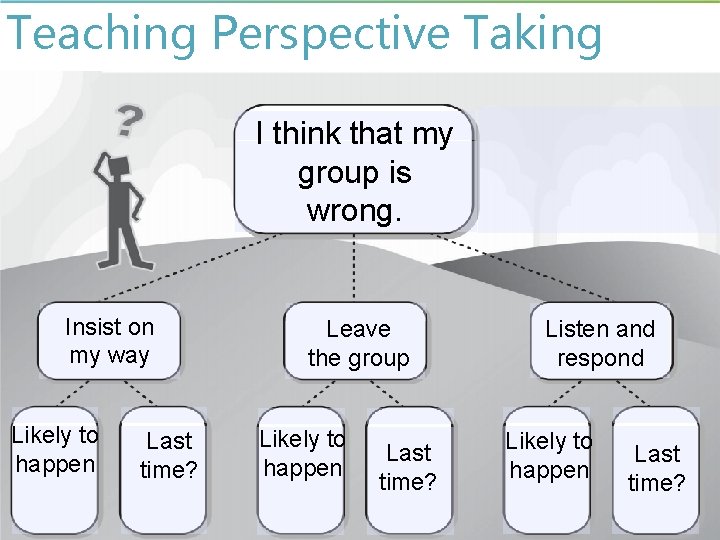
Teaching Perspective Taking I think that my group is wrong. Insist on my way Likely to happen Last time? Leave the group Likely to happen Last time? Listen and respond Likely to happen Last time?
Emotion Regulation
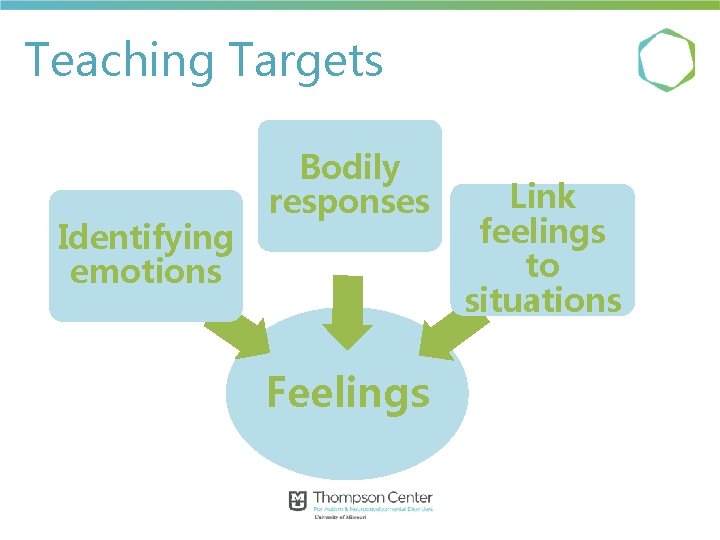
Teaching Targets Identifying emotions Bodily responses Feelings Link feelings to situations
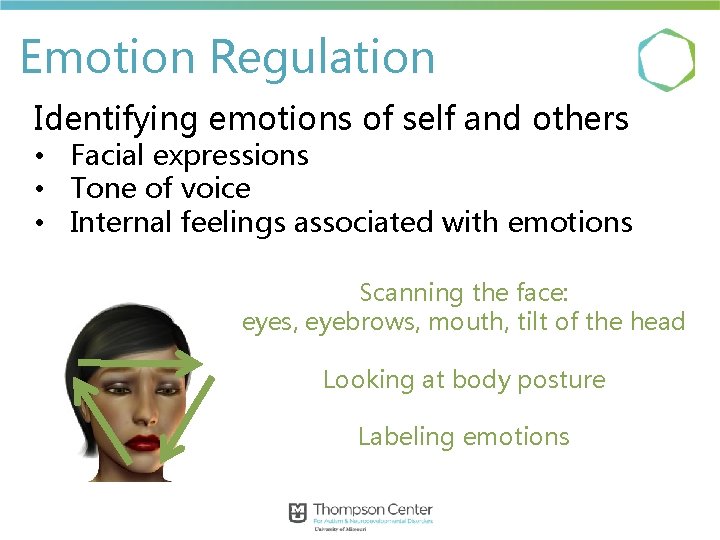
Emotion Regulation Identifying emotions of self and others • Facial expressions • Tone of voice • Internal feelings associated with emotions Scanning the face: eyes, eyebrows, mouth, tilt of the head Looking at body posture Labeling emotions
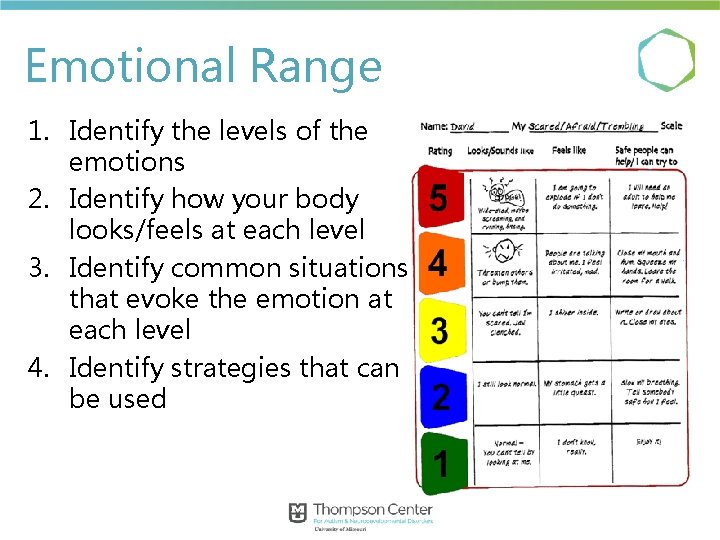
Emotional Range 1. Identify the levels of the emotions 2. Identify how your body looks/feels at each level 3. Identify common situations that evoke the emotion at each level 4. Identify strategies that can be used
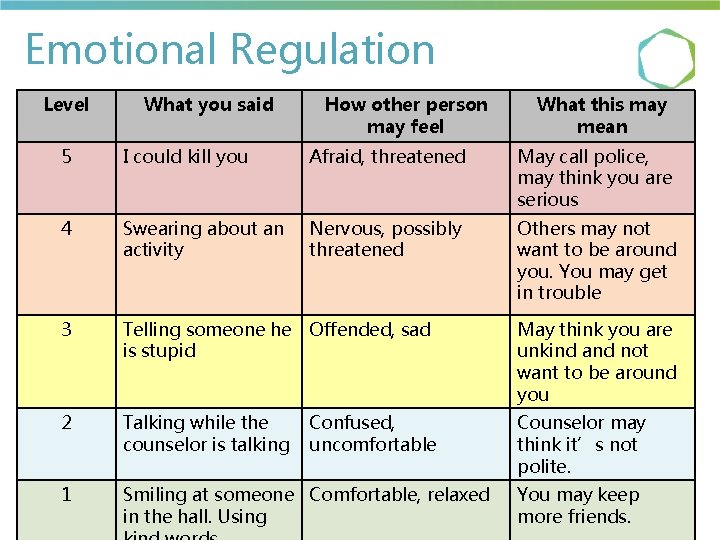
Emotional Regulation Level What you said How other person may feel What this may mean 5 I could kill you Afraid, threatened May call police, may think you are serious 4 Swearing about an activity Nervous, possibly threatened Others may not want to be around you. You may get in trouble 3 Telling someone he Offended, sad is stupid May think you are unkind and not want to be around you 2 Talking while the counselor is talking Counselor may think it’s not polite. 1 Smiling at someone Comfortable, relaxed in the hall. Using Confused, uncomfortable You may keep more friends.
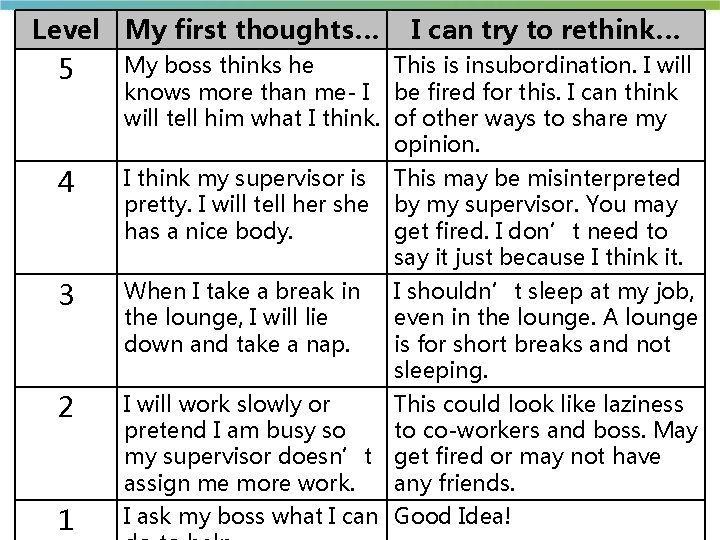
Level My first thoughts… I can try to rethink… 5 My boss thinks he This is insubordination. I will knows more than me- I be fired for this. I can think will tell him what I think. of other ways to share my opinion. 4 I think my supervisor is This may be misinterpreted pretty. I will tell her she by my supervisor. You may has a nice body. get fired. I don’t need to say it just because I think it. 3 When I take a break in the lounge, I will lie down and take a nap. I shouldn’t sleep at my job, even in the lounge. A lounge is for short breaks and not sleeping. 2 I will work slowly or pretend I am busy so my supervisor doesn’t assign me more work. This could look like laziness to co-workers and boss. May get fired or may not have any friends. 1 I ask my boss what I can Good Idea!
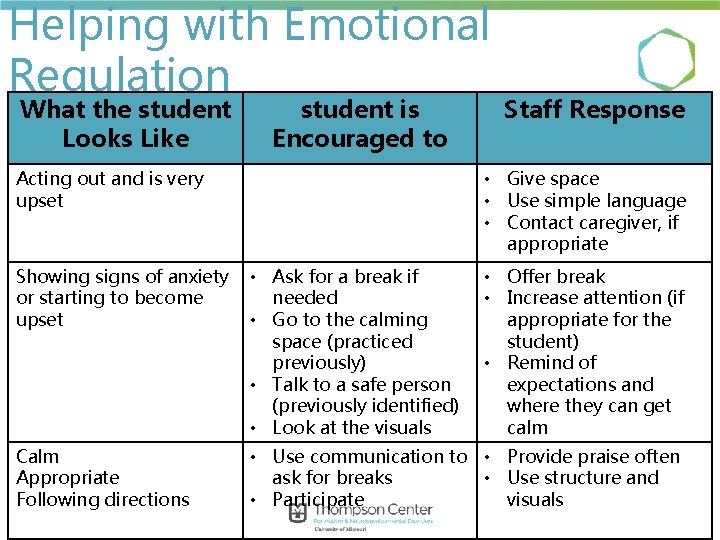
Helping with Emotional Regulation What the student Looks Like student is Encouraged to Staff Response Acting out and is very upset • Give space • Use simple language • Contact caregiver, if appropriate Showing signs of anxiety • Ask for a break if or starting to become needed upset • Go to the calming space (practiced previously) • Talk to a safe person (previously identified) • Look at the visuals • Offer break • Increase attention (if appropriate for the student) • Remind of expectations and where they can get calm Calm Appropriate Following directions • Use communication to • Provide praise often ask for breaks • Use structure and • Participate visuals
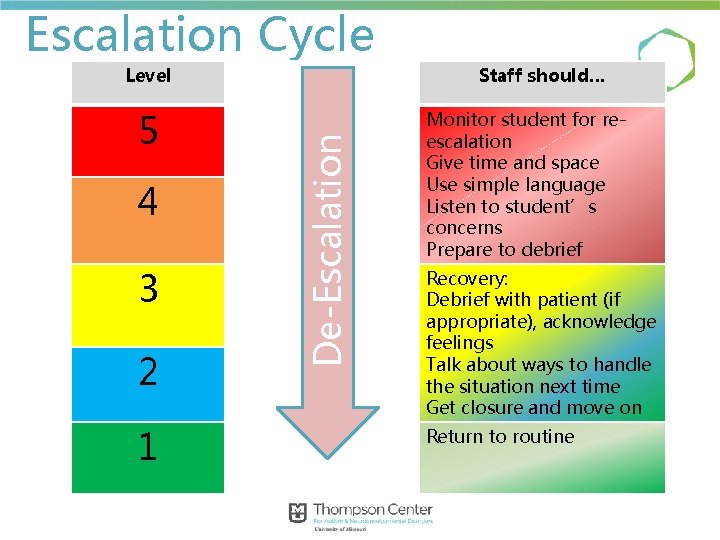
Escalation Cycle 5 4 3 2 1 De-Escalation Level Staff should… Monitor student for reescalation Give time and space Use simple language Listen to student’s concerns Prepare to debrief Recovery: Debrief with patient (if appropriate), acknowledge feelings Talk about ways to handle the situation next time Get closure and move on Return to routine
Supporting Skill Use
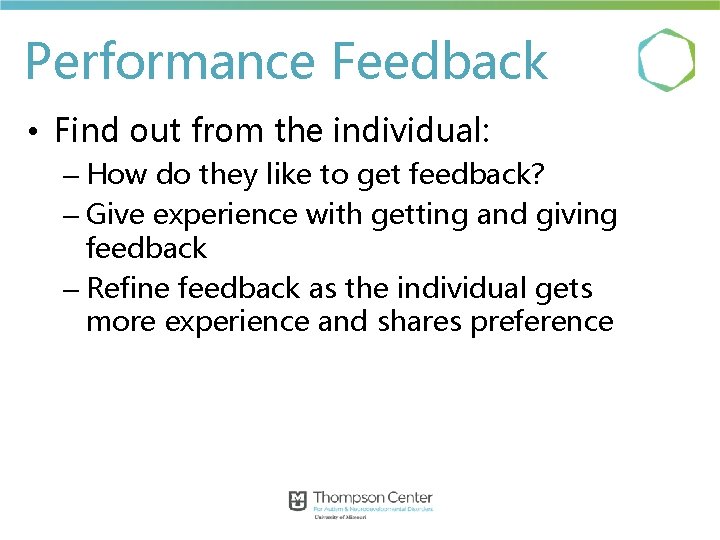
Performance Feedback • Find out from the individual: – How do they like to get feedback? – Give experience with getting and giving feedback – Refine feedback as the individual gets more experience and shares preference
Performance Feedback Have a Plan! Barrier Plan Progress
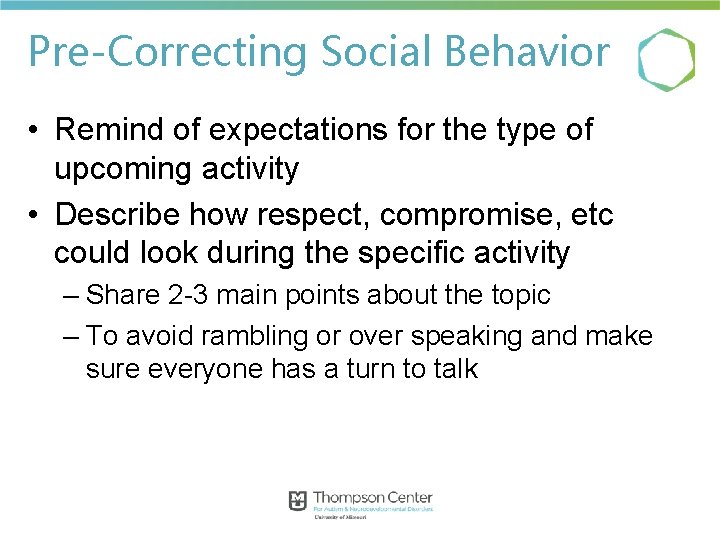
Pre-Correcting Social Behavior • Remind of expectations for the type of upcoming activity • Describe how respect, compromise, etc could look during the specific activity – Share 2 -3 main points about the topic – To avoid rambling or over speaking and make sure everyone has a turn to talk
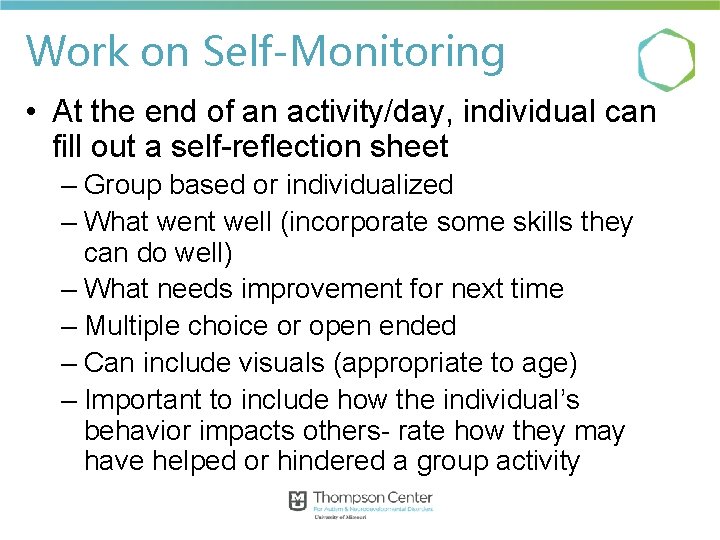
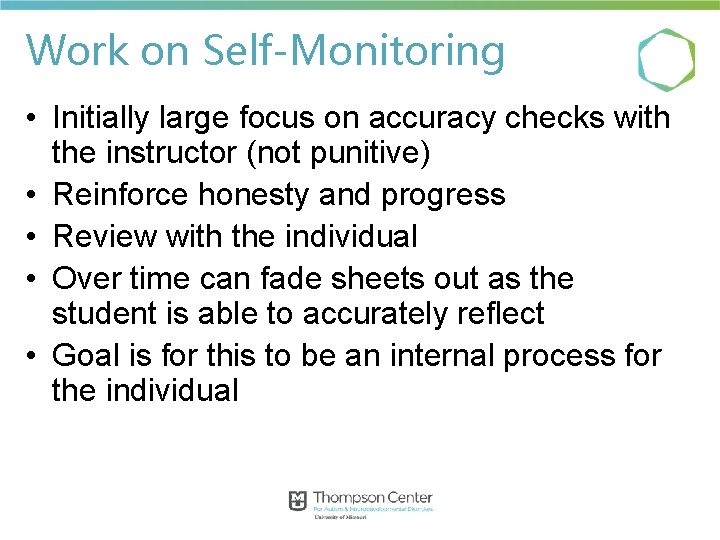
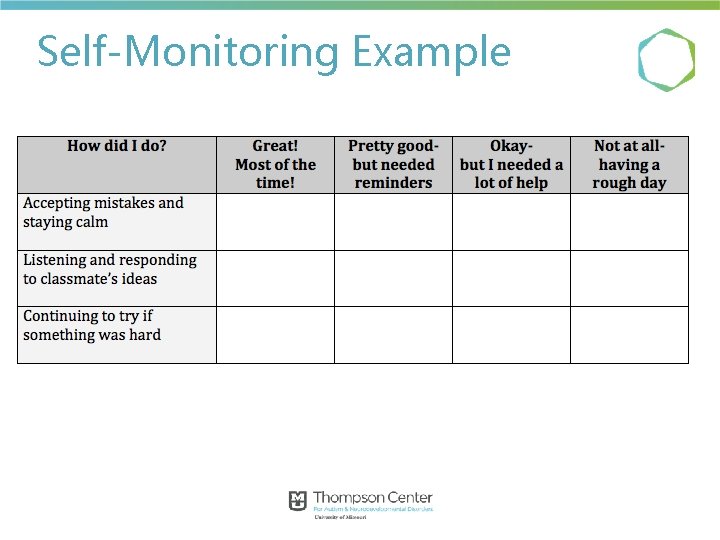
Work on Self-Monitoring • At the end of an activity/day, individual can fill out a self-reflection sheet – Group based or individualized – What went well (incorporate some skills they can do well) – What needs improvement for next time – Multiple choice or open ended – Can include visuals (appropriate to age) – Important to include how the individual’s behavior impacts others- rate how they may have helped or hindered a group activity
Work on Self-Monitoring • Initially large focus on accuracy checks with the instructor (not punitive) • Reinforce honesty and progress • Review with the individual • Over time can fade sheets out as the student is able to accurately reflect • Goal is for this to be an internal process for the individual
Self-Monitoring Example
Utilizing Peers
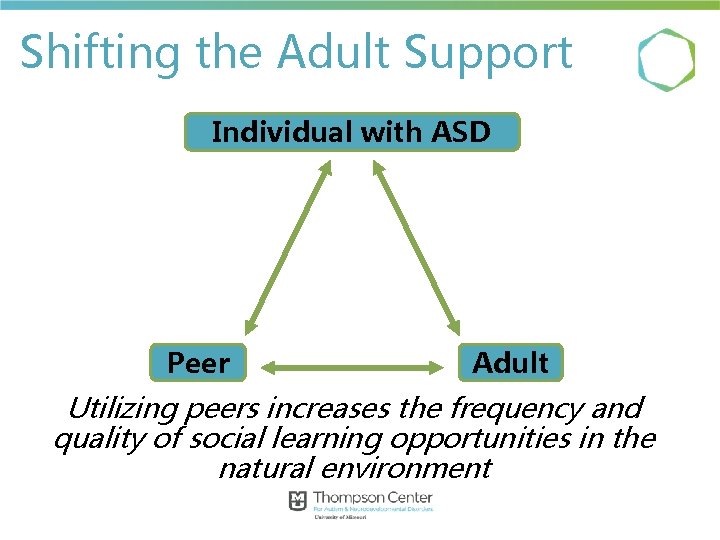
Shifting the Adult Support Individual with ASD Peer Adult Utilizing peers increases the frequency and quality of social learning opportunities in the natural environment
Peer Mediated Intervention • Teaching peers how to interact with individuals with autism to address social and communication skills • Peers are taught in a systematic way how to initiate and maintain interactions • Can be in pairs or small groups • Results in positive social interactions across a variety of activities
Teaching Peers 1. Describe what they are going to be working on and supporting 2. Model how to do it with them 3. Give them an opportunity to role play 4. Practice with the peers how to prompt and praise your student 5. Praise the peers! They need reinforcement too!
Social Skills Peers can Support Initial Skills to Target for Students: • Starting & engaging in conversations • Keeping interactions going • Giving & accepting compliments • Including others in activities • Speaks with an appropriate volume in conversations • Introduces self to others • Responds to questions directed at him/her • Makes appropriate comments • Maintains peer’s topic of conversation • Flexes conversation topic naturally with the flow of the conversation • Reads cues to end conversations • Ends conversations appropriately (not abruptly)
Make it Work for You • Consider the needs of the individual you are working with • Prioritize (with the individual) and link these to common goals – Make it concrete – Use visuals – Reinforce! • Utilize peers and strategically planned activities to practice and generalize
Resources Virginia Commonwealth University (VCU)- Autism https: //vcuautismcenter. org/resources/adolescence. cfm Autism Speaks Transition Toolkit and Community-Based Skills Assessment OCALI Autism Internet Modules http: //www. autisminternetmodules. org/ National Professional Development Center on ASD- Evidence Based Briefs and Modules http: //autismpdc. fpg. unc. edu http: //afirm. fpg. unc. edu/ Missouri Autism Guidelines Initiative (MAGI) http: //autismguidelines. dmh. mo. gov/
TEAM Program The mission of TEAM is to increase expertise on autism spectrum disorders and to advance the knowledge and implementation of current empirically supported practices through focused training, coached practice, feedback, and consultation.
SPARK – Simons Foundation Powering Autism Research for Knowledge • SPARK is an online research partnership with the mission of speeding up research and advancing the understanding of autism. • Eligibility: Individuals with a professional diagnosis of autism. • Participation can be done entirely at home – registration is completed online. • Benefits: – Gift card – Significant genetic results returned – Future autism research opportunities – Access to resources • For more information visit: https: //thompsoncenter. missouri. edu/
Mizzou Online! Master’s Degree in Autism
Thank you! Questions? All materials reviewed today can be found here! http: //tinyurl. com/TCSocial. Think 2017 Contact information: Karen O’Connor, Ph. D, BCBA, LBA oconnorkv@health. missouri. edu