
Social Technology Marti A Hearst UC Berkeley Social
Social Technology Marti A. Hearst UC Berkeley
Social Technology: Technology used by groups of people. How society is being changed by technologymediated interactions.
Talk Structure • • Examples of social (uses of) technology. Consequences. What makes social systems work? Implications for IT research.
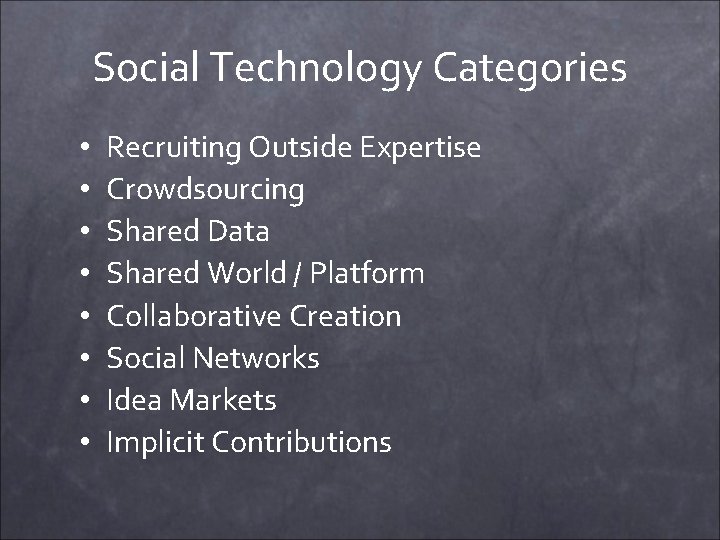
Social Technology Categories • • Recruiting Outside Expertise Crowdsourcing Shared Data Shared World / Platform Collaborative Creation Social Networks Idea Markets Implicit Contributions

Recruiting Outside Expertise: The Goldcorp Challenge
Gold. Corp Challenge • Rob Mc. Ewen was stuck for ideas about how to decide where to drill in Ontario. • Went to a meeting at MIT in 1999, heard about open source programming. • Decided to try it with gold prospecting! – Ran a contest – Predictions both confirmed their geologists’ predictions and produced new sites. fractaltechnologies. com
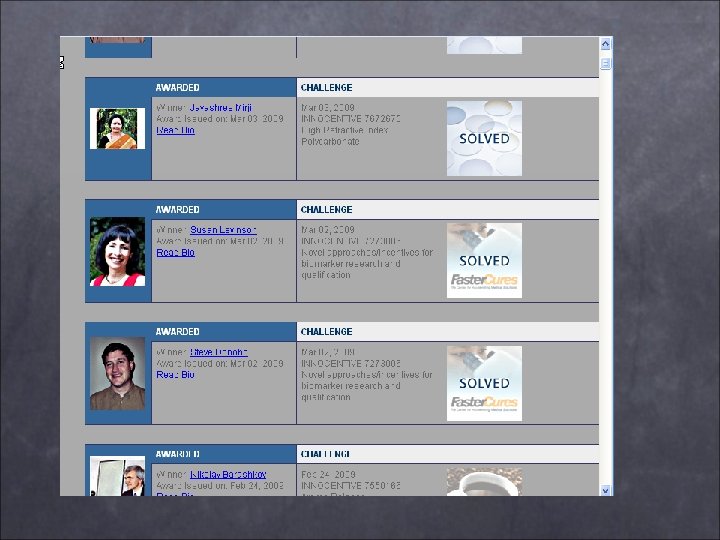
Recruiting Outside Expertise: Innocentive
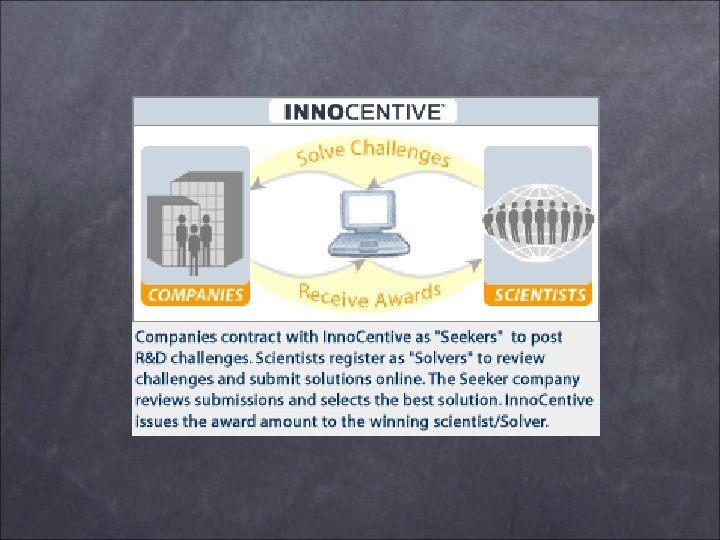
Recruiting Outside Expertise: Key Points • One organization can’t be employing all the necessary expertise to solve hard problems. • The connectivity of the Internet makes it possible like never before to find the missing expertise puzzle pieces. • The Long Tail of personal expertise.
Crowdsourcing
Crowdsourcing: Amazon’s Mechanical Turk • A pool of thousands of people • Small tasks, small pay – Many people do it for entertainment + pay • Careful modularization required • Already a research tool – Relevance judgements for search – NLP assessments – User Interface assessments
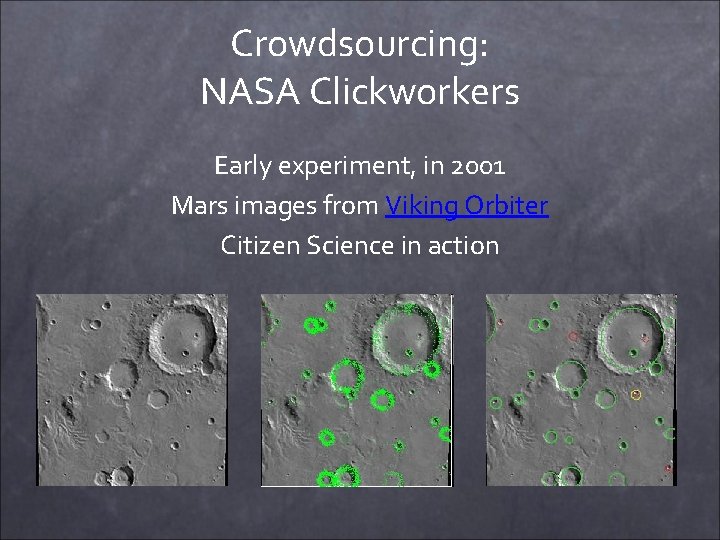
Crowdsourcing: NASA Clickworkers Early experiment, in 2001 Mars images from Viking Orbiter Citizen Science in action
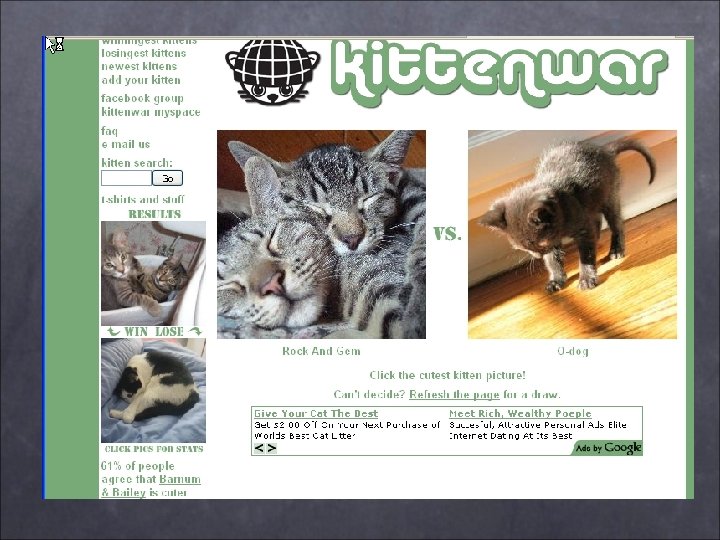
Crowdsourcing: More Examples • Stork’s Open. Mind Initiative (1999) – Including a game: shoot zeros vs. O’s • Hot. Or. Not (2000) • von. Ahn’s ESP game (2004) • Kitten. War! (~2005)
Crowdsourcing: Key Points • Little to no expertise needed. • The connectivity of the Internet makes it possible like never before to find enough people with the time and willingness to do these tasks.

Publicly Shared Data
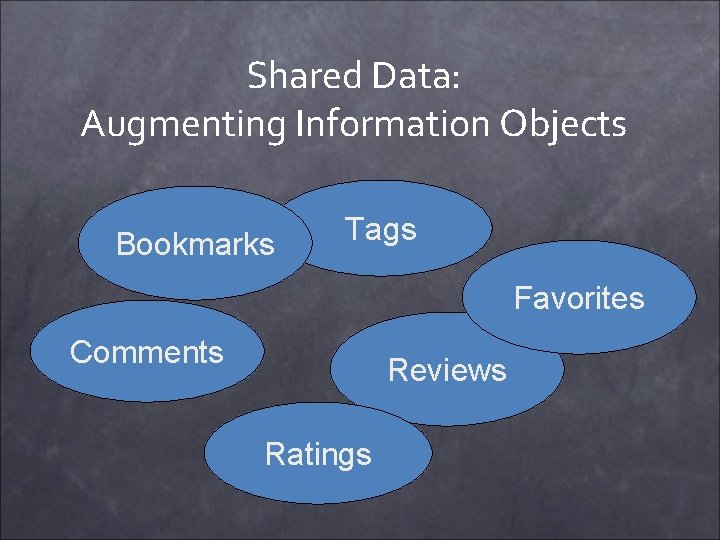
Shared Data: Augmenting Information Objects Bookmarks Tags Favorites Comments Reviews Ratings
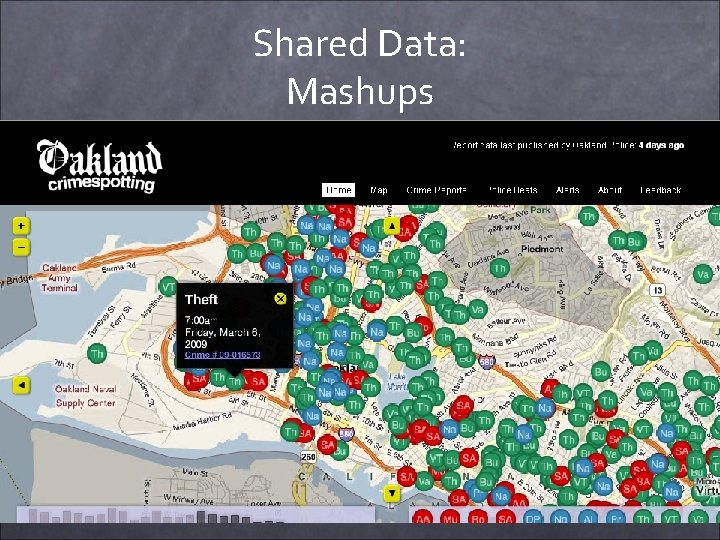
Shared Data: Mashups
Shared Data: Influencing Outcomes by Voting • American Idol • Kitchen Democracy
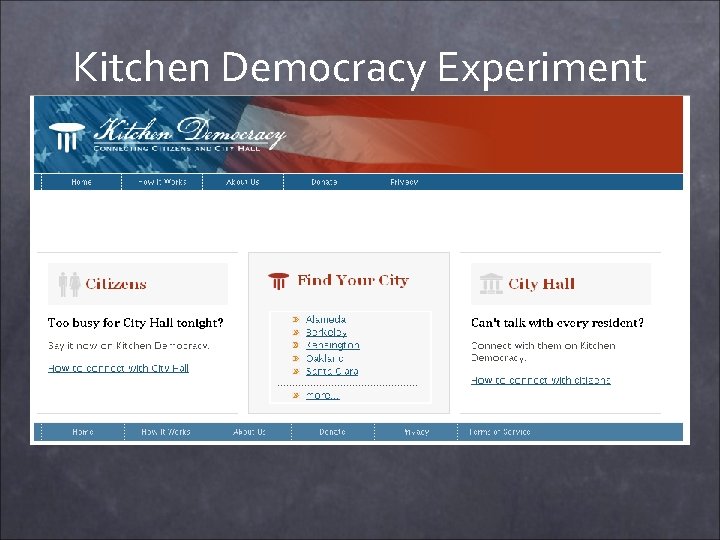
Kitchen Democracy Experiment
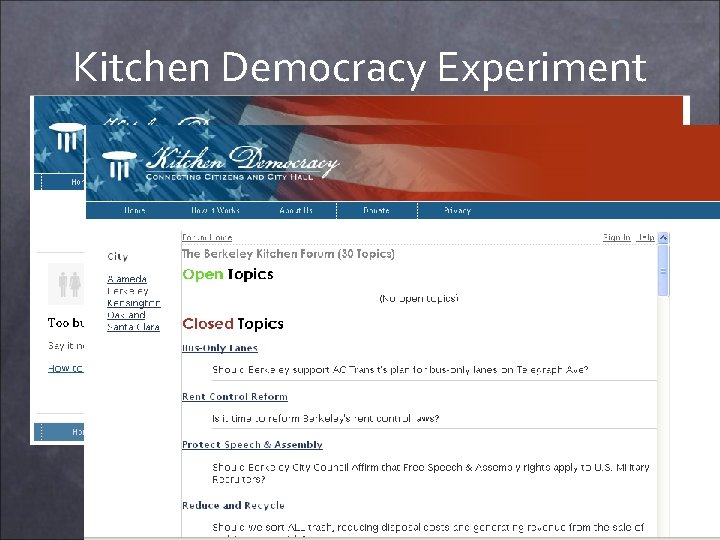
Kitchen Democracy Experiment
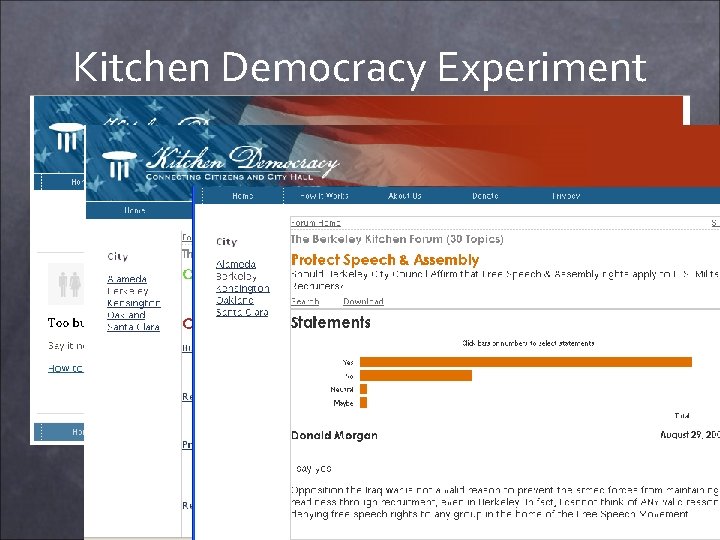
Kitchen Democracy Experiment
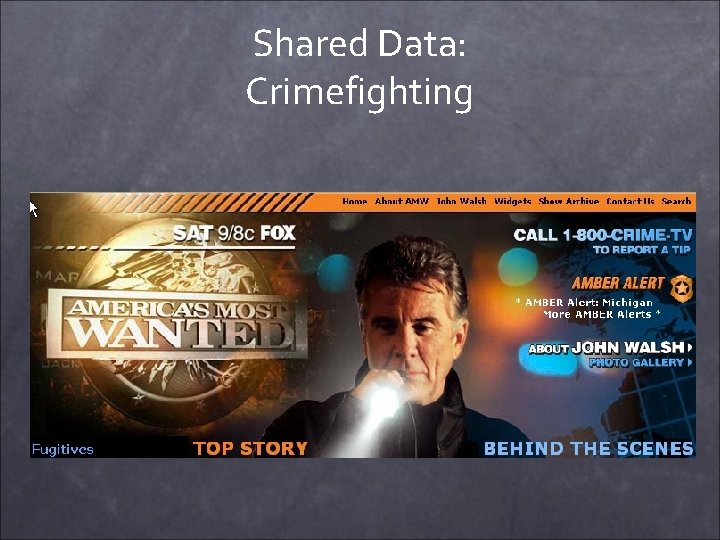
Shared Data: Crimefighting
Shared Data: Key Points • Easy to participate, but requires some expertise or specialized access (have bought and used product, read the book, have an opinion about the legislation). • Not a project with a coordinated goal; rather people are contributing to specific data items that they choose themselves. • Being able to see and search the entire set of useraugmented data creates value for everyone.
Shared World / Platform Inspiring People to Create
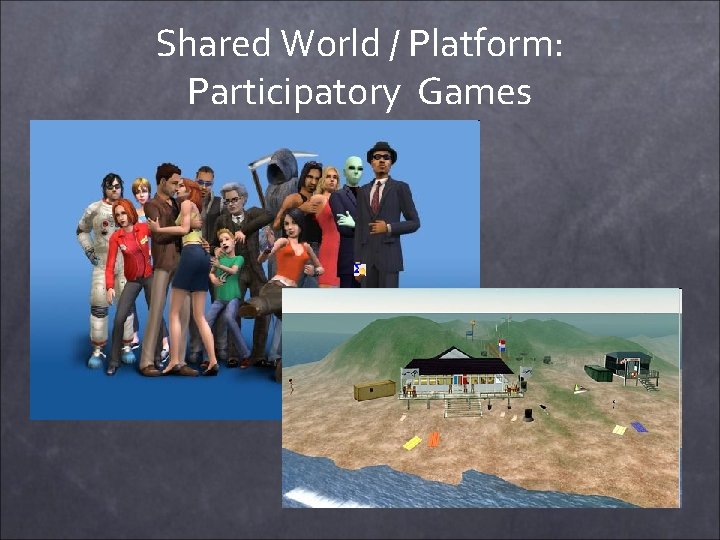
Shared World / Platform: Participatory Games • SIMS • WWC
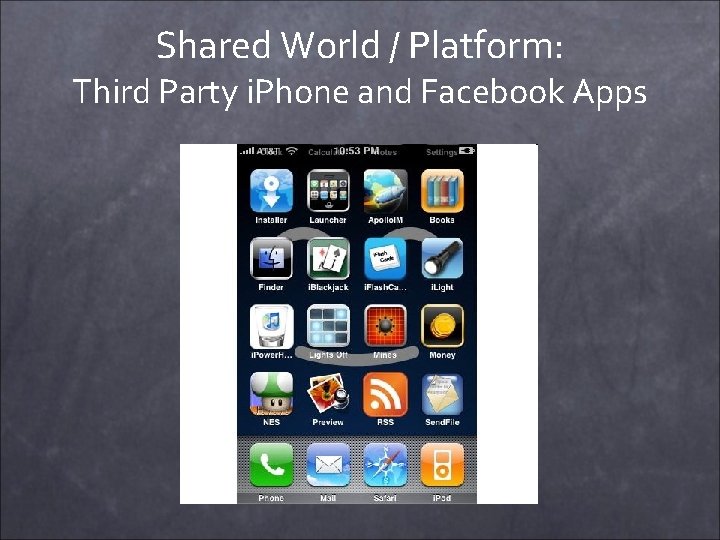
Shared World / Platform: Third Party i. Phone and Facebook Apps
Shared World / Platform: Key Points • Requires people to have some skill or creativity; only a subset contribute. • Long tail contributions, not to a coherent whole, not for a goal. • The massive exposure and participation levels make it worthwhile to make these creations.
Large-Scale Collaborations • Open source software • Top Coder • Wikipedia • Peer 2 Patent
Peer 2 Patent Collaborative Patent Review

Peer 2 Patent

Peer 2 Patent

Peer 2 Patent
Large-Scale Collaborations: Key Points • Usually requires some expertise; the kinds of expertise needed are heterogeneous. • People are working together towards a shared goal. • Can only be done because of the supporting technology. • The pieces need to be modularized (sometimes by a central entity).
Idea Markets • Set up a market with an idea as a premise. – Public policy questions. • How would crime rates change if more citizens could legally carry hidden guns? • Make a market based on the crime rate change after a hidden-gun bill was passed. (Hansen 1999) – Internal product markets. – Manage IT portfolio via a trading market.
Idea Markets: Key Points • Ferrets out hidden expertise or hidden information. • People don’t have to expose what they know directly. • People don’t have to know all pieces of the puzzle; it (hopefully) arises out of the mix. • The connectivity of the Internet makes it possible like never before to find enough people with the right pieces of information to do this.
Social Networks • Undirected social networks – Facebook, My. Space, etc. • Directed Social Networks – Connected within an organization, or for a purpose. • IBM’s Dogear Intranet system • Gov. Loop • Slideshare
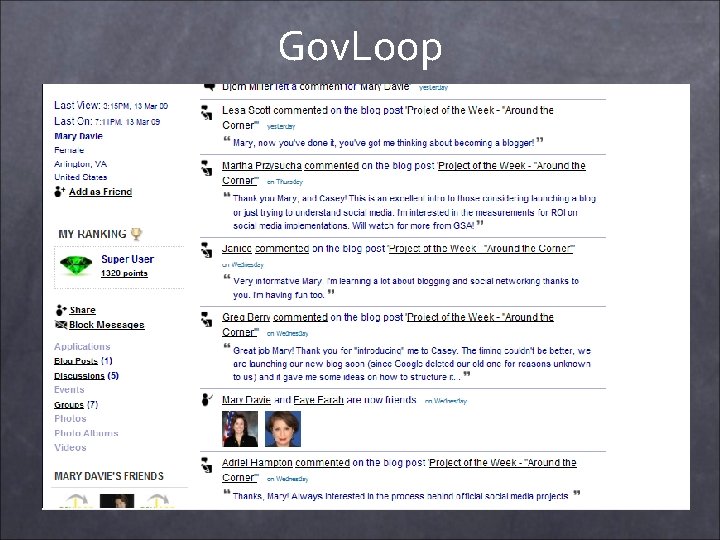
Gov. Loop
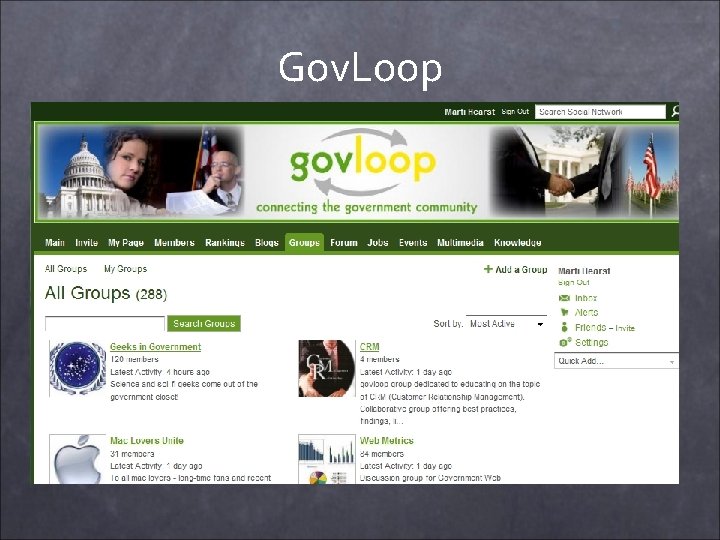
Gov. Loop
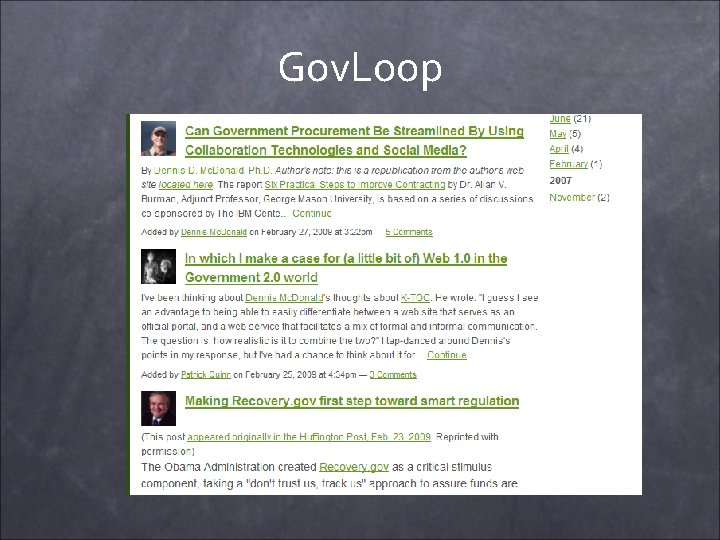
Gov. Loop
Social Networks: Key Points • Usually no expertise required. • Identity is central, relationships are key. • People make contributions, or just hang out. • Value rises out of connectedness, sometimes leading to virality.
Implicit Contributions • Clicks on – Search results – Recommended items – Ads • Search queries • Anchor text (in hyperlinks)

Putting it all Together
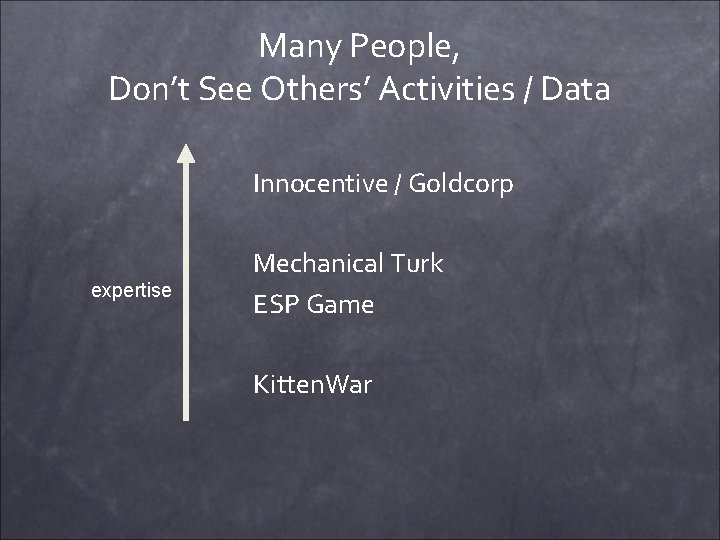
Many People, Don’t See Others’ Activities / Data Innocentive / Goldcorp expertise Mechanical Turk ESP Game Kitten. War
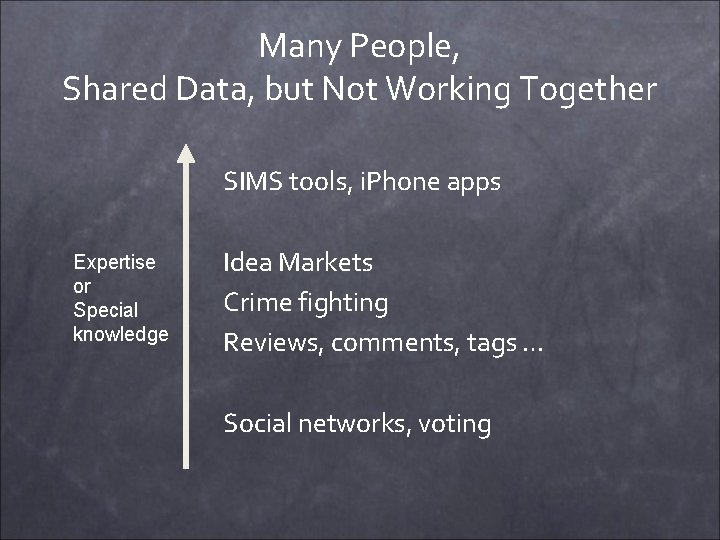
Many People, Shared Data, but Not Working Together SIMS tools, i. Phone apps Expertise or Special knowledge Idea Markets Crime fighting Reviews, comments, tags … Social networks, voting
Many People, Shared Data, and Working Together Open source software Peer 2 Patent Wikipedia Top Coder Scientific Research

Consequences
Participation has Consequences Comments – Influence the perception of which sentences should go in a summary • Hu, Sun, Lim, CIKM’ 07 – Affect purchasing choices. • Chevalier, J. A. , and Mayzlin, D. 2006 • Chen, Dhanasobhon, & Smith 2007 Reviews – Businesses no longer control the conversation about their products and brand. • Bickart & Schindler 2001
Latent Groups Reified Have Consequences • Stranded airplane passengers, 1999 vs 2006. • HSBC bank, student accounts. • Purple tunnel of doom ticket holders. • Every camera-bearing person attending the Inauguration.

Consequences: Expectations Have Changed • Building new CACM website: must have comments! • Government must make data available! • Companies must respond to customers!
Downsides • Socially destructive uses: – “Ana girls” – Autism/mercury controversy – e. Bay fraud • Also happens without social technology: – “Swiftboat veterans for truth” – Bernie Madoff

Theoretical Underpinnings Well, some thoughts anyhow
Some Pontificating • What has changed about groups? – Clay Shirky, author of “Here comes everybody” • What makes for a successful social site? – Rashmi Sinha, CEO of slideshare – Tim O’Reilly, O’Reilly media – Clay Shirky, author of “Here comes everybody”
Shirky on Groups We have lots of words for them: corporation, congregation, clique, cabal, club, crowd
Shirky on Groups • Much of the structure of social institutions is a response to the difficulty of managing groups. (The organizational tools we use are those that are the least bad. ) • In changing the way groups form, communication is key. • We now have tools that are flexible enough to match our in-built social capabilities.
Shirky on Groups • In the past, we unconsciously assumed that people cannot self-assemble easily. • Technology and expectations now allow the formation of otherwise “latent groups”. • “The scope of work that can [now] be done by non-institutional groups is a profound challenge to the status quo. ”

What leads to successful social?

Incentive-Centered Design • “ICD is the science of designing systems or institutions that align participants’ (individual) incentives with overall system (social) goals. ” – http: //mblog. lib. umich. edu/~jmm/archives/2006/02/what_is_incenti. html
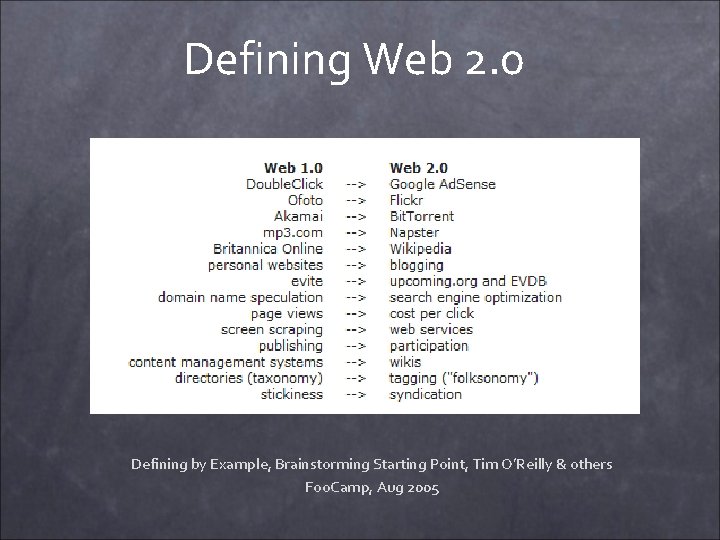
Defining Web 2. 0 Defining by Example, Brainstorming Starting Point, Tim O’Reilly & others Foo. Camp, Aug 2005
Web 2. 0 Principles • O’Reilly on The Web 2. 0 lesson: – leverage customer-self service and algorithmic data management • Web as Platform • Long tail (fringes) vs. Head – (Akamai vs bittorrent (p 2 p), doubleclick vs adsense, and more recently hulu vs youtube) • Participation vs. publishing (scripting) – Reality tv vs. situation comedies – American Idol vs. record studios
Long Tail = Lots of “Failure” • The power law nature of the information use means: – Most flickr photos are not commented on – Most blogs are read by only a few people – Most sourceforge projects have few downloads – Only a few meetup groups get really popular • Making it cheap to fail allows for exploring a wide range of options. • But companies can’t hire people this way.
Sinha: “Fast, cheap, & somewhat in control” – Leave the beta underdeveloped (perpetual beta) • Less polished look allows users to feel ownership – Put it out there. Respond. Refine. • • Communicate with the first 10, 000 users (Caterina Fake of flickr says the same thing) They email you every day, want to visit your offices Customer service as user research – Design for crowds: • Users drive navigation (tags, popularity) • Social networks, people interacting, comments, ratings.
Relinquish Control Example: Plentyoffish. com – – Markus Frind, NYTimes 1/13/08 1. 2 billion page hits in Dec ’ 07 Only one employee, 10 hours/week Site users do the photo screening • Example: Obama campaign – Give volunteers real responsibility – Incentivize with goals – Don’t try to control outsiders’ messages
Relinquish Control • Wikipedia, Linux, had visible leaders, but the rules were developed by the participants. • Edinburgh Fringe Festival / Foo camp: big public events; the organization arises via controlled chaos.
Shirky: Successful Social Sites • Three rules, but hard to combine them – Plausible Promise – Appropriate Tools – Acceptable Bargain
Plausible Promise • The paradox of groups: I won’t join unless I know others will too. • Must attend personally to those who join early to help with this in many cases.
Appropriate Tools • Delicious tagging allows the individual to benefit immediately, the group benefits as a side-effect. • Livejournal benefited from having groups of teens joining together.
Acceptable Bargain • Wikipedia had to make it clear they wouldn’t go commercial in order to continue to expand. • Some flickr groups have commenting rules. • e. Bay didn’t initially allow for a reputation system, but had to add it in. • AOL guide writers felt they had been wronged after the site sold for lots of money. • Digg had to allow posting of a DRM key

Research Questions
Main Questions • Should this fundamentally change how research / science is conducted? • Should this fundamentally change how research is funded?
Research Questions • How to support constructive online debate? • How to make citizen input scale? • How to divide up tasks to allow for large-scale user participation? • Which incentives work for which kinds of groups? • What to do about destructive uses? • What about those who are too shy to participate? • Can any contributions be anonymous? • Slander / correcting false information.
Research Example: What Makes Hit Songs? • Answer: – It’s strongly affected by what other people think! • NSF grant: – “Experimental Study of Inequality and Unpredictability in an Artificial Cultural Market”, Salganik, Dodds, Watts

Research on Collaborative X Collaborative Search Collaborative Visualization

Collaborative Visualization Sense. us (Heer): collaborative analysis around viz Jeff Heer
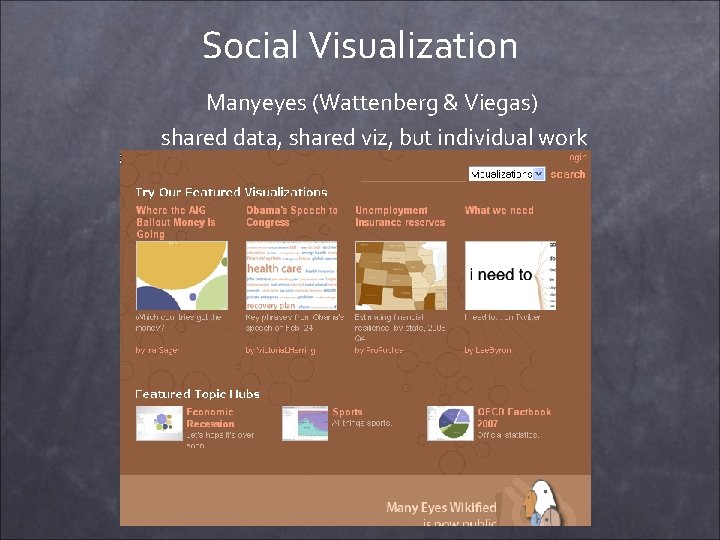
Social Visualization Manyeyes (Wattenberg & Viegas) shared data, shared viz, but individual work
NSF HSD Program: A Good Start • Human and Social Dynamics – Agents of Change (AOC) – Dynamics of Human Behavior (DHB) – Decision Making, Risk, and Uncertainty (DRU) • About 14 IIS awards – Collaborative Research: IT-Enhanced Market Design and Experiments – Transformed Social Interaction in Virtual Environments – Scalable Computational Analysis of the Diffusion of Technological Concepts – Investigating the Dynamics of Free/Libre Open Source Software Development Teams

How to Study This? Make your own social network: Garcia-Molina’s Course. Rank

Should Research Change?
Thank you! Marti Hearst ischool. berkeley. edu/~hearst
- Slides: 81