
Social Support and Personal Mastery as Protective Resources


- Slides: 39
Social Support and Personal Mastery as Protective Resources During Emerging Adulthood A study by: S. Melinda Spencer and Julie Hicks Patrick Presented by Olena Contreras
INTRODUCTION
Emerging Adulthood • Emerging Adulthood is the period of human development that takes place between 18 and late 20 s. • An individual no longer feel like an adolescent, but does not yet feel like an adult. • Five features of emerging adulthood: • • • Identity exploration Age of instability Self focused Feeling of in between Age of possibilities
Emerging Adulthood • Lesbian, gay and bisexual (LGB) adults experience the same developmental tasks and milestones as heterosexuals. • But due to negative societal attitudes, these individuals experiences additional stressors and variations in development. • Additional stressors include: • Marginalization (to isolate and shut out) by heterosexist society • Internalized homophobia (feeling shame or embarrassment for being LGB) • Maintaining relationships while in the face of stigma • Learning to deal with discrimination itself
Emerging Adulthood • Thus, LGB individuals may not experience developmental events at the same age or same way as heterosexuals. • Little is known about the impact of sexual orientation in emerging adulthood.
Minority Status • Sexual minority status is different from identification with any other minority group. • Why? • Disclosure is optional • Economic oppression is less predictable • LGB are forced to understand assimilate their minority status on their own, often with no support from their ethnic communities and no formal protections against discrimination.
Theory of Minority Stress • Meyer (1995) proposed theory of minority stress • Suggests that LGB persons spend the majority of their lives isolated from their cultural group (unlike other minorities) • Also suggests that experiences with heterosexism reinforce the minority status of LGB individuals. • How? • Internalized homophobia (feeling shame or embarrassment for being LGB) • Perceived stigma • Encounters with prejudice and discrimination
What does this all mean? • We need a better understanding of: • The relationship between the social stigma and the resulting psychosocial consequences of developing in a heterosexist society • The protective factors used against these negative influences and their impact. • With a better understanding, a more complete and comprehensive social and developmental psychology will result.
Self Esteem, Personal Mastery and Social Support • Self esteem plays a very important protective role throughout the lives of LGB individuals. • Personal mastery and social support can protect individuals (not just LGB) against poor psychological outcomes.
Personal mastery • Personal Mastery the extent to which people feel they have control over the forces which influence their lives. • A key component in handling stress • Mastery over environment reduces effects of stress on well-being • This is especially important during Emerging Adulthood due to the various rapid life changes, stressors and instability.
Social Support • Social Support term used to describe a wide array of social constructs. • Includes concept of social network, actual support and perceived support • Helps achieve a positive identity • Protects against negative consequences of stigma and heterosexism.
Ultimate Goal • Ultimately, the goal for LGB people is to successfully navigate through life and develop a positive identity; regardless of oppression. • Emerging Adulthood is one of the most challenging developmental stages for LGB adults • Why? Identity exploration hindered in adolescence by heterosexism
Purpose • The purpose of the study was to examine the following: • Psychological well-being (as measured by depressive symptoms and self-esteem) • Including differences across sexual orientation • Individual characteristics (gender and sexual orientation) and personal resources (personal mastery and social support) and their effect on well-being
Hypothesis • Sexual minorities would report greater psychological distress compared to heterosexuals • Strong personal resources would improve psychological well-being across sexual orientation
METHODS
Methods • 331 participants aged 18 -30 years old • Online, self administered survey • 32 gay men, 61 heterosexual men, 34 lesbian women and 179 heterosexual women • 24 bisexual men and women excluded form statistical analysis • Participants were recruited through research announcements sent to online LGB listservs and social support websites • In addition, flyers containing the hyperlinked survey address were distributed to a number of LGB-affirmative organizations in the area. • Recruitment for heterosexual group paralleled the strategies to recruit LGB groups • Financial compensation was not offered for this study in order to preserve anonymity
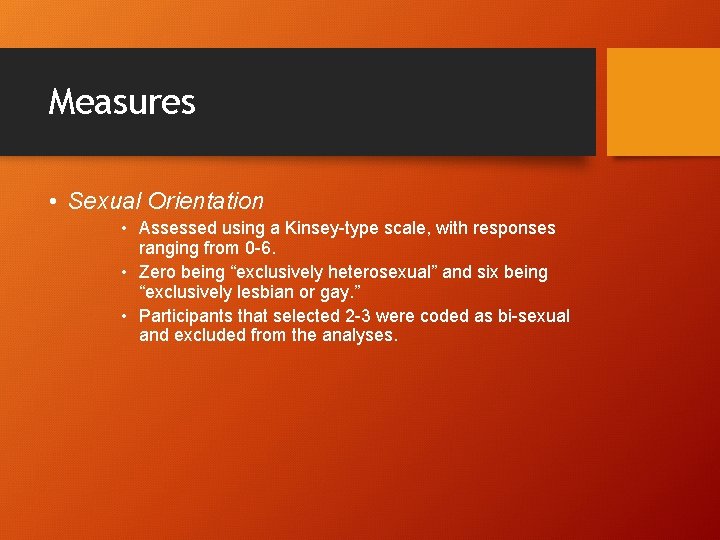
Measures • Sexual Orientation • Assessed using a Kinsey-type scale, with responses ranging from 0 -6. • Zero being “exclusively heterosexual” and six being “exclusively lesbian or gay. ” • Participants that selected 2 -3 were coded as bi-sexual and excluded from the analyses.
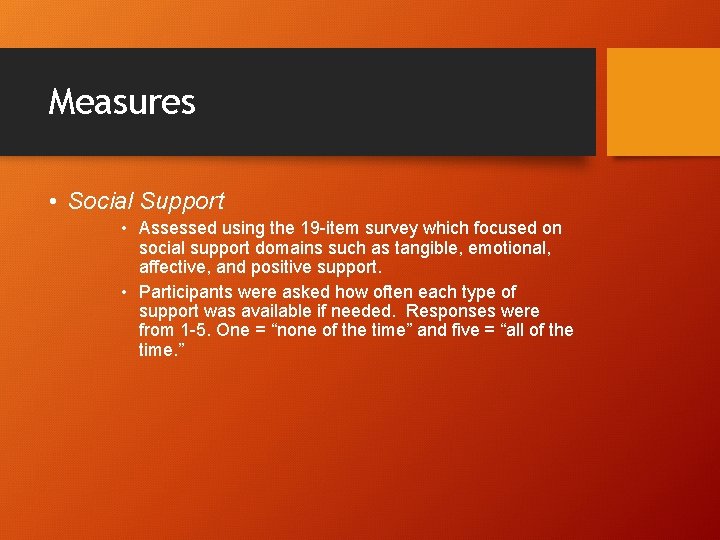
Measures • Social Support • Assessed using the 19 -item survey which focused on social support domains such as tangible, emotional, affective, and positive support. • Participants were asked how often each type of support was available if needed. Responses were from 1 -5. One = “none of the time” and five = “all of the time. ”
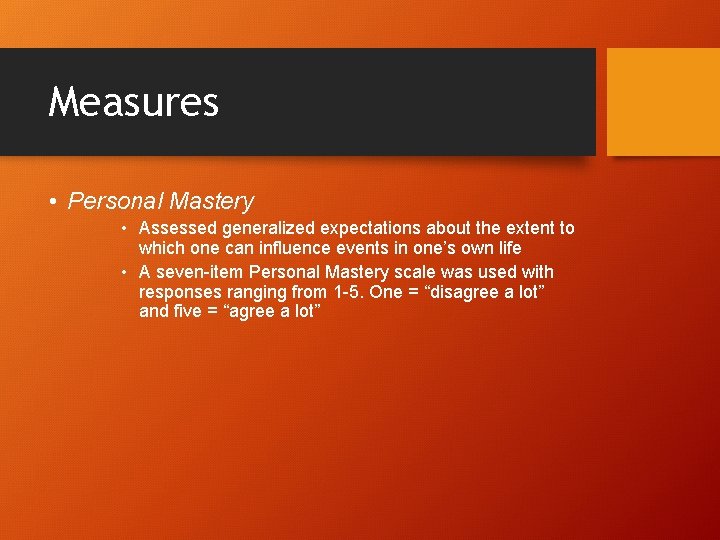
Measures • Personal Mastery • Assessed generalized expectations about the extent to which one can influence events in one’s own life • A seven-item Personal Mastery scale was used with responses ranging from 1 -5. One = “disagree a lot” and five = “agree a lot”
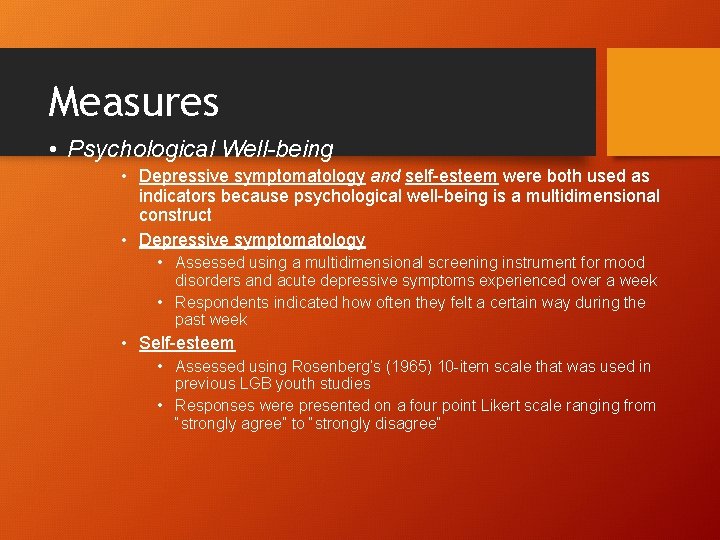
Measures • Psychological Well-being • Depressive symptomatology and self-esteem were both used as indicators because psychological well-being is a multidimensional construct • Depressive symptomatology • Assessed using a multidimensional screening instrument for mood disorders and acute depressive symptoms experienced over a week • Respondents indicated how often they felt a certain way during the past week • Self-esteem • Assessed using Rosenberg’s (1965) 10 -item scale that was used in previous LGB youth studies • Responses were presented on a four point Likert scale ranging from “strongly agree” to “strongly disagree”
Procedure • Cross-sectional design using an online self administered survey for secure data collection • Participants who agreed to participate were provided informed consent for the approximately 25 minute survey
Statistical Analysis • Descriptive statistics were used to describe and compare demographic characteristics by sexual orientation and gender. • A series of 2 (gender) x 2 (sexual orientation) analysis of covariance (ANCOVAs) were conducted to investigate group differences in psychological wellbeing • Two dependent variables were used: depressive symptomatology and self-esteem.
RESULTS
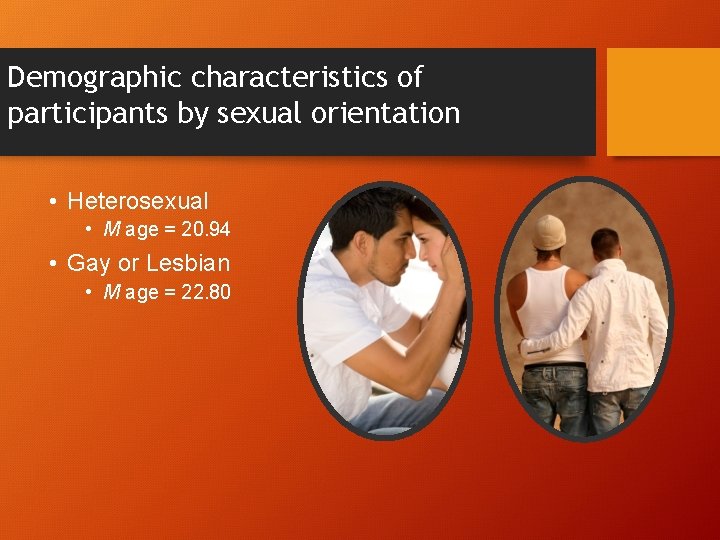
Demographic characteristics of participants by sexual orientation • Heterosexual • M age = 20. 94 • Gay or Lesbian • M age = 22. 80
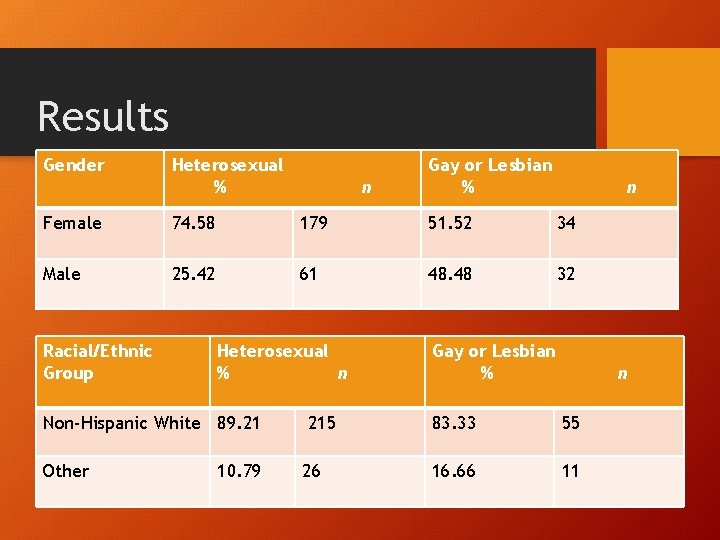
Results Gender Heterosexual % n Gay or Lesbian % n Female 74. 58 179 51. 52 34 Male 25. 42 61 48. 48 32 Racial/Ethnic Group Heterosexual % n Non-Hispanic White 89. 21 Other 10. 79 215 26 Gay or Lesbian % n 83. 33 55 16. 66 11
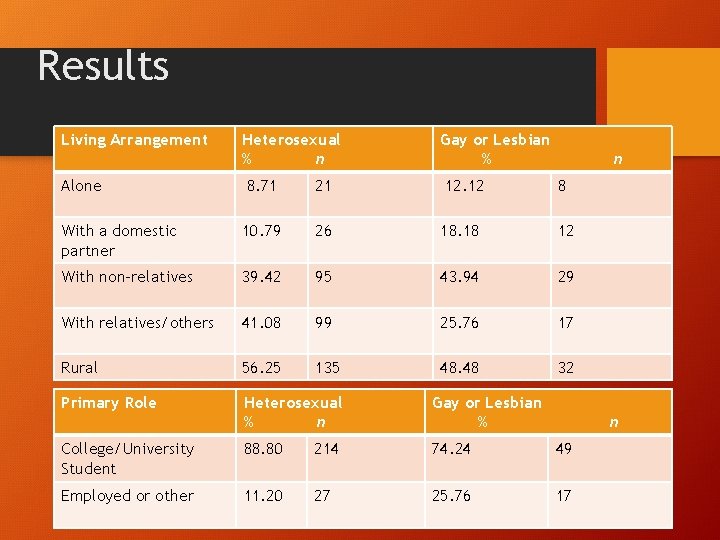
Results Living Arrangement Alone Heterosexual % n Gay or Lesbian % 12. 12 n 8. 71 21 8 With a domestic partner 10. 79 26 18. 18 12 With non-relatives 39. 42 95 43. 94 29 With relatives/others 41. 08 99 25. 76 17 Rural 56. 25 135 48. 48 32 Primary Role Heterosexual % n Gay or Lesbian % College/University Student 88. 80 214 74. 24 49 Employed or other 11. 20 27 25. 76 17 n
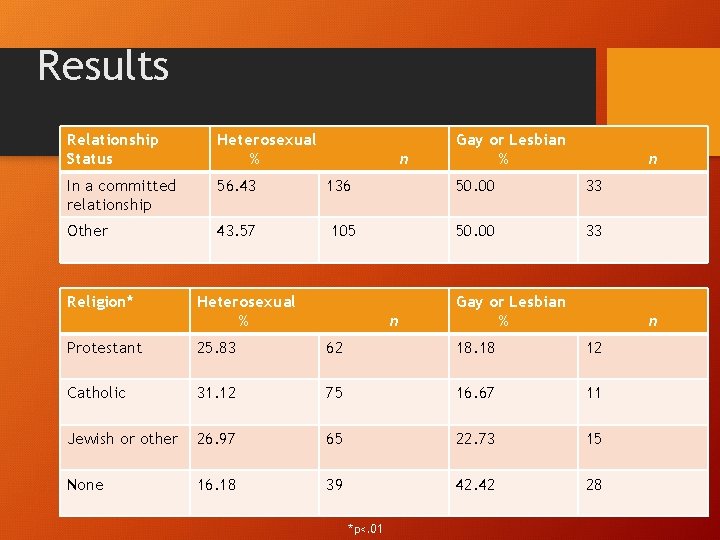
Results Relationship Status Heterosexual % In a committed relationship 56. 43 Other 43. 57 Religion* n 136 105 Heterosexual % n Gay or Lesbian % n 50. 00 33 Gay or Lesbian % n Protestant 25. 83 62 18. 18 12 Catholic 31. 12 75 16. 67 11 Jewish or other 26. 97 65 22. 73 15 None 16. 18 39 42. 42 28 *p<. 01
Results • Researchers used the Chi-square test to examine the differences in categorical demographic variables by gender and sexual orientation • Results show that groups did not differ on the majority of demographic variables
Depression • No significant differences by gender in depressive symptomatology, but there was a significant main effect of sexual orientation • LG individuals significantly higher on the CES-d than heterosexuals
Self-Esteem • Similar pattern emerged for the outcome of selfesteem • There was not a significant gender difference • However, heterosexuals reported significantly higher self-esteem than LG respondents
Sexual Orientation • Results show that LG individuals have increased depressive symptomatology • However, when social support and mastery were entered in the equation, sexual orientation no longer contributed to the variance in depressive symptoms • Social support and mastery were unique predictors of self-esteem and psychological well being
IMPLICATIONS
Implications • The study provides a deeper understanding into an area not sufficiently explored in Emerging Adulthood. • Gives an understanding of how LGB adults develop during an already volatile time that is Emerging Adulthood. • Sheds light on the differences between development as a heterosexual and a homosexual, and the need and importance of sustainable and effective resources; not just for LGB adults, but for all emerging adults.
Strengths • Codes used to diminish effects of multiple responses from same individuals • Use of Likert Scales allowed for greater range of responses • Measured different ethnicities, allowing results to be representative of the general population • Online survey allows for greater anonymity, possibly prompting more truthful answers
Weaknesses • Although there was ethnic diversity, the majority of the respondents were Caucasian females. It would be of greater benefit to include a larger number of males and different ethnicities. • Completed through a university List. Serv. This is exclusive to only college students. A study on a more general population would possibly yield broader results. • Study focused on depressive symptomology; however, depressive symptoms are not the only indicator of psychological well-being. Other symptoms (such as anger, social withdrawal, etc) should be explored.
Possibilities for Future Research • Studies piggybacking off of this one should explore the ethnic differences among LGB emerging adults. • They should explore the various cultural reactions and stereotypes of the LGB community, and their effect on LGB emerging adults • Follow up research should be done to see the effects of heterosexist society on LGB identity development and how it effects them later on in life. • Does a positive identity persist throughout, or do LGB adults experience gaps in identity development? • Can programs (Such as an ADP) positively influence LGB emerging adults in the same way it does heterosexual adults?
Recap • Lesbian and gay adults need to develop an identity while experiencing discrimination within the social constructs of heterosexist society. • Spencer and Patrick examined how depressive symptoms and self esteem differed by sexual orientation. • Also sought to explore function of personal resources and how they relate to psychological well being.
Recap • It was found that lesbian and gay individuals has higher depressive symptoms and lower self esteem than their heterosexual counterparts. • But, when personal mastery and social support exists, the psychological well being was more stable. • Personal mastery and social support also explained for the differences in psychological well being. • That means that the individuals’ social relationships, along with personal mastery, seem to serve as protective resources during their development through emerging adulthood.
THANK YOU!