
Social Studies US History GED Support Social Studies

- Slides: 29
Social Studies US History GED Support
Social Studies Section • 4 content areas: – US History – Civics & Government – Economics – Geography & the World
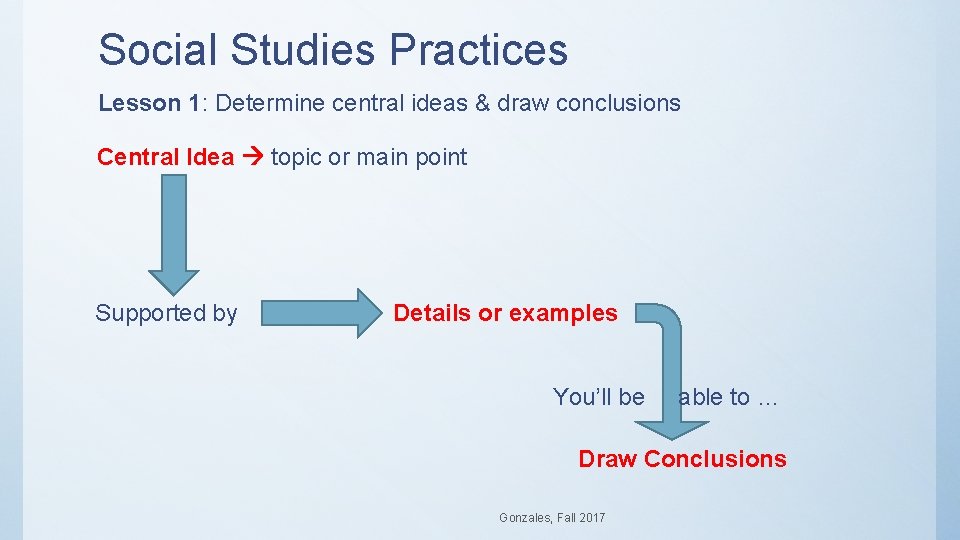
Social Studies Practices Lesson 1: Determine central ideas & draw conclusions Central Idea topic or main point Supported by Details or examples You’ll be able to … Draw Conclusions Gonzales, Fall 2017
Social Studies Practices • Lesson 2: Interpret words and ideas *understand key terms *social studies material is organized chronologically *organized by cause and effect Example: The decline of jobs and income played a role for why the Great Depression occurred. Gonzales, Fall 2017
Social Studies Practices • Lesson 3: Analyze authors purpose and point of view *to have a viewpoint or purpose Point of view authors way of looking at the world Need to look for bias only 1 point of view An extreme bias – propaganda author tries to convince people to act and think as the author wants -fake news Gonzales, Fall 2017
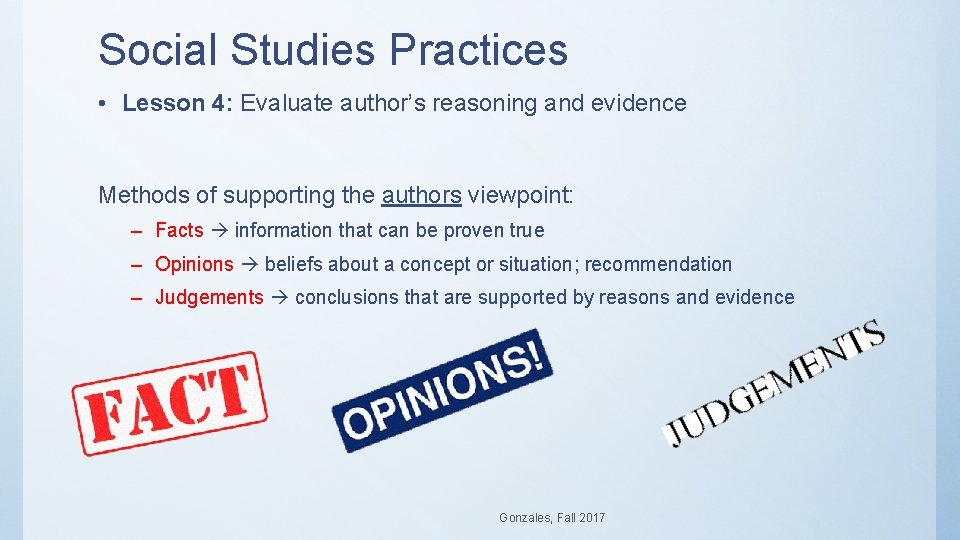
Social Studies Practices • Lesson 4: Evaluate author’s reasoning and evidence Methods of supporting the authors viewpoint: – Facts information that can be proven true – Opinions beliefs about a concept or situation; recommendation – Judgements conclusions that are supported by reasons and evidence Gonzales, Fall 2017
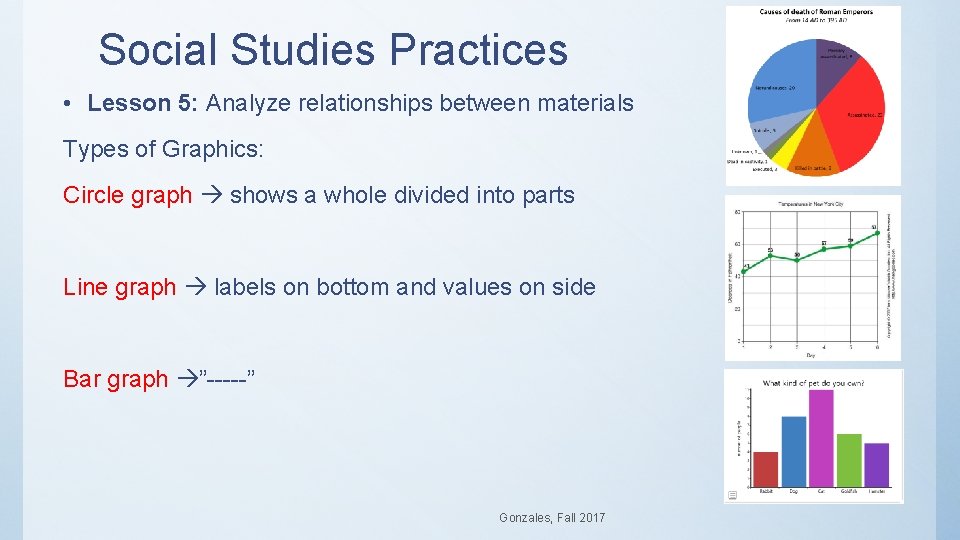
Social Studies Practices • Lesson 5: Analyze relationships between materials Types of Graphics: Circle graph shows a whole divided into parts Line graph labels on bottom and values on side Bar graph ”-----” Gonzales, Fall 2017
Social Studies Practices • Lesson 5: Analyze relationships between materials Graphics have: Maps use legends (a key) to explain symbols Compass rose indicate directions Scales determine distances Gonzales, Fall 2017
Social Studies Practices • Lesson 6: Interpret data and statistics *interpreting tables, finding measures of central tendency, making comparisons, and spotting trends Gonzales, Fall 2017
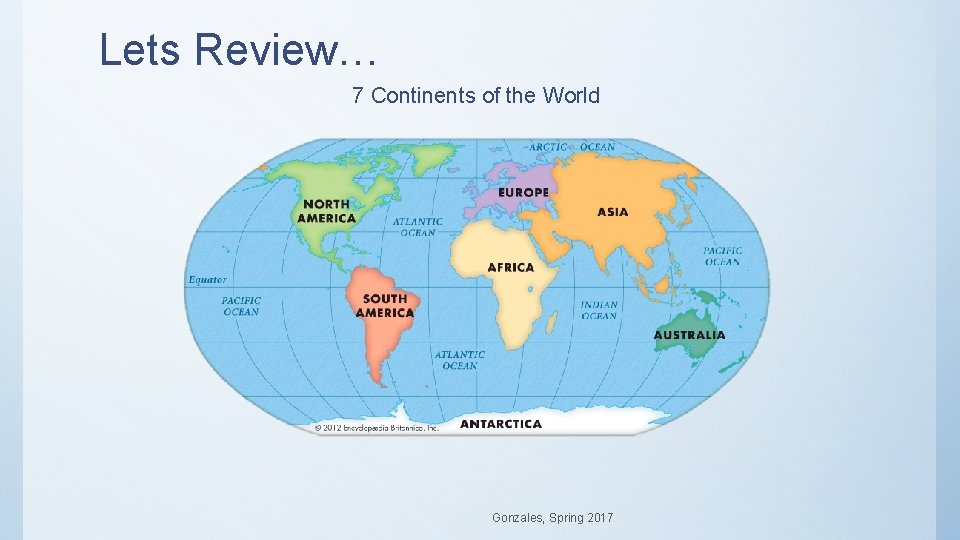
Lets Review… 7 Continents of the World Gonzales, Spring 2017
Keeping a Timeline… • As we travel through US History, gather dates, wars, people countries, and anything you find significant Gonzales, Spring 2017
US History
Lesson 1: Exploration, Colonialism & the American Revolution • The 1 st Americans to travel Native Americans • Late 1400 s Explorers from Europe • 1492 Christopher Columbus and the “New World” – Establishment of colonies Gonzales, Spring 2017
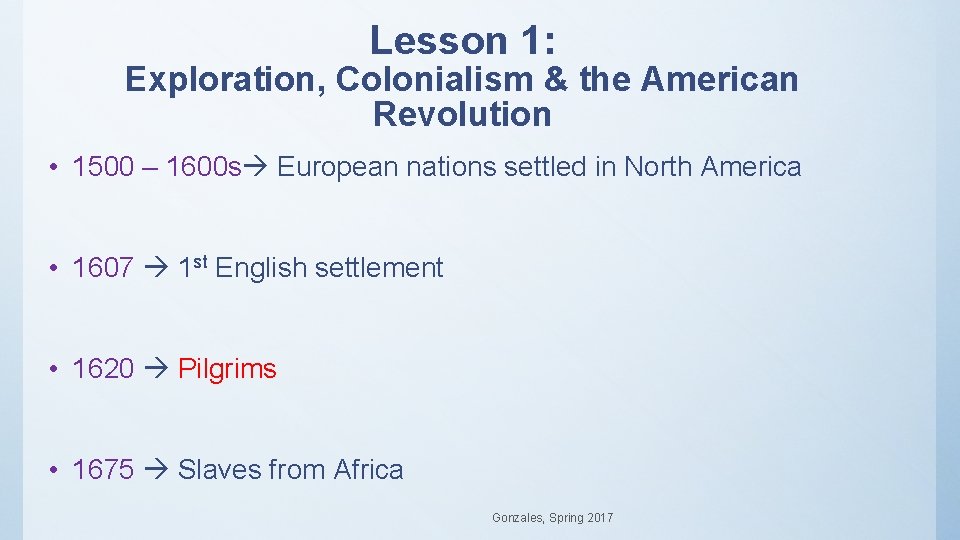
Lesson 1: Exploration, Colonialism & the American Revolution • 1500 – 1600 s European nations settled in North America • 1607 1 st English settlement • 1620 Pilgrims • 1675 Slaves from Africa Gonzales, Spring 2017
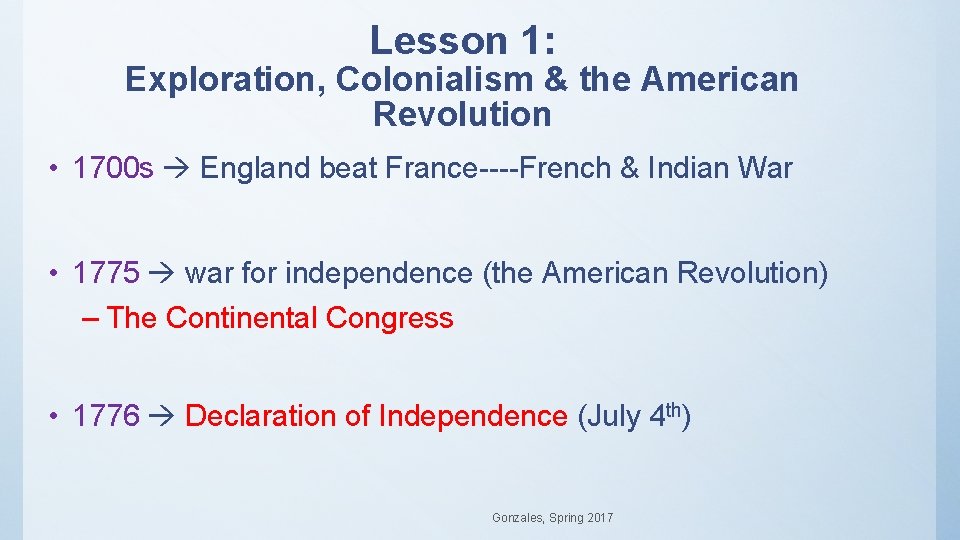
Lesson 1: Exploration, Colonialism & the American Revolution • 1700 s England beat France----French & Indian War • 1775 war for independence (the American Revolution) – The Continental Congress • 1776 Declaration of Independence (July 4 th) Gonzales, Spring 2017
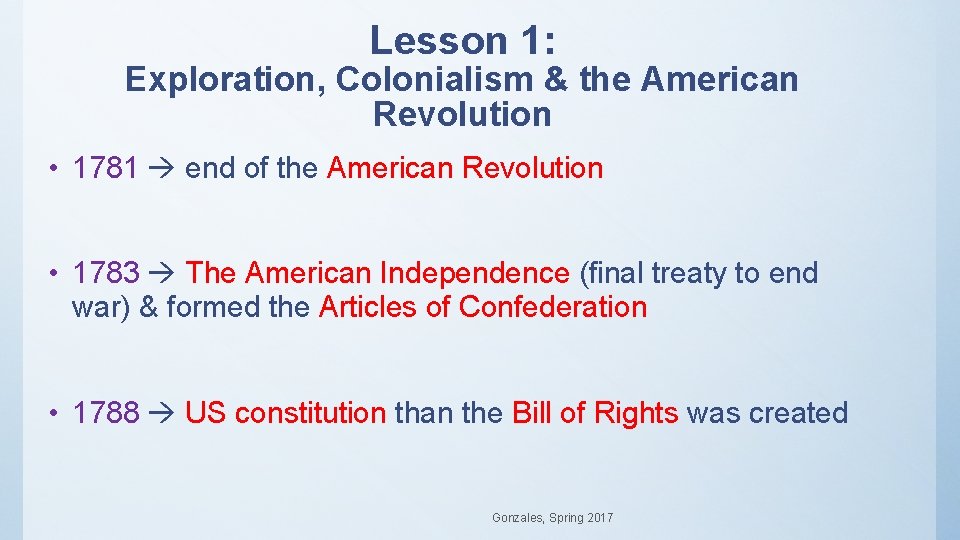
Lesson 1: Exploration, Colonialism & the American Revolution • 1781 end of the American Revolution • 1783 The American Independence (final treaty to end war) & formed the Articles of Confederation • 1788 US constitution than the Bill of Rights was created Gonzales, Spring 2017
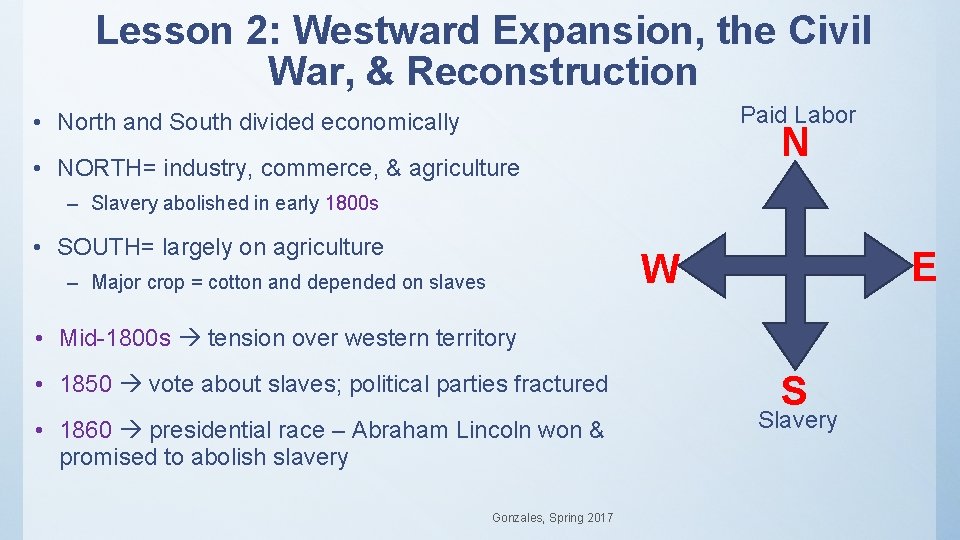
Lesson 2: Westward Expansion, the Civil War, & Reconstruction Paid Labor • North and South divided economically N • NORTH= industry, commerce, & agriculture – Slavery abolished in early 1800 s • SOUTH= largely on agriculture E W – Major crop = cotton and depended on slaves • Mid-1800 s tension over western territory • 1850 vote about slaves; political parties fractured • 1860 presidential race – Abraham Lincoln won & promised to abolish slavery Gonzales, Spring 2017 S Slavery
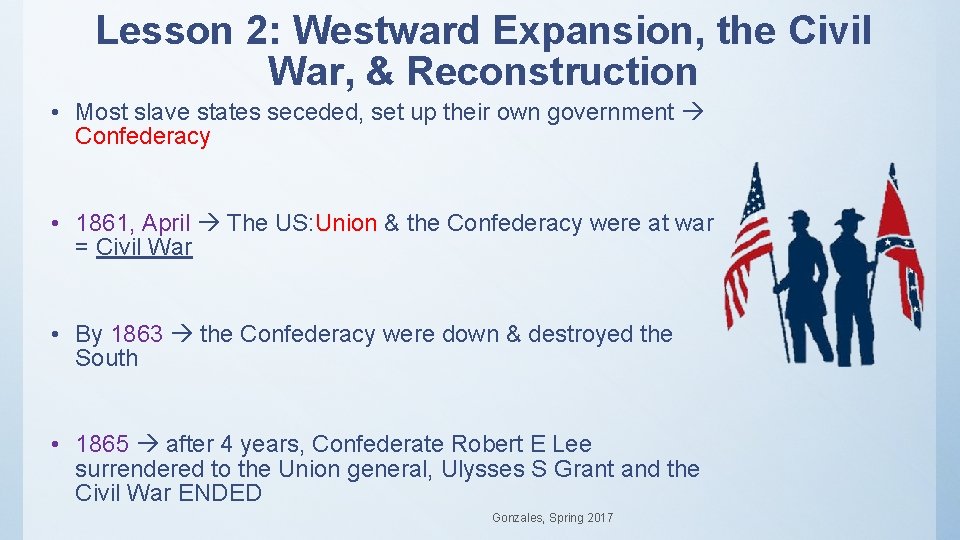
Lesson 2: Westward Expansion, the Civil War, & Reconstruction • Most slave states seceded, set up their own government Confederacy • 1861, April The US: Union & the Confederacy were at war = Civil War • By 1863 the Confederacy were down & destroyed the South • 1865 after 4 years, Confederate Robert E Lee surrendered to the Union general, Ulysses S Grant and the Civil War ENDED Gonzales, Spring 2017
Lesson 2: Westward Expansion, the Civil War, & Reconstruction • For 12 years, rebuilding of the South Reconstruction – Slaves were freed • Sharecropping system • 1870 s as the whites came back to power, they prevented African Americans from voting **Remember this…the Civil War ended SLAVERY but not RACISM!** Gonzales, Spring 2017
Lesson 3: Industrialization, Immigration, & the Progressive Era • Mid-1800 s the growth of the American industries grew very fast…rapid industrialization • Reasons for the growth: – Addition of Western territories, which the helped the US gain plentiful natural resources – Invention of new products & machines & industrial processes – Nations booming population – New factories were built, near large cities = lots of jobs!!! – These jobs drew in immigrants; increased immigrants from Europe Gonzales, Spring 2017
Lesson 3: Industrialization, Immigration, & the Progressive Era • American Factories – Grueling, dangerous work – Lower pay for long hours Lead to unions Late 1800 s-early 1900 s • Union workers pledged to work together for better & safer working conditions • Strikes when employers cut wages Gonzales, Spring 2017
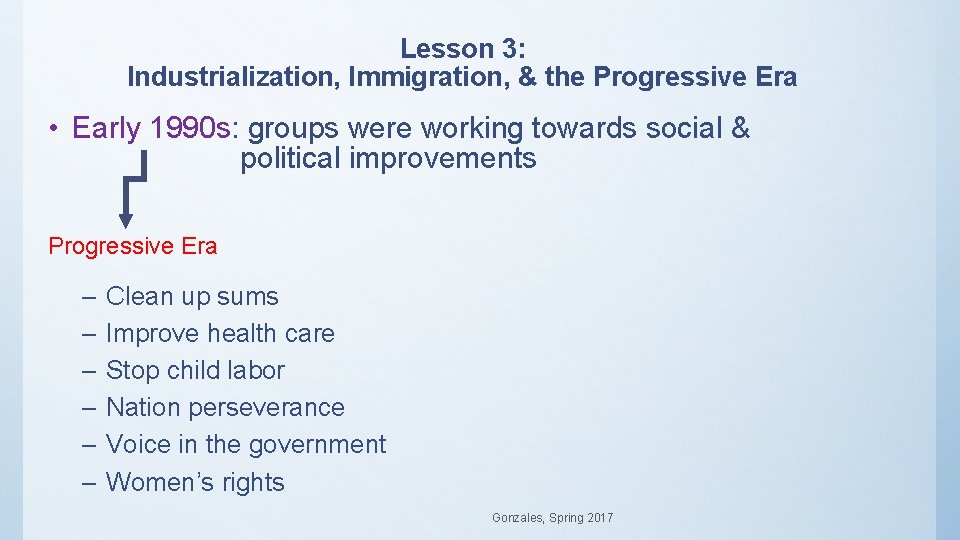
Lesson 3: Industrialization, Immigration, & the Progressive Era • Early 1990 s: groups were working towards social & political improvements Progressive Era – – – Clean up sums Improve health care Stop child labor Nation perseverance Voice in the government Women’s rights Gonzales, Spring 2017
Lesson 4: The United States as an Emerging World Power • Expansion of industries caused an effect on politics – Wanted more access to natural resources & sell more goods overseas • To promote industrial growth & increase US power, the US became – Imperialistic/Imperialism – Policy by which a stronger nation extends economic, military, &/or political control over a weaker nation or region; often by force • Late 1800 s the US joined the imperialism movement, following Europe Gonzales, Spring 2017
Lesson 4: The United States as an Emerging World Power • 1898 US fought in the Spanish-American War – US declared war on Spain because of their mistreatment of Cuba; they WON & took over the Spanish colonies THE NEXT WAR… Gonzales, Spring 2017
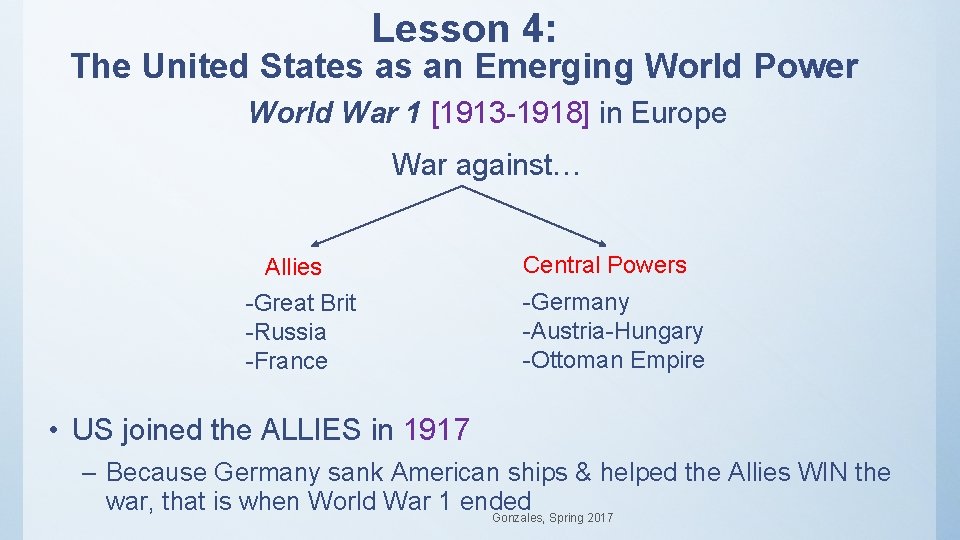
Lesson 4: The United States as an Emerging World Power World War 1 [1913 -1918] in Europe War against… Allies -Great Brit -Russia -France Central Powers -Germany -Austria-Hungary -Ottoman Empire • US joined the ALLIES in 1917 – Because Germany sank American ships & helped the Allies WIN the war, that is when World War 1 ended Gonzales, Spring 2017
Lesson 4: The United States as an Emerging World Power • Within 12 years, 1929 world had fallen into a serious economic downturn = The Great Depression • The economic problems lead to the rise of fascism – Squelched (silence) democracy & advocated the takeover of other nations – Example: Germany • Germany: – Lead by Adolf Hitler – Mid-1930 s: He started attacking smaller nations in Europe Gonzales, Spring 2017
Lesson 4: The United States as an Emerging World Power • Italy took over Ethiopia, Africa • Japan attacked China Joined an alliance Axis with Germany • 1939 war against the Allies & Axis World War II 1939 -1945 • US didn’t join the war until 1941 – When Japan bombed US at Pearl Harbor • World War II included: horrific battles, fire bombing, Holocaust, 2 atomic bombs on Japan • Victory by Allies in 1945! Gonzales, Spring 2017
Lesson 5: The Cold War & the Civil Rights Era • After WWII, capitalist & communist nations engaged in power struggle = the Cold War – Political and military tension – Little fights – US led the Capitalist nations – Soviet Union lead Communist nations • US sent soldiers to both Korean War [early 1950 s] Vietnam War [1954 -1975] *US pulled out in 1973 Gonzales, Spring 2017
Lesson 5: The Cold War & the Civil Rights Era • The Cold War ended with the break up of Soviet Union & end of Communism • For communists, loosing Soviet control led to collapse of communist government • The Berlin Wall separated Eastern & Western Germany • 1950 s African Americans launched the Civil Rights Movement – Try to end segregation & discrimination in the US Gonzales, Spring 2017