
Social Studies III A Study of the History
- Slides: 27
Social Studies III A Study of the History and Workings of Our Government and Economy
Government. u Institution which attempts to provide and enforce an orderly structure on all people living within a state. t Unitary system-All key powers held by central (national) government. t Federal system-powers divided between central (national) government and lower levels. n State. u A political community which occupies a defined territory and has the power to make and enforce laws without approval from a higher authority. n
Types of Governments I. Autocracy. A. Rule is in the hands of a single individual, power usually gained through inheritance or military/police power. 1. Totalitarian Dictatorship a. control all aspects of social and economic life, not responsible to the people and people lack power to limit them.
2. Absolute Monarchy. a. King, Queen, or Emperor exercise supreme power, usually inherited. b. Rule based on concept of “Divine Right of Kings”.
II. Oligarchy. A. Power held by a small group, based on wealth, social position, military power, or a mix of them. 1. Plutocracy: small group is based on wealth/social standing. 2. Junta: ruling group uses military status, usually gained power through revolution and overthrow.
III. Democracy. A. Rule by the people. 1. Direct Democracy: people govern themselves by voting on issues individually as citizens.
2. Indirect Democracy. a. Representative Democracy: People elect representatives and give them responsibility and power to govern (AKA: Republic). b. Constitutional Monarchy: Monarch serves as head of state or a figurehead, legislative body is a representative system.
Purposes of Government I. Maintaining social order. A. Government began when people united and gave the state the power to provide safety and order. 1. Called the Social Contract Theory. a. Developed in the 1600’s by John Locke, Thomas Hobbes, and Jean Jacques Rousseau.
Provide public services. A. Collectively society provides services individuals cannot or would not do. III. Provide national security. A. Protects society from threats, both internal and external. IV. Make economic decisions. A. Government decides how much control it will have over the economic life of the nation. 1. From “free enterprise” to total “command”. II.
The Origins of American Constitutionalism I. Early Greek influence. A. Greeks developed concept of “democracy”. 1. Many Greek “city-states” developed direct democratic systems.
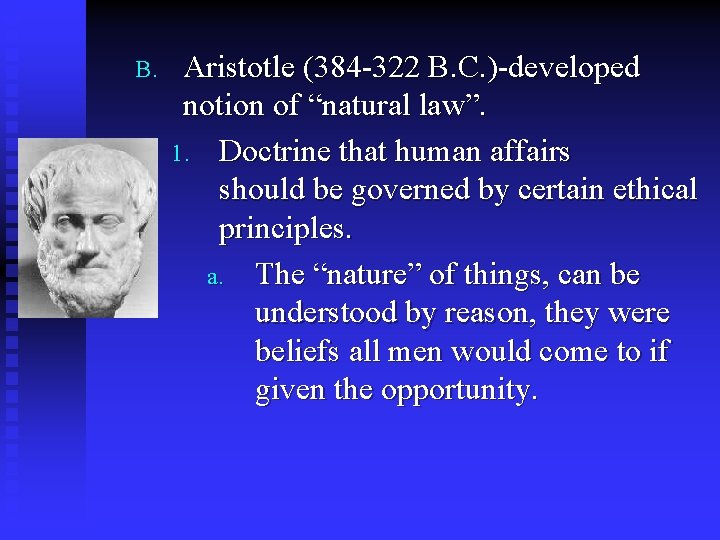
B. Aristotle (384 -322 B. C. )-developed notion of “natural law”. 1. Doctrine that human affairs should be governed by certain ethical principles. a. The “nature” of things, can be understood by reason, they were beliefs all men would come to if given the opportunity.
II. Early Roman influence. A. Created concept of the republic. 1. Originally only the wealthy (patricians) had the right to vote and serve. 2. By 350 B. C. the right to vote had been extended to the lower classes (plebeians).
B. C. By 450 B. C. they had also developed the concept of codification of laws. 1. Codified laws are ones written down. a. Prevented “changing” of laws. b. Believed would help curb abuse by those in power. Lastly developed the idea of checks and balances. 1. Would help prevent any one individual or small group from gaining to much power.
III. Early English influences. A. Beginning in the late 1100’s, England became the first European “nation” to move towards democracy. B. During the reign of King Henry II, the concept of “common law” was developed. 1. Common Law is a collection of laws, judgments, traditions, and customs which collectively becomes a system of government. a. Opposite is “constitutional law”.
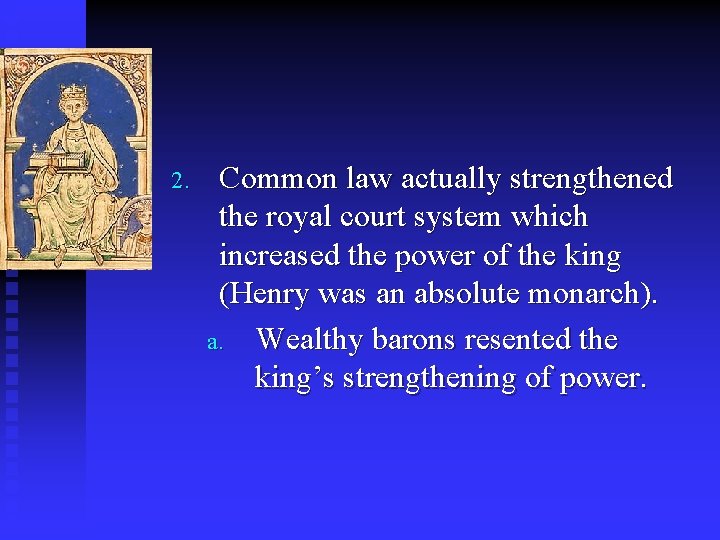
2. Common law actually strengthened the royal court system which increased the power of the king (Henry was an absolute monarch). a. Wealthy barons resented the king’s strengthening of power.
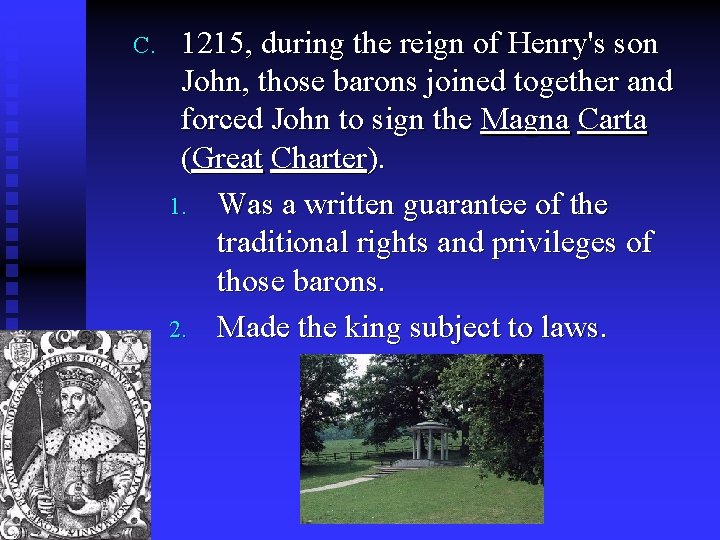
C. 1215, during the reign of Henry's son John, those barons joined together and forced John to sign the Magna Carta (Great Charter). 1. Was a written guarantee of the traditional rights and privileges of those barons. 2. Made the king subject to laws.
3. Created a Great Council to give consent to the king to rule. a. By late 1200’s the Great Council had gained more influence. i. Demanded king seek its approval before making decisions. ii. Organized ideas and policies and presented them to the king. iii. Eventually became known as Parliament, from the French “parler”, meaning “to talk”.
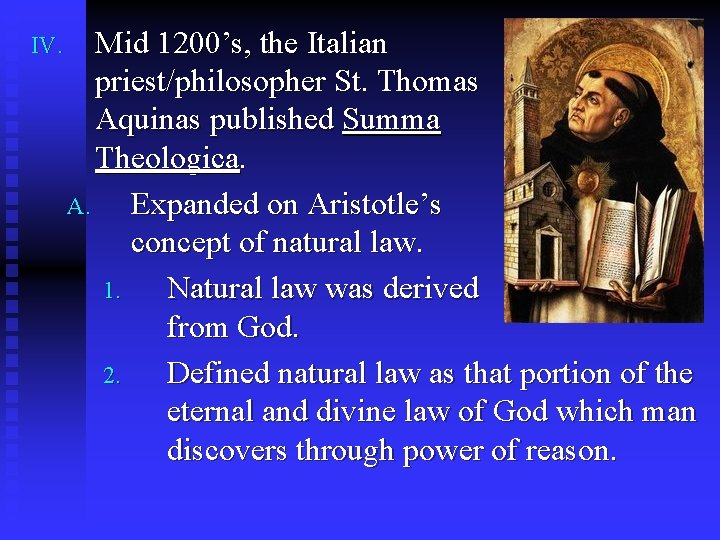
IV. Mid 1200’s, the Italian priest/philosopher St. Thomas Aquinas published Summa Theologica. A. Expanded on Aristotle’s concept of natural law. 1. Natural law was derived from God. 2. Defined natural law as that portion of the eternal and divine law of God which man discovers through power of reason.
B. C. Became basis for the concept of the “divine right of kings”. Caused governmental systems to remain relatively unchanged until the late 1500’s.
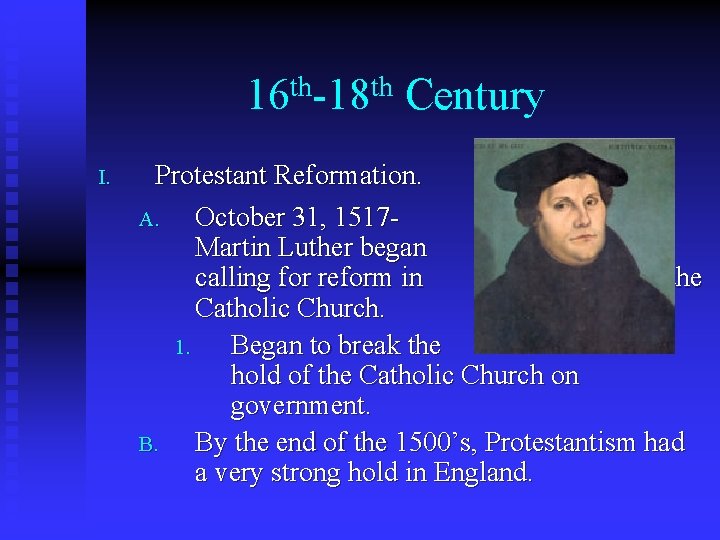
th th 16 -18 I. Century Protestant Reformation. A. October 31, 1517 Martin Luther began calling for reform in the Catholic Church. 1. Began to break the hold of the Catholic Church on government. B. By the end of the 1500’s, Protestantism had a very strong hold in England.
C. Protestantism promoted the belief that people could talk directly to God, without priestly intervention. 1. People transposed that belief to government, people should be able to have a say in government.
II. Enlightenment. A. Time period beginning in the early 17 th Century, marked by period where learning and reasoning were very important. 1. Many enlightened thinkers believed world could be improved through reasoning, science, and religious toleration. a. People controlled their destiny and questioned the concept of “Divine Right of Kings”. b. Believed government existed to provide order (Social Contract Theory).
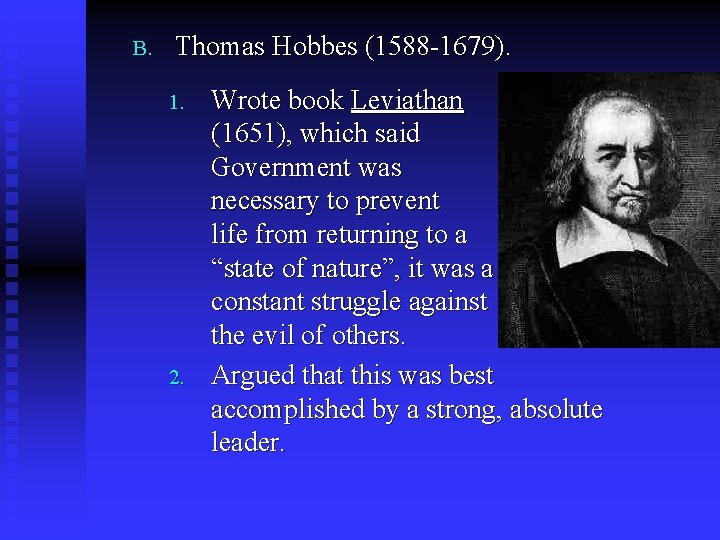
B. Thomas Hobbes (1588 -1679). 1. 2. Wrote book Leviathan (1651), which said Government was necessary to prevent life from returning to a “state of nature”, it was a constant struggle against the evil of others. Argued that this was best accomplished by a strong, absolute leader.
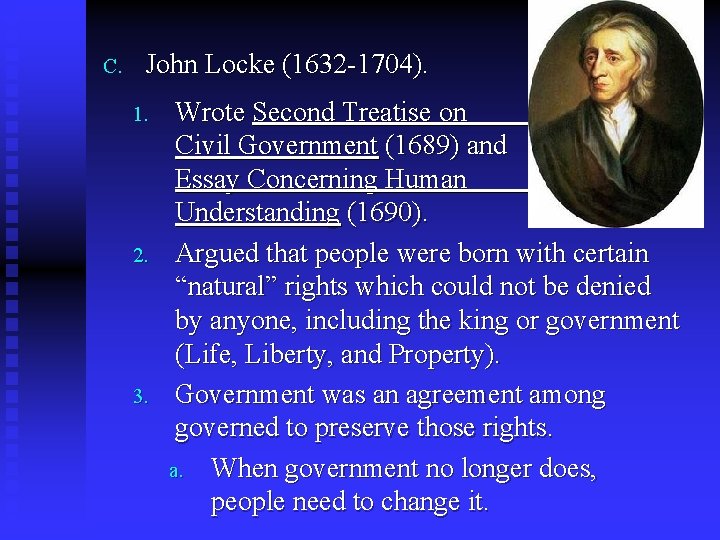
C. John Locke (1632 -1704). 1. 2. 3. Wrote Second Treatise on Civil Government (1689) and Essay Concerning Human Understanding (1690). Argued that people were born with certain “natural” rights which could not be denied by anyone, including the king or government (Life, Liberty, and Property). Government was an agreement among governed to preserve those rights. a. When government no longer does, people need to change it.
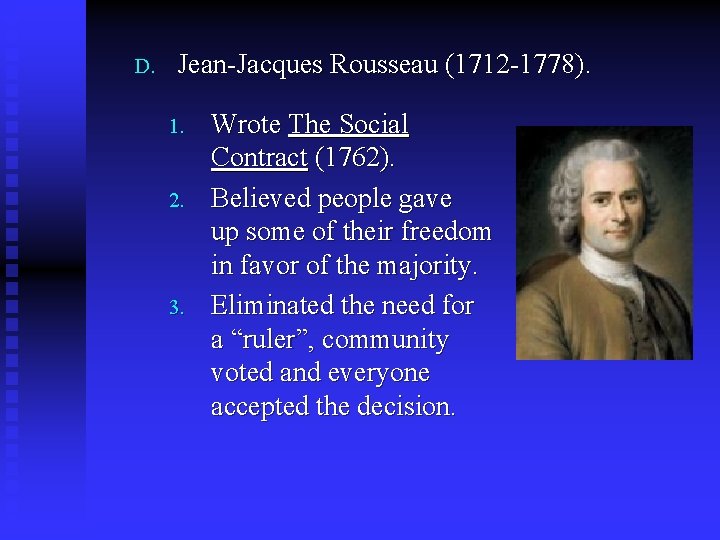
D. Jean-Jacques Rousseau (1712 -1778). 1. 2. 3. Wrote The Social Contract (1762). Believed people gave up some of their freedom in favor of the majority. Eliminated the need for a “ruler”, community voted and everyone accepted the decision.
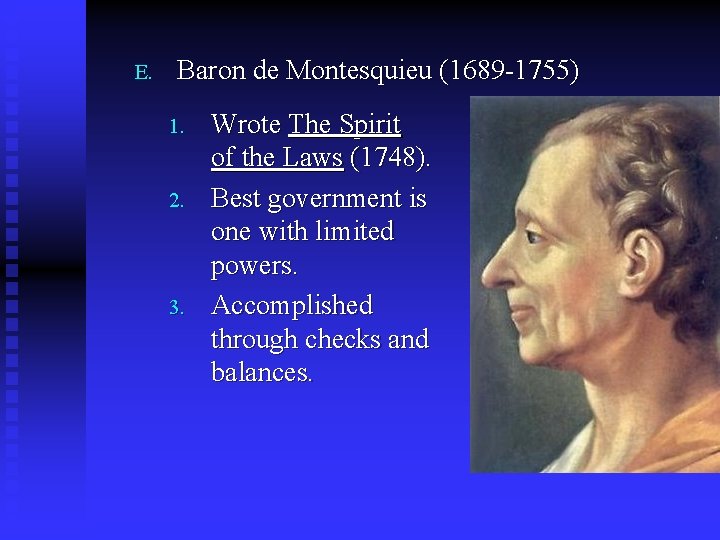
E. Baron de Montesquieu (1689 -1755) 1. 2. 3. Wrote The Spirit of the Laws (1748). Best government is one with limited powers. Accomplished through checks and balances.
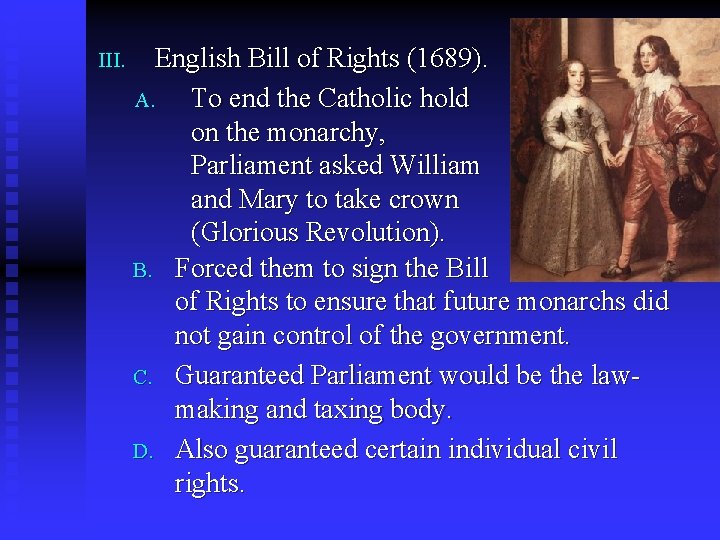
III. English Bill of Rights (1689). A. To end the Catholic hold on the monarchy, Parliament asked William and Mary to take crown (Glorious Revolution). B. Forced them to sign the Bill of Rights to ensure that future monarchs did not gain control of the government. C. Guaranteed Parliament would be the lawmaking and taxing body. D. Also guaranteed certain individual civil rights.