
Social Studies Chapter 6 Lesson 4 Lesson 1

- Slides: 13
Social Studies Chapter 6 Lesson 4
Lesson 1 Vocabulary Review � An official agreement between groups or nations � A person in charge of a colony’s land � A person chosen by a group to speak or act for them � A loss or sacrifice � A gain or advantage treaty proprietor representative cost benefit
Lesson 2 Vocabulary Review �A person whose job requires laborer hard physical work � Economy in which citizens decide what will be produced, free market economy rather than the government � Someone who works for a more experienced person to apprentice learn a skill � Someone who is skilled at making something by hand artisan � Freedom of people of businesses to earn money by making their own economic free enterprise decisions
Lesson 3 Vocabulary Review �A group of people with the legislature power to make and change laws � A large farm on which crops plantation are raised by workers who live on the land � A person who owes money debtor � A place protected from threat or harm refuge
Lesson 4 �A person who watches and directs workers, especially overseer laborers � A plant that can be made indigo into a dark blue dye � An African American spiritual religious folk song
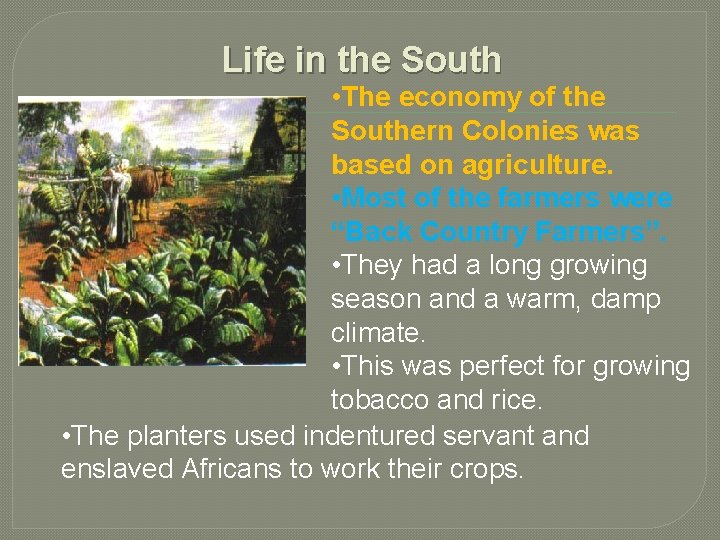
Life in the South • The economy of the Southern Colonies was based on agriculture. • Most of the farmers were “Back Country Farmers”. • They had a long growing season and a warm, damp climate. • This was perfect for growing tobacco and rice. • The planters used indentured servant and enslaved Africans to work their crops.
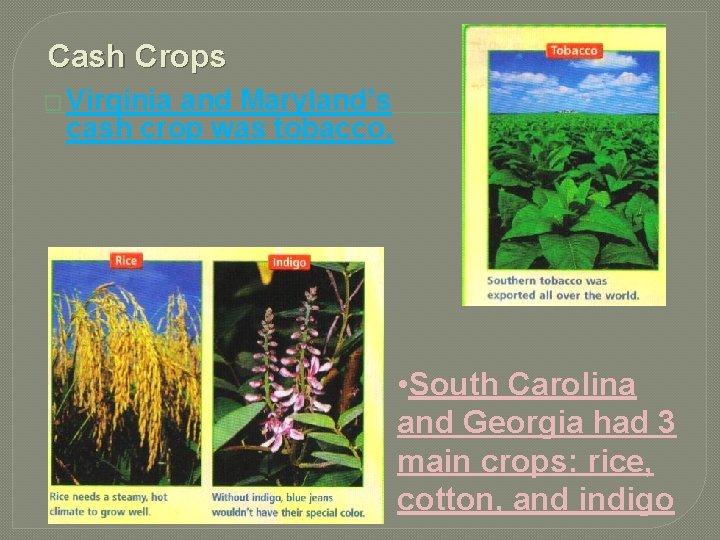
Cash Crops � Virginia and Maryland’s cash crop was tobacco. • South Carolina and Georgia had 3 main crops: rice, cotton, and indigo
Charles Town � The Southern Colonies had more farms but fewer towns than the other colonies. � Charles Town, South Carolina became a large port city and was a busy center of trade. � Charles Town’s port was used to export tobacco, rice, and indigo. � Ships from Europe and the West Indies brought their goods in through this port. � Charles Town had a diverse population: English, Scots-Irish, French, West Indies, and free and enslaved Africans.
Plantations � Were like small villages � Used laborers to do the work, usually enslaved Africans � Children were educated at home usually with hired tutors. Small Farms • Small farms usually in the backcountry • Family members and sometimes 1 or 2 slaves did the work • Children learned to read and write only if their parents could teach them.
Southern Slavery �At first, indentured servants did most of the work on plantations �As plantations grew, more workers were needed; Southern plantation owners began to rely on slaves. �All 13 colonies had slaves, but more slave lived in the Southern Colonies.
Life Under Slavery � Slaves were bought and sold as property. � Families were torn apart; husbands and wives were often separated. � Slaves were either laborers in the field or house servants. � Children were also expected to work. � Overseers watched slaves, whipped and punished them. � Many slaves died from overwork, poor food and shelter, and mistreatment.
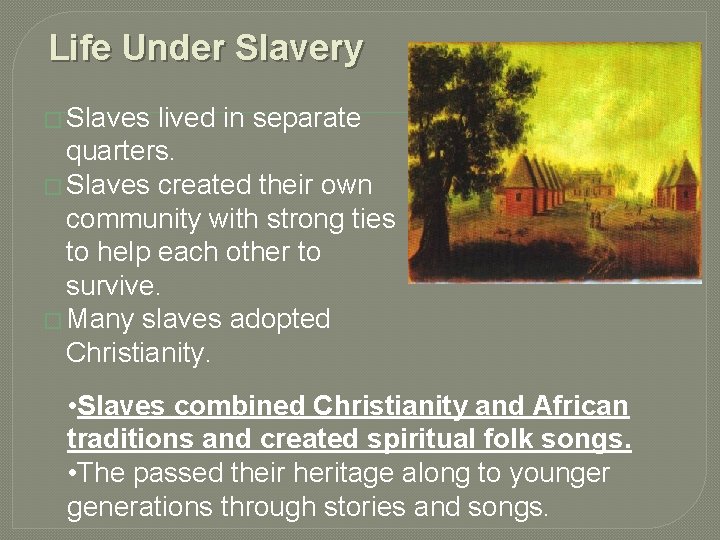
Life Under Slavery � Slaves lived in separate quarters. � Slaves created their own community with strong ties to help each other to survive. � Many slaves adopted Christianity. • Slaves combined Christianity and African traditions and created spiritual folk songs. • The passed their heritage along to younger generations through stories and songs.
�Watch ‘Southern Colony’ video