
Social Structure Chapter 4 Vocabulary social structure status

Social Structure Chapter 4 Vocabulary social structure status role social institution group reference group formal organization bureaucracy volunteer association Original Content Copyright © Holt Mc. Dougal. Additions and changes to the original content are the responsibility of the instructor.

Social Structure Section 1 at a Glance Building Blocks of Social Structure • Social structure is the network of interrelated statuses and roles that guides human interaction. • A status is a socially defined position in society, while a role is the behavior, or the rights and obligations, attached to a status. • A social institution is a system of statuses and roles organized to satisfy one or more of society’s basic needs. Original Content Copyright © Holt Mc. Dougal. Additions and changes to the original content are the responsibility of the instructor.
Social Structure Case Study: Six Degrees of Separation Experiments can prove the truth of proposed hypotheses. In “small-world” experiments, researchers test theory that all people are connected to each other through mutual acquaintances. In one example, random people are given the task of getting a letter to another random person using only personal contacts. These experiments lead researchers to believe that it takes five intermediaries to connect two perfect strangers. Original Content Copyright © Holt Mc. Dougal. Additions and changes to the original content are the responsibility of the instructor.

Social Structure Building Blocks of Social Structure Main Idea • Social structure is the network of interrelated statuses and roles that guides human interaction. A status is a socially defined position in society, while a role is the behavior attached to a status. Original Content Copyright © Holt Mc. Dougal. Additions and changes to the original content are the responsibility of the instructor.
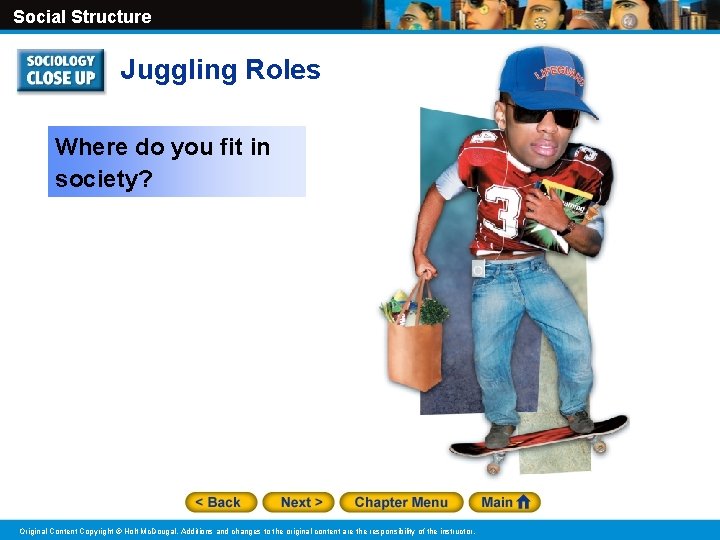
Social Structure Juggling Roles Where do you fit in society? Original Content Copyright © Holt Mc. Dougal. Additions and changes to the original content are the responsibility of the instructor.
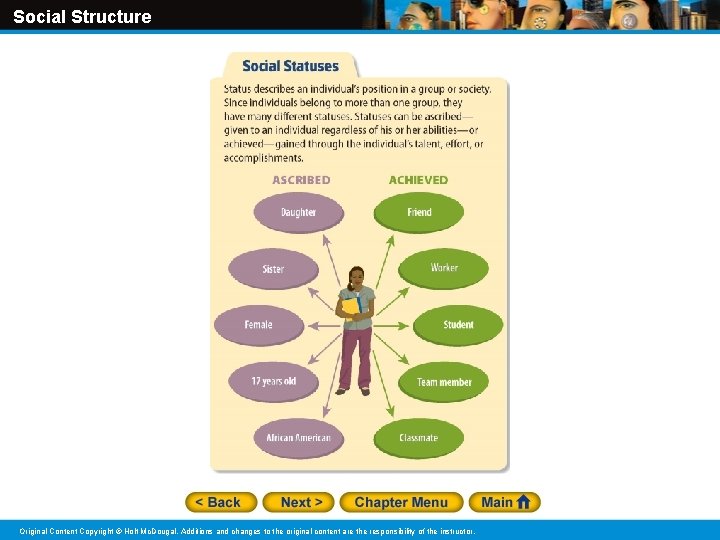
Social Structure Status A social structure is a network of interrelated statuses and roles that guide human behavior. A status is a socially defined position, while a role is the behavior associated with a status. Ascribed and Achieved Statuses Master Status • Ascribed status is assigned according to qualities beyond a person’s control, such as age. • Most people have many statuses, but a master status is the one that plays the greatest role in a person’s life. • Achieved status is acquired through a person’s direct efforts, such as education. • It can be either ascribed or achieved. Original Content Copyright © Holt Mc. Dougal. Additions and changes to the original content are the responsibility of the instructor.
Social Structure Original Content Copyright © Holt Mc. Dougal. Additions and changes to the original content are the responsibility of the instructor.
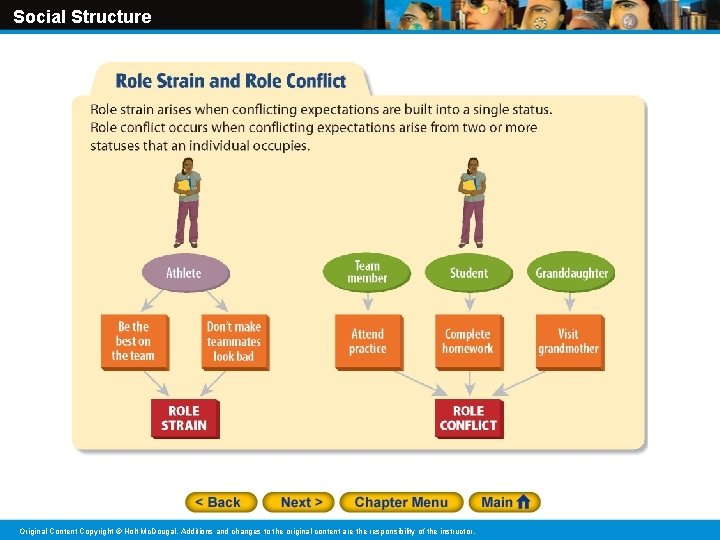
Social Structure Roles Role Expectations and Role Performance • Role expectations are the socially determined behaviors expected of a person with a particular status. • Role performance is the actual behaviors of a person with a particular status. They may or may not be the expected behaviors. Role Conflict, Role Strain, and Role Exit • A role set is the different roles associated with a particular status. • Role conflict occurs when fulfilling the role expectations of one status interferes with a second status. • Role strain occurs when a person has difficulty fulfilling the role of one status. • Role exit is the process people go through to detach from a role that was previously central to their social identity. Original Content Copyright © Holt Mc. Dougal. Additions and changes to the original content are the responsibility of the instructor.
Social Structure Original Content Copyright © Holt Mc. Dougal. Additions and changes to the original content are the responsibility of the instructor.
Social Structure Social Institutions • A social institution is a group of statuses and roles that are organized to satisfy one or more of the basic needs of society. – The family, the most universal social institution, takes responsibility for raising the young and teaching them accepted norms and values. – The economic institution organizes the production, distribution, and consumption of goods and services. – The political institution is the system of norms that governs the exercise and distribution of power in society. – Education ensures the transmission of values, patterns of behavior, and certain skills and knowledge. – Religion provides a shared, collective explanation of the meaning of life. Original Content Copyright © Holt Mc. Dougal. Additions and changes to the original content are the responsibility of the instructor.
Social Structure Section Questions • What do sociologists mean by the term status? • How are status and roles related? • What are social institutions? Page 70 • Questions 1, 2 Original Content Copyright © Holt Mc. Dougal. Additions and changes to the original content are the responsibility of the instructor.
Social Structure Section 2 at a Glance Groups Within Society • Groups are the foundation of social life. They differ in terms of size, life, organization, and purpose. • Groups perform important functions, such as setting membership boundaries, choosing leaders, fulfilling goals, and controlling members’ behavior. Types of Societies • Sociologists classify societies according to subsistence strategies, or the ways societies use technology to meet the needs of their members. • Sociologists recognize three broad categories of society —preindustrial, and postindustrial. Original Content Copyright © Holt Mc. Dougal. Additions and changes to the original content are the responsibility of the instructor.
Social Structure Groups Within Society Main Idea Groups are the foundation of social life and they differ in terms of size, organization, and purpose. Groups also perform many important functions in society. Questions to think about… • How do sociologists define the term group? • What types of groups do sociologists recognize? • What are the main functions of groups? Original Content Copyright © Holt Mc. Dougal. Additions and changes to the original content are the responsibility of the instructor.
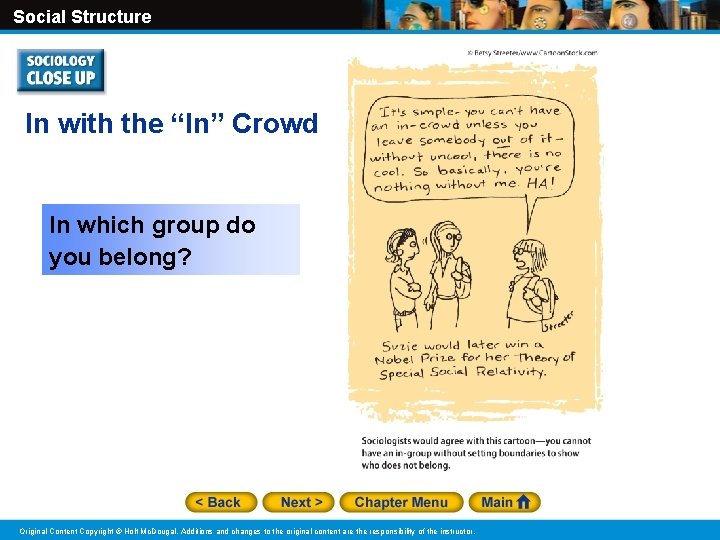
Social Structure In with the “In” Crowd In which group do you belong? Original Content Copyright © Holt Mc. Dougal. Additions and changes to the original content are the responsibility of the instructor.
Social Structure Defining Groups • Size – Small or large • Quality – Intimate or formal • Four features: – Two or more people – Interaction occurs between members – Shared expectations – Must possess a sense of common identity • Aggregate – A gathering of people without lasting organization • Social categories – People with a shared trait or status who do not interact with each other Original Content Copyright © Holt Mc. Dougal. Additions and changes to the original content are the responsibility of the instructor.
Social Structure • Size • A dyad is two people. • A triad is three people. • Fifteen is the largest number that works well as a group. • Time • A group can be a one-time meeting or a lifetime. • Interaction is not continuous; there are breaks. • Organization • A formal group has clearly defined structure, goals, and activities. • An informal group has no official structure or rules of conduct. Original Content Copyright © Holt Mc. Dougal. Additions and changes to the original content are the responsibility of the instructor.
Social Structure Types of Groups There are many kinds of groups. Most people belong to several. Primary Groups Secondary Groups • The most intimate type • Interaction is impersonal and temporary • Fundamental in forming the social nature and ideals of the individual • Involve only part of a member’s self • Small group that interacts over a long period of time on a personal basis • Casual and limited • Involves entire self of a member • Members can be replaced • Importance of person linked to his or her function Original Content Copyright © Holt Mc. Dougal. Additions and changes to the original content are the responsibility of the instructor.
Social Structure Types of Groups (cont. ) Reference Groups In-Groups and Out-Groups • A group with whom an individual identifies and whose attitudes and values are adopted • In-group: any group that a person belongs to and identifies with • Can have both positive and negative effect on behavior • Out-group: any group that the person does not belong to or identify with Electronic Communities Social Networks • Have arisen with arrival of internet • The web of relationships across groups that occurs because of the many groups people belong to • Some reflect primary-group dynamics • No clear boundaries Original Content Copyright © Holt Mc. Dougal. Additions and changes to the original content are the responsibility of the instructor.
Social Structure Group Functions • Define boundaries – Use of uniforms, gestures, handshakes, or language • Select leaders – Leaders influence the attitudes and opinions of others – Instrumental leaders help find specific means that will help the group reach its goals – Expressive leaders find ways to keep the group together and to maintain morale • Define purpose – Set goals – Assign tasks – Make decisions • Control members’ behavior Original Content Copyright © Holt Mc. Dougal. Additions and changes to the original content are the responsibility of the instructor.
Social Structure Section Questions • How do sociologists define the term group? • What types of groups do sociologists recognize? • What are the main functions of groups? Original Content Copyright © Holt Mc. Dougal. Additions and changes to the original content are the responsibility of the instructor.
Social Structure Types of Societies Main Idea Sociologists classify societies according to how each uses technology to meet the needs of its members. Sociologists recognize three broad categories of society—preindustrial, and postindustrial. Reading Focus • What are the types of preindustrial societies? • What is the main economic activity in industrial societies? • How do postindustrial societies and industrial societies differ? • What concepts have sociologists used to contrast societies? Original Content Copyright © Holt Mc. Dougal. Additions and changes to the original content are the responsibility of the instructor.
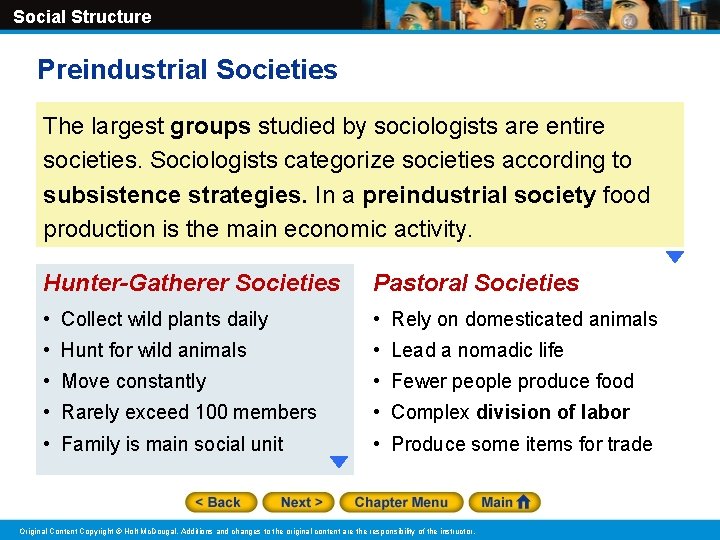
Social Structure Preindustrial Societies The largest groups studied by sociologists are entire societies. Sociologists categorize societies according to subsistence strategies. In a preindustrial society food production is the main economic activity. Hunter-Gatherer Societies Pastoral Societies • Collect wild plants daily • Rely on domesticated animals • Hunt for wild animals • Lead a nomadic life • Move constantly • Fewer people produce food • Rarely exceed 100 members • Complex division of labor • Family is main social unit • Produce some items for trade Original Content Copyright © Holt Mc. Dougal. Additions and changes to the original content are the responsibility of the instructor.
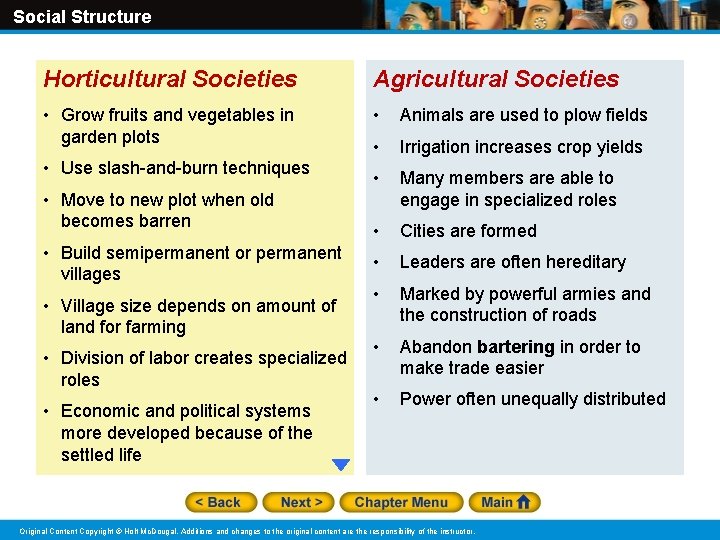
Social Structure Horticultural Societies Agricultural Societies • Grow fruits and vegetables in garden plots • Animals are used to plow fields • Irrigation increases crop yields • Many members are able to engage in specialized roles • Cities are formed • Leaders are often hereditary • Marked by powerful armies and the construction of roads • Abandon bartering in order to make trade easier • Power often unequally distributed • Use slash-and-burn techniques • Move to new plot when old becomes barren • Build semipermanent or permanent villages • Village size depends on amount of land for farming • Division of labor creates specialized roles • Economic and political systems more developed because of the settled life Original Content Copyright © Holt Mc. Dougal. Additions and changes to the original content are the responsibility of the instructor.
Social Structure Industrial Societies In an industrial society: • Production of food shifts to production of manufactured goods • Production moves from human and animal labor to machines • Increases food production and population • Numbers and kinds of jobs increase • Location of work changes to cities, away from the home • Social processes such as education take the place of family Original Content Copyright © Holt Mc. Dougal. Additions and changes to the original content are the responsibility of the instructor.
Social Structure Postindustrial Societies • Economic emphasis is on creation and exchange of information and services instead of manufacturing goods • United States is a postindustrial society • Standard of living improves • Education and science are important • Technological advances seen as key Original Content Copyright © Holt Mc. Dougal. Additions and changes to the original content are the responsibility of the instructor.
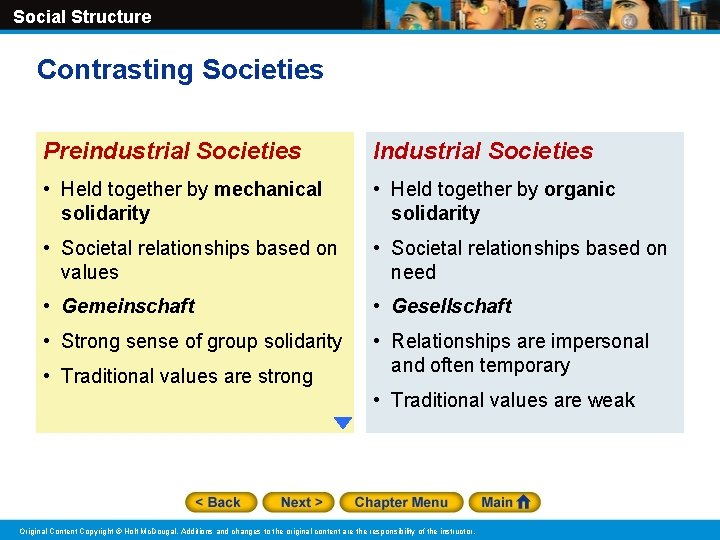
Social Structure Contrasting Societies Preindustrial Societies Industrial Societies • Held together by mechanical solidarity • Held together by organic solidarity • Societal relationships based on values • Societal relationships based on need • Gemeinschaft • Gesellschaft • Strong sense of group solidarity • Relationships are impersonal and often temporary • Traditional values are strong • Traditional values are weak Original Content Copyright © Holt Mc. Dougal. Additions and changes to the original content are the responsibility of the instructor.
Social Structure Sociology in Today’s World The New Barter One major development of agricultural societies was the creation of a money system. This system replaced the idea of barter, but bartering has made a comeback. • As many as 450, 000 companies barter in America today. • Computer technology makes bartering easier. • They trade goods and services through a “barter exchange. ” • Barter allows companies to “buy” goods or services without using cash. • Barter exchanges make money on barter transactions. • Rapid growth of bartering is changing the economy of the United States. Original Content Copyright © Holt Mc. Dougal. Additions and changes to the original content are the responsibility of the instructor.
Social Structure Thinking Critically • Why has the new barter grown, and how does it differ from barter in the past? • What effect do you think the expansion of electronic bartering will have on society in the United States? Explain your answer. • Page 79 #’s 2, 4 Original Content Copyright © Holt Mc. Dougal. Additions and changes to the original content are the responsibility of the instructor.
Social Structure Section 3 at a Glance Types of Social Interaction • There are five common forms of social interaction— exchange, competition, conflict, cooperation, and accommodation. • Exchange, cooperation, and accommodation tend to stabilize the social structure, while competition and conflict tend to encourage social change. Original Content Copyright © Holt Mc. Dougal. Additions and changes to the original content are the responsibility of the instructor.
Social Structure Types of Social Interaction Main Idea Sociologists identify five common forms of social interaction: exchange, competition, conflict, cooperation, and accommodation. Questions to think about… • What is the basis of exchange? • What are the similarities and differences between competition and conflict? • Why is cooperation important for society? • How do individuals and groups use accommodation to settle disputes? Original Content Copyright © Holt Mc. Dougal. Additions and changes to the original content are the responsibility of the instructor.
Social Structure Exchange • Exchange occurs when people interact in an effort to receive a reward or a return for their actions. • Reward might be tangible or intangible • Reciprocity is the idea that if you do something for someone, that person owes you something in return. • Basis of exchange interactions • Exchange theory is the idea that people are motivated by selfinterest in their interactions with other people. • Rewarded behavior is repeated Original Content Copyright © Holt Mc. Dougal. Additions and changes to the original content are the responsibility of the instructor.
Social Structure Competition and Conflict Competition • Competition occurs when two or more people or groups oppose each other to achieve a goal that only one can attain. – Common in Western societies – Sometimes considered basis of capitalism and democracy – Can lead to psychological stress, a lack of cooperation, and conflict Conflict • Conflict is the deliberate attempt to control a person by force, to oppose someone, or to harm another person. – Has few rules of accepted conduct – Can reinforce group boundaries and loyalty Original Content Copyright © Holt Mc. Dougal. Additions and changes to the original content are the responsibility of the instructor.
Social Structure Cooperation • Cooperation occurs when two or more people or groups work together to achieve a goal that will benefit more than one person. – A social process that gets things done – May be used along with competition to motivate members to work harder for the group Original Content Copyright © Holt Mc. Dougal. Additions and changes to the original content are the responsibility of the instructor.
Social Structure Accommodation Accomodation is a state of balance between cooperation and conflict. Compromise Each party gives up something they want in order to come to an agreement Mediation Calling in a third party who guides the two parties toward an agreement Truce Temporarily brings a halt to the competition or conflict until a compromise can be reached Arbitration A third party makes a decision that is binding on both parties Original Content Copyright © Holt Mc. Dougal. Additions and changes to the original content are the responsibility of the instructor.
Social Structure • Classwork/Homework • How do competition and conflict differ? • Page 82 • 1, 2 Original Content Copyright © Holt Mc. Dougal. Additions and changes to the original content are the responsibility of the instructor.
Social Structure Section 4 at a Glance The Structure of Formal Organizations • Formal organizations are complex secondary groups created to achieve specific goals. Most are structured as bureaucracies. • Max Weber noted that all bureaucracies, regardless of their goals or purposes, have common characteristics. • Formal and informal structures can affect the efficiency of bureaucracies. Original Content Copyright © Holt Mc. Dougal. Additions and changes to the original content are the responsibility of the instructor.
Social Structure The Structure of Formal Organizations Main Idea Formal organizations are complex secondary groups created to achieve specific goals. Most are structured as bureaucracies. Formal and informal structures can affect the efficiency of bureaucracies. Questions to think about… • How do sociologists view formal organizations? • What are the main characteristics of Max Weber’s model of bureaucracies? • What types of relationships are found in formal organizations? • What problems do bureaucracies face? Original Content Copyright © Holt Mc. Dougal. Additions and changes to the original content are the responsibility of the instructor.
Social Structure Formal Organizations • Formal organizations are large, complex secondary groups that have been established to achieve specific goals. • Schools, businesses, religious organizations, and labor unions are examples. • A bureaucracy is a ranked authority structure that operates according to specific rules and procedures. • Bureaucracies existed in ancient Egypt and China, but rose to prominence during the Industrial Revolution. • Rationality involves subjecting every feature of human behavior to calculation, measurement, and control. • Industrialization has increased the degree of rationalism in our society. Original Content Copyright © Holt Mc. Dougal. Additions and changes to the original content are the responsibility of the instructor.
Social Structure Weber’s Model of Bureaucracies • Division of labor – Work is divided among specialists. • Ranking of authority – There are clear-cut lines of responsibility. • Employment based on formal qualifications – Individuals are hired on the basis of tests, education, or experience. – Workers are replaceable. Original Content Copyright © Holt Mc. Dougal. Additions and changes to the original content are the responsibility of the instructor.
Social Structure Weber’s Model of Bureaucracies (cont’d. ) • Written rules and regulations – There are objective rules that identify each person’s responsibilities. • Specific lines of promotion and advancement – Lines of promotion reward loyalty with job security and seniority. • Organizations fit this ideal type to varying degrees – Some, like voluntary associations, may vary with the abilities of volunteers. Original Content Copyright © Holt Mc. Dougal. Additions and changes to the original content are the responsibility of the instructor.
Social Structure Relationships in Formal Organizations Informal structures based on strong primary relationships may exist within the most rigid of bureaucracies. • Called “bureaucracy’s other face” • First noted in study of Western Electric Company • Conformity to the norm enforced through negative sanctions Original Content Copyright © Holt Mc. Dougal. Additions and changes to the original content are the responsibility of the instructor.
Social Structure Problems of Bureaucracies Weber’s Bureaucracy • Views bureaucracy in a positive light – Best way to organize large numbers of people to attain a large goal – Create order by clearly defining tasks – Provide stability Flaws of Bureaucracy • Several significant weaknesses – No longer fulfill original goals – New goal might be self-continuation – Encourage bureaucratic personality – Create alienation among employees – Result in oligarchy—a tendency labeled the iron law of oligarchy Original Content Copyright © Holt Mc. Dougal. Additions and changes to the original content are the responsibility of the instructor.
Social Structure Current Research in Sociology The Mc. Donaldization of Society Max Weber suggested that as society progressed it would become increasingly guided by rules, regulations, and formal structures. George Ritzer called this tendency Mc. Donaldization. • Four aspects to Mc. Donaldization: efficiency, calculability, predictability, and control • Operations are performed to specific guidelines that maximize efficiency • Pros: convenient, familiar • Cons: removal of human aspect, no room for innovation, reduction of face-to-face interactions • Uniformity across production lines results in uniform products Original Content Copyright © Holt Mc. Dougal. Additions and changes to the original content are the responsibility of the instructor.
Social Structure Thinking Critically • What are the costs and benefits of Mc. Donaldization? • How is a large suburban shopping mall an example of Mc. Donaldization? • Classwork/Homework • Page 89 • 1, 3 • Chapter 4 Review • Critical Thinking 1, 2, 5 • Extending Imagination 1 • Primary Sources 1, 2, 3 Original Content Copyright © Holt Mc. Dougal. Additions and changes to the original content are the responsibility of the instructor.
- Slides: 44