
Social Security Disability Income and Supplemental Security Income

Social Security Disability Income and Supplemental Security Income Presented by: Chris Kerbawy Staff Attorney at Legal Action of Wisconsin
Brief History of Social Security (excerpted from “Historical Background And Development Of Social Security”, www. ssa. gov/history/briefhistory 3. html and “Disability Policy & History”, by Edward D. Berkowitz, https: //www. ssa. gov/history/edberkdib. html) • All peoples throughout all of human history have faced the uncertainties brought on by unemployment, illness, disability, death and old age. • The traditional sources of economic security are assets, labor, family, and charity. • The English Poor Law of 1601 was the first systematic codification of English ideas about the responsibility of the state to provide for the welfare of its citizens. – – Taxes were levied to fund relief activities Distinguished between the "deserving" and the "undeserving" poor Relief was local and community controlled Almshouses were eventually established to house those on relief • This was the tradition the pilgrims brought with them when they journeyed to the New World.
Brief History of Social Security • Colonial Poor Laws – Featured local taxation to support the destitute – Discriminated between the "worthy" and the "unworthy" poor – All relief was a local responsibility – Almshouses and poorhouses were eventually created – Relief was made as unpleasant as possible in order to "discourage" dependency – Those receiving relief could lose their personal property, the right to vote, the right to move, and in some cases were required to wear a large "P" on their clothing to announce their status
Brief History of Social Security • Agrarian Justice (1797), by Thomas Paine – Thomas Paine is historically known as “The Father of the American Revolution” – His works Common Sense (1776) and The American Crisis (1776) were critical to national identity during the American Revolution. – The Rights of Man (1791) and The Age of Reason (1794) were influential in the early life of the nation. – Agrarian Justice was his last pamphlet, and was one of the first proposals for retirement security in America.
Brief History of Social Security • Agrarian Justice (continued) – Paine contrasts the “natural and primitive state of man” where land is shared versus “civilized life” where land is privately cultivated. – “Poverty, therefore, is a thing created by that which is called civilized life. It exists not in the natural state. On the other hand, the natural state is without those advantages which flow from agriculture, arts, science and manufactures. ” – “The life of an Indian is a continual holiday, compared with the poor of Europe; and, on the other hand it appears to be abject when compared to the rich. Civilization, therefore, or that which is so-called, has operated two ways: to make one part of society more affluent, and the other more wretched, than would have been the lot of either in a natural state. ” – “[T]he first principle of civilization ought to have been, and ought still to be, that the condition of every person born into the world, after a state of civilization commences, ought not to be worse than if he had been born before that period. ”
Brief History of Social Security • Agrarian Justice (continued) – Paine called for the creation of a system whereby those inheriting property would pay a 10% inheritance tax to create a special fund out of which a one-time stipend of 15 pounds sterling would be paid to each citizen upon attaining age 21, to give them a start in life, and annual benefits of 10 pounds sterling to be paid to every person age 50 and older, to guard against poverty in old-age. – Paine argued, “Cultivation is at least one of the greatest natural improvements ever made by human invention. It has given to created earth a tenfold value. But the landed monopoly that began with it has produced the greatest evil. It has dispossessed more than half the inhabitants of every nation of their natural inheritance, without providing for them, as ought to have been done, an indemnification for that loss, and has thereby created a species of poverty and wretchedness that did not exist before. In advocating the case of the persons thus dispossessed, it is a right, and not a charity, that I am pleading for. ”
Brief History of Social Security • Civil War Pensions – The first national pension program for soldiers was created in early 1776, prior to the American Revolution. – Pensions of limited types were paid to veterans of America's various wars between the Revolution and the Civil War. – Immediately following the Civil War, a much higher proportion of the population was disabled or survivors of deceased breadwinners than at any time in America's history. – This led to the development of a generous pension program.
Brief History of Social Security • Civil War Pensions (continued) – Originally, benefits were linked to disabilities "incurred as a direct consequence of. . . military duty. “ – Widows and orphans could receive pensions equal in amount to that which would have been payable to their deceased solider if he had been disabled. – In 1890 the requirement for service-connected disability was dropped, and any disabled Civil War veteran qualified for benefits. – In 1894 military pensions accounted for 37% of the entire federal budget. – In 1906 old-age was made a sufficient qualification for benefits. – The last Civil War Widows Pension payment was made in 1999.
Brief History of Social Security • Demographic changes after the Civil War – Four important demographic changes happened in America beginning in the 1880 s: • • The Industrial Revolution The urbanization of America The disappearance of the "extended" family A marked increase in life expectancy – These changes rendered the traditional systems of economic security increasingly unworkable.
Brief History of Social Security • Demographic changes (continued) – The Industrial Revolution transformed the majority of working people from self-employed agricultural workers into wage earners working for large industrial concerns. – In an agricultural society, prosperity could be easily seen to be linked to one's labor, and anyone willing to work could usually provide at least a bare subsistence for themselves and their family. – When economic income is primarily from wages, one's economic security can be threatened by factors outside one's control--such as recessions, layoffs, failed businesses, etc.
Brief History of Social Security • Demographic changes (continued) – Along with the shift from an agricultural to an industrial society, Americans moved from farms and small rural communities to large cities--that's where the industrial jobs were. – In 1890, only 28% of the population lived in cities, by 1930 this percentage had doubled, to 56%. – The year 1920 was a historical tipping-point. In that year, for the first time in our nation's history, more people were living in cities than on farms.
Brief History of Social Security • Demographic changes (continued) – The toward urbanization also contributed to another significant shift in American society, the disappearance of the extended family and the rapid rise of the nuclear family. – For most of history, people lived in "extended families" that included children, parents, grandparents and other relatives. – The advantage of the extended family was that when a family member became too old or infirm to work, the other family members assumed responsibility for their support. – But when the able-bodied left the farms to seek employment in the cities, often the parents or grandparents stayed behind. – When new immigrants first arrived in our land, it was often the breadwinner who first made the passage and only later could he bring the family over.
Brief History of Social Security • Demographic changes (continued) – Thanks primarily to better health care and sanitation, and the development of effective public health programs, Americans began to live significantly longer. – From 1900 -1930, average life spans increased by 10 years. – This was the most rapid increase in life spans in recorded human history. – The result was a rapid growth in the number of aged persons, to 7. 8 million by 1935.
Brief History of Social Security • The Great Depression – The Stock Market lost 40% of its value ($26 billion) – Unemployment exceeded 25% – Roughly 10, 000 banks failed – Gross Domestic Product declined from $105 billion in 1929 to $55 billion in 1932. – Compared to pre-Depression levels, net new business investment was down $5. 8 billion in 1932. – Wages paid to workers declined from $50 billion in 1929 to only $30 billion in 1932.
Brief History of Social Security • The Great Depression (continued) – Radical Calls to Action • • Huey Long: Every Man a King Francis E. Townsend: The Townsend Movement Father Charles E. Coughlin: Union for Social Justice Upton Sinclair: End Poverty in California (“EPIC”) Robert Noble: Ham & Eggs Reverend Herbert S. Bigelow: Bigelow Plan Arthur L. Johnson: General Welfare Federation of America Technocracy (“Production for use”, as opposed to profit)
Brief History of Social Security • The Great Depression (continued) – The Establishment Response • • Do Nothing President Hoover's "Volunteerism“ Expand Welfare The “New" Alternative: Social Insurance – In 1935, there were 34 nations already operating some form of social insurance program, and about 20 of these were contributory programs like Social Security.
Brief History of Social Security • Legislative process – "Security was attained in the earlier days through the interdependence of members of families upon each other and of the families within a small community upon each other. The complexities of great communities and of organized industry make less real these simple means of security. Therefore, we are compelled to employ the active interest of the Nation as a whole through government in order to encourage a greater security for each individual who composes it. . . This seeking for a greater measure of welfare and happiness does not indicate a change in values. It is rather a return to values lost in the course of our economic development and expansion. . . “ Franklin D. Roosevelt: Message of the President to Congress, June 8, 1934.
Brief History of Social Security • Legislative process (continued) – The Social Security Act became law in 1935. – The major provisions were: • Title I - Grants to States for Old-Age Assistance, which supported state welfare programs for the aged – Modification of existing need-based assistance – Precursor to Supplemental Security Income (SSI)) • Title II - Federal Old-Age Benefits (Social Security as we know it) • Title III – Unemployment Insurance • Title IV – Aid to Families with Dependent Children (replaced by Temporary Assistance for Needy Families (TANF) in 1996) – Notably absent was a program for disabled individuals, although it was considered.
Brief History of Social Security • Legislative process (continued) – In 1936, the planners of the Social Security Administration outlined a plan for disability insurance. – They wrote a tough definition of disability into their proposals so as to distinguish sharply between unemployment and disability. • Proposed definition was: “an impairment of mind or body which continuously renders it impossible for the disabled person to follow any substantial gainful occupation, " and was likely to last for "the rest of a person's life“. • This differed from existing definitions of “disability” in workers' compensation and veterans pension laws.
Brief History of Social Security • Legislative process (continued) – Much of the conceptual work that underpinned Social Security Disability Insurance took place in the 1930's and early 1940's. – Attention was diverted from the issue in the 40’s and 50’s, due to World War II, and the fact that existing public assistance programs generally paid out more money than Social Security prior to 1950. – In 1950, Congress belatedly recognized that Cost of Living Adjustments (“COLAs”) were necessary to keep up with inflation. The first one was 77% in 1950. – After several small legislative steps between 1949 and 1956, the law creating Social Security Disability Income (SSDI) benefits passed in 1956.
Brief History of Social Security • Legislative process (continued) – In 1969, Congress began looking at federalizing administration of aid program under Title I and Title IV of the Social Security Act. – These aid programs had been operated by the States, and paid modest benefits. – The Supplemental Security Income (SSI) program came into being in 1975.

Sources of Social Security Law • The Law – 42 United State Code, Chapter 7 • Regulations – 20 Code of Federal Regulations, Chapter III • The Program Operations Manual System (POMS) – https: //secure. ssa. gov/apps 10/poms. nsf/Home? readf orm • Social Security Rulings And Acquiescence Rulings – https: //www. ssa. gov/OP_Home/rulings. html • Case law
SSDI vs. SSI (From “Disability Evaluation Under Social Security”, https: //www. ssa. gov/disability/professionals/bluebook/general-info. htm) • Overview of SSDI – SSDI pays monthly benefits equal to what the person would receive if they were full retirement age. • Benefit amounts are calculated based on earnings history. • A person has to pay taxes on self-employment in order for it to be counted. • The monthly benefit amount is called the Primary Insurance Amount (“PIA”) – A person must meet the requirements to be “insured” to be eligible for SSDI. • Insured means that a person has 20 quarters of coverage within the 10 years before their disability began. • A quarter of coverage is met by earning of $1300 (2017 dollars). • Up to 4 quarters can be met each year, and they are met as soon as they are earned. • Basically, if a person has worked 5 out of the last ten years, they are insured. • The Date Last Insured (“DLI”), is the last date before the quarters of coverage within the last 10 years drops below 20. • A person must show that their disability began before the DLI to get SSDI.
SSDI vs. SSI • Overview of SSI – SSI pays monthly benefits up to $735/month from the Federal Government, and a $83. 78 supplement from the State of Wisconsin. – Benefits are reduced if the person has income. • Unearned income reduces SSI dollar for dollar, after the first $20, which are not counted. • Earned income reduces SSI by 50 cents for every dollars earned, after the first $65. • If a person gets SSDI of less than $735, they can get both SSI and SSDI. – A person is ineligible for SSI if countable assets are over the $2000 limit. • Exempt assets include: – – – – the house you live in; one vehicle, if it is used for transportation for you or a member of your household; life insurance policies you own with a face value of $1, 500 or less person; burial plots or spaces for your immediate family; a burial fund of up to $1, 500 each for you and your spouse's burial expenses; household goods and personal effects; property you or spouse in a trade/ business, or on your job if you work for someone else; if disabled, money or property you set aside under a Plan to Achieve Self-Support (PASS). – An SSI application will not be forwarded for a disability determination if the person is over-income or over-assets.
Common Issues at Time of Application • The first step is to call or write your local Social Security office and ask for the person’s DLI and PIA for SSDI benefits. – If a person’s DLI is in the past, you should consider whether to list in the application that person became disabled prior to that date. • SSDI benefits can be paid retroactively up to one year prior to the date of application, if disability began prior to the date of application. – SSDI pays benefits starting five months after the date the disability began. (Alleging disability onset at least 18 months prior to the date of application maximizes the possible retroactive benefit. ) • SSI benefits can only be paid starting the month after the date of application. – In order to avoid loss of SSI benefit months, make sure to file the application as soon as possible.
Disability Determination • Under the laws creating SSDI and SSI, the power to make disability determinations is vested with each individual state. – In Wisconsin, the Disability Determination Bureau (“DDB”) is part of the Department of Health Services. • 1400 E Washington Ave, Madison, WI 53703 • Large office building with examiners and doctors who analyze the medical records and make decisions. • Decisions have two doctor signatures, one for physical impairments, and one for mental impairments.
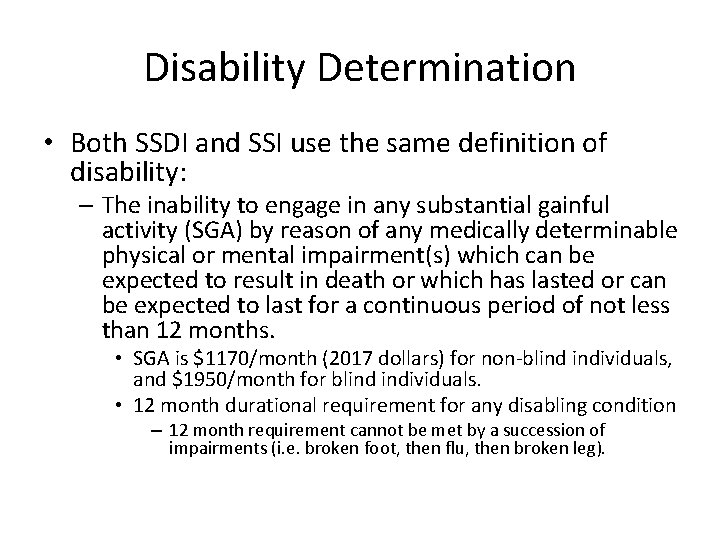
Disability Determination • Both SSDI and SSI use the same definition of disability: – The inability to engage in any substantial gainful activity (SGA) by reason of any medically determinable physical or mental impairment(s) which can be expected to result in death or which has lasted or can be expected to last for a continuous period of not less than 12 months. • SGA is $1170/month (2017 dollars) for non-blind individuals, and $1950/month for blind individuals. • 12 month durational requirement for any disabling condition – 12 month requirement cannot be met by a succession of impairments (i. e. broken foot, then flu, then broken leg).
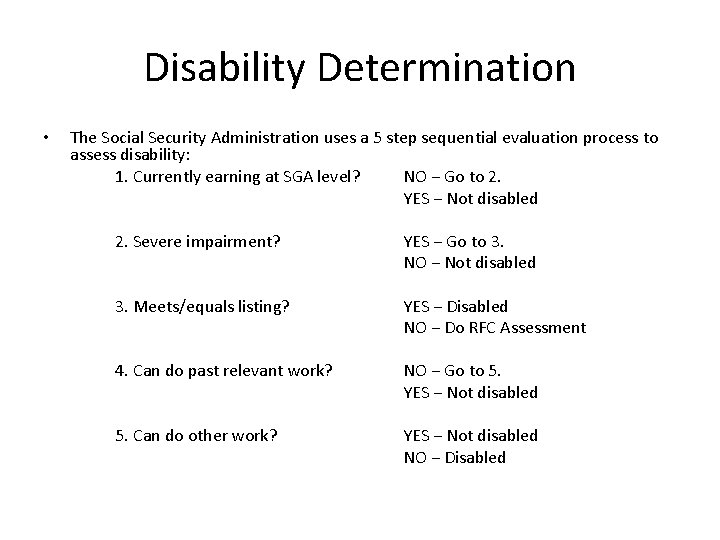
Disability Determination • The Social Security Administration uses a 5 step sequential evaluation process to assess disability: 1. Currently earning at SGA level? NO − Go to 2. YES − Not disabled 2. Severe impairment? YES − Go to 3. NO − Not disabled 3. Meets/equals listing? YES − Disabled NO − Do RFC Assessment 4. Can do past relevant work? NO − Go to 5. YES − Not disabled 5. Can do other work? YES − Not disabled NO − Disabled
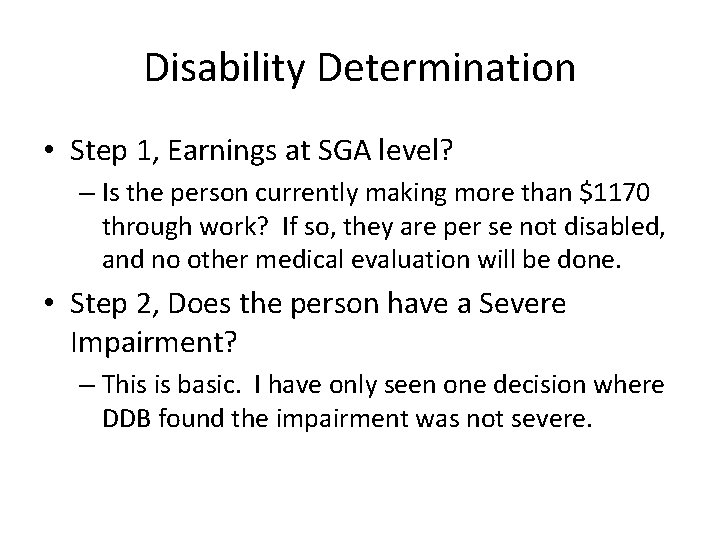
Disability Determination • Step 1, Earnings at SGA level? – Is the person currently making more than $1170 through work? If so, they are per se not disabled, and no other medical evaluation will be done. • Step 2, Does the person have a Severe Impairment? – This is basic. I have only seen one decision where DDB found the impairment was not severe.
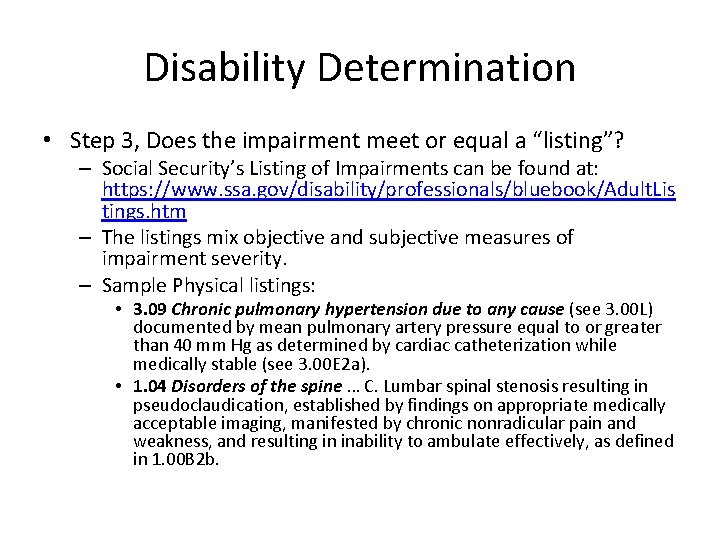
Disability Determination • Step 3, Does the impairment meet or equal a “listing”? – Social Security’s Listing of Impairments can be found at: https: //www. ssa. gov/disability/professionals/bluebook/Adult. Lis tings. htm – The listings mix objective and subjective measures of impairment severity. – Sample Physical listings: • 3. 09 Chronic pulmonary hypertension due to any cause (see 3. 00 L) documented by mean pulmonary artery pressure equal to or greater than 40 mm Hg as determined by cardiac catheterization while medically stable (see 3. 00 E 2 a). • 1. 04 Disorders of the spine … C. Lumbar spinal stenosis resulting in pseudoclaudication, established by findings on appropriate medically acceptable imaging, manifested by chronic nonradicular pain and weakness, and resulting in inability to ambulate effectively, as defined in 1. 00 B 2 b.
Disability Determination • Step 3, Listings (continued) – 1. 00 B 2 b. What we mean by inability to ambulate effectively. • (1) Definition. Inability to ambulate effectively means an extreme limitation of the ability to walk; i. e. , an impairment(s) that interferes very seriously with the individual's ability to independently initiate, sustain, or complete activities. Ineffective ambulation is defined generally as having insufficient lower extremity functioning (see 1. 00 J) to permit independent ambulation without the use of a hand-held assistive device(s) that limits the functioning of both upper extremities. (Listing 1. 05 C is an exception to this general definition because the individual has the use of only one upper extremity due to amputation of a hand. ) • (2) To ambulate effectively, individuals must be capable of sustaining a reasonable walking pace over a sufficient distance to be able to carry out activities of daily living. They must have the ability to travel without companion assistance to and from a place of employment or school. Therefore, examples of ineffective ambulation include, but are not limited to, the inability to walk without the use of a walker, two crutches or two canes, the inability to walk a block at a reasonable pace on rough or uneven surfaces, the inability to use standard public transportation, the inability to carry out routine ambulatory activities, such as shopping and banking, and the inability to climb a few steps at a reasonable pace with the use of a single hand rail. The ability to walk independently about one's home without the use of assistive devices does not, in and of itself, constitute effective ambulation.
Disability Determination • Step 3, Listings (continued) – Sample Mental listing: • 12. 04 Depressive, bipolar and related disorders causing extreme limitation of one, or marked limitation of two, of the following areas of mental functioning (see 12. 00 F): – – Understand, remember, or apply information (see 12. 00 E 1). Interact with others (see 12. 00 E 2). Concentrate, persist, or maintain pace (see 12. 00 E 3). Adapt or manage oneself (see 12. 00 E 4).
Disability Determination • Step 3, Listings (continued) – 12. 00 F 2. The five-point rating scale. We evaluate the effects of your mental disorder on each of the four areas of mental functioning based on a five-point rating scale consisting of none, mild, moderate, marked, and extreme limitation. To satisfy the paragraph B criteria, your mental disorder must result in extreme limitation of one, or marked limitation of two, paragraph B areas of mental functioning. Under these listings, the five rating points are defined as follows: • No limitation (or none). You are able to function in this area independently, appropriately, effectively, and on a sustained basis. • Mild limitation. Your functioning in this area independently, appropriately, effectively, and on a sustained basis is slightly limited. • Moderate limitation. Your functioning in this area independently, appropriately, effectively, and on a sustained basis is fair. • Marked limitation. Your functioning in this area independently, appropriately, effectively, and on a sustained basis is seriously limited. • Extreme limitation. You are not able to function in this area independently, appropriately, effectively, and on a sustained basis.
Disability Determination • Step 3, Listings (continued) – If Social Security determines that a person does not meet a listing, then Social Security must proceed to determine the person’s Residual Functional Capacity (“RFC”), in both the physical and mental domains. – Physical RFC is composed of • Exertional limitations – Lifting, pushing, pulling, standing, and sitting restrictions • Non-exertional limitations – Posture, manipulative, visual, communicative, and environmental restrictions – Mental RFC is composed of • Mental abilities needed for working – Each rated mild, moderate, marked, or extreme limitation.
Disability Determination • Step 4, Can the person do their past relevant work? – Look at the established RFC, and determine whether they are able to do the work they successfully performed in the past 15 years. • Work is not “relevant” if it was not done in the last 15 years. • Work is not “relevant” if the work was an unsuccessful work attempt. – Worked less than SGA earnings level, or – Worked in job less than 3 months, or – Worked between 3 -6 months and employment terminated due to disability
Disability Determination • Step 4, Past Relevant Work (continued) – If a past job was a hybrid of multiple jobs listed in the Dictionary of Occupational Titles, it is a “composite job”, and SSA must show that the person can still do all that they did at that job. – If the job no longer exists (i. e. Elevator operator), it still can be a basis for denial at step 4. • Unanimous Supreme Court decision in BARNHART V. THOMAS, 540 U. S. 20, 294 F. 3 d 568 (2003) – If the case goes to a hearing in front of an Administrative Law Judge, a vocational expert will testify if the person is capable of doing past work.
Disability Determination • Step 5, Can the person do any other work? – Vocational expert needed at hearing for Step 5. – For people under age 50, have to show that can’t do any job. – For people over 50 with physical limitations, the Social Security Administration has “Grids”. • The “Grids” were created because Social Security Administration found that older people have a harder time adjusting to new work. • Age 50 – 54, limited to “sedentary” work, limited education, unskilled work history Disabled. • Age 55 and above, limited to “light” work, limited education, unskilled work history Disabled. • Reminder, Grids irrelevant if can do past work and denied at Step 4
Disability Determination • Step 5, Any other work (continued) – Social Security definitions of physical exertion requirements: • (a) Sedentary work. No more than 10 pounds occasionally, standing no more than 2 hours. • (b) Light work involves lifting no more than 20 pounds at a time with frequent lifting or carrying of objects weighing up to 10 pounds. Even though the weight lifted may be very little, a job is in this category when it requires a good deal of walking or standing, or when it involves sitting most of the time with some pushing and pulling of arm or leg controls. To be considered capable of performing a full or wide range of light work, you must have the ability to do substantially all of these activities. • (c) Medium work involves lifting no more than 50 pounds at a time with frequent lifting or carrying of objects weighing up to 25 pounds.
- Slides: 38