
Social Reproduction Gender Inequality and Economic Growth How

- Slides: 10
Social Reproduction, Gender Inequality and Economic Growth
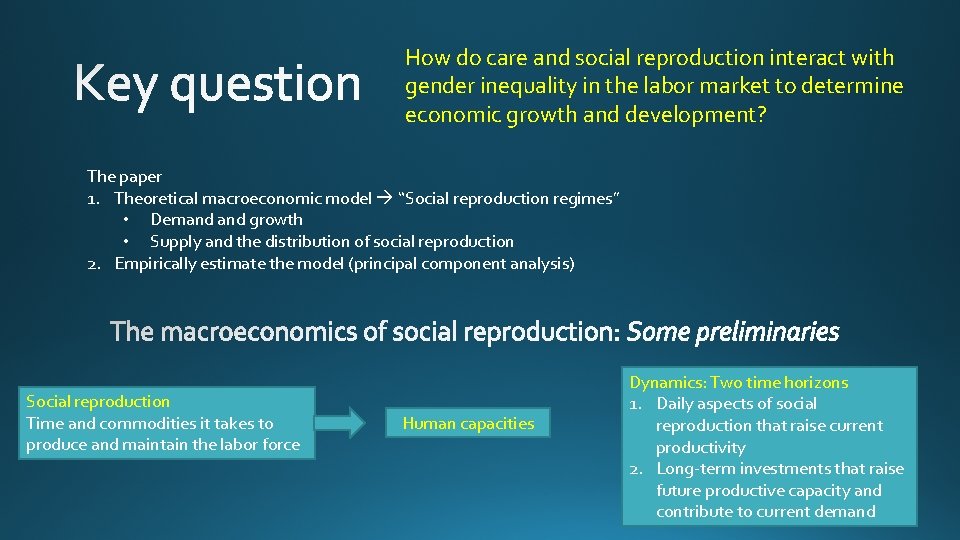
How do care and social reproduction interact with gender inequality in the labor market to determine economic growth and development? The paper 1. Theoretical macroeconomic model “Social reproduction regimes” • Demand growth • Supply and the distribution of social reproduction 2. Empirically estimate the model (principal component analysis) Social reproduction Time and commodities it takes to produce and maintain the labor force Human capacities Dynamics: Two time horizons 1. Daily aspects of social reproduction that raise current productivity 2. Long-term investments that raise future productive capacity and contribute to current demand
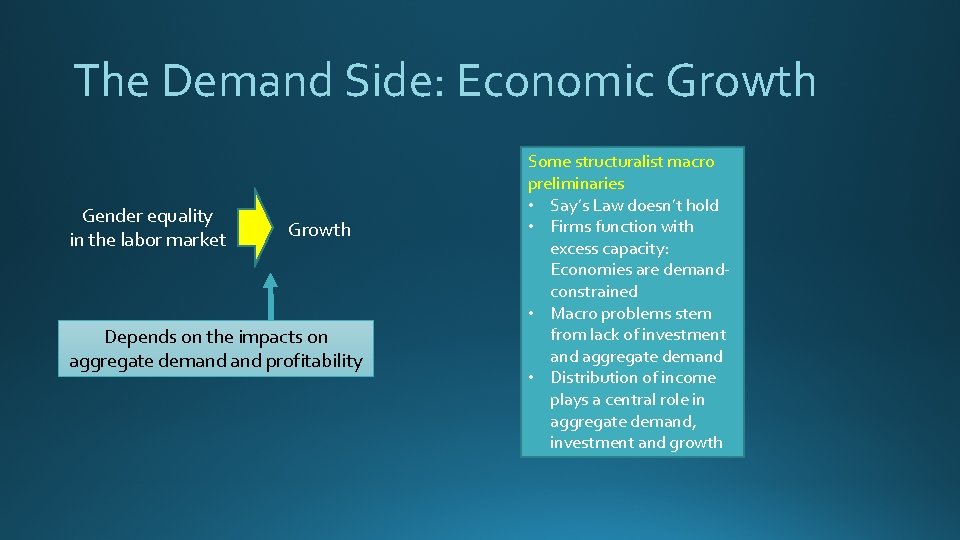
The Demand Side: Economic Growth Gender equality in the labor market Growth Depends on the impacts on aggregate demand profitability Some structuralist macro preliminaries • Say’s Law doesn’t hold • Firms function with excess capacity: Economies are demandconstrained • Macro problems stem from lack of investment and aggregate demand • Distribution of income plays a central role in aggregate demand, investment and growth
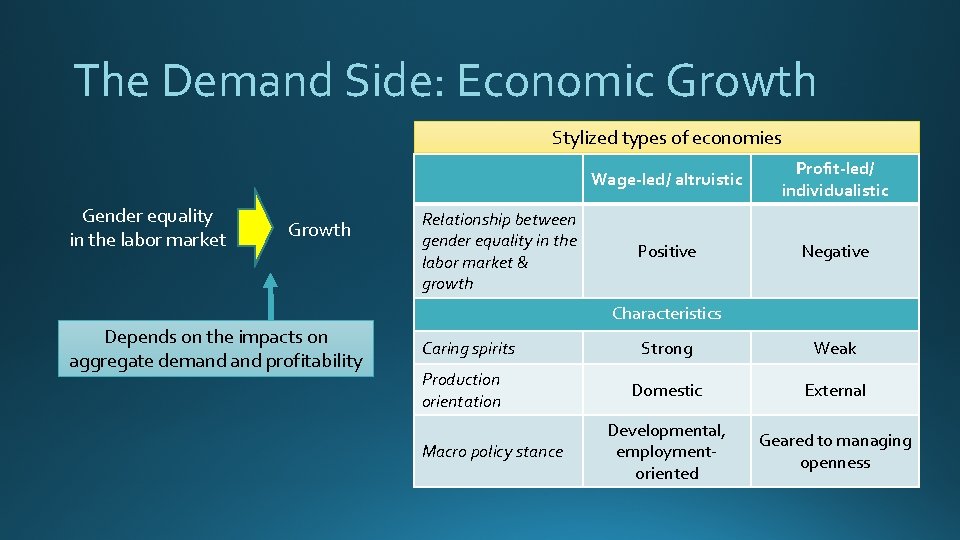
The Demand Side: Economic Growth Stylized types of economies Gender equality in the labor market Growth Relationship between gender equality in the labor market & growth Wage-led/ altruistic Profit-led/ individualistic Positive Negative Characteristics Depends on the impacts on aggregate demand profitability Caring spirits Production orientation Macro policy stance Strong Weak Domestic External Developmental, employmentoriented Geared to managing openness
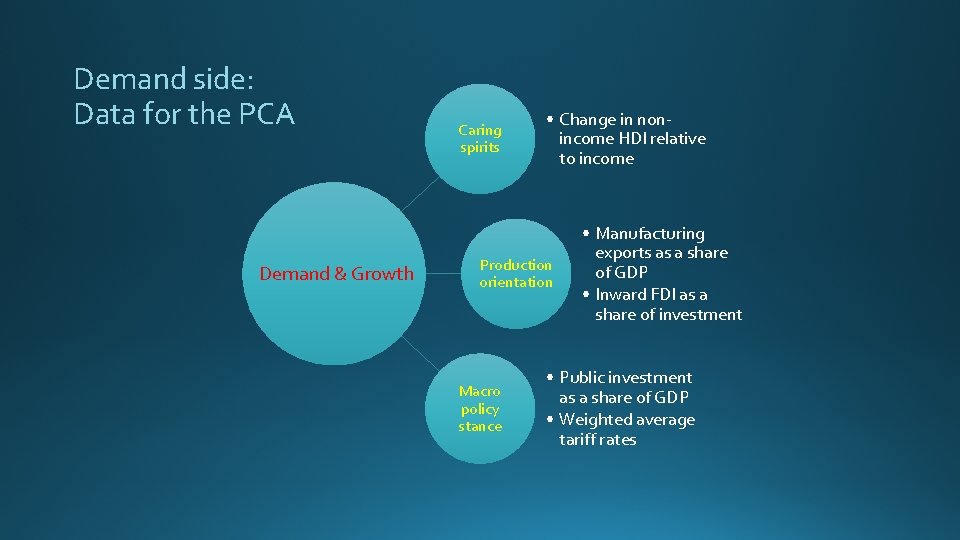
Demand side: Data for the PCA Demand & Growth Caring spirits • Change in nonincome HDI relative to income Production orientation Macro policy stance • Manufacturing exports as a share of GDP • Inward FDI as a share of investment • Public investment as a share of GDP • Weighted average tariff rates
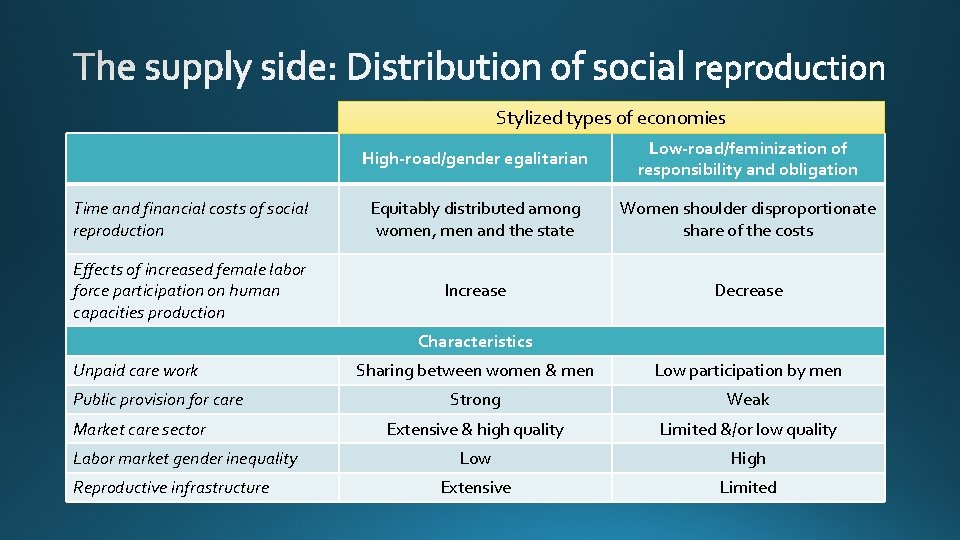
Stylized types of economies High-road/gender egalitarian Low-road/feminization of responsibility and obligation Time and financial costs of social reproduction Equitably distributed among women, men and the state Women shoulder disproportionate share of the costs Effects of increased female labor force participation on human capacities production Increase Decrease Characteristics Unpaid care work Public provision for care Market care sector Labor market gender inequality Reproductive infrastructure Sharing between women & men Low participation by men Strong Weak Extensive & high quality Limited &/or low quality Low High Extensive Limited
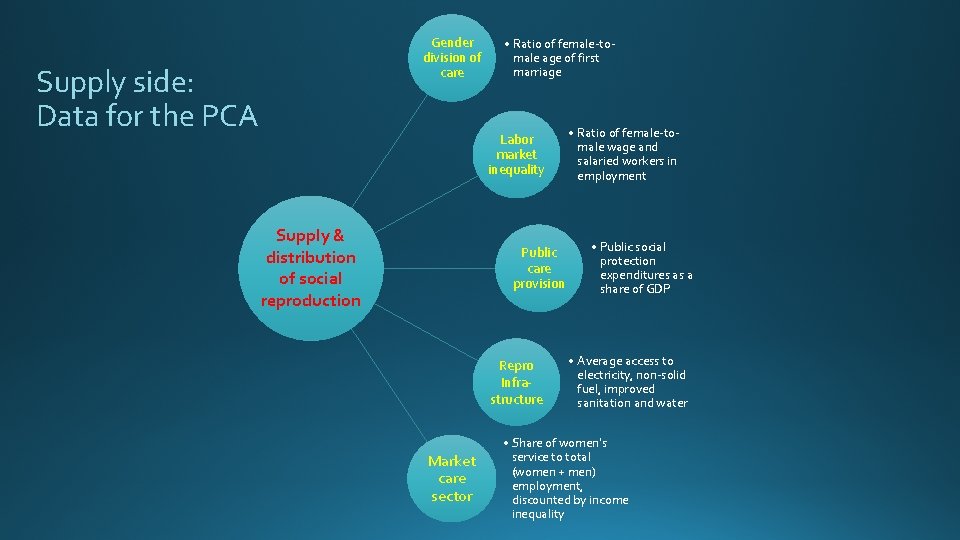
Gender division of care Supply side: Data for the PCA • Ratio of female-tomale age of first marriage Labor market inequality Supply & distribution of social reproduction Public care provision Repro Infrastructure Market care sector • Ratio of female-tomale wage and salaried workers in employment • Public social protection expenditures as a share of GDP • Average access to electricity, non-solid fuel, improved sanitation and water • Share of women’s service to total (women + men) employment, discounted by income inequality
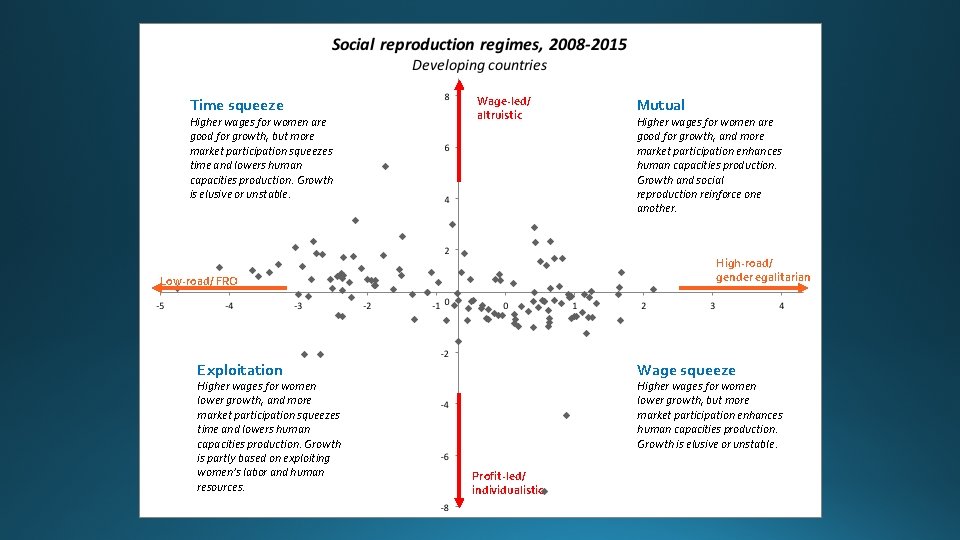
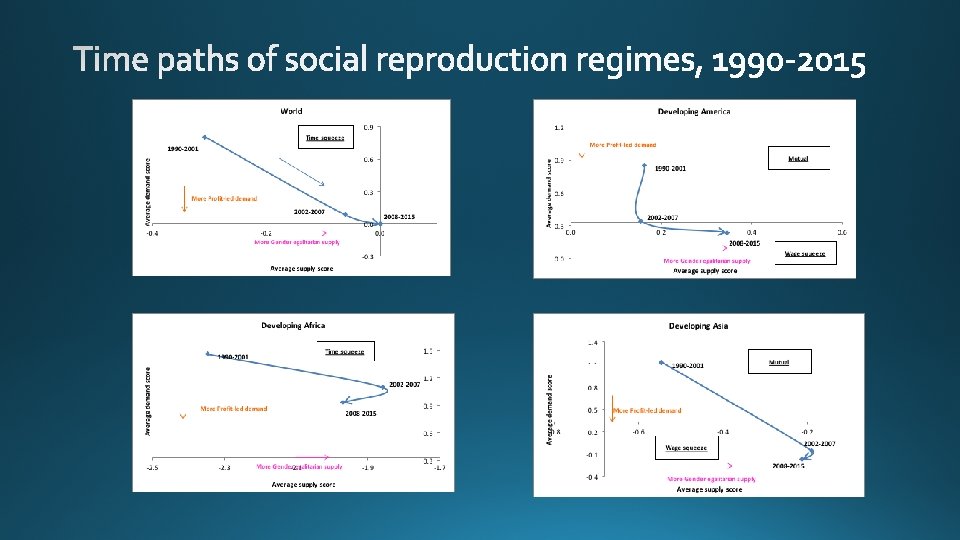
Time squeeze Higher wages for women are good for growth, but more market participation squeezes time and lowers human capacities production. Growth is elusive or unstable. Wage-led/ altruistic Higher wages for women are good for growth, and more market participation enhances human capacities production. Growth and social reproduction reinforce one another. High-road/ gender egalitarian Low-road/ FRO Exploitation Higher wages for women lower growth, and more market participation squeezes time and lowers human capacities production. Growth is partly based on exploiting women’s labor and human resources. Mutual Wage squeeze Higher wages for women lower growth, but more market participation enhances human capacities production. Growth is elusive or unstable. Profit-led/ individualistic
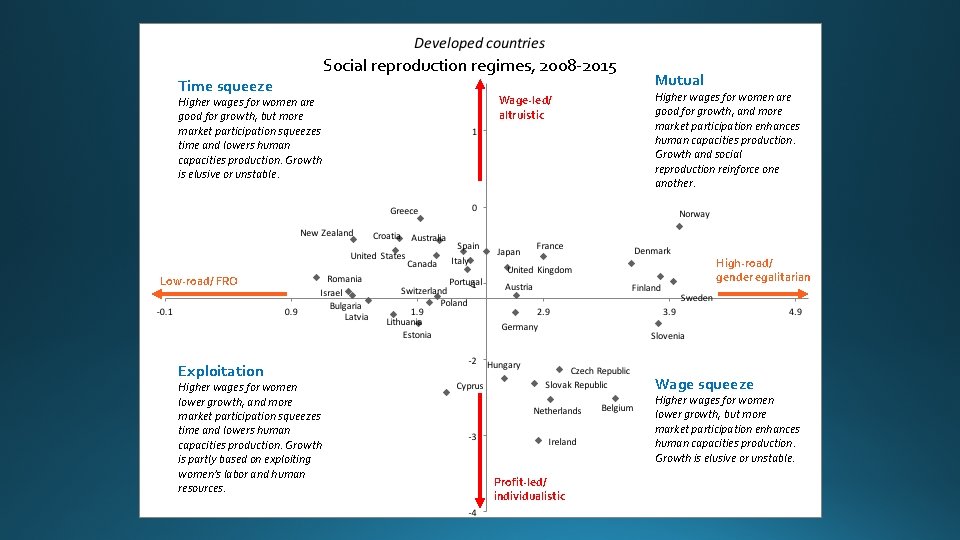
Time squeeze Higher wages for women are good for growth, but more market participation squeezes time and lowers human capacities production. Growth is elusive or unstable. Social reproduction regimes, 2008 -2015 Wage-led/ altruistic Higher wages for women are good for growth, and more market participation enhances human capacities production. Growth and social reproduction reinforce one another. High-road/ gender egalitarian Low-road/ FRO Exploitation Higher wages for women lower growth, and more market participation squeezes time and lowers human capacities production. Growth is partly based on exploiting women’s labor and human resources. Mutual Wage squeeze Higher wages for women lower growth, but more market participation enhances human capacities production. Growth is elusive or unstable. Profit-led/ individualistic