
Social Reforms Under Alexander II The Zemstvo Reforms
- Slides: 8
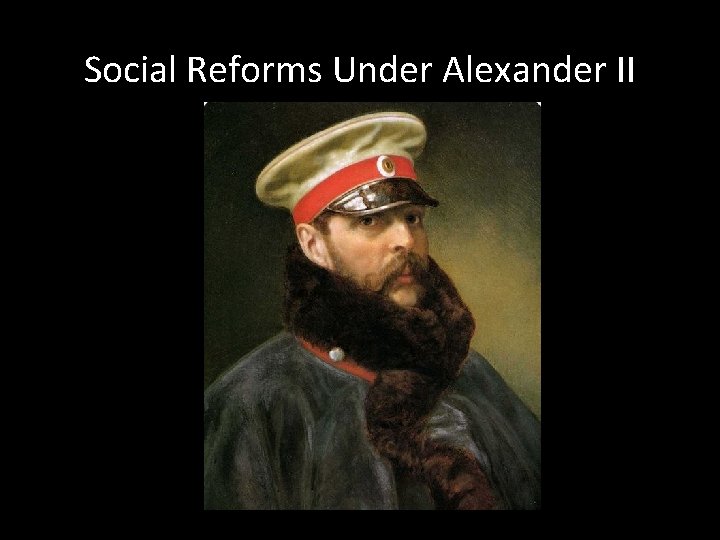
Social Reforms Under Alexander II
The Zemstvo Reforms • The emancipation of the serfs was part of a broader re-organisation of the countryside. • In 1864 a new local government law was passed – The Zemstvo Act. • Landowners and townsmen with property were allowed to vote. • This form of local government met annually.
The Details of the Zemstvo Act Responsibilities of the Zemstvo: • Tax raising • Coordination of education, healthcare and roads • 3, 300 health centres and 50, 000 schools were opened under the Zemstvo • 3 million children were educated by 80, 000 teachers • The Zemstvo operated in 33 provinces, and cost 400 million roubles to operate.
The Judicial Reforms From 1864, major legal reforms were introduced: • • Trial by jury Defence and prosecution counsel were allowed Defendants to be tried in person Evidence would have to be presented in open court
Educational Reforms School Reforms: • December 1864, new Elementary School Code was promulgated. • Schooling was based on the German model of the Gymnasium and Realschule. This is an example of Western modernising influences. (Many Tsarist civil servants were Baltic Germans. ) • District school boards were also established. (Lenin’s father was a civil servant who administered a school district. )
Educational Reforms University Reforms: An imperial decree of 18 June 1863 was passed that greatly liberalised higher education. • Remission of fees for poorer students • Relaxation of censorship on academic books and journals. • Women were allowed to attend universities for the first time.
Military Reforms The Army Reforms Decree 13 January 1874: • Greater fairness and uniformity was applied to conscription. • Active service to last six years (from 20 -26), with nine years in the reserves and five in the militia. • This reduced the length of actual full-time service – previously some peasants had been conscripted for 25 years. • The quality of training was increased and the more extreme physical punishments of soldiers were banned.
Summary of the influences behind the reforms The reforms of Alexander II reveal both Slavic and Westernising influences. The strengthening of the Mir was traditionally Slavic in character; while the Army and Educational reforms were influenced by Prussia. Many of the senior Tsarist officials were Baltic Germans who looked to Germany for examples of modernity and efficiency.